

Follow Up Email Best Practices That Actually Work in 2026
You wrote the perfect follow-up. Tight copy, clear CTA, sent on a Tuesday morning. It landed in spam because your tracking pixel flagged it.
Most follow up email best practices haven't caught up to this reality. Executives receive 120+ emails a day, hyper-targeted lists outperform mass blasts by 2.76x, and the infrastructure behind your sends matters more than the words inside them. Precision beats volume every time.
Here's the short version before we get into the weeds:
- Keep sequences to 3-4 emails total. Past that threshold, unsubscribe rates triple and spam complaints spike - based on 16.5M emails analyzed across 93 business domains.
- Personalize your subject line in 2-4 words. That's a 133% lift in replies.
- Verify your contact data before sending. Bounces compound across every follow-up and wreck your domain.
How Many Follow-Ups (and When to Stop)
The instinct is to keep pushing. The data says otherwise.
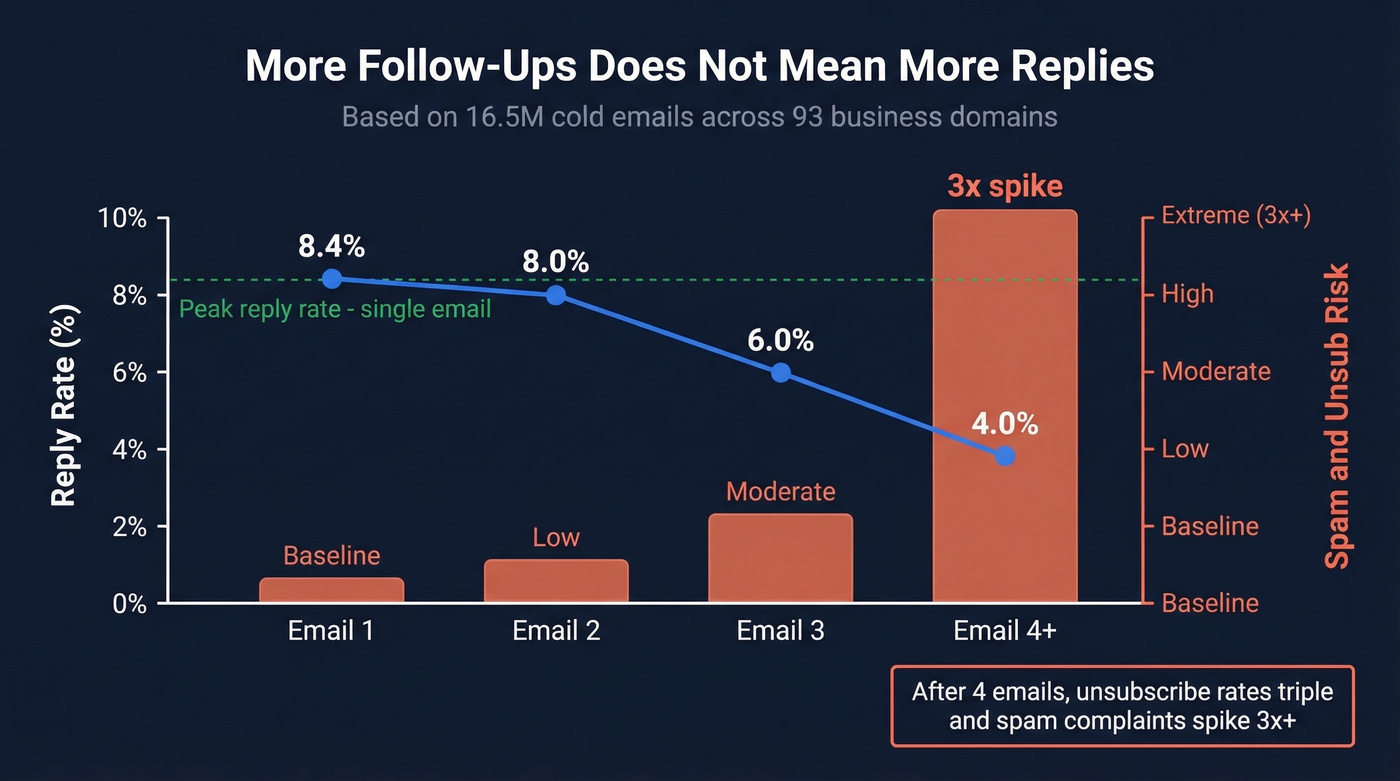
A 2024 analysis of 16.5 million cold emails across 93 business domains found the highest reply rate - 8.4% - came from a single email. Every additional follow-up showed diminishing returns, and once you hit 4+ emails in a sequence, unsubscribe rates tripled and spam-complaint risk more than tripled.
The decay isn't uniform, though. Small businesses with 2-50 employees tolerate more persistence, with reply rates holding around 8-9% through the second follow-up. Founders peak at 6.94% on the second email, then crater to 3.01% by the fourth. Enterprise contacts ghost quickly and punish persistence with spam reports.
Three follow-ups is the ceiling for most sequences. Not a floor. How you write each one matters far more than sending five mediocre messages.
| Follow-Up # | Avg Reply Rate | Spam/Unsub Risk |
|---|---|---|
| Email 1 | 8.4% | Baseline |
| Email 2 | ~7-9% | Low |
| Email 3 | ~5-7% | Moderate |
| Email 4+ | ~3-5% | ~3x unsub; 3x+ spam complaints |
Cadence and Message Structure
Spacing matters as much as quantity. The SPBC framework gives each email a distinct job and provides a repeatable structure you can adapt to any audience:
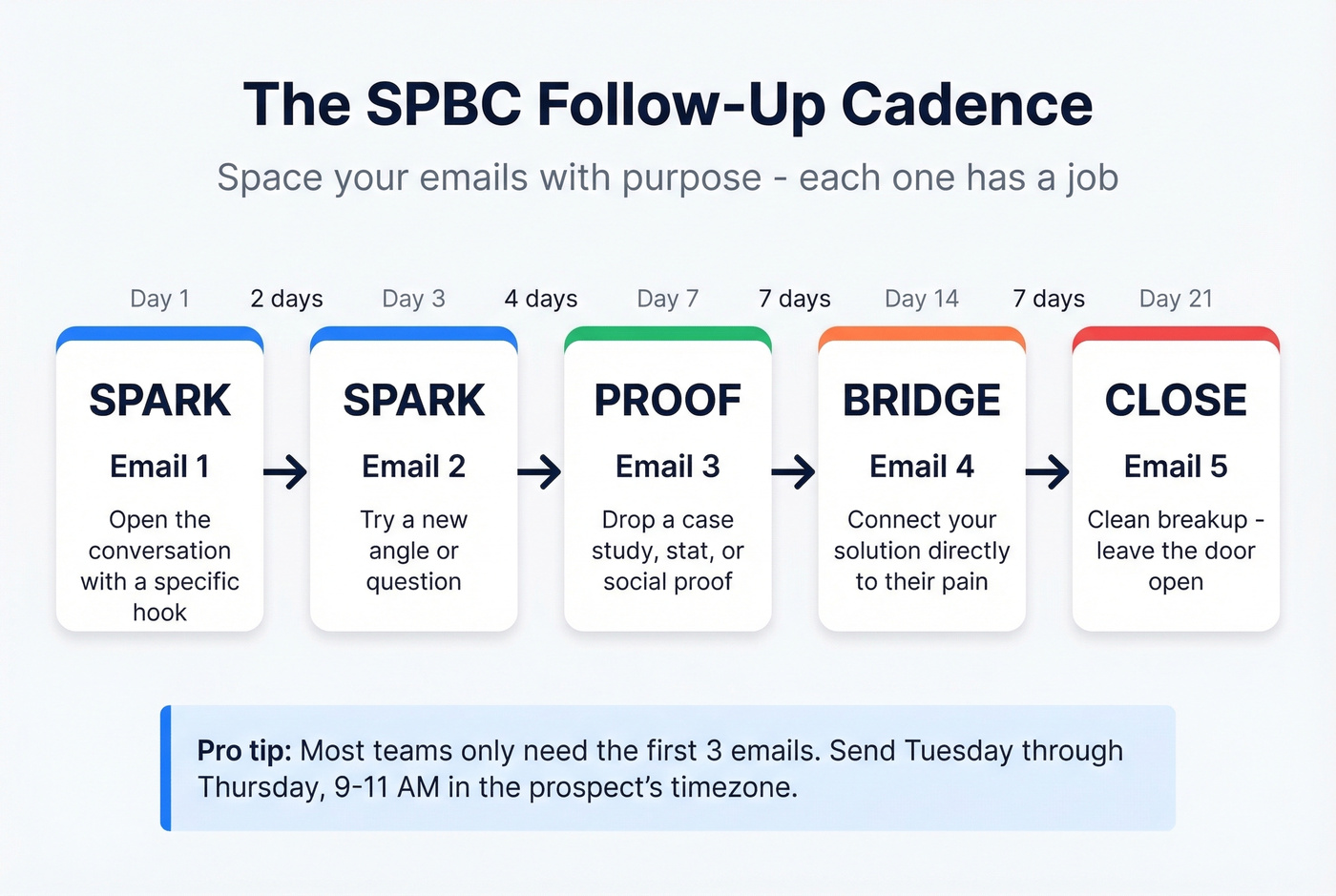
- Spark (emails 1-2) - open the conversation
- Proof (email 3) - add credibility with a case study or stat
- Bridge (email 4) - connect your solution to their pain
- Close - a clean breakup
Most teams only need the first three. Default to Tuesday-Thursday sends, 9-11 AM in the prospect's timezone, with gaps that widen as the sequence progresses. Here's a simplified SPBC-style cadence you can steal:
| Day | Email # | Message Intent |
|---|---|---|
| Day 1 | Email 1 | Spark - open the thread |
| Day 3 | Email 2 | Spark - new angle |
| Day 7 | Email 3 | Proof - case study or stat |
| Day 14 | Email 4 | Bridge - connect to pain |
| Day 21 | Email 5 | Close - clean breakup |
Subject Lines That Get Opens
A parallel study across 5.5 million emails found personalized subject lines hit a 46% open rate versus 35% without - and reply rates jumped from 3% to 7%. The sweet spot is 2-4 words. Performance drops after seven words and bottoms out at ten.
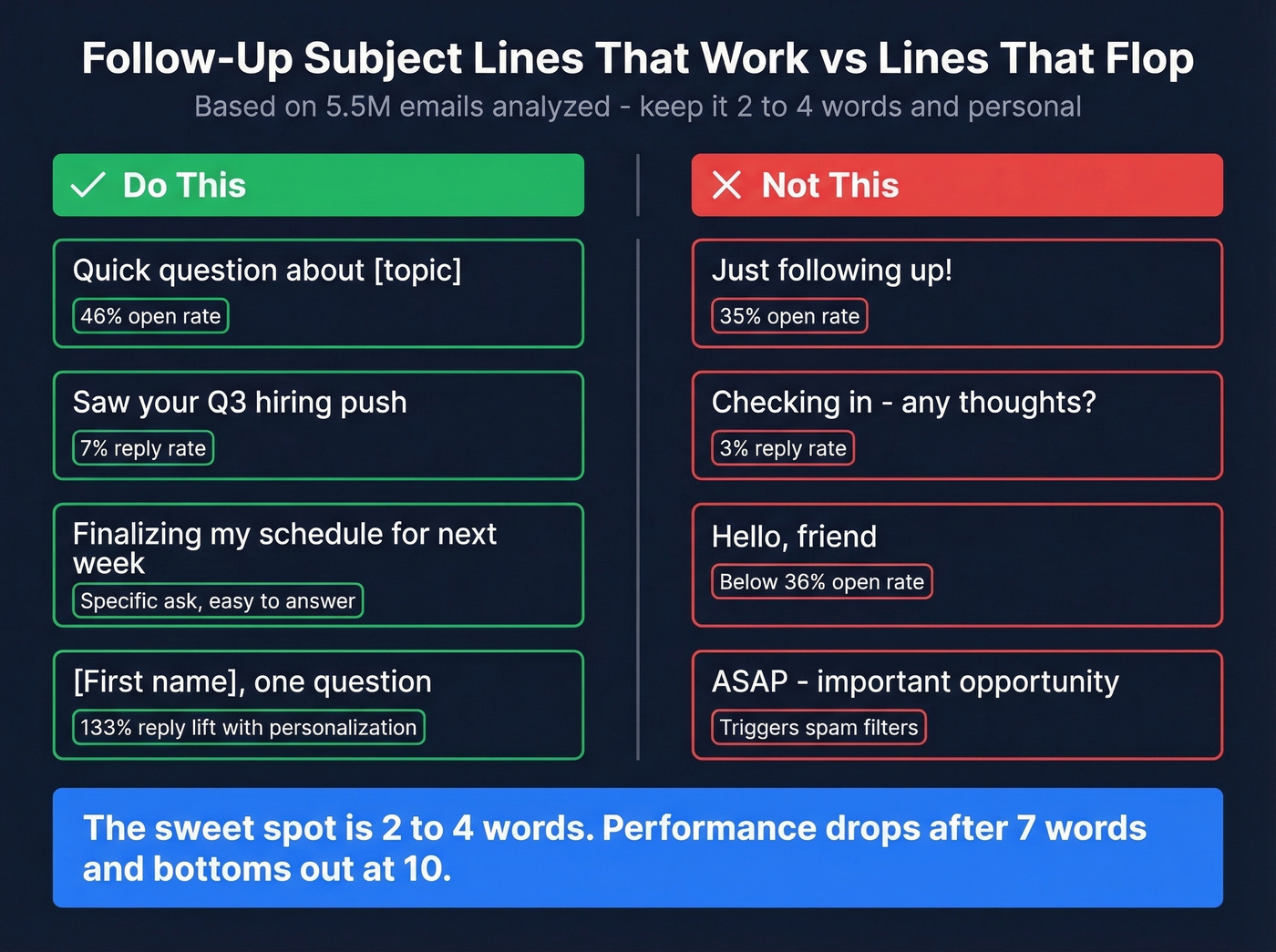
What kills opens: marketing hype, urgency words like "ASAP," and generic greetings like "Hello, friend" push open rates below 36%. The words "follow-up," "touching base," and "circling back" are dead weight - they signal zero new value. The strongest messages replace these filler phrases with a specific reason to reply.
Here's the thing: a simple schedule-specific ask outperforms most clever copywriting. Something like "I'm trying to finalize my schedule for next week - wanted to know if X date worked for you?" gives the recipient a concrete action that's easy to say yes or no to.
Do this: "Quick question about [specific topic]" or "Saw your Q3 hiring push"
Not this: "Just following up!" or "Checking in - any thoughts?"

Every bounced follow-up compounds the damage to your sender reputation. Prospeo's 5-step verification catches invalid addresses, spam traps, and honeypots before they touch your domain - 98% email accuracy, refreshed every 7 days. Snyk dropped their bounce rate from 35-40% to under 5%.
Stop burning your domain on unverified lists. Fix it before you send.
Deliverability Mistakes Nobody Talks About
Most follow-up advice ignores the infrastructure that determines whether your email reaches an inbox at all. Google's spam complaint threshold sits at 0.3% - cross it, and delivery rates collapse across your entire domain. Not just for that campaign. For everything.
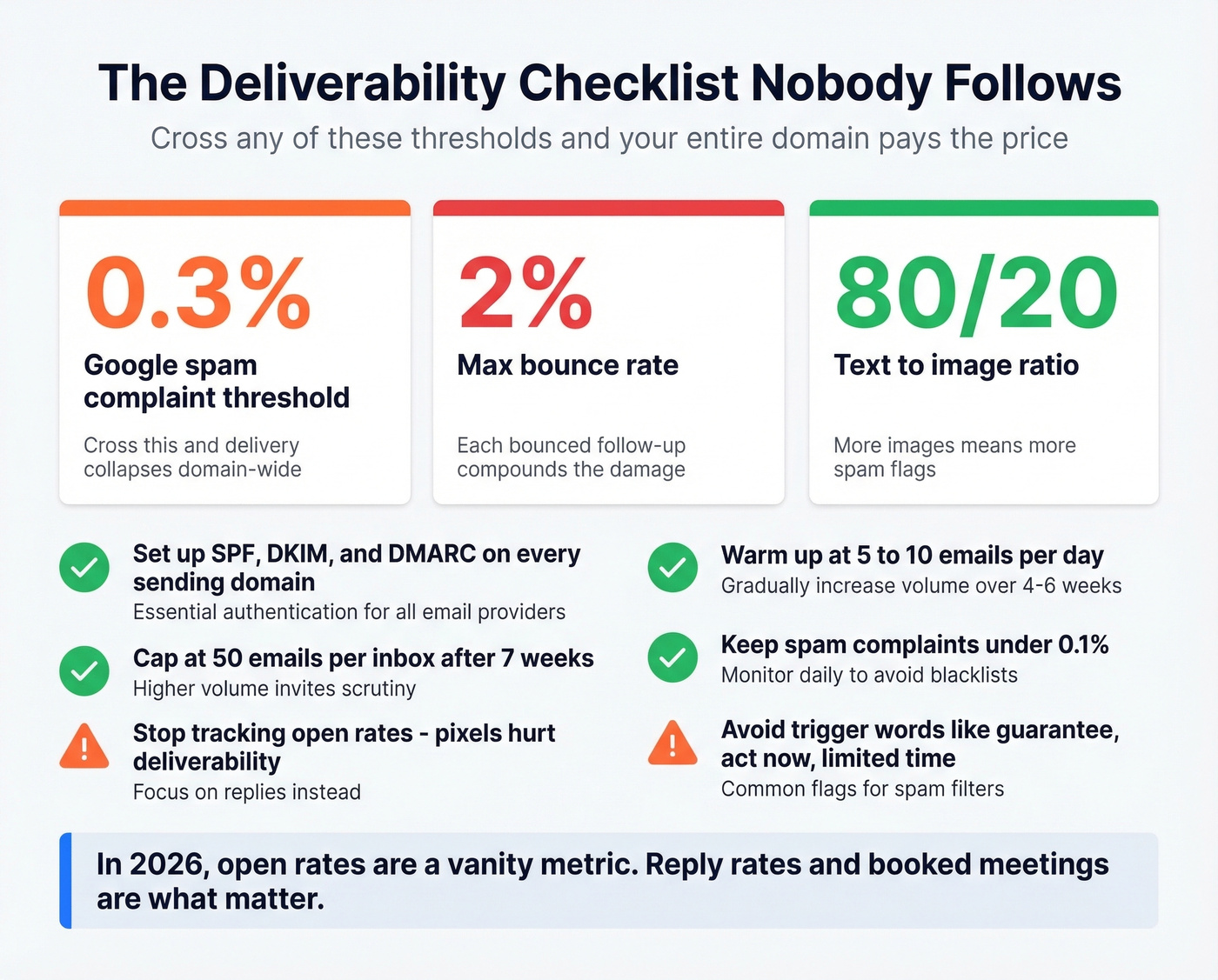
SPF, DKIM, and DMARC authentication aren't optional on any sending domain. Warm up at 5-10 emails per day and don't exceed 50 per inbox even after seven weeks. Keep bounce rates under 2%, spam complaints under 0.1%. Avoid content-level triggers too - words like "guarantee," "act now," and "limited time" flag filters, and your text-to-image ratio should stay at 80/20 or higher.
Let's be honest about open rates: stop tracking them. Tracking pixels hurt deliverability. The 16.5M-email dataset led researchers to stop measuring opens entirely because tracking pixels were degrading inbox placement. In 2026, open rates are a vanity metric. Reply rates and booked meetings are what matter.
Verify Before You Send
Every deliverability problem above gets worse with bad data. High bounce rates compound damage across the sequence - each bounced follow-up is another hit to your sender reputation.
We've seen teams lose months of sender reputation from a single unverified list. It's painful and completely preventable. Prospeo's 5-step verification catches invalid addresses, spam traps, and honeypots before they touch your domain, running at 98% email accuracy with a 7-day refresh cycle. Snyk's team of 50 AEs dropped their bounce rate from 35-40% to under 5% after switching, generating 200+ new opportunities per month.
Skip this step if you enjoy explaining to your VP of Sales why half your pipeline isn't getting emails.
Mistakes That Kill Reply Rates
"Just checking in" with no new value. Every follow-up needs a fresh angle - a case study, a relevant stat, a new question. "Making sure you saw this" tells the prospect you have nothing left to say. A good follow-up earns the next reply: "Saw [Company] just opened a new AE role - we helped a similar team cut ramp time from 10 weeks to 4. Worth a quick look?" (If you need angles and wording, start with these sales follow-up templates.)
Follow-ups that look like marketing. HTML templates, banner images, and multiple links scream automation. Keep it plain text, short, and sent as a threaded reply. It should look like a real person typing a real email - indistinguishable from something you'd send a colleague. The consensus on r/sales is pretty clear: if your follow-up looks like a newsletter, it's getting deleted. (More on writing that converts in our email copywriting guide.)
Not knowing when to stop. Three follow-ups with no response is a signal. Four is a risk. Five is how you get marked as spam and drag your domain reputation down for every other prospect in your pipeline. We've tested this across dozens of client campaigns, and the pattern holds: the fourth email rarely saves a dead thread, but it often damages the next one. (If you're unsure on timing, see when should you follow up on an email.)
Send Fewer, Better Messages
The best follow-up is the one you don't have to send.
Target 50 prospects instead of 500. Verify your data. Then follow up with purpose - a new angle every time, plain text, threaded replies, and a clean exit when the signal says stop. If you're hunting for fresh angles, mine your CRM for recent trigger events like funding rounds, new hires, or product launches. Each one gives you a reason to reach out that feels relevant, not random. (To systematize this, use a sales prospecting techniques checklist and a simple ideal customer profile scorecard.)
When email isn't landing after three touches, a direct dial or a message on another channel often breaks through. In our experience, the teams that verify first follow up less and book more - and their domains stay healthy enough to keep doing it month after month. (If deliverability is the bottleneck, start with an email deliverability guide and then work on improve sender reputation.)
Sending fewer, better follow-ups starts with knowing you're reaching real inboxes. Prospeo gives you 143M+ verified emails at $0.01 each with catch-all handling and honeypot filtering built in - so your 3-email sequence actually lands.
Three perfect follow-ups beat ten that bounce. Start with clean data.