

How to Write a Follow Up Letter That Actually Gets a Response
You interviewed on Tuesday. It's Monday now, and your inbox is empty. That silence isn't a rejection - it's a gap a well-timed follow up letter can fill.
Most follow-up advice hands you one generic template and wishes you luck. What you actually need is a system that adapts to the scenario - different timing, different tone, different structure depending on whether you're chasing a hiring manager, a prospect, or an overdue invoice. We've pulled the research, tested the templates, and built the playbook below.
Do Follow-Up Letters Actually Work?
Let's kill the doubt first. 68% of hiring managers say a thank-you note matters in their hiring decision. 22% are less likely to hire someone who skips the follow-up entirely. That's not a soft preference - it's a filter.
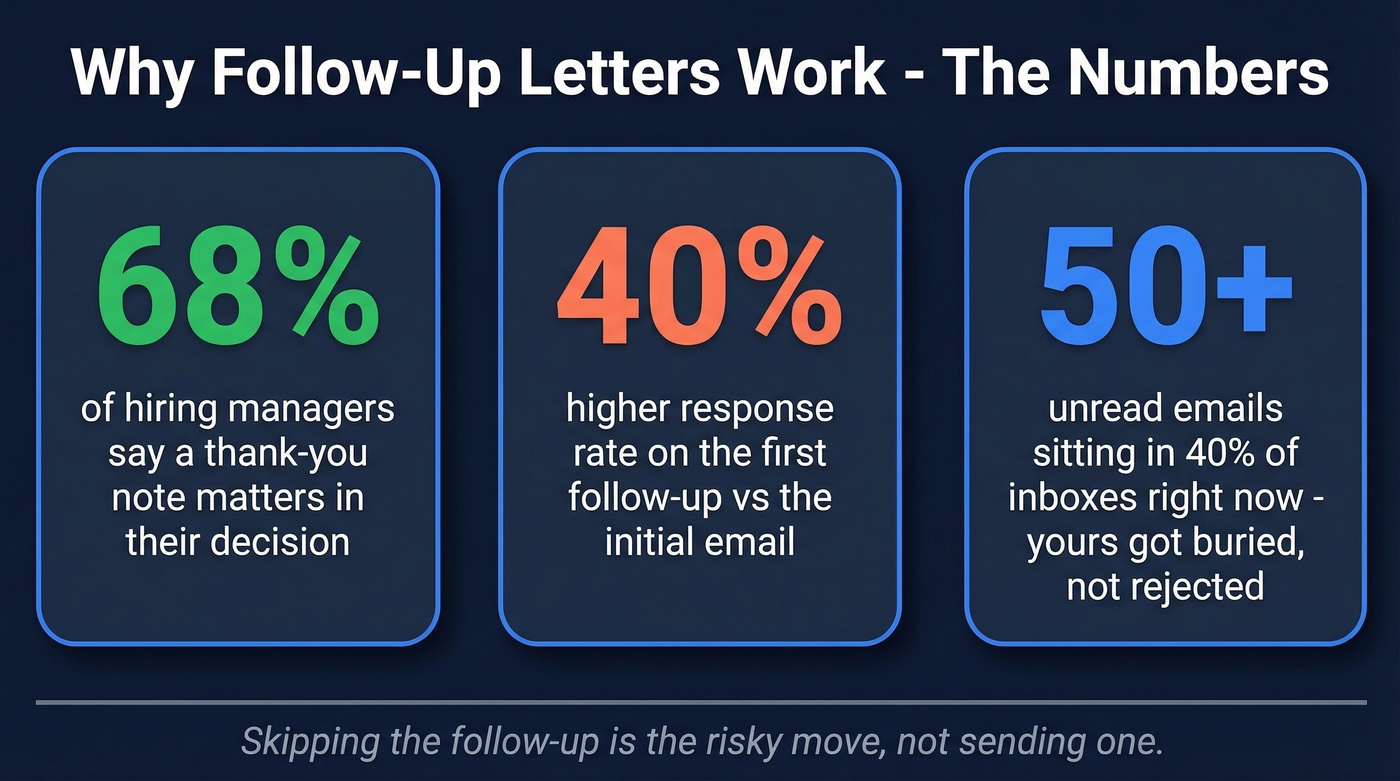
On the sales side, the numbers are just as clear. The first follow-up has a 40% higher response rate than the initial email, which only averages about 6% on its own. And here's the inbox reality that explains why: 40% of people have 50+ unread emails sitting in their inbox right now. Your message didn't get rejected. It got buried. People intend to respond, get distracted, and your email sinks below the fold. A follow-up resets the clock.
Following up isn't desperate. Skipping it is the risky move.
When to Send Your Follow-Up
Many career sites recommend a thank-you within 24 hours - but nobody tells you what to do when that message gets ignored too.
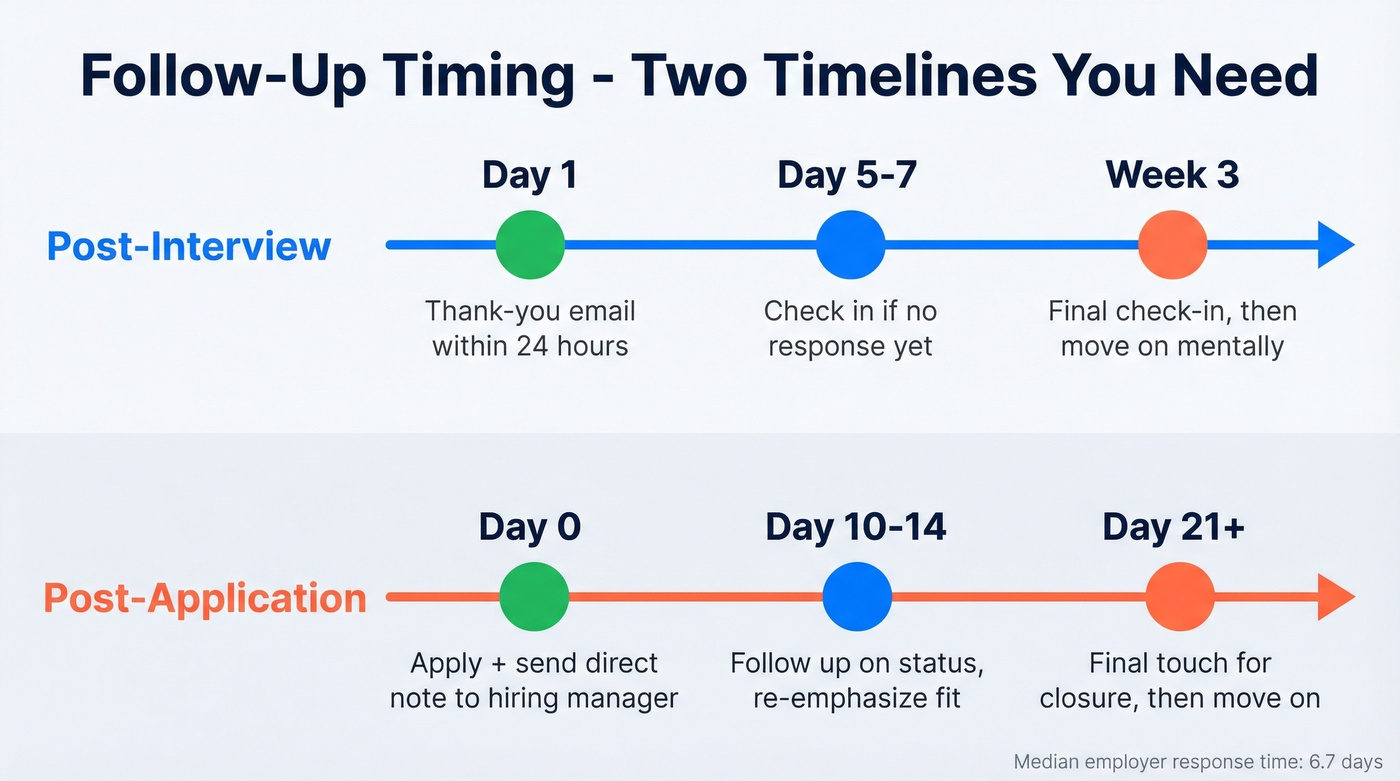
Careery's research analyzed 1,000+ job seekers and found the median response time is 6.7 days. 75% of interview-related responses arrive within 8 days. There's even seasonal variation - May averages 6.0 days, while October stretches to 7.2 days. For non-job scenarios, waiting 3 days before following up boosts responses by 31%. Patience pays, but only to a point.
Here are two practical timelines, because post-interview and post-application behave differently:
Post-interview timeline
- Day 1: Thank-you email (within 24 hours, always)
- Day 5-7 business days: Check-in if you haven't heard back
- ~Week 3: Final check-in - then move on mentally
Post-application timeline
- Day 0: Apply + send a direct note to the hiring manager
- Day 10-14: Follow up to check status and re-emphasize fit
- Day 21+: Final touch if you want closure - then move on
| Scenario | When to Follow Up | Best Day | Max Touches |
|---|---|---|---|
| Post-interview thank-you | Within 24 hours | Any | 1 |
| Job application | Day 10-14 | Tue-Thu | 3 |
| Sales proposal | Day 2-3 | Tue-Wed | 4-5 |
| Networking | 48-72 hours | Tue-Thu | 2 |
| Meeting recap | Same day | Any | 1 |
| Payment reminder | 1-2 weeks past due | Tue-Wed | 3 |
Best Send Times
Tuesday through Thursday are your best days. Monday inboxes are flooded, and Friday attention drops off a cliff. Aim for 8-10am or 1-2pm in the recipient's time zone, with a secondary sweet spot at 4-5pm when people clear their inbox before logging off.
How to Write a Follow Up Letter
Quick distinction worth knowing: a thank-you letter is sent within 24 hours and focuses on gratitude. A follow-up letter comes later and focuses on value. The best thank-you does both at once.
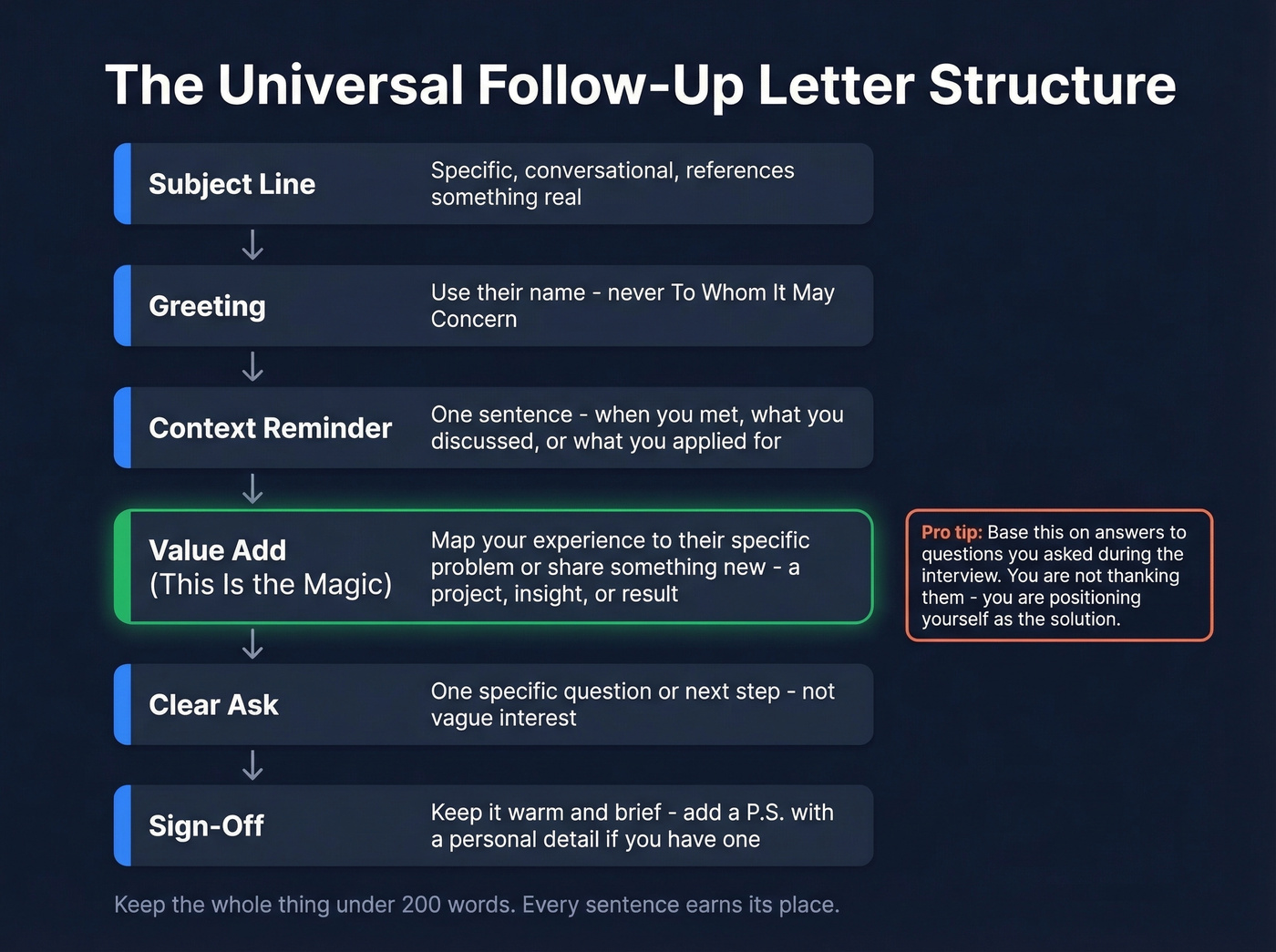
The universal structure is simple: subject line, greeting, context reminder, value add, clear ask, sign-off. That's it. The magic is in the value add.
A hiring manager with 10+ years and 1,000+ interviews shared what he calls the "magic bullet" on Reddit: base your follow-up on the answers to questions you asked during the interview. If they told you the team's biggest challenge is onboarding speed, your follow-up should map your experience directly to that problem. You're not thanking them - you're positioning yourself as the solution. That same hiring manager recommends following up at four distinct points: when you apply, after every interview step, after a period of silence, and to update anyone who referred you. Most candidates only do one of these. Do all four and you're already in the top 10%.
Here's the thing: the best follow-up message is under 200 words. If yours is longer than the original email, you're doing it wrong. Every sentence should earn its place.

The best follow-up letter in the world won't work if it lands in the wrong inbox. Prospeo gives you verified email addresses for hiring managers, prospects, and decision-makers - 98% accuracy, refreshed every 7 days. Stop guessing. Start reaching the right person.
Find the hiring manager's real email before you hit send.
Follow-Up Letter Templates by Scenario
You don't need 15 templates. You need the right one for your situation, with the right timing and the right structure.
Post-Interview Thank-You
Timing: Within 24 hours. Don't wait for the "right moment."
Subject line: Great conversation about [specific topic discussed]
Hi [Name],
Thank you for the conversation today about [role]. When you mentioned that [specific challenge or goal they shared], it resonated - at [Previous Company], I [specific experience that maps to their stated goal].
I'm excited about the opportunity to bring that same approach to [Company]. Looking forward to the next steps.
Best, [Your name]
P.S. [Personal detail from the conversation - a book they mentioned, a shared interest, anything human.]
Reference specific conversation details. Generic gratitude is forgettable. Bonus move: include one observation about the team or company culture you noticed during the visit - it shows you were paying attention to more than just the questions.
Right After Applying (Day 0)
Most people apply and wait. Don't be most people. Before you even submit the application - or immediately after - find the hiring manager's name and send a direct note.
Subject line: Just applied for [Role] - quick intro
Hi [Name],
I just submitted my application for [Role] and wanted to introduce myself directly. My background in [relevant skill] maps closely to [something specific about the role or team].
I'd welcome the chance to discuss how I can contribute. Happy to work around your schedule.
Best, [Your name]
This is the move that separates you from the pile.
Job Application Follow-Up
Timing: Day 10-14. The median response window is 6.7 days, but many employers need a full two weeks to process applications.
Subject line: Following up on [Role Title] application - [Your Name]
Hi [Name],
I applied for the [Role] position about two weeks ago and wanted to follow up. Since submitting, I [new value: completed a relevant project, published an article, earned a certification - something concrete].
I'd love the chance to discuss how my background in [specific skill] aligns with what you're building. Would a brief call this week work?
Best, [Your name]
Don't just repeat your application - give them a reason to look at it again.
Second Follow-Up (No Response)
Timing: ~3 weeks after your last touch.
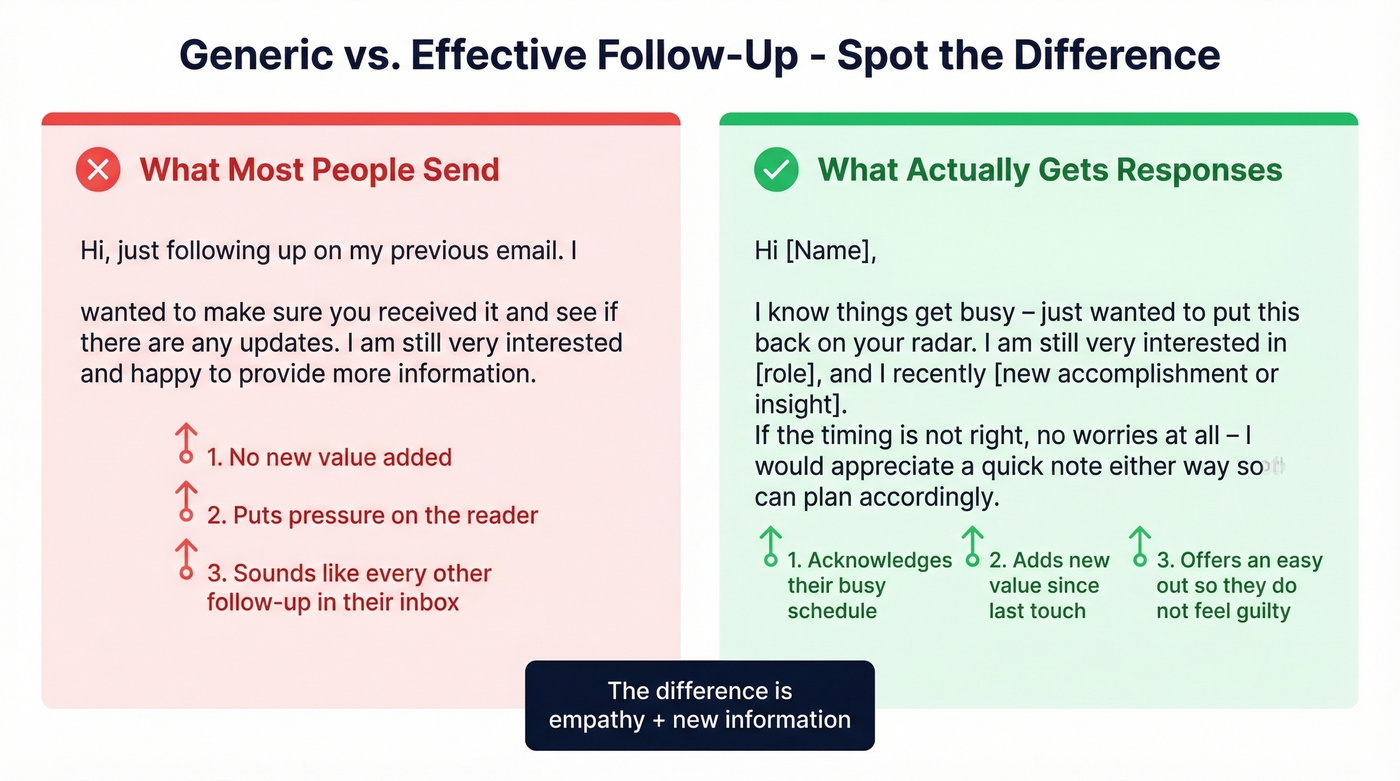
You sent your message. Nothing. The anxiety is real - Reddit threads are full of people drafting messages like "Just wanted to ensure you received my last email." That's exactly what not to send.
Before (generic):
"Hi, just following up on my previous email. I wanted to make sure you received it and see if there are any updates. I'm still very interested and happy to provide more information."
After (improved):
Hi [Name],
I know things get busy - just wanted to put this back on your radar. I'm still very interested in [role/project], and I recently [new value-add: relevant accomplishment or insight].
If the timing isn't right, no worries at all - I'd appreciate a quick note either way so I can plan accordingly.
Thanks, [Your name]
Acknowledge their busy schedule. Offer an easy out. People respond to messages that don't make them feel guilty.
Sales/Business Proposal Follow-Up
Timing: 3-touch cadence - Day 2-3, Day 5-7, Day 10-14.
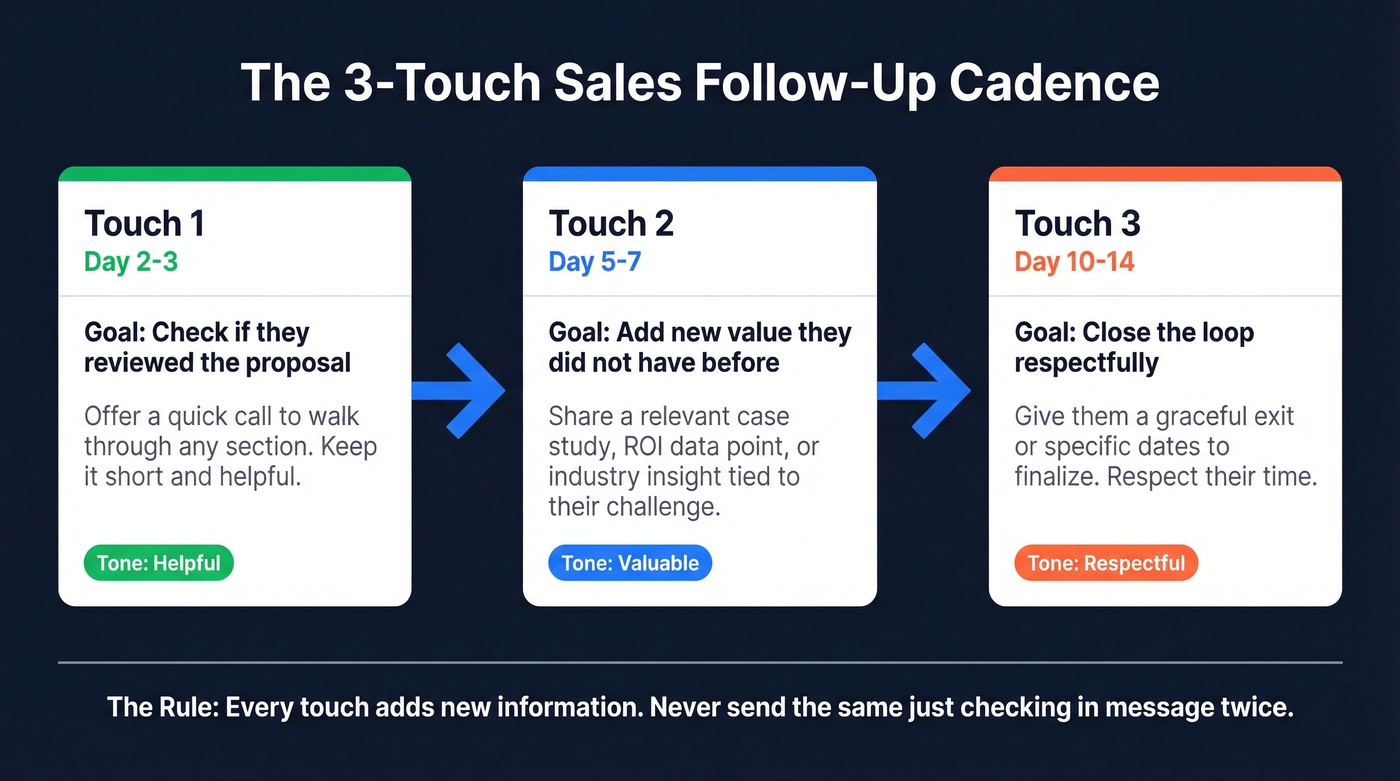
Touch 1 (Day 2-3):
Subject: Quick question on the [Project Name] proposal
Hi [Name], wanted to check if you had a chance to review the proposal I sent on [date]. Happy to walk through any section on a quick call - does [day] work?
Touch 2 (Day 5-7):
Subject: [Company Name] case study - relevant to your [challenge]
Hi [Name], thought this might be useful - [link to case study or ROI data point relevant to their situation]. It's similar to what we discussed for [their project]. Let me know if you'd like to dig into the numbers.
Touch 3 (Day 10-14):
Subject: Closing the loop on [Project Name]
Hi [Name], I want to be respectful of your time. If [Project Name] isn't a priority right now, totally understand. If it is, I have availability [specific dates] to finalize details. Either way, just let me know.
Each touch adds new information - a case study, an ROI figure, a deadline. Never send the same "just checking in" message twice. If you want more options, start with these sales follow-up templates.

None of this matters if your email bounces. Before launching a follow-up sequence, verify your contact list - Prospeo's 5-step verification process catches invalid addresses, spam traps, and catch-all domains before they tank your sender reputation.
Networking Follow-Up
Timing: 48-72 hours after the conversation.
Subject line: Great meeting you at [event/context]
Hi [Name],
Really enjoyed our conversation about [specific topic]. Your point about [specific detail] stuck with me - I'd love to continue that discussion. Would you be open to a coffee or quick call sometime next week?
Best, [Your name]
"It was great meeting you" without context is forgettable. Anchor to something specific.
Meeting Recap
Timing: Same day or next morning.
Subject line: Recap + next steps from today's call
Hi [Name],
Thanks for the time today. Here's what we covered:
- [Action item 1 - owner + deadline]
- [Action item 2 - owner + deadline]
- [Decision made or pending]
I'll [your next step] by [date]. Let me know if I missed anything.
Best, [Your name]
This isn't a follow-up that needs persuasion - it's a professional courtesy that builds trust.
Payment Reminder
Timing: 3-stage escalation.
Gentle (1-2 weeks past due):
Subject: Invoice #[number] - quick reminder
Hi [Name], just a friendly reminder that invoice #[number] for [amount] was due on [date]. Let me know if you need me to resend it.
Firm (30-60 days past due):
Subject: Invoice #[number] - overdue
Hi [Name], following up on invoice #[number], now [X] days past due. Please let me know the expected payment date.
Final (~90 days past due):
Subject: Invoice #[number] - action required
Hi [Name], this is my final follow-up regarding invoice #[number]. If I don't hear back by [date], I'll need to [next step - escalation, late fee, collections]. I'd prefer to resolve this directly.
Escalate tone gradually. The first message assumes good faith. The last one sets a boundary.
Five Mistakes That Kill Your Response Rate
These come from GMass's research on follow-up failures and patterns we've seen across thousands of outreach campaigns.
1. Bumping with no new info. "Just checking in" is the worst thing you can send. It adds zero value and tells the recipient you have nothing new to say. Every message should include one new piece of information - a case study, a relevant article, a recent accomplishment. If you need better phrasing, see how to say just checking in professionally.
2. Not addressing objections. If they went silent, there's a reason. Your follow-up should preemptively address the most likely objection: "If timing is the concern, we can start with a pilot" or "If budget shifted, here's a smaller-scope option." (More on this in our guide to reduce sales objection rate.)
3. Follow-ups that don't look real. HTML-heavy emails with banners and buttons scream "mass email." Plain text, short paragraphs, reply-in-thread when possible. Make it look like a 1:1 message. If you're running sequences, follow the basics in our email deliverability guide.
4. Using the same subject line. If they didn't open the first one, the same subject line won't work the second time. Change the angle: "Quick question about [project]" becomes "[Case study] relevant to your team." For ideas, borrow from these email subject line examples.
5. Wrong frequency. Three emails in three days is spam. One email every three weeks is forgettable. Follow the timing frameworks above - they're calibrated to each scenario. If you want a deeper timing breakdown, use this guide on when should i follow up on an email.
Skip the follow-up entirely if the job posting explicitly says "no calls or emails." Ignoring that instruction tells them everything they need to know about how you follow directions.
"Find the hiring manager's name and send a direct note" - easier said than done. Prospeo's Chrome extension lets you pull verified emails from any company page or LinkedIn profile in one click. 40,000+ professionals already use it to skip the guesswork.
One click. Verified contact. Follow-up sent to the right person.
Email vs. Physical Letter
Email is the answer for virtually every follow-up situation in 2026. It's faster, trackable, and what recipients expect.
The rare exceptions where a physical letter still makes sense: executive-level roles at traditional companies, highly formal industries like law or finance where letterhead carries weight, and final-round standout plays where you want to be memorable in a stack of identical candidates.
If the role pays under $150k or the deal size is modest, a physical letter is performative, not strategic. Save the stationery. Spend that energy writing a better subject line.
FAQ
How many follow-ups is too many?
Three is the max for job applications - after that, silence is the answer. For sales outreach, 4-5 touches over 2-3 weeks is standard. Beyond that, you're burning goodwill.
Should I follow up by phone instead?
Only after two or more unanswered emails, and only if you have a direct number. A phone call after one email feels aggressive. Use it as an escalation tool, not a first move.
What if the job posting says "no calls or emails"?
Respect it. A post-interview thank-you is still appropriate since they've already engaged with you directly. But don't follow up on an application when they've explicitly asked you not to.
Is it too late to follow up after two weeks?
For interviews, you've likely lost the window - most hiring decisions move faster. For proposals and networking, two weeks is still fine with the right framing. Lead with new value, not an apology for the delay.
The follow up letter you don't send is the one that definitely won't work. Pick the template that fits your scenario, hit the timing window, and add one piece of genuine value. That's the whole system.