

Follow-Up Statistics: What the Real Data Says in 2026
Every follow-up statistics article you've ever read tells you the same thing: "80% of sales require five follow-ups." Nobody can trace that stat to an original study. It's been copy-pasted across sales blogs for over a decade, and the definition of "follow-up" shifts with every retelling - sometimes it means emails, sometimes calls, sometimes any touchpoint including the signed contract itself. The r/sales community has called this out directly, with practitioners questioning whether averages are skewed by extremes and whether over-following-up actually causes drop-off.
Here's what the real data says: follow up less, follow up faster, and make sure your emails actually land.
Three Takeaways Before You Read Further
- Send 2-3 follow-ups max (not 8). Past 4+ emails in a sequence, unsubscribe rates and spam-mark risk spike hard.
- Use a 3-7-7 cadence (Day 0, Day 3, Day 10, Day 17). 93% of replies arrive by Day 10.
- Respond to inbound leads within 5 minutes - or lose 21x conversion potential.
Follow-Up Email Statistics That Hold Up
The most useful dataset we've found comes from [Belkins' analysis of 16.5 million cold emails](https://belkins.io/blog/cold-email-response-rates) across 93 business domains, covering January through December 2024. The headline finding runs counter to conventional wisdom: the highest reply rate - 8.4% - came from sending just one email. Not a sequence. Not a cadence. One email.
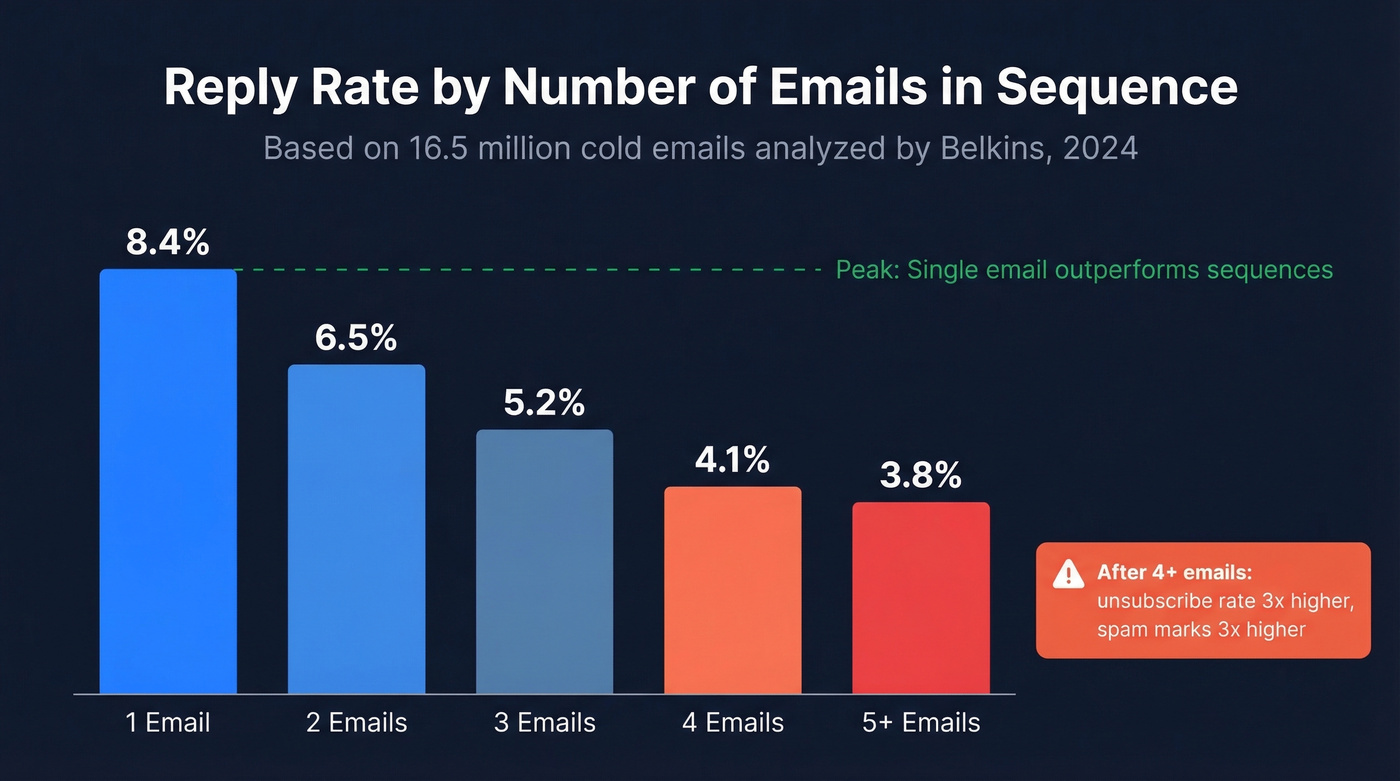
The first follow-up still delivers a meaningful lift. Woodpecker's data shows a 22% conversion improvement from that initial nudge. But returns drop fast. Going from one to five or more emails in a sequence cuts reply rates by more than half.
Open rates in the dataset hit 45.37%, though Belkins stopped tracking opens later in the year because tracking pixels were hurting deliverability. That's an important caveat - the metric is increasingly unreliable, and chasing it can actively damage your sender reputation.
When Follow-Ups Backfire
Most articles on sales follow-up statistics skip this part. Sending 4+ emails in a sequence more than triples your unsubscribe rate and more than triples your risk of being marked as spam. The inflection point hits at the 4th follow-up (the 5th email total). That's not a marginal increase - it's a structural threat to your domain.
The founder persona illustrates this perfectly. Founders hold steady through early touches (6.64% initial, 6.66% after one follow-up) and actually peak at 6.94% on the second follow-up. Then it falls off a cliff: 5.75% on the third, 3.01% by the fourth. Two extra emails cut the reply rate in half.
Enterprise prospects are even less forgiving. The dataset describes them as "allergic to persistence," and reply rates decline sharply after the first follow-up. If you're selling into enterprise, pushing long email threads is usually doing more harm than good. (If you're building an enterprise motion, see our guide to enterprise B2B sales.)
Response Rates by Audience Segment
Not all prospects tolerate the same cadence. Company size and industry create dramatically different response curves.
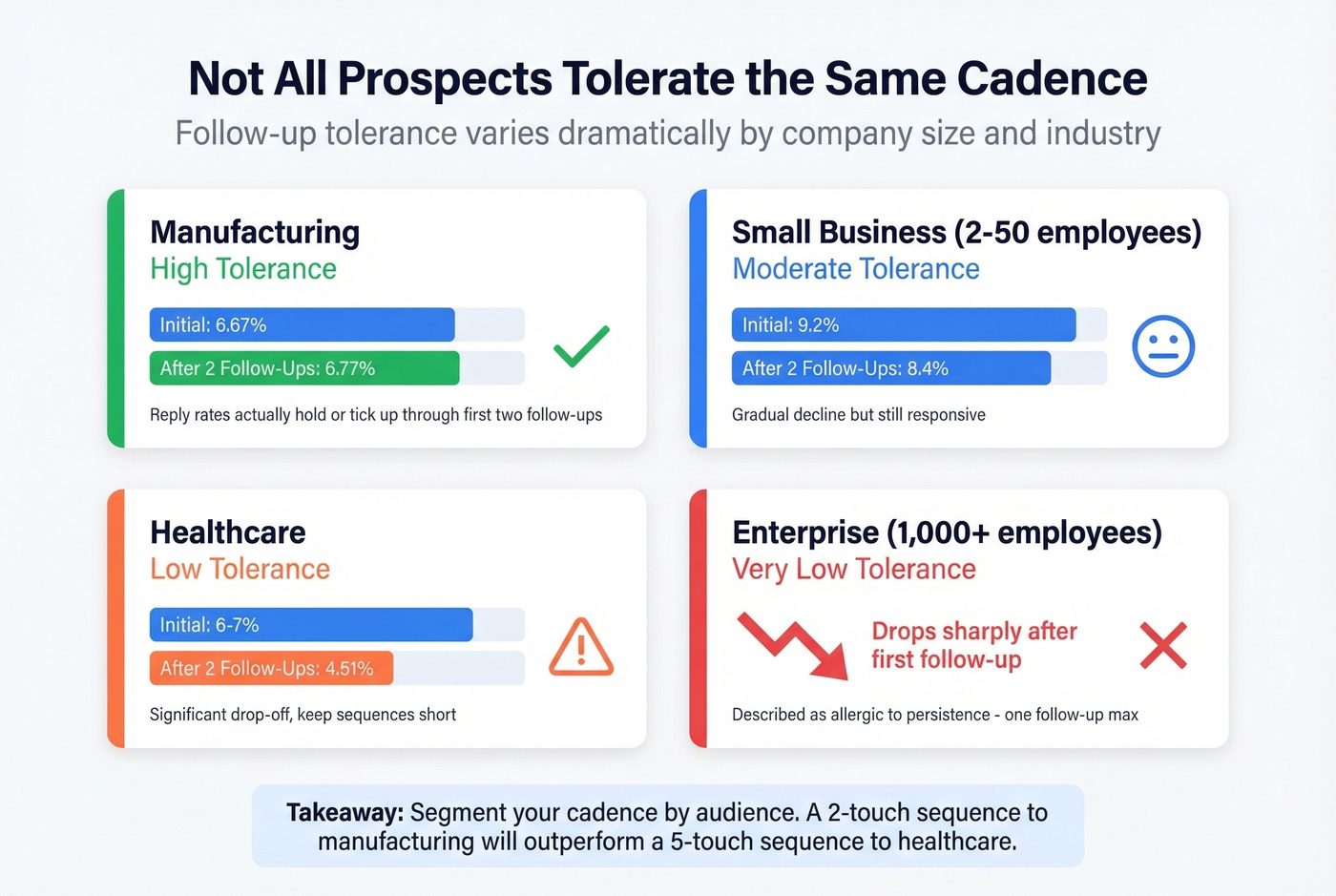
| Segment | Initial Reply | After 2 Follow-Ups | Tolerance |
|---|---|---|---|
| Small biz (2-50) | 9.2% | 8.4% | Moderate |
| Enterprise (1,000+) | Drops sharply after first follow-up | Drops further with persistence | Very low |
| Manufacturing | 6.67% | 6.77% | High |
| Healthcare | ~6-7% | 4.51% | Low |
Manufacturing prospects barely flinch at follow-ups - reply rates actually hold or tick up slightly through the first two. Healthcare and cloud solutions are the opposite, dropping to 4.51% and 4.47% respectively. If you're running the same cadence across all verticals, you're over-emailing half your list and under-emailing the other half.
Let's be honest: most teams would get better results by cutting their sequence length in half and spending that saved effort on segmenting by industry tolerance. A short sequence to a manufacturer will outperform a long sequence to a healthcare exec almost every time. When you look at the variance across verticals, a one-size-fits-all approach is indefensible. (If you need a framework for this, start with firmographic filters.)

If your bounce rate is above 5%, shorter cadences won't save you. Prospeo's 5-step email verification delivers 98% accuracy - keeping you under 2% bounce and out of spam folders. At $0.01 per email, cleaning your list costs less than a single wasted follow-up.
Stop burning follow-ups on dead addresses. Verify before you send.
Speed-to-Lead and Reply Time
Follow-up cadence gets all the attention, but response speed matters more. A 2024 benchmark across 1,000+ companies found that 63% didn't respond to inbound leads at all. Not slowly. Never. The drop-off by minute is brutal:
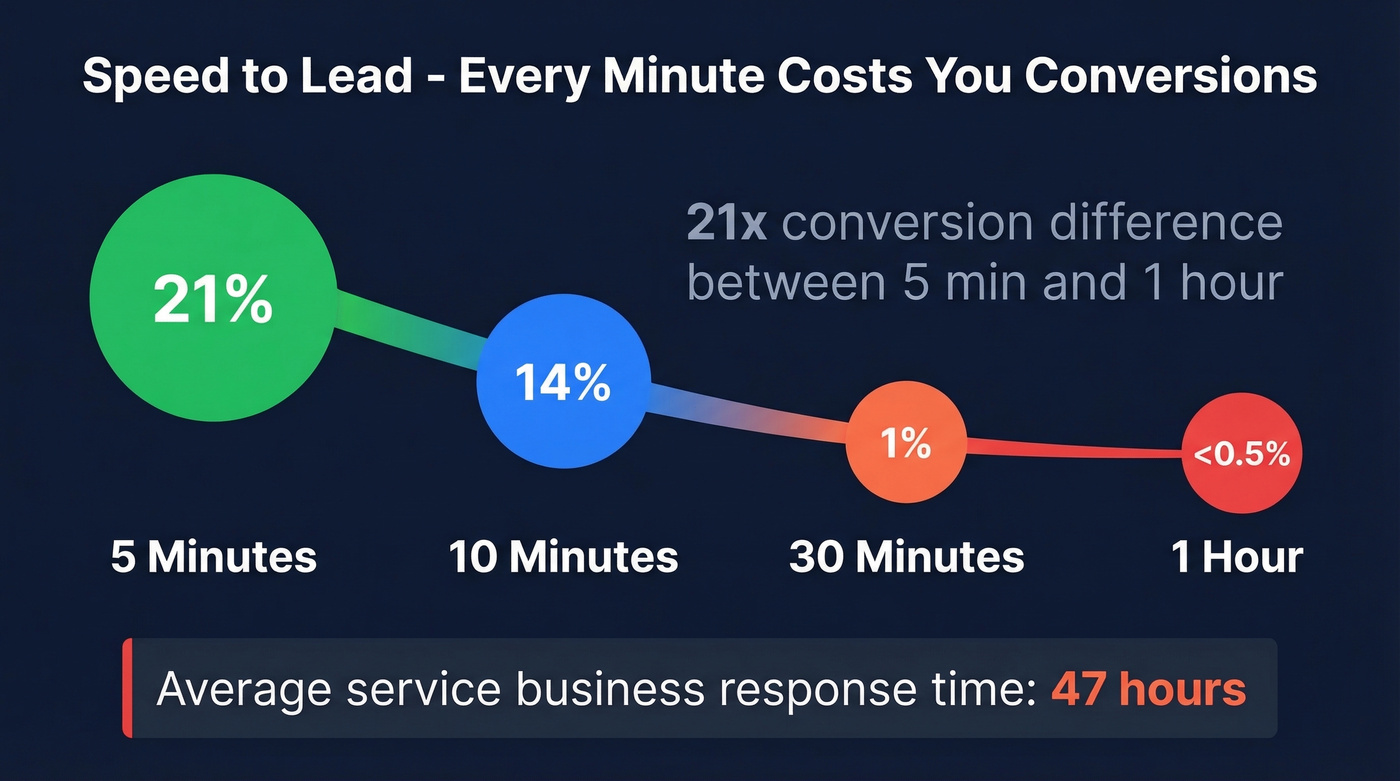
| Response Time | Qualification Rate |
|---|---|
| 5 minutes | 21% |
| 10 minutes | 14% |
| 30 minutes | 1% |
| 1 hour | <0.5% |
Leads contacted within five minutes are 21x more likely to convert. The average service business takes 47 hours to respond - nearly two full days. One analysis of 2,847 contractor leads found that text responses under 60 seconds achieved a 73% appointment booking rate. After 30 minutes? Four percent.
That gap is staggering, and it's where most pipeline actually dies.
The Right Cadence
The data points to a simple framework we call the 3-7-7 cadence. Send your initial email on Day 0, follow up on Day 3, again on Day 10, and a final touch on Day 17. Research from Digital Bloom shows 93% of replies arrive by Day 10, which means everything after that is marginal at best and domain-damaging at worst.
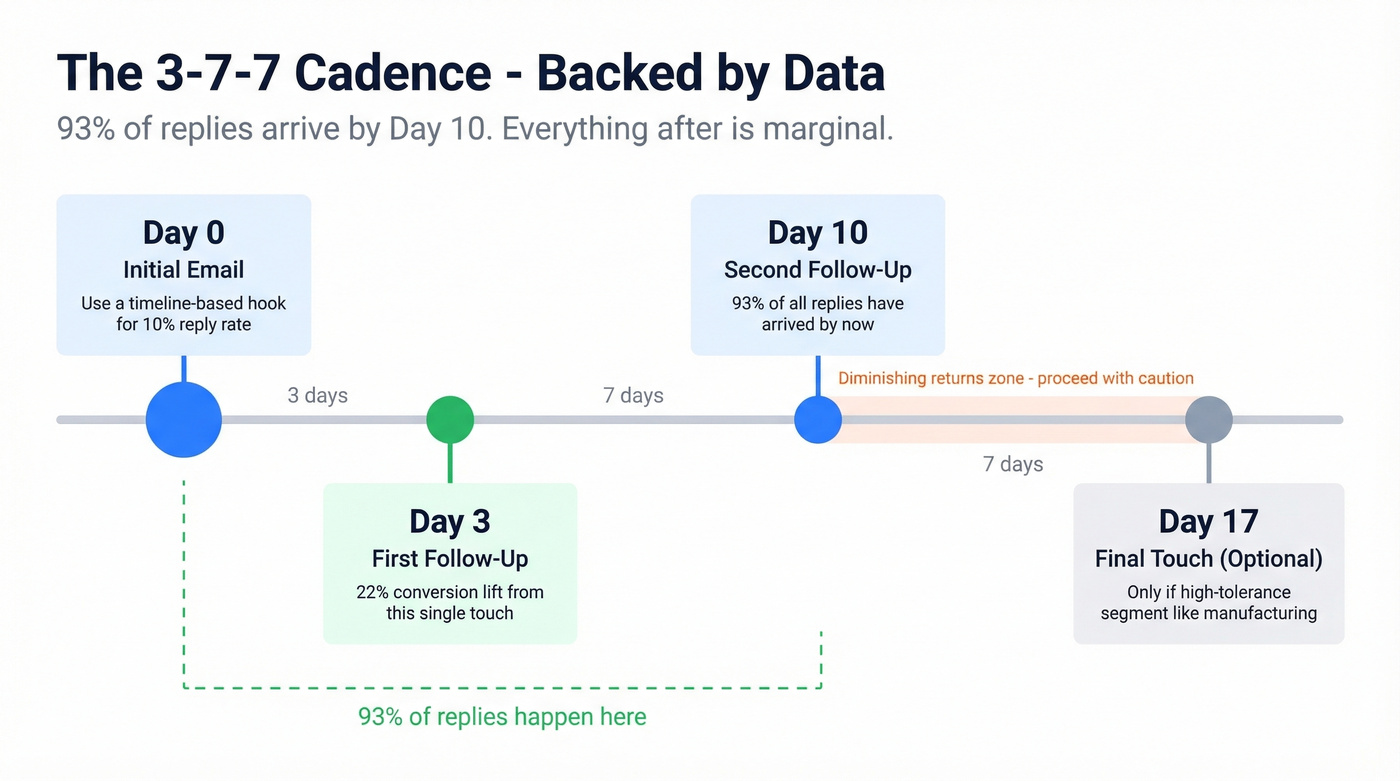
What you say matters as much as when you say it. Timeline-based hooks ("We're rolling this out in Q2") pull a 10.01% reply rate versus 4.39% for problem hooks - a 2.3x gap. The same dataset found that a message plus profile visit combo pulled an 11.87% reply rate, outperforming even the best email-only sequences. The r/sales consensus aligns: one practitioner reported that weekly follow-ups capped at three attempts outperformed longer sequences. More isn't better. Better is better.
In our experience, teams that switch from 5+ email sequences to a 3-touch cadence see immediate improvements in both deliverability and reply quality. AI tools make this cadence executable at scale - 56% of sales pros already use AI daily to manage timing and personalization. (If you're evaluating tooling, see AI tools for automating sales follow-ups and follow up email software.)
2026 Cold Email Benchmarks
Use this reference table - based on community-reported ranges and published benchmarks - to calibrate where your campaigns actually stand.
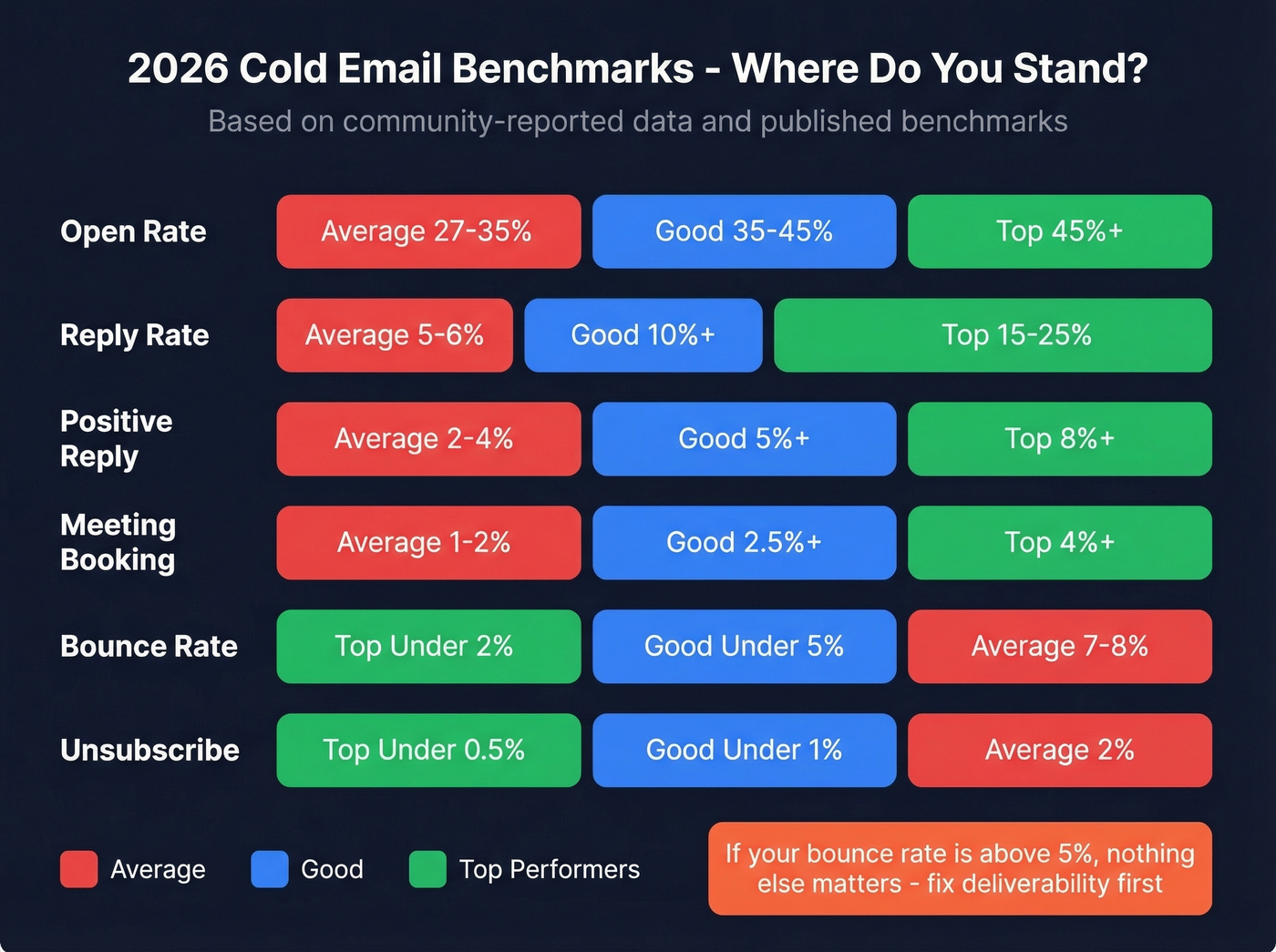
| Metric | Average | Good | Top Performers |
|---|---|---|---|
| Open rate | 27-35% | 35-45% | 45%+ |
| Reply rate | 5-6% | 10%+ | 15-25% |
| Positive reply | 2-4% | 5%+ | 8%+ |
| Meeting booking | 1-2% | 2.5%+ | 4%+ |
| Bounce rate | 7-8% | Under 5% | Under 2% |
| Unsubscribe | ~2% | Under 1% | Under 0.5% |
If your bounce rate sits above 5%, none of the cadence optimization above matters. You're burning sends on dead addresses, training spam filters to ignore you, and inflating every other metric in the wrong direction. (Benchmarks and fixes: email bounce rate.)
The Hidden Variable: Data Quality
Look - none of the cadence data above matters if your emails never reach an inbox. A 7-8% bounce rate (the community average) means roughly one in thirteen emails never arrives. That's not just wasted effort; it's active damage to your sender reputation, compounding across every subsequent campaign. (For the full system, see our email deliverability guide.)
We've seen teams obsess over subject lines and send timing while ignoring the fact that 8% of their list is dead weight. Prospeo's 5-step verification process catches invalid addresses, spam traps, and honeypots at 98% accuracy, with data refreshing every 7 days instead of the 6-week industry average. That means you're not sending follow-ups to someone who changed jobs last month. Your two or three follow-ups actually land, which is the only way the statistics above translate into pipeline. (If you want to go deeper on list hygiene, read spam trap removal.)
Segmenting by industry tolerance only works when you have the data to segment. Prospeo gives you 30+ filters - including industry, company size, buyer intent, and technographics - across 300M+ profiles so you can match cadence length to the audience that actually responds.
Send fewer, smarter follow-ups to the right segments. Start free today.
FAQ
How many follow-up emails should I send?
Two to three. The 16.5M-email study shows reply rates peak with one email at 8.4%, and pushing into 4+ emails in a sequence sharply increases unsubscribe and spam-mark risk. The sweet spot is an initial email plus one or two follow-ups - enough to stay visible without burning your domain.
What's the best spacing for follow-up emails?
Use a 3-7-7 cadence: follow up on Day 3, Day 10, and Day 17 after your initial send. 93% of replies arrive by Day 10, making additional touches after that point marginal at best and harmful to deliverability at worst.
How fast should I respond to inbound leads?
Within five minutes. Leads contacted in that window are 21x more likely to convert. After one hour, qualification rates drop below 0.5%. The average service business takes 47 hours to respond - don't be average.
How do I make sure follow-up emails actually reach inboxes?
Verify every address before launching a sequence. A bounce rate above 5% damages sender reputation and tanks deliverability for future campaigns. Use a verification tool with catch-all handling and spam-trap removal, and make sure the underlying data refreshes frequently - stale contacts are the fastest way to wreck a domain.