

The Data-Driven Follow Up Strategy: Cadences, Templates, and Benchmarks From 16.5M Emails
42% of campaign replies come from follow-ups. Not the first email - the second, third, or fourth. Yet 48% of reps never send a single one. That's not a skills gap. It's a follow up strategy gap, and it's costing teams half their pipeline.
The fix isn't "follow up more." It's follow up smarter - with the right cadence, the right message, and data that actually reaches the inbox.
The Short Version
Send 1-3 follow-ups max. A Belkins study of 16.5M cold emails shows reply rates decline after that, and spam-complaint risk more than triples by follow-up #4. Use the 3-7-7 cadence for SMB deals and a longer multi-threaded approach for enterprise. And before you optimize cadence or rewrite templates, verify your contact data - 17% of cold emails never reach the inbox.
What the Data Actually Says
Let's ground this in real numbers. Belkins analyzed 16.5M cold emails across 93 business domains, and the key finding is straightforward: the highest reply rate comes from just one email, with every follow-up after that delivering diminishing returns.
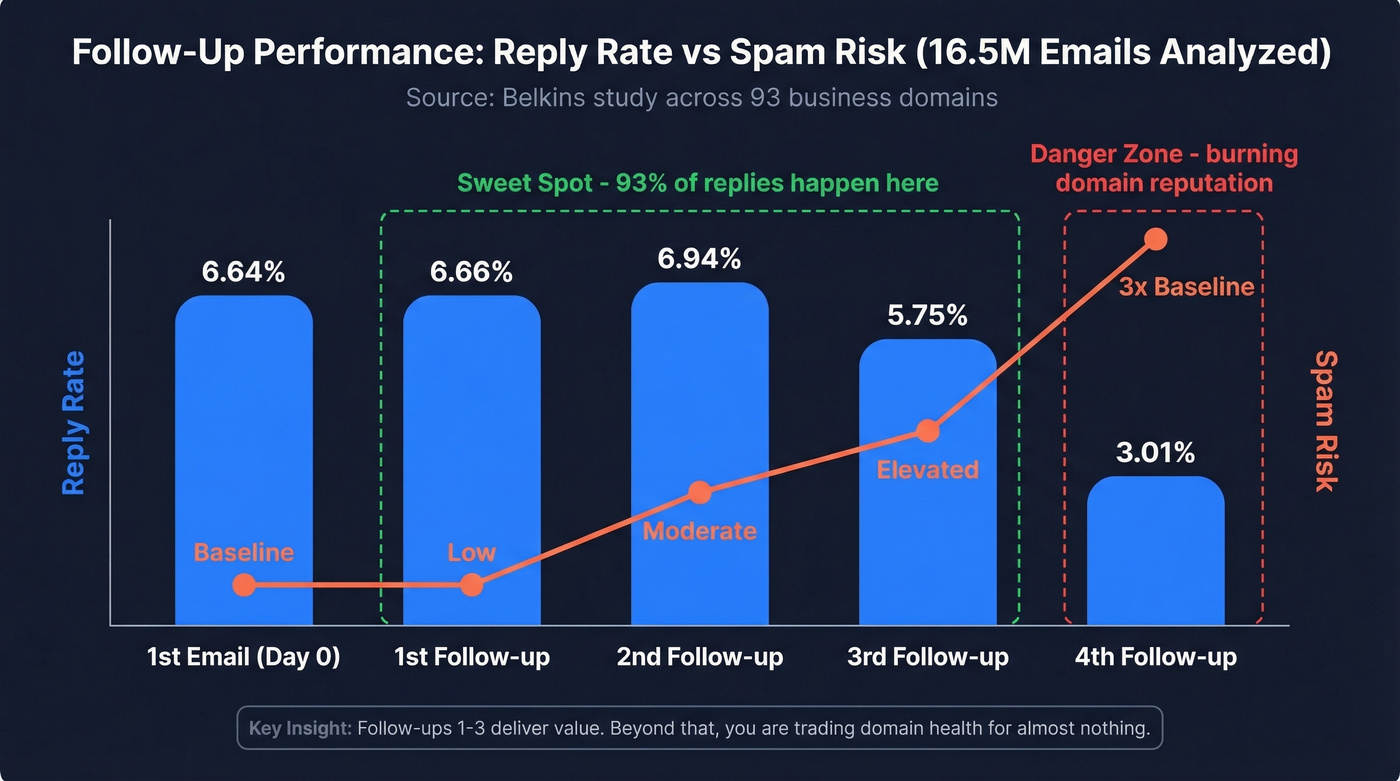
The first email pulls an 8.4% reply rate with a 45.37% open rate. Each subsequent follow-up chips away at engagement while driving up spam complaints and unsubscribes. By the fourth follow-up, you've more than tripled your spam-complaint risk for marginal gains.
Broader benchmarks tell a similar story. Average cold email open rates sit around 27.7%, with a platform-wide reply rate of 3.43%. Those aren't exciting numbers, which is exactly why effective follow-up techniques matter - you need every percentage point you can get.
What's especially useful in the Belkins data is the industry breakdown, which nobody else seems to talk about. Manufacturing holds steady at 6.67%-6.77% reply rates across early follow-ups. Transportation clusters around 6.46%-6.66%. Solar sits at 6.73% initially and 6.83% on the first follow-up. If you're selling into these verticals, your follow-up ceiling is lower than the aggregate suggests - plan accordingly and don't expect 8%+ reply rates just because the overall average says so.
Here's how the numbers break down using the founder reply-rate pattern from the Belkins dataset:
| Follow-Up # | Reply Rate | Open Rate Trend | Spam Risk |
|---|---|---|---|
| 1st email (Day 0) | 6.64% | Peak | Baseline |
| 1st follow-up | 6.66% | Declining | Low |
| 2nd follow-up | 6.94% | Declining | Moderate |
| 3rd follow-up | 5.75% | Declining | Elevated |
| 4th follow-up | 3.01% | Declining | 3x baseline |
The takeaway isn't "never follow up." Follow-ups 1-3 are where the value lives. Beyond that, you're burning domain reputation for almost nothing.
Two Cadences That Actually Work
The SMB Cadence (3-7-7)
For deals with a single decision-maker and a 1-3 month sales cycle, the 3-7-7 cadence captures the vast majority of replies without triggering spam filters.
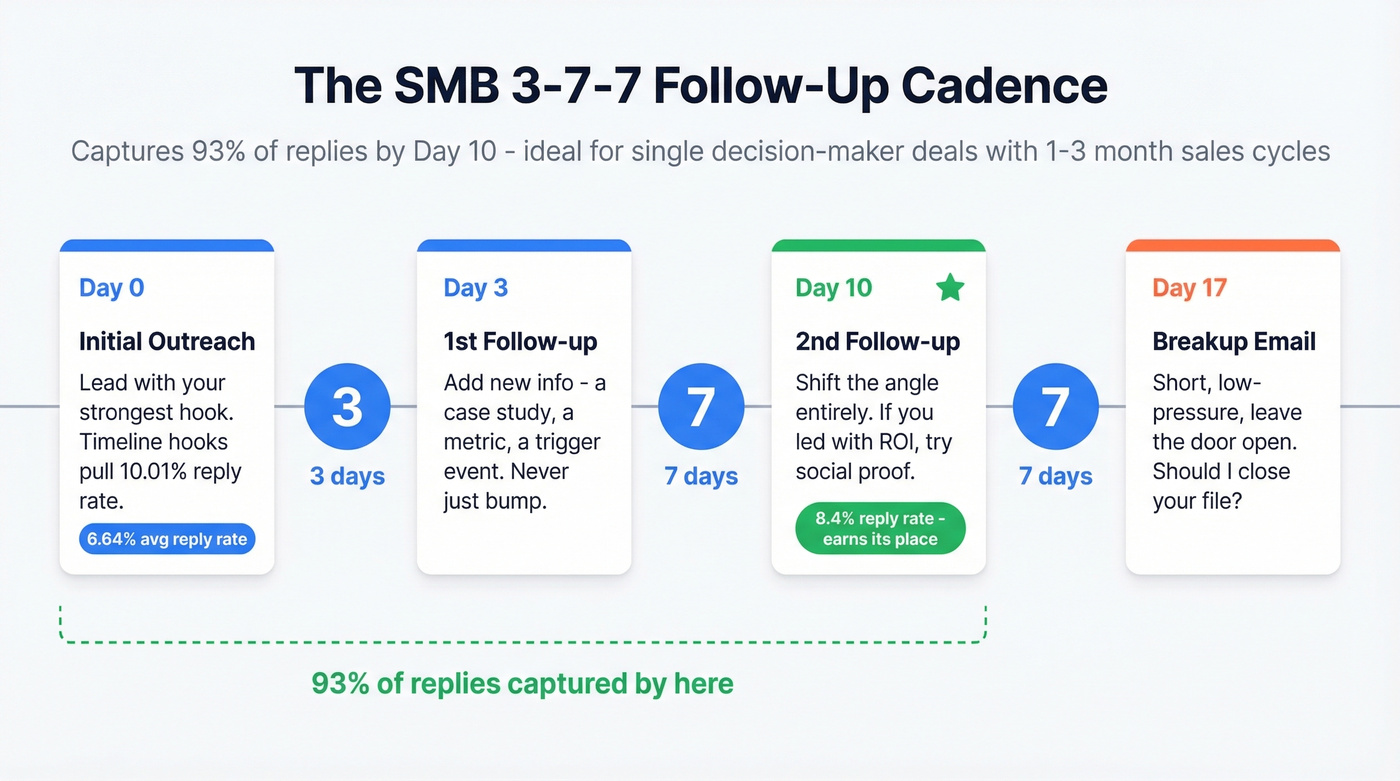
- Day 0: Initial outreach. Lead with your strongest hook.
- Day 3: First follow-up. Add new information - a relevant case study, a metric, a trigger event. Don't just bump.
- Day 10: Second follow-up. Shift the angle entirely. If you led with ROI, try social proof. If you led with a problem, try a timeline hook.
- Day 17: Breakup email. Short, low-pressure, leaves the door open.
This framework captures 93% of replies by Day 10. Small business reply rates actually hold up well through the first two follow-ups - starting at 9.2%, dipping to 8%, then bouncing back to 8.4% on the second follow-up. That second follow-up earns its place.
We've tested both the 3-7-7 and the more common Day 1/3/7/14 pattern. The 3-7-7 gives your prospect more breathing room between touches 2 and 3, which matters when you're emailing busy founders who check email in batches.
The Enterprise Cadence
Enterprise follow-up runs on a completely different clock. B2B tech sales cycles now average 6.5 months (up from 4.9 in 2019), buying groups involve 6-25 stakeholders, and deals require 15-20+ coordinated touchpoints.
A rapid-fire email sequence that works for a 30-person startup will get you blocked at a Fortune 500. The enterprise approach looks more like this:
Weeks 1-2: Multi-thread across 3-5 stakeholders. Email the champion, connect with the technical evaluator on social, and engage the economic buyer through a separate channel.
Weeks 3-6: Space follow-ups 7-14 days apart. Each touchpoint should reference something specific to their business - a quarterly earnings mention, a competitor move, a relevant industry shift.
Months 2-6+: Shift to nurture mode. Monthly value-adds like research, benchmarks, and case studies that keep you visible without being pushy.
The key difference isn't just timing - it's threading. You're not following up with one person. You're orchestrating touchpoints across a buying committee.
What to Say at Each Step
The hook you use matters more than most reps realize. Digital Bloom's 2026 benchmarks show significant performance gaps by hook type:
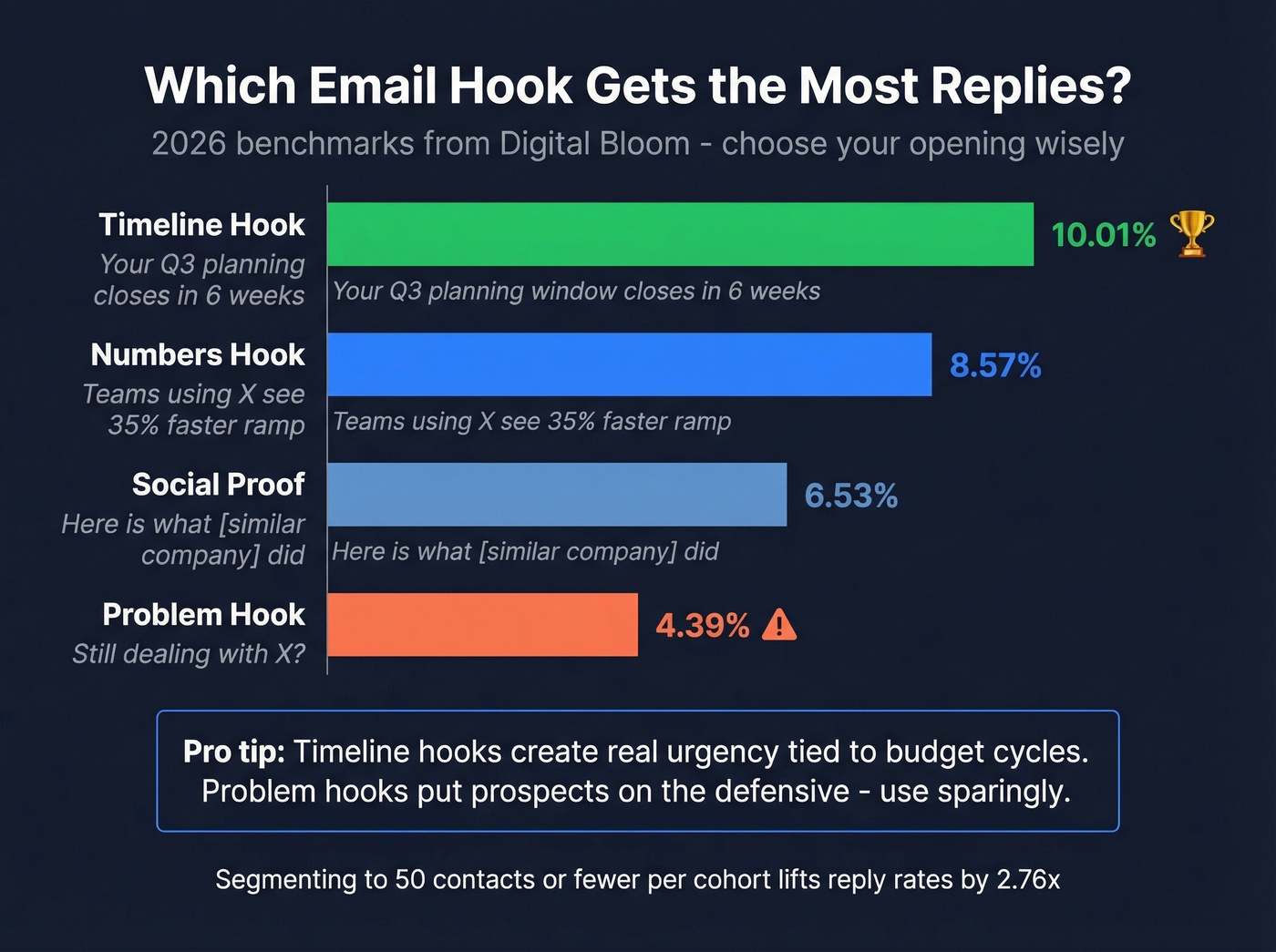
- Timeline hook ("Your Q3 planning window closes in 6 weeks"): 10.01% reply rate
- Numbers hook ("Teams using X see 35% faster ramp"): 8.57%
- Social proof ("Here's what [similar company] did"): 6.53%
- Problem hook ("Still dealing with X?"): 4.39%
Timeline hooks consistently outperform in our campaigns, especially for mid-market deals where budget cycles create real urgency. Problem hooks sound intuitive but they put the prospect on the defensive.
One more thing that moves the needle: keep your cohorts tight. Segmenting to 50 contacts or fewer per cohort lifts reply rates by 2.76x. Mass blasts kill personalization, and the data proves it.
Here are templates you can steal (or compare against these sales cadence templates):
First follow-up (Day 3-5, no response):
Subject: Re: [original subject] Hey [Name], wanted to share one quick number - [specific metric relevant to their role]. [One sentence connecting it to their situation]. Worth a 15-min call this week?
Value-add follow-up (Day 10):
Subject: [New subject line - shift the angle] [Name], just published a breakdown of how [similar company/industry] handled [specific challenge]. Thought of you given [trigger event]. Here's the link: [resource]. Happy to walk through what's relevant to [company].
Breakup email (after 7-10 touchpoints):
Subject: Should I close your file? [Name], I've reached out a few times and haven't heard back - totally fine. If [problem you solve] isn't a priority right now, I'll stop reaching out. If timing changes, just reply to this thread.
Post-demo follow-up (within 24 hours):
Subject: Re: [demo subject] [Name], great conversation today. Recapping the three things you flagged: [1], [2], [3]. I'll send over [promised resource] by EOD. Does [specific date] work for the next step with [stakeholder name]?
90% of buyers who respond do so within two days of their most recent message - which is why the 24-hour window for post-demo follow-ups isn't optional. It's the difference between momentum and a stalled deal.
Post-quote follow-up (2-3 days):
Subject: Re: [proposal subject] [Name], checking if you've had a chance to review the proposal. Happy to jump on a quick call to walk through the numbers or adjust scope. What works this week?

Your follow-up cadence is only as good as the data behind it. 17% of cold emails never reach the inbox - not because of bad copy, but because of bad contact data. Prospeo's 98% email accuracy and 7-day refresh cycle mean every follow-up actually lands.
Stop wasting follow-ups on emails that bounce.
Layering Channels for Better Results
Email alone leaves money on the table. A social message paired with a profile visit pulls an 11.87% reply rate - significantly higher than email's 8.4%. Combining email, phone, and social can boost results by 287%+ versus email alone.
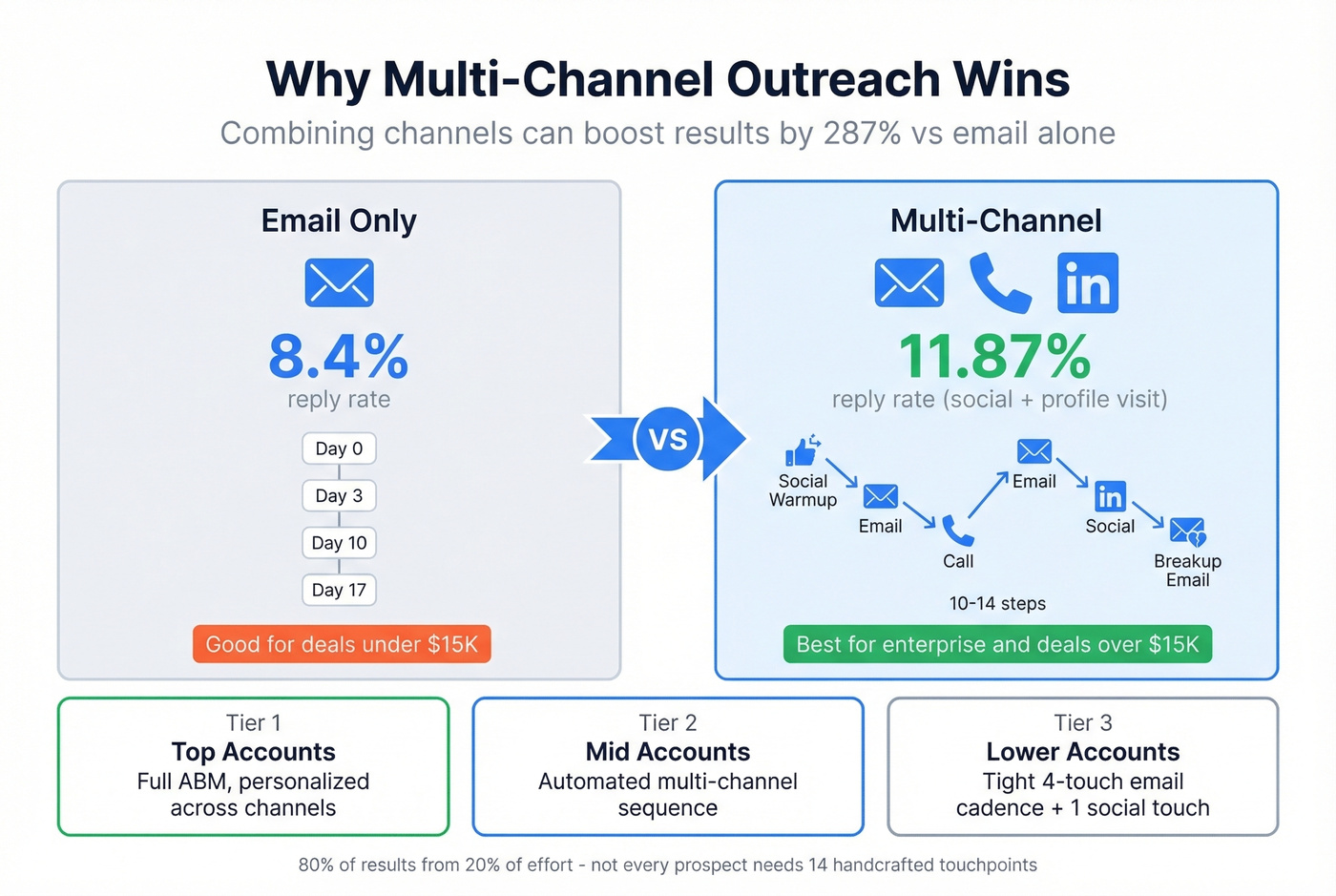
The strongest sequences we've seen run 10-14 steps, starting with social engagement, layering in calls, and ending with a breakup email. Warm up on social first, then earn the right to land in their inbox.
Here's my honest take: if your average deal size is under $15K, you probably don't need a 14-step multi-channel sequence. A tight 4-touch email cadence with one social touchpoint will get you 80% of the results at 20% of the effort. Save the full ABM treatment for accounts that justify the time investment.
For enterprise-tier accounts, consider video follow-ups. A 60-second Loom walking through a personalized insight lands differently than another text email in a crowded inbox. It's more effort per touch, but the signal-to-noise ratio is dramatically better (more on video follow-up in sales).
Tier your approach. Top accounts get full ABM treatment - personalized across channels, aligned with marketing. Tier 2 gets a more automated multi-channel sequence. Not every prospect deserves 14 handcrafted touchpoints.
The Deliverability Prerequisite
Here's the thing: none of this matters if your emails don't reach the inbox.
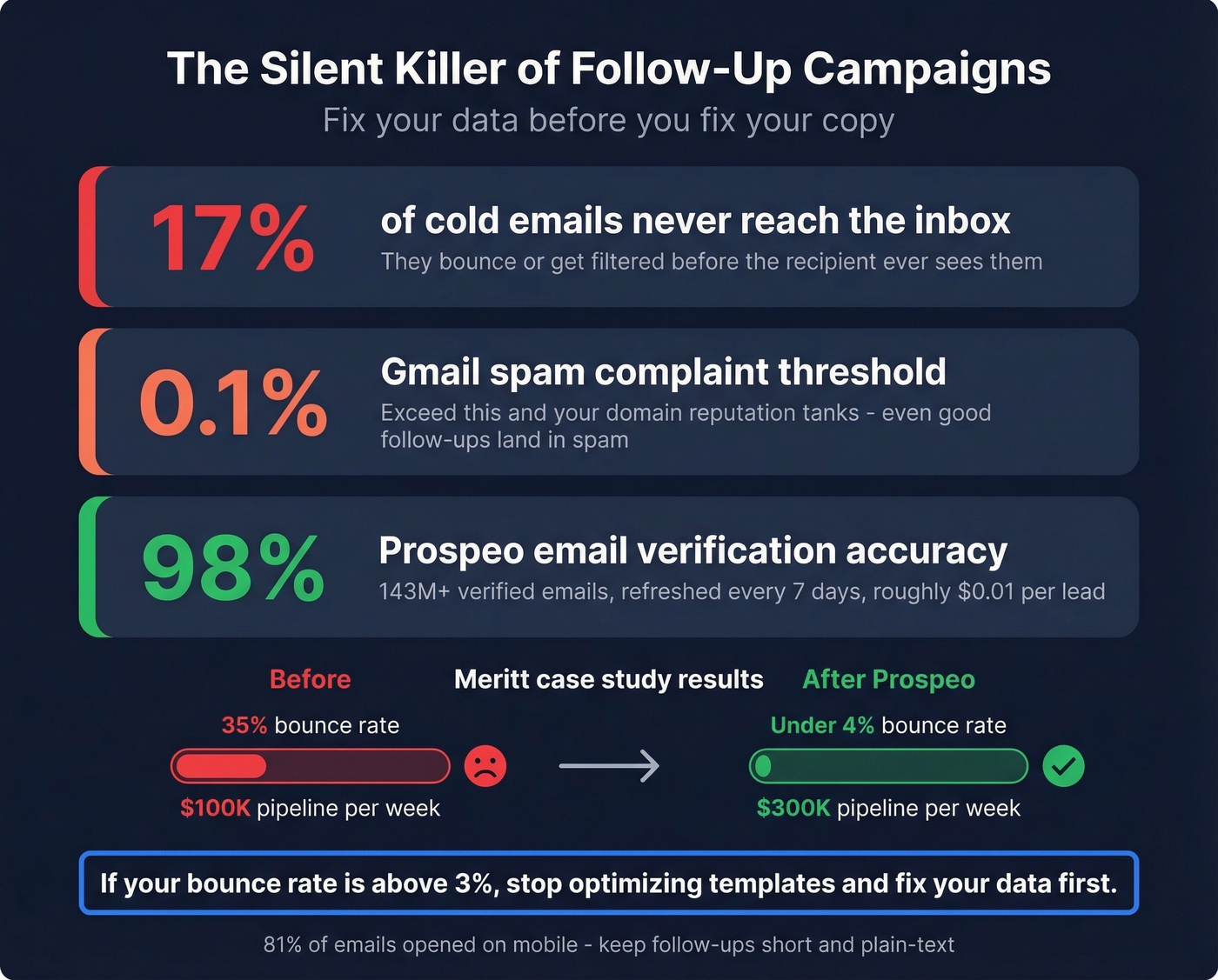
About 17% of cold emails never make it](https://martal.ca/b2b-cold-email-statistics-lb/) - they bounce or get filtered before the recipient ever sees them. Gmail enforces a 0.1% spam complaint threshold. Exceed it, and your domain reputation tanks. Once that happens, even perfectly crafted follow-ups to valid addresses land in spam.
This is the silent killer of follow-up campaigns. You optimize your cadence, rewrite your templates, test your hooks - and your bounce rate is quietly destroying your sender reputation in the background. In our experience, the single biggest reply-rate killer is bad data, not bad copy. No follow up strategy can overcome emails that never arrive.
Before you touch anything else, verify your list. Prospeo runs a 5-step verification process with catch-all handling, spam-trap removal, and honeypot filtering - 98% email accuracy across 143M+ verified emails, refreshed on a 7-day cycle. At roughly $0.01 per lead, it's the cheapest insurance policy your outbound program can buy. Meritt dropped their bounce rate from 35% to under 4% after switching and tripled pipeline from $100K to $300K per week. Stack Optimize built to $1M ARR with client deliverability above 94% and zero domain flags across all clients.
With 81% of emails opened on mobile, keep your follow-ups short and plain-text. Heavy HTML breaks on small screens and triggers spam filters more often than most reps realize.
If your bounce rate is above 3%, stop optimizing templates and fix your data first (use these bounce rate benchmarks as a reference).
Five Mistakes That Kill Reply Rates
1. Bumping without new information. "Just checking in" and "wanted to circle back" add zero value. Every follow-up needs a new angle, a new data point, or a new reason to reply.
2. Not addressing different objections. Your prospect didn't reply for a reason. Maybe the timing was wrong, maybe they didn't see the ROI, maybe they're evaluating competitors. Each follow-up should tackle a different potential objection rather than hammering the same pitch louder.
3. Follow-ups that don't look real. Long HTML emails with headers and footers scream "mass blast." Keep follow-ups short, plain-text, and reply-in-thread. They should look like a real person typing a quick note.
4. Not using new subject lines when needed. Threading works for the first 1-2 follow-ups. After that, a fresh subject line can re-engage someone who's been ignoring the thread. Test it.
5. Wrong frequency. Too fast and you're annoying. Too slow and they've forgotten you. The founder reply rate pattern illustrates the ceiling: 6.64% initial, 6.66% first follow-up, 6.94% second follow-up, then a drop to 5.75% by the third and 3.01% by the fourth. Even warm-ish prospects have a limit.
Tools to Execute Your Cadence
Reps spend roughly 30% of their time actually selling - the rest is admin. The right tools flip that ratio. A complete follow-up tech stack runs $70-$350/user/mo depending on your choices. Here's how to think about the three layers:
Data quality and verification is the foundation. Without clean data, your sequencing tool is just an expensive way to burn your domain. Prospeo covers this with 300M+ profiles, 98% email accuracy, 125M+ verified mobiles, and native integrations with Salesforce, HubSpot, Smartlead, Instantly, and Lemlist. Free tier available, no contracts required.
CRM keeps your follow-up history centralized. HubSpot's free CRM handles basic deal tracking; Sales Hub starts around $20/user/mo for sequences and automation. Salesforce runs $25-$300+/user/mo depending on the edition - overkill for most teams under 50 reps.
Sales engagement and sequencing is where your cadences actually run. Outreach and Salesloft both run ~$100-$150/user/mo and are the enterprise standard. Apollo.io offers a free tier with 275M+ contacts and paid plans from ~$49/user/mo - the obvious choice for teams that want prospecting and sequencing in one tool without the enterprise price tag (see more sales prospecting platforms).
| Category | Tool | Starting Price | Best For |
|---|---|---|---|
| Data/Verification | Prospeo | Free; paid ~$39/mo | Email accuracy, verified mobiles |
| CRM | HubSpot | Free; Sales Hub ~$20/mo | SMB deal tracking |
| CRM | Salesforce | ~$25/user/mo | Enterprise workflows |
| Sequencing | Apollo.io | Free; paid ~$49/mo | All-in-one prospecting |
| Sequencing | Outreach | ~$100/user/mo | Enterprise sequences |
| Sequencing | Salesloft | ~$100-$150/user/mo | Enterprise multi-channel |
Segmenting to 50-contact cohorts lifts reply rates 2.76x - but only if those contacts have real, verified emails. Prospeo gives you 300M+ profiles with 30+ filters so you can build hyper-targeted cohorts at $0.01/email, not $1.
Build tighter cohorts with data that actually connects.
FAQ
How many follow-ups should I send?
1-3 follow-ups is the sweet spot based on 16.5M emails analyzed. The fourth more than triples spam-complaint risk while adding minimal reply gains. Go beyond three only if you have strong engagement signals like opens or clicks.
What's the best day to send follow-up emails?
Launch sequences on Monday for maximum inbox visibility. Wednesday shows peak engagement for subsequent follow-ups. Keep formatting mobile-friendly - short paragraphs, no heavy HTML, clear CTAs.
When should I stop following up?
After three follow-ups with no engagement - opens, clicks, or replies. If they haven't opened anything, verify the address first. If they've opened but not replied, send a breakup email and re-engage in 3-6 months.
Does multi-channel follow-up actually work?
Yes - combining email, phone, and social boosts results by 287%+ versus email alone. A social message with a profile visit alone hits 11.87% reply rate, well above email-only outreach. The strongest approaches layer channels rather than relying on a single one.
How do I know if my follow-up emails are reaching the inbox?
Check your bounce rate. Above 3% means your domain reputation is suffering and follow-ups are landing in spam. Clean your list with email verification before launching any sequence - bad data is the top reply-rate killer, not bad copy.