

Sales Cadence Templates That Actually Work (2026)
80% of deals require five or more touches. Yet 44% of reps give up after one. That gap is where pipeline goes to die.
Here's the contrarian truth about sales cadence templates: six well-timed, data-verified touches outperform fifteen spray-and-pray emails every single time. We've watched teams cut their total touchpoints in half and double their reply rates just by getting the timing and channel mix right. The templates below give you day-by-day schedules, paste-ready scripts, and the benchmarks to know if they're working.
What Makes a Great Cadence Work
Morgan J Ingram recommends 17-21 days as the ideal cadence length. Florin Tatulea puts the sweet spot at 8-12 touchpoints - never over-index on one channel. The data backs this up: multichannel cadences see 287% higher response rates than email-only, and 17% of cold emails land in spam or get blocked outright. If you're running email-only sequences, you're fighting with one arm tied behind your back.
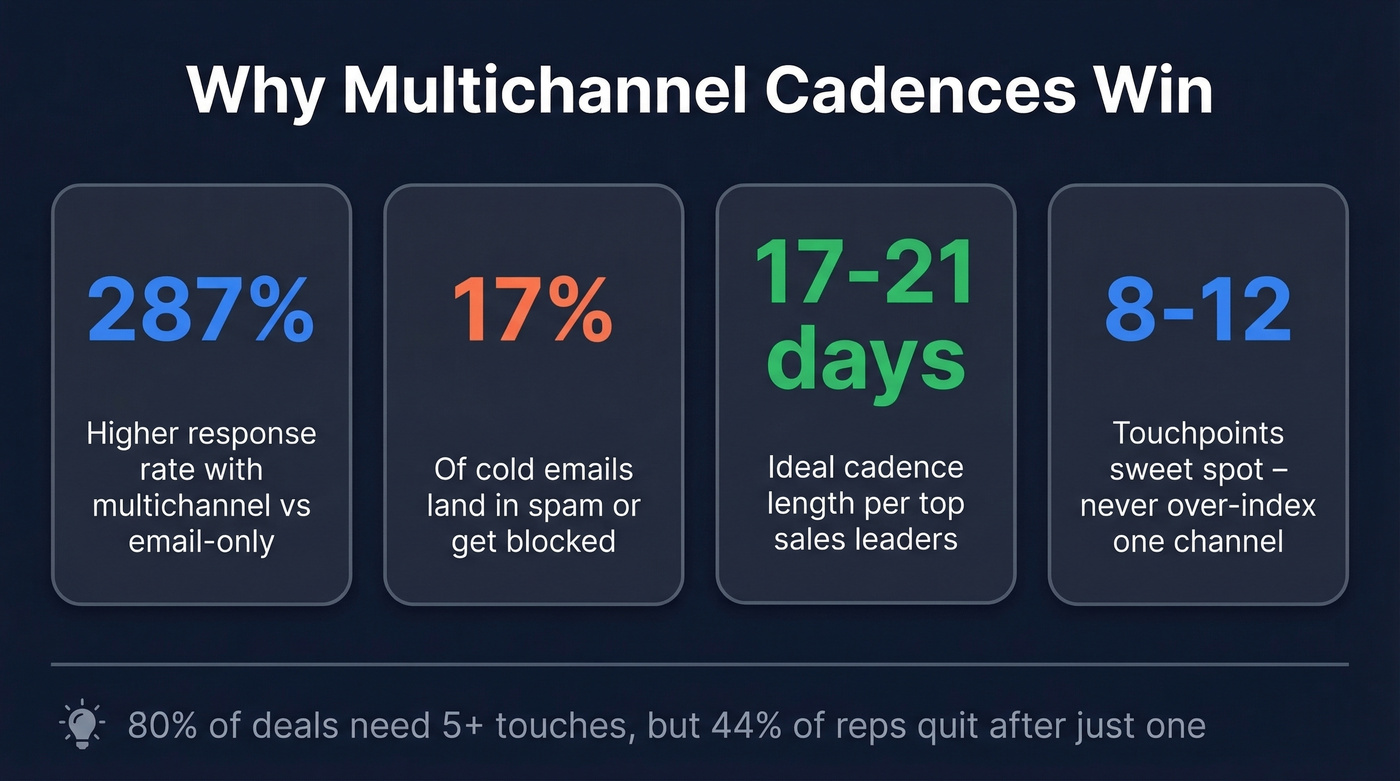
Keep emails around 75-100 words. Start with a blank connection request on social - Ingram's data shows higher acceptance rates without a note. Use permission-based CTAs early ("Are you open to an email exchange?") instead of asking for a meeting in touch one. Cold email reply rates sit between 1-5% industry-wide, so don't panic if your numbers land there. Just make sure every reply counts.
5 Proven Sales Cadence Templates
1. Cold Outbound (21-Day, 10-Touch)
Use this when you're reaching out completely cold with no prior signal. Skip it if the prospect already knows your brand - jump to the intent-triggered cadence instead.
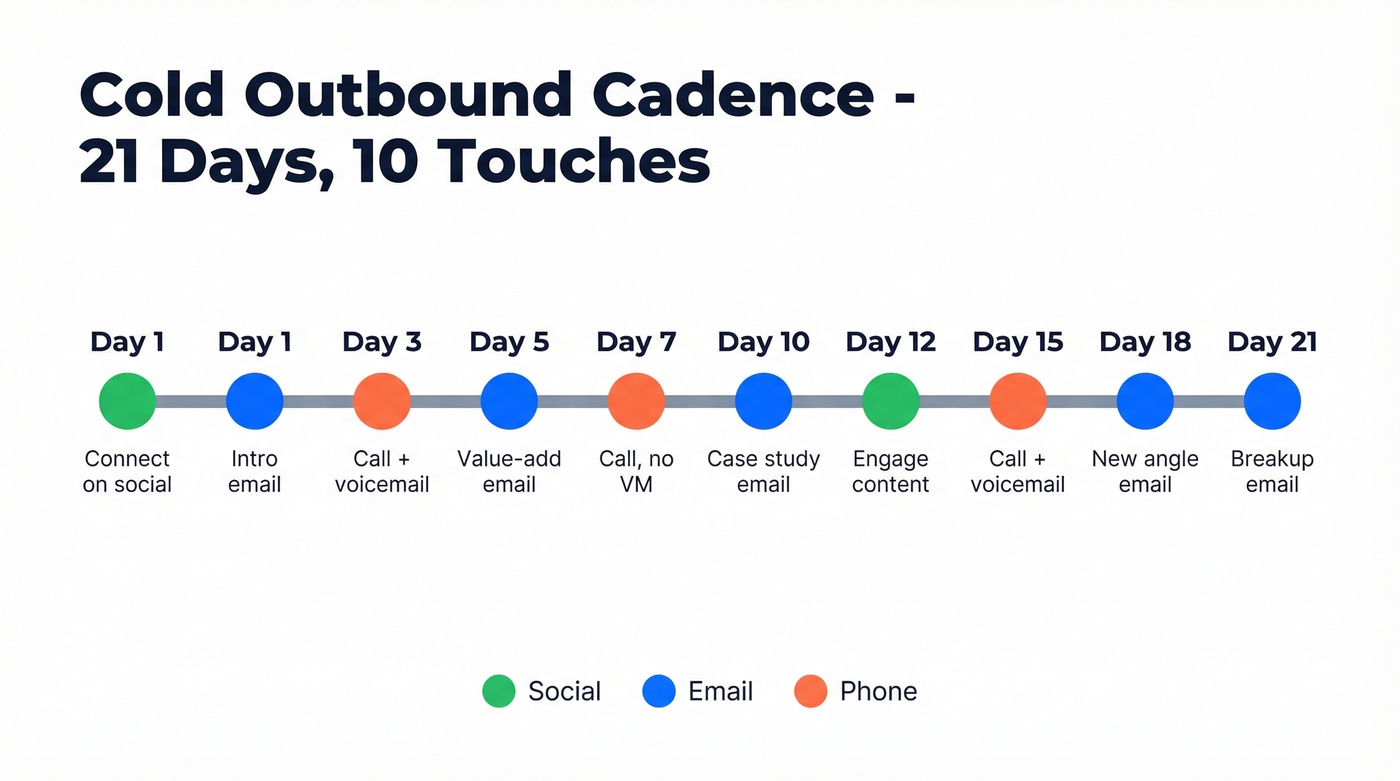
| Day | Channel | Action |
|---|---|---|
| 1 | Social | Blank connection request |
| 1 | Intro email (below) | |
| 3 | Phone | Call + voicemail |
| 5 | Value-add follow-up | |
| 7 | Phone | Call (no voicemail) |
| 10 | Case study or proof point | |
| 12 | Social | Engage with their content |
| 15 | Phone | Call + voicemail |
| 18 | New angle or insight | |
| 21 | Breakup email |
Day 1 email (47 words):
Subject: Quick question about {{company}}
Hi {{first_name}},
Noticed {{company}} is hiring {{role}} - usually means {{pain point}} is top of mind. We help {{ICP}} {{outcome}} without {{thing they want to avoid}}.
Worth a conversation?
{{Your name}}
This format mirrors what's pulling replies on r/copywriting - absurdly short, specific offer, soft CTA. If you want more variations, borrow a few patterns from our cold outreach playbook.
2. Inbound Lead Follow-Up (7-Day, 6-Touch)
Use this when someone downloads content, fills a form, or requests info. Skip it if the lead came from a demo request - call them immediately instead.
First touch within 24 hours is non-negotiable. Inbound leads go cold fast, so it helps to standardize your inbound sales process:
Subject: Your {{content piece}} download
Hi {{first_name}},
You grabbed our {{resource}} yesterday - most people downloading that are trying to solve {{problem}}. We've helped {{similar company}} cut {{metric}} by {{result}}.
Are you open to a quick email exchange on what you're working on?
| Day | Channel | Action |
|---|---|---|
| 1 | Reference their download/form | |
| 2 | Phone | Call + voicemail |
| 3 | Share related resource | |
| 4 | Social | Connect + engage |
| 5 | Phone | Call (no voicemail) |
| 7 | "Still interested?" close |
3. Intent-Triggered Burst (5-Day, 5-Touch)
A prospect just visited your pricing page. You have 24 hours before that intent signal goes cold. When the first touch lands within that window, teams see 2-3x lift in response rates.
Use this when you catch a trigger - pricing page visit, job change, content download. Skip it if the signal is older than 48 hours; default to cold outbound instead.
Compress everything into five days: email referencing the trigger on Day 1, call with voicemail on Day 2, case study with ROI proof on Day 3, social DM on Day 4, and a final call plus breakup email on Day 5. Name the trigger in your subject line ("Timing on {{pain point}}") and lead with a relevant proof point. Speed and specificity are the whole game here. (If you want more trigger ideas, see cold email triggers.)
4. Demo No-Show Re-Engagement (10-Day, 5-Touch)
Use this when a booked prospect ghosts the demo. Skip it if they explicitly cancelled - send a single reschedule link instead.
Subject: Missed you today
Hi {{first_name}},
Things come up - no worries at all. I kept your slot flexible. Here's a link to rebook whenever works: {{link}}
If priorities shifted, totally understand. Just let me know.
No guilt-tripping. Empathy books more reschedules than passive aggression. Follow up with a call on Day 3, a 60-second video recap on Day 5 that gives them a taste of the demo without another calendar commitment, social engagement on Day 7, and a breakup email on Day 10. If no-shows are a recurring issue, build a system around how to reduce no-shows in sales.
5. Enterprise Multi-Stakeholder (30-Day, 12-Touch)
Use this when the deal involves 2-3 contacts - champion, economic buyer, technical evaluator. Skip it for single-threaded SMB deals.
Enterprise deals need a longer runway. Deals closed within 50 days have a 47% win rate; after 50 days, it drops to 20% or lower. Your 30-day cadence isn't just outreach - it's the clock on your deal velocity. (More on this in our enterprise sales strategy guide.)
| Day | Channel | Action |
|---|---|---|
| 1 | Social | Blank connect to champion |
| 2 | Intro to champion | |
| 4 | Phone | Call champion |
| 7 | Value-add to champion | |
| 10 | Persona-based email to economic buyer | |
| 12 | Phone | Call economic buyer |
| 14 | Social | Engage with champion's content |
| 17 | Technical resource to evaluator | |
| 20 | Phone | Call champion (check-in) |
| 23 | ROI case study to economic buyer | |
| 27 | Social | Direct message to champion |
| 30 | Breakup to all contacts |
The Day 10 email is key - tailor it to the economic buyer's priorities like cost, timeline, and risk, not the champion's. Regional note: if you're selling into EMEA or APAC, dial back the touchpoint density. Triple-touching on Day 1 feels intrusive in DACH markets.

Every template above assumes your emails actually reach inboxes. With 17% of cold emails hitting spam, bad data turns a 10-touch cadence into a 10-bounce waste of time. Prospeo's 98% email accuracy and 7-day data refresh mean your sequences connect with real people - not dead addresses.
Stop rewriting copy when the real problem is your contact list.
Cadence Benchmarks to Track
It's Monday morning. Your SDR manager pulls the weekly report: 200 emails sent, 38 bounced, 4 replies, zero meetings. The cadence isn't broken - the list is. If you need a broader KPI set, track these outbound sales metrics alongside your cadence stats.
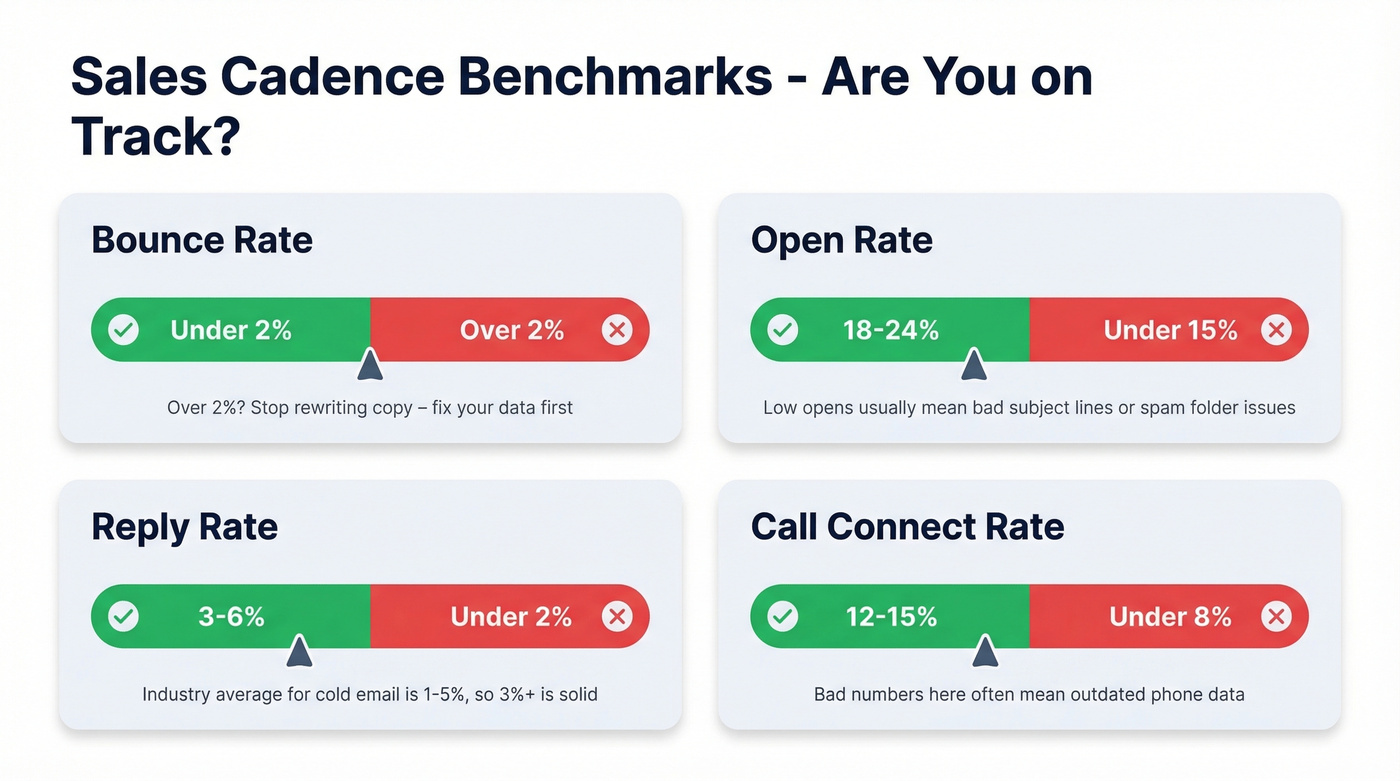
| KPI | Target | Red Flag |
|---|---|---|
| Bounce rate | < 2% | > 2% |
| Open rate | 18-24% | < 15% |
| Reply rate | 3-6% | < 2% |
| Call connect | 12-15% | < 8% |
Here's the thing: if your bounce rate exceeds 2%, stop rewriting your messaging and fix your data. I've watched teams rewrite copy three times before realizing 15% of their list was dead emails. One Prospeo customer dropped their bounce rate from 35% to under 4% and tripled their pipeline just by running real-time verification before sequences went live. If you want the full breakdown, see the benefits of email verification.
5 Mistakes That Kill Reply Rates
Over 90% of sales emails get ignored. Here's why most cadences fail:
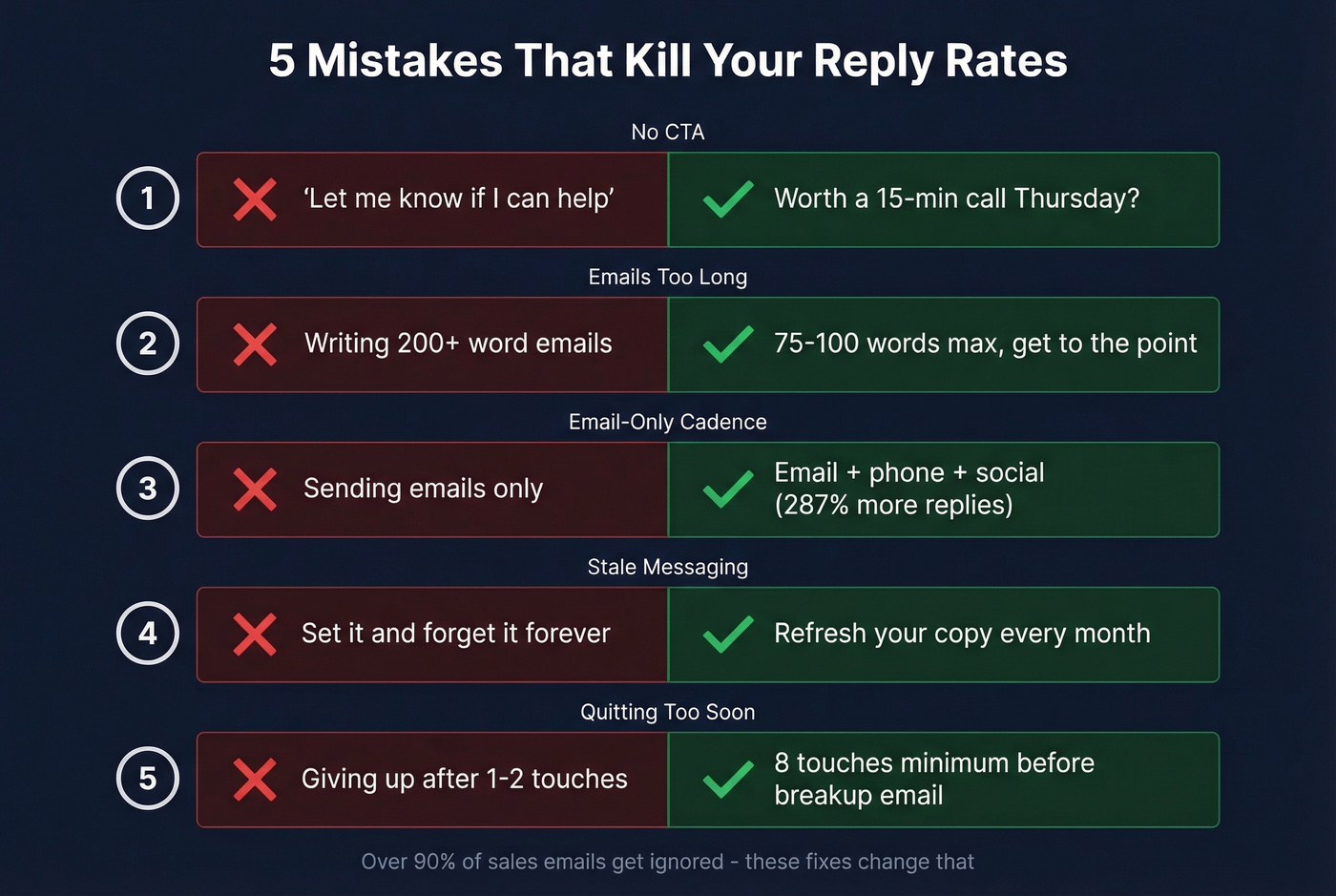
- No CTA. "Let me know if I can help" isn't a CTA. Say "Worth a 15-min call Thursday?" (If you struggle here, use a bank of open-ended questions to keep replies flowing.)
- Emails too long. If you can't explain your value in 75-100 words, you don't understand your own value prop well enough.
- Email-only cadence. You're leaving 287% on the table. Add phone and social. If you need a framework, start with multi-channel outreach.
- Stale messaging. Refresh copy monthly. "Set it and forget it" is how cadences die.
- Quitting too soon. Eight touches minimum before your breakup email. Most reps bail at two. If your team needs a rulebook, align on sales cadence best practices.
Tools to Run Your Cadence
Let's be honest: under 10 reps, Instantly or Smartlead gives you 90% of what enterprise tools offer at a tenth of the cost. At 50+ reps, Outreach or Salesloft earn their price with workflow automation and analytics. But regardless of your sequencer, verify your data first - bad emails burn sender domains and mask every other metric you're tracking. (If you're evaluating platforms, start with these outbound email tools.)
| Tool | Best For | Starting Price |
|---|---|---|
| Instantly | SMB cold email | ~$30/mo |
| Smartlead | Multi-inbox scaling | ~$39/mo |
| Mailshake | Simple outbound | ~$25/user/mo |
| Outreach | Enterprise sequencing | ~$100+/user/mo |
| Salesloft | Enterprise sequencing | ~$100+/user/mo |
For email verification, Prospeo integrates natively with Smartlead, Instantly, Salesloft, and Outreach at roughly $0.01/email, with a free tier of 75 emails each month. Cheapest insurance against bounced sequences we've found. If you're comparing options, see our guide to the cheapest email verifier.
Running an enterprise multi-stakeholder cadence? You need verified emails and direct dials for every contact in the buying committee. Prospeo gives you 125M+ verified mobiles with a 30% pickup rate and 30+ filters to find champions, economic buyers, and technical evaluators - all at $0.01 per email.
Multi-thread deals faster when every number and email is verified.
FAQ
How many touchpoints should a sales cadence have?
Eight to twelve across 17-21 days for cold outbound. Fewer for inbound - six over seven days. More for enterprise - twelve-plus over 30 days. Treat each template as a starting point and adjust touchpoint count based on your ICP's responsiveness and deal complexity.
What channels should a multichannel cadence include?
Email, phone, social, and video - minimum three channels. Email alone should account for only four to five of your total touches. Multichannel sequences see 287% higher response rates than email-only outreach.
How do I build a follow-up cadence playbook?
Document each scenario your reps encounter - cold outbound, inbound, no-show, enterprise - and assign a dedicated sequence to each. A standardized playbook ensures every rep follows the same proven steps instead of improvising, which makes coaching easier and results more predictable. Use the templates above as your foundation, then customize messaging for your vertical.
How do I know if my cadence is working?
Track bounce rate (under 2%), open rate (18-24%), reply rate (3-6%), and call connect rate (12-15%). If bounce rate is high, fix your data before changing your messaging. Real-time verification catches invalid addresses before they hit your sequencer and tank your sender reputation.