

Sales Cadence Best Practices: The Practitioner's Guide for 2026
Most sales cadence guides hand you a template and call it done. The hard part - the part nobody talks about - is making sure your emails actually land in the inbox and your phone numbers actually connect. Here's a framework that starts with the foundation, not the copy.
Why Cadence Strategy Matters Now
80% of B2B sales interactions now happen in digital channels. Buyers use an average of 10 interaction channels, up from 5 in 2016. Some teams report needing 1,000+ touchpoints per sourced opportunity - up from 200-400 just a few years ago - while buying committees have grown to roughly 7 decision-makers for mid-market deals. Meanwhile, 84% of reps missed quota last year.
The old playbook - blast a list, make some calls, hope for the best - doesn't survive this environment. A structured, multi-channel sales cadence is the minimum viable outbound motion.
Before You Build Anything
Three things to lock down first:
- 17-21 day, 8-12 touch multi-channel cadence - segmented by deal size. The same sequence for a 15-person startup and a 2,000-person enterprise is a waste of everyone's time.
- Fix deliverability and data quality first. No template saves you if your bounce rate is 28%.
- Measure reply rate, not open rate. Benchmark: 3.43% average, 5.5% top quartile, 10.7%+ elite. If you're below 3%, the problem isn't your copy.
Framework: Duration, Touches, Channels
A cadence that runs 17-21 days with 8-12 touches hits the sweet spot for most B2B motions. 58% of replies come from the first email, but the remaining 42% need follow-ups to materialize.
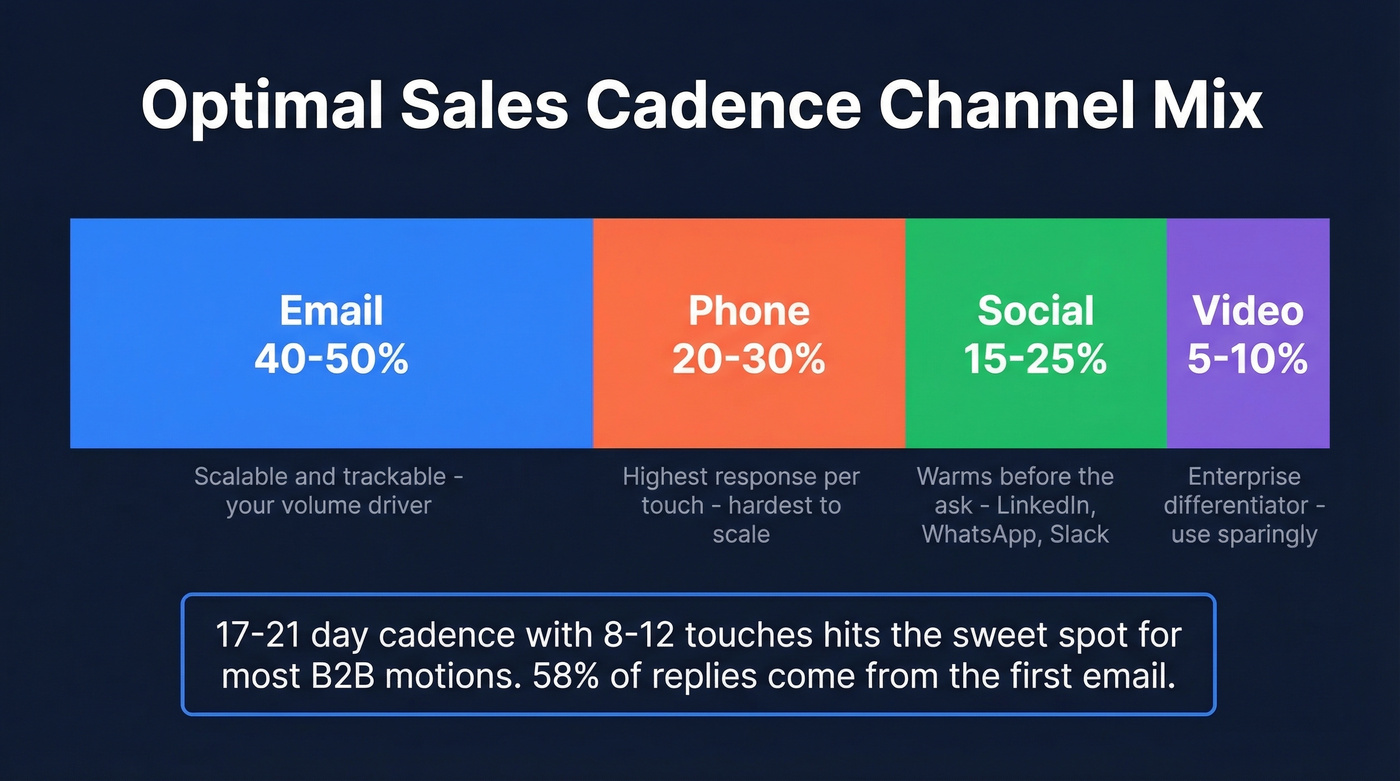
| Channel | % of Touches | Why |
|---|---|---|
| 40-50% | Scalable, trackable | |
| Phone | 20-30% | Disproportionate response per touch |
| Social (incl. WhatsApp, Slack Connect) | 15-25% | Warms before the ask |
| Video | 5-10% | Differentiator for enterprise |
Don't run an email-only cadence and wonder why reply rates are flat. The phone still converts better per touch than anything else - it's just harder to scale.
Day-by-Day Cadence Templates
The best cadence design fails if reps don't execute it consistently. Track adherence rates alongside reply rates.
SMB Cadence (14 Days)
For deals with 1-3 month cycles and a single decision-maker: start with a personalized email on Day 1 with one clear CTA. Follow up with a phone call and voicemail on Day 2, then send a case study or data point via email on Day 4. Drop a social touch on Day 6 - comment on their content or send a connection note. Hit the phone again on Day 8 at a different time of day, send a new-angle email referencing their company news on Day 10, and close with a breakup email on Day 14 that leaves the door open.
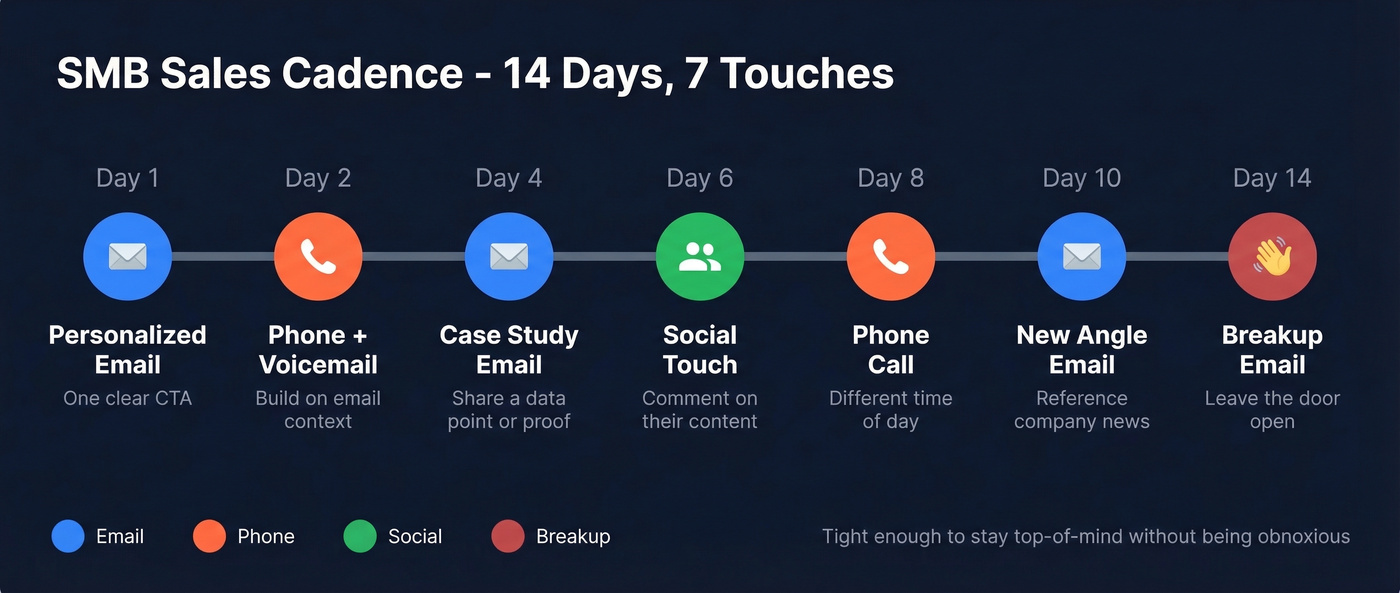
Seven touches. Two weeks. Tight enough to stay top-of-mind without being obnoxious.
Enterprise Cadence (21+ Days)
For 6-12 month cycles with 6-25 stakeholders, you need to multi-thread across the buying committee. Email the primary contact on Day 1 with an executive-level insight, then call them on Day 2 while emailing a second stakeholder. Space social touches on Days 5 and 19, phone the second stakeholder on Day 9, and loop in a third stakeholder - champion or influencer - by Day 12. Close with a breakup email to the primary on Day 21+, then move the rest into a nurture sequence.
Enterprise buyers don't respond to urgency. They respond to relevance. Space touches further apart than SMB. Regional note: US cadences can be aggressive from Day 1, but EMEA and APAC buyers respond better to a slower ramp. A Day-1 multi-touch blitz that works in New York can feel intrusive in Munich or Tokyo.
Intent-Triggered Burst Cadence
When a prospect shows an intent signal - content download, pricing page visit, competitor research - compress the timeline. First touch within 24 hours. Intent-triggered cadences see 2-3x lift in response rates when you hit that window. Email referencing the specific signal on Day 1, call on Day 2, deeper value prop email on Day 4, social touch on Day 6, final phone + breakup email on Day 7.
We've seen teams layer Prospeo's intent data - tracking 15,000 topics via Bombora - with job role and company growth filters to decide which accounts get pushed into a burst cadence and which stay in the standard sequence. The difference in reply rates is stark.
After the Breakup
Don't delete the prospect. Move opens and clicks to a 6-month nurture drip. Move zero-engagement contacts to a re-engagement sequence in 90 days. The consensus on r/sales is that breakup emails are often the highest-converting touch in the entire cadence - so make them count, and keep the door open.

Your cadence has 8-12 touches - each one costs time, effort, and reputation. If 28% of your emails bounce, you're burning your domain with every step. Prospeo delivers 98% email accuracy with a 7-day refresh cycle, so every touch in your cadence reaches a real inbox. Teams like Snyk cut bounce rates from 35% to under 5% and added 200+ opportunities per month.
Stop optimizing copy when the real problem is your contact data.
The Deliverability Foundation Most Guides Skip
Here's the thing: most cadence guides still don't mention email authentication. Your non-negotiable checklist:
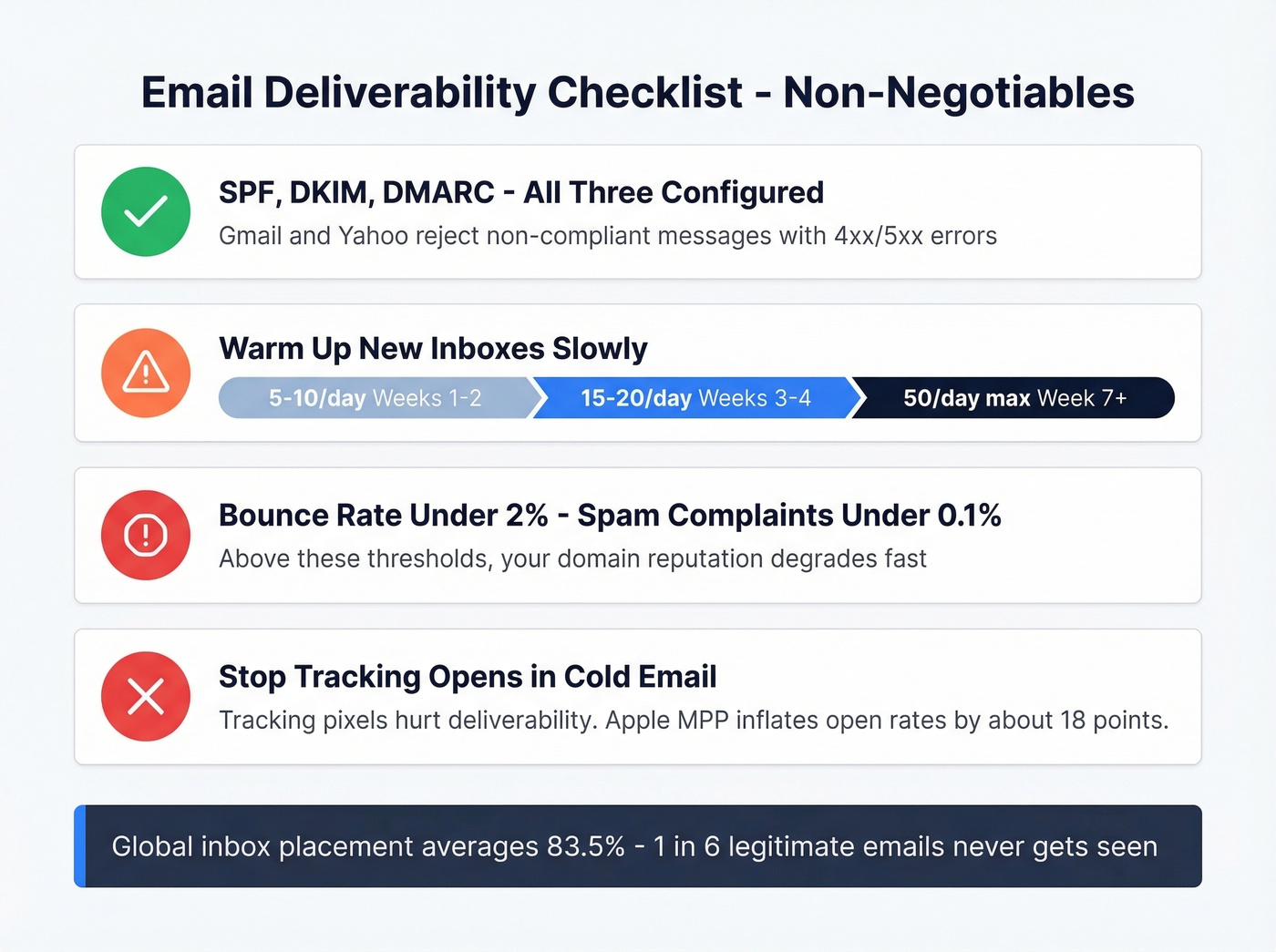
- SPF, DKIM, DMARC - all three, properly configured. Gmail and Yahoo enforce this for bulk senders, and non-compliant messages now get rejected with 4xx/5xx SMTP errors. (If you need a deeper technical breakdown, start with DMARC and SPF.)
- Warm up new inboxes slowly: 5-10/day for weeks 1-2, ramp to 15-20 by week 3-4, max 50/day per inbox by week 7+. (More on safe email velocity limits.)
- Bounce rate under 2%. Spam complaints under 0.1%. (Also worth doing spam trap removal if you’re cleaning older lists.)
- Stop tracking opens in cold email. Tracking pixels hurt deliverability, and Apple MPP inflates open rates by roughly 18 percentage points anyway. (If your team still uses them, see email tracking pixels.)
Global inbox placement averages 83.5% - meaning 1 in 6 legitimate emails never gets seen. Verify your list before sending. The most refined cadence strategy in the world falls apart when messages never reach the prospect.
Data Quality: The Silent Cadence Killer
We've seen this play out dozens of times. An SDR team launches a new cadence. Reply rate: 1.2%. The manager rewrites the subject lines, tweaks the copy, A/B tests the CTA. Nothing moves. Then someone checks the bounce rate: 28%.
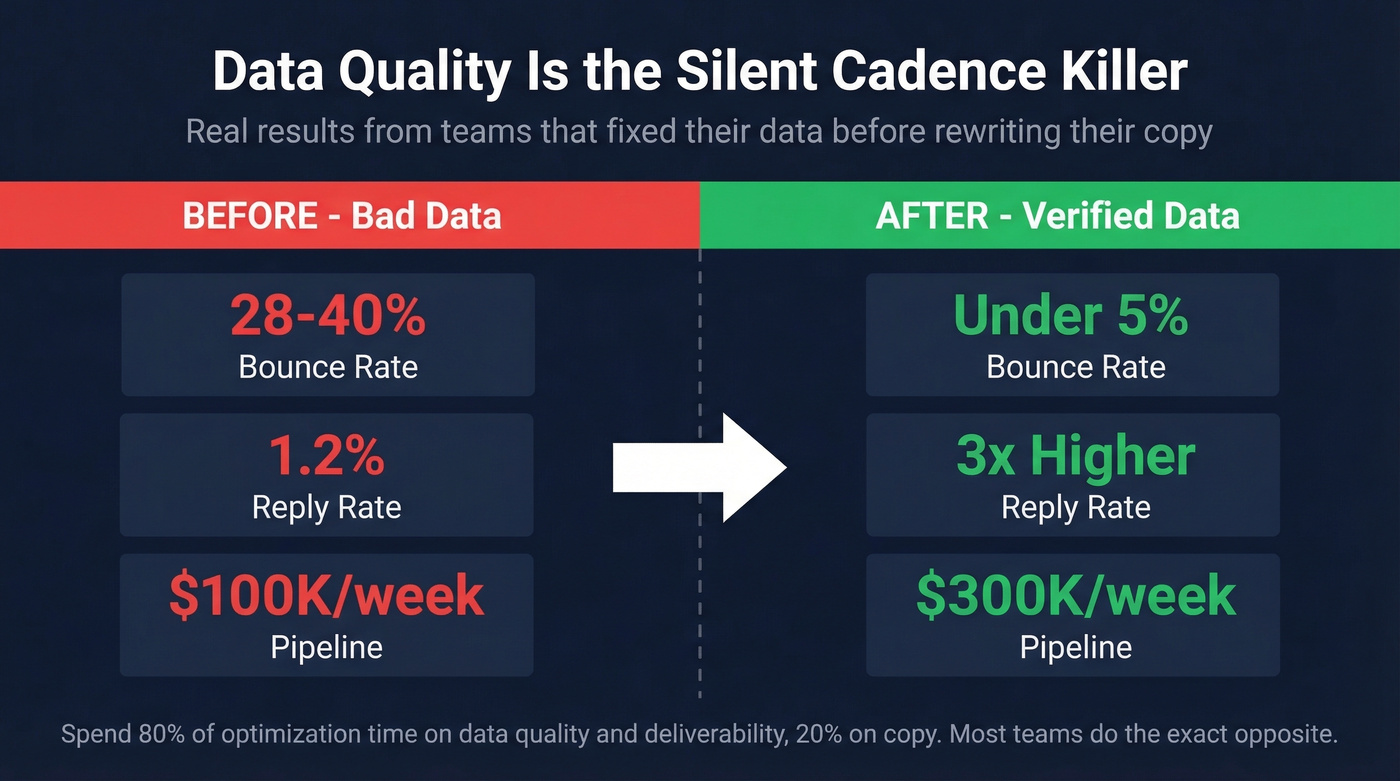
The problem was never the messaging. It was the data.
Bad data doesn't just waste sends - it actively destroys your sender reputation, which tanks deliverability for every future email you send from that domain. Snyk's 50-person AE team went from 35-40% bounce rates to under 5% after switching to verified data, with AE-sourced pipeline up 180% and 200+ new opportunities per month. Meritt saw bounce rates drop from 35% to under 4%, and pipeline tripled from $100K to $300K per week.
Our strong opinion: You can run the best cadence template in the world, but if a quarter of your emails bounce, you're burning your domain. Most teams should spend 80% of their optimization time on data quality and deliverability, and 20% on copy. The industry does the exact opposite.
Intent-triggered burst cadences only work if you can act fast with accurate contact data. Prospeo tracks 15,000 intent topics via Bombora and pairs them with 143M+ verified emails and 125M+ direct dials - so when a prospect surges, you reach the right person on Day 1, not Day Never. At $0.01 per email, scaling your burst cadences costs less than a bad bounce costs your domain.
Catch the intent signal. Reach the buyer. Skip the bounce.
AI in Your Cadence Workflow
56% of sales professionals now use AI daily, and Gartner found that sellers who effectively partner with AI tools are 3.7x more likely to meet quota. Bain & Company's research showed early AI deployments in sales boosted win rates by 30%+. The applications that actually move numbers: research compression (90% time reduction on research and personalization), first-draft email generation, and signal-based prioritization.
AI won't replace your outreach strategy. But it makes each touch sharper and faster to produce, which means reps spend more time on the phone and less time staring at a blank compose window. (If you’re building this into your stack, start with AI cold email outreach and best AI for automating sales follow-ups.)
Benchmarks and Goals to Track
| Metric | Average | Top Quartile | Elite |
|---|---|---|---|
| Reply rate | 3.43% | 5.5% | 10.7%+ |
| Meeting book rate | 1.5-4% | - | - |
| Cold call connect | 5-15% | - | - |
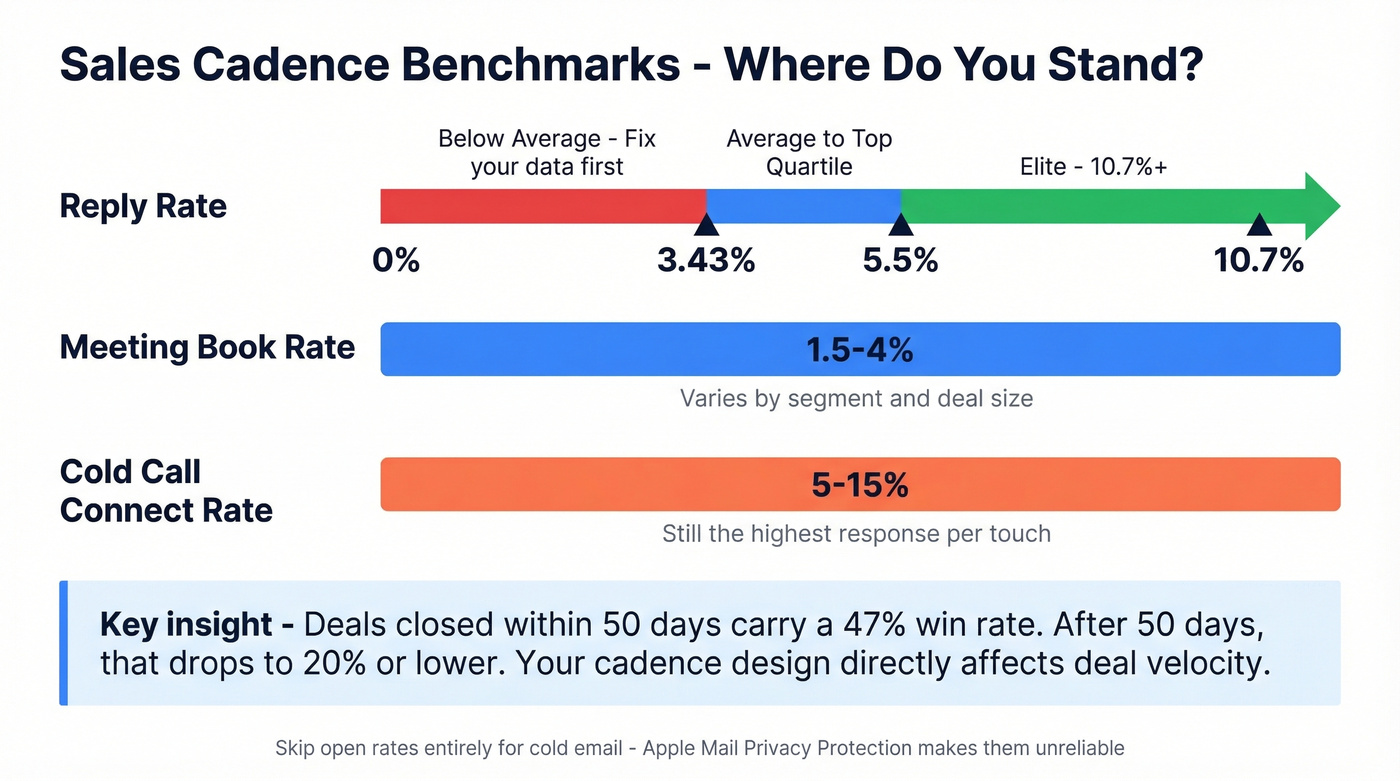
One benchmark that doesn't get enough attention: deals closed within 50 days carry a 47% win rate. After 50 days, that drops to 20% or lower. Speed matters, and your cadence design directly affects how fast deals move.
Skip open rates for cold email entirely. Apple Mail Privacy Protection makes them unreliable, and tracking pixels hurt deliverability. If your team is still optimizing for opens, redirect that energy toward reply rate and meetings booked. (For more KPI context, see follow-up email reply rate and sales activities examples.)
Ongoing Cadence Optimization
Even after launch, treat your cadence as a living system. Review reply and bounce metrics weekly, rotate underperforming email copy every two weeks, and A/B test one variable at a time - subject line, CTA, or send time. Let's be honest: the teams that iterate on their sales cadence consistently outperform those that set and forget. If you're not reviewing performance at least biweekly, you're flying blind.
For teams running multiple cadences across segments, skip the temptation to optimize everything at once. Pick the cadence with the highest volume and lowest reply rate. Fix that one first. Then move to the next. (If you need fresh copy angles, pull from sales follow-up templates and cold email follow-up templates.)
FAQ
How many touchpoints should a sales cadence have?
Eight to twelve for SMB deals, 15-20+ for enterprise. Segment by deal complexity and buying committee size - a single generic sequence for every prospect wastes effort and tanks reply rates.
What's a good reply rate for cold outreach?
Average is 3.43%, top quartile hits 5.5%, and elite teams reach 10.7%+. If you're consistently below 3%, audit your bounce rate and deliverability setup before rewriting any email copy.
How do I stop cadence emails from going to spam?
Configure SPF, DKIM, and DMARC on every sending domain. Warm up new inboxes over 6+ weeks starting at 5-10 sends/day. Keep bounce rate under 2% by verifying contacts before each campaign - Prospeo's bulk verification catches invalid addresses, catch-alls, and spam traps at 98% accuracy.
How do I set effective cadence goals?
Start with your target pipeline number and work backward to per-rep weekly targets. Define goals for reply rate (aim for 5%+), meetings booked per rep per week, and connect rate by channel. Align these targets with your overall sales process so every touchpoint has a measurable purpose.