

Cold Outreach in 2026: What Actually Works (and What Kills Your Domain)
A founder posted on r/SaaS about their cold outreach experiment: 2,000 cold emails sent, 6 replies, zero customers. They declared the channel dead and pivoted to SEO content - eventually hitting $4.7k MRR. Fair enough. But another practitioner on the same subreddit sent 500 emails over 20 days and pulled a 4.2% reply rate using a multichannel sequence. Same channel, wildly different outcomes. The difference wasn't talent or luck - it was infrastructure, data quality, and discipline.
Cold outreach isn't dead. It's just punishing people who do it lazily.
The Short Version
- Your data is the #1 variable. Verify every email before sending. Keep bounce rate under 1%. A high bounce rate will crater your domain reputation before anyone reads your subject line.
- Never send from your primary domain. Buy secondary domains, warm them for 21 days, and cap volume at 15 emails per inbox per day.
- Write 40-75 word emails with a soft CTA. A 16.5M-email study shows 6-8 sentence emails hit a 6.9% reply rate - the highest in the dataset. Practitioners report even shorter formats working well.
What Cold Outreach Actually Means
Cold outreach is contacting someone who hasn't asked to hear from you - with the goal of starting a business conversation. No prior relationship, no inbound signal, no hand-raise. It spans email, phone, social touches, direct mail, and even physical drop-ins. Email dominates because it scales cheaply and measurably, but in-person visits can still work in high-ACV sales where a single deal justifies the effort. Forbes still highlights "walk-in pitches" as a way to stand out in a digital-heavy world - proof that the channel is broader than most people's inboxes.
You're interrupting someone's day and betting that your relevance earns a reply. That bet only pays off with precise targeting and clean data.
2026 Benchmarks
Let's ground this in data, not vibes. Belkins analyzed 16.5 million cold emails across 93 business domains from January through December 2024 - one of the largest public datasets available. The headline: average reply rates dropped from 6.8% in 2023 to 5.8% in 2024, roughly a 15% year-over-year decline.
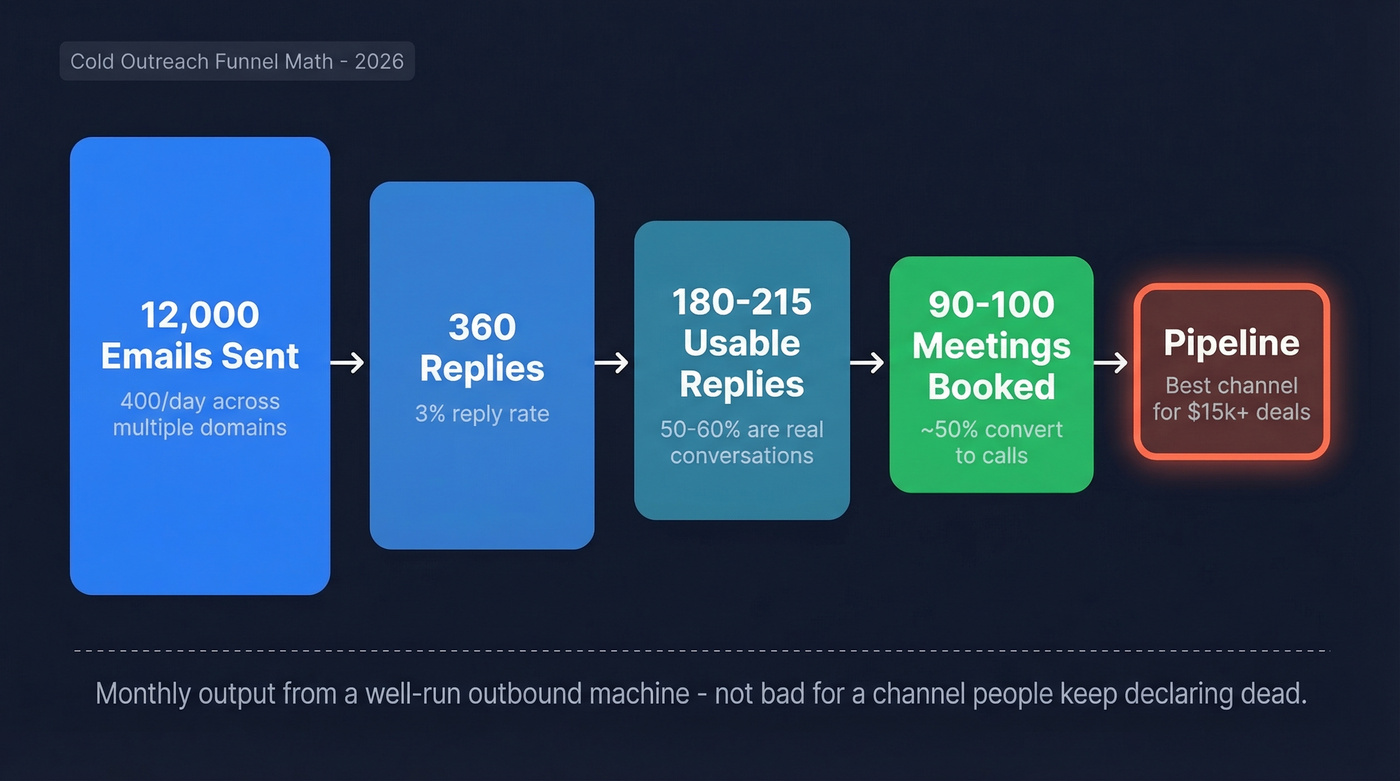
The decline is real but manageable. Here's what the funnel math looks like at scale: send 400 emails per day across multiple domains and inboxes, roughly 12,000 per month. At a 3% reply rate, you get 360 replies. About 50-60% are usable (the rest are "not interested" or auto-replies). Half of those convert to booked calls. That's 90-100 meetings per month. Not bad for a channel people keep declaring dead.
Here's the thing: if you're closing deals under $5k, you probably don't need outbound at all - content and community will get you further for less pain. But if you're selling $15k+ contracts to specific buyer personas, there's still no faster path to pipeline than a well-run outbound machine.
Reply Rate by Sequence Length
| Emails in Sequence | Reply Rate | Spam Rate | Notes |
|---|---|---|---|
| 1 email only | 8.4% | 0.5% | Highest per-email rate |
| + 1st follow-up | +49% lift | 0.5% | Best ROI touchpoint |
| + 2nd follow-up | -20% vs prior | 0.8% | Diminishing returns |
| + 3rd follow-up | -55% vs prior | 1.6% | Spam complaints jump sharply |
Your first follow-up is gold. After that, you're fighting diminishing returns and escalating spam complaints. By the fourth email, spam rates jump from 0.5% to 1.6% - enough to trigger reputation damage at most ESPs.
Email Length vs. Reply Rate
| Length | Reply Rate |
|---|---|
| 1-3 sentences | ~4.5% |
| 4-5 sentences | ~5.2% |
| 6-8 sentences | 6.9% |
| 9+ sentences | ~4.0% |
Based on the 16.5M-email study; approximate ranges for non-peak lengths.
The 6-8 sentence range hits the highest reply rate. Practitioners on Reddit report even shorter formats (40-60 words) performing well for simple value props. Both data points agree on one thing: shorter is better, but not so short you can't deliver value.
Why Most Campaigns Fail
Most campaigns die before the copy even matters. If you're getting poor results, work through these in order.
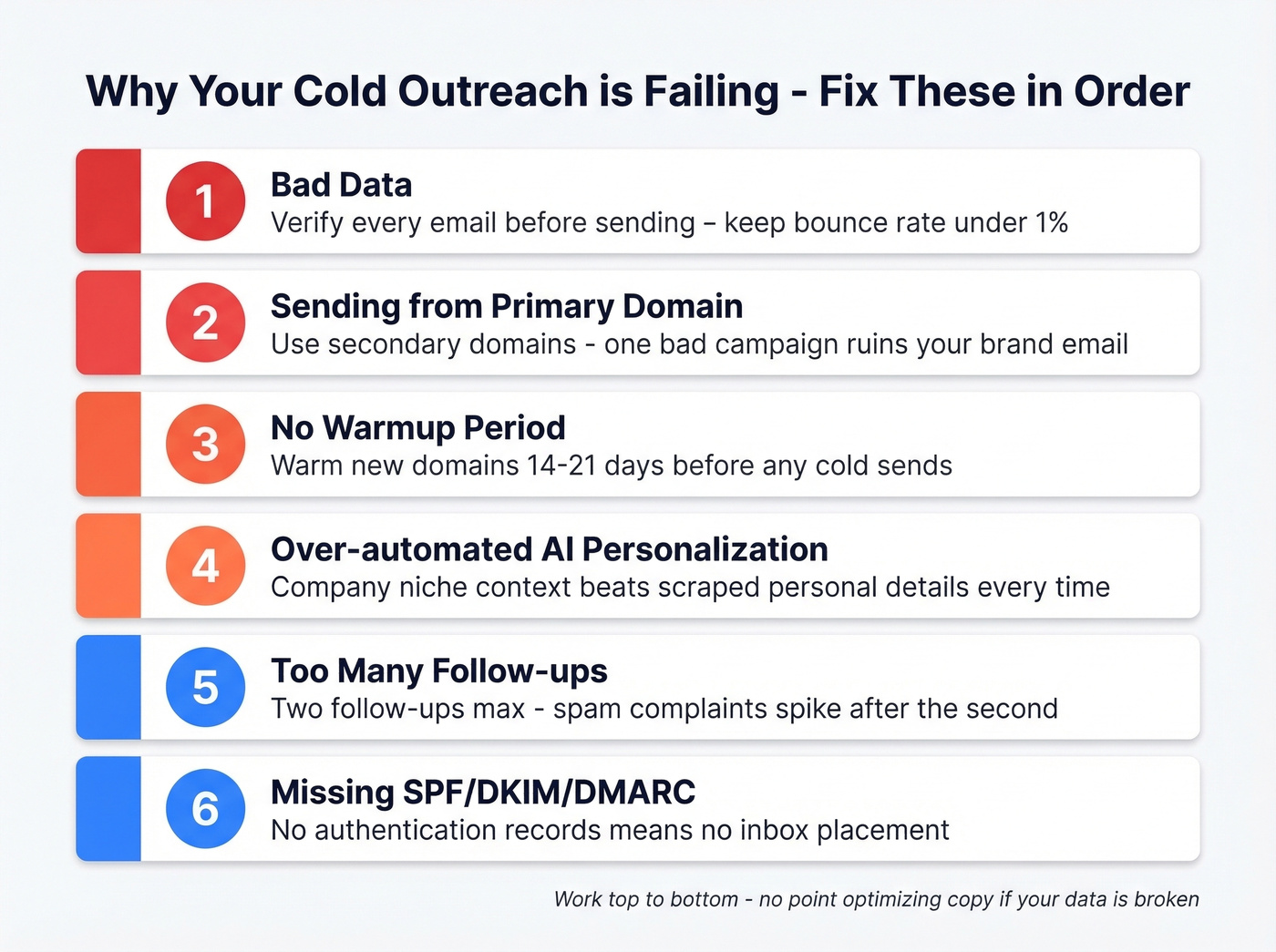
Bad data is the #1 killer. When a big chunk of your list bounces, your domain reputation tanks fast. Fix this first, before you touch anything else.
Sending from your primary domain. Your company's main domain is your brand's email reputation. One bad campaign and your team's regular business emails start landing in spam. Use secondary domains. Always.
No warmup period. A brand-new domain sending high volume on day one is a giant red flag to every inbox provider. You need 14-21 days of warmup activity before sending a single cold message.
Over-automated AI personalization. The consensus on r/SaaS is blunt: AI-generated emails referencing scraped personal details are easy to spot in 2026. Personalization based on company niche and general context outperforms "I saw your post about..." every time. (If you're leaning on AI, read our AI Cold Email Outreach playbook first.)
Too many follow-ups. Spam complaints rise sharply after the second follow-up. Two is the sweet spot. Three is the absolute maximum. If you need examples, use these cold email follow-up templates.
Missing SPF/DKIM/DMARC. Without these authentication records, you're sending emails without an ID badge. Inbox providers treat you accordingly. (Start with DMARC alignment if you're unsure what to configure.)
Infrastructure That Decides Deliverability
Most guides skip straight to templates. But infrastructure determines whether your emails reach an inbox or vanish into a spam folder - and we've seen teams waste months on copy optimization when the real problem was a misconfigured DNS record.
Safe Sending Limits
Every email provider has a technical ceiling and a practical safe limit. The gap between them is where your domain reputation lives.
| Provider | Technical Limit | Safe Limit |
|---|---|---|
| Google Workspace | 2,000/day | 100-150/day |
| Microsoft 365 | 10,000 recipients | 100-150/day |
| GoDaddy | 250 recipients | 50-75/day |
| Free Gmail | 500/day | Don't use it |
These safe limits are per-account totals, not per-inbox. If you're running outbound through free Gmail, stop. It's not built for this, and you'll burn the account fast.
The 4-Week Ramp-Up
| Week | Daily Volume | Notes |
|---|---|---|
| Week 1 | 10-20/day | Warmup emails only |
| Week 2 | 20-40/day | Mix warmup + light cold |
| Week 3 | 40-60/day | Shift toward cold |
| Week 4 | 60-80/day | Full cold volume |
Domain maturity takes 2-4 weeks minimum, and some providers need up to 12 weeks before they consider you fully established. Patience here pays dividends for months. (If you're struggling with pacing, use an email velocity framework.)
Domain Strategy
Scale by adding domains and inboxes, not by cranking up volume per account. The formula: 2-3 inboxes per secondary domain, 10-15 cold emails per inbox per day. Want to send 500 emails daily? That's roughly 5 domains with 2-3 inboxes each.
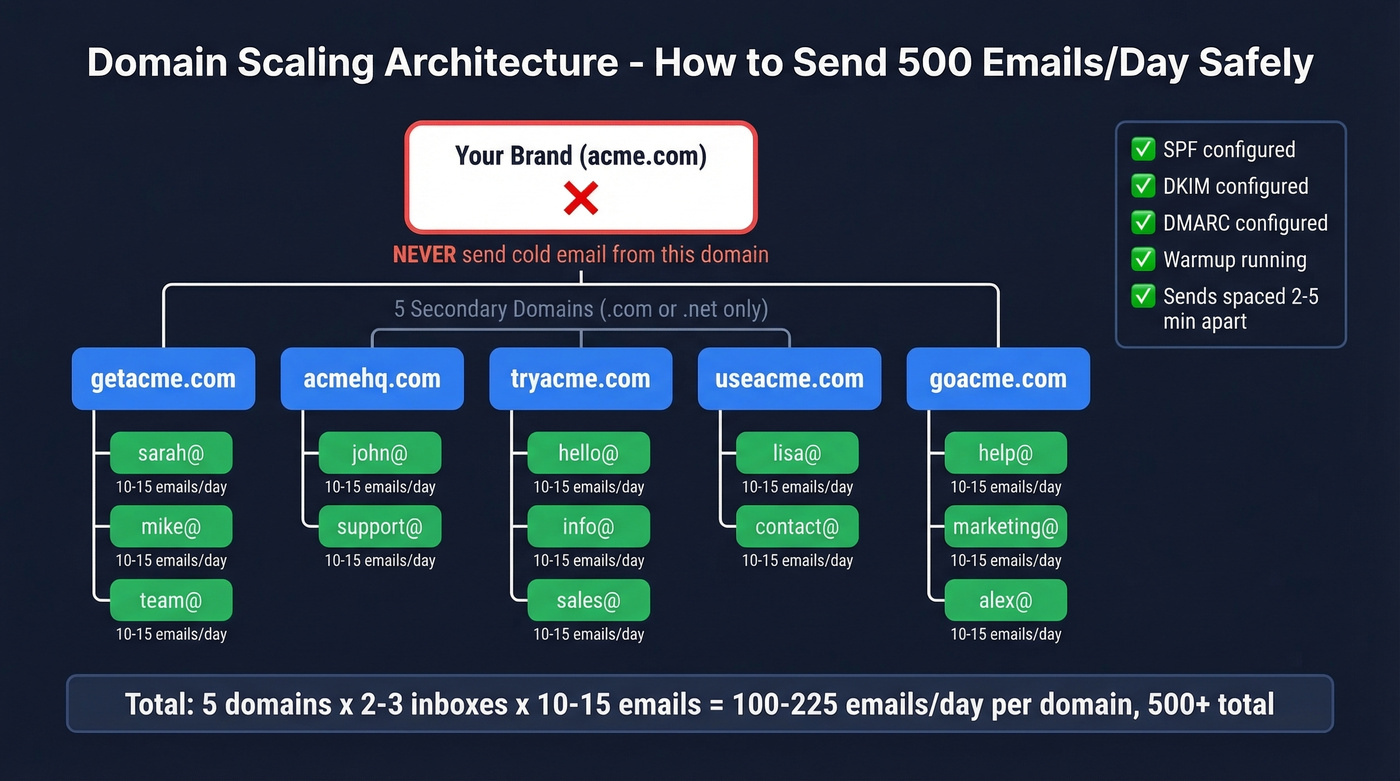
Buy domain variations of your brand (getacme.com, acmehq.com, tryacme.com) and stick to .com or .net TLDs - less common TLDs can hurt deliverability. Configure SPF/DKIM/DMARC on each and warm them individually.
Google and Yahoo enforce a 0.1% complaint threshold - that's 1 complaint per 1,000 emails. They've been aggressive about this since their 2024 policy updates. Keep warmup running continuously, even after you start sending cold, and space sends 2-5 minutes apart per mailbox.
Two more tips that nobody talks about: match your sending ESP to your recipient's ESP when possible (Gmail-to-Gmail and Outlook-to-Outlook deliverability is measurably higher), and monitor blacklists like Barracuda and Spamhaus weekly. If a domain gets listed, retire it immediately - don't try to rehabilitate it. (If you do get listed, follow a proper Spamhaus blacklist removal process.)

You just read it: bad data is the #1 killer of cold outreach campaigns. Prospeo's 5-step email verification delivers 98% accuracy - keeping your bounce rate under 1% and your domain reputation intact. At $0.01 per email, clean data costs less than a single wasted send.
Stop burning domains. Start with verified data.
Writing Emails That Get Replies
Your infrastructure is set. Your data is clean. Now the copy matters.
The format working in 2026 is almost aggressively short: 40-75 words, plain text, single soft CTA. No links in the first email. No images. No tracking pixels. No calendar invites. All of these hurt deliverability, and none of them help a cold first touch.
Subject lines should stay under 50 characters, ideally under 4 words. 35% of recipients open based on subject line alone. Think "Quick question" or "{{company}} + growth" - not "Exclusive Opportunity to Transform Your Revenue Pipeline." A/B test your subject lines and first lines across variants. Even small changes - a question vs. a statement, a name vs. a company reference - can swing reply rates by 1-2 percentage points. If you want a swipe file, use these cold email subject line examples.
Template 1: First Touch
Subject: {{company}} pipeline
Hi {{first_name}},
Noticed {{company}} is hiring 3 AEs this quarter.
We help scaling sales teams cut list-building from 15 hours to 2 hours/week with verified contact data.
Meritt tripled their pipeline to $300K/week after switching.
Worth a quick conversation?
47 words. Every line earns its place. The context signal proves relevance. The value prop is specific. The proof is concrete. The CTA asks for almost nothing.
Template 2: Follow-Up (Day 4)
Subject: Re: {{company}} pipeline
{{first_name}} - wanted to make sure this didn't get buried.
The short version: we help teams like {{company}} reach decision-makers with 98% verified emails instead of burning domains on bad data.
Interested?
38 words. Same thread. New angle. Still soft.
Template 3: Breakup (Day 10)
Subject: Re: {{company}} pipeline
No worries if the timing's off, {{first_name}}. I'll close the loop here.
If pipeline sourcing becomes a priority next quarter, happy to pick this back up.
28 words. Graceful exit. No guilt trip. Breakup emails often get surprisingly strong reply rates because they remove pressure.
The Multichannel Playbook
Email alone works. Email plus other channels works better. The practitioner data from r/SaaS is consistent: 80% of replies come after the 3rd touchpoint, and multichannel sequences deliver roughly 20-50% more replies than email-only campaigns.
Here's the sequence that's working for our team and the outbound agencies we talk to:
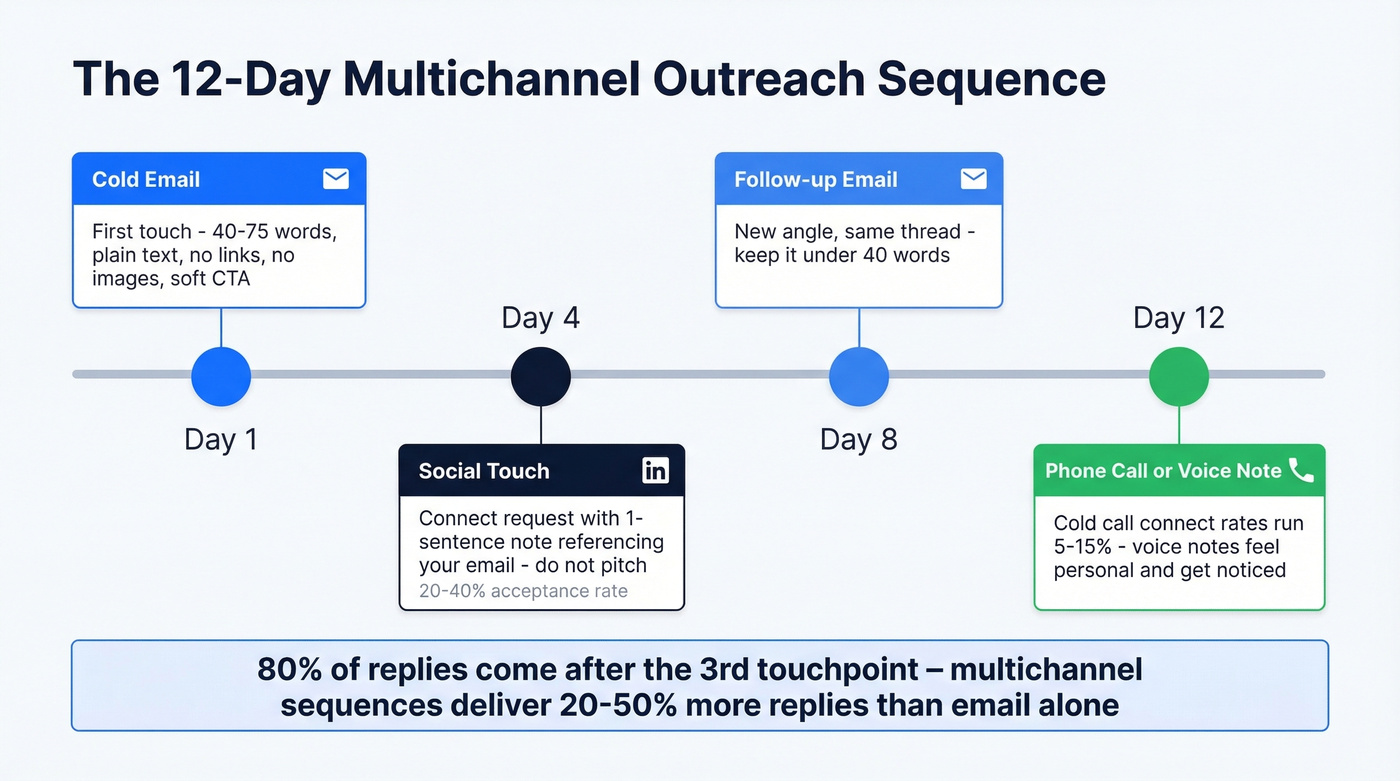
- Day 1: Cold email (first touch)
- Day 4: Social touch - connect with a 1-sentence note referencing your email. Don't pitch. Something like: "Sent you a note about {{company}}'s pipeline - thought it'd be worth connecting either way." Connection requests see 20-40% acceptance rates and 5-15% reply rates on follow-up messages.
- Day 8: Follow-up email (new angle, same thread)
- Day 12: Phone call or voice note. Cold call connect rates run 5-15%, with 1-3% converting to meetings - low per-attempt, but the calls that do connect are high-intent conversations. (If you're adding calls, build a real cold calling system.)
- Day 16: Breakup email
Space touchpoints 3-4 days apart. Bring new value each time - don't just "bump" the thread. Standard prospects typically need about 5 touches; executives need closer to 9. Each touch should feel like a separate reason to engage, not a reminder that you exist.
Building a Clean Prospect List
Everything above is irrelevant if your list is garbage.
Data quality is the single highest-leverage variable in any outbound campaign - more than copy, more than timing, more than your sequencing tool. We see this constantly: a team buys a list from a cheap provider, loads it into their sequencer, and sends 2,000 emails. 34% bounce. Their domain reputation takes a hit. Now their follow-up emails - and their team's regular business emails - are landing in spam. One bad list, weeks of recovery.
Verification before sending isn't optional. Not "spot-check a few addresses" - verify every single email on your list. (If you want the benchmarks and fixes, start with email bounce rate.)
Prospeo's 98% email accuracy runs on a proprietary 5-step verification process that catches catch-all domains, spam traps, and honeypots that other providers miss. The 7-day data refresh cycle means you're not emailing someone who left their company three weeks ago - a problem that plagues providers refreshing on 4-6 week cycles. Meritt went from a 35% bounce rate to under 4% after switching, tripling their pipeline to $300K/week. Stack Optimize built to $1M ARR with zero domain flags across all clients and 94%+ deliverability.
Start with your ICP definition: industry, company size, job titles, geography. Build your list using 30+ search filters - buyer intent, technographics, job changes, headcount growth, funding signals. Export verified contacts directly to your sequencer. The whole workflow takes minutes, not hours. (If you need a structure, use an ideal customer profile template.)
Running 5 domains with 500 daily sends means 15,000 emails a month that need to hit real inboxes. Prospeo refreshes 300M+ profiles every 7 days - not every 6 weeks like competitors. Teams using Prospeo book 26% more meetings than ZoomInfo users because the data actually connects.
Your outbound infrastructure deserves data that's less than a week old.
The 2026 Tool Stack
You don't need 10 tools. You need three: a data provider, a sequencer, and patience for warmup. For most teams, Prospeo plus a sequencer like Instantly covers the core workflow without a bloated stack.
| Tool | Best For | Starting Price | Free Tier |
|---|---|---|---|
| Prospeo | Verified emails + mobiles, no contracts | ~$0.01/email | 75 emails/mo |
| Clay | Enrichment workflows | Not public | No |
| Instantly | Sequencing + warmup | Not public | No |
| Smartlead | High-volume campaigns | $39/mo | 14-day trial |
| Lemlist | Multichannel sequences | Not public | No |
| Apollo | All-in-one prospecting | $59/mo/user | Yes |
| Hunter | Quick email lookups | Free tier available | Yes |
| Gmass | Budget sequencing | $25/mo | Yes (limited) |
Clay is the enrichment power tool for teams that want to chain dozens of data sources into automated workflows - find the company, enrich with technographics, score by ICP fit, push to sequencer. The learning curve is steep, but teams that master it build prospecting machines. Skip this if you're a small team without a dedicated RevOps person; you'll spend more time configuring than prospecting. (If you're evaluating vendors, compare data enrichment services first.)
Instantly has become the go-to sequencer for cold email teams because it combines sequencing, warmup, and deliverability monitoring in one place. Smartlead competes directly with Instantly on high-volume sending, with a more campaign-management-oriented UI. $39/mo gets you started. Pick whichever interface you prefer; both handle the core job well.
Lemlist adds multichannel natively - email, social touches, and calls in one sequence. It's pricier than pure email sequencers, but worth it if you're running the full multichannel playbook described above. Apollo tries to be everything - database, sequencer, dialer, intent data. The free tier is generous, and at $59/mo per user it's reasonable, but in our experience the data accuracy doesn't match dedicated providers. Hunter is the quick-lookup tool - paste a domain, get emails. Fine for one-off research, not built for scale prospecting. Gmass is the budget option at $25/mo if you just need basic sequencing inside Gmail - limited compared to Instantly or Smartlead, but functional for small-volume senders.
Compliance - What You Must Do
Cold outreach is legal in most jurisdictions. Illegal outbound is the kind that ignores opt-outs, hides sender identity, or uses misleading subject lines. The penalties are real.
| Regulation | Jurisdiction | Key Requirements | Max Penalty |
|---|---|---|---|
| CAN-SPAM | United States | Opt-out + physical address | $50,120/violation |
| GDPR | EU/UK | Consent or legit interest | 20M EUR or 4% turnover |
| CASL | Canada | Express or implied consent | $10M/violation |
| Spam Act | Australia | Consent + sender ID | $1.1M AUD/violation |
The practical checklist: include a valid physical address in every email. Provide a clear unsubscribe mechanism. Honor opt-outs within 10 business days. Don't use misleading subject lines or sender names. 53% of recipients mark emails as spam because they can't find the unsubscribe option - make it visible and you eliminate half your complaint risk.
Real talk: compliance isn't just about avoiding fines. It's about protecting your domain reputation. One spam complaint wave does more damage than any regulatory fine ever will.
FAQ
Is cold outreach still effective in 2026?
Yes. A 16.5M-email study shows a 5.8% average reply rate - down from 6.8% in 2023, but still a viable channel. Teams with verified data and proper infrastructure consistently book 90+ meetings per month at scale. The channel rewards discipline and punishes laziness more than ever.
How many cold emails should I send per day?
Cap at 10-15 per inbox per day. Scale by adding domains and inboxes - 2-3 inboxes per domain - not by increasing volume per account. Google Workspace and M365 safe limits sit at 100-150/day total, but spreading sends across multiple inboxes protects your reputation far better than maxing out one account.
What's a good cold email reply rate?
At scale, 2-4% is solid. Top campaigns hit 5-7%. Anyone claiming 10%+ consistently is cherry-picking small samples or counting "not interested" as replies. The 16.5M-email benchmark is 5.8% average.
How do I stop cold emails from going to spam?
Verify every email address before sending (keep bounce rate under 1%), authenticate your domain with SPF/DKIM/DMARC, and warm up new domains for 21 days before sending cold. A tool with 98% accuracy and catch-all handling eliminates the most common deliverability killer - bad data - while a short refresh cycle keeps contacts current.
What's the best cold email length?
Aim for 40-100 words. The 16.5M-email study found 6-8 sentence emails hit a 6.9% reply rate - the highest in the dataset. Practitioners report even shorter formats (40-60 words) performing well for straightforward value props. Strip out everything that doesn't directly earn the reply.