

FOMO in Sales: The B2B Playbook for Creating Urgency That Closes Deals
It's the last week of the quarter. A $45K deal that looked solid in week two has gone silent - the champion's "running it up the chain," and your follow-up emails are disappearing into the void. The deal isn't dead. But it isn't moving either.
This is where roughly 40% of pipeline deals end up - not lost to a competitor, but lost to "no decision." FOMO in sales, applied correctly, is how you fix that.
The Quick Version
- FOMO in sales isn't countdown timers and flash sales. It's deal psychology - helping buyers feel the real cost of standing still.
- 40% of your pipeline dies to indecision, not competition. Urgency is the antidote.
- Fake deadlines destroy credibility. Tie urgency to the buyer's timeline, not your quota close date.
What FOMO Actually Means in B2B
If you're reading about limited-time offers and "only 3 left in stock," you're reading the wrong article. That's ecommerce FOMO.
In a sales cycle with multiple stakeholders, procurement reviews, and six-figure budgets, urgency isn't about scarcity of product. It's about scarcity of time, competitive advantage, and budget windows. The fear isn't "I'll miss this deal." It's "we'll fall behind while we deliberate." That distinction changes everything about how you build pressure into a conversation.
The Psychology Behind Sales Urgency
Kahneman and Tversky's Prospect Theory gives us the foundational insight: losses are felt roughly twice as intensely as equivalent gains. Offer someone a coin flip - win $150 or lose $100 - and most people reject it, even though the expected value is positive. That's loss aversion, and it's the engine behind every effective urgency play.
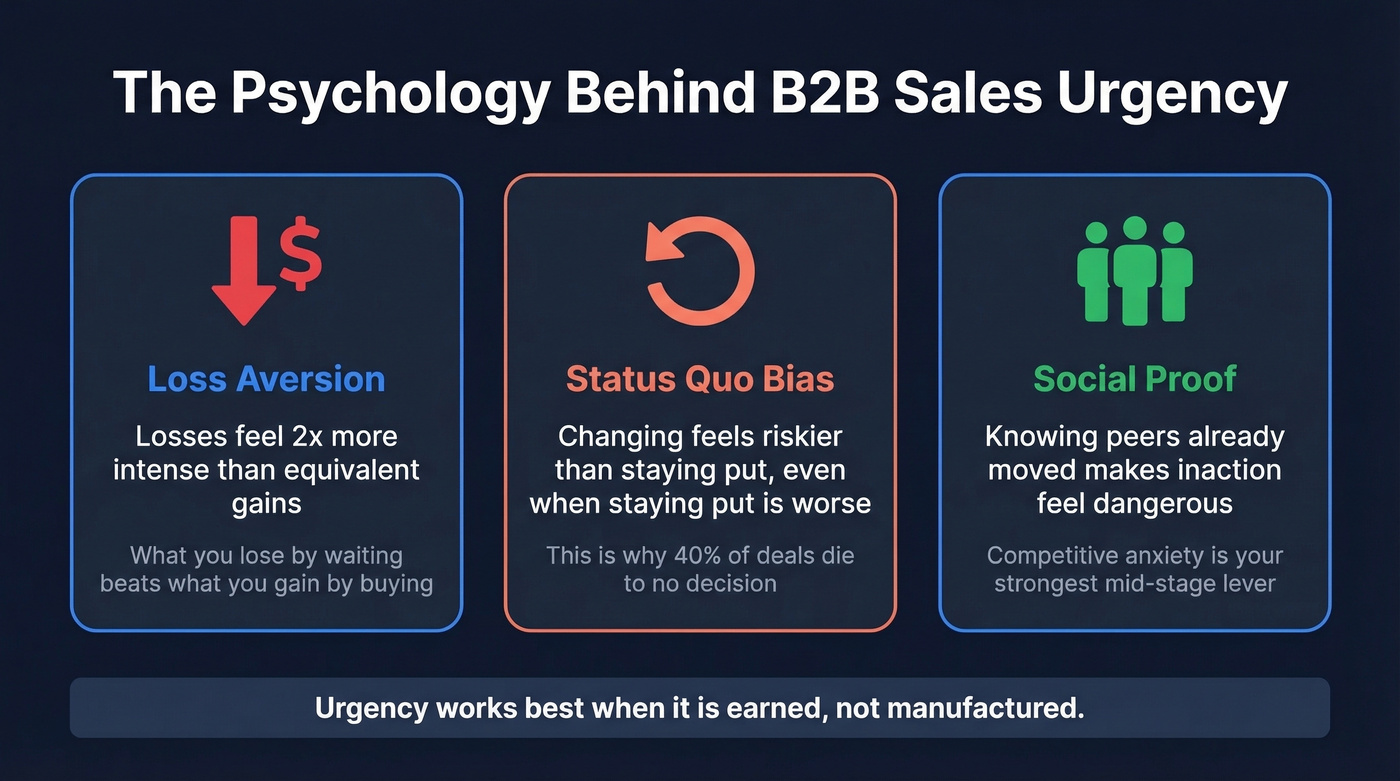
Three psychological mechanisms matter most in deal cycles.
Loss aversion makes "what you'll lose by waiting" more powerful than "what you'll gain by buying." Status quo bias explains why deals stall - changing feels riskier than staying put, even when staying put is objectively worse. And social proof triggers competitive anxiety - knowing peers have already moved makes inaction feel dangerous.
Here's the thing: urgency works best when it's earned, not manufactured. A rep who surfaces a genuine cost of delay is being helpful. A rep who invents a deadline is being manipulative. Buyers can tell the difference every time.

You just built the perfect cost-of-inaction framework. Now imagine it landing in a dead inbox because your champion changed roles last quarter. Prospeo refreshes 300M+ profiles every 7 days - not every 6 weeks - so your urgency emails reach real decision-makers with 98% accuracy.
Stop wasting your best FOMO plays on bounced emails.
Stage-Based Urgency Tactics
Early Stage: Cost of Inaction
The most underused urgency lever in early conversations is a simple question: "What does another quarter of the status quo cost you?"
If you need a tighter discovery framework to quantify that cost, borrow a few discovery questions that force numbers, deadlines, and owners.
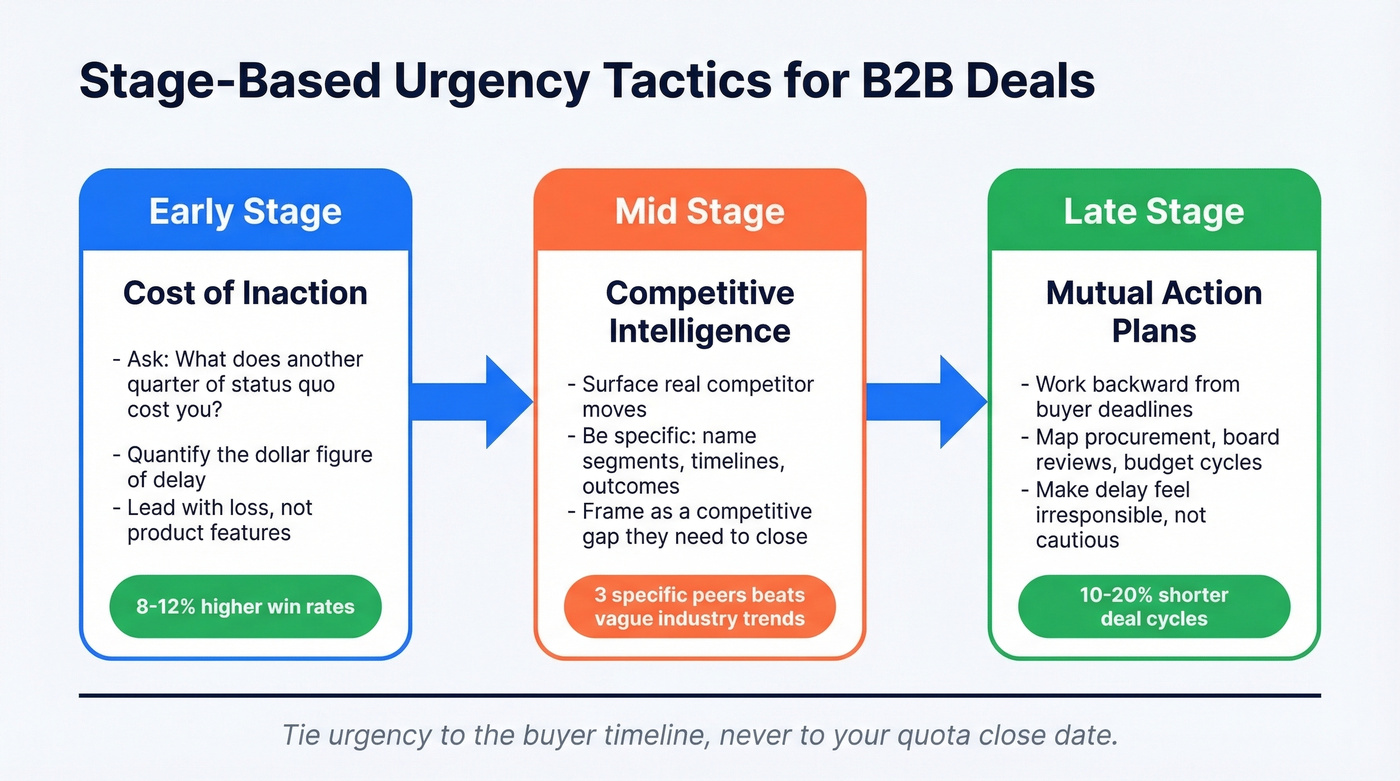
Most reps lead with product value. Better reps lead with the cost of doing nothing. If a prospect's current process leaks $200K in annual revenue, that number compounds every month they delay. Quantify it. Put it in a slide. Make it impossible to ignore.
This works because 57-70% of B2B buyers have already done enough research to know your product features - another demo won't move them. But a concrete dollar figure attached to their inaction? That's novel. Methodology-driven sales teams that lead with cost-of-inaction frameworks see 8-12% higher win rates and are 48-66% more likely to hit quota, according to research from Gartner's sales practice. The math speaks louder than the pitch deck.
If you're building this into your outbound motion, pair it with proven sales prospecting techniques so the urgency lands with the right accounts.
Mid-Stage: Competitive Intelligence
Mid-stage is where competitive displacement creates natural urgency. "Your competitor just signed with us" isn't a gimmick if it's true - it's intelligence the buyer needs.
Frame it as a competitive gap: "What [competitor] is missing" positions your solution as the thing that separates winners from laggards in their market. The key is specificity. "Companies in your space are adopting this" is weak. "Three Series C fintechs in your segment went live last quarter" hits differently.
To operationalize this, build lightweight Sales Battle Cards so reps can cite specifics without guessing.
Late Stage: Mutual Action Plans
Enterprise-approved urgency looks like a mutual action plan. Work backward from the buyer's real deadlines - procurement freeze dates, Q4 budget flush, board review cycles - and build a shared timeline that makes delay feel irresponsible rather than cautious.
We've seen mutual action plans cut deal cycles by 10-20% in enterprise sales, not because they create artificial pressure, but because they expose how little slack exists between "yes" and "go-live." When a buyer sees that a 2-week procurement delay pushes their launch past a board milestone, the urgency isn't manufactured. It's math.
If you're selling into longer cycles, this is a core skill in enterprise B2B sales.
Urgency Email Scripts That Work
| Subject Line | When to Use | Why It Works |
|---|---|---|
| "What [competitor] is missing" | Mid-stage, competitive deal | Triggers competitive anxiety |
| "Timeline for hitting [goal] by [date]" | Early/mid-stage | Anchors to buyer's deadline |
| "How does your team compare?" | Cold outreach / re-engage | Curiosity + benchmarking |
| "[Company] just made the switch" | Late-stage stall | Social proof from a peer |
| "The cost of waiting another quarter" | Deal stall / no-decision | Loss aversion framing |
Two rules for urgency emails. First, never invent a conversation. "I was just talking to your competitor" only works if you actually were - buyers talk to each other, and getting caught kills the deal permanently.
Second, personalize the loss. "Your team is still running [manual process] while [specific competitor] automated it in Q1" is a reason to reply. Generic warnings aren't. We've tested both approaches across hundreds of sequences, and personalized loss framing consistently pulls 2-3x the reply rate of vague "don't miss out" language.
If you want more plug-and-play options, keep a set of sales follow-up templates ready for stalls and no-decision deals.
When FOMO Backfires
A rep on r/sales put it bluntly: they were tired of "bullshitting prospects with fake timelines" - and their prospects were tired of it too. This comes up constantly in SaaS sales conversations. Manufactured urgency erodes trust faster than almost any other tactic.
If you want a clean line to coach to, anchor it in Ethics in Sales: real urgency informs; fake urgency coerces.
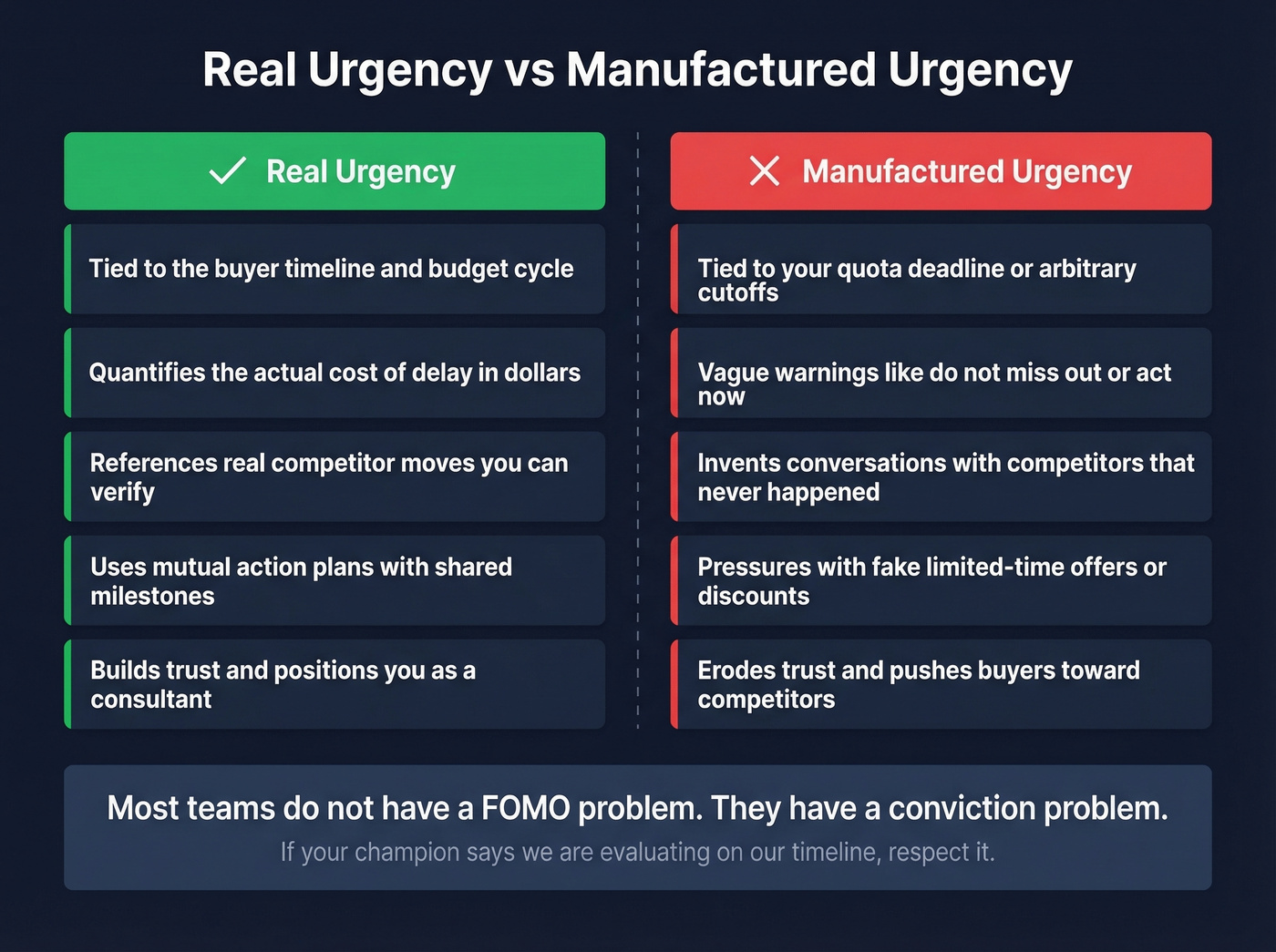
A 2025 study in Business Horizons confirmed what practitioners already knew: while fear-of-missing-out appeals can trigger immediate purchases, they frequently generate negative cognitive and emotional effects and can permanently damage brand perception. The researchers identified four buyer archetypes (Butterflies, Devotees, Endorsers, Shopaholics), each responding differently to urgency. Some lean in. Others resent it and never come back.
Look - most teams don't have a FOMO problem. They have a conviction problem. If your champion has explicitly said "we're evaluating on our timeline," doubling down on urgency will push them toward a competitor who respects their process. Not every deal needs manufactured pressure. Some just need patience and a sharper business case.
Your Data Has to Be Right First
None of these tactics matter if your urgency email bounces.
If you're diagnosing why sequences fail, start with email bounce rate benchmarks and root causes before you rewrite copy.
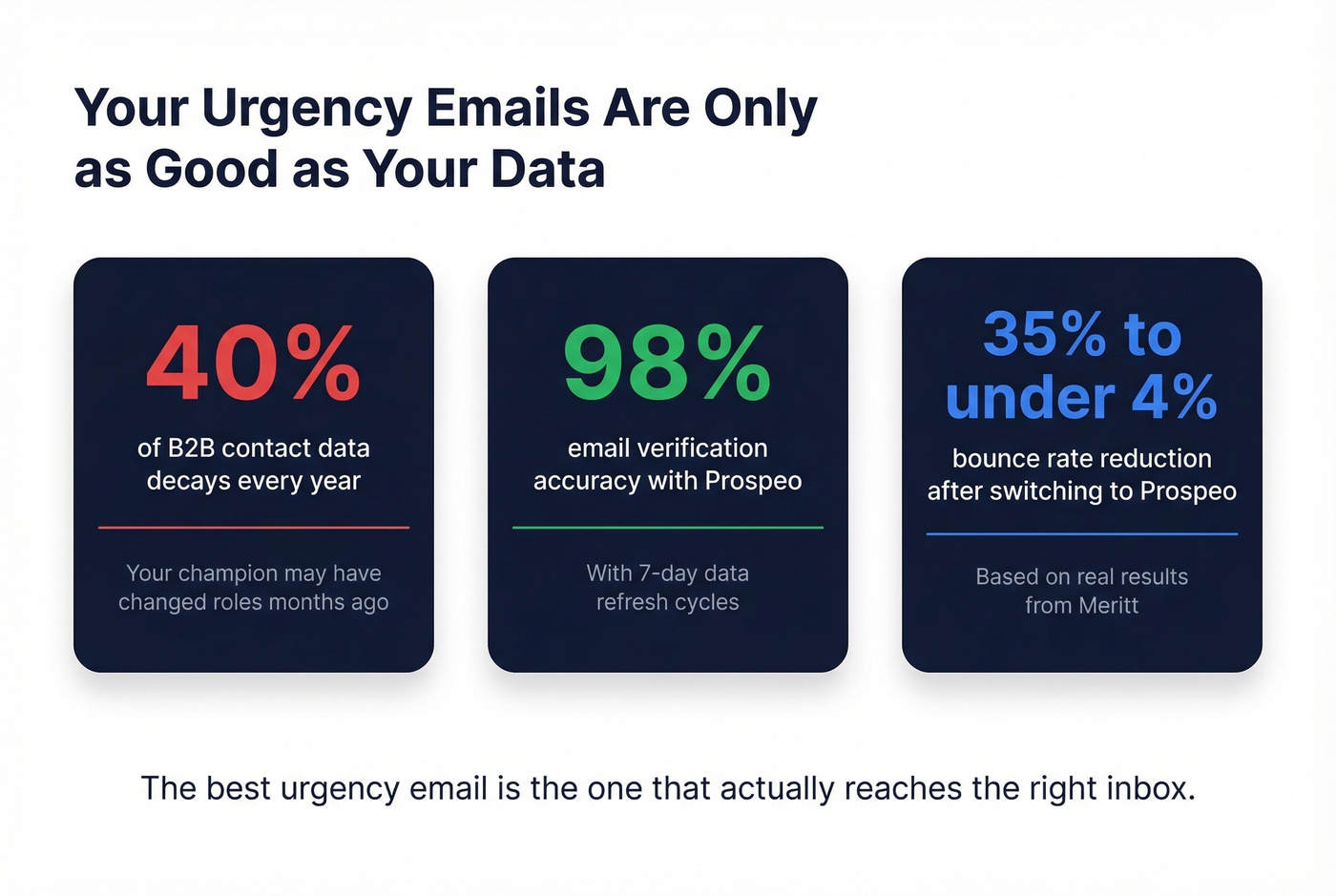
In our experience, the best urgency emails aren't the cleverest - they're the ones that actually reach the right inbox. Roughly 40% of B2B contact data decays annually, and we've watched teams craft the perfect cost-of-inaction message only to discover their champion changed roles three months ago. All that careful framing, wasted on a dead address.
Prospeo's 98% email accuracy and 7-day data refresh cycle means your carefully crafted urgency emails actually land where they should. Meritt saw their bounce rate drop from 35% to under 4% after switching - that's the difference between a pipeline-moving sequence and an expensive exercise in talking to nobody.
If you're comparing vendors, this roundup of data enrichment services can help you sanity-check options.

Competitive displacement only works when you know exactly who to target. Prospeo gives you 30+ filters - buyer intent, job changes, technographics, headcount growth - so you can surface the right prospects at the right moment, for roughly $0.01 per verified email.
Real urgency starts with reaching the right person first.
FAQ
Is using FOMO in sales manipulative?
Not if the urgency is real. Tying pressure to the buyer's own timeline, budget cycle, or competitive landscape is genuinely helpful - it's consultative selling. Manufacturing fake deadlines is manipulative, and buyers see through it fast. Stick to quantifiable cost-of-inaction data and you'll stay on the right side of the line.
Does fear of missing out work in enterprise deals?
Yes, but it looks different. Mutual action plans, procurement deadlines, and cost-of-inaction frameworks replace "offer expires Friday." The urgency comes from the buyer's calendar, not yours. Enterprise cycles averaging 6-9 months need milestone-based pressure, not countdown timers.
How do I create urgency without discounting?
Frame around what the buyer loses by waiting - lost revenue, competitive ground, delayed headcount ROI - rather than what they save by acting now. Discounts train buyers to stall. Loss framing trains them to move.
What tools help deliver time-sensitive outreach reliably?
Start with verified contact data so your emails actually arrive - Prospeo handles that with 98% accuracy and weekly refreshes. Pair it with sequencing tools like Smartlead or Instantly for automated follow-ups. Bad data turns even the best urgency copy into wasted effort.