


Forager Pros and Cons: Is It Worth It in 2026?
Looking for Forager.ai, the B2B data platform? This article covers food foraging - harvesting wild plants and fungi. Different thing entirely. If you're after B2B prospecting tools, Prospeo is what we build.
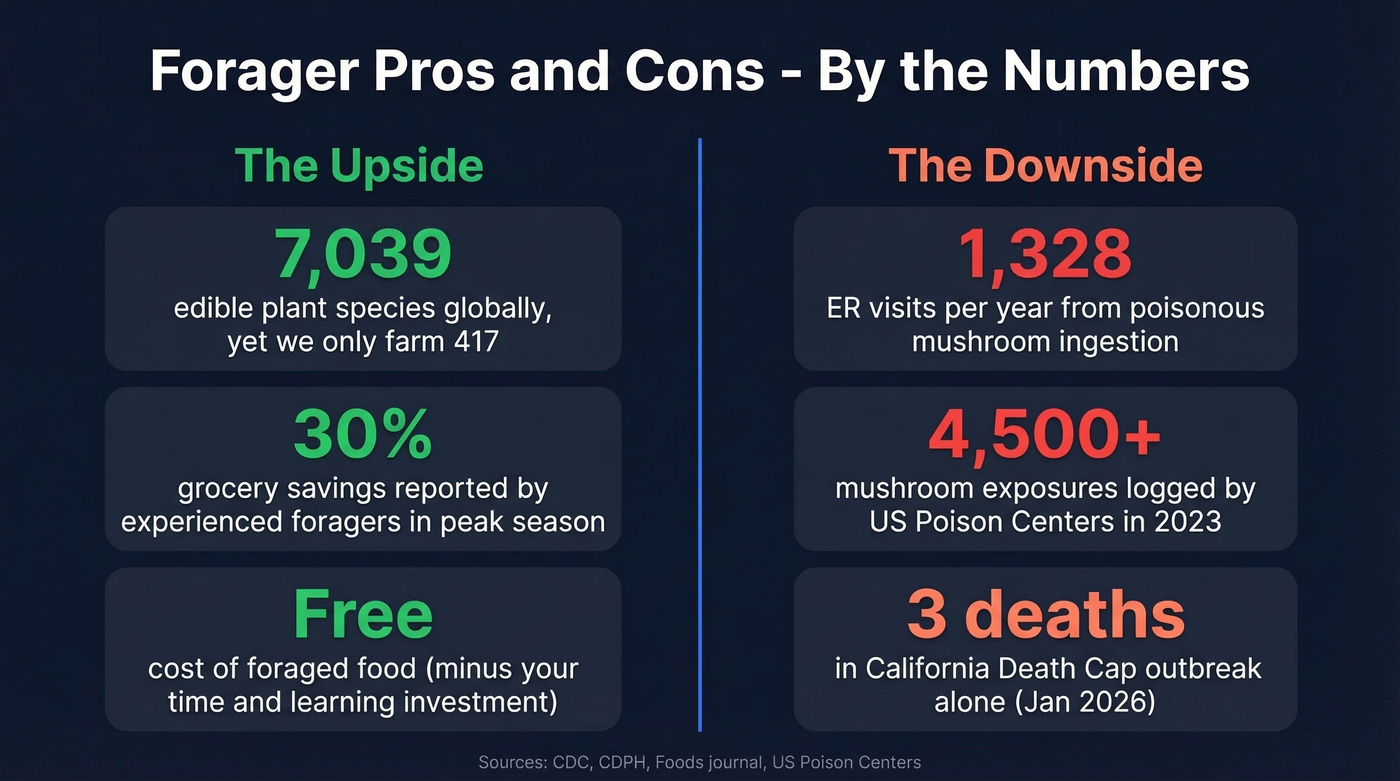
Every forager faces the same tradeoff: nutritionally superior food for free, but accidental poisonous mushroom ingestion sends 1,328 people to the ER annually. Understanding the forager pros and cons upfront matters - foraging pays off if you invest in identification skills and start with low-risk plants. It's not worth it if you're hoping to wing it with a phone app.
The Benefits of Foraging
Nutritional Edge Over Store-Bought
There are roughly 7,039 edible plant species globally, yet we rely on about 417 as food crops. That's a staggering gap. A 2024 peer-reviewed study in Foods found that wild food plants pack more micronutrients than their cultivated counterparts, and that in species where a domesticated version exists, the wild taxa consistently outperform on nutrient density. A Syracuse University study sampling 196 uncultivated species backed this up with specifics: black mulberries beat market strawberries, and dandelion greens ranked at or above popular commercial produce for key vitamins.
It's Genuinely Free (With a Catch)
The "30% grocery savings" claim shows up in real-world foraging writeups - but only if you don't count your time. Each walk takes one to two hours, and sometimes you come home empty-handed. Availability is seasonal too; winter months in northern climates offer almost nothing. Think of it as exercise that occasionally produces free food, not as a grocery replacement strategy.
Mental and Physical Health
Foraging forces you into nature for extended, focused walks - scanning the ground, identifying plants, moving through varied terrain. The BBC's deep dive on foraging frames it as both physical activity and a mindfulness practice, and that tracks with what we've heard from people on our team who forage regularly. It's a structured excuse to cure what some researchers call "plant blindness" - the tendency to walk past hundreds of species without registering a single one.
The Risks and Downsides
Poisoning Risk Is Quantified
Most foraging articles gloss over the danger with a vague "be careful." The numbers tell a different story.
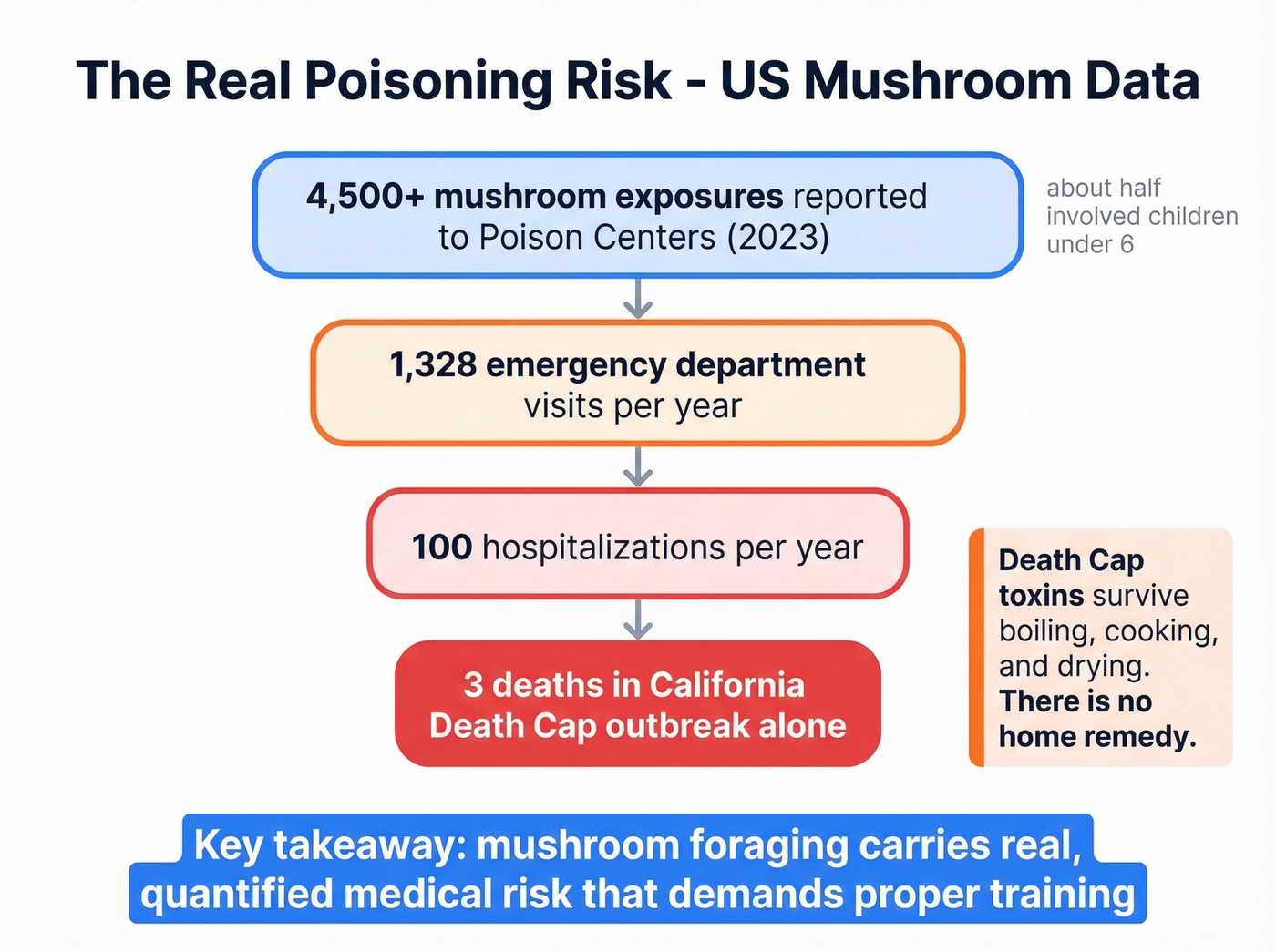
The CDC estimates 1,328 emergency department visits and 100 hospitalizations per year from accidental poisonous mushroom ingestion. In 2023, US Poison Centers logged over 4,500 exposures to unidentified mushrooms - about half involving young children.
California's recent Death Cap outbreak makes the stakes visceral. As of January 2026, the California Department of Public Health reported 35 cases, 3 deaths, and at least 3 liver transplants - in a state that typically sees fewer than 5 cases per year. Death Cap toxins aren't destroyed by boiling, cooking, or drying. There's no home remedy. Let's be honest: that should scare anyone who's cavalier about identification.
The Legal Side Is a Mess
Foraging legality depends entirely on where you're standing.
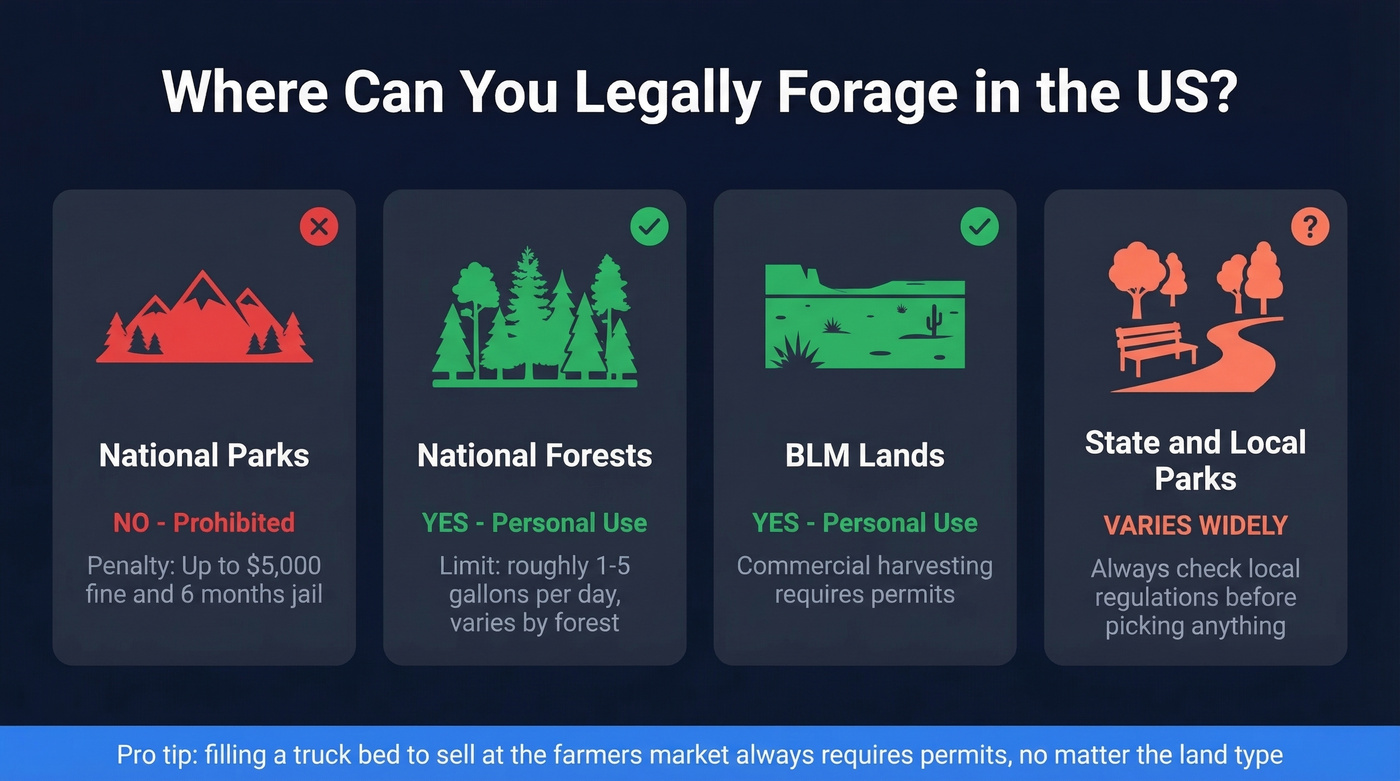
| Land Type | Allowed? | Limits | Penalty |
|---|---|---|---|
| US National Parks | No | Prohibited | Up to $5K fine, 6 mo. jail |
| US National Forests | Yes (personal) | ~1-5 gal/day (varies) | Varies by forest |
| US BLM Lands | Yes (personal) | Restrictions apply | Permit for commercial |
| UK (public access) | Yes (Four Fs) | Foliage, Fungi, Fruit, Flowers | No digging or timber |
Picking chanterelles for dinner on National Forest land is generally fine. Filling a truck bed to sell at the farmers' market requires permits. Always check local rules - the fines are real.
Contamination and Sustainability
Wild doesn't mean clean. Urban and roadside plants can carry heavy metal contamination. One analysis highlighted by the BBC found heavy metal concentrations in wild edible plants decrease by about 10% when plants grow 50 meters from traffic - so distance matters, but even that reduction isn't huge.
On the sustainability front, foraging's environmental reputation holds up most of the time. A peer-reviewed assessment across Eurasian case studies found that competitive foraging for "fashionable" species can cause ecological degradation when driven by market pressure. On the flip side, foraging invasive species like garlic mustard and Japanese knotweed is genuinely good for ecosystems - one of the rare cases where eating more of something helps.
Foraging wild plants takes hours of study to avoid deadly mistakes. Prospecting for B2B leads shouldn't. Prospeo gives you 300M+ profiles with 98% email accuracy - no guesswork, no poisonous data killing your domain reputation. See the sales prospecting techniques that work without guesswork.

Foraging wild plants takes hours of study to avoid deadly mistakes. Prospecting for B2B leads shouldn't. Prospeo gives you 300M+ profiles with 98% email accuracy - no guesswork, no poisonous data killing your domain reputation.
Stop foraging for leads. Get verified contact data at $0.01 per email.
Is Foraging Worth It?
Weighing the forager pros and cons, the learning investment pays off within a single season. The nutritional quality is genuinely superior, the cost is zero, and the process itself is good for your body and mind. But most articles romanticize wild food harvesting without acknowledging that the consequences of getting it wrong are liver transplants and death. That's not hyperbole - it's what the California data shows.
Here's the thing: if you aren't willing to invest 20-30 hours learning identification before eating anything wild, foraging isn't for you. A phone app won't keep you safe. But if you put in the work, it becomes one of the most rewarding ways to eat. We've seen a few people on our team go from total beginners to confidently filling bags of chanterelles in a single autumn - the learning curve is steep but short.
If you're doing the same kind of "learning curve" in outbound, it helps to have a system for lead generation workflow and a clean list-building process.
Getting Started Safely
Skip this section if you're already experienced. For everyone else, this order matters.
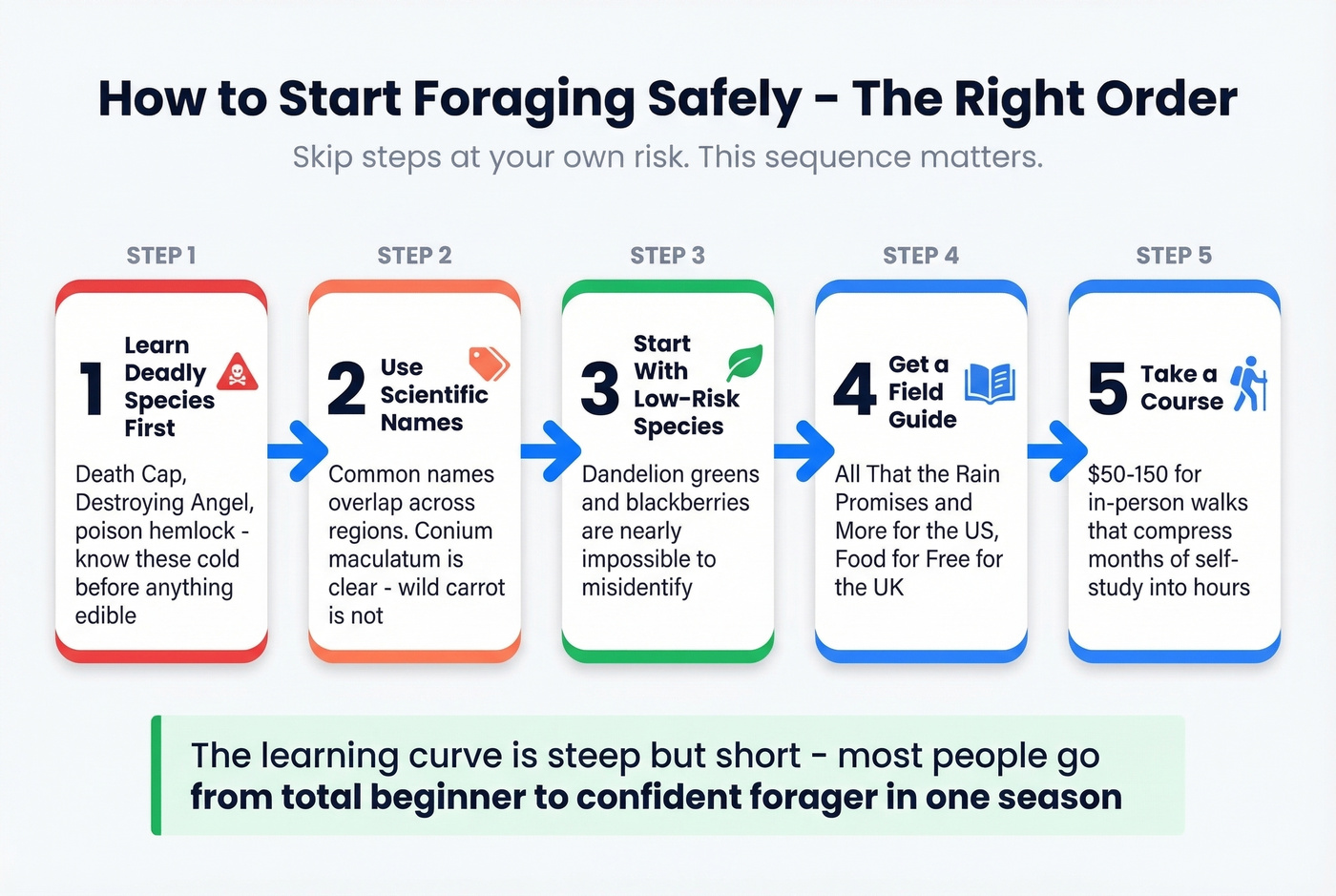
Learn deadly species first. Death Cap, Destroying Angel, poison hemlock - know these cold before anything edible. You're building a mental "do not touch" list, and it's more important than your "safe to eat" list.
Use scientific names. Common names overlap across regions and species. Conium maculatum is unambiguous; "wild carrot" is not, and confusing it with poison hemlock can kill you.
Start with low-risk species. Dandelion greens and blackberries are nearly impossible to misidentify. Build confidence there before moving to mushrooms or anything with dangerous lookalikes.
Get a field guide. All That the Rain Promises and More is the go-to recommendation on r/foraging, and for good reason - it's practical and organized around what you'll actually encounter. In the UK, Richard Mabey's Food for Free is the equivalent.
Take a course. In-person foraging walks run $50-150 and compress months of self-study into a few hours. Worth every penny for the hands-on identification practice alone.
Before you scale outreach, it’s the same idea: validate first, then scale. That’s where email deliverability and email bounce rate basics matter.
FAQ
Is foraging legal in the US?
National Parks prohibit foraging with fines up to $5,000 and possible jail time. National Forests and BLM lands generally allow personal-use harvesting with daily limits, typically 1-5 gallons. State and local parks vary widely - always check before you pick.
What's the safest foraged food for beginners?
Dandelion greens and blackberries are nearly impossible to misidentify, making them ideal first targets. For mushrooms, chanterelles and chicken of the woods have distinctive features with few dangerous lookalikes. Avoid gilled mushrooms entirely until you're experienced.
How many people get poisoned from foraging each year?
The CDC estimates 1,328 emergency department visits per year from mushroom poisoning alone, with 100 hospitalizations. In 2023, US Poison Centers logged over 4,500 mushroom exposures - roughly half involving young children under six.
Can foraging actually replace grocery shopping?
Not realistically. Experienced foragers report up to 30% savings on produce during peak seasons, but availability drops to near zero in northern winters. Foraging supplements a diet well; treating it as a full grocery replacement leads to nutritional gaps and frustration.
Bad mushroom identification sends 1,328 people to the ER each year. Bad email data sends your domain to spam. Prospeo's 5-step verification and 7-day refresh cycle keep your outbound clean - bounce rates under 4%, guaranteed.
Protect your sender reputation the way smart foragers protect their health.
This article is published by the team at Prospeo.io. When we're not building B2B data tools, we explore topics our team is genuinely curious about - like whether foraging is worth the hype. If you’re building pipeline instead, start with free lead generation tools, tighten your sender reputation, and use sales follow-up templates to keep conversations moving.