

How to Write a Formal Sales Proposal That Survives Procurement
You finished a great demo and the prospect says: "Send a formal proposal and we'll review next week." That's the moment deals stall. It's a common complaint on r/sales - prospect asks for a formal sales proposal, then goes silent. Your champion loves you, but procurement, legal, and security are about to enter the chat, and a sloppy document gives them every reason to slow things down.
A formal sales proposal isn't a brochure or a slide deck. It's an approval document designed to survive forwarding to finance, legal, and IT without you in the room to explain it.
The Short Version
- A formal proposal is a report-style document with front matter, body sections, and appendices - not a slide deck.
- You need one when procurement, legal, or finance are involved, especially for RFPs, government, healthcare, and education deals.
- The three sections most people jump to first: executive summary, pricing, and scope/SOW.
- Deals that close within 50 days win at 47%; after that, win rates drop below 20%. Build urgency into your proposal.
- Present the proposal live first, then send it. Never lead with a cold PDF.
What Makes a Proposal "Formal"?
An informal proposal is short - memo or letter format - and typically includes six sections: introduction, background, plan, staffing, budget, and authorization. It's the kind of thing you'd use for smaller projects under $100,000 that don't require a heavy procurement process.
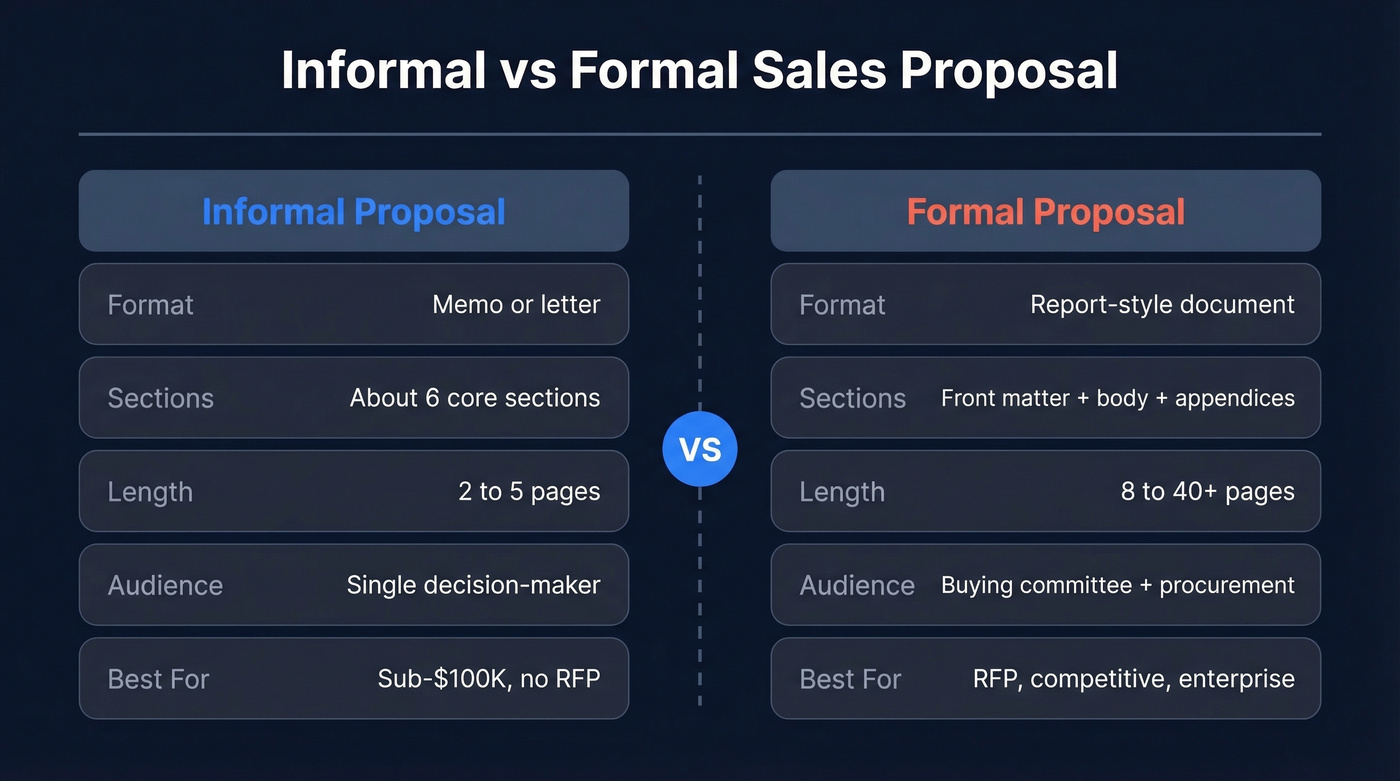
A formal proposal adds report-style front matter: a letter of transmittal, title page, table of contents, list of figures, executive summary, and appendices. It's longer, more structured, and built for multiple reviewers who'll each read different sections. The table below breaks down the key differences so you can decide which format fits your deal.
| Informal | Formal | |
|---|---|---|
| Format | Memo or letter | Report-style document |
| Sections | ~6 core sections | Front matter + body + appendices |
| Length | 2-5 pages | 8-40+ pages |
| Audience | Single decision-maker | Buying committee + procurement |
| When | Sub-$100K, no RFP | RFP, competitive, enterprise |
When You Actually Need One
Not every deal requires a formal proposal. Here's when you do:
- The buyer issued an RFP, RFI, or RFQ with submission requirements
- Procurement, legal, or finance must sign off before the deal closes
- You're selling into government, healthcare, or education - industries where formal RFPs are standard
- The deal is competitive and multiple vendors are evaluated side by side
- Contract value exceeds $100K
If none of these apply, skip the formal document entirely. A clean slide deck or a simple sales proposal - even a one page sales proposal with scope, pricing, and next steps - will close faster. We've seen teams waste two weeks building a 30-page document for a $15K deal that only needed a two-page scope summary and a DocuSign link.
Proposal Structure That Procurement Expects
Here's the thing: most "sales proposal templates" online skip the sections procurement actually cares about. They'll give you an executive summary and pricing table but leave out assumptions, exclusions, and acceptance criteria. That's how you create future conflict.
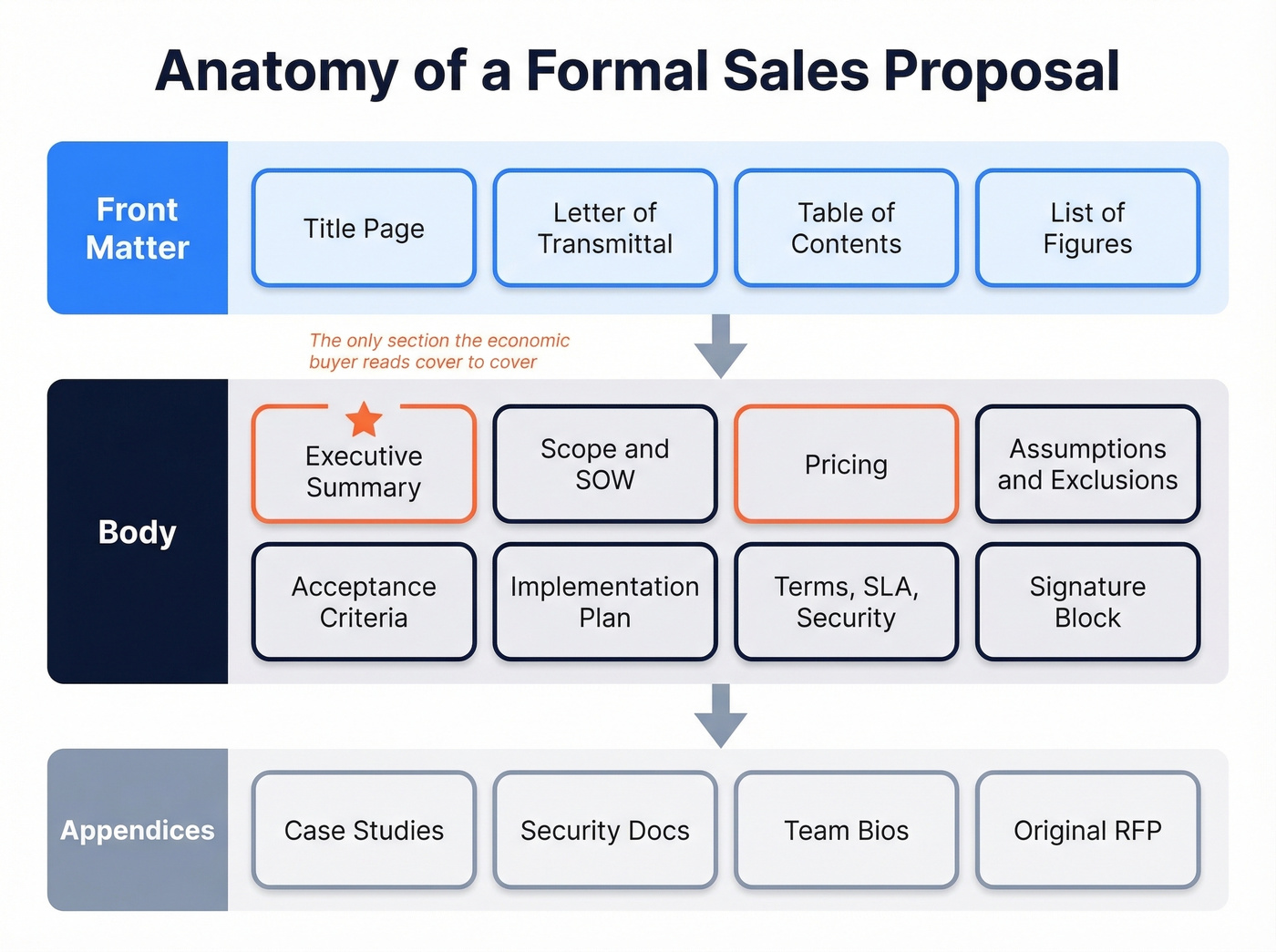
Length scales with deal complexity - 3-7 pages for SMB, 8-15 for mid-market, 15-40+ pages plus appendices for enterprise.
Front Matter
This is the packaging that signals professionalism before anyone reads substance.
Include a title page with client name, your company, date, and version number. Add a one-page letter of transmittal summarizing what's enclosed. For anything longer than a few pages, include a table of contents. Longer RFP responses should also have a list of figures and tables - procurement reviewers use these to navigate directly to what they need.
Body Sections
Every section should be written for the person who'll read it. The economic buyer skims the executive summary. Procurement reads terms and pricing. IT reviews security.
- Executive summary - the single most important section (framework below).
- Scope / SOW - what you're delivering, in specific terms. Include deliverables, milestones, and what's explicitly out of scope.
- Pricing - tiered options work better than a single number. Group costs by category so finance can map them to budget lines.
- Assumptions and exclusions - what must be true for your pricing and timeline to hold. Skip this and you're creating disputes down the road.
- Acceptance criteria - how both parties agree the work is complete.
- Implementation plan - timeline, phases, dependencies, and who's responsible on both sides.
- Terms, SLA, security, and compliance - service levels, uptime guarantees, data handling, certifications like SOC 2, ISO 27001, and GDPR DPAs.
- Signature block with names, titles, dates, and e-signature fields.
Appendices
Appendices keep the body clean while giving reviewers the depth they need. Include case studies relevant to the buyer's industry, security and compliance documentation, team bios for the delivery team, and a copy of the original RFP when responding to one.

A formal sales proposal that reaches only one stakeholder is a proposal that stalls. Prospeo gives you verified emails and direct mobile numbers for every decision-maker on the buying committee - procurement, finance, and the economic buyer. 98% email accuracy means your proposal lands, not bounces.
Stop sending proposals into a single inbox and hoping they get forwarded.
The Executive Summary Framework
If you obsess over three sections, make it executive summary, scope, and pricing. In our experience, the executive summary is the only section the economic buyer reads cover to cover. Here's a four-part framework that works:
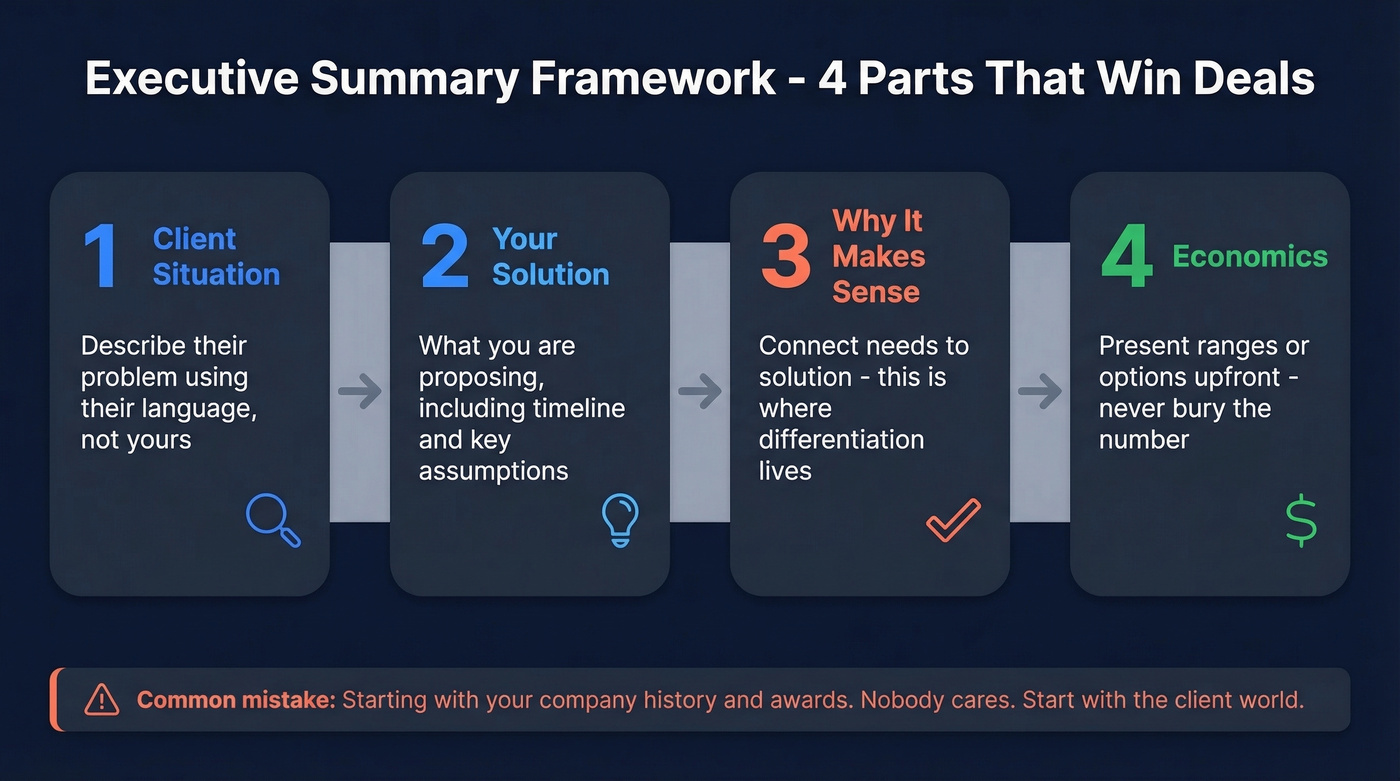
- Client situation - describe their problem using their language, not yours.
- Your solution - what you're proposing, including timeline and key assumptions.
- Why it makes sense - connect needs to solution. This is where differentiation lives.
- Economics - don't bury the number. Present ranges or options upfront.
Most executive summaries fail because sellers waste the first paragraph on company history. Nobody cares. Start with the client's world. I've read proposals where the first 400 words were about the vendor's founding story and awards - by the time the CFO gets to the actual solution, they've already checked out.
Confirm Stakeholders Before Sending
Buyers say "send a proposal" when they actually mean "give me something I can forward internally." If you don't design for forwarding, you get ghosted.
Before you send anything, confirm who's reviewing it and what their decision criteria are. Build a mutual action plan with a specific review date and an expiry on your pricing. Deals that close within 50 days win at nearly 2.5x the rate of deals that drag - urgency isn't aggressive, it's respectful of everyone's time.
The most common failure mode? Your proposal reaches one contact and dies in their inbox. Formal proposals involve procurement, finance, and an economic buyer at minimum. Tools like Prospeo can pull verified emails and direct mobile numbers for the full buying committee so your proposal doesn't stall with a single champion.
Mistakes That Kill Formal Proposals
We've reviewed hundreds of proposals across our team. These are the patterns that kill deals:
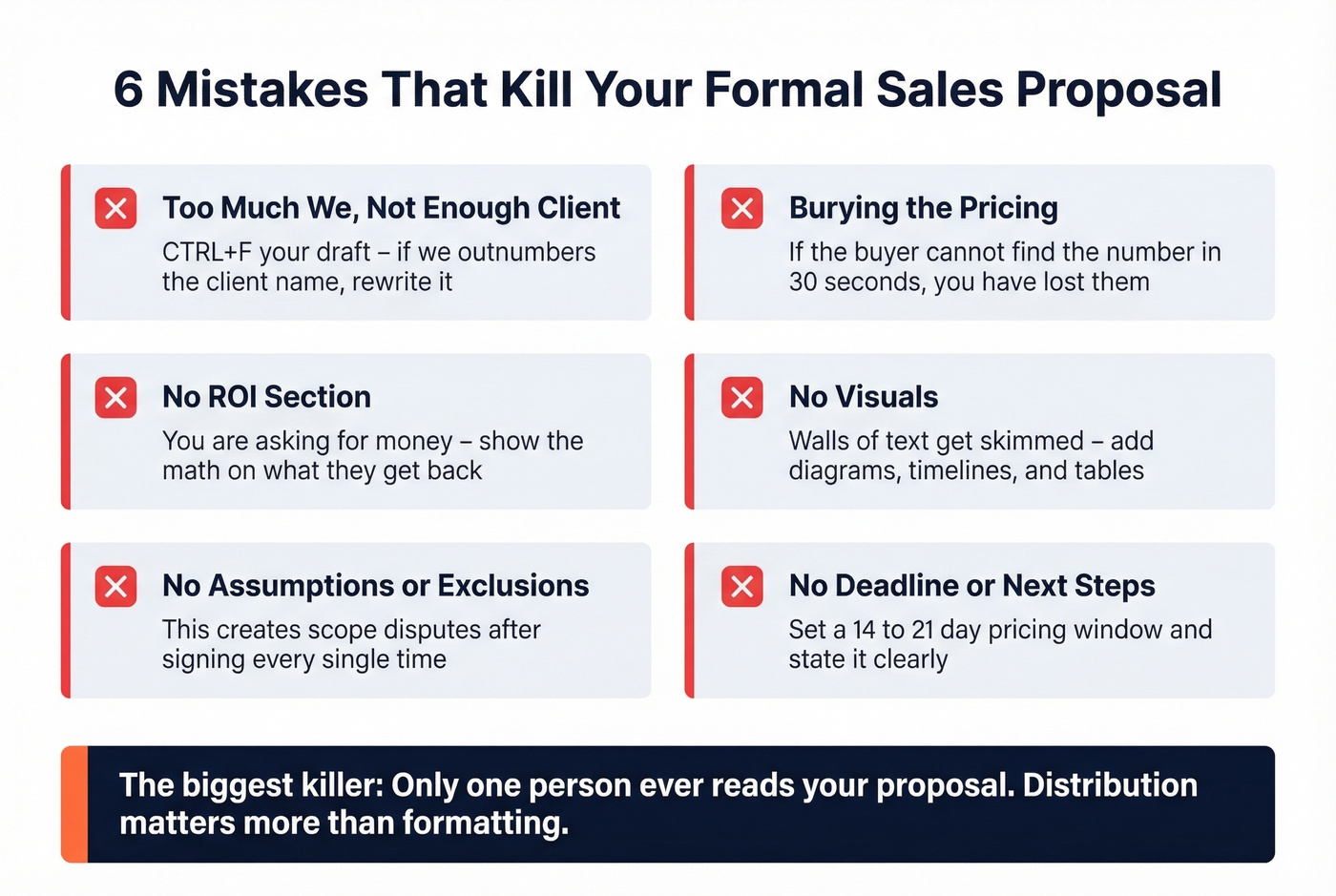
Too much "we," not enough client. Use CTRL+F to compare how often you say "we" versus the client's name. If "we" wins, rewrite.
Burying pricing. Look, if the buyer can't find the number in 30 seconds, you've lost them. Put a pricing summary in the executive summary and the full breakdown in its own section.
No ROI section. You're asking for money. Show the math on what they get back. Even a rough calculation beats nothing.
No visuals. Walls of text get skimmed. Add diagrams, timelines, and comparison tables to break up dense sections.
No assumptions or exclusions. This creates scope disputes after signing. Every proposal should spell out what's included and what isn't.
No clear next steps or expiry. A proposal without a deadline sits in a folder forever. Set a 14-21 day pricing window and state it clearly.
Let's be honest about the biggest killer, though: most formal proposals lose not because of what's in them, but because only one person ever reads them. Distribution matters more than formatting. If you can't reach the full buying committee directly, your proposal is a lottery ticket.
Proposal Software Worth Knowing
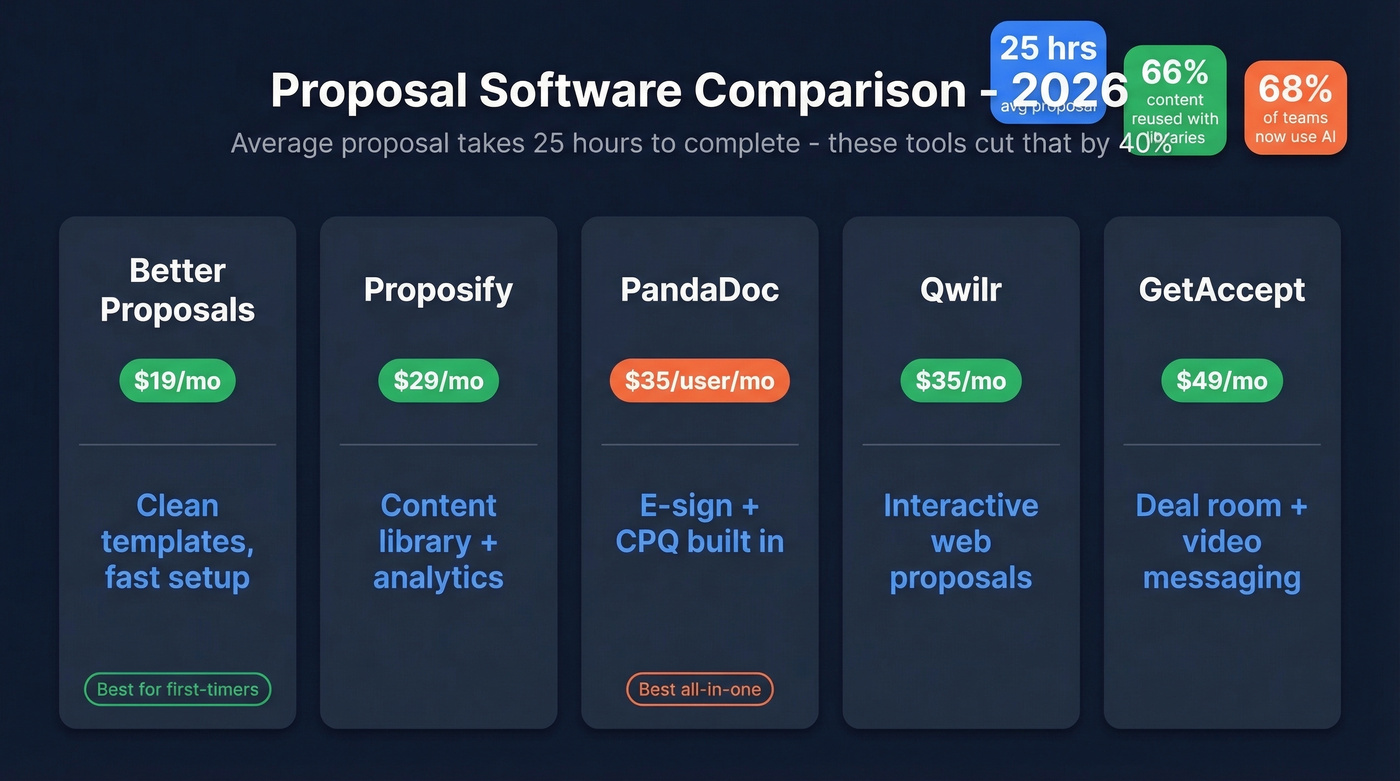
The average proposal takes 25 hours to complete. Teams with content libraries reuse 66% of their content and cut writing time by 40%. And 68% of proposal teams now use generative AI, up from 34% in 2023.
If you're producing more than a few proposals per quarter, dedicated software pays for itself. Skip this section if you're only sending a handful of proposals a year - a well-structured Google Doc or Word template will serve you fine.
| Tool | Starting Price | Standout Feature |
|---|---|---|
| Better Proposals | $19/mo | Clean templates, fast setup |
| Proposify | $29/mo | Content library + analytics |
| PandaDoc | $35/user/mo | E-sign + CPQ built in |
| Qwilr | $35/mo | Interactive web proposals |
| GetAccept | $49/mo | Deal room + video messaging |
For teams writing their first formal proposals, Better Proposals offers the fastest setup. If you need e-signatures and CPQ in one tool, PandaDoc is the stronger pick - it handles the entire workflow from proposal to signed contract without switching apps.
If you're sending proposals as a deck instead of a doc, use a Sales Proposal PPT structure that still makes pricing and scope easy to forward.
If you're producing lots of proposals, add proposal tracking so you can see who opened what and when.
Deals that close within 50 days win at 2.5x the rate. Don't waste that window chasing wrong contacts. Prospeo's 300M+ profiles and 30+ filters - including job title, department, and seniority - let you identify and reach every stakeholder before you hit send on that PDF.
Find every reviewer's direct contact in minutes, not days.
FAQ
How long should a formal sales proposal be?
SMB deals need 3-7 pages. Mid-market runs 8-15 pages. Enterprise RFP responses stretch to 15-40+ pages plus appendices. For smaller deals with a single decision-maker, a simple 2-5 page document covering scope, pricing, and next steps will close faster than a full formal document.
What's the difference between a formal and informal proposal?
Informal proposals use memo format with six sections (introduction, background, plan, staffing, budget, authorization) and run 2-5 pages. Formal proposals add front matter like a letter of transmittal, table of contents, and appendices - built for buying committees, not a single signer.
Can I use a one page sales proposal instead?
Yes - if there's no RFP, no procurement process, and a single decision-maker. A one-pager covering scope, pricing, and next steps often closes faster than a 20-page document. Reserve the full formal structure for deals where multiple stakeholders need to review and approve.
How do I stop proposals from getting ghosted?
Present live before sending, include a pricing expiry date (14-21 days works well), and make sure you have direct contact info for every stakeholder. The biggest reason proposals die isn't bad content - it's that only one person on the buying committee ever sees them.