

How to Build a Sales Action Plan That Doesn't Collect Dust
It's January. Your VP just dropped a 20% growth target on the team's lap, and the only "plan" anyone can find is last year's slide deck with updated logos. Even after quotas were reduced across the industry, nearly 77% of sellers still missed their number. The problem isn't ambition - it's that most sales action plans are built for board decks, not for a rep's Monday morning.
What You Need (Quick Version)
- Reverse-engineered funnel math - start with your revenue target and work backward to daily activities. (If you need a baseline, use funnel math benchmarks.)
- Pipeline stages built around buyer commitment, not rep activity like "demo delivered." (This is one of the most common sales pipeline challenges teams run into.)
- A weekly review cadence with lost-deal feedback loops.
- Verified prospect data so your activity targets aren't wasted on bounced emails. (More on email bounce rate and how to prevent it.)
That's the skeleton. Let's put muscle on it.
What a Sales Action Plan Actually Looks Like
A sales action plan translates revenue goals into specific activities, owners, and deadlines. It answers three questions: what are we trying to hit, what do we do every day to get there, and who owns each piece?
| Document | What It Does | Analogy |
|---|---|---|
| Sales strategy | Sets direction | The destination |
| Sales plan | Defines the route | The GPS route |
| Sales action plan | Drives daily execution | Turn-by-turn directions |
You can slice action plans by timeframe - annual, quarterly, 30-60-90 day - or by use case: territory plans, product launches, individual rep plans. The format matters less than the discipline. Pick the cadence that matches your sales cycle and stick with it.
Why Most Plans Die Before Q2
Three failure modes kill plans before the second quarter.
Stages designed for reporting, not buyer reality. Your CRM says "demo delivered" and "proposal sent." Those describe what your rep did - nothing about whether the buyer acknowledged a problem or confirmed budget. The consensus on r/salestechniques is blunt: stages should reflect buyer commitment signals, not internal activity logs.
Static documents nobody opens after kickoff. A plan that lives in a Google Doc and gets ignored by February is a wish list. Udemy reduced annual planning time by 80% by moving from one static annual plan to continuous in-year adjustments. Meanwhile, 65% of B2B sales orgs are transitioning to data-driven decision-making by 2026 - because static plans can't survive contact with reality. An effective execution framework adapts as market conditions shift, not just when the quarter ends.
Plans assume perfect data. Your SDR team sent 1,200 emails last week. If 400 bounced, your funnel math is fiction. Reps already spend 60% of their time on non-selling tasks. Layer in bad contact data and you're burning what little selling time they have. In long-cycle industries, it can take months to move from first contact to a workshop - when your cycle is that long, every wasted touch compounds into real revenue loss.

Your funnel math assumes every email lands. If a third of your list bounces, you need 50% more activity to hit the same pipeline number - and your reps don't have the hours. Prospeo delivers 98% email accuracy on a 7-day refresh cycle, so Monday's list still works on Friday.
Stop building action plans on data that expires before the week ends.
How to Build Yours in 6 Steps
Step 1: Reverse-Engineer Your Revenue Target
Start with a single number. Not three scenarios, not a range - one SMART revenue target. Then work backward using your actual conversion rates. (If you want a structured model, start from a B2B sales funnel template.)
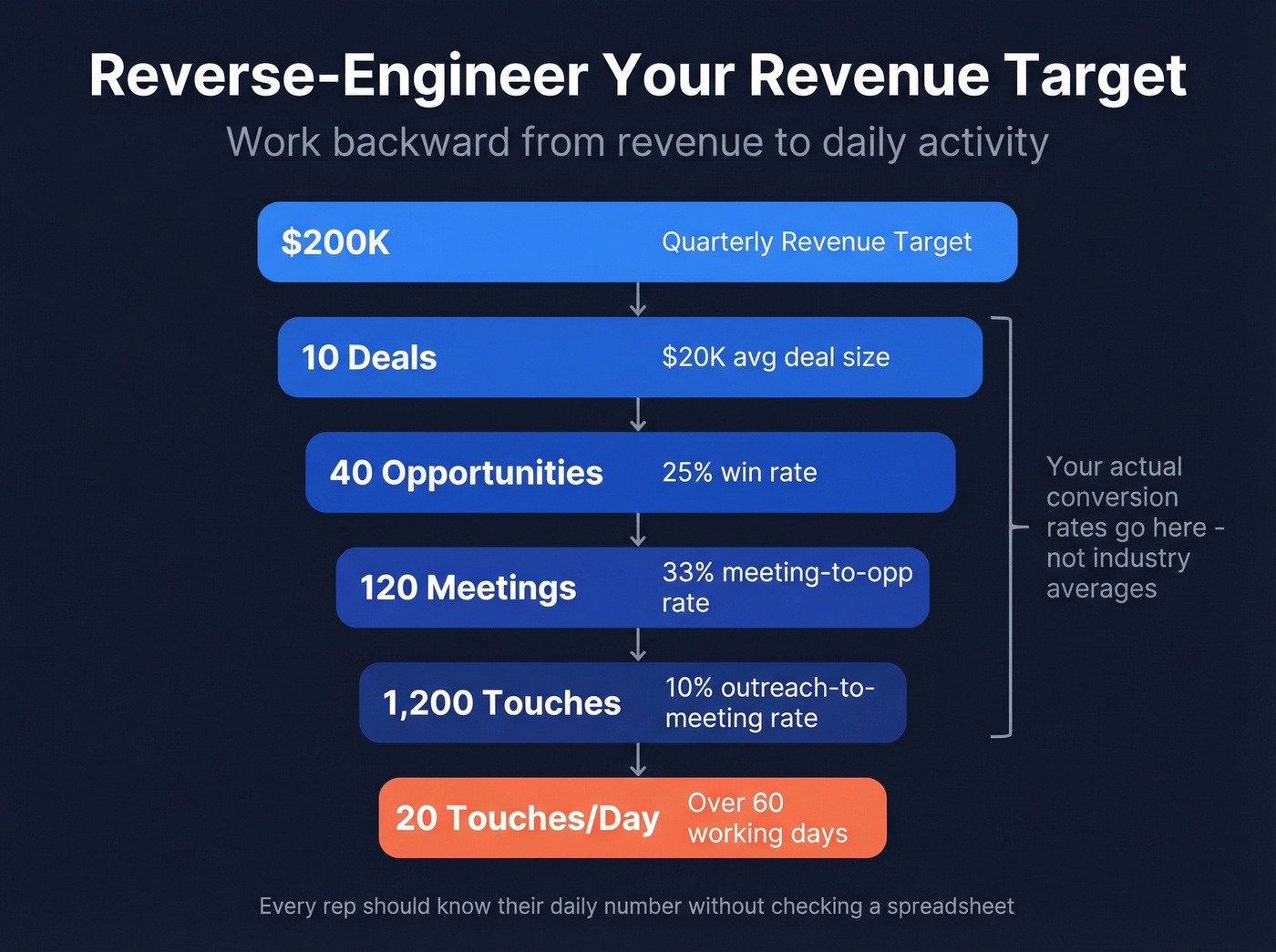
Here's the math for an SMB/mid-market motion:
- Revenue target: $200K/quarter
- Average deal size: $20K → you need 10 closed deals
- Win rate: 25% → you need 40 qualified opportunities
- Meeting-to-opportunity rate: 33% → you need 120 meetings
- Outreach-to-meeting rate: 10% → you need 1,200 touches
- Over ~60 working days: 20 meaningful touches per day
For enterprise motions, the SPOTIO cascading method works well: annual → quarterly → monthly → daily. Every rep should know their daily number without checking a spreadsheet.
Step 2: Define Your ICP in One Page
Pull your last 10-20 closed-won deals and look for patterns - industries, company sizes, titles that signed, tech stacks. Rank 5-7 attributes by correlation with closed revenue. Compress it into a one-page reference guide every rep can pull up in 30 seconds. (If you need a format, use an ideal customer profile template.)
If your ICP definition takes longer than a page, it's too complex to be useful under pressure. We've seen teams build gorgeous 12-page ICP documents that nobody reads past the first meeting. One page, laminated, next to the monitor. That's what works.
Step 3: Build Pipeline Stages Around Buyer Commitment
Most teams get this wrong. When your stages describe what reps did instead of what the buyer committed to, your forecast is fiction. (This is also where sales process optimization pays off fast.)
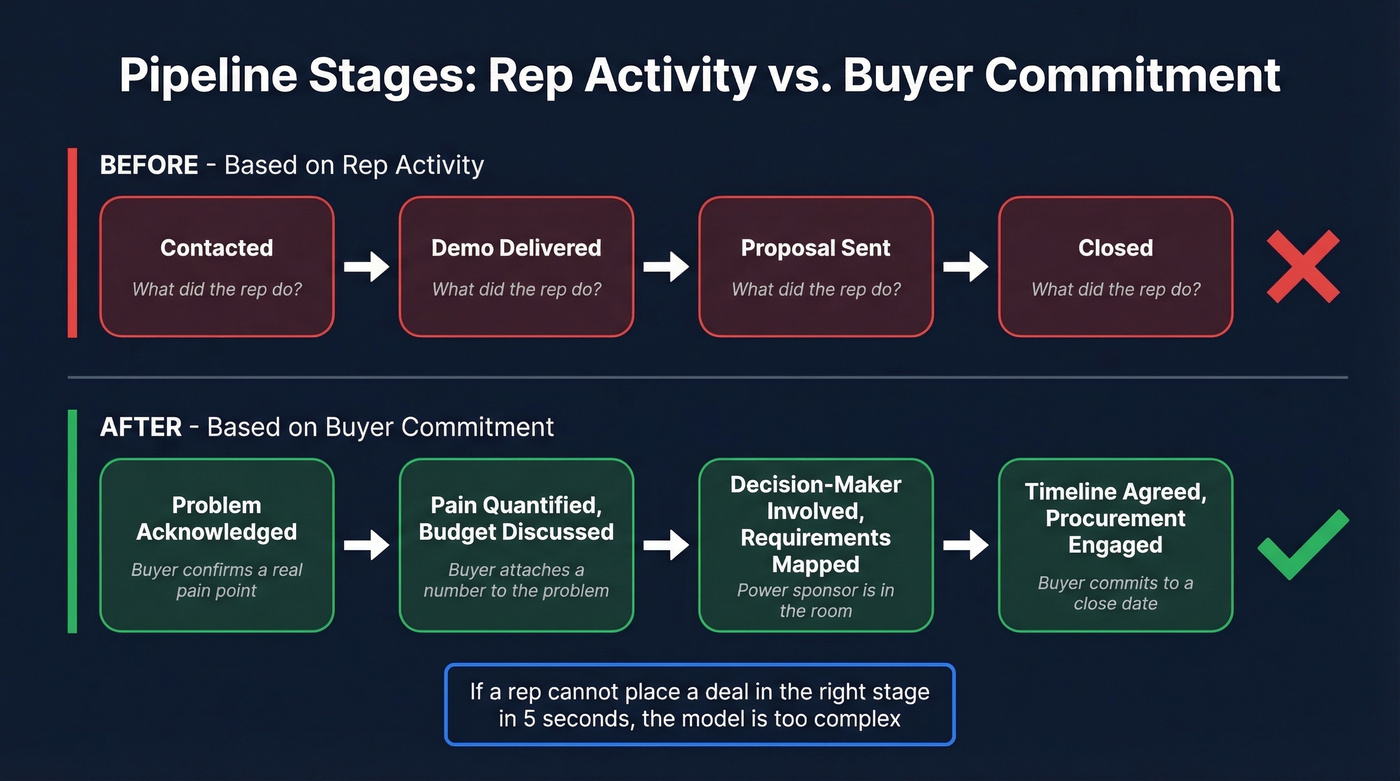
Before (rep activity): Contacted → Demo Delivered → Proposal Sent → Closed
After (buyer commitment): Problem Acknowledged → Pain Quantified, Budget Discussed → Decision-Maker Involved, Requirements Mapped → Timeline Agreed, Procurement Engaged
Each stage needs a clear entry and exit criterion. If a rep can't place a deal in the right stage in five seconds, the model is too complex. Get these wrong and everything downstream - your forecast, your coaching conversations, your board deck - breaks.
Step 4: Assign Owners and Deadlines
Every tactic needs an owner, a deadline, and a measurable target. "Increase outbound" isn't a tactic. "Sarah sends 40 personalized emails per day to ICP accounts in the Northeast, reviewed weekly" is. (If you want a menu of options, pull from these sales activities examples.)
The planning process shouldn't happen in a silo - involve RevOps and Finance early. In our experience running outbound campaigns across 50+ teams, the most common failure is quotas set before capacity validation. Xactly's research backs the same pattern: territories assigned without sufficient data and quotas set before capacity validation burn teams out fast.
Step 5: Fix Your Data First
Here's the thing: your SDR built a list of 1,200 contacts on Monday. If a third bounce, you need 1,800 touches to hit the same 120 meetings - and your reps don't have the hours. (If you're evaluating vendors, start with data enrichment services and a sales prospecting database comparison.)
Prospeo's database covers 300M+ professional profiles with 98% email accuracy on a 7-day refresh cycle, compared to the 6-week industry average. That keeps Monday's list far fresher by Friday. Teams like Snyk cut bounce rates from 35-40% to under 5% and saw AE-sourced pipeline jump 180% after switching to verified data.
Step 6: Set a Weekly Review Cadence
37% of employees say greater visibility of goals would improve their performance. Build that visibility into three loops:
| Cadence | Focus | Format |
|---|---|---|
| Weekly | Activity vs. targets, deal stalls | 30-min standup |
| Monthly | Stage drop-off, recurring objections, lost-deal patterns | Conversion review |
| Quarterly | Update funnel math, reassess ICP, kill underperforming tactics | Full plan reset |
The patterns in your losses are more valuable than your wins. Build lost-deal reviews into the monthly cadence and feed the insights back into next quarter's targets.
Benchmarks to Calibrate Your Plan
Your funnel math is only useful if the assumptions are realistic. Anchor every assumption to actual data - not industry averages you found in a random blog post. (For more baselines, see sales pipeline benchmarks.)
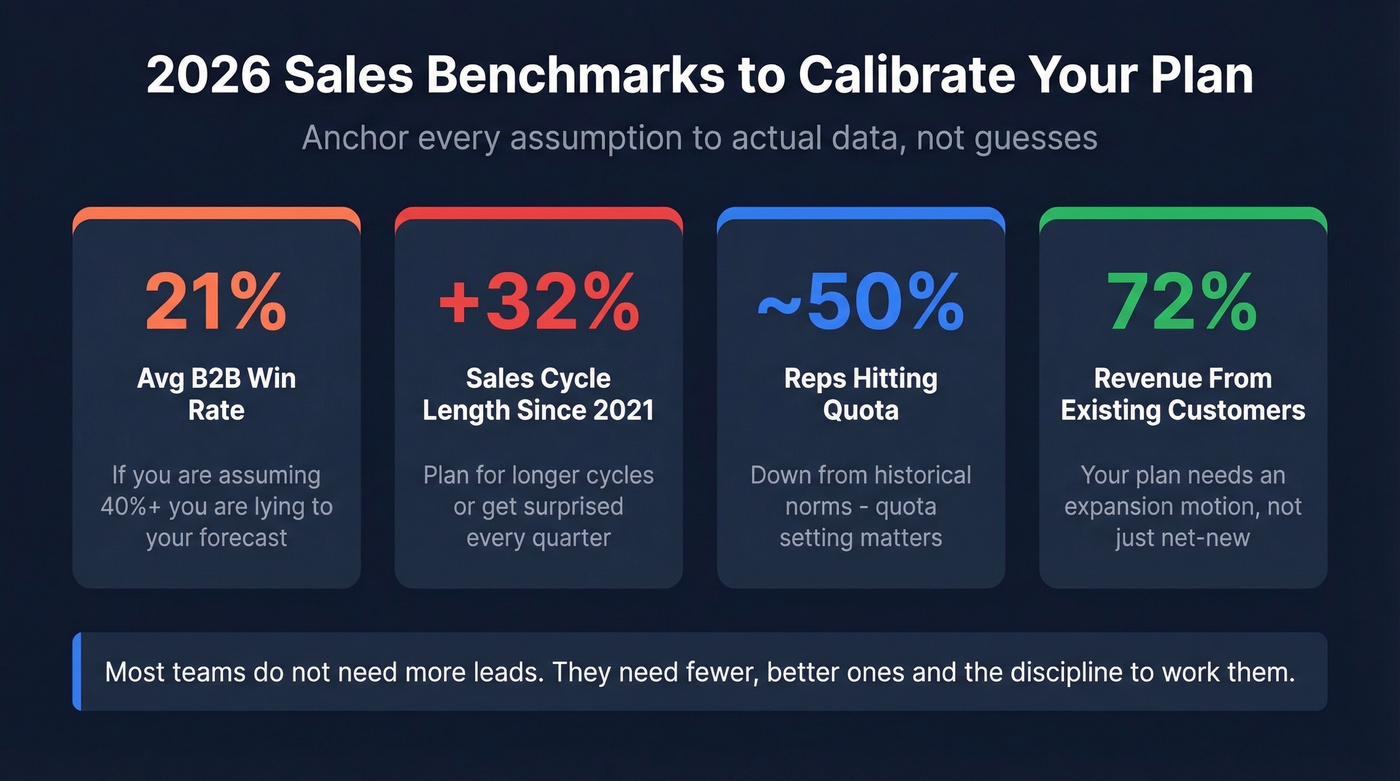
| Metric | Benchmark |
|---|---|
| Avg B2B win rate | 21% |
| Sales cycle change | +32% since 2021 |
| Reps consistently hitting quota | ~50% |
| Revenue from existing customers | 72% |
That last number is critical. If 72% of revenue comes from existing customers, your plan needs an expansion motion - not just net-new prospecting.
The teams seeing the best results are getting ruthless about focus. Box reduced rep books to 200-250 high-potential accounts and shifted from handing reps zip codes to handing them opportunity. Another company cut books to 300-400 accounts and watched win rates jump from 13% to over 20% in under a year. Smaller books, better data, higher conversion.
Most teams don't need more leads. They need fewer, better ones - and the discipline to actually work them. A 500-account book with verified data will outperform a 5,000-account book of stale contacts every single quarter. I've watched it happen too many times to think otherwise.
One-Page Template
Use this outline as a starting point, then customize it for your team's motion and sales cycle.
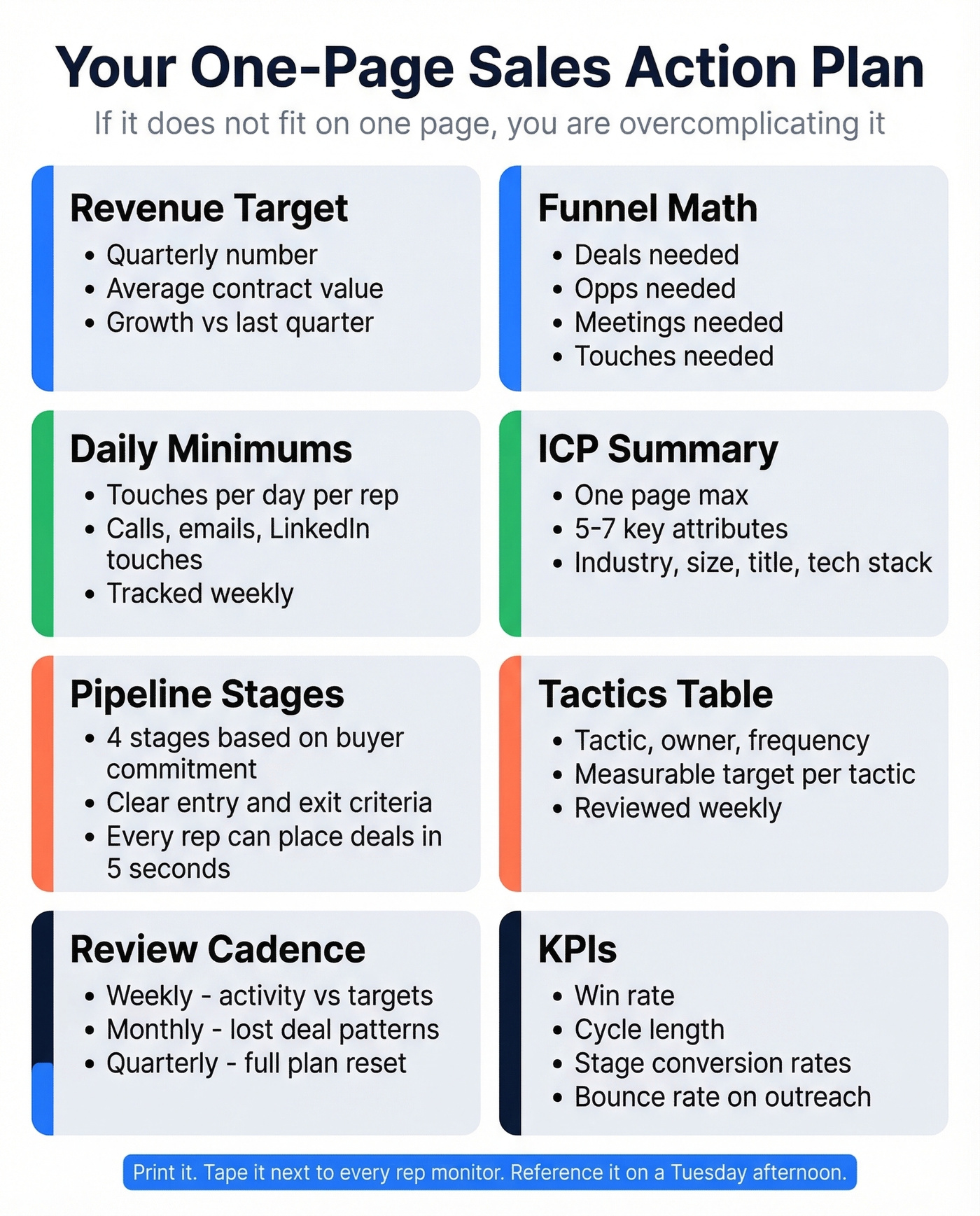
| Section | What to Include |
|---|---|
| Revenue target | Quarterly number, ACV |
| Funnel math | Deals → opps → meetings → touches |
| Daily minimums | Touches/day per rep |
| ICP summary | One-page, 5-7 attributes |
| Pipeline stages | 4 stages + entry/exit criteria |
| Tactics table | Tactic / owner / frequency / target |
| Review cadence | Weekly / monthly / quarterly |
| KPIs | Win rate, cycle length, stage conversion |
If it doesn't fit on one page, you're overcomplicating it. Print it and tape it next to every rep's monitor. A beautiful 30-page document nobody opens is worthless - the whole point is building something your reps actually reference on a Tuesday afternoon when they're deciding what to do next.
Tools That Make Execution Possible
CRM: Salesforce for enterprise, typically ~$25-$330/user/month depending on edition. HubSpot for mid-market with a free CRM tier, paid Sales Hub running ~$20-$150+/seat/month. Pipedrive for SMB velocity at ~$15-$100/user/month. The best CRM is the one your reps actually update - skip this if your team is under five people and a shared spreadsheet still works. (If you're comparing options, start with examples of a CRM.)
Verified prospect data: Prospeo covers 300M+ profiles with 98% email accuracy and 125M+ verified mobile numbers. For a team running the funnel math above, that's the difference between 1,200 touches that land and 1,200 touches where a third bounce. With 30+ search filters - including buyer intent powered by Bombora, technographics, and headcount growth signals - you can build lists that match your ICP definition precisely instead of spraying into generic firmographic segments. (If you’re tightening targeting, use firmographic and technographic data properly.)
AI assistance: 88% of reps with AI agents say it increases their odds of hitting targets. Even basic AI for email personalization and call prep saves hours per week, and the gap between teams using it and teams ignoring it is widening fast. (If you want a practical workflow, see AI cold email outreach.)
Snyk's 50 AEs cut bounce rates from 35-40% to under 5% and grew AE-sourced pipeline 180%. When your daily touch targets are reverse-engineered from revenue goals, every bounced email is lost pipeline. Prospeo's 300M+ profiles and 7-day data refresh keep your action plan grounded in reality.
Make your 20 daily touches count - start with data that connects.
FAQ
Sales plan vs. sales action plan?
A sales plan is strategic - it covers market positioning, revenue goals, and team structure. A sales action plan is tactical: specific activities, owners, and deadlines that drive daily execution. Think of the plan as your overall strategy and the action plan as the daily playbook that makes it real.
How often should you update it?
Review weekly against activity targets, adjust monthly based on conversion trends, and overhaul quarterly with fresh funnel math. If your plan doesn't adapt monthly, it's outdated by quarter's end. Teams using continuous in-year adjustments consistently outperform those running static annual plans.
What's the best 30-60-90 day structure?
Days 1-30: audit data, define ICP, set funnel math from actual conversion rates. Days 31-60: execute daily targets, track stage conversions, run your first lost-deal review. Days 61-90: optimize based on data, adjust targets, scale what works. This structure works especially well for onboarding new reps or territory transitions.
How do you set realistic activity targets?
Reverse-engineer from your revenue goal using actual conversion rates - not aspirational ones. Work backward through meeting and outreach rates to a daily number, then validate against available selling hours. If reps have 4 hours of actual selling time, 20 quality touches is realistic. Eighty isn't.
What tools do you actually need?
A CRM for pipeline tracking, a verified data source so prospect lists don't bounce, and a review cadence you actually follow. Complexity kills adoption - start with three tools and add only when you've maxed out what they offer.