

How to Write a Sales Proposal That Actually Wins
Your prospect just said "send me a proposal." You've got 48 hours. Maybe less. And here's the uncomfortable truth: only 47% of sellers win the deals they propose. More than half of every proposal ever written ends up ignored, rejected, or ghosted.
Knowing how to write a sales proposal that wins isn't about talent. It's structure, research, and follow-up.
Quick Version: Anatomy of a Winning Proposal
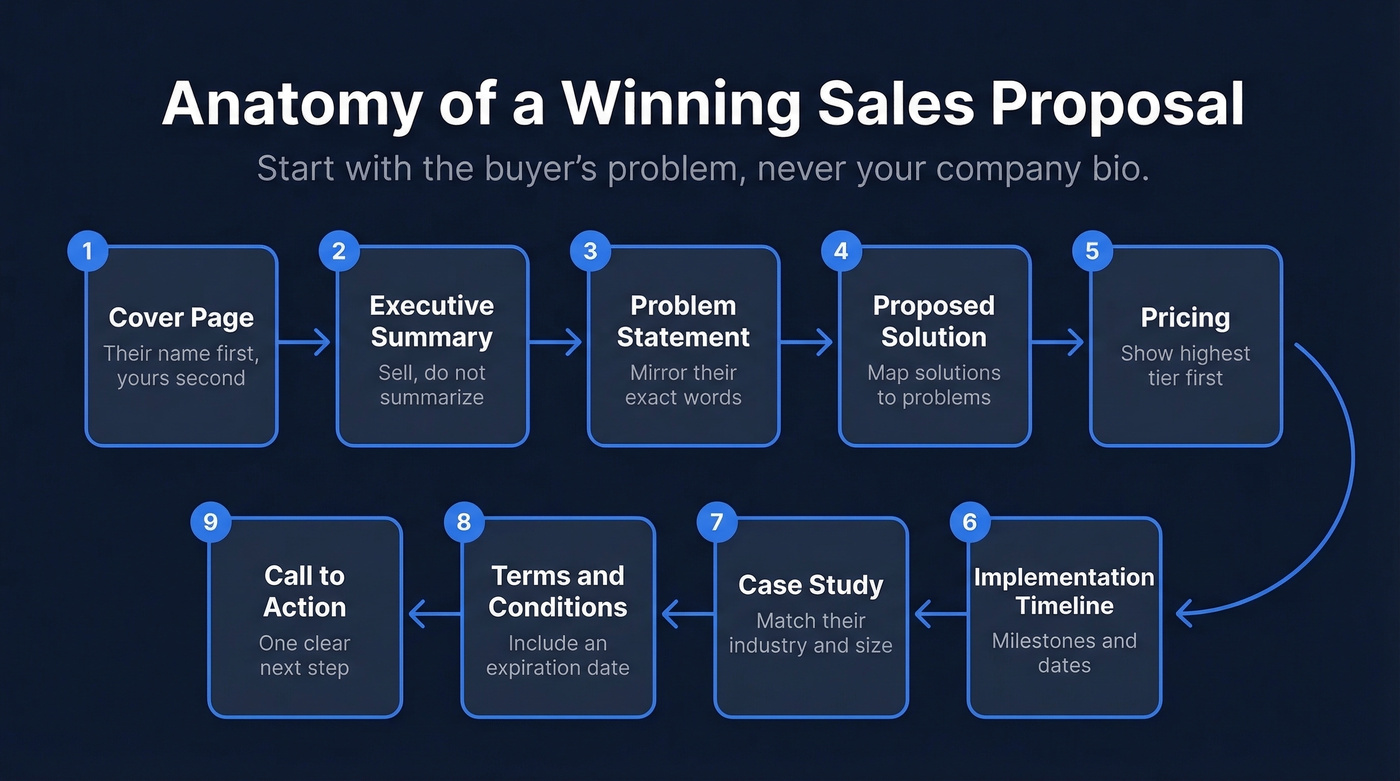
A winning sales proposal has nine sections - cover page through call to action - and it starts with the buyer's problem, never your company bio. Present pricing with confidence; buyers want it earlier than you think. Send it to verified stakeholders, not guessed email addresses. Follow up within 24-48 hours, because that first follow-up alone boosts reply rates by 49%.
What Is a Sales Proposal?
A sales proposal sits in the middle of your sales cycle - after discovery and qualification, before negotiation and close. It's not a quote, which is just numbers. It's not an RFP response, which is reactive. A sales proposal is proactive: you're packaging everything the buyer needs to say yes into one document.
When paired with e-signatures, it can function as a binding contract. That changes how you think about terms, scope, and precision.
What Separates Winning Proposals
Process maturity beats tools. Every time.
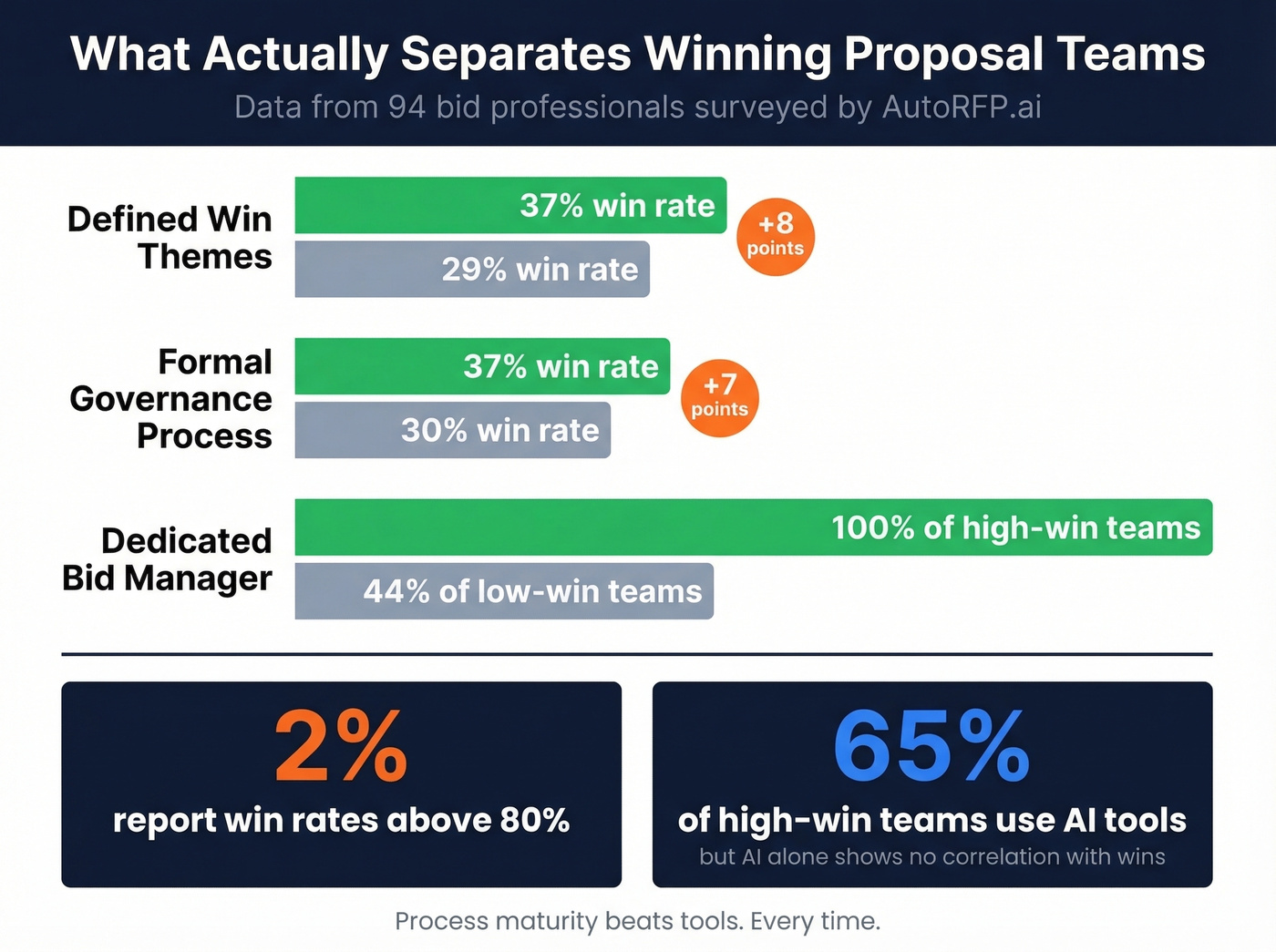
An AutoRFP.ai survey of 94 bid professionals found that teams with defined win themes averaged a 37% win rate versus 29% without - an 8-point lift from simply having a repeatable framework. Formal governance processes showed a similar gap: 37% vs 30%. And 100% of high-win teams (above 51% win rate) had at least one dedicated bid manager, while only 44% of low-win teams could say the same.
Winning is genuinely rare. A 2026 Flowcase report found just 2% of firms report win rates above 80%. At the other end, 4% reported rates below 10%. Meanwhile, 65% of high-win teams use AI proposal technology, but AI alone shows no independent correlation with wins. Tools help you move faster, but the proposal process underneath is what actually closes deals.
Before You Write: Research Your Prospect
Every proposal guide tells you to "research your buyer." Here's what that actually looks like in practice: before drafting anything, you need to know who's on the buying committee, what their titles are, which departments have budget authority, and whether the email addresses you have are still active. This is where most proposals quietly die - you spend hours crafting the perfect document, then send it to a contact who left the company six months ago.
We use Prospeo's B2B database for this step. Thirty-plus filters - job title, department, company size, headcount growth - let you map every stakeholder on the buying committee, then verify their emails before sending. The 98% email accuracy and 7-day data refresh cycle mean you're working with current contacts, not stale CRM records. The free tier gives you 75 verified emails per month, which is plenty for pre-proposal research on a single deal.

Consider the stakes: per Time magazine, 55% of people spend fewer than 15 seconds actively reading any piece of content. If your proposal lands in the wrong inbox, those 15 seconds go to zero.

Half of all proposals lose because they reach the wrong person. Before you spend hours writing, map the entire buying committee with Prospeo's 30+ filters and verify every email with 98% accuracy. Data refreshes every 7 days, so you're never sending to someone who left six months ago.
Send your next proposal to verified decision-makers, not dead inboxes.
Step-by-Step: Writing Your Sales Proposal
Think of your proposal as a story arc: challenge, solution, resolution. Every section below moves the buyer one step closer to "yes."
Cover Page
Prospect's company name goes first. Yours goes second. Clean design, no clutter, no stock photos of handshakes. The cover page signals this document was built for them, not pulled from a template library.
Executive Summary
This is the section most people get wrong. An executive summary should sell, not summarize. Use the five-part framework: Opener, Need, Solution, Evidence, Call to Action. Open with the prospect's situation, articulate the need you uncovered in discovery, present your solution in one paragraph, back it with a proof point, and close with a clear next step.
In our experience, the executive summary gets 80% of the attention. Treat it like a standalone pitch.
Problem Statement
Mirror the prospect's own words from your discovery calls. If they said "our reps waste two hours a day on manual data entry," don't rewrite that as "operational inefficiencies in the sales workflow." Start with their pain, not your capabilities.
Proposed Solution
Map each solution element to a specific problem from the previous section. "Reduce churn by 15% within 6 months" beats "improve customer satisfaction" every time. Measurable outcomes give the buyer something to take to their CFO.
Pricing
Here's the thing: 58% of buyers want to discuss pricing on the first call, but only 23% of sales reps bring it up. Don't bury pricing on page 12. Make it the clearest section in the document.
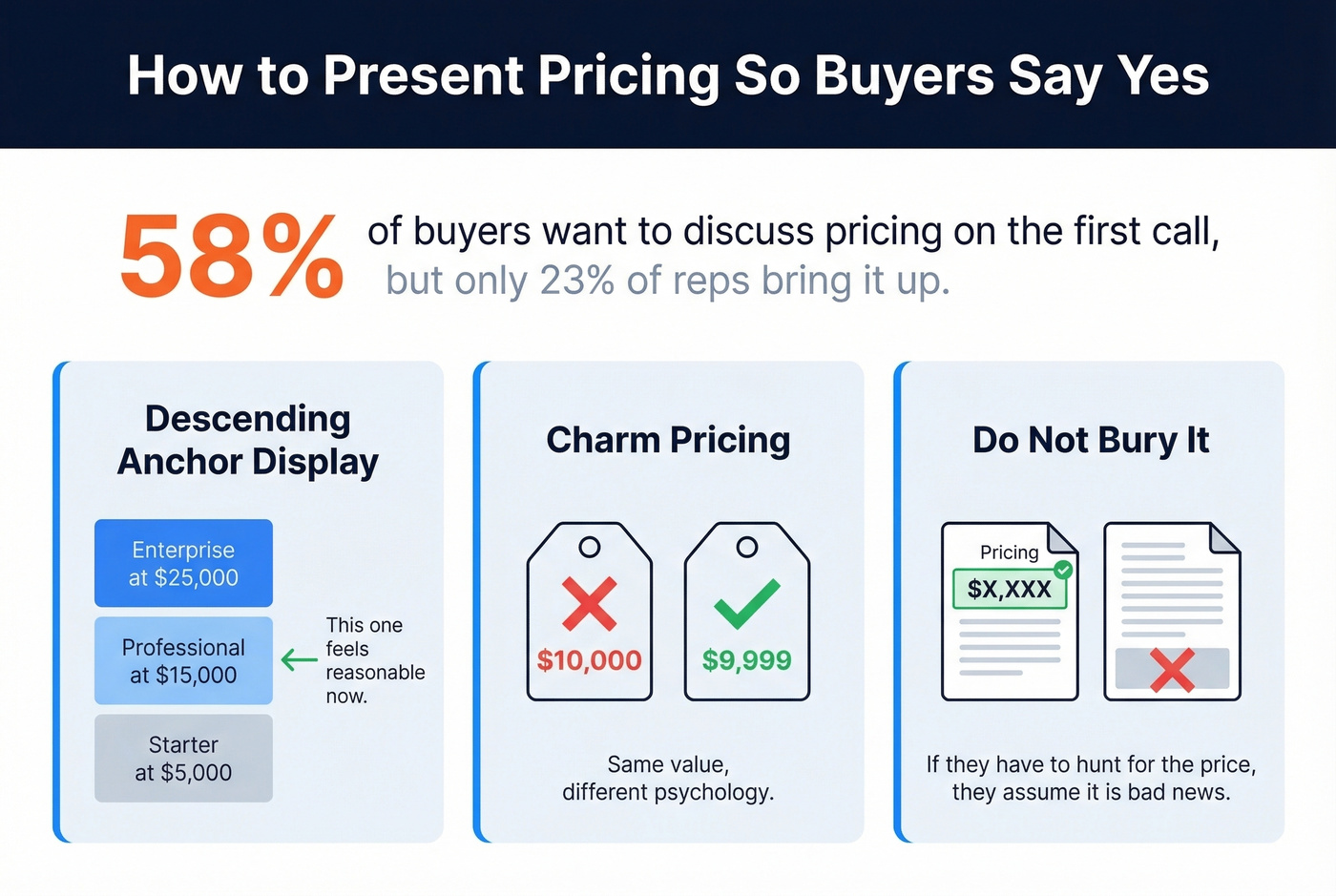
Show your highest tier first - anchoring works. Use descending-anchor display so the option you want them to pick feels reasonable by comparison, and consider charm pricing. $9,999 lands differently than $10,000. (If you want to go deeper on this, see anchoring in negotiation.)
Implementation Plan & Timeline
Milestones, deliverables, dates. "Phase 1: onboarding complete by Week 2. Phase 2: first campaign live by Week 4." Specificity builds trust. Vague timelines signal you haven't thought this through.
Case Studies & Social Proof
One relevant case study beats five generic logos. Match industry and company size to the prospect. If you're pitching a 200-person SaaS company, don't lead with your Fortune 500 case study.
Terms & Conditions
Payment terms, scope boundaries, validity period. With e-signatures, this proposal can become a binding contract - make sure legal has reviewed your standard terms and include an expiration date.
Call to Action
One clear next step. "Sign by [date]" or "Book a 15-minute walkthrough to finalize details." Never end with "let us know your thoughts." That's not a CTA - it's an invitation to procrastinate.
Copy-Ready Sales Proposal Template
Use this skeleton as your starting point. Replace the bracketed text with your deal specifics.
Cover Page Prepared for: [Prospect Company Name] Prepared by: [Your Name], [Your Company] Date: [Date]
Executive Summary [Prospect Company] is facing [core problem from discovery]. Based on our conversations with [champion name], we propose [one-sentence solution] to achieve [primary measurable outcome] within [timeframe].
Problem Statement [2-3 sentences using the prospect's own language from discovery calls. Quote them directly where possible.]
Proposed Solution [Feature/service 1] → solves [Problem 1], expected impact: [metric] [Feature/service 2] → solves [Problem 2], expected impact: [metric]
Pricing [Tier name]: $[amount]/[period] - includes [scope summary] [Optional second tier for anchoring]
Implementation Timeline Week 1-2: [Onboarding milestone] Week 3-4: [First deliverable milestone] Week 5+: [Ongoing support/optimization]
Case Study [Company similar to prospect] achieved [result] in [timeframe] using [your solution].
Terms & Conditions Payment: [Net 30 / upon signing / milestone-based] Scope: [What's included and excluded] Validity: This proposal expires on [date].
Next Step [Single clear CTA: "Sign below by [date]" or "Book your kickoff call: [link]"]
Hot take: If your deal size is under $10k, this template in a clean Google Doc will outperform any $35/month proposal tool. Fancy software doesn't fix bad content - it just makes bad content prettier.
Mistakes That Kill Proposals
We've reviewed enough proposals to see the same patterns tank deals repeatedly. These seven hurt the most:
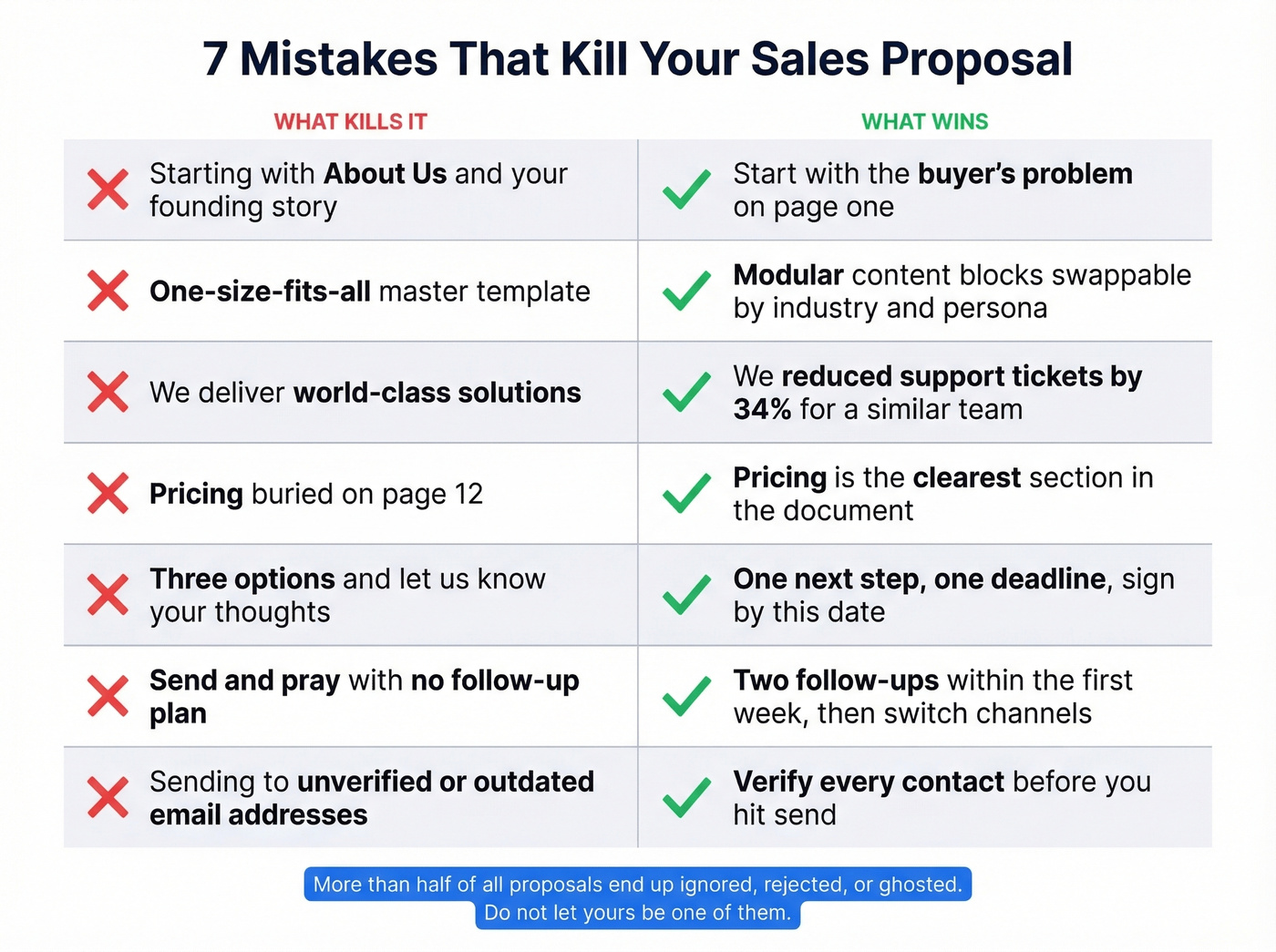
- Starting with "About Us." Nobody cares about your founding story on page one. Start with the buyer's problem.
- Using one-size-fits-all templates. Modular content blocks - swappable by industry, persona, and deal size - beat a single master template.
- Fluff value props. "We deliver world-class solutions" means nothing. "We reduced support ticket volume by 34% for a similar-sized team" means everything.
- Burying pricing. If the buyer has to hunt for your price, they'll assume it's bad news.
- No clear CTA. One next step. One deadline. Not three options.
- No follow-up plan. Sending a proposal and waiting is not a strategy. (Use a repeatable sequence instead.)
- Sending to unverified contacts. A proposal that lands in a dead inbox is worse than no proposal at all. Verify every address before you hit send.
You nailed the proposal. Now nail the follow-up. Prospeo gives you verified emails and direct mobile numbers for every stakeholder on the deal - 125M+ verified mobiles with a 30% pickup rate. When your first follow-up boosts reply rates by 49%, reaching the right person on the first try changes everything.
Stop following up with gatekeepers. Get direct lines to decision-makers.
What to Do After You Hit Send
The data here is clear. A first follow-up email boosts reply rates by 49%. The second adds another 3%. But the third actually decreases your chance of a reply by 30%. Two follow-ups is the sweet spot - and 48% of reps never even send one. That's at least one lost deal per quarter for most reps.
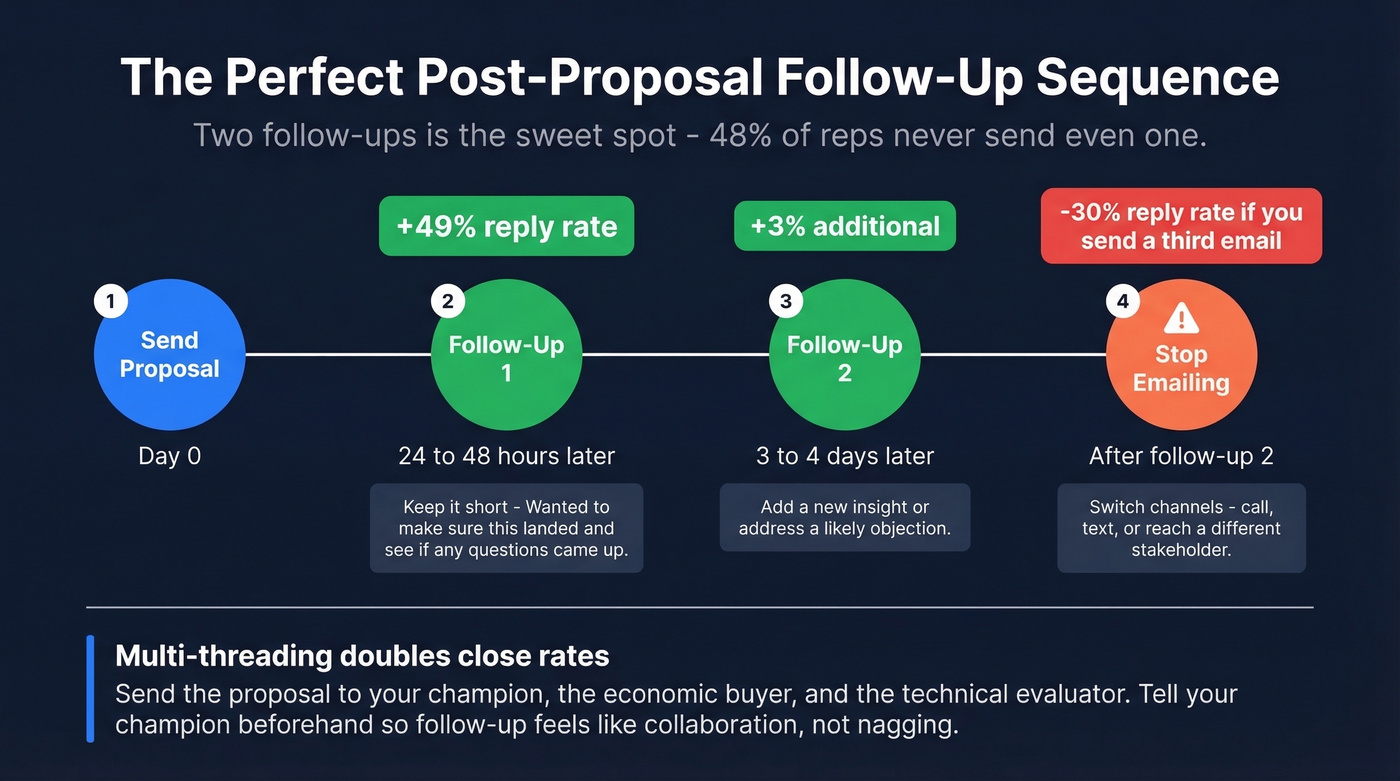
Follow up within 24-48 hours. Keep it short: "Wanted to make sure this landed and see if any questions came up." Second follow-up three to four days later, adding a new insight or addressing a likely objection. After that, switch channels - call, text, or reach out to a different stakeholder. (If you want copy you can paste, use these sales follow-up templates.)
Let's be honest about multi-threading: it doubles close rates. When more than one stakeholder views a proposal, the close rate doubles. Send the proposal to your champion, but also share it with the economic buyer and the technical evaluator. Tell your champion beforehand: "I'll check in tomorrow to walk through the numbers together." That reframes the follow-up from nagging to collaboration. (More on selling to multiple stakeholders: technical buyer vs economic buyer.)
Best Proposal Software Tools
You don't need proposal software to close deals. A well-structured Google Doc beats a beautiful template with bad content every time. But tracking opens, collecting e-signatures, and seeing which sections buyers spend time on - that gives you intelligence for the follow-up. Interactive proposals, where buyers click through a web-based document rather than scrolling a PDF, are becoming the default for mid-market and enterprise deals. (This overlaps with the idea of a digital sales room.)
| Tool | Starting Price | Best For |
|---|---|---|
| Proposify | From $29/user/mo | Proposal analytics |
| PandaDoc | From $35/mo | E-sign + CRM integration |
| Better Proposals | From $19/user/mo | Bootstrapped teams |
| Qwilr | From $35/user/mo | Interactive web proposals |
| GetAccept | From $49/mo | Full deal room experience |
| Oneflow | Free (limited) | Budget-conscious starters |
| Prospero | From $10/mo | Simple, low-volume deals |
| Proposally.ai | From $9/mo | AI-assisted first drafts |
For most sales teams, PandaDoc or Proposify is the safest bet - both have strong analytics and CRM integrations. If you want a full digital sales room with video, chat, and proposal tracking in one place, GetAccept is worth a look. Skip the paid tools entirely if you're closing fewer than five deals a month - a Google Doc or Canva template is genuinely fine.
FAQ
How long should a sales proposal be?
SMB deals: 2-4 pages. Mid-market: 5-8 pages. Enterprise: 10-15+. Match length to deal complexity - every page needs to earn its place. If a section doesn't move the buyer closer to "yes," cut it.
Should I send a PDF, slide deck, or interactive proposal?
PDFs work for straightforward deals under $15k. Slide decks suit live presentations. Interactive platforms like Proposify or Qwilr let you track opens and time-on-page across multiple stakeholders - critical for multi-threaded deals where you need to know who's actually reading.
When should I follow up after sending a proposal?
First follow-up within 24-48 hours - that alone boosts reply rates by 49%. Send a second touch 3-4 days later with a new insight or objection-handler. Two follow-ups is the sweet spot; a third actually decreases reply likelihood by 30%.
What's the difference between a sales proposal and an RFP response?
A sales proposal is proactive - you create it after discovery to pitch on your terms. An RFP response is reactive - the buyer defines the format and criteria. Writing a proactive proposal gives you control over the narrative, the structure, and the pricing presentation in a way that responding to someone else's template never can.