

The Forrester Wave for Sales Engagement: What It Found, Why It's Outdated, and What Replaced It
You're a VP of Sales trying to benchmark your tech stack, so you pull up the Forrester Wave sales engagement report - and hit a wall. Every public source is either a gated PDF or a vendor press release claiming they "won." The actual report costs thousands. And here's the part nobody tells you upfront: the standalone Sales Engagement Wave isn't the current lens anymore. Forrester moved to a new category in 2024 called revenue orchestration.
Let's break down what the 2022 report actually found, why Forrester retired it, and what you should be evaluating instead.
The short version: the 2022 Forrester Wave for sales engagement evaluated 13 vendors across 30 criteria, with Outreach and Groove publicly confirmed as Leaders. The successor is the Forrester Wave: Revenue Orchestration Platforms for B2B, Q3 2024 - 12 vendors, 29 criteria. If you're making a buying decision in 2026, that's the report that matters.
What the 2022 Sales Engagement Wave Found
Forrester's 2022 Sales Engagement Wave landed when 66% of companies were operating in remote or hybrid environments, and sales teams needed platforms that could orchestrate multichannel outreach without in-person coaching. Thirteen vendors were scored across 30 criteria.
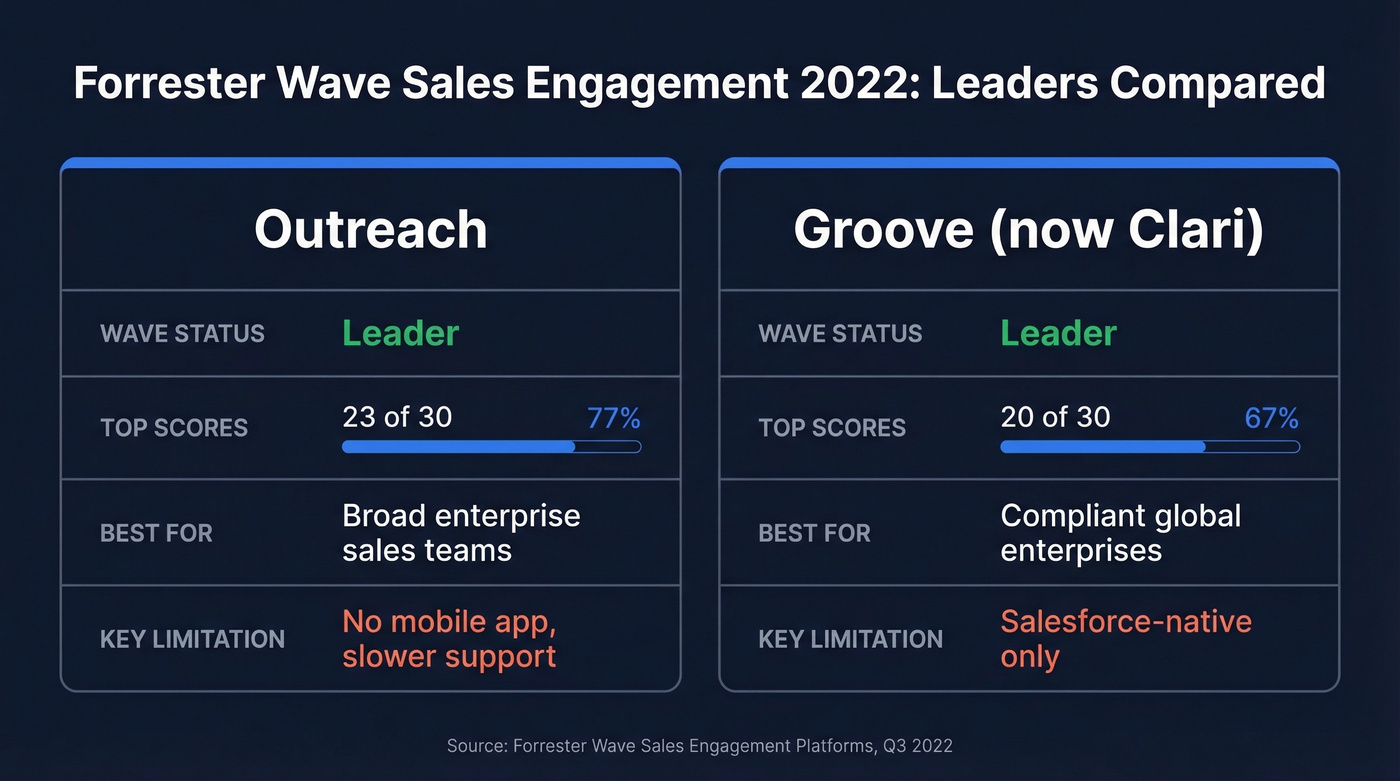
Two Leaders publicly shared detailed scoring takeaways:
Outreach received the highest possible scores in 23 of 30 criteria. Forrester also flagged Outreach's most notable gap as mobile - it was one of the few vendors without a mobile app - and noted longer-than-average response and resolve times for support tickets. On Gartner Peer Insights, Outreach sits at 4.5 stars across 185 ratings.
Groove (now part of Clari) earned the highest possible scores in 20 criteria. Forrester called it "best for global enterprises seeking to better understand buyer interactions and optimize seller productivity in highly compliant industries." The catch? Groove was Salesforce-native only. If your org ran a different CRM, it wasn't an option.
| Outreach | Groove (Clari) | |
|---|---|---|
| Wave Status (2022) | Leader | Leader |
| Top Scores | 23 of 30 | 20 of 30 |
| Best For | Broad enterprise sales teams | Compliant global enterprises |
| Key Limitation (2022) | No mobile app, slower support | Salesforce-native only |
| Approx. Pricing | ~$100-500/user/mo | Now bundled with Clari |
Forrester also flagged category-wide gaps: limited marketing integrations, content creation as a persistent hole, and enterprise adoption as the next growth frontier. These gaps turned out to be the exact forces that killed the category as a standalone evaluation.
Why the Sales Engagement Wave Is Outdated
Even before the 2022 Wave published, Forrester was signaling that the category's boundaries were dissolving. Their "single pane of glass" thesis argued that sales engagement platforms were absorbing conversation intelligence, next-best-action recommendations, and deal scoring - while marketing automation, sales enablement, and revenue intelligence vendors encroached from the other direction.
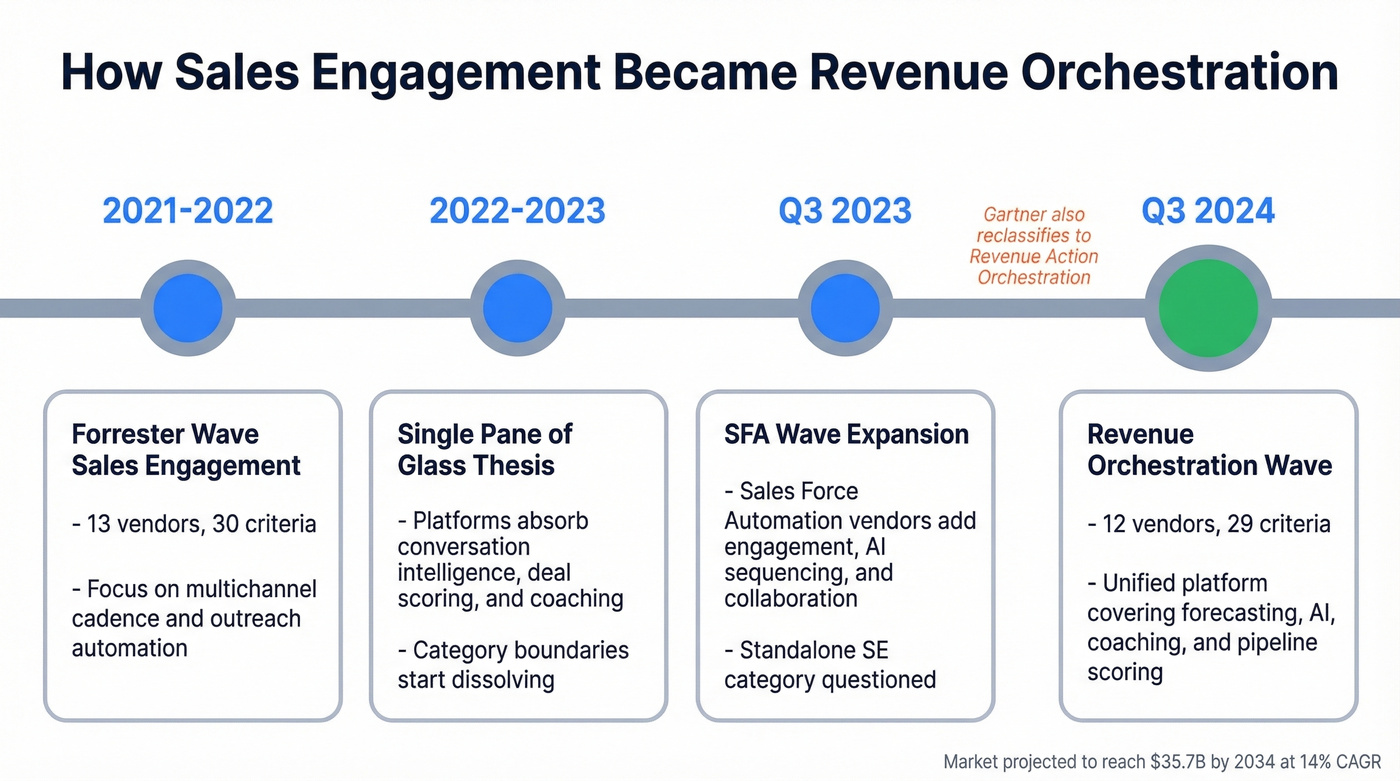
By Q3 2023, Forrester's SFA Wave explicitly positioned Sales Force Automation as the foundational layer, noting SFA vendors had expanded into engagement experiences, embedded collaboration, AI-driven sequencing, and coaching. RevOps communities have been debating whether sales engagement still exists as a standalone market since then. The analysts answered with a new category.
Gartner made the same call. Their Peer Insights page now labels the market as "Sales Engagement Applications (Transitioning to Revenue Action Orchestration)". The market - valued at $9.6B in 2024 and projected to hit $35.7B by 2034 at a 14% CAGR - isn't shrinking. It's being absorbed into something bigger.

Forrester evaluated sales engagement platforms on 30 criteria - but none of them scored the data layer underneath. Prospeo refreshes 300M+ profiles every 7 days with 98% email accuracy. That's the foundation no Wave report accounts for, at $0.01 per lead instead of $100+/user/month.
Stop paying six figures for platforms built on stale data.
The 2024 Replacement: Revenue Orchestration
Forrester's answer arrived in Q3 2024: The Forrester Wave: Revenue Orchestration Platforms for B2B. Twelve vendors, 29 criteria, and three evaluation themes: unified user experiences, impactful AI capabilities, and revenue management covering forecasting, guidance, coaching, and pipeline/deal scoring.
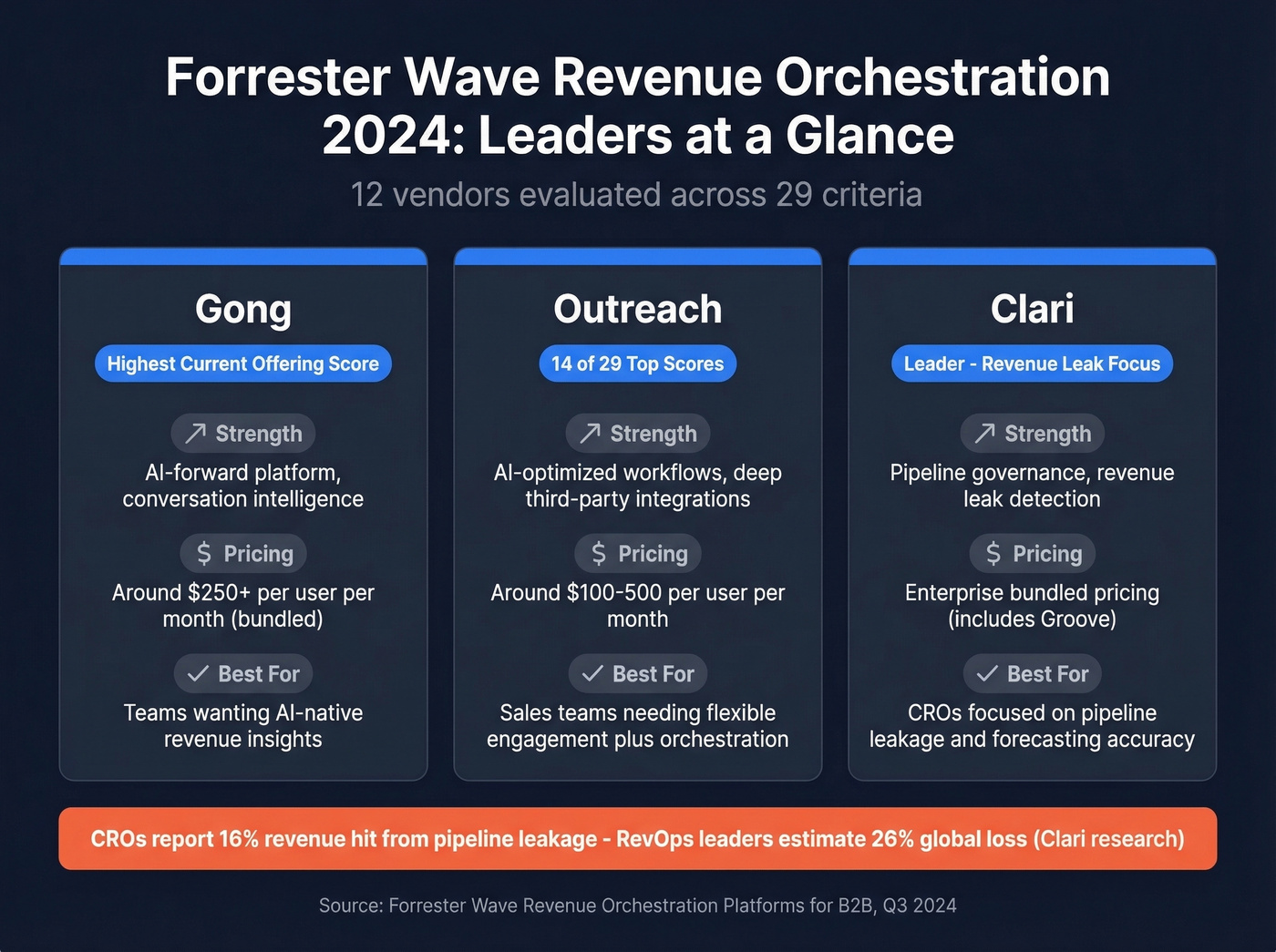
The results reshuffled the deck.
Gong earned the highest Current Offering score, positioning itself as the AI-forward option at around $250+/user/month in bundled configurations. Outreach received the highest possible scores in 14 of 29 criteria, with Forrester highlighting its AI-optimized workflows and third-party integration ecosystem. Clari was named a Leader, leaning into the revenue leak problem - their research shows CROs report a 16% revenue hit from pipeline leakage, with RevOps leaders estimating a 26% global loss.
These aren't cadence tools anymore. They're full-stack revenue platforms priced accordingly, and the gap between what a 50-person SDR team needs and what these platforms sell has never been wider.
What This Means for Buyers in 2026
Don't base a 2026 purchasing decision on a 2022 report. The more practical question: does your team need full revenue orchestration - forecasting, conversation intelligence, deal scoring - or do you primarily need engagement automation with solid data underneath?
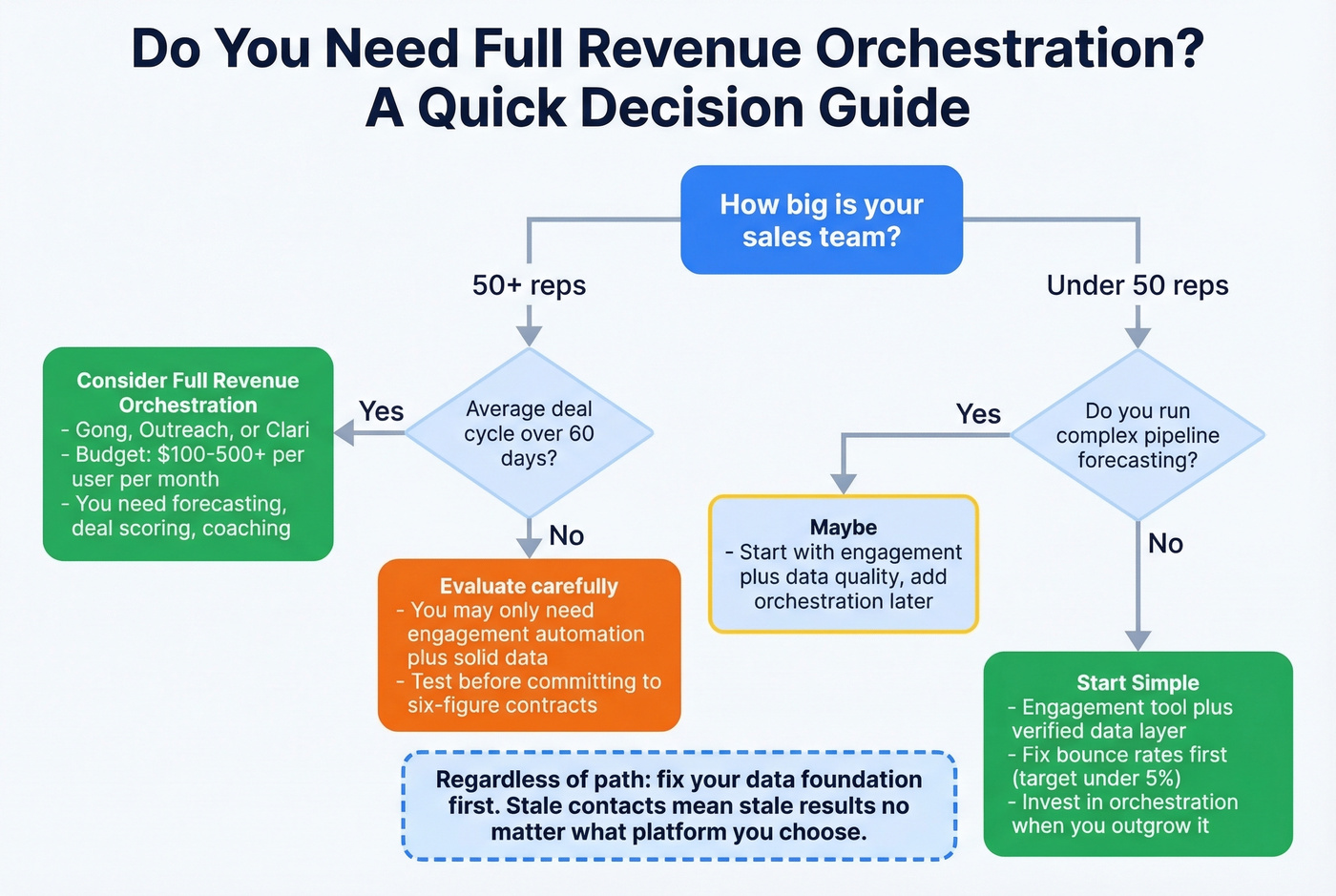
In our experience, that distinction maps more to team size and average deal value than to feature checklists. If you're not running complex forecasting and pipeline governance, you probably don't need a six-figure orchestration platform. A team of 10 SDRs doing outbound to mid-market accounts has fundamentally different needs than a 200-person enterprise sales org managing $500K+ deals through 9-month cycles.
Here's the thing nobody in these analyst reports addresses: the data layer. We've seen orgs deploy six-figure orchestration platforms and still hit double-digit bounce rates because the underlying contact data was stale. Your sequencing engine, your AI recommendations, your deal scoring - all of it depends on whether you're actually reaching real people at valid email addresses. Prospeo runs a 7-day data refresh cycle across 300M+ profiles with 98% email accuracy, at roughly $0.01 per lead. That's the foundation layer beneath any platform choice, and it costs a fraction of what these Wave vendors charge.
If you want to pressure-test that foundation, start with email bounce rate benchmarks and an email deliverability checklist before you buy another platform.
Skip the full orchestration stack if your team is under 50 reps and your deal cycles are under 60 days. You'll get more ROI from nailing data quality and a simpler engagement tool than from paying for forecasting features you won't use for another two years. If you're rebuilding your outbound motion, a tighter sales prospecting system and better sequence management usually beat adding more software.
Teams running Outreach, Gong, or Clari still hit 30%+ bounce rates when contact data decays. Prospeo's 7-day refresh cycle and 5-step verification keep your sequences hitting real inboxes - whether you're 10 SDRs or 200. One customer cut bounce rates from 35% to under 4%.
Your engagement stack is only as good as the emails feeding it.
FAQ
Is there a 2026 Forrester Wave for sales engagement?
No. Forrester retired the standalone sales engagement evaluation. The current report is The Forrester Wave: Revenue Orchestration Platforms for B2B, Q3 2024, covering 12 vendors across 29 criteria. There's no indication a separate Sales Engagement Wave will return.
What changed from sales engagement to revenue orchestration?
Sales engagement focused on multichannel outreach and cadence automation. Revenue orchestration adds conversation intelligence, forecasting, deal scoring, and AI-driven next-best-actions into a unified platform - essentially merging three or four previously separate tool categories into one buying decision.
How do I improve results regardless of platform?
Start with data quality. If your email bounce rate exceeds 5%, no orchestration platform will compensate. Teams like Snyk cut bounce rates from 35-40% to under 5% and saw AE-sourced pipeline jump 180% after fixing their data foundation. Fix the data first, then optimize the workflows.