

Free Bulk Email Validation: 10 Best Tools and What "Free" Actually Gets You
Your ESP just suspended your sending account. Bounce rate hit 8%, and now you're staring at a list of 20,000 contacts wondering how many are dead. Nearly 1 in 6 marketing emails never reach the inbox, and the industry standard is clear: keep your total bounce rate under 2%. Free bulk email validation sounds great - until you realize most tools cap their free tier at 100 emails. That's not bulk. That's a taste test.
Here's the thing: if your bounce rate is above 5%, the verifier isn't your problem - your data source is. Fix the source and the symptom disappears. Most teams would save money switching to pre-verified data instead of paying to clean dirty lists every quarter.
Below, we break down what's actually available for free, what these tools really cost at scale, and which ones are worth paying for.
Our Picks (TL;DR)
| Pick | Tool | Why |
|---|---|---|
| Best if you need verified emails, not just verification | Prospeo | Emails come pre-verified at 98% accuracy. Skip the verification step entirely. Free: 75 emails/mo. |
| Best standalone bulk verifier | ZeroBounce | 100 free/mo, strong accuracy. The safe default. |
| Best value per verification | Kickbox | Transparent pay-as-you-go pricing, and unknowns are free. GDPR compliant. |
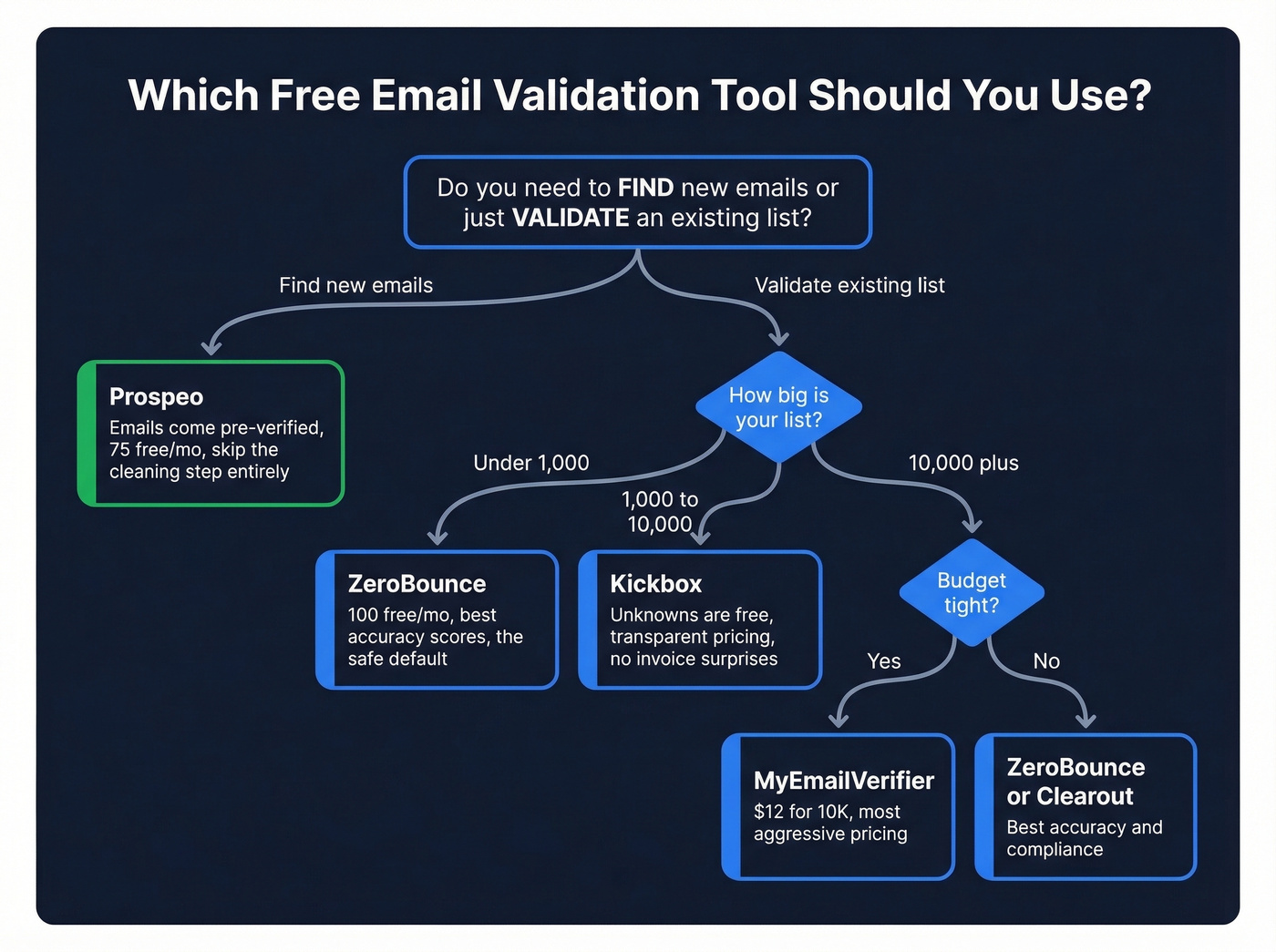
Prospeo is a different animal - it's a B2B data platform where verification is baked into the email-finding process. You're not cleaning a dirty list; you're starting with clean data. ZeroBounce is the workhorse most teams default to. Kickbox wins on pricing transparency, especially their policy of not charging for unknown results.
What "Free Bulk" Actually Means
Email lists decay by 25%+ per year. People change jobs, domains expire, inboxes get abandoned. Every marketer eventually needs a bulk email verification tool - but there's a big gap between "free single lookup" and "free bulk credits" where you can upload a CSV and clean thousands. Most tools offer the former generously and the latter sparingly.
If you’re trying to protect sender reputation, free tiers are usually only enough to spot-check a source - not clean a real campaign list.
One warning: Reddit threads promoting "free validation tools" are often thinly veiled marketing for unknown verifiers. Stick with established tools that publish their methodology.
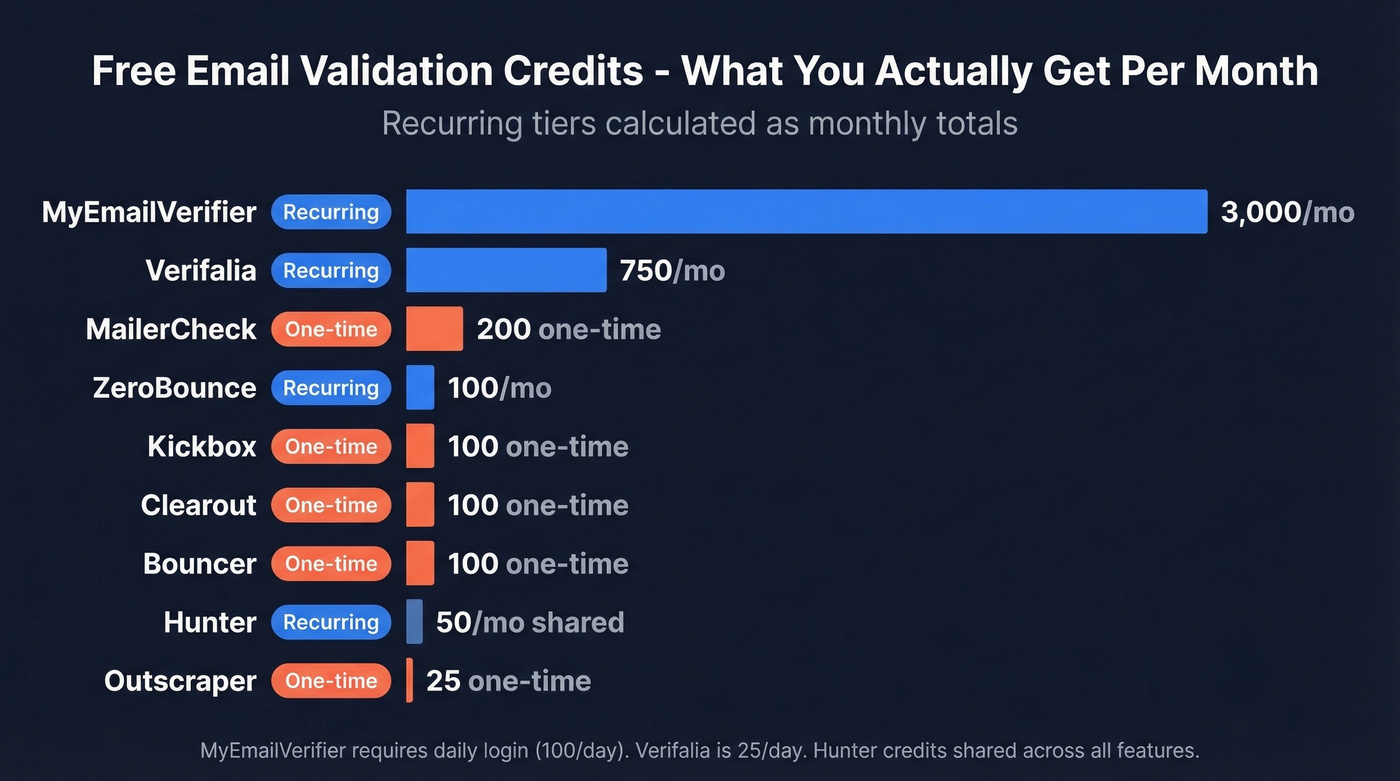
Here's how every tool's free tier actually breaks down:
| Tool | Free Tier | Recurring? | Credits Expire? |
|---|---|---|---|
| ZeroBounce | 100/mo | Yes, monthly | Monthly reset |
| Kickbox | 100 one-time | No | - |
| Clearout | 100 on signup | No | Never expire |
| MyEmailVerifier | 100/day | Yes, daily | Daily reset |
| Verifalia | 25/day (~750/mo) | Yes, daily | Daily reset |
| Hunter | 50 credits/mo (shared) | Yes, monthly | Monthly reset |
| MailerCheck | 200 on signup | No | Never expire |
| Bouncer | 100 on signup | No | Never expire |
| Outscraper | 25 one-time | No | - |
The recurring tiers from MyEmailVerifier and Verifalia look generous on paper. MyEmailVerifier's 100/day adds up to ~3,000/month if you log in every single day. Verifalia's 25/day gets you ~750/month. But for a real bulk clean of 10K+ contacts, you're paying. That's just the reality.
Best Free Bulk Email Validation Tools
ZeroBounce: The Safe Default
In Clay's non-catch-all verifier test, ZeroBounce scored 99.25% data quality and 99.37% coverage - the strongest numbers in that dataset. That's why it's the tool most teams reach for first.
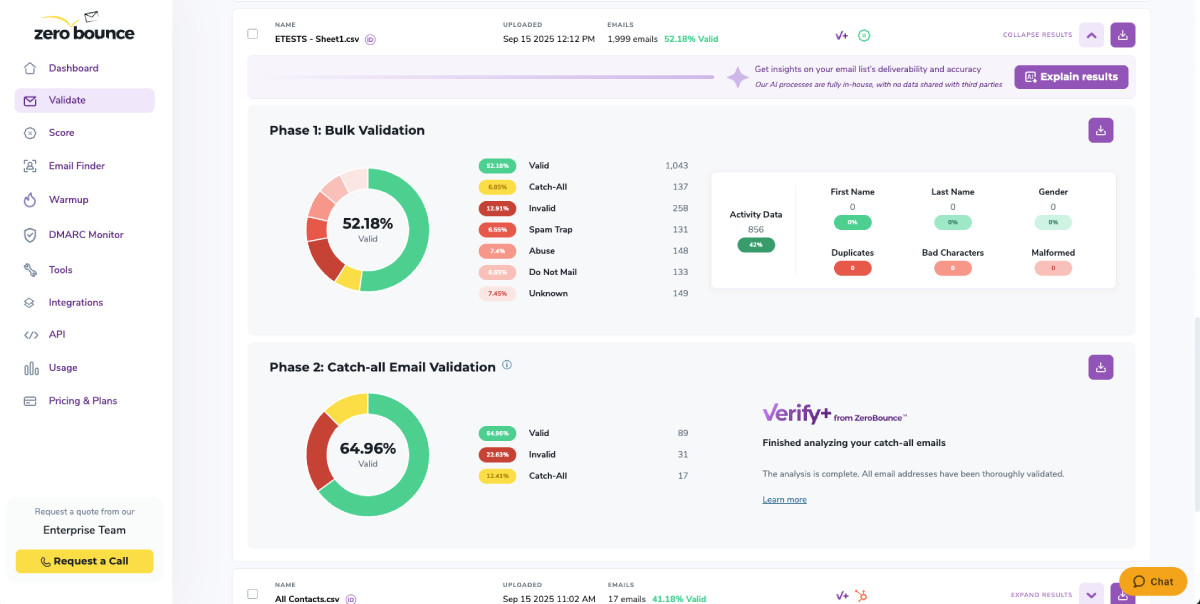
You get 100 free validations per month when you sign up with a business or premium domain. Pay-as-you-go credits never expire, though verification results expire after 30 days. ZeroBounce ONE starts at $99/month and includes a minimum of 10,000 credits, with pay-as-you-go options for smaller volumes. Beyond simple valid/invalid classification, the platform includes spam-trap detection, abuse email detection, and an email scoring API.
If you’re troubleshooting bounces, it helps to understand bounce codes and benchmarks before you blame the tool.
Use this if: You want a reliable verifier with strong accuracy and don't mind paying typical mid-market rates at scale.
Skip this if: You're on a tight budget and need the absolute cheapest per-verification cost.
Kickbox: Unknowns Are Free (Seriously)
Every other verifier charges you when they can't determine if an email is valid. Kickbox doesn't. If they can't give you a definitive answer, you don't burn a credit. That single policy makes their published pricing genuinely fair: $5 for 500, $10 for 1,000, scaling down to $4,000 for 1M verifications.
You get 100 free credits on signup - one-time, not recurring. They're GDPR compliant and SOC II certified. In a 2026 benchmark of 15 tools, Kickbox scored 67.53% overall accuracy, placing third. That benchmark has a bias caveat worth noting (more on that below), but Kickbox's real strength is pricing predictability, not raw accuracy numbers.
Use this if: You run regular list cleans on a budget and hate invoice surprises.
Skip this if: You need a recurring free tier - Kickbox's 100 credits are one-and-done.
Prospeo: Pre-Verified at the Source
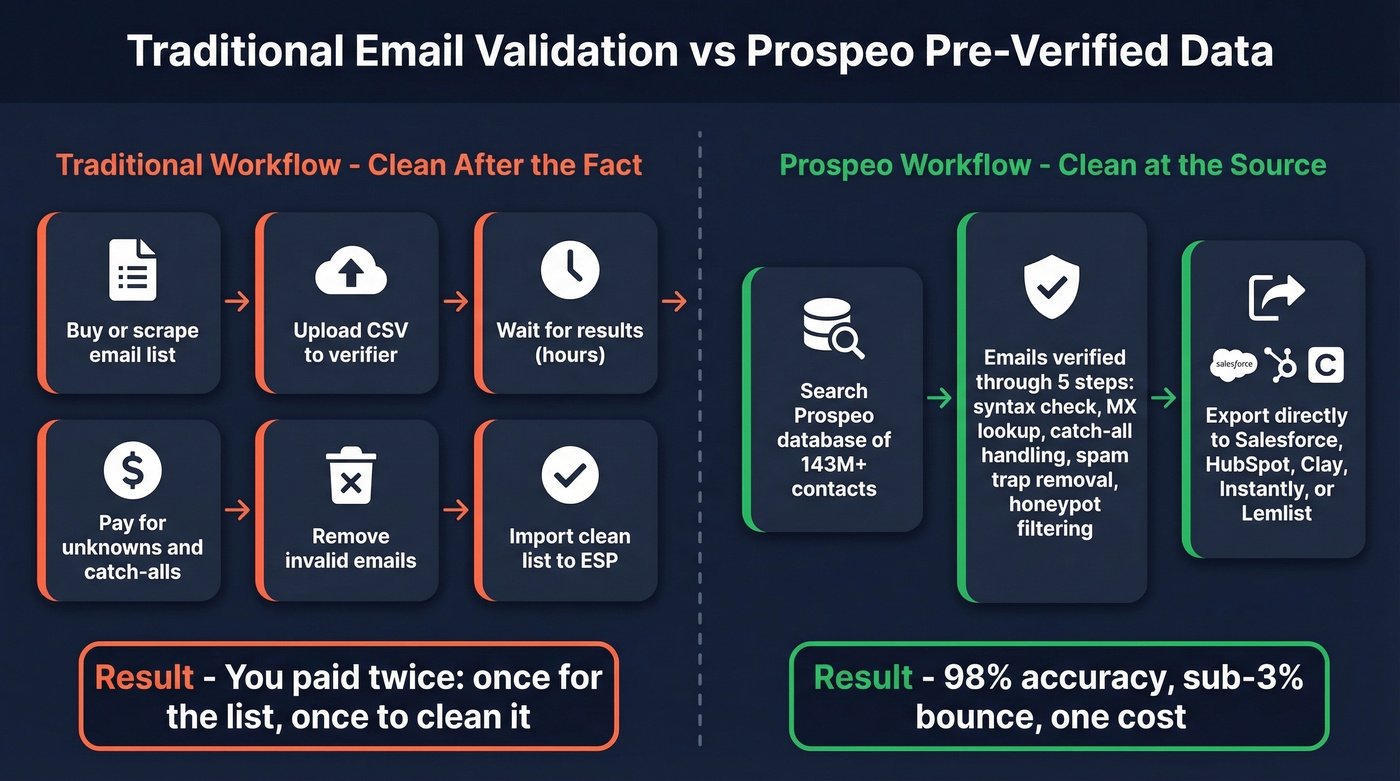
Most email validation tools solve a symptom: you have bad data, so you clean it. Prospeo fixes the source. Every email in its database of 143M+ verified addresses goes through a 5-step verification process - catch-all handling, spam-trap removal, honeypot filtering - before it ever reaches your export. That's a fundamentally different approach than running a CSV through a checker after the fact.
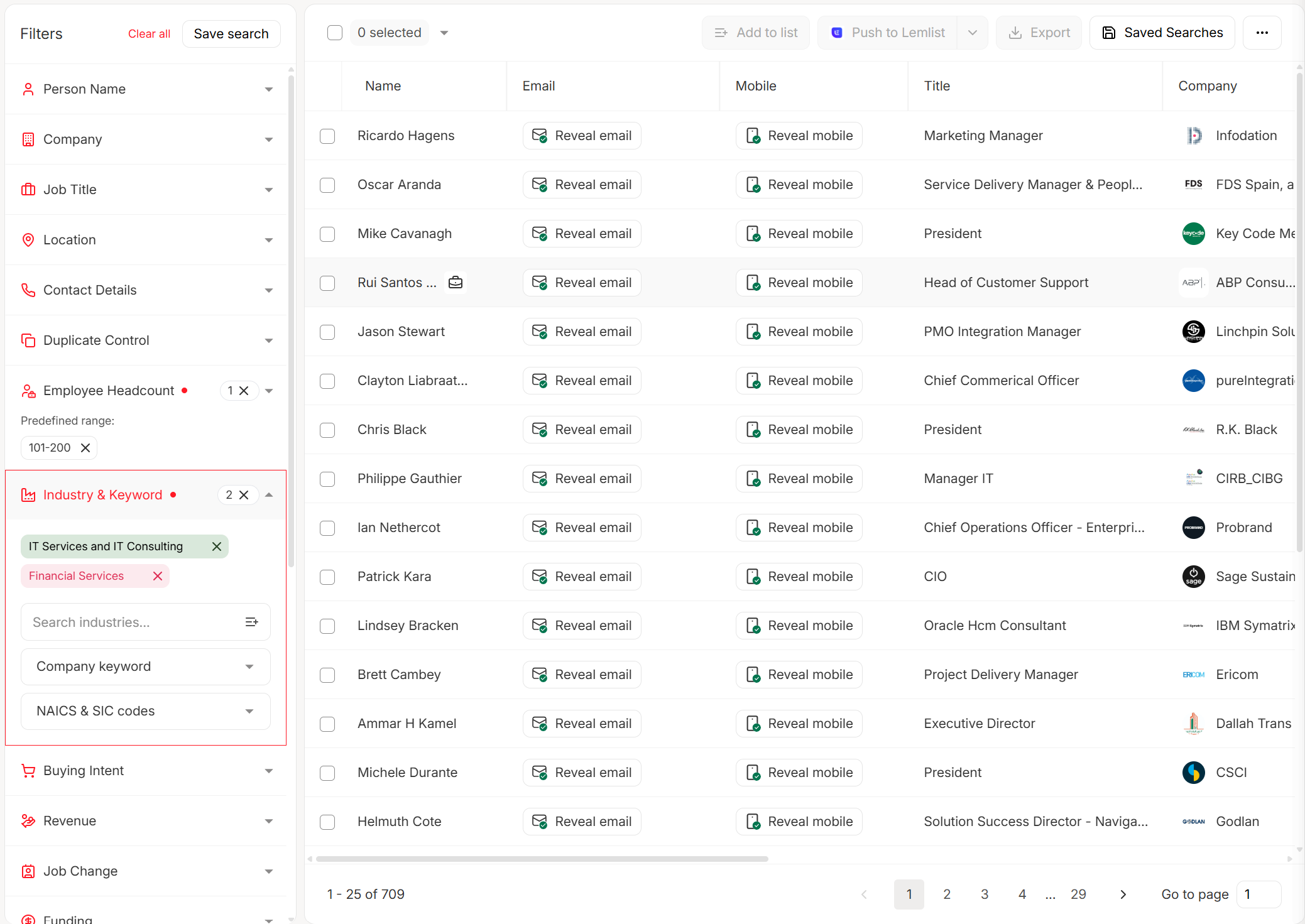
The free tier gives you 75 verified emails per month plus 100 Chrome extension credits. Paid plans run ~$0.01 per email. Integrations cover Salesforce, HubSpot, Clay, Instantly, and Lemlist. Stack Optimize built to $1M ARR using Prospeo with 94%+ deliverability and sub-3% bounce across all their clients - the kind of data quality that makes a separate verifier redundant.
If you’re building lists from scratch, pairing verification with data enrichment usually beats cleaning after the fact.
Use this if: You need verified B2B emails from scratch, not just cleaning an old list.
Skip this if: You only need to validate an existing CSV with no new prospecting needs.

Free validation tools cap at 100 emails - that barely dents a real list. Prospeo skips the cleanup step entirely: 143M+ emails pre-verified through 5-step verification, 98% accuracy, sub-3% bounce rates. At ~$0.01/email, you stop paying twice for the same contact.
Start with clean data instead of cleaning dirty data.
Clearout
Clearout gives you 100 free credits on signup with no credit card required, and unused subscription credits roll over - a nice touch most competitors skip. They're GDPR compliant, ISO and SOC 2 Type II certified, and scored 68.37% in the same 15-tool benchmark, placing second. They also guarantee they'll reduce your bounce rate to 3% or less, which is a bold claim few competitors make publicly.
Paid plans land around $3-$15 per 1,000 depending on volume. The platform handles bulk uploads, real-time API verification, and integrates with major ESPs. For teams that want a solid all-around verifier without overthinking it, Clearout is a strong pick.
MyEmailVerifier
The most generous free tier on this list: 100 credits per day, resetting daily. If you're patient, that's ~3,000 verifications per month for free - the closest thing to a no-cost bulk email checker that actually scales without a credit card.
Paid pricing is extremely aggressive: $12 for 10K verifications. G2 users rate it 4.7/5 across 120 reviews, praising accuracy and affordability. The tradeoffs are real, though - the UI feels dated, CRM integrations are limited without Zapier, and some users report occasional service interruptions. Bulk upload supports verifying up to 100,000 emails at once with a maximum file size of 10MB. Their marketing emphasizes "live SMTP verification" versus cached databases, which is a meaningful distinction: live checks are more accurate in the moment but slower and more prone to connection failures during bulk runs.
If you’re doing this for outbound, it’s worth aligning verification with your cold email marketing workflow (warming, throttling, and segmentation).
Verifalia
Verifalia takes an unusual approach: 25 free credits per day on the free plan, with quality levels that consume credits differently. Standard verification costs 1 credit, High costs 2, and Extreme costs 4 - each level adds more validation passes and longer anti-greylisting wait times.
Bulk uploads support TXT, CSV, and Excel files up to 100MB. Paid plans scale from Starter (250/day) through Ultimate (25,000/day). A strong pick for teams that want granular control over verification depth, especially for catch-all-heavy domains.
Hunter
Hunter's 50 free credits per month are shared across email finding, verification, and domain search - so verification competes with your other Hunter usage. The platform has 6M+ users and a Google Sheets add-on that's genuinely useful for quick list work.
One important caveat: Hunter published a 2026 email verifier benchmark where they scored highest at 70% out of 15 tools tested on 3,000 real business emails. They explicitly note the dataset uses "email activity observed on Hunter" for validity labeling, which likely biases results in their favor. We reference this benchmark throughout the article with that caveat in mind. Paid plans start around ~$49/month.
If you’re comparing finders vs verifiers, see our breakdown of Hunter alternatives for different stacks.
Quick Mentions
Outscraper offers just 25 free verifications, but scales aggressively - $3/1K at moderate volume, dropping to $1/1K after 100K+. Worth a look for very large lists on a budget.
MailerCheck gives you 200 free credits on signup with no expiry. Paid pricing runs ~$10/1K. Clean interface, straightforward bulk upload, no surprises.
Bouncer starts you with 100 free credits, no expiry, and charges ~$8/1K after that. Reliable and simple, but nothing that separates it from the mid-tier pack.
NeverBounce (10 free credits) and Snov.io (50/month) exist but offer too few free credits to be useful for bulk work. Skip them unless you're already locked into their ecosystem.
If you want more options in this category, our roundup of Bouncer alternatives covers more verifiers and pricing models.
Email lists decay 25%+ per year. You can re-verify every quarter - or switch to a source that refreshes every 7 days. Prospeo's database is rebuilt weekly, not monthly. Stack Optimize hit $1M ARR with 94%+ deliverability and zero domain flags using Prospeo alone.
Kill your bounce rate at the source, not after the damage.
Pricing at Scale
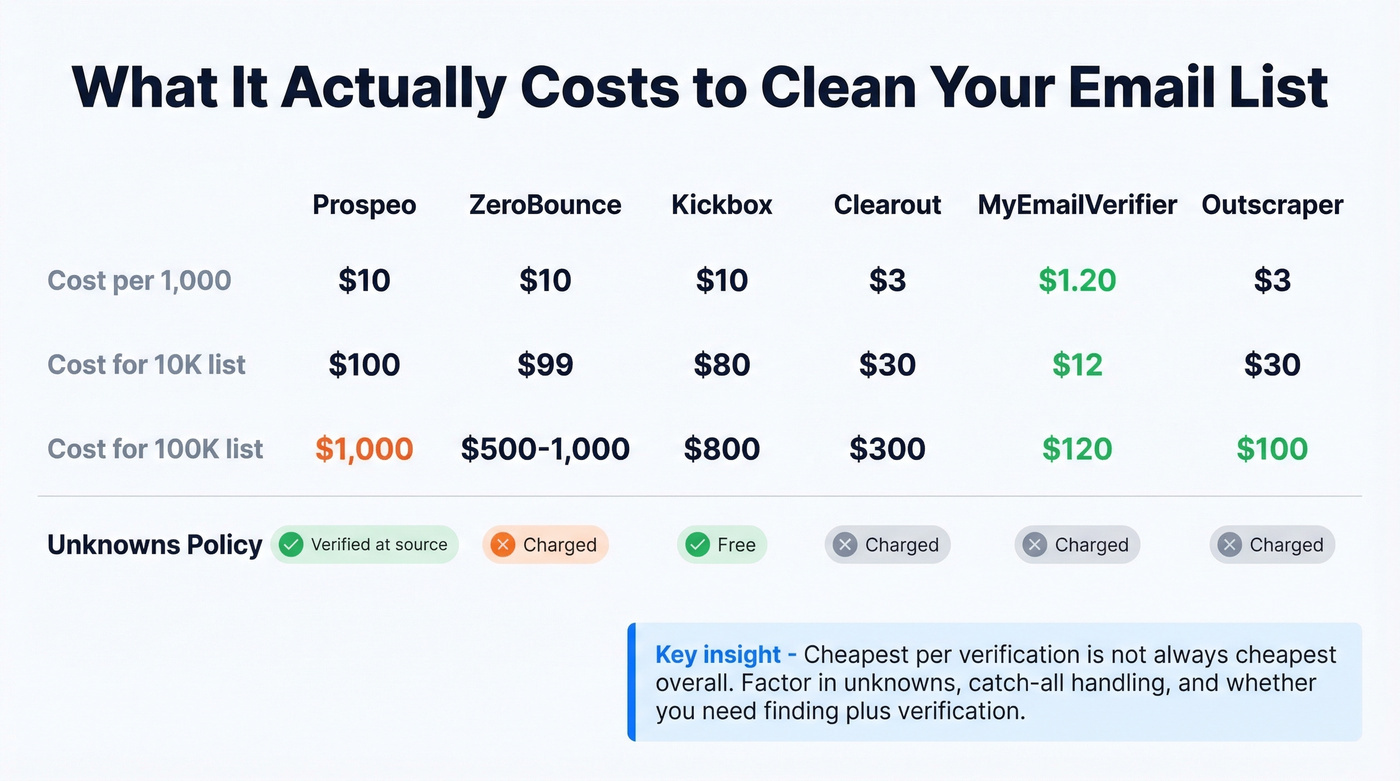
At $10/1K, cleaning a 50K list costs $500. That math matters, and the spread across tools is wider than you'd expect.
If you’re also paying to source contacts, compare against email list providers to avoid “pay twice” stacks.
| Tool | Cost/1K | Cost/10K | Cost/100K | Unknowns Policy |
|---|---|---|---|---|
| Prospeo | ~$10 (find + verify) | ~$100 | ~$1,000 | Verified at source |
| ZeroBounce | ~$10 | $99/mo (10K included) | ~$500-$1,000 | Charged |
| Kickbox | $10 | $80 | $800 | Free |
| Clearout | ~$3-$15 | ~$30-$150 | ~$300-$1,500 | Charged |
| MyEmailVerifier | ~$1.20 | $12 | $120 | Charged |
| Verifalia | ~$10 | ~$80 | ~$500 | Charged |
| Hunter | ~$10 | ~$80 | ~$500 | Charged |
| Outscraper | $3 | $30 | $300 | Charged |
| MailerCheck | ~$10 | ~$80 | ~$500 | Charged |
| Bouncer | ~$8 | ~$60 | ~$400 | Charged |
Note that Prospeo's cost includes finding and verifying the email - every other tool on this list only verifies. If you're already sourcing emails elsewhere, that's an apples-to-oranges comparison. When you need both prospecting and verification, ~$0.01/email is genuinely hard to beat.
How Accurate Are These Tools?
Every email verifier markets 98-99% accuracy. The independent benchmarks tell a different story.

Hunter scored highest at 70% in their own 2026 benchmark of 15 tools tested on 3,000 real business emails - though they acknowledge the dataset favors their tool. That's a massive gap between marketing claims and measured results. Clay's non-catch-all test paints a more optimistic picture: ZeroBounce hit 99.25% data quality, Hunter 98.52%. The difference? Clay tested non-catch-all domains specifically, which are far easier to verify definitively. Catch-all domains - where the server accepts everything - are where verifiers struggle and disagree.
We've run lists through multiple verifiers and consistently seen 5-15% disagreement on catch-all domains.
A real-world example from Reddit illustrates the problem well: one user found that MillionVerifier returned "unknown" for a known-valid Yahoo address in their bulk API, but "ok" when they checked the same email through the single-email API. The bulk system simply couldn't connect to the server during that verification pass. Different tools, different moments, different results.
The "live SMTP vs. cached database" debate matters here too. Tools that verify in real time against mail servers get fresher results but are more vulnerable to connection timeouts during bulk runs. Cached databases are faster but can serve stale data. Neither approach is universally better - it depends on your list size and how you handle unknowns.
What to Do With Results
Once verification finishes, you'll get contacts sorted into categories. Handle each one differently.
Valid emails are confirmed deliverable - send confidently. Invalid addresses should be suppressed immediately and never sent to. Risky contacts deserve caution: send in small batches and monitor bounces closely.
Unknown results are trickier. Re-run them through a second verifier or a single-email API. This "waterfall" approach - a concept that's gained real traction in outbound communities on r/sales and r/coldemail - catches what the first tool missed. In our testing, waterfalling unknowns through a second tool recovers 30-50% as valid, which is a significant chunk of otherwise wasted contacts.
Catch-all addresses require the most care. Test in small batches of 50-100 before sending to the full segment. Never blast your entire catch-all list at once.
For context, here's what "normal" bounce rates look like by industry:
| Industry | Avg Bounce Rate |
|---|---|
| Ecommerce | 0.19% |
| IT / Software | 0.90% |
| Financial Services | 1.20% |
| Construction | 2.20% |
If you're above 2% after verification, switch data providers before you burn your domain.
How Often to Re-Verify
Lists don't stay clean. Email addresses decay 25%+ annually, and average professional turnover hit 41% in 2023, with 38% of new hires leaving within their first year. The contact you verified in January is often gone by June.
Let's be honest - most teams don't re-verify often enough. Kickbox recommends every 3-6 months. We've seen teams that send weekly push it to monthly re-checks on their active segments. The right cadence depends on your send volume and how fast your target market churns, but quarterly is the bare minimum for any list you're actively mailing.
If you’re scaling outbound, make sure your cadence matches your email deliverability plan (warming, throttling, and list hygiene).
FAQ
Is there a truly free bulk email validation tool?
No tool offers unlimited free bulk validation. The best recurring free tiers are MyEmailVerifier (100/day, ~3,000/month), Verifalia (25/day, ~750/month), and ZeroBounce (100/month). For lists over 1,000 contacts, expect to pay $1-10 per 1,000 verifications depending on volume.
What's a safe bounce rate after cleaning a list?
Under 2% total bounce rate is the industry standard; under 1% is ideal for strong sender reputation. If you're above 5% after running verification, the problem isn't your verifier - it's your data source.
What should I do with "unknown" or "catch-all" results?
Re-verify unknowns through a second tool or single-email API - bulk and single checks often return different results for the same address. Send to catch-all addresses in small batches of 50-100 and monitor bounces before scaling. Never blast your entire catch-all segment at once.
Can I skip verification if my data source pre-verifies emails?
Yes. If your data provider verifies emails during the finding process - delivering 98%+ accuracy with catch-all handling built in - a separate bulk validator is redundant. The need for post-hoc validation usually signals a data source problem worth fixing upstream.