

GDPR and Email Addresses: What Counts as Personal Data in 2026
GDPR email address classification isn't a marketing problem. It's a data quality problem. And most teams get it wrong.
You scanned 200 badges at a trade show last quarter. Marketing dumped them into HubSpot. A sequence fired. Now someone in Hamburg is filing a complaint with their supervisory authority, and your legal team wants to know why nobody checked whether those contacts opted in. By 2023, GDPR fines had already topped EUR 2.1 billion in a single year - and enforcement has only accelerated since. Misdirected emails are one of the most common real-world breach scenarios, especially when teams move fast and skip basic checks.
Is an Email Address Personal Data Under GDPR?
The answer depends entirely on whether the address identifies a natural person. Understanding how GDPR classifies email addresses is foundational to every compliance decision your team makes.
Work Emails vs. Generic Inboxes
A named work email like john.smith@company.com is personal data under GDPR. It identifies a specific individual - full stop. Generic inboxes like info@company.com or sales@company.com don't identify anyone, so they fall outside GDPR's scope.
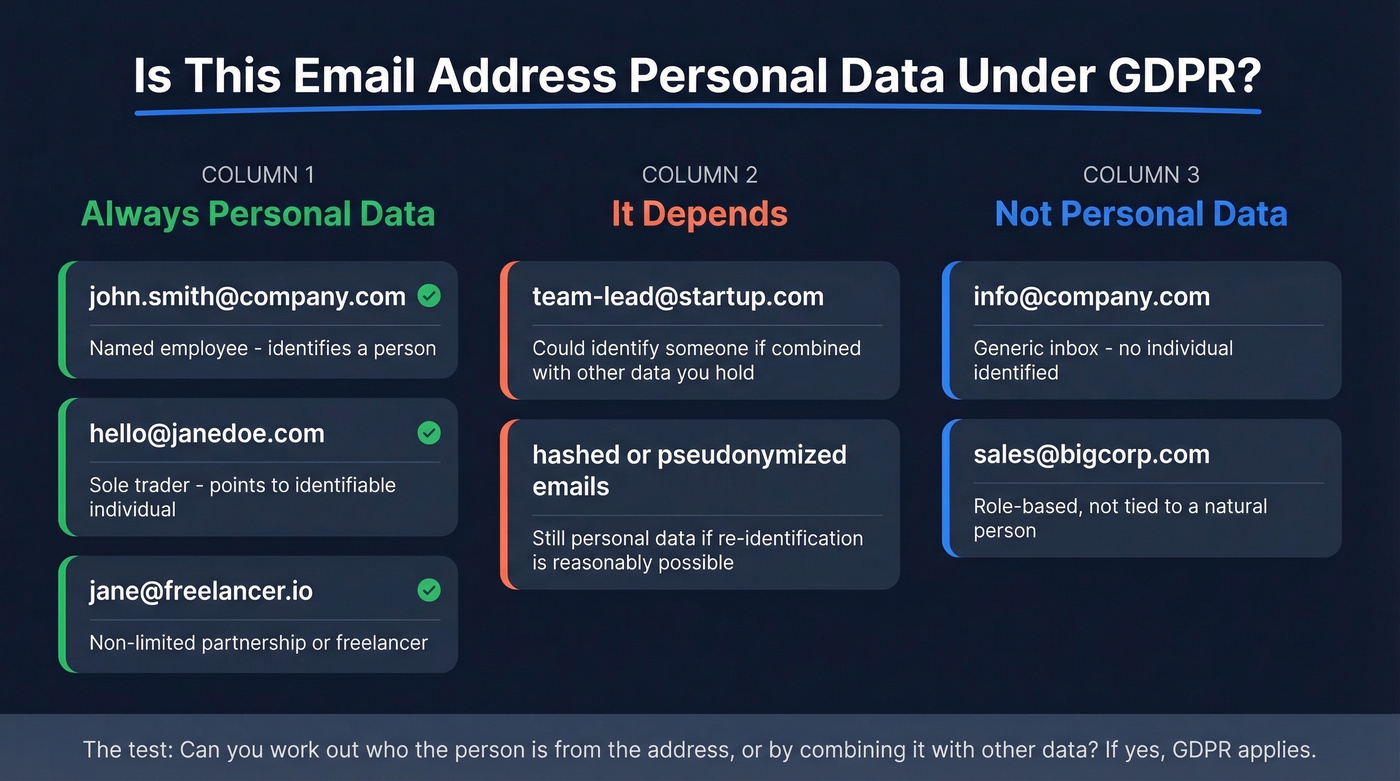
Sole traders and non-limited partnerships are the exception that catches people off guard. Even if the email looks "business-y," it's personal data if it points to an identifiable individual. A freelance consultant's hello@janedoe.com? Personal data, every time. The practical rule: if you can work out who the person is from the address - or by combining it with other data you hold - GDPR applies.
Hashed or Pseudonymized Emails
"We hashed the emails, so we're fine." We've heard this more than once, and it's wrong.
The EDPB's January 2025 pseudonymisation guidance makes this explicit: pseudonymized data remains personal data under GDPR if re-identification is reasonably possible. Hashing reduces risk, which is great, but the data stays in scope. The effectiveness of pseudonymization depends on practical re-identification risk - context, external data availability, attack vectors - not just the fact that you ran SHA-256 on it.
If you're matching hashed email lists for ad targeting or enrichment, you're still processing personal data. Plan accordingly.
GDPR vs. ePrivacy: Which Rules Apply?
Most guides conflate GDPR with ePrivacy, and it creates real confusion. They're two different legal instruments governing two different things.
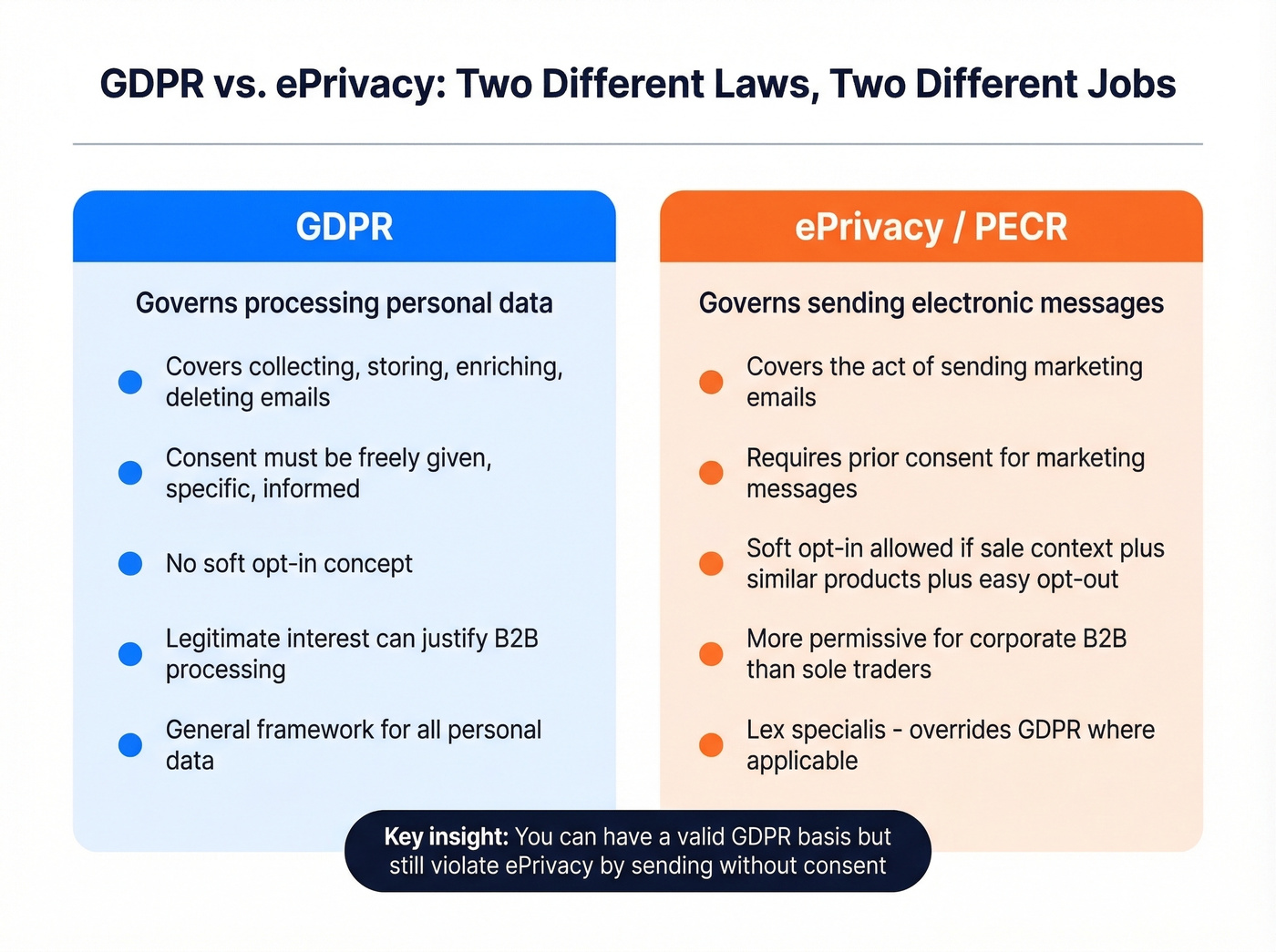
GDPR governs the processing of personal data - collecting, storing, enriching, deleting email addresses. ePrivacy (and its UK implementation, PECR) governs the act of sending electronic marketing messages. The CJEU has confirmed the lex specialis principle: where ePrivacy rules apply to email marketing, they override GDPR's general framework.
| Aspect | GDPR | ePrivacy / PECR |
|---|---|---|
| Governs | Processing personal data | Sending electronic comms |
| Consent standard | Freely given, specific, informed | Prior consent for marketing (with limited exceptions) |
| Soft opt-in | N/A | Sale context + similar products + easy opt-out |
| B2B outreach (UK) | Legitimate interest may apply | More permissive for corporate B2B than for sole traders |
| Relationship | General framework | Lex specialis - overrides GDPR |
This split changes your compliance strategy. You might have a valid GDPR lawful basis (legitimate interest) but still violate ePrivacy rules by sending unsolicited marketing without consent. Or you might qualify for the soft opt-in exception under ePrivacy, which means you don't need a separate GDPR Article 6 basis for that specific email marketing processing.
Consent vs. Legitimate Interest
The soft opt-in exception under ePrivacy Article 13(2) is the most misunderstood rule in email marketing. Three conditions must all be met:
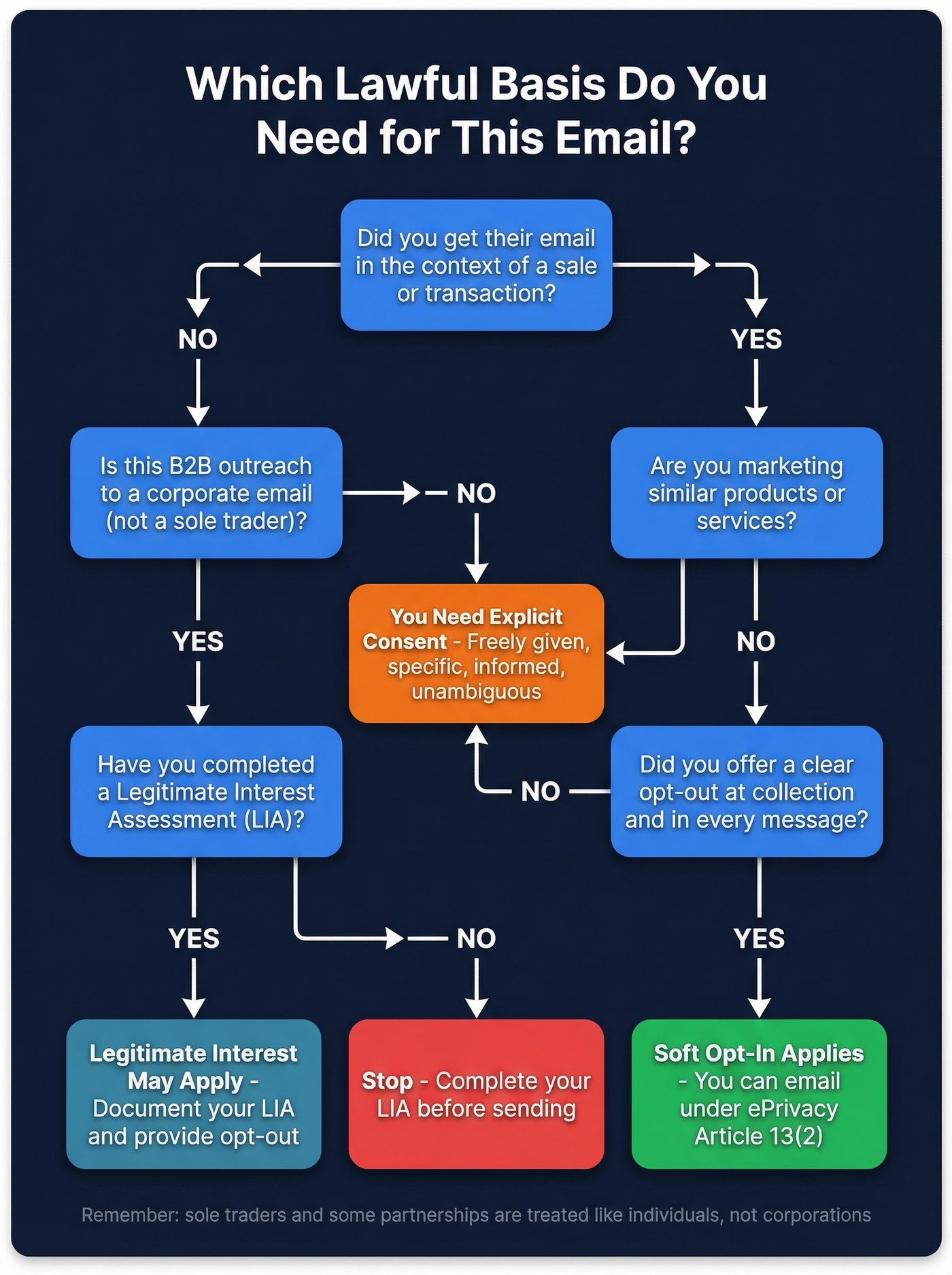
- Contact details were obtained in the context of a sale. The CJEU has clarified that "sale" can include indirect remuneration - for example, a free service used to promote paid products.
- You're marketing similar products or services to what the person originally engaged with.
- The recipient was given a clear, easy opt-out at collection and in every subsequent message.
One nuance that catches marketers off guard: the CJEU confirmed that a free newsletter with a commercial purpose can still qualify as direct marketing. If your "content newsletter" promotes paid subscriptions, it's marketing.
Where soft opt-in doesn't apply, you need either explicit consent or a documented legitimate interest assessment. Consent must be freely given, specific, informed, and unambiguous. Withdrawal must be as easy as giving consent.
For a deeper outbound-focused breakdown, see our GDPR for Sales and Marketing guide, plus the more tactical GDPR Email Marketing compliance checklist.
B2B Cold Emails Under GDPR
The consensus on r/DigitalMarketing is that cold email is basically illegal under GDPR. That's not accurate - but the confusion is understandable, especially since many Reddit threads conflate "automated sequence" with "spam" when the legal distinction has nothing to do with automation.
Legitimate interest is a valid lawful basis for B2B outreach when properly documented. You need a legitimate interest assessment (LIA) demonstrating your interest in reaching the prospect, that the processing is necessary, and that it doesn't override the individual's rights.
In the UK, PECR sits alongside data protection law and sets the rules for email marketing. The practical takeaway: the rules are typically more permissive for outreach to corporate addresses than they are for sole traders and individual subscribers, and you still need a clear opt-out mechanism (see our Email Compliance guide for the operational checklist).
Here's the thing: the critical exception is sole traders and some partnerships, who are treated closer to individuals under PECR. Don't assume the corporate B2B approach works universally. If you're prospecting SMBs, you need to know whether you're emailing a limited company or a sole trader. In our experience working with outbound teams, this is the single biggest compliance risk - not the cold email itself, but failing to classify the recipient correctly and document the lawful basis.
If your list is sourced via scraping or enrichment, make sure you understand the risk profile first (see: Is Email Scraping Legal).

GDPR Article 5(1)(d) requires personal data to be accurate and kept up to date. Prospeo's 5-step verification, spam-trap removal, and 7-day data refresh cycle mean every email you pull is 98% accurate - no stale records triggering complaints to supervisory authorities.
Stop risking GDPR fines on unverified email data.
Is a BCC Mistake a Data Breach?
This exact scenario comes up constantly on r/gdpr - someone sends a client update to 150 contacts using CC instead of BCC, and every recipient now sees every other recipient's email address.
Yes, it can constitute a personal data breach. You've disclosed personal data to unauthorized recipients. The severity depends on context: how many recipients, how sensitive the information is, and the likelihood of harm. A CC mistake exposing 5 colleagues' work emails is very different from one exposing 500 patients' addresses.
Your immediate steps: report to your DPO, document what happened, and assess the risk. Whether you need to notify your supervisory authority within 72 hours depends on that assessment. Not every BCC mistake triggers a notification obligation, but every one should trigger an internal review.
Data Accuracy: The Overlooked Obligation
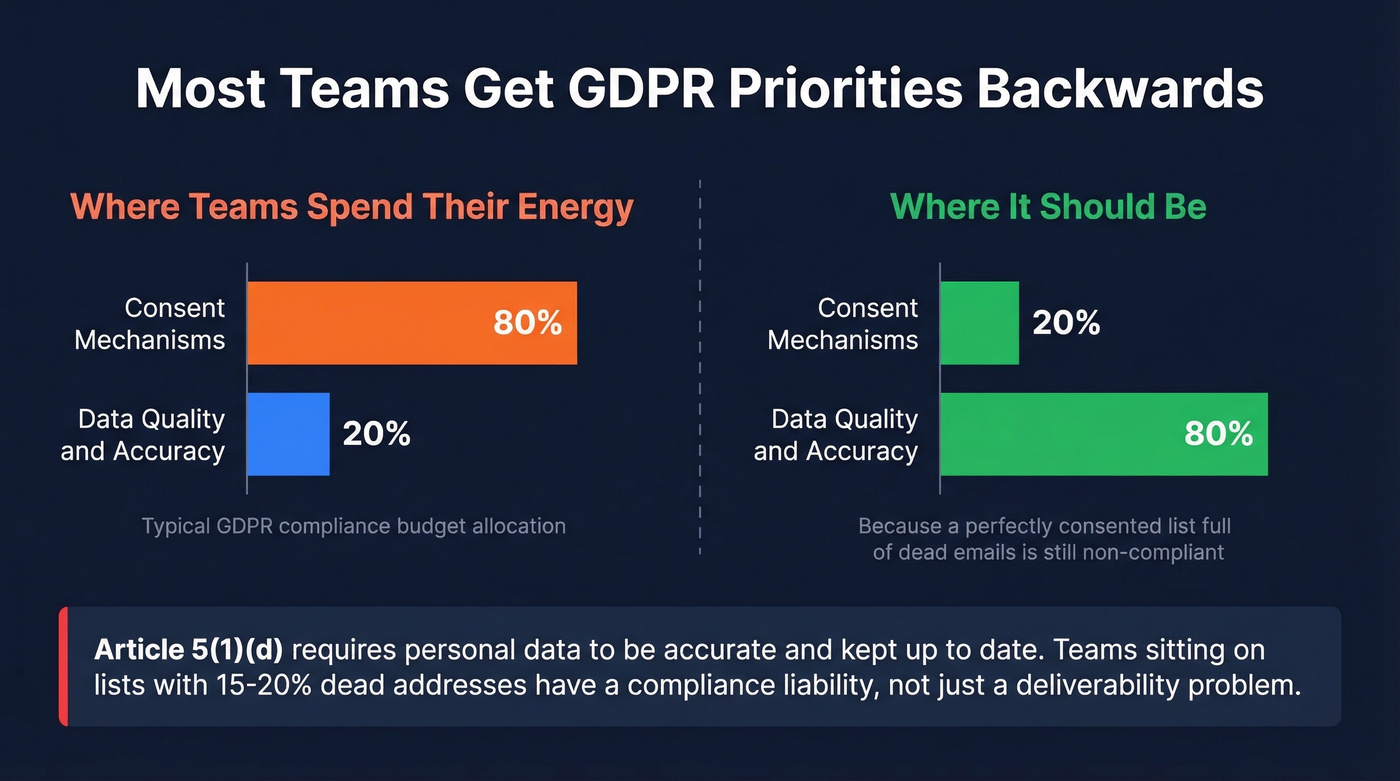
Everyone focuses on consent and lawful basis. Almost nobody talks about Article 5(1)(d), which requires personal data to be accurate and kept up to date. If your database is full of long-bouncing addresses, you aren't meeting the accuracy principle. That's not just a deliverability problem - it's a compliance liability.
Look, nobody wants to audit a database they spent months building. But we've seen teams sitting on lists where 15-20% of addresses are dead, and nobody's checked because "the data came from a reputable source." The source doesn't matter. Your obligation to maintain accuracy does. GDPR email address compliance extends well beyond consent - it encompasses the entire lifecycle of how you collect, verify, store, and eventually delete contact data.
If you’re seeing bounces spike, it’s worth aligning compliance work with deliverability hygiene (start with Email Hygiene Solutions and a quick read on Email Bounce Rate).
Prospeo's 98% email accuracy and 7-day data refresh cycle directly address this obligation. Instead of manually auditing your list, you can batch-verify an entire database and get valid/invalid/catch-all results in minutes - keeping your records compliant without the manual overhead. (If you’re dealing with ambiguous results, Catch-All Emails explains what to do next.)
Classifying recipients correctly is the biggest compliance risk in B2B outreach. Prospeo gives you 50+ data points per contact - company type, job role, verified corporate emails - so you can document legitimate interest and never accidentally cold-email a sole trader.
Compliant outreach starts with data you can actually trust.
Retention and Deletion
Article 5(e) requires you to keep personal data no longer than necessary. Article 17 gives individuals the right to erasure "without undue delay." Together, they mean your marketing email list needs a retention policy - and "we keep everything forever" isn't one.
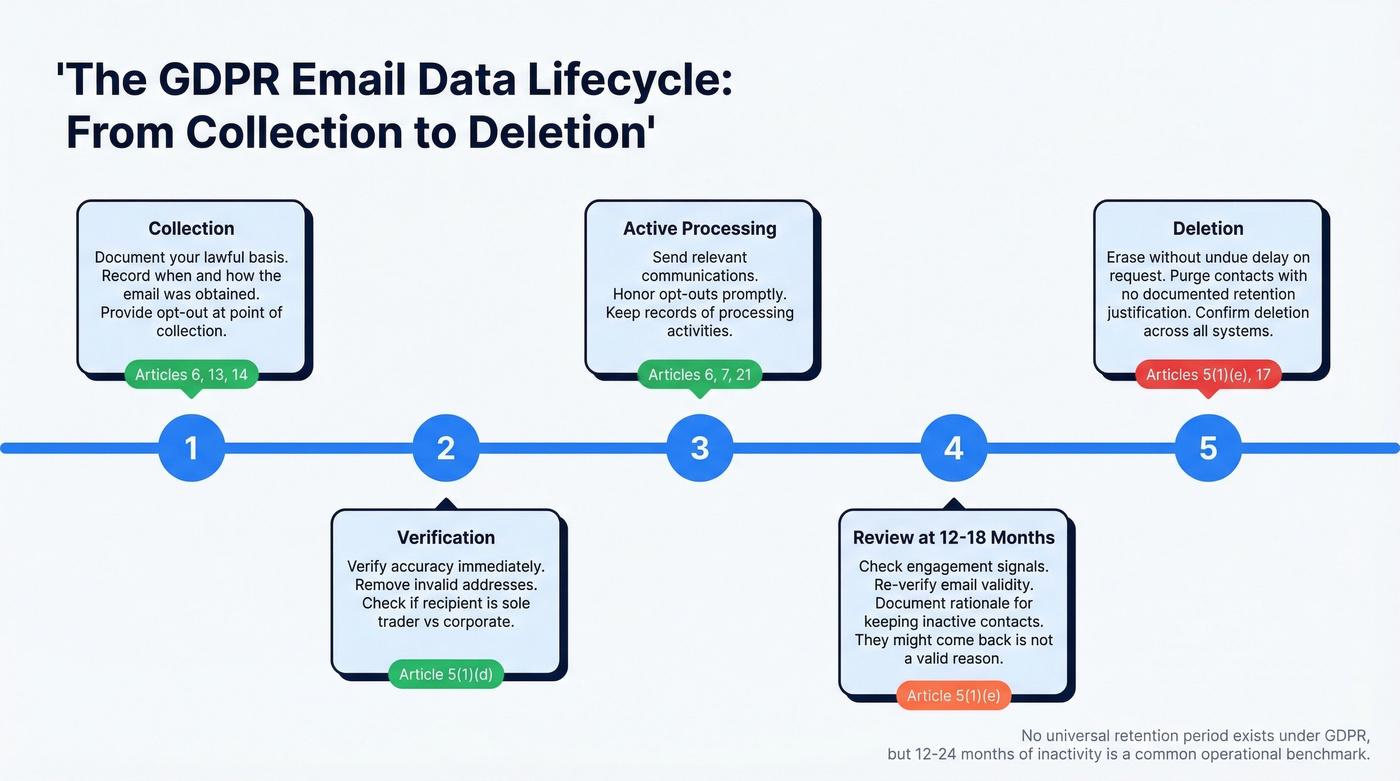
There's no universal retention period prescribed by GDPR, but a common operational standard is 12-24 months of inactivity. If someone hasn't opened, clicked, or engaged in 18 months, you need a documented rationale for keeping their data. "They might come back" doesn't cut it.
Before purging inactive contacts, verify whether addresses are still valid so you're making retention decisions based on accurate data rather than guessing. Skip this step if your list is under 500 contacts - at that scale, manual review is faster and cheaper than any tool. (If you’re formalizing this process, our Database Hygiene guide is a good companion.)
Email Security and Encryption
Encryption is recommended but not strictly required under GDPR. The regulation calls for "appropriate technical and organizational measures" - and what's "appropriate" depends on the risk.
TLS in transit is a baseline control. For sensitive personal data, stronger encryption is often appropriate. In 2026, TLS is table stakes. If you suffer a breach without encryption, good luck explaining your "appropriate technical measures" to a regulator. The cost of implementing encryption is trivial compared to the cost of defending a decision not to.
If you’re tightening your sending stack at the same time, it’s worth reviewing Email Authentication basics (SPF/DKIM/DMARC) alongside your security controls.
Let's be honest about where most teams get this backwards. They spend 80% of their GDPR compliance energy on consent mechanisms and 20% on data quality. It should be the reverse. A perfectly consented list full of dead email addresses is still non-compliant under Article 5(1)(d) - and it's the violation regulators are starting to pay attention to.
FAQ
Does GDPR apply to business email addresses?
Yes, if the address identifies an individual - for example, firstname.lastname@company.com. Generic inboxes like info@ or sales@ aren't personal data. Sole trader emails are always personal data. The key test is whether the address can be linked back to a natural person, directly or in combination with other data you hold.
Can I buy an email list and use it under GDPR?
No. Purchased lists almost never carry valid consent for your specific purposes. Using them risks fines up to EUR 20 million (or 4% of global turnover) and destroys sender reputation. Build your own list with proper consent or documented legitimate interest instead.
Do I need double opt-in for GDPR compliance?
GDPR doesn't explicitly require double opt-in, but it's the gold standard for proving consent. It provides clear evidence that the individual actively confirmed their subscription - which is your burden to prove if a supervisory authority challenges you.
How do I keep email data accurate under GDPR?
Article 5(1)(d) requires personal data to be accurate and current. Use a verification tool that checks addresses in real time. Prospeo, for instance, catches invalid addresses before they enter your CRM and keeps existing records current with a 7-day refresh cycle across 143M+ verified emails.
What should I do if I accidentally exposed addresses via CC?
Treat it as a potential personal data breach. Report to your DPO immediately, document the incident, and assess risk based on recipient count, data sensitivity, and likelihood of harm. Notify your supervisory authority within 72 hours if the risk to individuals is non-trivial.