

GDPR vs CAN-SPAM: What Actually Matters for Email Compliance
Your VP of Sales wants to launch outbound into Europe. Legal says no - "cold email isn't GDPR compliant." The entire pipeline plan stalls. Meanwhile, your US campaigns run fine under CAN-SPAM, and nobody can explain why one law kills outbound and the other doesn't.
This confusion floods r/coldemail and r/Emailmarketing constantly, and it's rooted in the same misunderstanding: people treat GDPR and CAN-SPAM as the same type of law. They aren't. Getting email compliance right starts with understanding that distinction.
GDPR vs CAN-SPAM at a Glance
| CAN-SPAM | GDPR | |
|---|---|---|
| Scope | US | EU/EEA + anyone targeting EU residents |
| Consent model | Opt-out | Opt-in or legitimate interest |
| Max fine tier | $53,088/email | EUR 20M or 4% global turnover |
| Enforcement | FTC | National supervisory authorities (DPAs) |
| Opt-out timeline | 10 business days | Promptly |
| B2B exception | None | None (legitimate interest pathway available) |
| Data subject rights | No GDPR-style rights | Access, erasure, portability |
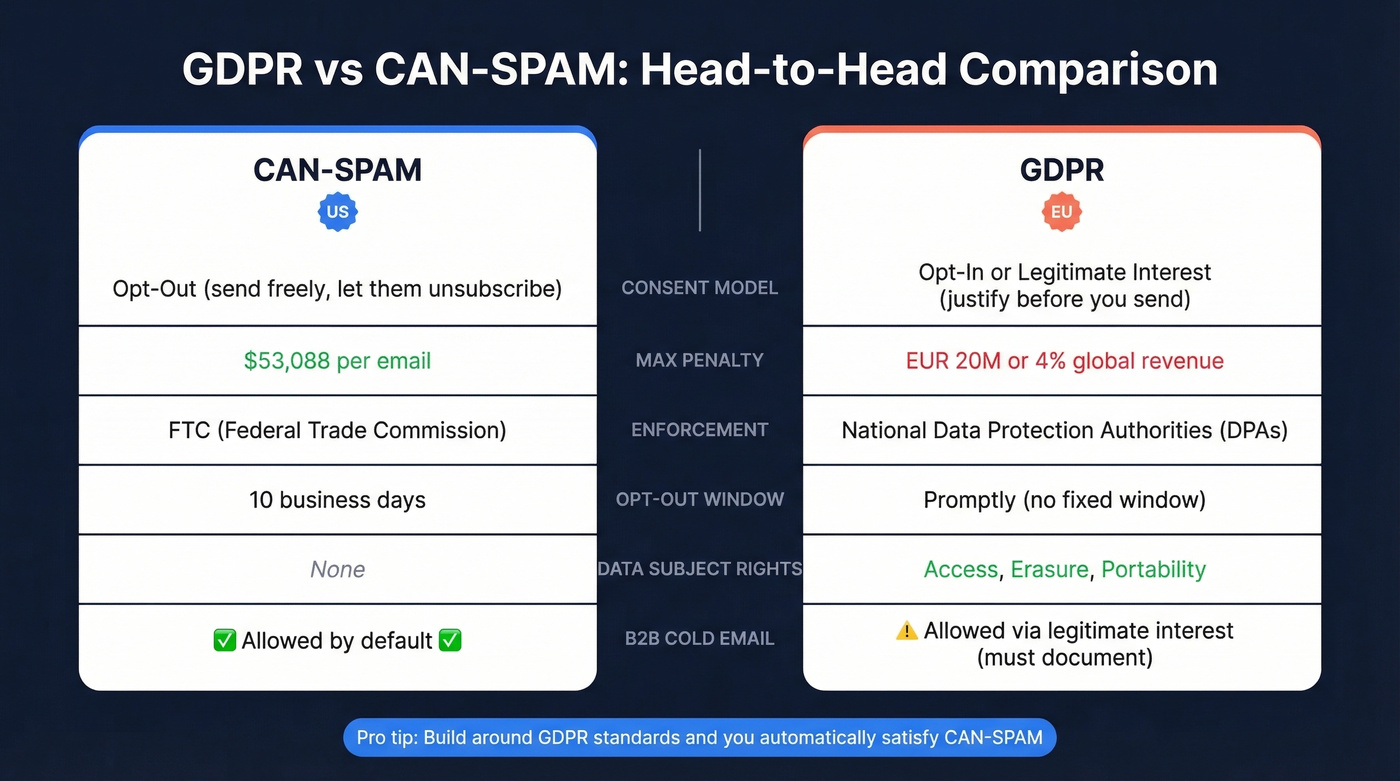
CAN-SPAM is the floor, not the ceiling. If you email both US and EU contacts, build around GDPR. You'll satisfy CAN-SPAM automatically.
What CAN-SPAM Actually Requires
CAN-SPAM is an opt-out law. You can send unsolicited commercial email to anyone in the US as long as you follow seven core requirements: no false or misleading header information, no deceptive subject lines, identify the message as an ad, include a valid physical postal address, provide a clear opt-out mechanism, honor opt-outs within 10 business days, and keep that opt-out mechanism functional for at least 30 days after sending.
The FTC draws a line between commercial messages and transactional/relationship messages like order confirmations, account updates, and warranty notices. Transactional emails are mostly exempt - they just can't use false or misleading routing information.
Here's the thing most sales teams miss: the FTC is explicit that "the law makes no exception for business-to-business email." Every commercial message must comply, whether you're emailing a consumer or a CFO. Enforcement is real. In August 2024, the FTC hit Verkada with a $2.95 million fine for sending commercial emails without proper unsubscribe options - the largest CAN-SPAM penalty the FTC has imposed.
What GDPR Actually Requires
GDPR flips the model. Instead of "send until they say stop," you need a lawful basis before you send anything. For B2B outreach, the two relevant bases are consent (explicit opt-in) and legitimate interest under Article 6(1)(f).
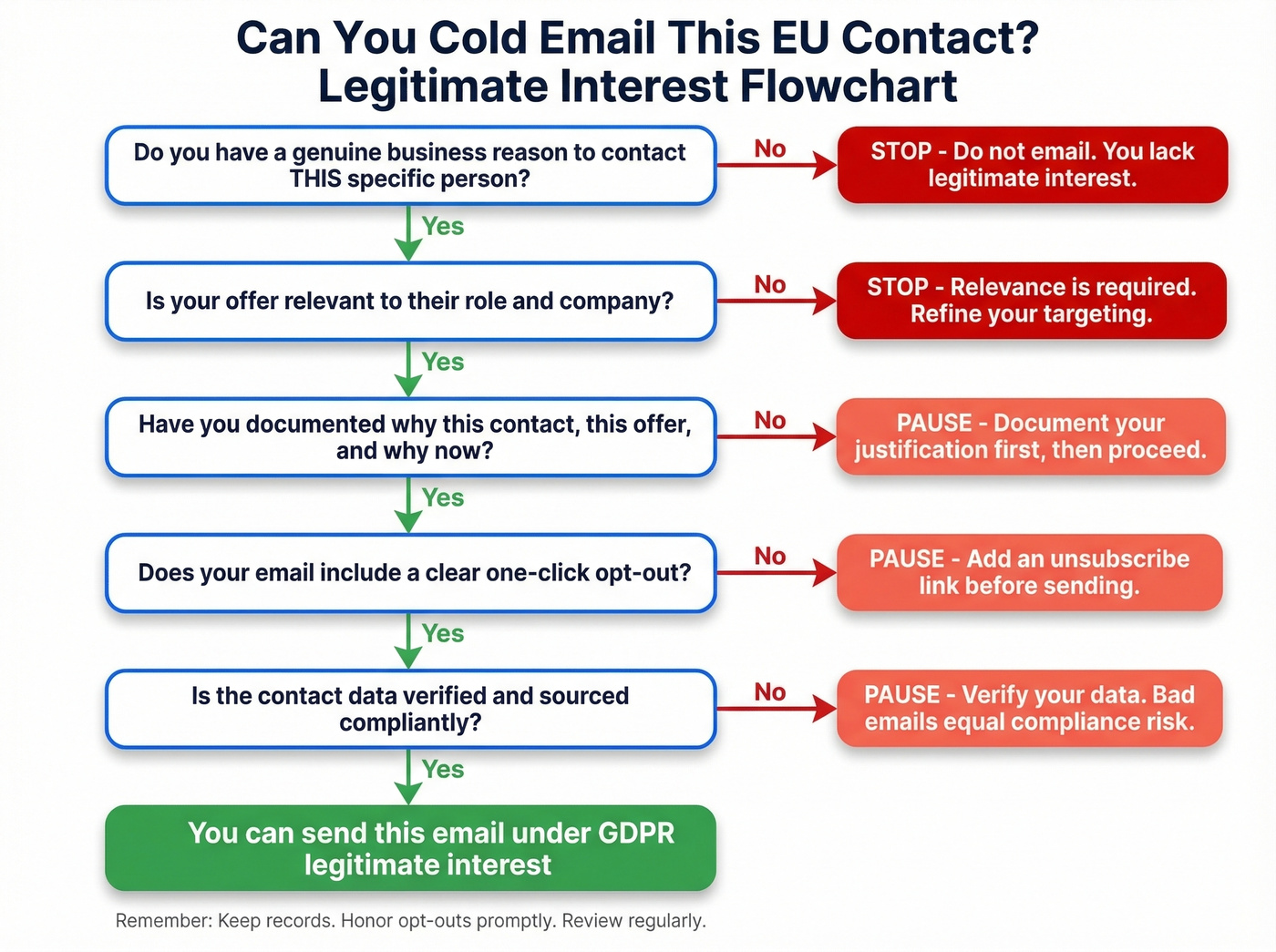
Legitimate interest is the pathway most B2B teams use. It requires you to document why contacting a specific person serves a genuine business purpose, target precisely, and offer a clear opt-out. The key word is "specific" - you need a reason to email this person at this company, not just "they're in our ICP." In our experience, the teams that get blocked by legal are the ones who can't articulate this pathway clearly. Show your legal team the legitimate interest assessment framework, walk them through your targeting criteria, and the conversation changes fast.
One myth that won't die: "business email addresses aren't personal data under GDPR." Wrong. A business email like john.smith@company.com identifies a natural person. It's personal data. Full stop.
The enforcement numbers tell the story. In 2025, EU data protection authorities issued nearly EUR 1.15B across 330+ fines. The most common violation category - insufficient technical and organizational measures - accounted for 29% of fines, jumping from 69 in 2024 to 97 in 2025. GDPR also grants data subjects rights that CAN-SPAM doesn't touch: access, erasure, and data portability.
The practical shift this creates is real. The old playbook of blasting 10,000 emails at a 0.5% reply rate doesn't work under GDPR. The new one - 500 precisely targeted emails at 8-12% reply rates - does.
Hot take: If your deal sizes sit below the $10k mark, you probably don't need to send enough volume for GDPR to be a real obstacle. The law punishes lazy targeting, not outbound itself.

Precise targeting is the foundation of GDPR-compliant outbound. Prospeo's 30+ search filters let you build legitimate interest into every list - target by job role, intent signals, and company fit so you can document exactly why you're emailing each contact. 98% verified email accuracy means no bounces destroying your domain reputation.
Send 500 precise emails that convert instead of 10,000 that get you fined.
The ePrivacy Layer Most Guides Skip
Every other comparison of these two frameworks stops at GDPR. That's incomplete.
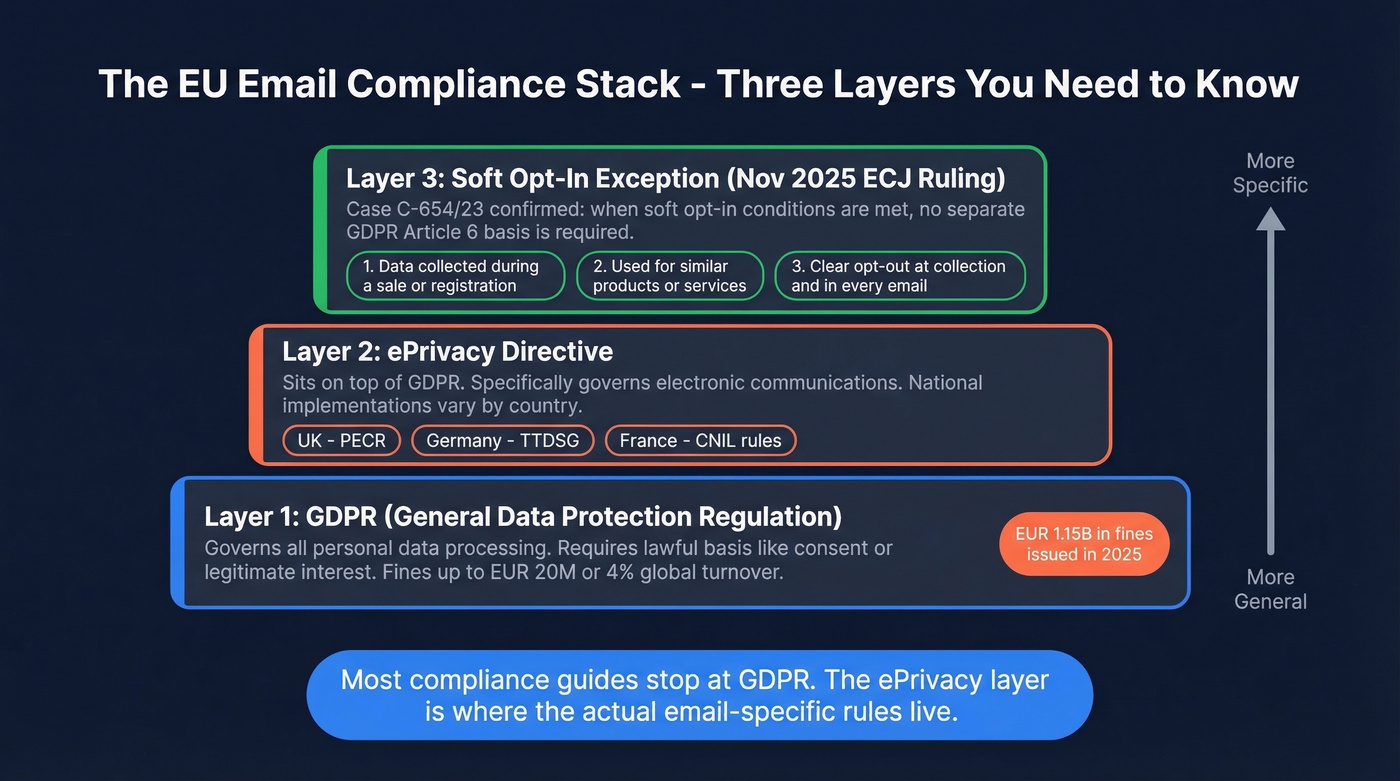
The ePrivacy Directive is a separate EU law that specifically governs electronic communications consent, and it sits on top of GDPR. National implementations vary - the UK has PECR, Germany has the TTDSG - and this is where many of the specific rules about email marketing actually live.
A major clarification came in November 2025 when the European Court of Justice ruled in Case C-654/23 that when soft opt-in conditions are met, no separate GDPR Article 6 basis is required. The soft opt-in itself constitutes a valid legal basis. Those conditions: data collected in connection with a sale (including certain freemium/registration models), used for similar products or services, with a clear and free opt-out provided at collection and in every subsequent email.
This overturns the stricter interpretation previously held by the Belgian DPA, which had required an additional GDPR Article 6 basis even when soft opt-in conditions were satisfied. For existing-customer marketing in the EU, that's a significant practical relaxation.
Can You Cold Email Under Each Law?
Under CAN-SPAM: Yes. It's an opt-out regime. Send to anyone, follow the seven requirements, honor unsubscribes.
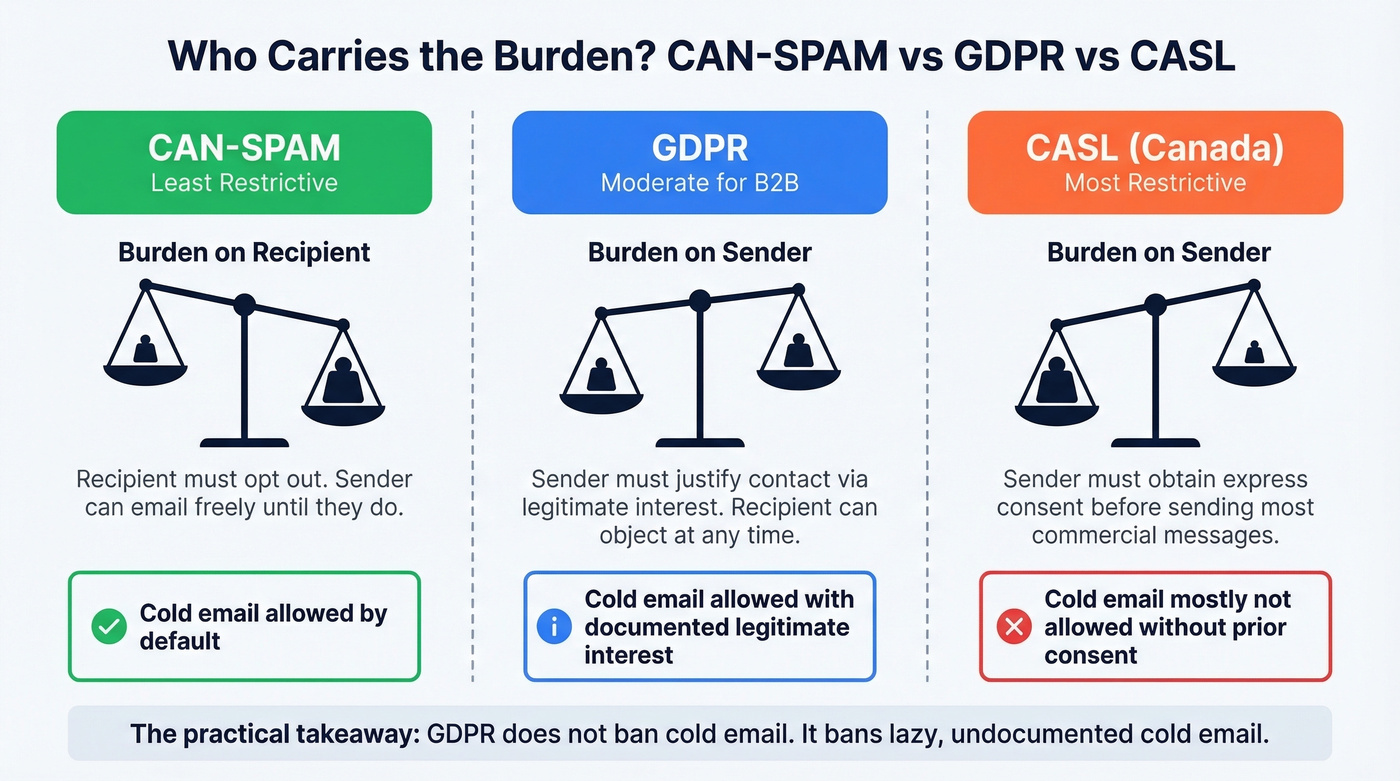
Under GDPR: Yes, for B2B - under legitimate interest. But you must document your justification, target with precision, and provide an easy opt-out in every message. The blanket claim that "cold email is illegal under GDPR" is wrong. If your legal team is blocking outbound because "GDPR bans cold email," show them the legitimate interest pathway.
The difference isn't legality - it's burden of proof. CAN-SPAM puts the burden on the recipient to opt out. GDPR puts the burden on the sender to justify the contact. CASL, Canada's anti-spam law, goes even further by requiring express consent for most commercial messages - but that's a separate comparison.
Email List Compliance Checklist
These steps satisfy both laws simultaneously, giving you a single framework your sales team can actually follow:
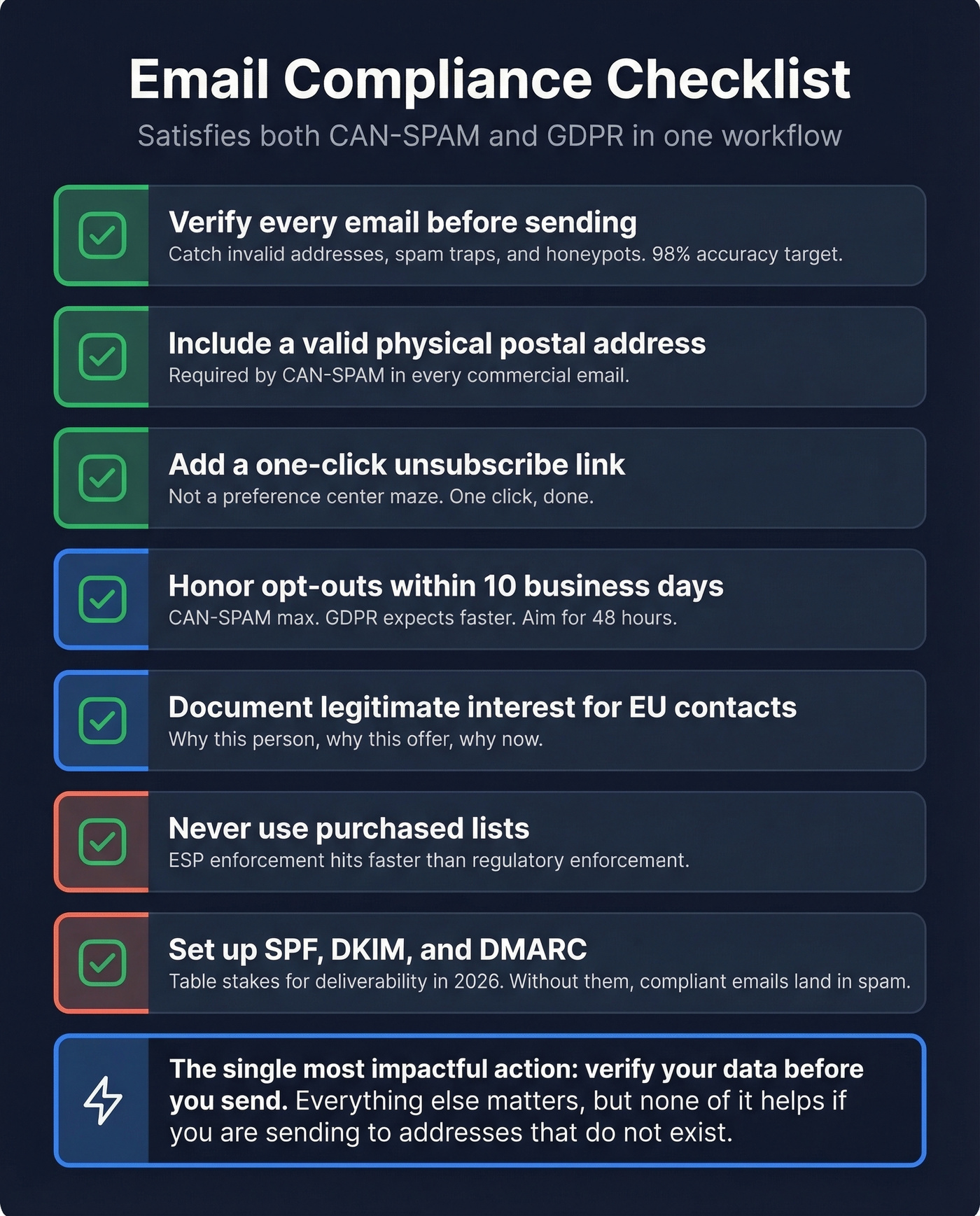
- Verify every email before sending. Bad data leads to bounces, bounces trigger spam complaints, and spam complaints destroy domain reputation. Prospeo's 5-step verification catches invalid addresses, spam traps, and honeypots before they cause damage - 98% email accuracy on a 7-day data refresh cycle, with GDPR-compliant data sourcing built in. (If you want the deliverability side of this, start with email deliverability.)
- Include a valid physical address in every commercial email.
- Add a one-click unsubscribe link in every message - not a preference center maze.
- Honor opt-outs within 10 business days (CAN-SPAM requirement; GDPR expects faster).
- Document legitimate interest for every EU contact - why this person, why this offer, why now. (Use an Ideal Customer Profile so your targeting is defensible.)
- Never use purchased lists. We've seen this play out badly: one team pulled thousands of contacts from a data vendor, blasted them through HubSpot, and had their Gmail account disabled for spam. ESP enforcement hits faster than regulatory enforcement. (If you're debating it, read purchased lists.)
- Set up SPF, DKIM, and DMARC. These are table stakes for deliverability in 2026. Without them, even compliant emails land in spam. (Start with DMARC and SPF, then confirm DKIM.)
Let's be honest: the single most impactful compliance action is verifying your data before you send. Everything else - the legal documentation, the unsubscribe links, the authentication records - matters, but none of it helps if you're sending to addresses that don't exist. (If you're troubleshooting, see email bounce rate.)

Bad data doesn't just hurt deliverability - it's a compliance liability. Every bounce from a stale email is a contact you can't justify under legitimate interest. Prospeo's 5-step verification and 7-day data refresh cycle keep your lists clean, accurate, and GDPR-ready - no spam traps, no honeypots, no excuses for legal to block your pipeline.
Stop choosing between compliance and pipeline. Get both at $0.01 per verified email.
FAQ
Does CAN-SPAM apply to B2B email?
Yes. The FTC states explicitly: "The law makes no exception for business-to-business email." Every commercial message needs a physical address, a clear opt-out, and honest headers - whether the recipient is a consumer or a C-suite executive.
Is cold email legal under GDPR?
For B2B, yes - under Article 6(1)(f) legitimate interest. Document why contacting a specific person serves a genuine business purpose, target precisely, and offer a clear opt-out in every message. Starting with verified, GDPR-compliant contact data makes the legal and technical foundation much simpler to maintain.
How much stricter is GDPR than CAN-SPAM?
Significantly. GDPR requires a lawful basis before sending, grants data subjects rights to access and erasure, and enforces fines up to EUR 20M or 4% of global turnover. CAN-SPAM allows sending until someone opts out and caps penalties at $53,088 per email. The gap in enforcement severity alone should shape how you build your compliance program.
How do I handle compliance for a global email list?
Segment by geography. Apply GDPR-level controls to EU/EEA contacts and CAN-SPAM requirements to US contacts. In practice, building your entire program around GDPR standards is simpler - it automatically satisfies CAN-SPAM, so you maintain one process instead of two.