Stop Generating Leads. Start Generating SQLs.
Your VP of Sales says 80% of the leads marketing sends over are garbage. Marketing says sales doesn't follow up fast enough. Meanwhile, the funnel math tells the real story: only 1.5-2.5% of raw leads ever become customers.
If you want to generate sales qualified leads consistently, the fix isn't more volume. It's better qualification, sharper scoring, and data clean enough that reps actually reach decision-makers instead of bouncing off dead inboxes. We've watched teams throw money at the top of funnel for months when the real problem was sitting in the middle - a broken handoff between marketing and sales that no amount of ad spend can fix.
This guide breaks down exactly how to do it using frameworks, scoring models, and signal-based strategies that actually move pipeline.
If Your MQL-to-SQL Rate Is Below 10%, Read This First
The problem isn't lead volume. It's qualification. You need three things: a shared SQL definition using BANT, CHAMP, or MEDDIC; a lead scoring model with negative scoring built in; and verified contact data so reps reach the right people on the first touch. Get those three right and the rest follows.
What Is a Sales Qualified Lead?
An SQL is a lead that sales has personally validated - confirmed budget, authority, need, and timeline through an actual conversation. That's the key distinction from an MQL, which only signals intent and ICP fit through marketing behavior like form fills, content downloads, and email engagement.
Two other lead types are worth knowing. A PQL (product-qualified lead) has used your product - free trial, freemium tier - and demonstrated buying behavior inside it. A SAL (sales-accepted lead) sits between MQL and SQL: marketing passed it over, sales agreed to work it, but hasn't fully qualified it yet. Only 47% of SALs actually become SQLs.
| Lead Type | Typical Conversion | Converts To |
|---|---|---|
| MQL | 5-15% | SQL |
| SQL | 20-30% | Customer |
| PQL | 25-40% | Customer |
| Expansion | 40-60% | Upsell/cross-sell |
Those PQL numbers explain why every PLG company obsesses over product usage signals. But for outbound-heavy teams, the MQL-to-SQL gap is where the real upside lives.
The SQL Funnel Math
Let's work the numbers backward from a revenue target. Say you need 10 new customers this quarter. Here's what the funnel benchmarks demand:
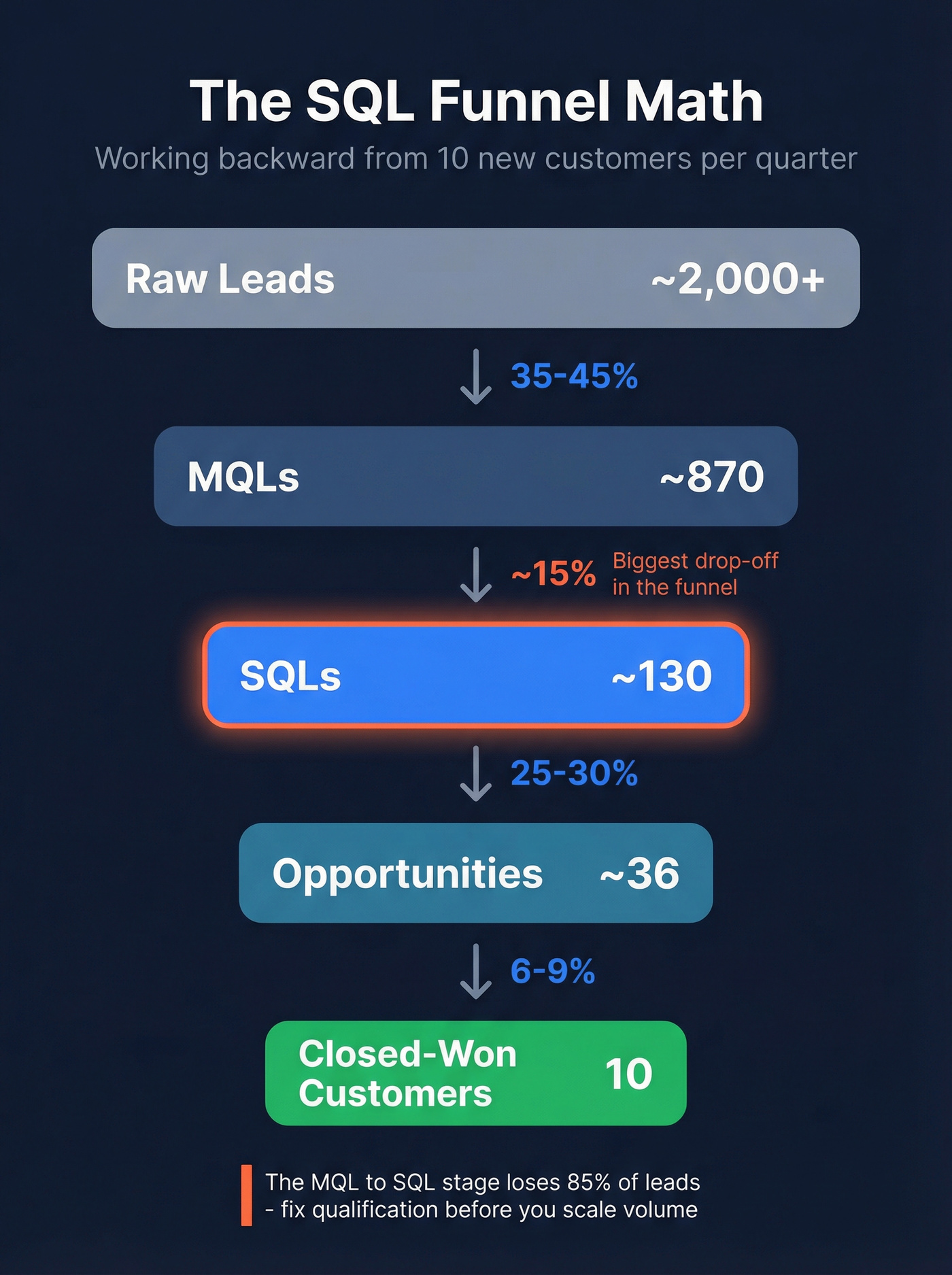
| Funnel Stage | Conversion Rate | Volume Needed |
|---|---|---|
| Raw Leads | - | ~2,000+ |
| Lead to MQL | 35-45% | ~870 MQLs |
| MQL to SQL | ~15% | ~130 SQLs |
| SQL to Opportunity | 25-30% | ~36 Opps |
| Opp to Closed-Won | 6-9% | 10 Customers |
That's the math nobody wants to see. You need roughly 2,000 raw leads to close 10 deals. The MQL-to-SQL stage is the single biggest drop-off in the entire funnel, and it varies wildly by industry.
| Industry | MQL to SQL Rate |
|---|---|
| Business Insurance | 26% |
| eCommerce | 23% |
| Cybersecurity | 15% |
| B2B SaaS | 13% |
| Construction | 12% |
| Fintech | 11% |
| Legal Services | 10% |
FirstPageSage MQL-to-SQL benchmarks, dataset 2019-2026.
If you're in B2B SaaS running at 13%, that's not a crisis - that's the benchmark. But if you're at 6%, you've got a qualification problem, not a volume problem. Fix the definition before you scale the top of funnel.
Choose Your Qualification Framework
Pick one framework and enforce it across every rep. Mixing frameworks is how you get inconsistent pipeline and unpredictable forecasting.
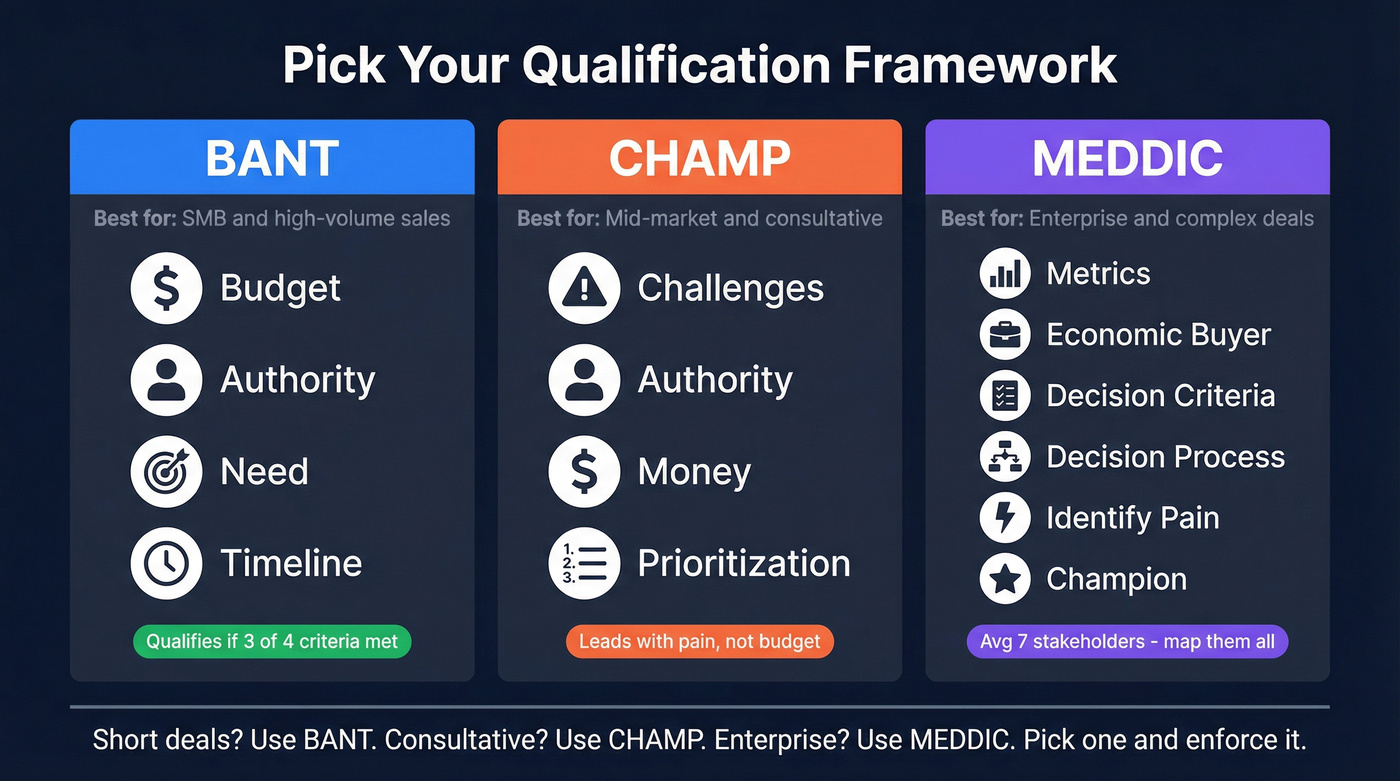
| Framework | Best For | Criteria |
|---|---|---|
| BANT | SMB / high-volume | Budget, Authority, Need, Timeline |
| CHAMP | Mid-market / consultative | Challenges, Authority, Money, Prioritization |
| MEDDIC | Enterprise / complex deals | Metrics, Economic Buyer, Decision Criteria, Decision Process, Identify Pain, Champion |
BANT gets criticized for leading with budget, but it works beautifully for transactional sales where deal cycles are short and the buyer already knows what they need. The practical rule: a lead qualifies if it meets 3 of 4 BANT criteria. CHAMP flips the conversation to start with pain - better for consultative motions where the prospect doesn't know their budget yet. MEDDIC is the heavy artillery: it requires training, discipline, and deals large enough to justify the overhead.
With an average of 7 stakeholders involved in B2B purchases, MEDDIC's emphasis on mapping the decision process and identifying a champion becomes essential for enterprise deals. For everyone else, keep it simple. BANT for SMB, CHAMP for mid-market.

Your scoring model is only as good as the data underneath it. A +50 demo request means nothing if the email bounces. Prospeo's 98% email accuracy and 7-day data refresh ensure reps reach the decision-makers your model identifies - not dead inboxes that inflate your SAL count and waste quota.
Stop losing SQLs to bad contact data. Fix the foundation first.
Build Your Lead Scoring Model
Here's the thing: a scoring model without negative scoring is just a vanity leaderboard. Every team we've seen with inflated SQL counts has the same problem - they score positive signals but never penalize bad-fit indicators. A competitor downloading your whitepaper shouldn't get the same treatment as a VP of Engineering requesting a demo.
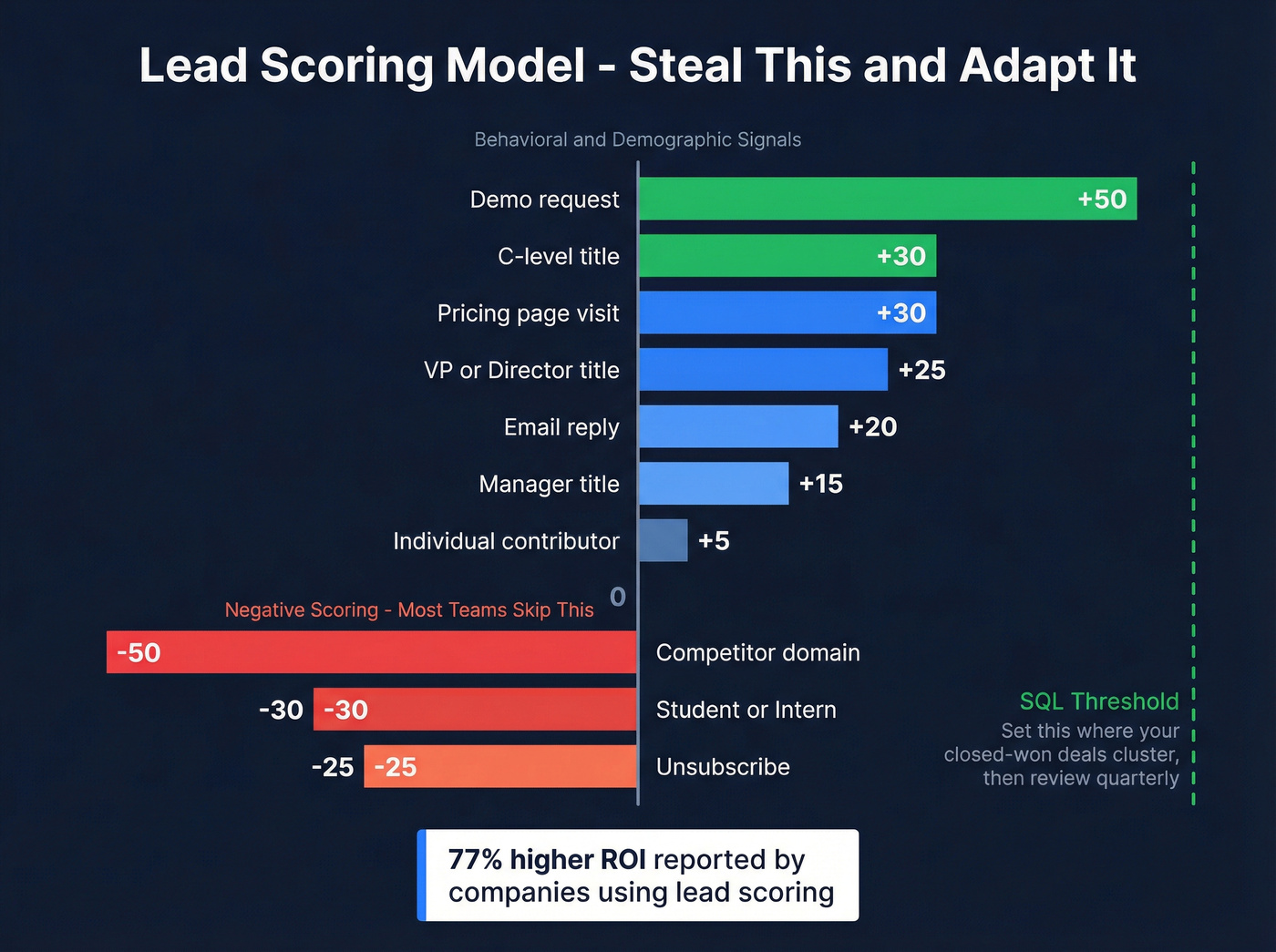
A scoring rubric you can steal and adapt:
| Signal | Points | Category |
|---|---|---|
| C-level title | +30 | Demographic |
| VP / Director | +25 | Demographic |
| Manager | +15 | Demographic |
| Individual contributor | +5 | Demographic |
| Demo request | +50 | Behavioral |
| Pricing page visit | +30 | Behavioral |
| Email reply | +20 | Behavioral |
| Student / Intern | -30 | Negative |
| Competitor domain | -50 | Negative |
| Unsubscribe | -25 | Negative |
Set your SQL threshold at a score that correlates with actual closed-won deals. Then review quarterly. Companies using lead scoring report a 77% boost in ROI, and teams layering AI into their scoring and prioritization have seen conversion rates nearly double - from 1.8% to 3.0% in just 12 weeks.
The quarterly review matters more than the initial model. Your first scoring rubric will be wrong. That's fine. What kills pipelines is setting it and forgetting it for 18 months while your ICP shifts underneath you.
Strategies That Produce More SQLs
Not all channels produce qualified leads at the same rate. The channel conversion benchmarks tell a clear story:
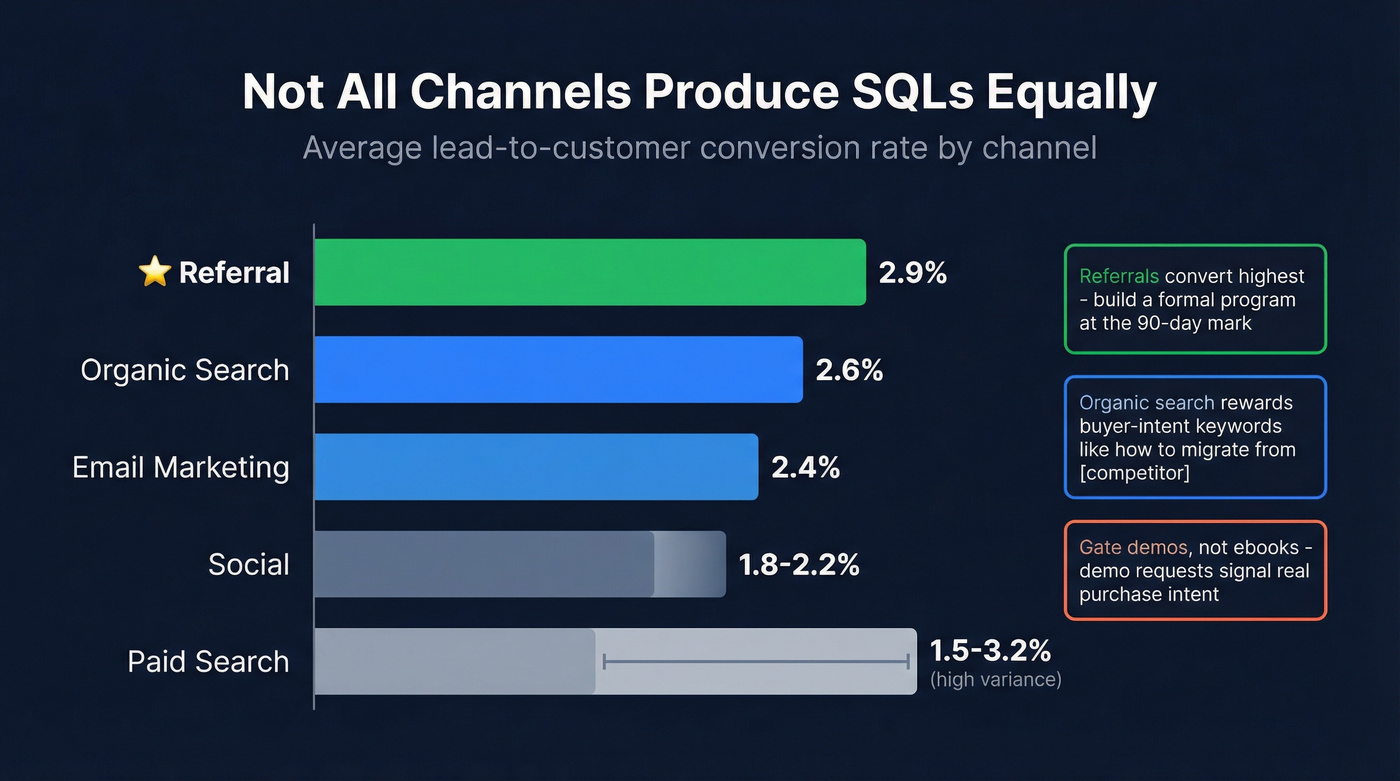
| Channel | Avg Conversion Rate |
|---|---|
| Referral | 2.9% |
| Organic Search | 2.6% |
| Email Marketing | 2.4% |
| Social | 1.8-2.2% |
| Paid Search | 1.5-3.2% |
Gate Demos, Not Ebooks
A gated ebook generates an MQL at best - someone who's curious, not someone who's buying. A demo request signals real purchase intent and should route directly to sales. Build your content strategy around buyer-intent keywords like "how to migrate from [competitor]" rather than "what is [category]," and use webinars with qualification gates that require company size and role during registration. That way you can score attendees before they even show up.
Outbound: Precision Over Volume
Multi-channel sequences consistently outperform single-channel plays. The key is account-based targeting: identify 50-200 accounts that match your ICP, multi-thread into 3-5 contacts per account, and run coordinated sequences. Spray-and-pray outbound at scale just burns domains and annoys people.
And with 2026 regulations carrying penalties up to $53,088 per violation for non-compliant outreach, sloppy data hygiene isn't just ineffective - it's expensive.
Signal-Based Targeting
This is where modern SQL generation gets interesting. Instead of static lists, you trigger outreach based on observable signals: a company that just raised a Series B has verified purchasing power, one hiring 5 SDRs is scaling its sales motion, a new CTO means new tech stack decisions, and a competitor adoption signals a displacement opportunity.
Signal-based selling flips the model from "who fits our ICP" to "who fits our ICP and is actively buying right now." With 80% of buyer interactions now happening digitally, these signals are more reliable than ever. The consensus on r/sales is that intent-based outbound consistently outperforms static list campaigns by 2-3x - and our experience lines up with that.
Referrals: Don't Sleep on Them
Referrals convert at 2.9%, one of the best-performing channels in the benchmark set. Build a formal referral program with incentives, pursue co-selling partnerships with complementary vendors, and invest in review site presence. You can grow referral pipeline fast just by systematically asking happy customers for introductions at the 90-day mark.
Fix Your Data Before You Scale
This scenario plays out every week: an SDR team launches a new outbound campaign on Monday. By Wednesday, bounce rates hit 8%. By Friday, the sending domain is flagged. Recovery takes months. The entire quarter's outbound motion is compromised because someone uploaded a list from a sketchy vendor.
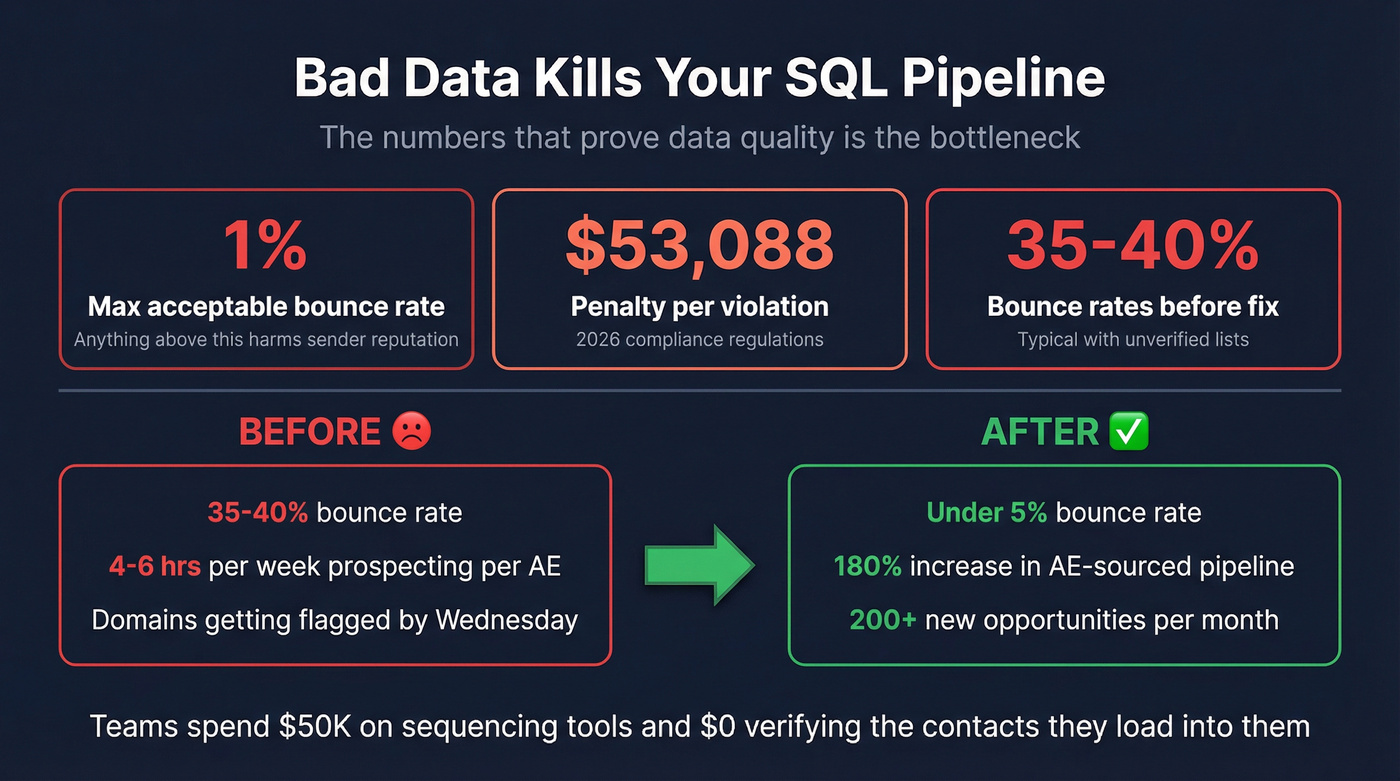
The threshold is clear: bounce rates above 1% signal poor list quality and actively harm your sender reputation. Every email that bounces tells inbox providers you're not a legitimate sender.
Data quality is the single biggest bottleneck for SQL generation, and most teams underinvest in it by an order of magnitude. They'll spend $50K on a sequencing tool and $0 verifying the contacts they load into it. It's maddening.
The proof points are dramatic. Snyk had 50 AEs prospecting 4-6 hours per week with bounce rates running 35-40%. After switching to Prospeo, bounce rates dropped under 5%, AE-sourced pipeline jumped 180%, and they were generating 200+ new opportunities per month. Meritt saw similar results: pipeline tripled from $100K to $300K per week, with bounce rates falling from 35% to under 4%.
Skip this step if you want to spend the next quarter rebuilding your domain reputation instead of closing deals.
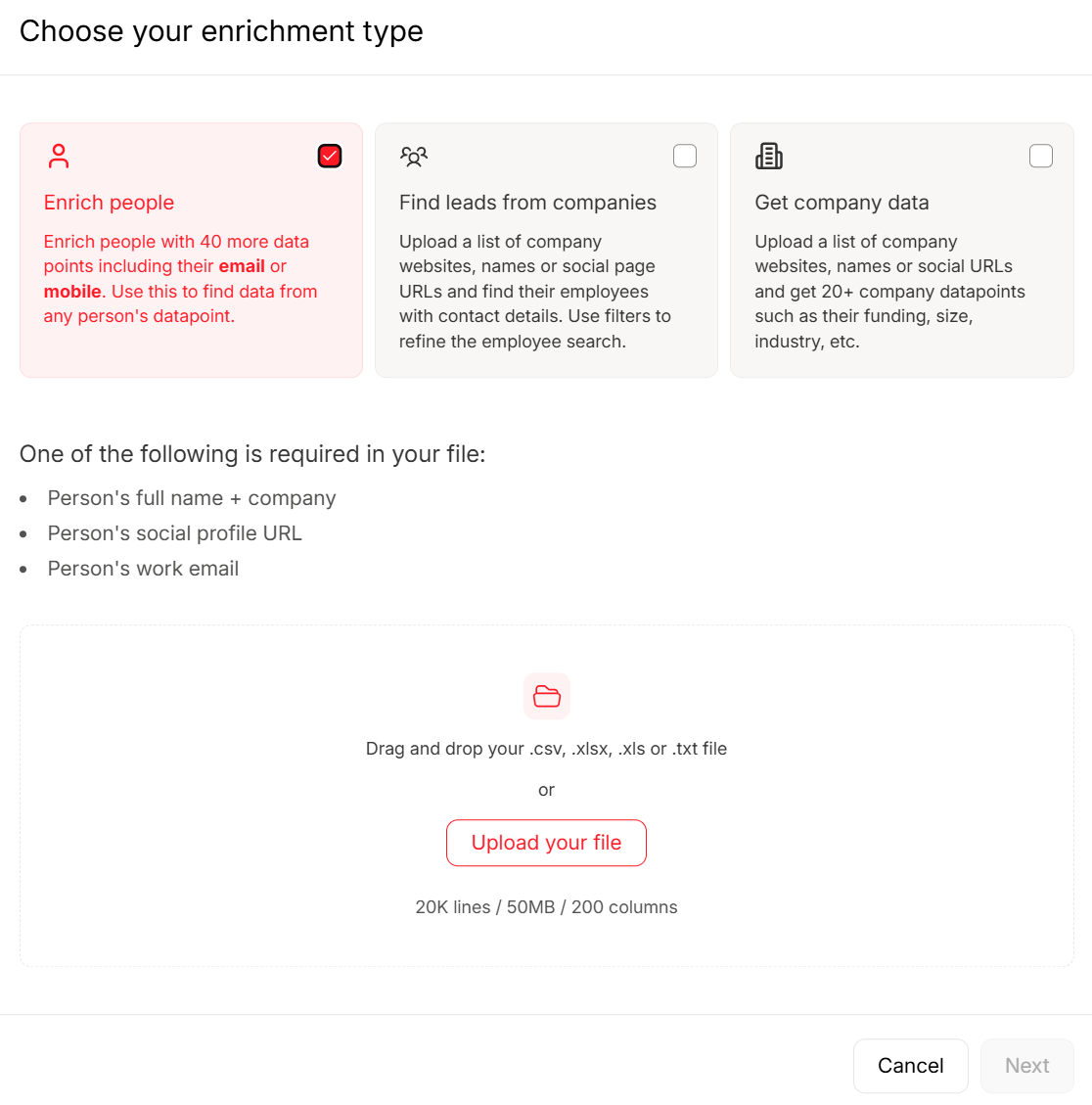
You need ~2,000 raw leads to close 10 deals, and the biggest drop-off is MQL to SQL. Prospeo's 30+ filters - buyer intent, job changes, headcount growth, technographics - let you skip the unqualified volume and build lists that already match 3 of 4 BANT criteria before a rep ever picks up the phone. At $0.01 per email, the funnel math finally works.
Build lists pre-qualified by intent, role, and budget signals.
Use Intent Signals to Find In-Market Buyers
Only 47% of sales-accepted leads become SQLs. The gap exists because most SALs fit the ICP on paper but aren't actively buying. Intent signals close that gap by identifying who's in-market right now.
Build your signal taxonomy around five categories:
- Funding events like Series A/B/C announcements signal budget and growth urgency
- Hiring surges - 5+ open roles in a department - mean active investment
- Executive changes bring new tech stack decisions
- Tech stack shifts reveal companies adopting or dropping tools in your category
- Content consumption patterns show who's researching your problem space across the web
Layer these signals into your scoring model so that a perfect-fit account showing active research behavior gets prioritized over one that matches on firmographics alone. The difference between a nurture target and an SQL is often just timing, and intent data gives you that timing dimension.
Five Mistakes That Kill Your SQL Pipeline
Stale data. Reaching out to contacts who left the company three months ago doesn't just waste rep time - it bounces, damages your domain, and makes every subsequent email less likely to land. Verify every contact before it enters a sequence. Refresh lists monthly at minimum.
Volume over quality. Flooding the pipeline with 500 "leads" that don't match your ICP creates busywork for sales and erodes trust between teams. Tighten your ICP definition and enforce it at the list-building stage, not after reps have already wasted a week calling the wrong people.
Unclear qualification criteria. When one rep qualifies on budget and another qualifies on interest, your forecast is fiction. Pick a framework, document it, make it non-negotiable.
Ignoring intent signals. Static lists miss the timing dimension entirely. A perfect-fit account that isn't buying right now is a nurture target, not an SQL. Layer intent data into your scoring model and prioritize accounts showing active research behavior.
Delayed follow-up. 67% of lost sales result from inadequate qualification - and slow follow-up is a big part of that. A lead that requested a demo on Tuesday and gets a call on Friday has already talked to your competitor. Route high-scoring leads to reps in real time with SLA alerts.
FAQ
What's a good MQL-to-SQL conversion rate?
The cross-industry average is roughly 15%. B2B SaaS runs around 13%, business insurance hits 26%, and legal services sits at 10%. If you're below 10%, tighten your SQL definition and scoring model before investing in more top-of-funnel volume.
What's the difference between an MQL and an SQL?
An MQL shows intent based on marketing signals - form fills, content downloads, email engagement. An SQL has been validated by sales through a conversation confirming budget, authority, need, and timeline. MQLs convert to customers at 5-15%; SQLs convert at 20-30%.
How many SQLs do I need to hit my revenue target?
Work backward from your revenue goal. At typical conversion rates, 10 new customers requires roughly 130 SQLs, 870 MQLs, and 2,000+ raw leads. Plug your own stage-by-stage conversion rates into this framework - industry benchmarks are starting points, not gospel.
How do I keep bounce rates low for outbound?
Verify every email before it enters a sequence and keep your bounce rate under 1%. Data freshness matters most - a 7-day refresh cycle versus the 6-week industry average means you're not emailing people who've already moved on. Run verification on any list older than 30 days before launching.
How can I generate sales qualified leads faster?
Combine signal-based targeting with verified contact data. Identify accounts showing active buying signals - funding rounds, hiring surges, executive changes - then reach decision-makers with multi-channel sequences. Teams layering intent data on top of ICP fit consistently see 2-3x higher SQL conversion rates versus static list outbound.