

GetProspect vs QuickEnrich: Which Email Finder Is Worth It?
Two email finders, wildly different architectures, and a roughly 10x gap in cost per valid email. GetProspect's Starter plan works out to $0.049 per valid email ($49 for 1,000), while QuickEnrich's Starter comes in at $0.00483 per email/phone ($29 for 6,000). That spread makes you wonder what you're actually paying for - and what you're giving up.
Here's the thing: neither tool has independent accuracy validation from a major benchmark. GetProspect has 41 reviews on G2. QuickEnrich doesn't have a meaningful third-party review footprint in our research. So you're choosing between a tool with some social proof and a tool with aggressive pricing but no external track record.
GetProspect at a Glance
GetProspect is a Chrome-extension-led email finder built around browser-based prospecting. The database covers 18M contacts with business emails, plus access to a 900M-member network for lookups. Install the Chrome extension, browse professional profiles or websites, and pull valid emails into lists. There's also a Google Sheets add-on and built-in CRM features like folders, lists, custom fields, and team collaboration.
On G2, it holds a 4.0/5 rating across 41 reviews. Users consistently praise the ease of use and responsive support. The criticism? Accuracy can be inconsistent, database coverage is thinner than larger platforms, and reporting is basic. Use GetProspect if:
- You prospect manually via browser and want a one-click email grab (see more sales prospecting techniques)
- You need a free tier to test (50 valid emails/month + 100 verifications)
- You value an independently reviewed tool with real user feedback
Skip GetProspect if:
- You need phone coverage - it's extremely limited at 5 phone numbers/month
- You're running high-volume API enrichment (compare data enrichment services)
- You need job-change monitoring or advanced intent signals
QuickEnrich at a Glance
QuickEnrich is an API-first enrichment tool targeting budget-conscious outbound teams. The database covers 130M+ contacts, and the vendor markets a 97% accuracy rate with "Double Verified Emails" - including catchall verification and SMTP verification. Mobile numbers come with around 25% of enriched contacts.
One Reddit user in r/salesdevelopment called it "the cheapest email vendor on the market right now." That tracks with the pricing, and the Clay integration makes it a natural fit for enrichment waterfall workflows (more on Clay list building).
Let's be honest: QuickEnrich's pricing is genuinely impressive, but a tool with no major independent reviews asking you to trust a 97% accuracy number is a leap of faith. We've seen this pattern before - tools without third-party validation tend to overstate their numbers. Run a test batch of 200-500 emails through your sequencer and measure real bounce rates before you scale (use email bounce rate benchmarks as your baseline).
Skip QuickEnrich if:
- You want independent accuracy validation before committing
- You need a Chrome extension for manual prospecting
- Third-party reviews and established support matter to your team
Feature-by-Feature Comparison
| Feature | GetProspect | QuickEnrich | Winner |
|---|---|---|---|
| Database size | 18M + 900M network | 130M+ contacts | QuickEnrich |
| Accuracy (vendor) | Not published | 97% | Unverifiable - neither is benchmarked |
| Phone numbers | Very limited (5/mo) | ~25% coverage | QuickEnrich |
| Verification | Email verification (single + bulk + API) | Double (catchall + SMTP) | QuickEnrich (on paper) |
| Chrome extension | Yes | No | GetProspect |
| API access | Available | Core feature | QuickEnrich |
| CRM | Built-in CRM features | Via API only | GetProspect |
| Free tier | 50 emails/mo | None | GetProspect |
| Review rating | 4.0/5 (41 reviews) | No major third-party reviews found | GetProspect |
| Credits | Fixed monthly | Fixed monthly, no rollover listed | Tie |
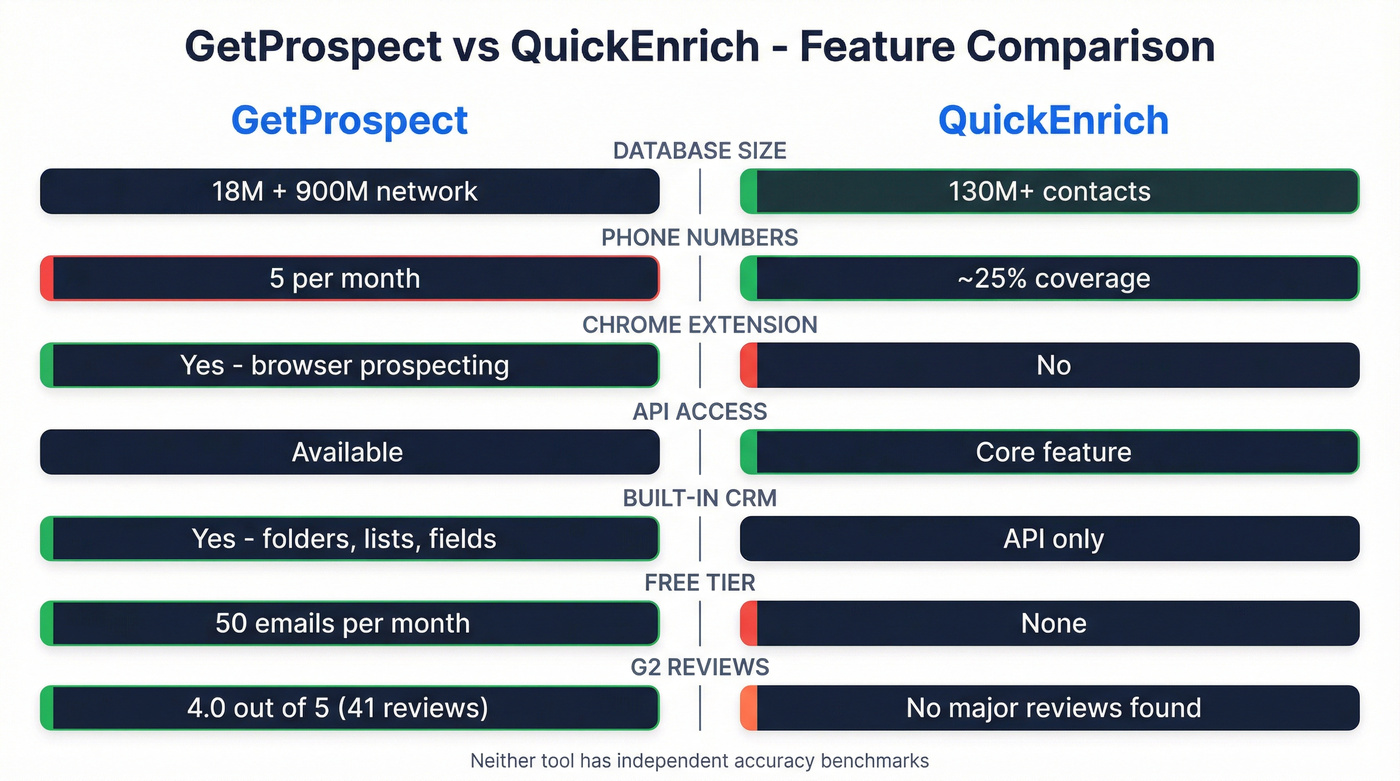
They solve different problems. GetProspect is a fishing rod for one-at-a-time prospecting; QuickEnrich is a net for bulk enrichment. Your workflow determines the winner (and your broader stack may look like a typical SDR tool setup).

GetProspect gives you 18M contacts. QuickEnrich claims 130M. Prospeo gives you 300M+ profiles with 98% verified email accuracy - independently proven, not self-reported. Plus 125M+ mobile numbers with a 30% pickup rate, not the 5/month or ~25% coverage you're comparing above.
Stop choosing between cheap and accurate. Get both at $0.01 per email.
Pricing Breakdown
| Plan | GetProspect | QuickEnrich |
|---|---|---|
| Free | 50 emails/mo | None |
| Starter (monthly) | $49/mo (1,000 emails) | $29/mo (6,000 emails) |
| Growth (monthly) | $99/mo (5,000 emails) | $99/mo (25,000 emails) |
| Starter (annual) | ~$34/mo billed annually | $24/mo (72,000/yr) |
| Growth (annual) | ~$69/mo billed annually | $83/mo (300,000/yr) |
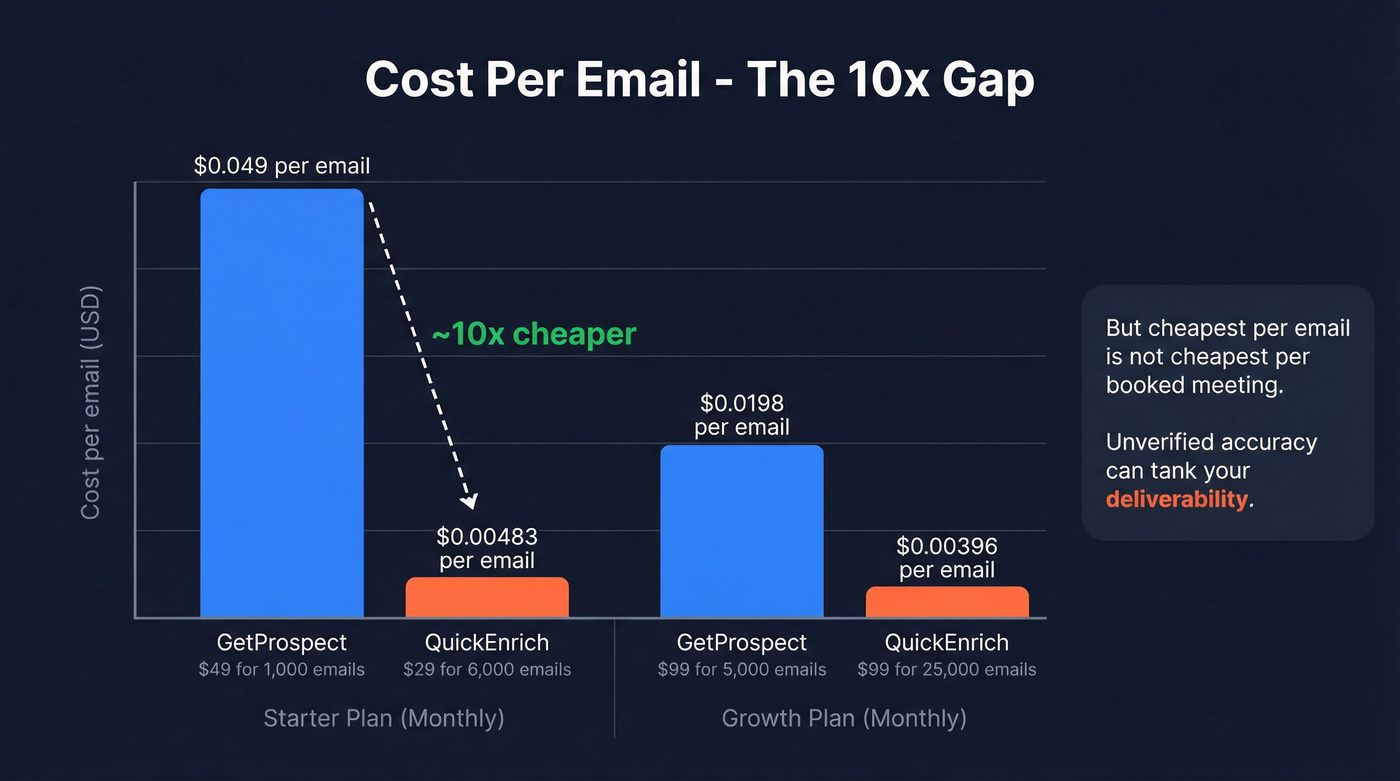
Real-world scenario: Say you're an SDR team of 5 sending 10,000 emails per month. GetProspect can cover that volume on higher tiers - 20,000 emails for $199/mo - but QuickEnrich's $99/mo plan already covers 25,000. For enrichment-heavy workflows, QuickEnrich is the cleaner fit and the lower-cost option at scale.
On annual plans, QuickEnrich's Starter drops to $24/mo, making it roughly 8-9x cheaper per email than GetProspect's ~$34/mo billed annually.
The cheapest email finder is never the one with the lowest per-email cost. It's the one that doesn't tank your email deliverability (see the full email deliverability guide). The Dropcontact email finder benchmark tested 15 tools on 20,000 real contacts with live sending - neither GetProspect nor QuickEnrich appeared in the results. When you're paying less, you should be asking harder questions about what "97% accuracy" actually means without independent testing.
When to Pick Each
Pick GetProspect if you prospect manually from professional profiles and websites, want a free tier to test before paying anything, and need a tool with 41 real user reviews and established support channels. It's the safer bet for solo outbound prospecting where you're working profile-by-profile (pair it with strong email subject lines examples to maximize replies).
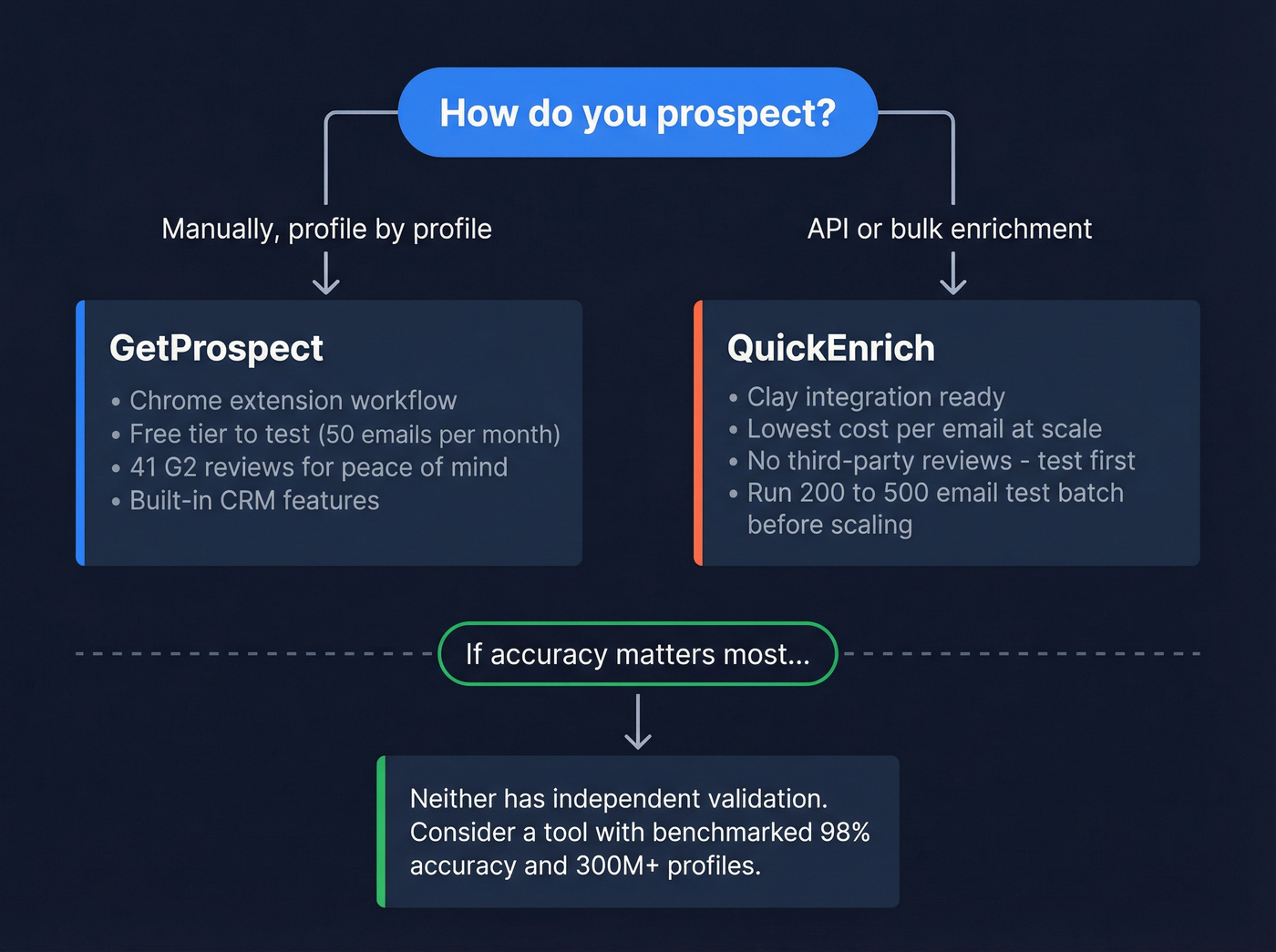
Pick QuickEnrich for API or Clay enrichment workflows at high volume where lowest cost per email is the priority. You'll need to be comfortable adopting a tool without major third-party reviews - but if the test batch checks out, the savings are real.
If accuracy is your top priority, neither tool has independent validation. That should give you pause.
A Stronger Third Option
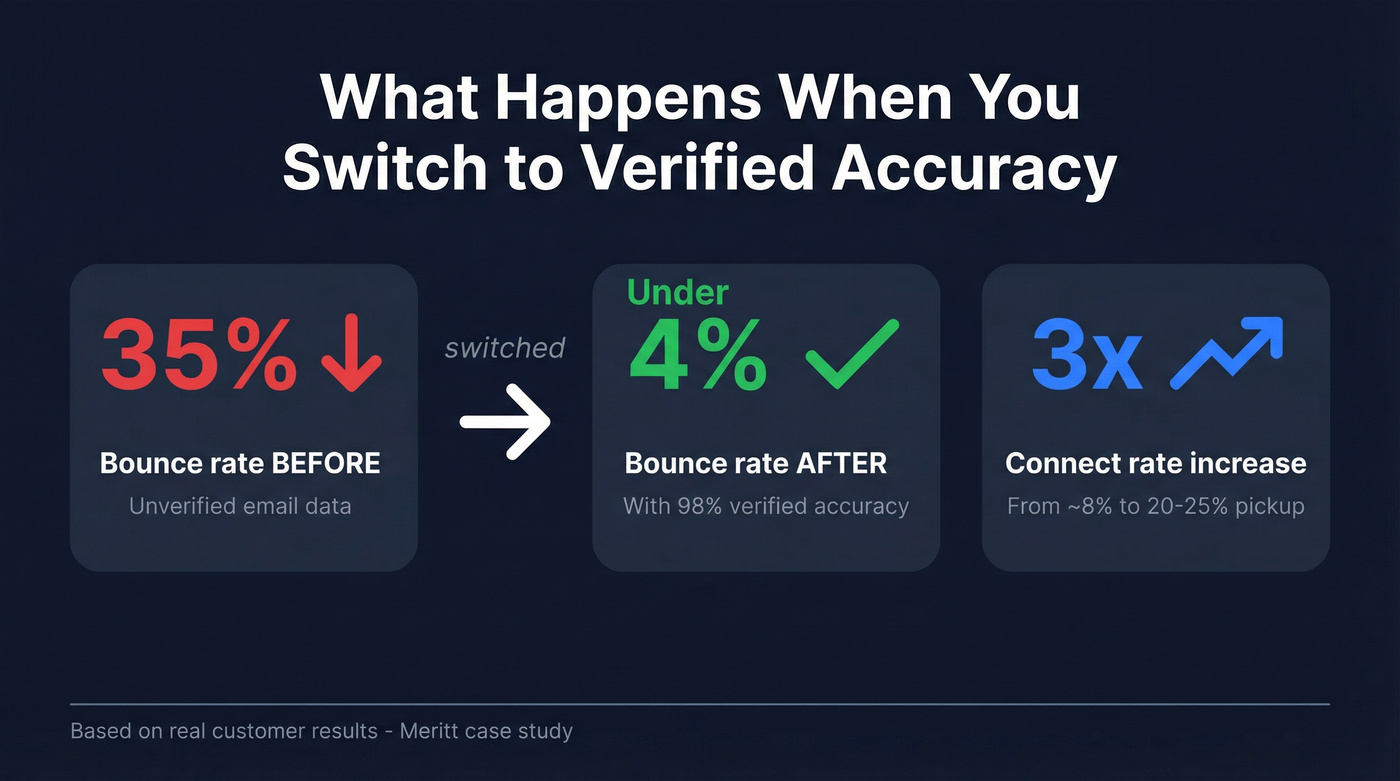
Real results back this up: one customer went from 35% bounce rates to under 4% after switching, and their connect rate tripled to 20-25%.

Neither GetProspect nor QuickEnrich has independent accuracy validation. Prospeo's 98% email accuracy is backed by a 5-step verification process, 7-day data refresh, and real customer results - like Meritt cutting bounce rates from 35% to under 4% while tripling pipeline.
75 free emails per month. Test real accuracy before you pick a side.
FAQ
Is QuickEnrich accurate without third-party reviews?
QuickEnrich's 97% accuracy is a vendor-reported number with no independent benchmark validation. The Dropcontact study of 15 tools didn't include it. Run a test batch of 200-500 emails and measure real bounce rates before scaling - if bounces exceed 2%, your domain reputation is at risk regardless of vendor claims.
Does GetProspect include phone numbers?
GetProspect is primarily an email tool with extremely limited phone coverage - plans show 5 phone numbers/month. If your outbound motion depends on direct dials, you need a dedicated mobile database.
What's the cheapest email finder for Clay workflows?
QuickEnrich is the cheapest per email at $0.00483 with native Clay integration. But cheapest per email isn't cheapest per booked meeting. Bounced emails cost you domain reputation and wasted sequence slots. A tool with 98% accuracy at roughly $0.01 per email and native Clay integration will outperform a cheaper tool with unverified accuracy every time.