


Gigasheet vs Lusha: A Comparison That Shouldn't Exist
Your RevOps lead wants to enrich a million-row CSV. Your SDR wants a phone number in 10 seconds. These are completely different problems - and Gigasheet vs Lusha maps to exactly that split. B2B data decays roughly 30% per year, so the tool you pick and how often it refreshes data will directly impact whether your outbound actually lands.
G2 places Gigasheet in Big Data Analytics - alongside Snowflake and Databricks - and Lusha in Sales Intelligence. Let's stop pretending this is a clean head-to-head and figure out what you actually need.
30-Second Verdict
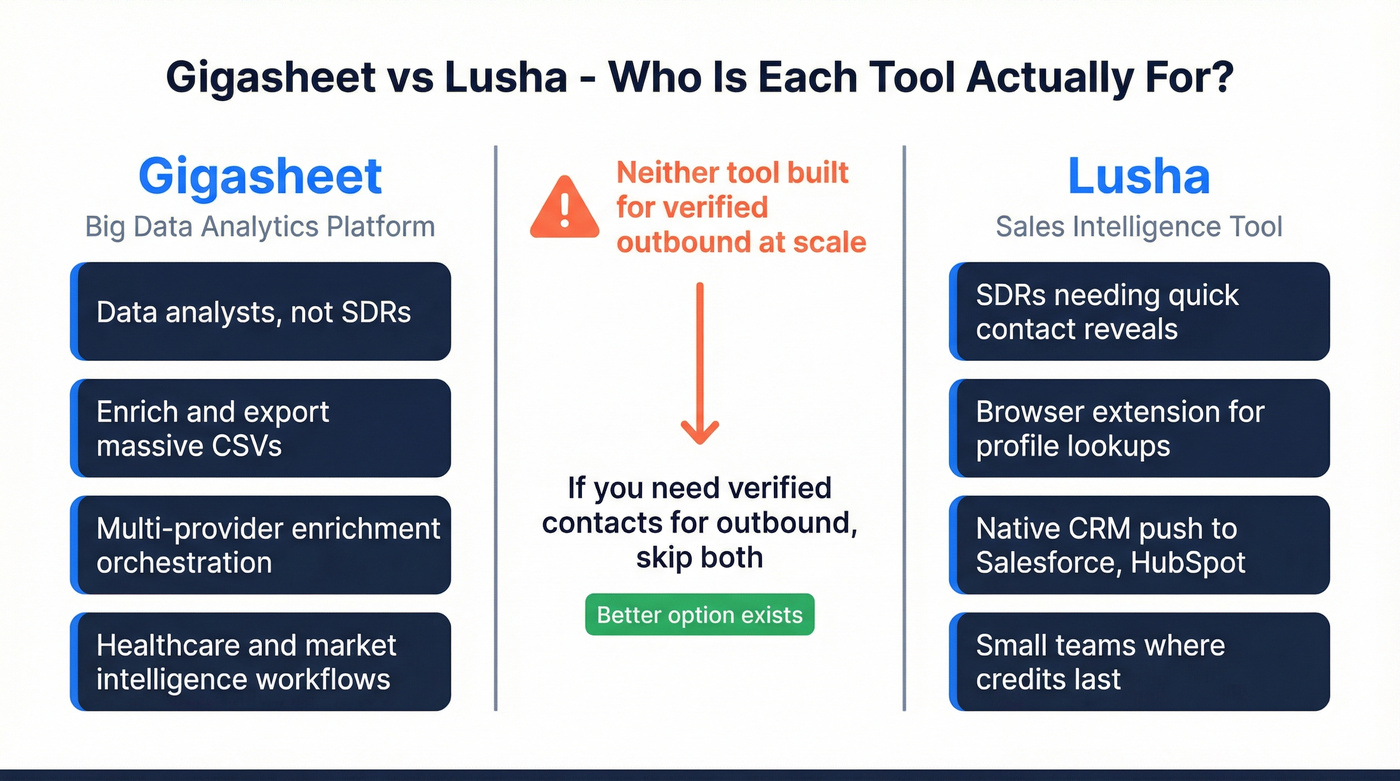
- Pick Gigasheet if you need to analyze, enrich, and export massive datasets across multiple data providers in a spreadsheet interface. You're a data analyst, not an SDR.
- Pick Lusha if you need quick contact reveals while browsing professional profiles and want native CRM push into Salesforce or HubSpot.
- Skip both if your real need is verified contact data for outbound at scale. Neither tool was built for that.
What Gigasheet Actually Is
Gigasheet is a no-code analytics platform used heavily in healthcare price transparency and market intelligence workflows. A core strength is source-traceable outputs - row-level visibility that ties results back to the original machine-readable files - which is very different from contact-reveal workflows. The B2B contact play comes through a partnership with RevenueBase, providing access to 300M+ contacts with monthly refreshes.

Think of it as an enrichment orchestrator. You can pull data from Apollo, Hunter, People Data Labs, ChatGPT, and RevenueBase itself, all inside a spreadsheet interface that handles up to a billion rows across files. Premium caps at 25M rows per sheet. Exports are unlimited - up to 1M rows at a time - though exports consume storage, and they can fail if you exceed a 10GB personal storage quota until you clear space or upgrade.
Here's the important distinction: RevenueBase access is flat-fee with no per-contact charges for searching, filtering, or downloading. The credit meter only shows up when you run enrichments and column-appends. Premium includes 100 enrichment credits per month, and enrichments consume 1 credit per row.
We've seen teams buy Gigasheet for data enrichment, then realize they still need a separate prospecting workflow. It's powerful for what it does, but it's an analytics workbench, not a sales tool.
Pricing: Premium runs $95/month on monthly billing, or $295/year ($25/mo effective) on annual. Higher tiers list at $1,650/year and $2,500/year depending on row limits and storage. The RevenueBase database itself uses a flat annual fee - expect mid four-figures to low five-figures based on market norms for unlimited-export contact datasets. Most of Gigasheet's 23 G2 reviews (4.9/5) come from healthcare analytics users, not sales teams.
Who should skip Gigasheet: Anyone who needs a sales prospecting workflow with CRM integrations, verified phone numbers, or real-time data.

Gigasheet charges flat fees for bulk exports but leaves you without a prospecting workflow. Lusha gives you CRM push but bleeds you dry at 10 credits per phone number. Prospeo combines 300M+ profiles, 30+ search filters, and native CRM integrations - with emails at ~$0.01 each and 98% accuracy.
Stop stitching two tools together when one platform handles both.
What Lusha Actually Is
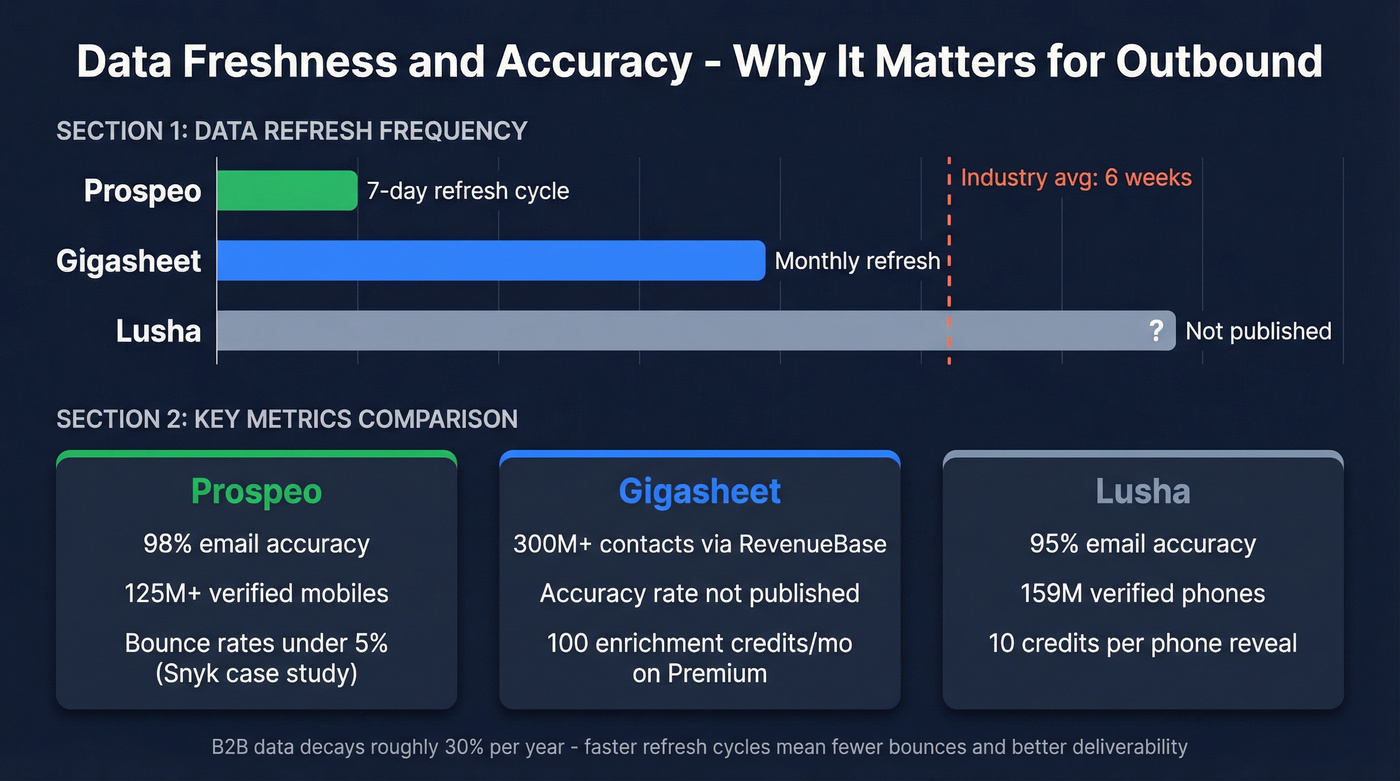
Lusha is a straightforward sales intelligence tool. It covers 280M+ profiles, 187M verified emails, and 159M verified phones, delivered through a browser extension and CRM integrations with Salesforce, HubSpot, and Outreach. Lusha reports 95% email accuracy and 90% phone accuracy.

The credit system is where things get painful. One email reveal costs 1 credit. One phone number costs 10 credits. The free plan gives you 70 credits/month - that's just 7 phone numbers if phones are what you need. In our experience, credit-based reveal tools feel cheap until you start pulling phone numbers, and then the math gets ugly fast.
Paid plans run ~$30-$70/user/month for SMB tiers depending on tier and billing cycle, with enterprise pricing on request. Unused credits roll over up to 2x the limit on monthly plans; annual plans issue credits up front and reset at cycle end - a detail worth understanding before you commit.
Lusha's G2 rating sits at 4.3/5 across 1,619 reviews, and the recurring complaints are predictable: credits evaporate fast, data goes stale, and Reddit users flag a buggy HubSpot integration that can override deal ownership. On the compliance side, Lusha holds GDPR, CCPA, SOC 2, and ISO 27701 certifications - strong posture for enterprise buyers.
Who should skip Lusha: Teams doing high-volume outbound. At 10 credits per phone number, scaling past a handful of SDRs gets expensive fast.
Head-to-Head Feature Comparison
| Feature | Gigasheet | Lusha | Edge |
|---|---|---|---|
| G2 category | Big Data Analytics | Sales Intelligence | Different tools |
| Database size | 300M+ (RevenueBase) | 280M+ profiles | Gigasheet (slightly) |
| Credit system | 1 credit/row enrichment (100/mo included); flat-fee exports | 1 credit/email; 10 credits/phone | Gigasheet (bulk) |
| Starting price | $25/mo (annual) | Free (70 credits/mo); paid ~$30-70/user/mo | Lusha (free tier) |
| Data refresh | Monthly | Not published | Gigasheet |
| G2 rating | 4.9/5 (23 reviews) | 4.3/5 (1,619 reviews) | Lusha (volume) |
| Export limits | 1M rows/export, unlimited | Credit-gated | Gigasheet |
| CRM integrations | Limited (API add-on) | Salesforce, HubSpot, Outreach | Lusha |
| Compliance | Not a primary marketing focus | GDPR/CCPA + SOC 2/ISO | Lusha |
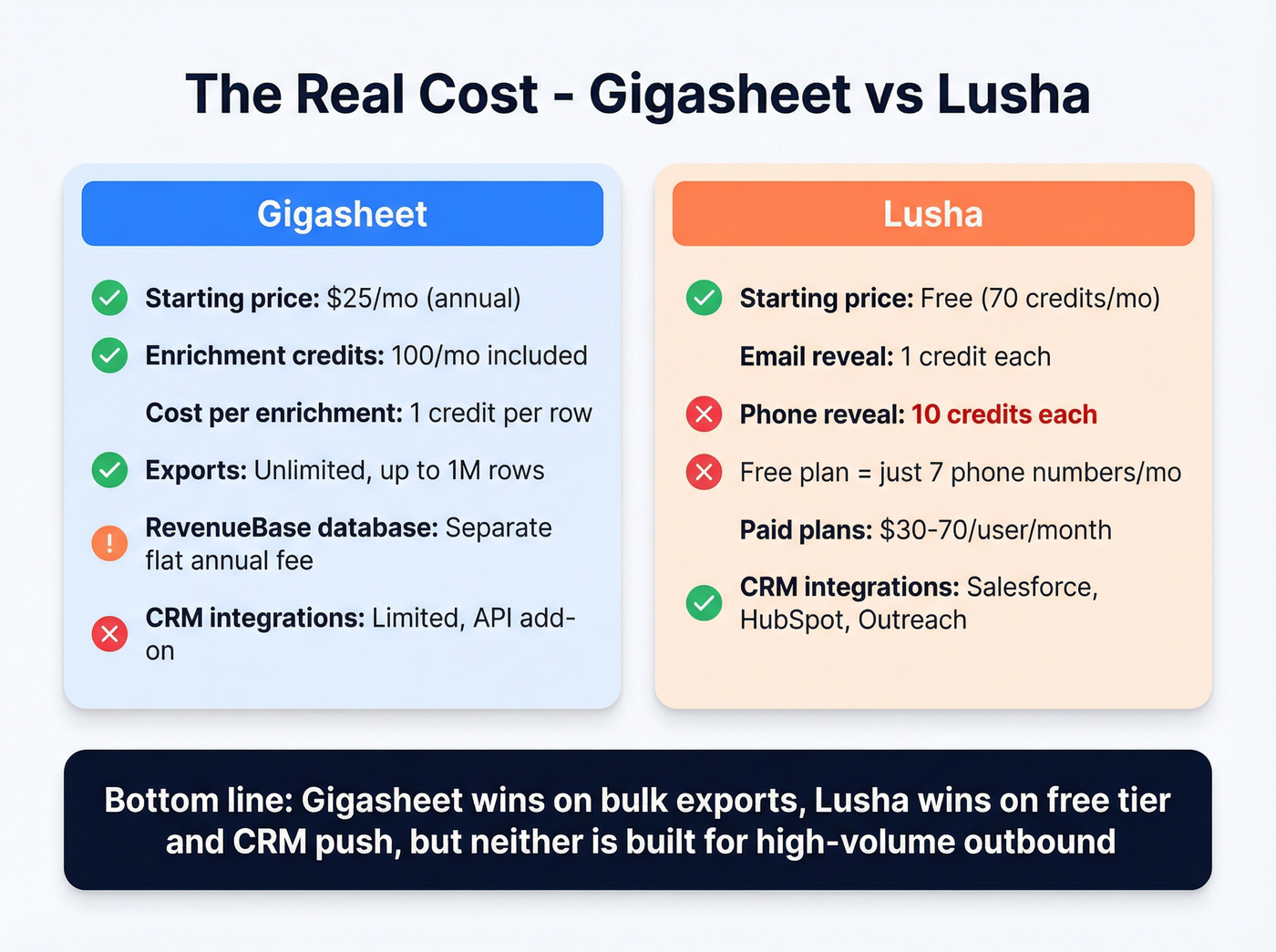
Here's the thing: most teams searching this comparison don't actually need either tool. Gigasheet is an analytics workbench that happens to have a B2B contact database bolted on. Lusha is a sales extension that reveals contacts one at a time behind a credit wall. If you're a data analyst who needs to enrich and export millions of rows, pick Gigasheet. If you're an SDR who needs a phone number right now and your team is small enough that credits won't bleed you dry, pick Lusha.
But if you need verified outbound data at scale - the thing most sales teams actually need - neither one is the answer.
A Stronger Fit for Outbound Teams
Prospeo covers 300M+ professional profiles with 143M+ verified emails at 98% accuracy and 125M+ verified mobile numbers that hit a 30% pickup rate. Data refreshes every 7 days, compared to a 6-week industry average, which matters when bounce rates can tank your domain reputation overnight. One customer, Snyk, saw bounce rates drop from 35-40% to under 5% after switching, with AE-sourced pipeline up 180%.

Search filters go 30+ deep: buyer intent across 15,000 Bombora topics, technographics, job changes, headcount growth, funding rounds, and revenue. Exports push directly into Salesforce, HubSpot, Lemlist, Instantly, and Smartlead. The Chrome extension has 40,000+ users finding contacts from company websites, professional profiles, and CRMs.
If you're evaluating sales prospecting databases, this is the layer that usually matters more than raw database size: freshness, verification, and workflow fit.
Self-serve, transparent pricing works out to about $0.01 per verified email on typical plans. The free tier includes 75 verified emails and 100 Chrome extension credits per month. No annual contracts, no sales calls - predictable economics instead of per-reveal sticker shock.
If you're trying to protect deliverability while scaling, pair any data source with an email deliverability process and track your email bounce rate like a core revenue metric.
B2B data decays 30% per year, and neither monthly refreshes nor unpublished cycles cut it. Prospeo refreshes every 7 days - so the emails and mobiles you pull today still connect next week. Snyk dropped bounce rates from 35-40% to under 5% and grew AE-sourced pipeline 180%.
Get contact data that's still accurate when you hit send.
FAQ
Is Gigasheet a real Lusha competitor?
Not really. Gigasheet is a big-data analytics platform whose B2B contact database (RevenueBase) is an add-on to its core healthcare analytics product. Lusha is purpose-built for sales prospecting. G2 categorizes them in entirely different software categories. Gigasheet excels at workflow flexibility and traceability; Lusha wins on speed and CRM integrations.
Which tool has more accurate contact data?
Lusha reports 95% email accuracy across 187M verified emails. Gigasheet/RevenueBase doesn't publish accuracy rates but does offer monthly refreshes and verified fields. For teams where deliverability is non-negotiable, look for providers with published accuracy above 95% and refresh cycles measured in days, not weeks.
What's cheaper for high-volume prospecting?
Gigasheet Premium starts at $25/mo on annual billing, but it's designed for data analytics, not prospecting workflows. Lusha's free plan gives 70 credits - just 7 phone numbers. Paid plans run ~$30-70/user/month. For teams running outbound at scale, credit-based reveal pricing almost always loses to flat-rate or per-email models.
Can I use Gigasheet and Lusha together?
Technically, yes - Gigasheet for bulk enrichment and analysis, Lusha for one-off reveals during live prospecting. But managing two tools, two credit systems, and two data freshness cadences adds operational overhead most teams don't need. A single platform with bulk search, verification, and CRM integrations will save you time and headaches.