

Gmail Spam Trigger Words: The List You Want (and What Actually Matters)
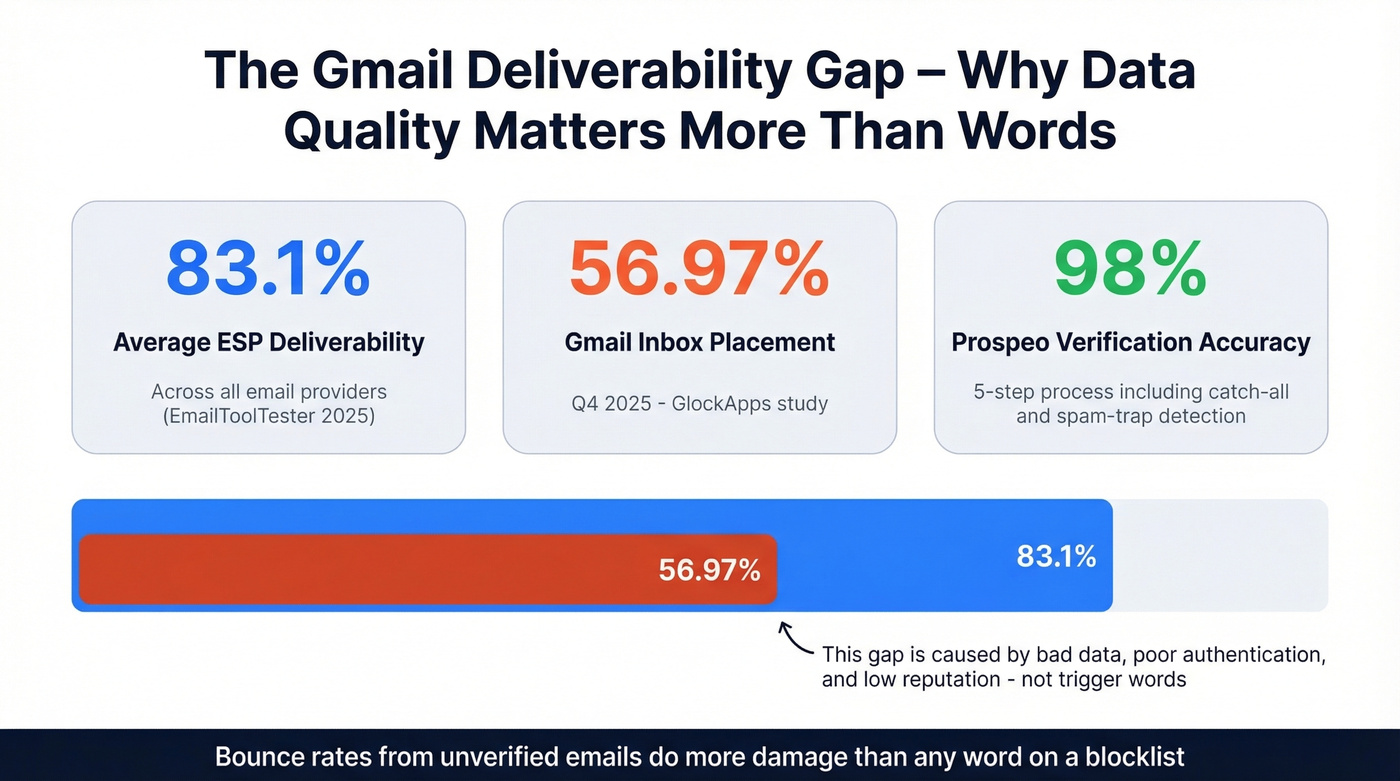
You rewrote your subject line five times to avoid the word "free" and the email still landed in spam. Sound familiar? That's because Gmail doesn't care much about individual trigger words anymore - it prioritizes authentication, sender reputation, and engagement signals first. Gmail's inbox placement rate hit just 56.97% in Q4 2025, and not one of the top-ranking trigger-word articles cites a controlled test proving specific words caused that drop. We've tested this repeatedly: a clean sender reputation overrides word choice every single time.
Here's what you actually need:
- Set up SPF, DKIM, and DMARC properly (and understand DMARC alignment).
- Keep your Gmail spam complaint rate below 0.1% - monitor it in Google Postmaster Tools (or other email reputation tools).
- Verify every email address before sending. High bounce rates damage your reputation far more than tweaking a few words (see email bounce rate benchmarks and fixes).
Now here's why - and the word list you came for.
Promotions Tab Isn't Spam
Let's clear this up. Landing in Gmail's Promotions tab isn't a deliverability failure. Promotions is inbox. Your email got delivered, and the reader can see it. Around 50% of Gmail users don't even have tabbed inboxes enabled, per a Sinch Mailjet 2024 study - so for half your audience, there's no Promotions tab to worry about.
A September 2025 Gmail update added "Most Relevant" sorting inside Promotions, surfacing brands recipients actually engage with. The path to visibility isn't avoiding Promotions. It's being relevant enough that Gmail ranks you higher within it.
What Gmail Actually Filters For in 2026
Gmail's filtering uses multiple layers. Words sit at the bottom of the stack.

1. Authentication (pass/fail gate)
SPF, DKIM, and DMARC need to pass with alignment. One-click unsubscribe (RFC 8058) is required for bulk senders. Starting November 2025, Gmail ramped up enforcement on non-compliant bulk senders sending 5,000+ messages per day to Gmail addresses, including temporary deferrals and outright rejections.
2. Sender reputation (the big one)
Google Postmaster Tools tracks your domain reputation, spam complaint rate, and authentication pass rates. Stay below 0.1% spam complaints. Cross 0.3% consistently and Gmail starts blocking you outright - no amount of subject-line wordsmithing saves you at that point (more on how to improve sender reputation).
3. Engagement signals
Opens, clicks, replies, moves-to-inbox, and deletes all feed Gmail's model. In the Gemini era, deliverability is increasingly visibility-based - delivered doesn't always mean seen.
4. Content signals (including trigger words)
This is where words live. They're a tiebreaker when everything above is borderline. They're not the main event.

Gmail's spam filter cares about your bounce rate far more than your word choice. Every unverified email you send chips away at your sender reputation - the #1 factor in inbox placement. Prospeo's 5-step verification catches bad addresses with 98% accuracy, including catch-all handling, spam-trap removal, and honeypot filtering.
Stop rewriting subject lines. Start cleaning your list.
Gmail Spam Trigger Words That Still Hurt
Here's the list you came for. Fair warning: no published trigger-word list - not MailGenius's 400-word list, not Mailmeteor's 349 entries - cites a controlled experiment with seed accounts and repeatable methodology. These lists are largely recycled across blogs. Even HubSpot acknowledges that modern filters prioritize reputation and authentication first, with words acting as a secondary tipping point.
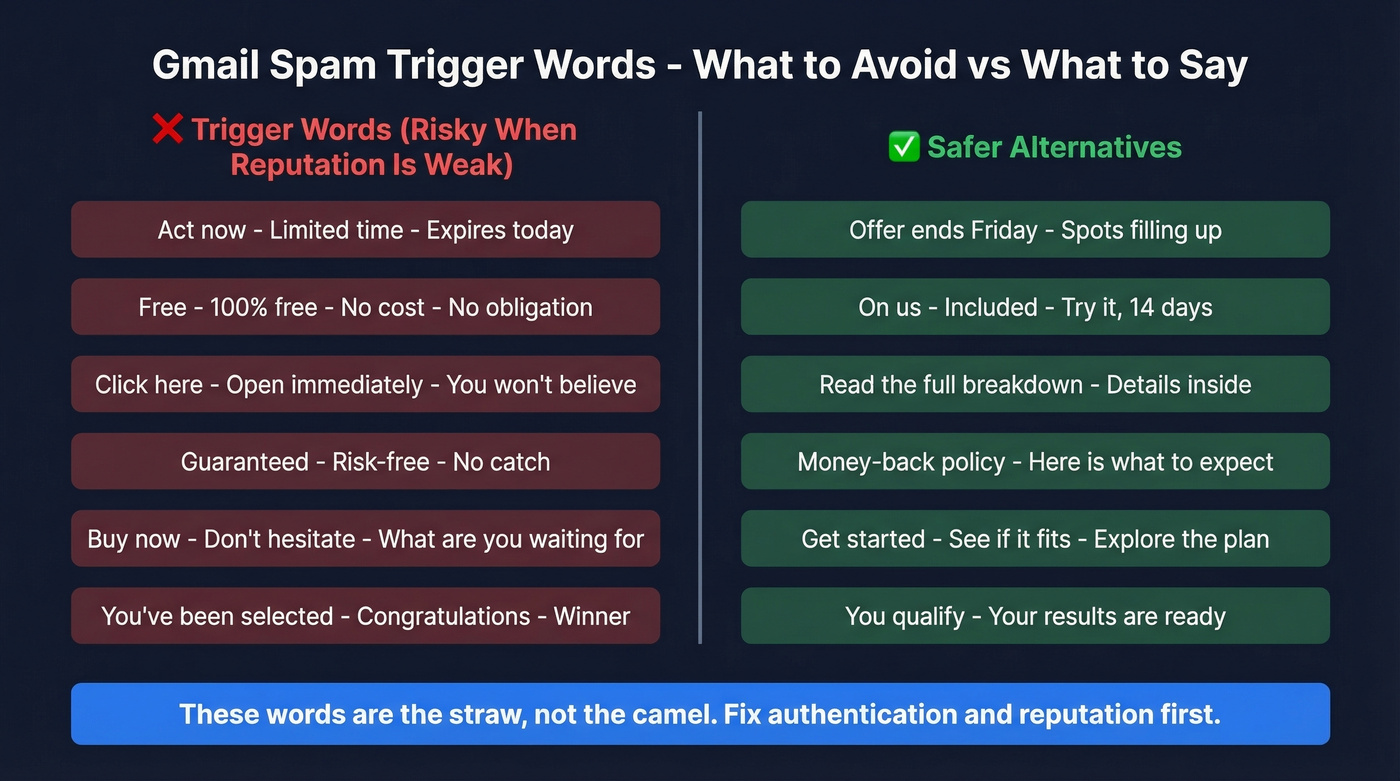
That said, stacking these phrases in a low-reputation context can push you over the edge. They apply to subject lines, body copy, preheaders, and even image alt text. Use this as a sanity check, not a rulebook.
| Category | Examples | Say Instead |
|---|---|---|
| Financial | Act now, no fees, no cost, earn extra cash, double your money, million dollars, cash bonus, credit card, lowest price | "Included at no extra cost," "see pricing" |
| Urgency/Pressure | Limited time, expires today, don't delete, urgent, immediately, once in a lifetime, while supplies last, final notice | "Offer ends Friday," "spots filling up" |
| Free Offers | Free, 100% free, free trial, free access, free gift, free consultation, complimentary, no charge, no obligation | "On us," "included," "try it - 14 days" |
| Health/Weight | Lose weight, miracle cure, weight loss, anti-aging, life-changing, cure, remedy, no prescription, diet | "Feel stronger," "science-backed results" |
| Scam/Deception | No catch, this isn't spam, not junk, you've been selected, congratulations, winner, you won, guaranteed, risk-free | "Here's what to expect," "money-back policy" |
| Clickbait | Click here, click below, open immediately, see for yourself, you won't believe, shocking, secret, revealed, exclusive deal | "Read the full breakdown," "details inside" |
| Legal Risk | No questions asked, no strings attached, cancel anytime, as seen on, endorsed by, certified, official notice | "Flexible terms," "featured in [publication]" |
| Aggressive Sales | Buy now, order today, don't hesitate, what are you waiting for, call now, sign up free, special promotion, one-time offer | "Get started," "see if it fits," "explore the plan" |
In our testing, emails with "free" in the subject line delivered fine when sent from domains with strong reputations. These words matter when your sender reputation is already shaky - they're the straw, not the camel.
Here's the thing: if your bounce rate is under 3% and your complaint rate is under 0.1%, stop agonizing over word choice. The hours teams spend scrubbing subject lines for trigger words would be better spent cleaning their contact lists. Bad data is the real spam trigger.
What Matters More Than Words
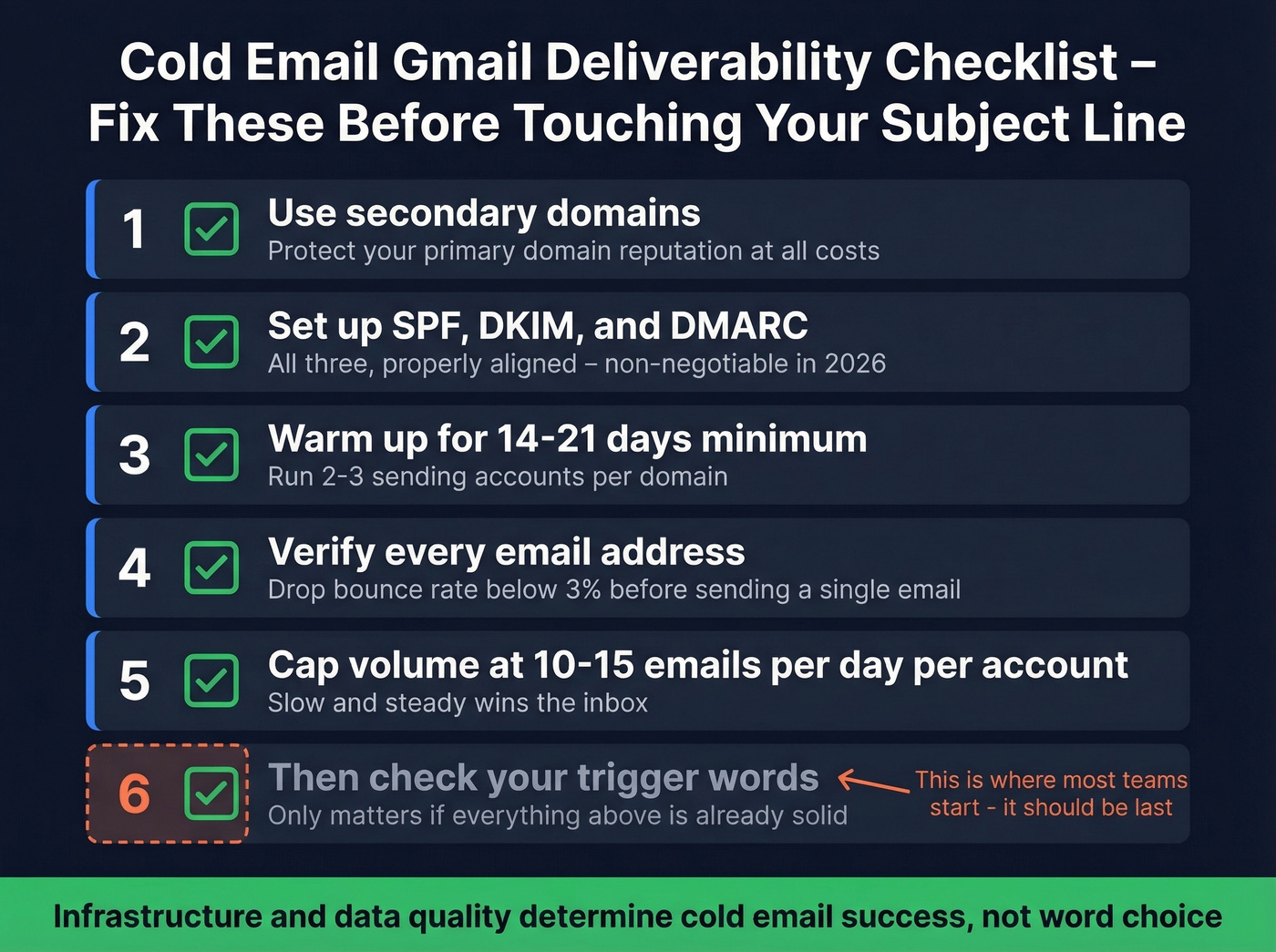
Fix your authentication stack. SPF, DKIM, DMARC - all three, properly aligned. Non-negotiable in 2026. Gmail is actively deferring and rejecting non-compliant bulk mail (use this email deliverability guide as a checklist).
Monitor your spam complaint rate. Google Postmaster Tools is free. Set it up today. Stay below 0.1%. Run your draft through Mail-Tester.com for a quick pre-send spam score (or use an email spam checker workflow).
Clean your data before you send. Average email deliverability across ESPs runs about 83.1%, but Gmail-specific inbox placement is far lower at 56.97%. Bounces from unverified emails do more damage than any word on a blocklist. We've watched teams obsess over avoiding "limited time" in a subject line while sending to a list with a 15% bounce rate - that's like rearranging deck chairs on the Titanic. Prospeo's 5-step verification process catches bad addresses with 98% accuracy, including catch-all handling, spam-trap removal, and honeypot filtering. The free tier gives you 75 email verifications per month, enough to test before your next campaign.

Watch your HTML. Broken code and all-image emails with no text are easy spam triggers that fly under the radar. If you're sending image-heavy promotional emails, always include a plain-text version.
For cold email specifically: Use secondary domains to protect your primary domain reputation. Run 2-3 sending accounts per domain, cap at 10-15 emails per day per account, and warm up for 14-21 days minimum (and keep an eye on email velocity). The consensus on r/coldemail is consistent - infrastructure and data quality determine cold email success, not whether you used "exclusive" in your opener. Skip the trigger-word obsession if your domain isn't warmed and your list isn't verified. Fix the foundation first (start with a solid B2B cold email sequence).
FAQ
Do spam trigger words matter for cold email?
Words are a minor factor. Infrastructure determines whether cold emails reach Gmail inboxes - secondary domains, SPF/DKIM/DMARC, proper warmup, and verified data. A clean list with low bounce rates matters ten times more than avoiding "free" in your subject line.
How do I check if Gmail is flagging my emails?
Use Google Postmaster Tools - it's free and shows your domain reputation, authentication pass rates, and spam complaint rate from Gmail's perspective. Focus on 30-day trends rather than daily fluctuations.
Can verifying my email list improve Gmail deliverability?
Yes. High bounce rates from bad data destroy sender reputation, which is the primary factor Gmail uses for filtering. Verification tools can drop your bounce rate below 3%, which meaningfully shifts how Gmail treats your entire sending domain.
You just read the full trigger word list. Now fix what actually matters: your data. Teams using Prospeo's verified emails see bounce rates drop below 3% - keeping sender reputation intact so Gmail stops flagging you regardless of word choice. At $0.01 per email, it costs less than one lost deal sitting in spam.
Bad data is the real spam trigger. Kill it at the source.