

6 Go-to-Market Model Examples (With a Decision Matrix)
Your investor asks "what's your GTM motion?" and you say "content marketing and outbound." That's a channel list, not a model. A GTM model is the structural motion for how strangers become paying customers - a GTM strategy is the execution plan for a specific launch. Companies now spend $2 in sales and marketing for every $1 of new ARR, up 14% over the past two years. Here are six go-to-market model examples and a decision matrix so you pick the right one.
Which GTM Model Fits Your ACV?
Your average contract value determines your GTM model more than any other variable. Not your product category, not your competitor's playbook, not what worked at your last company.
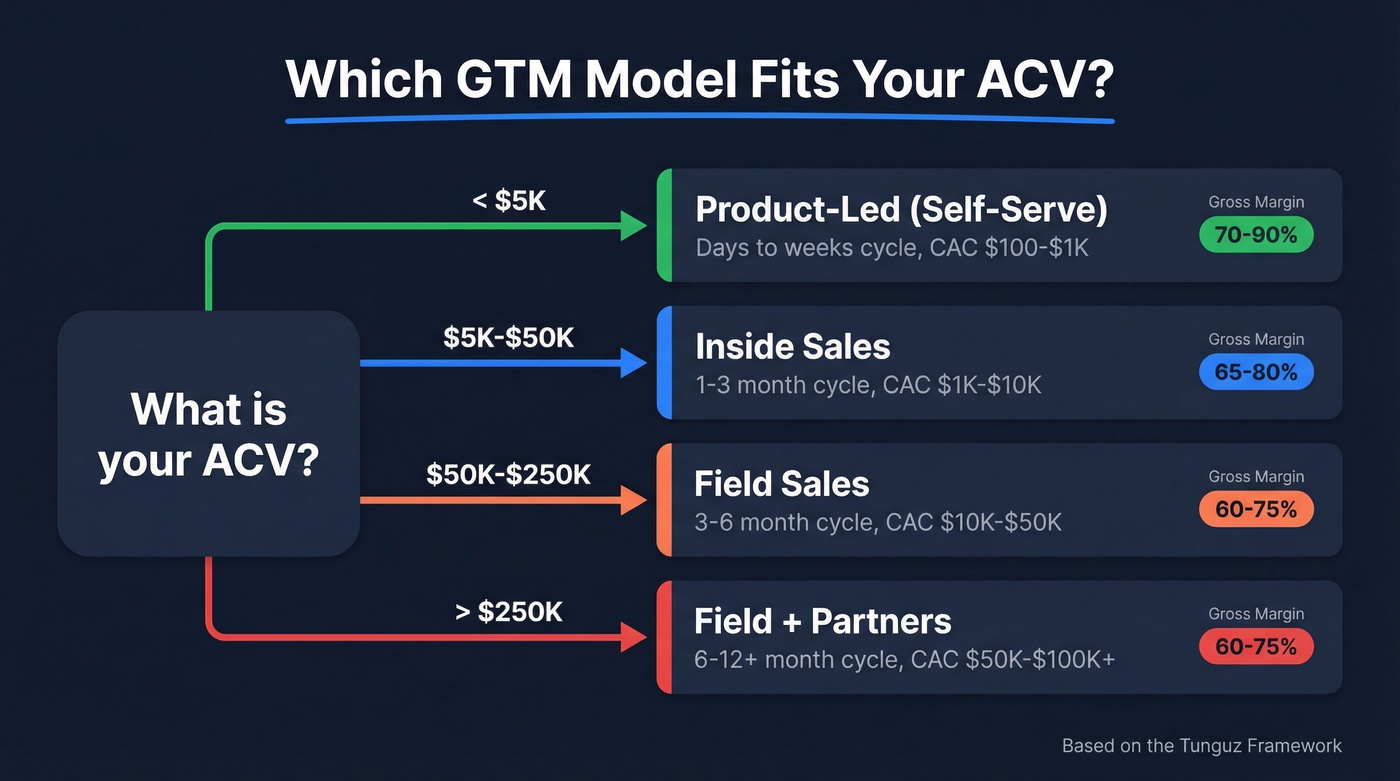
| ACV Range | Best Model | Sales Cycle |
|---|---|---|
| < $5K | Product-led (self-serve) | Days to weeks |
| $5K-$50K | Inside sales | 1-3 months |
| $50K-$250K | Field sales | 3-6 months |
| > $250K | Field + partnerships | 6-12+ months |
That's the Tunguz framework in four rows. Ask any PMM who's done a GTM take-home exercise - the model question is where most candidates stumble because they conflate channels with motions. Below are the worked examples and the "when NOT to use" for each.
6 GTM Motions With Real Examples
Product-Led (Self-Serve)
Use this if your product delivers value before anyone talks to sales, your ACV sits under $5K, and you can build a free or freemium tier. Slack is the canonical example - viral team invites, usage limits that nudge upgrades naturally.
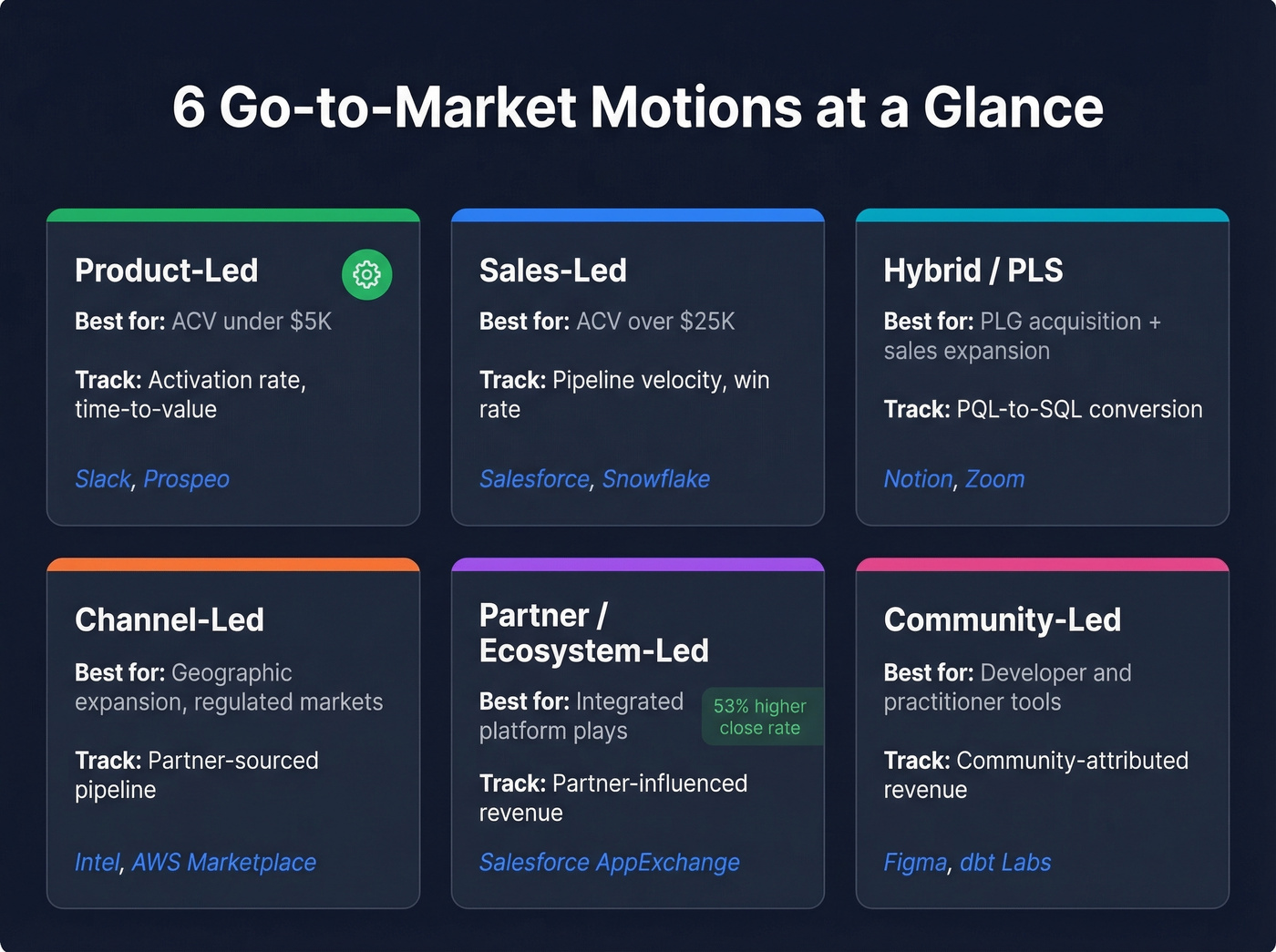
Prospeo runs this same motion in B2B data: free tier, credit-based pricing at about $0.01 per verified email, no contracts. Over 15,000 companies onboarded through the product itself - nobody scheduled a demo to get started. When self-serve adoption feeds expansion revenue back into product development, you create a flywheel that compounds without proportionally increasing headcount. That's the whole point of PLG: the product does the selling, and humans step in only when the deal size justifies it.

Skip this if your buyers sit in multi-stakeholder committees. PLG CAC runs $100-$1K with 70-90% gross margins - beautiful economics when the motion fits. Track activation rate and time-to-value.
Sales-Led
A dedicated sales team drives pipeline through demos, relationships, and tailored contracts. This works when ACV exceeds $25K, buying committees involve 6-10 stakeholders, and the product requires implementation support. Salesforce and Snowflake are the textbook examples.
CAC runs $10K-$100K+, margins compress to 60-75% because you're paying reps, SEs, and CSMs. Here's the thing: if your ACV is under $15K, the math gets ugly fast. A high-CAC motion can't pay for itself on small contracts. We've watched teams burn through six figures of SDR payroll against a $3K ACV before someone finally pulls up the unit economics spreadsheet. Measure pipeline velocity and win rate.
Hybrid / Product-Led Sales
PLG handles acquisition; sales steps in for expansion. Notion and Zoom both run this - self-serve gets millions of users in the door, and sales converts the accounts that matter.
Hybrid is the default in 2026. PLG for acquisition, sales for expansion when usage signals and enterprise requirements show up. In our experience, the teams doing it intentionally outperform the ones who stumbled into it. The difference is usually a clear PQL definition and a handoff trigger that sales actually trusts. The number that matters: PQL-to-SQL conversion rate.
Channel-Led
Intermediaries - distributors, resellers, affiliates, marketplace listings - reach customers you can't efficiently reach direct. Intel's reseller network is the classic example; AWS Marketplace listings are the modern one.
Use this if you're expanding geographically or selling into regulated industries where local partners already have trust and compliance infrastructure. Skip this if you need tight control over the buyer experience or your product requires a high-touch onboarding that partners won't replicate well. The 2026 shift is from partner quantity to partner quality. Track partner-sourced pipeline.
Partner / Ecosystem-Led
Not a referral program. Ecosystem-led means complementary partners delivering an integrated end-to-end offering. The Salesforce AppExchange is the clearest example - thousands of ISVs building on the platform, each expanding the other's addressable market.
Partner-involved deals close 53% more often, carry 40% higher AOV, and convert 46% faster. This is the most underrated GTM motion. Most startups ignore it until Series C, which is a mistake - the economics reward early movers who build integrations before their competitors do. Measure partner-influenced revenue.
Community-Led
Not "having a Slack group." Community-led means the community itself drives acquisition, engagement, and retention as a revenue engine. Figma and dbt Labs are the standout examples - practitioners influence buying decisions, creating pull that paid channels can't match.
The consensus on r/startups and r/SaaS is that community-led growth is the hardest motion to fake and the hardest to scale, but the moat it builds is nearly impossible to compete against once it's working. Use this if you're building developer, design, or data tools where practitioners hold purchasing influence. Skip this if your buyers are executives who don't participate in communities. Track community-attributed revenue.

Product-led GTM only works when your data doesn't burn your domain. Prospeo's 5-step email verification delivers 98% accuracy - the reason 15,000+ companies run self-serve outbound without bouncing into spam folders.
Pick your GTM model. We'll give you the data that makes it work.
The Full Decision Matrix
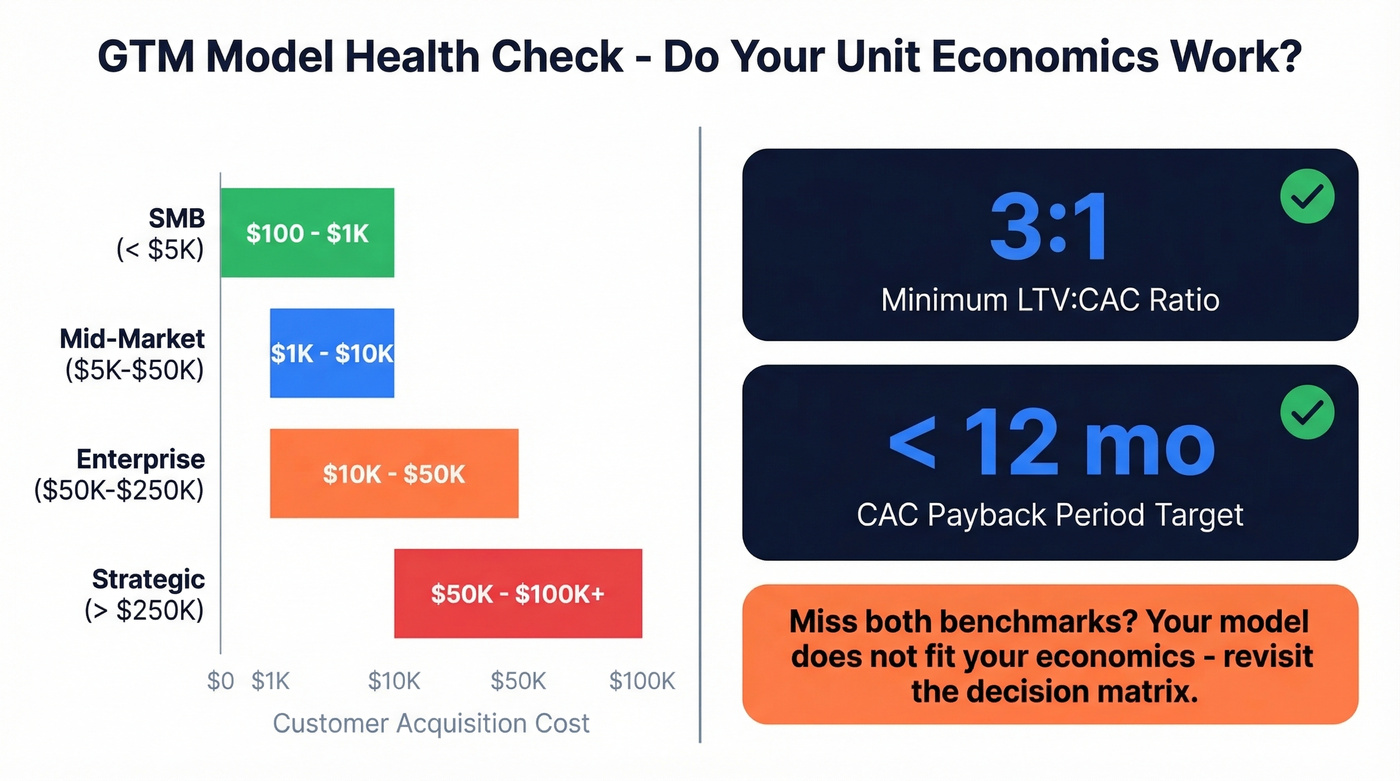
The complete framework with unit economics:
| ACV (Segment) | Model | Cycle | CAC | Margin |
|---|---|---|---|---|
| < $5K (SMB) | Product-led | Days to weeks | $100-$1K | 70-90% |
| $5K-$50K (Mid-market) | Inside sales | 1-3 mo | $1K-$10K | 65-80% |
| $50K-$250K (Enterprise) | Field sales | 3-6 mo | $10K-$50K | 60-75% |
| > $250K (Strategic) | Field + partners | 6-12+ mo | $50K-$100K+ | 60-75% |
Two health checks: LTV:CAC ratio of 3:1 or higher, and CAC payback under 12 months. If you're outside both, your model doesn't fit your economics.
Let's be honest - if your ACV is under $10K, you almost certainly don't need a sales-led motion. Your SDR team burning $80K/month against a $3K ACV is a model problem, not a pipeline problem. The matrix would've caught that before you hired rep number four.
Building a Revenue Acceleration Model
Picking the right motion from the examples above is step one. Step two is turning that motion into a revenue acceleration model - a system where each stage of the funnel compounds the next. That means aligning marketing, sales, and customer success around shared pipeline metrics rather than siloed KPIs.
There's a real debate happening right now between predictable impact and predictable revenue. Traditional GTM planning optimizes for predictable revenue: quota attainment, bookings targets, linear forecasts. But the best-performing teams in 2026 optimize for predictable impact - measuring how each motion moves customer outcomes, which in turn drives retention and expansion. Revenue follows impact. Chasing revenue alone leads to discounting and churn.
Validate Before You Commit
Two tools will save you from picking the wrong model:
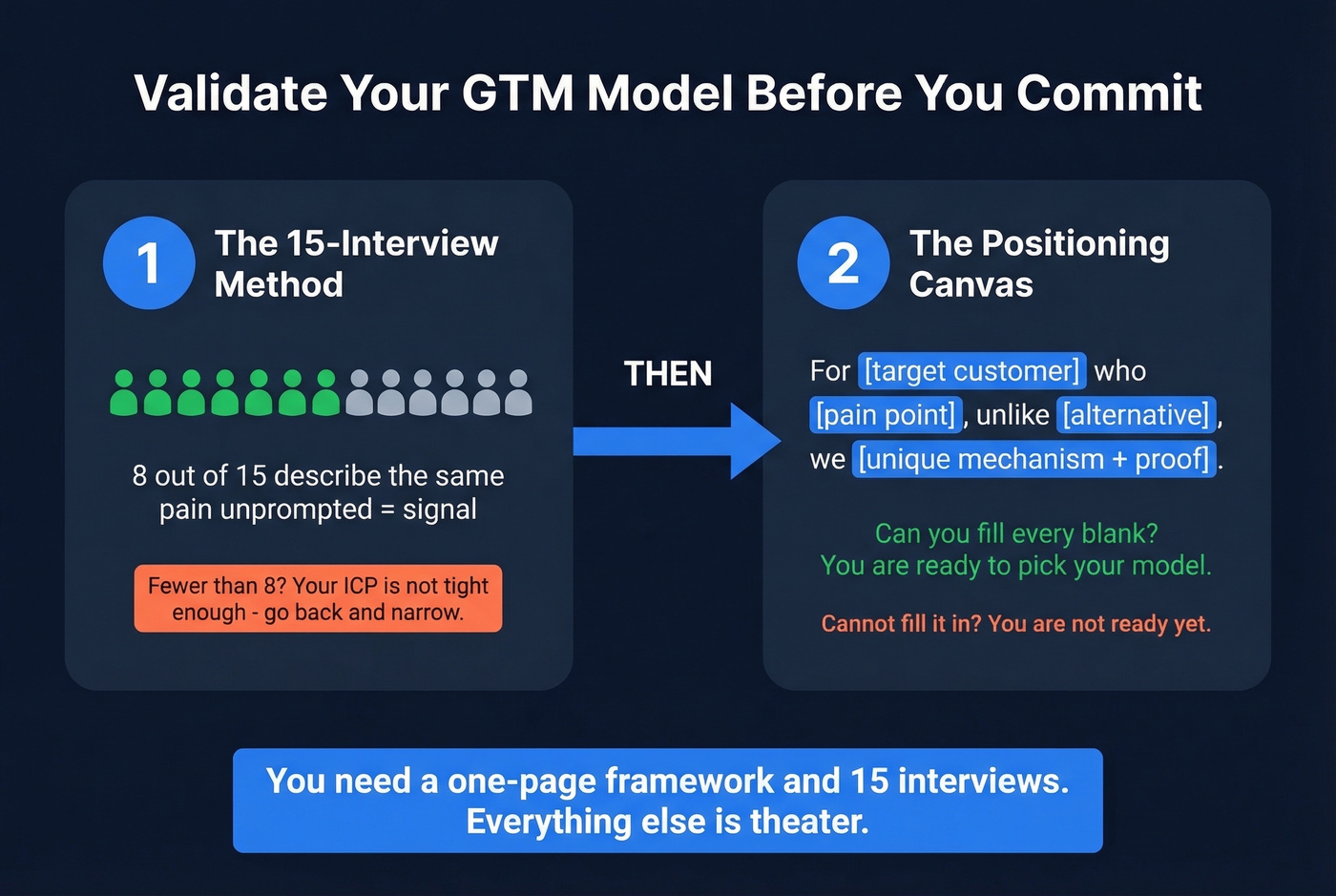
The 15-interview method. Talk to 15 potential customers. If 8+ describe the same pain unprompted, you have signal. Fewer than that, your ICP isn't tight enough - go back and narrow before you spend a dollar on execution.
The positioning canvas. "For [target customer] who [pain point], unlike [alternative], we [unique mechanism + proof]." If you can't fill it in, you're not ready to choose a model.
You don't need a 50-slide GTM deck. You need a one-page model selection framework and 15 customer interviews. Everything else is theater.
Whether you're running inside sales at $25K ACV or PLG at $3K, your CAC payback depends on reaching real buyers. Prospeo's 300M+ profiles with 30+ filters - intent data, technographics, headcount growth - let you build pipeline that fits your motion, not fight it.
Stop paying enterprise data prices for an SMB GTM model.
FAQ
What's the difference between a GTM model and a GTM strategy?
A model is the structural motion - product-led, sales-led, channel-led. A strategy is the execution plan for a specific launch using that model. Model equals how you sell; strategy equals how you launch.
Can you run multiple GTM models at once?
Yes. Most B2B companies in 2026 run hybrid motions - PLG for acquisition, sales-led for expansion. Match each model to the right customer segment and ACV range rather than forcing one motion across your entire business.
How do I know if my GTM model is working?
Two benchmarks: LTV:CAC ratio of 3:1+ and CAC payback under 12 months. Miss both, and it's time to revisit the decision matrix. Also check whether your model creates a compounding flywheel - where customer success feeds referrals, expansion, and lower acquisition costs over time.
What tools help validate an outbound GTM motion?
Start with a B2B data platform that lets you test list quality before committing budget. Prospeo's free tier gives you 75 verified emails per month to validate ICP targeting and reply rates. Pair that with a sequencing tool like Instantly or Smartlead to measure connect rates against your ACV threshold.