

How to Build a Go-to-Market Strategy That Actually Works
A RevOps lead we know spent six months building a go-to-market strategy - 47-slide deck, executive alignment sessions, the whole production. They launched, hit 12% of their pipeline target in Q1, and scrapped the plan by Q2. The deck was beautiful. The operating system behind it didn't exist.
That's the GTM problem nobody talks about. Only 9% of 2,300 global companies managed to sustain 5.5%+ annual revenue and profit growth over a decade - not because they lacked strategy decks, but because they lacked systems that adapted. Bain highlights recurring failure modes: functional fiefdoms between sales and marketing, poor handoffs from strategy to execution, and frontline teams that never understood the plan they were supposed to run. Meanwhile, the average software company runs 10.5 GTM initiatives simultaneously: five core channels plus five-and-a-half experimental ones. That's not a strategy. That's a scatterplot.
What You Need (Quick Version)
If you're skimming, here's the core framework in 60 seconds:
Pick your motion by ACV. Product-led growth (PLG) for deals under $5K. Hybrid for $5K-$50K. Sales-led for $50K+. This single decision shapes everything downstream - channels, hiring, pricing, metrics.
Track three metrics above all others. CAC payback period (target: 80-90 days). Activation rate (33% is average, 65%+ is top-decile) (33% is average, 65%+ is top-decile). Net revenue retention (110%+ means your existing customers fund your growth).
Treat GTM as a launch plan and a post-launch operating system. The slide deck gets you alignment. The operating system - feedback loops, metric cadences, channel iteration - gets you revenue. Most teams over-invest in the deck and under-invest in the system.
What Is a Go-to-Market Strategy?
A go-to-market strategy is the system that connects your product, pricing, distribution channels, and sales motion to a specific buyer in a specific market. It's not a marketing plan (that's one component). It's not a business plan (that's the financial model and corporate strategy). GTM sits between the two - it's the operational bridge from "we built something" to "someone's paying for it."
The distinction matters because teams confuse GTM with marketing. They'll run ads, publish blog posts, and launch a Product Hunt campaign, then wonder why pipeline isn't converting. That's demand generation without a system.
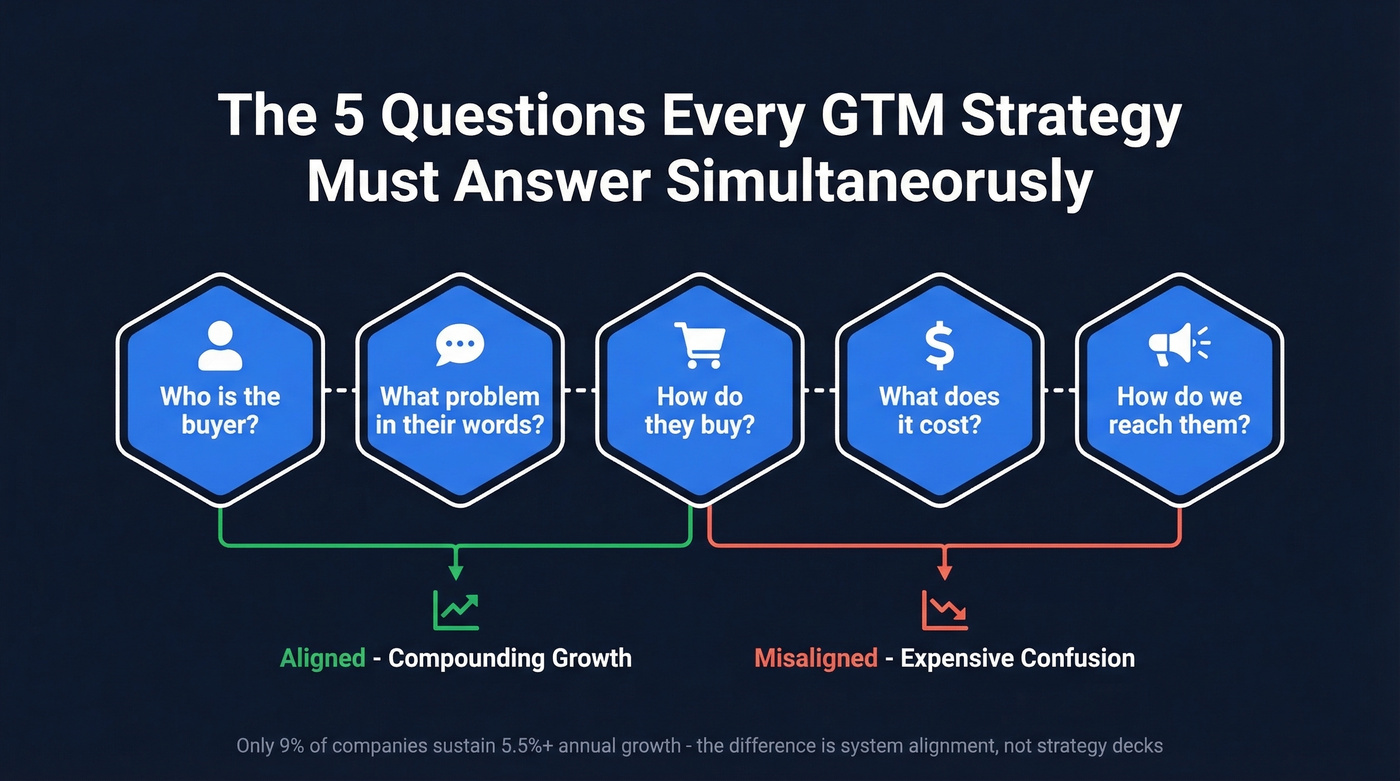
A real GTM plan answers five questions simultaneously: Who's the buyer? What problem are we solving in their words? How do they buy? What does it cost? And how do we reach them at the right moment? When those five answers are aligned, you get compounding growth. When they're misaligned - say, you're running PLG pricing with an enterprise sales cycle - you get expensive confusion.
What separates the 9% of companies that sustain growth from the rest is adaptiveness. Their GTM systems have fast feedback loops between the field and leadership, integrated coordination between strategy design and delivery, and frontline teams that actually understand the plan they're executing. A static document can't do this. An operating system - with quarterly reviews, metric cadences, and built-in iteration cycles - can.
How to Choose Your GTM Motion
This is the highest-leverage decision in your entire go-to-market strategy, and most teams get it wrong by copying whatever's trendy. In 2021, everyone wanted to be PLG. By 2024, "sales-led is back" was the rallying cry. The truth is simpler: your ACV determines your motion.
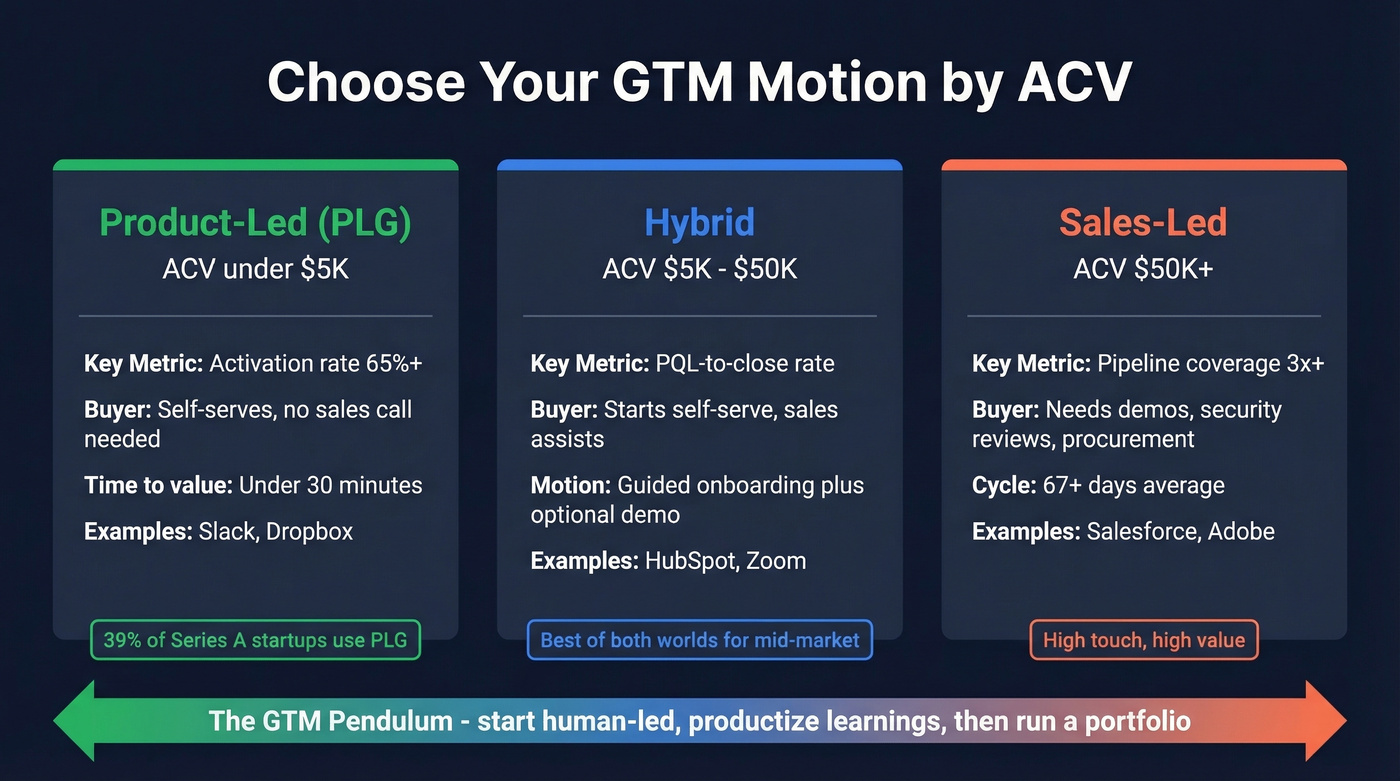
| GTM Motion | ACV Range | Key Metric | Example |
|---|---|---|---|
| Product-led (PLG) | <$5K | Activation rate (65%+) | Slack, Dropbox |
| Hybrid | $5K-$50K | PQL-to-close rate | HubSpot, Zoom |
| Sales-led | $50K+ | Pipeline coverage (3x+) | Salesforce, Adobe |
A scan of 474 Series A startups found that 39% enable PLG/self-serve and 25% offer a free tier. In DevTools specifically (n=122), 50% are PLG, 47% are self-serve, and 34% offer a free plan. But here's the nuance most people miss: PLG means a frictionless start without talking to sales. It doesn't mean free. Many PLG companies charge from day one.
The smartest operators think of this as a "GTM pendulum." Early stage, you swing toward human-led onboarding - founder-led sales, high-touch demos - because you're learning. Middle stage, you productize those learnings into guided self-serve with optional sales assist. Later, you run a portfolio: self-serve for low-complexity deals, sales-assisted for high-ACV or security-sensitive buyers.
When to shift from sales-led to self-serve. Three readiness signals tell you it's time: your time-to-value drops below 30 minutes without hand-holding, your activation-to-paid conversion rate stabilizes across cohorts, and your support questions shift from "how do I use this?" to "can it also do X?" Until all three are true, keep humans in the loop.
Your first 10 customers come from founder-led sales, not marketing funnels. Regardless of which motion you pick long-term, the early traction is manual. Accept that.
How to Build a Go-to-Market Strategy
Step 1: Define the Problem
If you can't describe the pain in your buyer's words, you don't understand it yet. Not your words - theirs. The language they use in Slack channels, on support calls, in Gong recordings. "We help companies optimize their revenue operations" means nothing. "Your reps spend 4 hours a day on data entry instead of selling" means everything.
Spend time in the environments where your buyers complain: Reddit threads, G2 reviews of competitors, sales call transcripts. The problem statement you extract from those sources is worth more than any positioning workshop.
Step 2: Identify Your ICP
A sharp ICP converts 2-3x better than a broad one. That's not a marginal improvement - it's the difference between a pipeline that converts and one that doesn't.
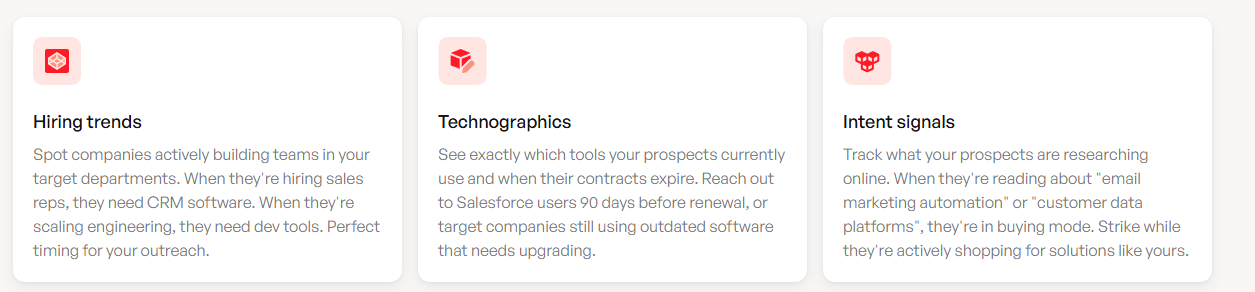
Job title plus company size isn't an ICP. It's a filter. A real ICP includes trigger events (just raised a Series B, hired a new VP of Sales, switched CRMs), internal champion profiles, budget cycle timing, and technographic signals - what tools they already use that yours integrates with or replaces.
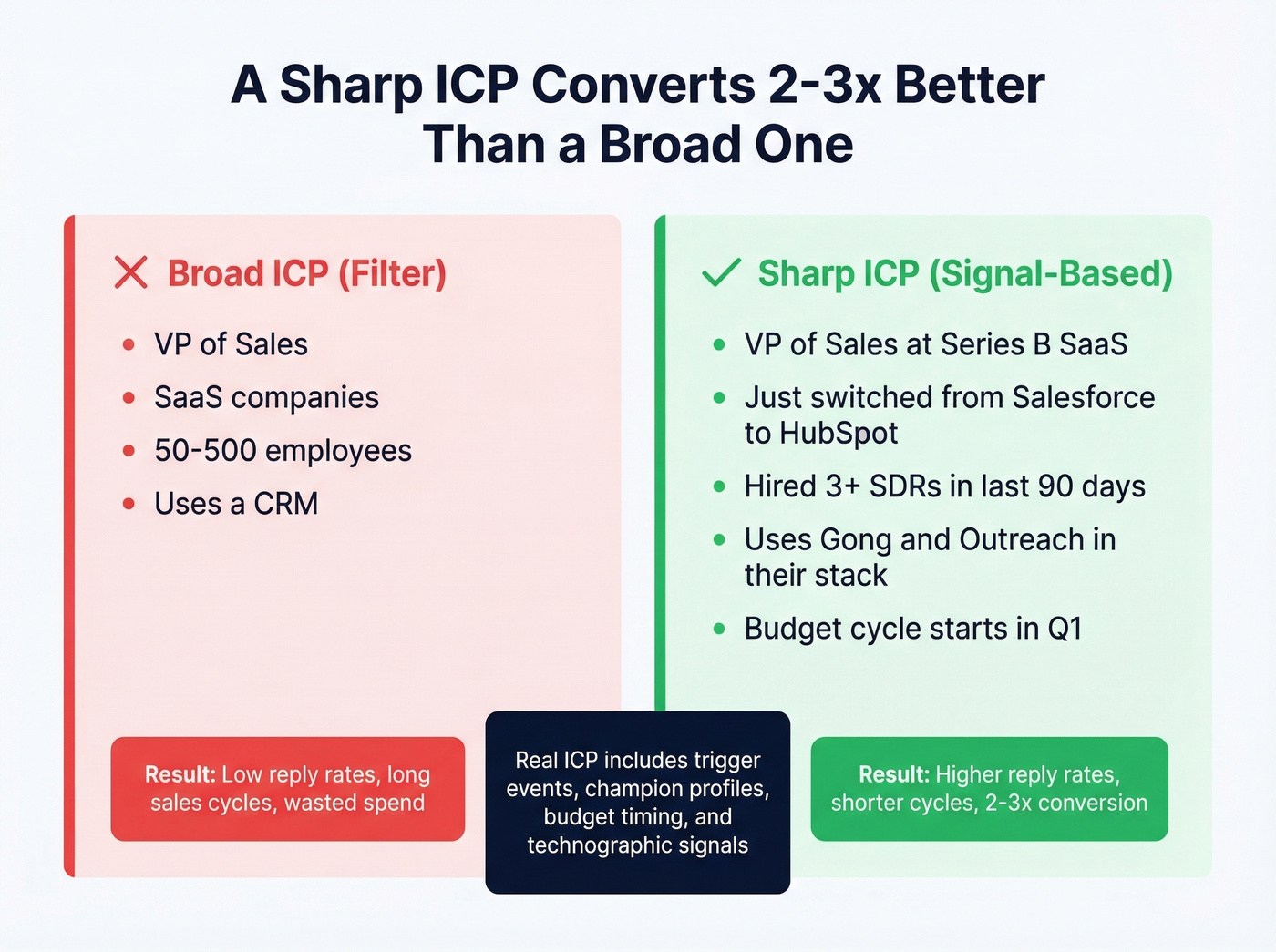
The more specific your ICP, the more efficient every downstream dollar becomes. Your content resonates harder, your outbound gets higher reply rates, and your sales cycles shorten because you're talking to people who already have the problem. We've seen teams cut their sales cycle in half just by narrowing from "VP of Sales at any SaaS company" to "VP of Sales at Series B SaaS companies that just switched from Salesforce to HubSpot." That kind of specificity feels uncomfortable at first - like you're leaving money on the table - but the math always works out in your favor.
Step 3: Map the Competition
You're not mapping competitors for a strategy deck. You're mapping them to steal demand. One of the most effective competitive GTM tactics is competitor conquesting content: TCO comparison pages, alternatives pages, "vs" pages, and review roundups that capture buyers already evaluating solutions.
These pages work because the buyer has already decided they need a solution - they're just deciding which one. If you're not building these pages, your competitors are, and they're capturing your prospects at the moment of highest intent.
Step 4: Craft Your Value Proposition
Features describe what your product does. A value proposition describes what changes in the buyer's world. "AI-powered analytics dashboard" is a feature. "Know which deals will close this quarter before your reps do" is a value proposition.
The test: can your buyer repeat your value prop to their CFO in one sentence when requesting budget? If not, it's too complex or too feature-oriented. Strip it down until it passes. The best value props are almost embarrassingly simple.
Step 5: Set Pricing and Packaging
Pricing is the most underrated GTM lever. Underpricing doesn't make you accessible - it makes you look unserious. When a buyer sees a $29/month price tag for enterprise software, they don't think "great deal." They think "this probably doesn't work."
Price based on the value you deliver, not your costs. If your tool saves a 10-person sales team 15 hours per week, that's worth $3,000-$5,000/month in labor alone. Pricing at $99/month leaves massive value on the table and signals that you don't believe in your own product.
Step 6: Choose Your Channels
Outbound is getting harder. Cold email reply rates dropped from 6.8% in 2024 to 5.8% in 2025. But the decline isn't uniform - timeline-based hooks still pull a 10.01% reply rate versus 4.39% for generic problem hooks. That's a 2.3x gap based purely on messaging approach, not volume. Meeting rates tell an even sharper story: timeline hooks convert at 2.34% versus 0.69% for problem hooks, a 3.4x difference that compounds across thousands of sends.
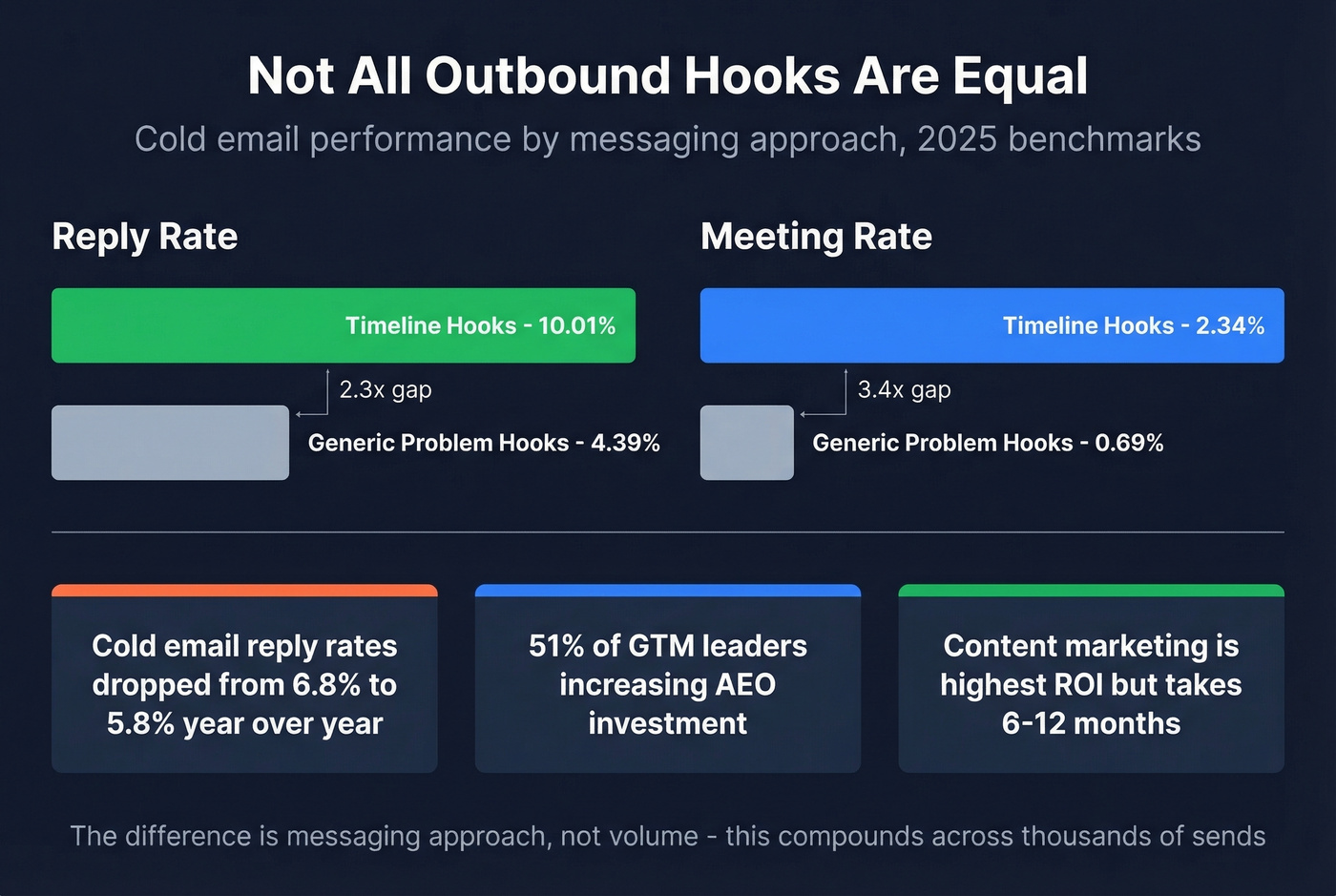
Content marketing remains the highest-ROI channel long-term, but it takes 6-12 months to generate meaningful inbound. Meanwhile, 51% of GTM leaders plan to increase investment in answer engine optimization (AEO) - optimizing for AI-generated answers, not just traditional search rankings.
To execute outbound well, you need verified contact data for your ICP. Bad data doesn't just waste sends - it craters your domain reputation before you learn anything about your messaging. Prospeo gives you 300M+ professional profiles with 30+ search filters, including buyer intent, technographics, job changes, and funding signals, plus 98% email accuracy on a 7-day data refresh cycle.
In our experience, teams that validate one channel before adding a second hit profitability 2x faster. The channel mix that works for your first $1M ARR won't work for $10M. Validate, prove unit economics, then layer. Running five channels simultaneously with no clear winner is how you burn cash without learning anything.
Step 7: Build Your Sales Plan
For the first 10 customers, the founder is the sales team. This is where you learn your objections, refine your pitch, and discover whether your pricing holds up in real negotiations.
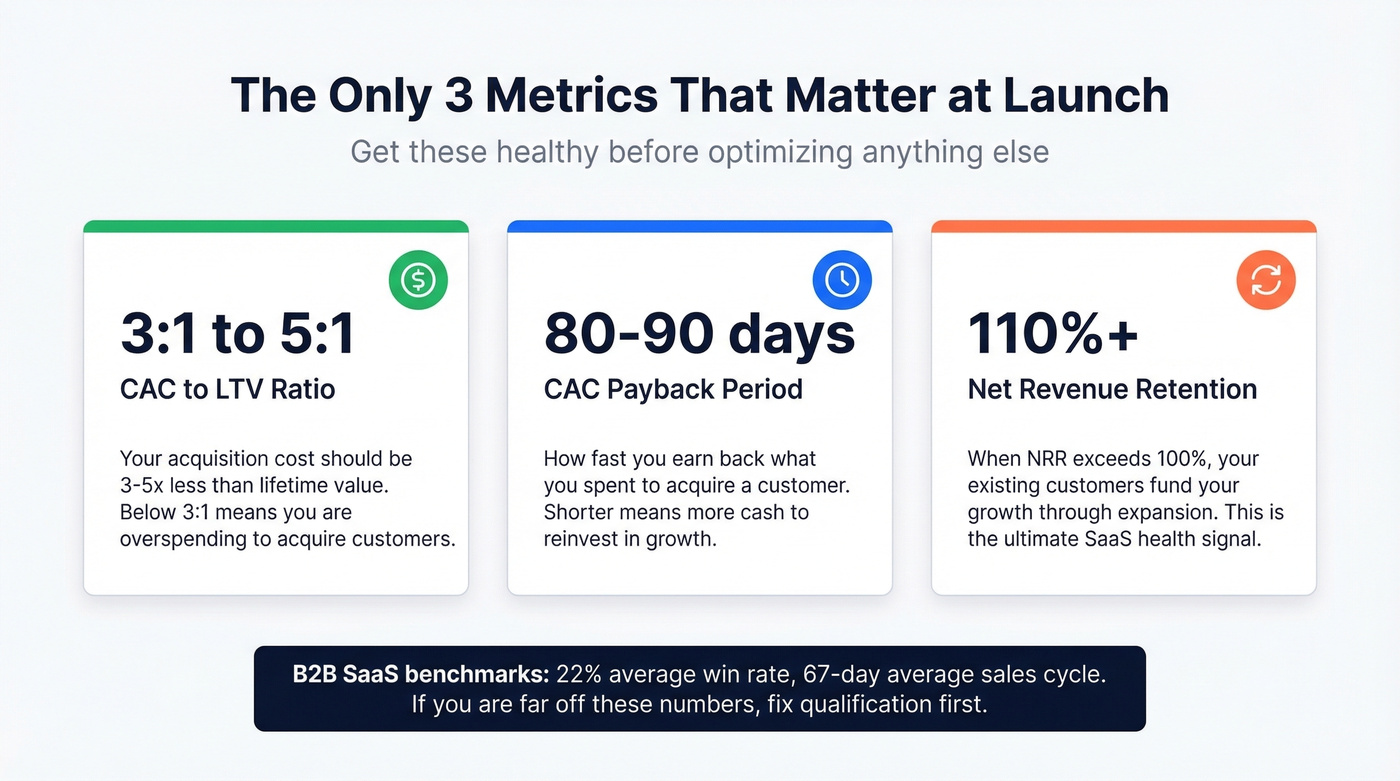
Once you're past founder-led sales, benchmark against reality: B2B SaaS averages show 22% win rates and 67-day sales cycles. If your win rate is significantly below 22%, the problem is usually qualification, not closing. If your cycle is significantly above 67 days, you're likely selling to the wrong seniority level or missing a key stakeholder. Let's be honest - most pipeline problems are qualification problems wearing a "we need better closers" disguise.
Step 8: Define Metrics and Launch
Three metrics matter above all others at launch: CAC-to-LTV ratio (target 3:1 to 5:1), CAC payback period (80-90 days), and net revenue retention (110%+ means expansion revenue exceeds churn). Everything else is secondary until these are healthy.
The first 72 hours after launch are your critical diagnostic window. Track activation rate, first-session behavior, and drop-off points obsessively. If users aren't reaching your "aha moment" within the first session, no amount of marketing spend will fix it. The product experience is the GTM strategy at this stage.
Once you're past launch, run quarterly GTM reviews led by RevOps to catch shifting buyer patterns before they become pipeline problems. Buyer personas drift. Channels decay. Pricing tolerance shifts. A quarterly cadence forces you to update the operating system instead of running on stale assumptions.

Your ICP definition is useless without accurate contact data to activate it. Prospeo gives you 30+ filters - buyer intent, technographics, job changes, funding, headcount growth - so your GTM motion reaches the right buyers at the right moment. 98% email accuracy. 7-day data refresh. $0.01 per lead.
Stop building GTM plans on stale data. Build them on Prospeo.
The 2026 B2B Buyer Journey
The B2B buyer journey in 2026 is absurdly complex, and most GTM frameworks don't account for it. The average buying group involves 13 people across five distinct business functions, and getting to a closed deal requires roughly 2,879 impressions and 266 touchpoints. For deals above $100K ACV, that jumps to nearly 5,500 impressions and 417 touchpoints.
75% of B2B buyers say they prefer a rep-free experience. That doesn't mean they don't want to talk to sales - it means they want to do their own research first and engage sales on their terms.
Here's the thing about the tech stack problem: the average GTM enterprise team pulls data from 23 sources and uses 16+ tools, but only uses 33% of their stack's capabilities. That's not a technology problem - it's an integration and adoption problem. Before you add another tool, ask whether your team is actually using what they already have.
The implication is clear. You need to be present across more touchpoints than you think, but you need to do it efficiently. Multi-threading into buying committees, creating content for each stakeholder's concerns, and tracking engagement across channels isn't optional anymore - it's the baseline.
GTM Mistakes That Kill Launches
1. Confusing GTM with marketing. Running ads and publishing blog posts isn't a go-to-market strategy. It's demand generation without a system. Build the full system - ICP definition, value proposition, pricing, sales motion, and channel strategy. Marketing is one piece.
2. Targeting too broadly. "We sell to any company with 50+ employees" is a death sentence. Different segments have different buying processes, different pain points, and different willingness to pay. Pick one segment, win it, then expand. A narrow ICP that converts at 8% beats a broad one that converts at 2%, every time.
3. Skipping channel validation. The channel that got your first 20 customers often doesn't scale to 200. CAC that works at $500/month in spend can triple at $5,000/month. We've seen this kill more launches than any other mistake - validate unit economics at each spend tier before increasing budget.
4. Neglecting pricing. If you're priced at $49/month and your competitor charges $500/month, buyers assume you're the inferior product - even if you're not. Price with intention. Anchor to the value you deliver, not your cost structure.
5. Ignoring sales motion realities. Self-serve assumptions break when enterprise buyers need procurement approval, security reviews, and legal sign-off. If your ICP includes companies with 500+ employees, build a sales-assisted motion regardless of your PLG aspirations. Skip this step at your own risk.
6. Focusing only on acquisition. A leaky bucket doesn't need more water - it needs fewer holes. If your NRR is below 100%, fix that before scaling acquisition. Retention, expansion, and referral revenue are cheaper than new logos.
7. Scaling outbound with unverified data. Blasting unverified email lists before your product is ready craters your domain reputation, spikes your bounce rates, and poisons the channel before you learn anything. Verify every email before you send. Domain reputation is a one-way door - once it's gone, recovery takes months.
GTM Examples With Real Numbers
Slack (PLG)
Slack's GTM was textbook product-led growth. Frictionless signup, no sales conversation required, and an integrations-first strategy that made the product stickier with every tool connected. They tracked daily active users and free-to-paid conversion obsessively. By 2019, Slack had 8M daily active users and 3M paid users. Salesforce acquired them for $27.7B.
The lesson: PLG works when time-to-value is measured in minutes, not days.
Aiter.io (Indie Founder)
On the opposite end of the spectrum, the founders behind Aiter.io hit $10K in revenue in 2024 using a scrappy, channel-by-channel approach. AI directories (specifically TAAFT) were their top traffic source - other directories scraped TAAFT and amplified their reach for free. Creators found them via those directories and made videos without being paid, giving them earned influencer coverage at zero cost. Email marketing drove consistent conversions at a ~25% open rate. Google Ads flopped because their landing page wasn't ready.
The lesson: channel selection matters less than channel-readiness. A great channel with a bad landing page is a waste of money.
Emerging Markets (BCG)
GTM isn't just a SaaS concept. BCG's analysis of emerging markets - 4.3B people representing half of global GDP growth over the past decade - found that FMCG companies in India and Southeast Asia with mature GTM systems outperform laggards by roughly 4% compound annual revenue growth and 6% profit growth. The difference isn't product quality. It's distribution execution: segmented approaches, channel partner management, and frontline teams that actually understand the strategy they're executing.
Your GTM Tech Stack in 2026
You don't need a $30K data contract to execute outbound GTM. Here's what a functional stack looks like by category, with realistic price ranges.
CRM: HubSpot (free tier to $150+/user/month for Enterprise), Salesforce ($25-$300/user/month depending on edition). Start free if you're pre-revenue. Don't let anyone sell you Enterprise CRM before you have 5 reps.
B2B data and prospecting: This is where you source verified emails, direct dials, and intent signals for your ICP. Self-serve platforms run $39-$99/month. Enterprise platforms like ZoomInfo start at $15K-$40K/year. If your average deal size is under $10K, you probably don't need the enterprise contract - a self-serve tool with high accuracy and CRM integration will get you further than a locked-in annual commitment you signed before finding product-market fit.
Sales engagement: Outreach and Salesloft run $100-$150/user/month. Instantly and Smartlead are $30-$97/month for higher-volume cold email. Pick based on whether you need multi-channel sequences or pure email volume.
Intent data: Standalone intent costs $1K-$5K/month for SMB. Many data platforms now bundle it, which saves you from managing yet another vendor.
Attribution: $1K-$5K/month for tools like HockeyStack or Dreamdata. Critical once you're running multiple channels and need to understand what's actually driving pipeline. Skip this until you're spending $10K+/month on demand gen.
The trap is buying enterprise tools before you have enterprise problems. Start lean, prove your channels, then invest in the stack that supports scale.
If you want a practical outbound motion, start with sales prospecting techniques and a clean lead generation workflow so you can scale without breaking deliverability.
Whether you're running PLG, hybrid, or sales-led, pipeline coverage depends on reaching real buyers with verified contact data. Prospeo delivers 143M+ verified emails and 125M+ mobile numbers with a 30% pickup rate - so your reps spend time selling, not chasing bounces.
Teams using Prospeo book 26% more meetings than ZoomInfo users.
FAQ
What's the difference between a GTM strategy and a marketing plan?
A go-to-market strategy encompasses your entire market entry system: product positioning, pricing, sales motion, channel selection, ICP definition, and success metrics. A marketing plan is one component focused on demand generation and campaign execution. You can have a GTM strategy that relies on channels beyond marketing - like partnerships, PLG, or founder-led sales.
How long does it take to build a GTM plan?
The initial framework takes 4-8 weeks - ICP research, competitive mapping, pricing decisions, channel selection. The real strategy emerges in the first 90 days of execution as you iterate on actual buyer data. Any plan that hasn't been pressure-tested by real customers is still a hypothesis.
What's the best GTM approach for startups?
Founder-led sales for your first 10 customers, full stop. After that, choose your motion by ACV: PLG for deals under $5K, hybrid for $5K-$50K, sales-led for $50K+. The most common startup mistake is spending on growth before the product reliably delivers value.
What tools do you need for a go-to-market launch?
At minimum: a CRM (HubSpot's free tier works), a B2B data platform for verified emails and direct dials, a sales engagement tool for sequences, and basic analytics. The average team uses only 33% of their stack's capabilities, so start lean and expand based on actual bottlenecks - not vendor demos.
What are the most important GTM metrics?
CAC payback period (80-90 days target), activation rate (33% average, 65%+ top-decile), and net revenue retention (110%+ means existing customers fund growth). These three tell you whether your GTM engine is sustainable. MQLs, demo requests, and website traffic are secondary until these are healthy.