

FMCG Go-to-Market Strategy: The Practitioner's Playbook
You've read five GTM guides this week and none of them told you what a slotting fee actually costs, how distributor margins stack, or why your modern trade "win" is bleeding money through backend deductions. Most go-to-market strategy content is written for SaaS companies launching software - not for FMCG teams trying to get a physical product onto a physical shelf in a country like India, which has 15 million FMCG stores.
We've watched teams blow six figures on modern trade listings without modeling the full fee stack. Companies in India and Southeast Asia with mature GTM strategies outperform laggards by roughly 4% CAGR revenue growth and 6% profit growth. The gap isn't strategy decks. It's execution mechanics.
The Short Version
- Sequence your channels: general trade first in emerging markets, then modern trade, then e-commerce/DTC. Don't try all three simultaneously.
- Budget 20-30% of revenue for trade costs - slotting, distributor margins, promotional contributions. This isn't marketing spend. It's table stakes.
- Use price-pack architecture as a margin lever. Roland Berger research shows optimized PPA can boost EBIT margins by up to 4 percentage points.
- Separate branded vs. non-branded ROAS in every digital campaign.
- Build a contact list of retail buyers before you pitch. Your GTM plan isn't a PowerPoint. It's a contact list.
FMCG Channel Strategy: GT vs. MT vs. E-Com
The channel mix decision drives everything downstream - margins, working capital, team structure, and timeline. Strategy& (PwC) frames this as a routes-to-market design problem: balancing customer needs, revenue growth, and cost-to-serve across each channel, then testing alternatives before committing.
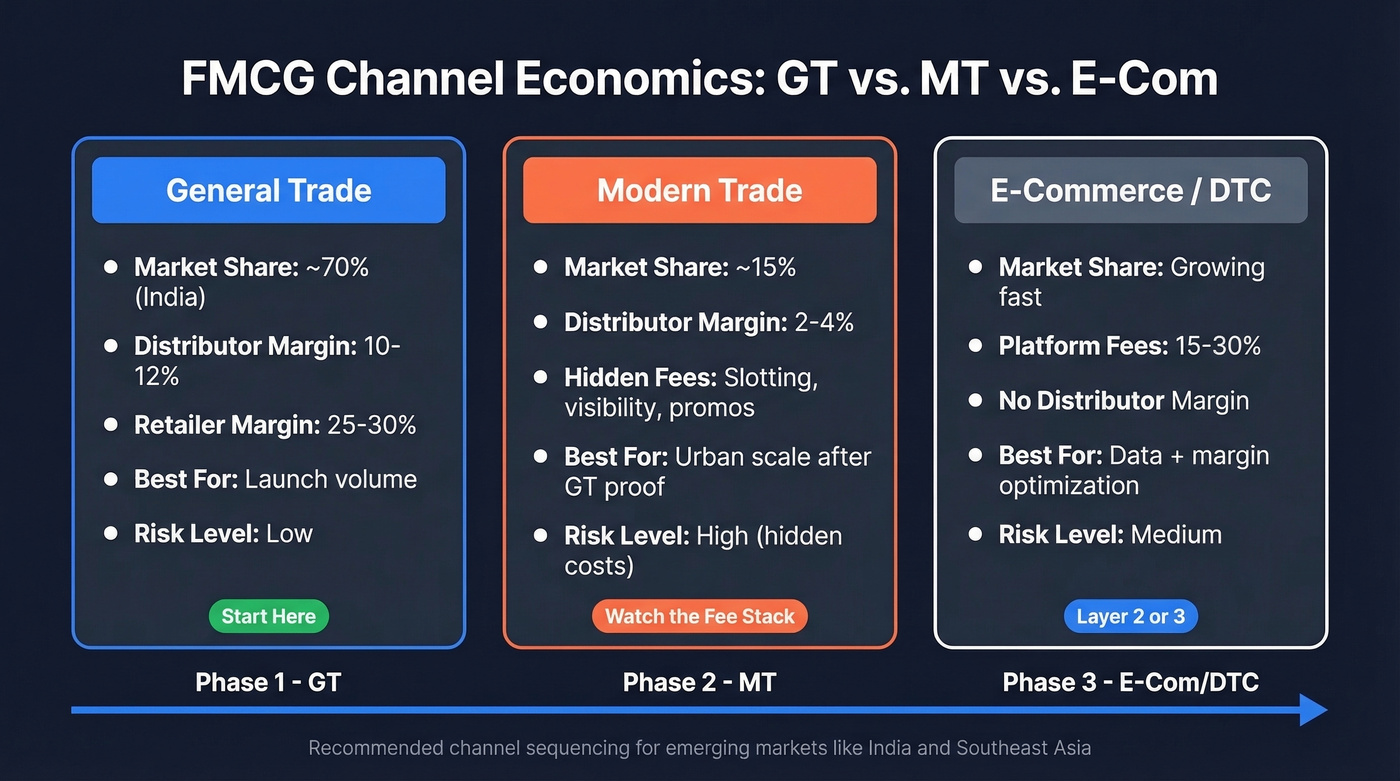
Here's how the economics break down, using India as the reference market:
| Channel | Market Share (India) | Distributor Margin | Retailer Margin | Best For |
|---|---|---|---|---|
| General Trade | ~70% | 10-12% | 25-30% | Launch volume in emerging markets |
| Modern Trade | ~15% | 2-4% | + hidden fees | Urban scale after GT proof |
| E-Commerce/DTC | Growing | N/A | Platform fees 15-30% | Data + margin optimization layer |
| Quick Commerce | Emerging | Varies | Varies | Urban density play, test only |
General trade still dominates emerging markets, with mom-and-pop retailers forming the backbone of distribution. The average small retailer in these markets does $3,000-$4,000/month in sales - context that matters when you're modeling credit terms and minimum order quantities. If you're launching in Southeast Asia or South Asia, GT is where volume lives. Start there.
Modern trade offers urban scale, but the margin picture is deceptive. That 2-4% distributor margin looks lean until you layer on listing fees, visibility charges, promotional contributions, and backend deductions that can quietly eat your profit. The real risk is death by a thousand fees - sometimes deducted without documentation, sometimes discovered only during quarterly reconciliation when it's too late to negotiate.
E-commerce and quick commerce platforms like Zepto, Blinkit, and Gopuff are growing fast. In Singapore, 1 in 2 consumers has shopped online for FMCG, and cross-border shopping grew 20%+. But these channels work best as a second or third layer, not a launch channel - unless you're running a DTC-first model in a developed market.
The Trade Cost Stack Nobody Talks About
Here's the thing most first-time FMCG launchers underestimate: trade spend consumes 20-30% of revenue. Not marketing. Not COGS. Trade - the cost of getting your product onto shelves and keeping it there.
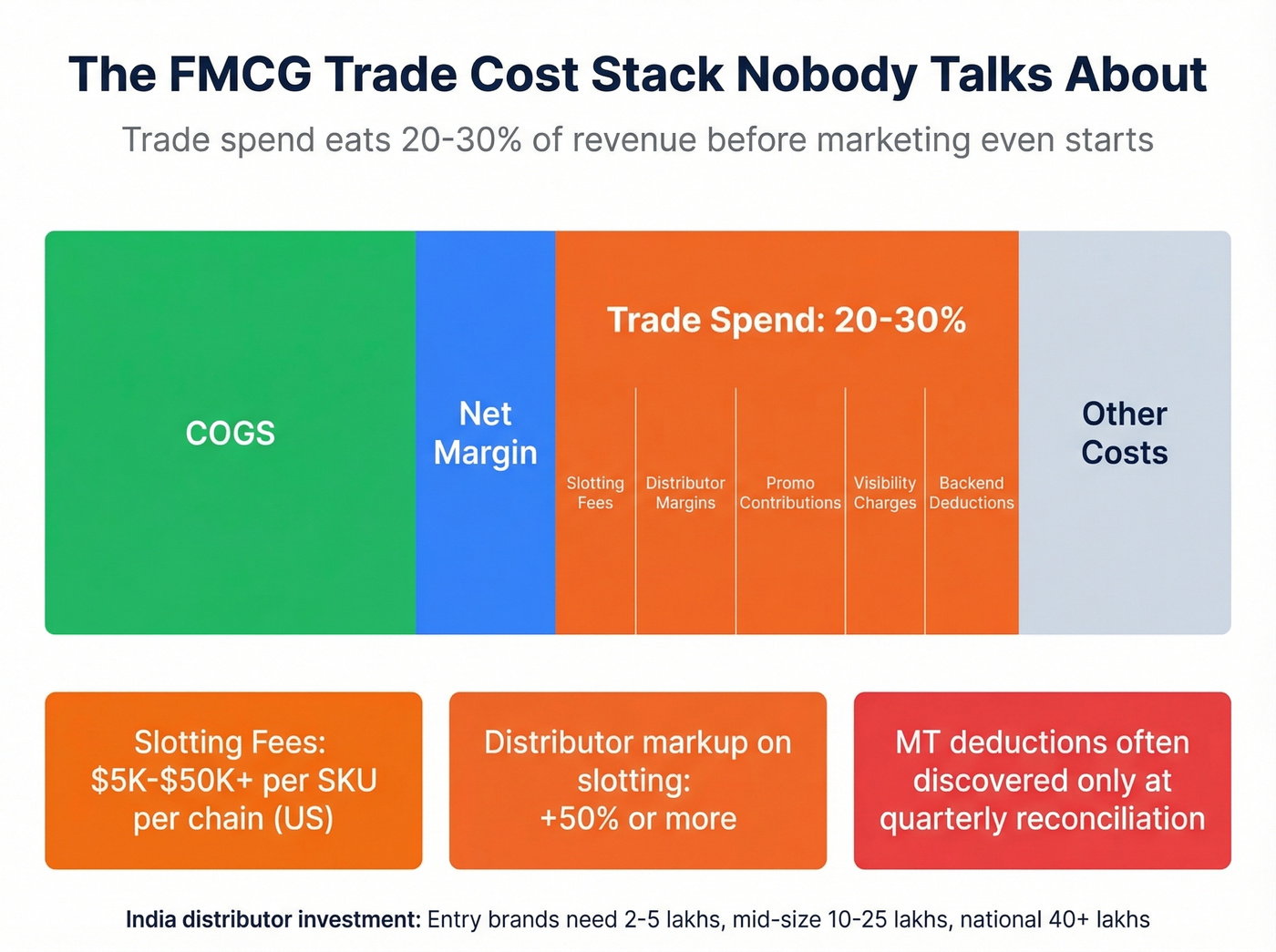
Slotting fees alone can run $5,000-$50,000+ per SKU per chain for major US retailers, depending on category and footprint. The structures vary: flat fee per SKU, per-store charges, or free goods - often one free case per SKU per store. When a distributor handles slotting on your behalf, expect them to add 50% or more to the true cost. And paying slotting doesn't guarantee eye-level placement, a specific number of facings, or even a guaranteed duration on shelf.
In India, distributor investment ranges tell a similar story. Entry-level brands need ₹2-5 lakhs to get started. Mid-size brands run ₹10-25 lakhs. National brands? ₹40 lakhs and up. That's before retailer credit management, beat route execution, and the working capital drag of delayed payments.
Modern trade adds its own hidden cost layer: listing fees, promotional contributions, visibility charges, and backend margins deducted from payments. In our experience, teams that model MT profitability on gross margins consistently discover they're underwater once the full fee stack hits. We've seen brands celebrate a modern trade "win" only to realize three quarters later that the channel was net-negative after deductions.

You said it yourself: your GTM plan isn't a PowerPoint - it's a contact list. Prospeo gives you 30+ filters to find retail buyers, category managers, and distribution partners across 300M+ profiles with 98% email accuracy. Stop guessing who to pitch. Start with verified contacts.
Build your FMCG buyer list in minutes, not months.
Price-Pack Architecture as a Margin Lever
Price-pack architecture isn't shrinkflation. It's engineering your format portfolio to align with consumer value perception and channel behavior - different pack sizes, price points, and configurations for different channels and occasions.
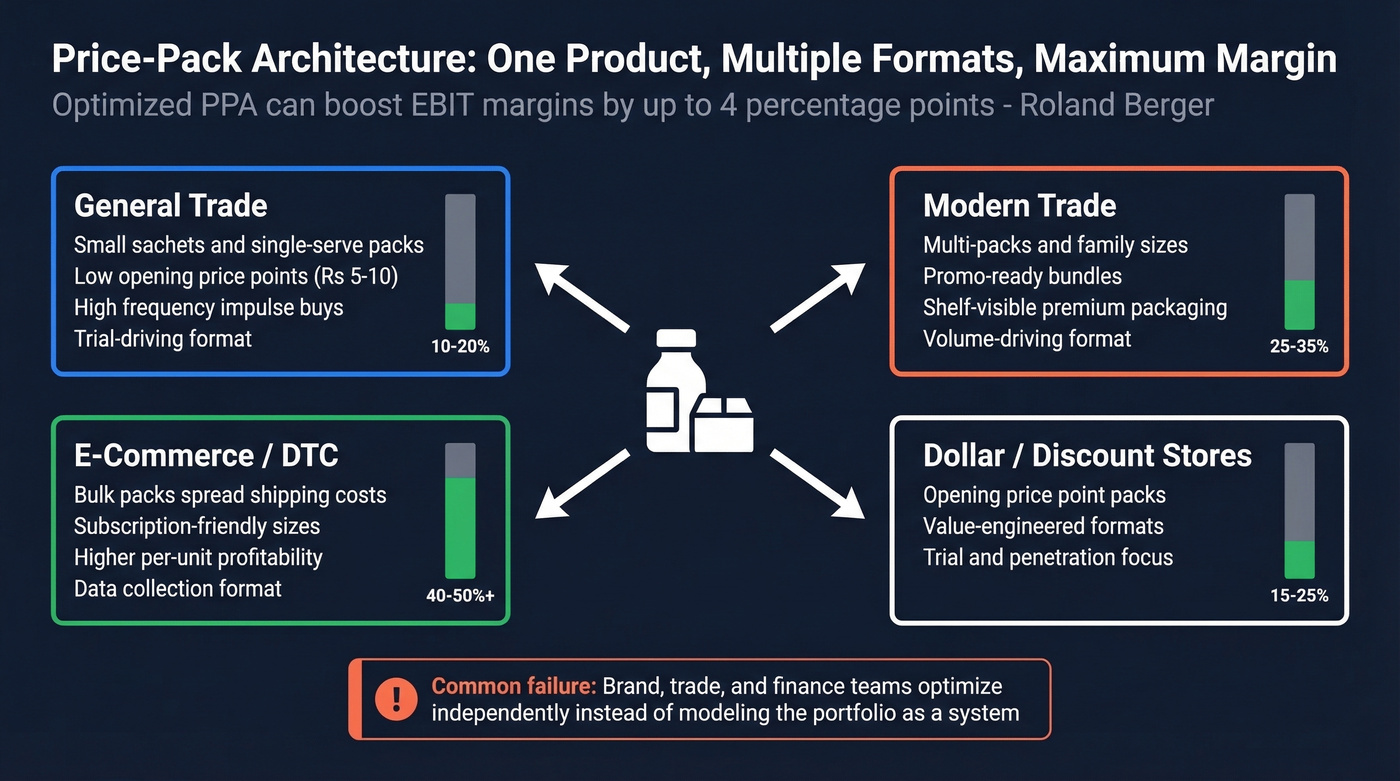
Done well, it's one of the highest-ROI levers in consumer goods. Roland Berger's research shows PPA initiatives can increase EBIT margins by up to 4 percentage points. That's massive for a category where net margins often sit in single digits.
E-commerce bulk packs spread shipping costs and improve per-unit profitability. Dollar stores need small "opening price point" packs that drive trial. The common failure mode is siloed decisions where brand, trade, and finance teams optimize independently - brand wants premium positioning, trade wants a price point that moves volume, and finance wants margin. Nobody's modeling the portfolio as a system.
Digital and DTC Execution
What works:
SKU-specific creative consistently outperforms generic "premium" messaging in paid campaigns. Clean product feeds, dedicated landing pages, and segmented intent targeting drive measurable lifts. DTC channels give you first-party data that feeds funnel optimization and creative iteration - that feedback loop is the real DTC advantage, not the margin.
Niche CPG categories - mushroom coffee, vegan collagen, specialty supplements - can support premium DTC pricing because first-party data lets you iterate on creative, funnel, and even product formulation faster than retail feedback loops allow. For teams that already have a retail footprint, DTC becomes the R&D channel: test new flavors, formats, and messaging before committing to a retail rollout.
What doesn't:
FMCG practitioners on Reddit consistently flag the same trap - Performance Max campaigns that look great on paper but are mostly capturing branded search demand. If nobody's searching for your brand, PMax won't magically create demand. The fix is simple but rarely implemented: separate branded vs. non-branded ROAS in every report. If 70% of your "performance" is branded queries, you're paying Google to intercept people who were already coming to you.
Finding the People Who Control Shelf Space
Your go-to-market strategy for FMCG isn't a PowerPoint. It's a contact list.
The execution gap in consumer goods isn't strategy - it's access. Category managers at retail chains, distributor principals in target geographies, regional buying committees - these are the gatekeepers. India has 15M+ stores. The Philippines has 1.4M across 7 channels. The scale of outreach required is staggering, and most teams waste weeks manually hunting for the right contacts at the right chains.
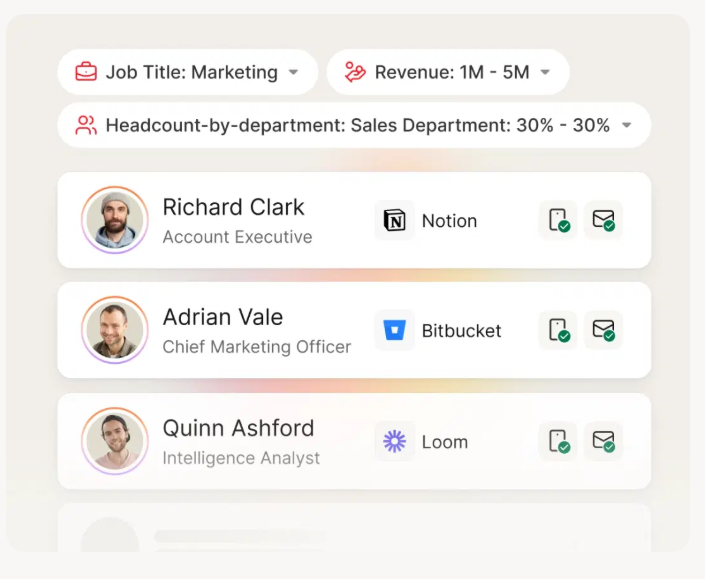
Prospeo turns that months-long research project into an afternoon's work. Search by job title - category manager, retail buyer, distribution head - filtered by industry, company size, and geography across 300M+ professional profiles. Emails are 98% accurate, and you get direct dials on 125M+ verified mobile numbers. The free tier gives you 75 emails per month plus 100 Chrome extension credits, enough to test outreach to a regional chain before committing budget.
If you want a broader framework for building and sequencing channels, see go-to-market channels.
Pitching modern trade chains and distributors means reaching the right category managers before your competitors do. Prospeo's 125M+ verified mobile numbers deliver a 30% pickup rate - so your intro call actually connects. Layer intent data across 15,000 topics to target buyers actively evaluating new SKUs.
Get direct dials to the buyers who control shelf space.
Launch KPIs That Actually Matter
Track these from day one. Everything else is vanity.
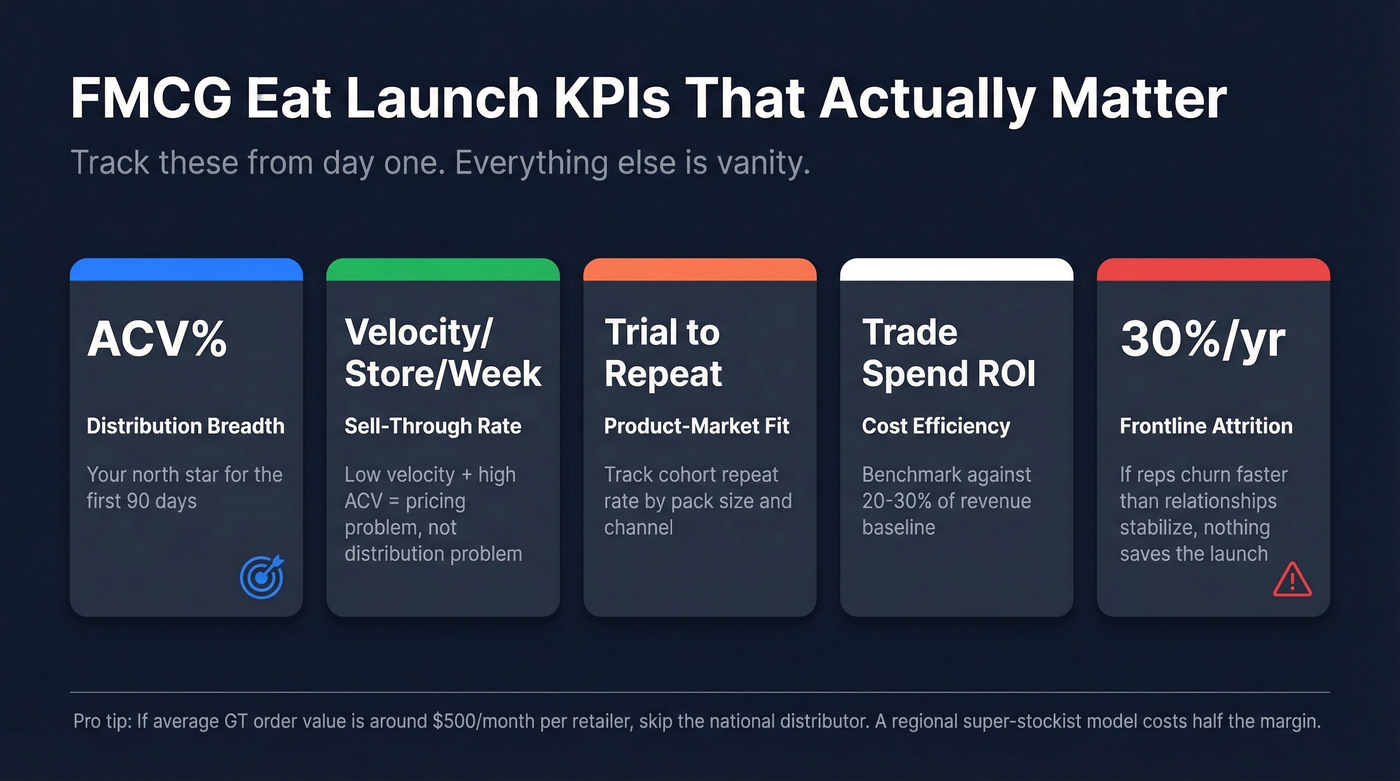
| KPI | What It Measures | Benchmark |
|---|---|---|
| ACV% | Distribution breadth | Set a channel-specific target and track weekly |
| Velocity/store/week | Sell-through rate | Category-dependent |
| Trial-to-repeat | Product-market fit | Track cohort repeat rate by pack + channel |
| Trade spend ROI | Cost efficiency | Track vs. 20-30% baseline |
| Frontline attrition | Execution stability | 30%/year is a crisis |
ACV% is your north star for the first 90 days. If you aren't building distribution fast enough in that window, you've got a distribution problem, not a marketing problem. (If you need the definition and variants, see ACV%.)
Velocity per store per week tells you whether consumers are actually pulling product off shelves or whether you've just achieved expensive shelf decoration. Low velocity with high ACV means your distribution team did their job but the product or pricing isn't resonating - a very different problem that requires a very different fix.
Frontline attrition deserves special attention. Attrition rates hit 30% per year in emerging market sales teams. If your field reps are churning faster than your retail relationships can stabilize, no amount of trade spend will save the launch. Skip this metric at your own risk. (Related: what is customer attrition.)
Let's be honest about one more thing: if your average order value through GT is around $500/month per retailer, you probably don't need a national distributor. A regional super-stockist model with tighter beat routes will outperform - and cost half as much in margin giveaway. If you're building through partners, use a channel sales strategy lens to avoid margin leakage.
FAQ
How much does it cost to launch an FMCG product in retail?
Trade costs typically consume 20-30% of revenue. Slotting alone often runs $5,000-$50,000+ per SKU per chain for major US retailers, and distributor handling adds 50%+ to those costs. Budget for trade before marketing.
What's the difference between general trade and modern trade?
General trade is independent mom-and-pop stores - roughly 70% of India's FMCG market - offering massive reach but extreme fragmentation. Modern trade is organized retail with higher operational costs but urban scale and promotional infrastructure.
Should an FMCG brand launch DTC or retail first?
In emerging markets, start with general trade for volume, then layer modern trade and e-commerce. In developed markets, DTC validates demand and builds first-party data before retail expansion - expect $2-5K/month minimum ad spend to test viability.
How do I find retail buyers and category managers fast?
Use a B2B data platform to search by job title, industry, and company size. With tools like Prospeo, you can build a targeted outreach list in hours instead of weeks - the free tier is enough to test outreach to a regional chain before committing budget.