

What Is Customer Attrition? Definition, Formulas & How to Fix It
Customer attrition costs US businesses $168 billion per year. That's not a rounding error - it's a structural leak that compounds every quarter you ignore it. Most teams are measuring it wrong, which means they're fixing the wrong things. We've watched companies obsess over logo churn while revenue churn tells a completely different story, and the disconnect burns months of effort on the wrong problems.
Here's the short version: the average US business loses 21% of its customer base annually. If your attrition rate sits above your industry benchmark, start with onboarding and failed-payment recovery. Those two fixes alone cover the majority of preventable churn.
Customer Attrition Defined
Customer attrition is the rate at which a business loses customers over a defined period. It's also called churn, customer defection, or customer turnover - the terms are functionally interchangeable in a business context. Some analysts draw a technical distinction where "attrition rate" accounts for net change (including new customer gains) while "churn rate" counts only losses. In practice, most teams use them the same way. (If you want the full breakdown, see our guide on churn.)
One quick disambiguation, because this trips people up constantly: customer attrition isn't employee turnover. The frustration on r/humanresources about executives using "attrition" when they mean "staff turnover" is real. Words matter.
Voluntary attrition is when customers actively decide to leave - they cancel, switch to a competitor, or stop buying. Involuntary attrition is when customers leave without intending to: expired credit cards, failed payment retries, billing errors. In subscription SaaS, involuntary churn accounts for roughly 10-20% of total churn. That's a meaningful chunk you can fix with dunning automation before you ever touch your product.
There's also a distinction between contractual and non-contractual attrition. Contractual attrition happens in subscription businesses where a customer formally cancels. Non-contractual attrition happens in retail and eCommerce where customers simply stop buying without any formal exit - you're inferring departure from silence, which makes it much harder to measure and even harder to act on.
Why It Matters More Than You Think
The math on attrition is brutal because it compounds. Losing 5% of customers per month doesn't feel catastrophic - until you realize that's 46% gone in a year.
It costs 6x more to acquire a new customer than to retain an existing one. New customers spend 67% less than returning ones. And 72% of customers will switch after just one bad experience - not two, not three, one.
The upside is equally dramatic. A 5% improvement in customer retention can boost revenue by 25-95%, and the average retention rate across industries is 75%, which means the average business is losing a quarter of its customer base every year. If you're above that line, you're compounding growth. Below it, you're on a treadmill.
Want to frame this for your CFO? Calculate your Return on Customer Acquisition Investment: total sales and marketing spend divided by new customers acquired. (For a deeper CAC view, see cost to acquire customer.)
How to Calculate Attrition Rate
Most articles give you one formula. You need three.
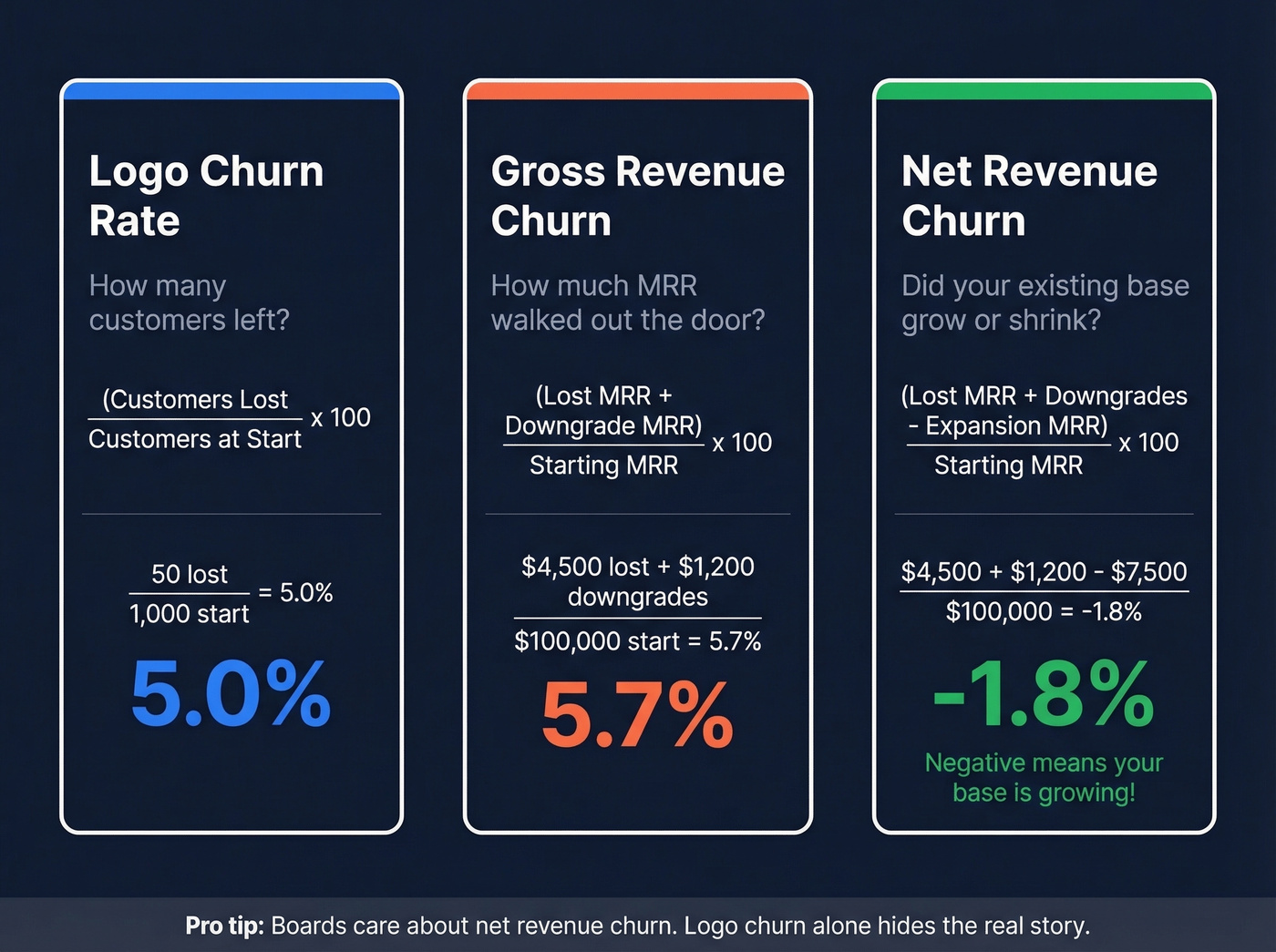
Logo Churn Rate
The simplest version: what percentage of customers did you lose?
Logo Churn Rate = (Customers Lost During Period / Customers at Start of Period) x 100
Don't include new customers acquired during the period in your denominator. You're measuring retention of your existing base, not diluting the number with fresh signups.
Gross Revenue Churn
Logo churn treats every customer equally. Gross revenue churn doesn't - it weights by dollars.
Gross Revenue Churn = (MRR Lost to Cancellations + MRR Lost to Downgrades) / Starting MRR x 100
This tells you how much revenue is walking out the door before any expansion offsets it.
Net Revenue Churn
This is the metric boards actually care about, because it factors in expansion revenue from existing customers.
Net Revenue Churn = (Lost MRR + Downgrade MRR - Expansion MRR) / Starting MRR x 100
Let's walk through a worked example. You start the month with $100,000 in MRR. You lose $4,500 to cancellations and $1,200 to downgrades, but existing customers expand by $7,500. Your gross revenue churn is 5.7%. Your net revenue churn is -1.8%. That negative number means your existing customer base is actually growing - expansion outpaces losses.
This is why net revenue retention matters so much. Top-quartile public SaaS companies maintain NRR above 120% (and if you want to go deeper on diagnosing the drivers, use a structured churn analysis workflow). That's the holy grail - your existing customers generate more revenue every month without you closing a single new deal.
Common mistakes we see constantly: using total customers (including new ones) in the denominator, mixing monthly and annual rates without annualizing, and tracking logo churn when revenue churn tells a completely different story. You can lose 10 small accounts and still grow revenue if enterprise accounts expand. For segment context, SMB SaaS monthly churn runs 3-5%, mid-market 1-2%, and enterprise annual churn 5-10%.
2026 Benchmarks by Industry
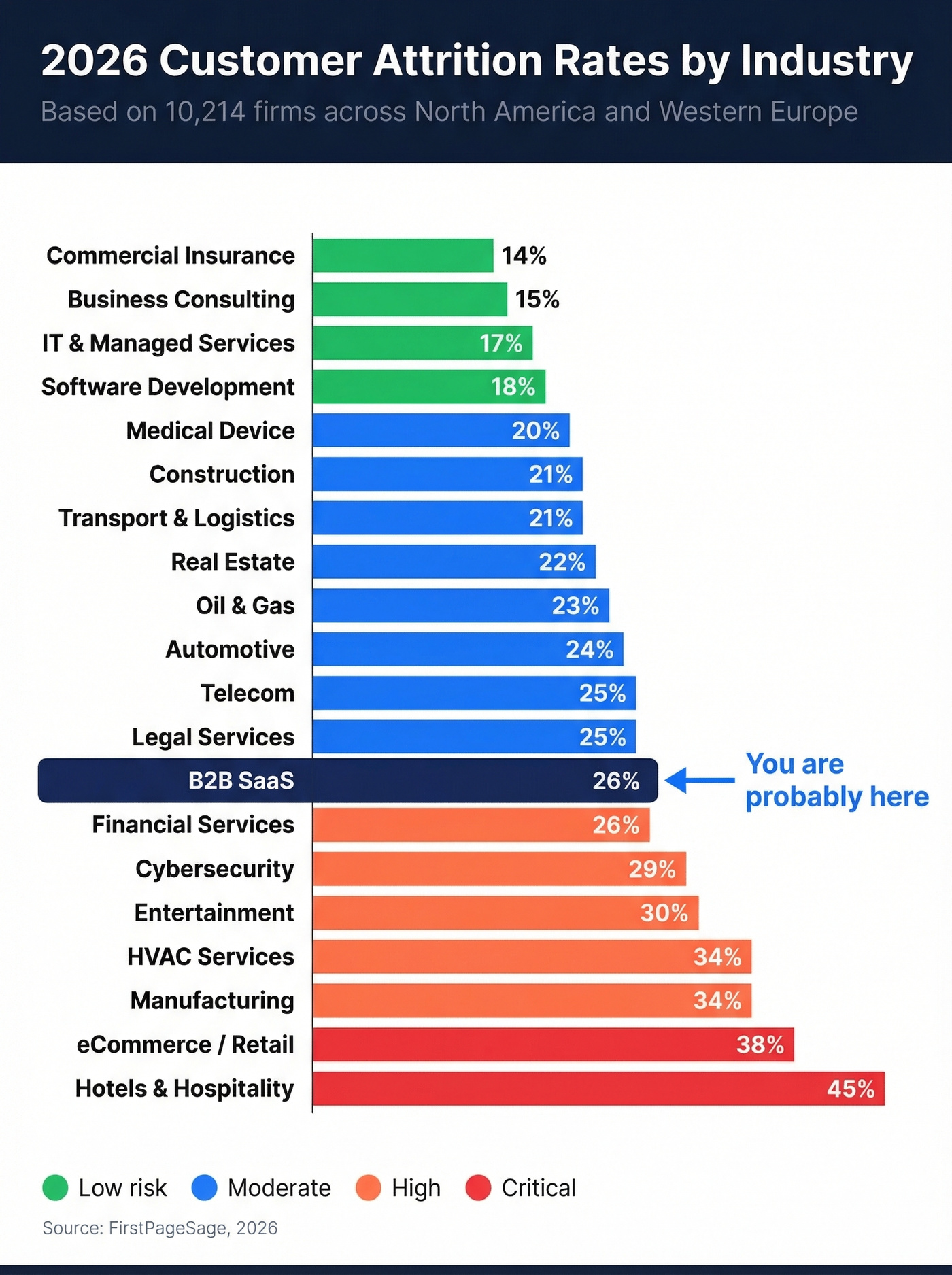
A FirstPageSage study covering 10,214 firms across North America and Western Europe provides the most useful benchmark set we've found:
| Industry | Retention | Churn |
|---|---|---|
| Commercial Insurance | 86% | 14% |
| Business Consulting | 85% | 15% |
| IT & Managed Services | 83% | 17% |
| Software Development | 82% | 18% |
| Medical Device | 80% | 20% |
| Construction | 79% | 21% |
| Transport & Logistics | 79% | 21% |
| Real Estate | 78% | 22% |
| Oil & Gas | 77% | 23% |
| Automotive | 76% | 24% |
| Telecom | 75% | 25% |
| Legal Services | 75% | 25% |
| B2B SaaS | 74% | 26% |
| Financial Services | 74% | 26% |
| Cybersecurity | 71% | 29% |
| Entertainment | 70% | 30% |
| HVAC Services | 66% | 34% |
| Manufacturing | 66% | 34% |
| eCommerce / Retail | 62% | 38% |
| Hotels & Hospitality | 55% | 45% |
A few patterns jump out. The lowest-churn industries - commercial insurance at 14%, business consulting at 15% - benefit from longer relationships and high switching friction. At the other end, hospitality at 45% and eCommerce at 38% face structural headwinds: low switching costs, commoditized offerings, and price-sensitive buyers. B2B SaaS sits at 26%, which means roughly one in four customers disappears every year.
If you're above your vertical's benchmark, you're winning. If you're below it, keep reading.

Customer attrition erases your acquisition investment entirely. The fastest way to offset churn is filling your pipeline with verified buyers - not bounced emails that waste another cycle. Prospeo delivers 98% email accuracy and 125M+ verified mobiles so every dollar you spend on replacement revenue actually connects.
Stop compounding losses. Start compounding pipeline at $0.01 per lead.
What Causes Customer Attrition?
Onboarding failure is the biggest driver. The consensus on r/Entrepreneur mirrors what we've seen repeatedly: customers don't leave because the product is bad. They leave because they never learned to use it. Customers who reach meaningful product adoption in the first week stick around. Those who don't, churn.
If you need a practical way to define who should (and shouldn't) be retained, start with an ideal customer profile and segment your base accordingly.
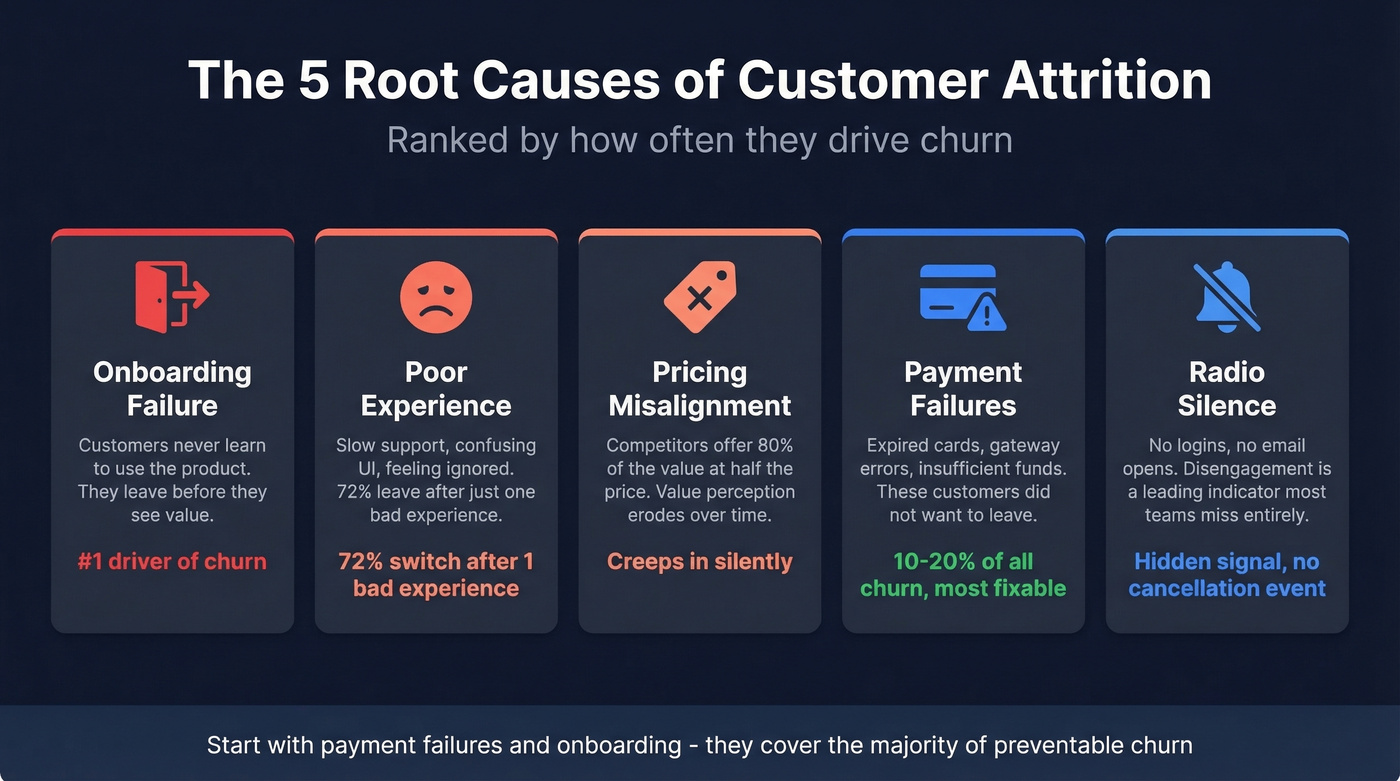
Poor customer experience is the second killer. One bad experience and 72% are gone. This isn't about having a bad product - it's about slow support responses, confusing UIs, and the feeling that nobody's paying attention.
Pricing misalignment creeps in over time. The customer who signed at $500/month is fine until they realize a competitor offers 80% of the value at half the price. And payment failures - the involuntary churn bucket - are the most fixable cause on this list. Expired cards, insufficient funds, gateway errors. These customers didn't want to leave. Fix your dunning flow and you recover revenue overnight.
Then there's radio silence: the hidden signal. When a customer stops logging in and stops opening emails, that's not satisfaction - it's disengagement, and it's a leading indicator most teams miss entirely because there's no cancellation event to trigger an alert. (If you're tracking this in RevOps, it helps to pair it with pipeline health metrics so churn risk and revenue risk are visible together.)
How to Predict Attrition
You don't need a data science team to start predicting churn - but it helps to know what the state of the art looks like.
A 2025 study in Scientific Reports built a Random Forest churn model on a telecom dataset of 2,668 customers and achieved 95.13% accuracy with an AUC of 0.89. The most influential predictors were total day minutes, total day charge, and number of customer service calls. Translation: usage patterns and support interactions are the strongest signals.
A systematic review of 240 churn prediction studies from 2020-2024 confirms that ensemble methods like XGBoost and LightGBM dominate the field. The biggest challenges in practice aren't algorithmic - they're class imbalance, interpretability, and concept drift as customer behavior shifts over time.
If you don't have a data team, you can still build a basic health score. Track login frequency, feature adoption depth, support ticket volume, and time since last engagement. Weight them, score each account, and set alerts when scores drop below a threshold. It's not machine learning, but it catches 70-80% of at-risk accounts before they cancel. Layer in CLV estimates to prioritize which at-risk accounts deserve human intervention first.
How to Reduce Customer Attrition
Ranked by ROI, starting with the fastest wins.
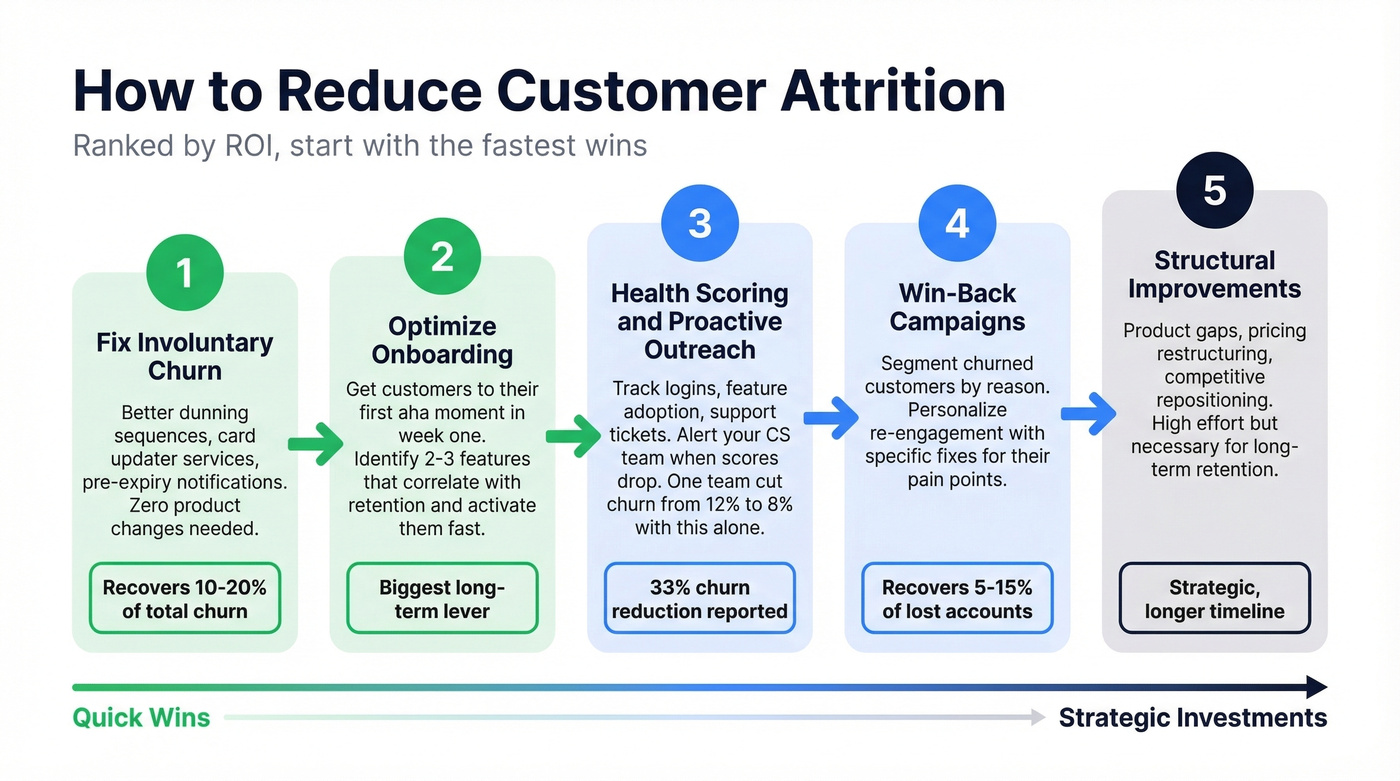
1. Fix involuntary churn first. If 10-20% of your churn is failed payments, that's revenue you can recover with better dunning sequences, card updater services, and pre-expiry notifications. Zero product changes required.
2. Optimize onboarding. Get customers to their first "aha moment" in the first week - not the first month. Define the two or three core features that correlate with retention and build your onboarding flow around activating them fast.
3. Implement health scoring and proactive outreach. A practitioner on r/CustomerSuccess reported reducing annual churn from 12% to 8% by implementing usage monitoring, login frequency tracking, and automated alerts when accounts went cold. That's a 33% improvement from basic CS hygiene. None of this works if your outreach bounces, though - if a chunk of your re-engagement emails hit dead addresses because your CRM data is six months old, you've turned recoverable churn into permanent churn. Prospeo verifies emails at 98% accuracy on a 7-day refresh cycle, which keeps save campaigns out of the bounce folder. (If you're cleaning and updating records at scale, data enrichment services can help close the gaps.)

4. Run a 90/60/30 renewal cadence. Touch base at 90 days out for a value review, 60 days to address concerns, and 30 days to close the renewal. By the time you're at 30 days, there should be no surprises. (You can also formalize this with a clear renewal rate target and reporting cadence.)
5. Build cancellation flow interventions. When someone clicks "cancel," offer a pause option, a downgrade path, or a quick call with CS. Even a simple exit survey gives you data to fix the next cancellation.
Here's the thing: if your annual contract value is under $8k, you probably can't afford white-glove retention for every account. Automate saves for the long tail and reserve human outreach for accounts where the CLV justifies it. Most teams spread their CS resources too thin trying to save everyone equally, and the result is mediocre effort across the board instead of focused effort where it counts.
If your net revenue churn is positive, you need new logos faster than attrition drains them. Prospeo's 30+ search filters - including buyer intent, headcount growth, and technographics - let you target accounts that match your highest-retention segments. Teams using Prospeo book 26% more meetings than with ZoomInfo.
Replace churned accounts before they hit your quarterly number.
Mistakes That Make Attrition Worse
Starting too late. Retention starts at onboarding, not at the renewal conversation. By the time a customer signals they want to cancel, you've already lost.
Tracking logo churn when revenue churn matters more. Losing 50 $20/month accounts is very different from losing one $50,000/year enterprise deal.
Over-discounting to save accounts. Slashing prices trains customers to threaten churn for discounts and destroys your unit economics. Sometimes the right move is to let them go.
No segmentation. SMB churn has different causes than enterprise churn. Treat all churn the same and you'll optimize for the wrong thing. (If you want a repeatable system, use intent based segmentation to separate “at-risk” from “not a fit.”)
No closed-loop analysis. If you're not systematically categorizing why customers leave and feeding that back into product and CS, you're guessing.
Not all churn is bad. Losing unprofitable customers who drain support resources and never expand is a business improvement, not a failure. The goal isn't zero attrition - it's retaining the customers who drive your growth.
FAQ
What is customer attrition in simple terms?
It's the percentage of customers a business loses over a set time period. The average US business loses about 21% of its customers annually - also called churn or customer defection.
What's a good attrition rate?
It depends on your vertical. B2B SaaS averages 26% annual churn while commercial insurance averages just 14%. Compare against your industry's benchmark, not a universal number - anything below your sector average puts you ahead.
What's the difference between logo churn and revenue churn?
Logo churn counts lost customers equally. Revenue churn measures lost MRR, weighting each account by its dollar value. You can lose 10 small accounts and still grow revenue if enterprise accounts expand - which is why investors focus on revenue churn.
Can you have negative churn?
Yes. Net revenue churn goes negative when expansion revenue from existing customers exceeds losses from cancellations and downgrades. Top-performing SaaS companies maintain net revenue retention above 120%, meaning their installed base grows without any new logos.
How do you prevent attrition from stale contact data?
Outdated CRM records cause re-engagement emails to bounce, turning recoverable churn into permanent losses. Keeping your contact database on a weekly refresh cycle - rather than the industry-standard six weeks - ensures save campaigns and renewal outreach actually reach the right inbox.