

How to Build a Channel Sales Strategy That Actually Produces Revenue
Your CEO came back from a conference last week with a napkin sketch of a "partner ecosystem" and a mandate to "build out channel." No budget specifics, no timeline, no headcount. Just vibes and a vague reference to how Datadog does it.
Sound familiar? Building a channel sales strategy without a playbook is how most companies waste 18 months and burn their best potential partners before the product is ready. 75% of global B2B transactions already flow through channel sales partners, so the instinct isn't wrong. The execution is where everyone blows it.
The Short Version
If you're pressed for time, here's the distilled version of everything below:
- Budget 12-18 months before expecting meaningful revenue. Channel isn't a quick win. If your board wants pipeline in 90 days, this isn't the motion.
- Start with 5-10 quality partners, not 50. The 80/20 rule is brutal here - a handful of partners drive the vast majority of revenue.
- Use recurring commissions for SaaS. 10-20% of first-year ACV is standard. One-time payouts kill long-term partner motivation.
- Build a 90-day onboarding plan before you recruit a single partner. If you can't articulate what a partner's first 30 days look like, you're not ready.
- Equip partners with prospecting tools and co-branded collateral - not just a portal login and a PDF. Partners who can self-serve leads close faster than partners waiting on your marketing team.
What Is Channel Sales?
Channel sales is an indirect sales model where you sell your product through third parties - resellers, VARs, affiliates, MSPs, system integrators - instead of (or alongside) your own sales team. The partner handles the customer relationship, takes a margin or commission, and you get distribution without hiring 50 reps.
Don't confuse "sales channels" with "channel sales." The first refers to the various ways buyers purchase - web, phone, field sales. The second is a go-to-market model built on partner distribution. They're related concepts but operationally different.
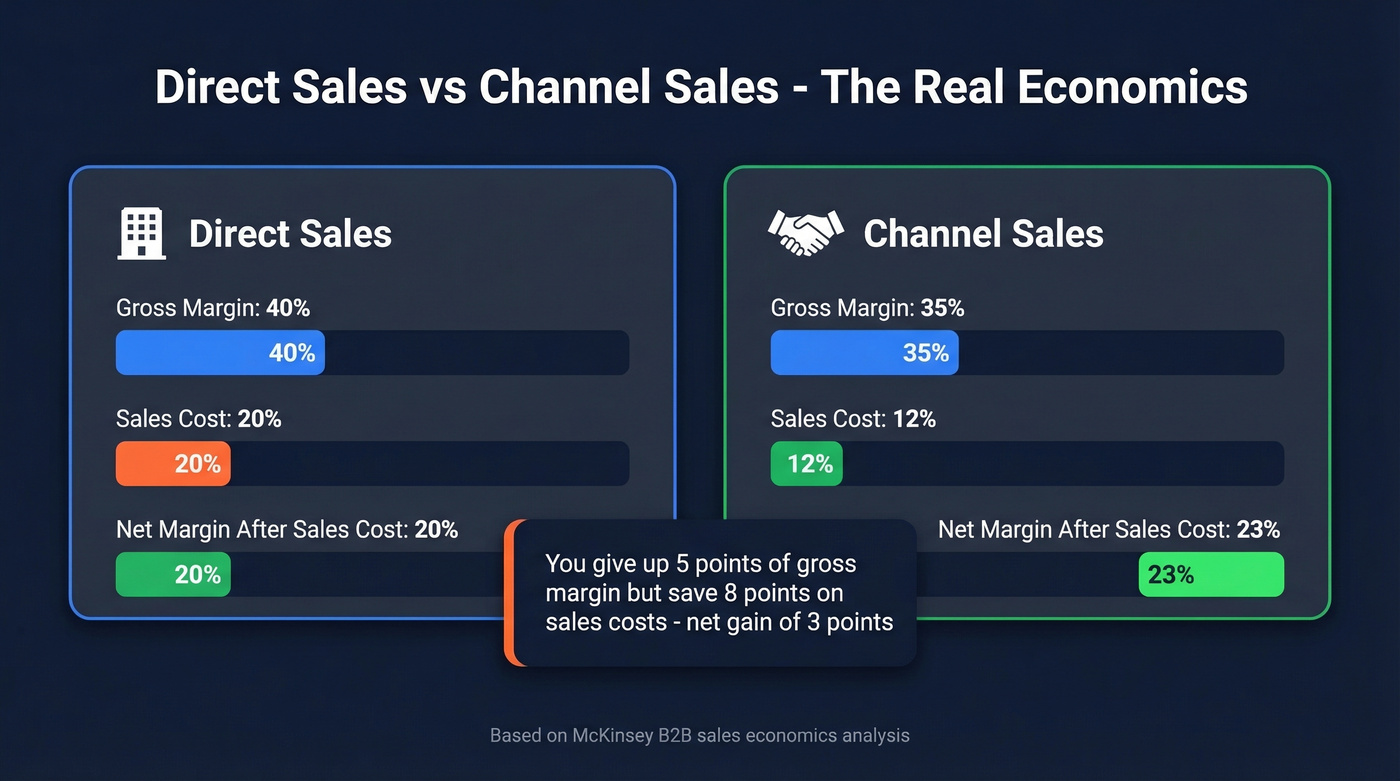
The economics are worth examining. Here's the tradeoff, based on McKinsey's analysis of B2B sales economics:
| Metric | Direct Sales | Channel/Distributor |
|---|---|---|
| Gross margin | 40% | 35% |
| Sales cost (% of revenue) | 20% | 12% |
| Net margin after sales cost | 20% | 23% |
You give up 5 points of gross margin but save 8 points on sales costs. That's the math that makes channel work at scale.
Why Indirect Sales Outperform
The ROI case isn't theoretical. In McKinsey's analysis of 73 B2B technology companies, one company's indirect channel delivered 50% greater sales ROI than its direct sales motion. Across the broader dataset, multichannel sellers achieved more than 40% higher sales ROI than single-channel companies.
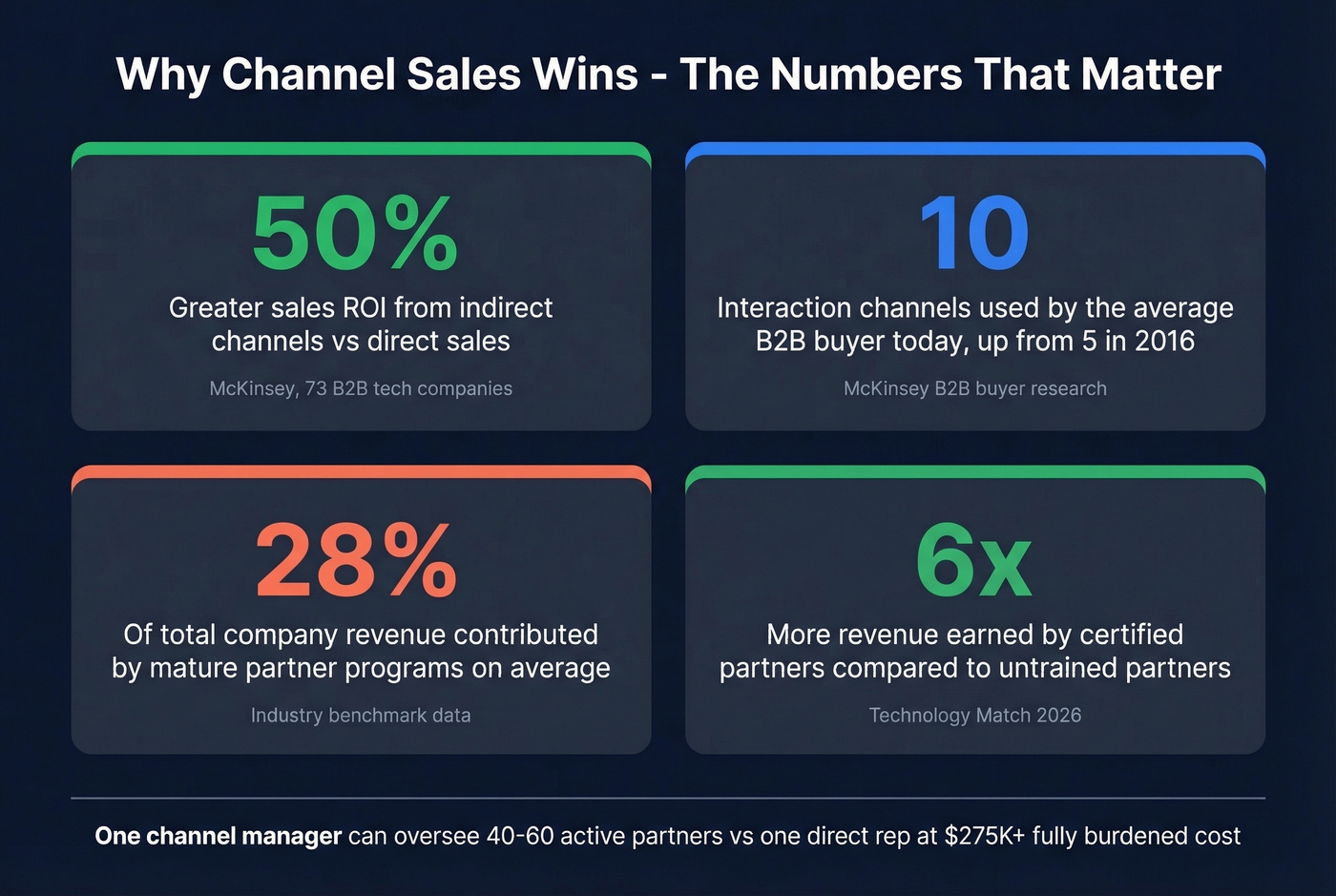
The buyer side has shifted too. B2B buyers now use an average of ten interaction channels - up from five in 2016. McKinsey's "rule of thirds" captures the new buying preference: one-third want in-person, one-third remote, one-third digital self-serve. A partner ecosystem gives you presence across channels you'd never staff internally.
Mature partner programs contribute 28% of total company revenue on average. The fully burdened cost of a direct enterprise rep runs north of $275,000 annually, while one channel manager can oversee 40-60 active partners. The cost comparison isn't close.
Is Your Company Ready?
Not every company should launch a channel program. Before you recruit a single partner, answer these five questions honestly:
Do you have a repeatable sales process? If your own reps can't close consistently, partners won't either. Channel amplifies what works - it doesn't fix what's broken. (If you need to tighten the basics first, start with sales process optimization.)
Is the product proven in-market? Partners won't invest time selling something unvalidated. You need reference customers and a clear value prop.
Can you build enablement resources? Partners need playbooks, battle cards, demo scripts, and co-branded collateral. If your marketing team is already underwater, pause. (A good starting point is marketing enablement.)
Do you have 12+ months of runway for this investment? Channel is a long game. If you need revenue this quarter, hire more direct reps instead.
Is there a geographic or vertical expansion opportunity? Channel shines when partners bring local relationships and domain expertise you don't have. 37% of mid-market businesses actively prefer buying through resellers or MSPs rather than going direct - that's a primary revenue engine waiting for the right partner program.
If you answered "no" to two or more of those, don't start yet. Build the foundation first. We've seen teams launch partner programs prematurely and burn through their best potential partners before the product was ready to support them.
Channel Partner Types
Not all partners are created equal. Here's what each type actually does:
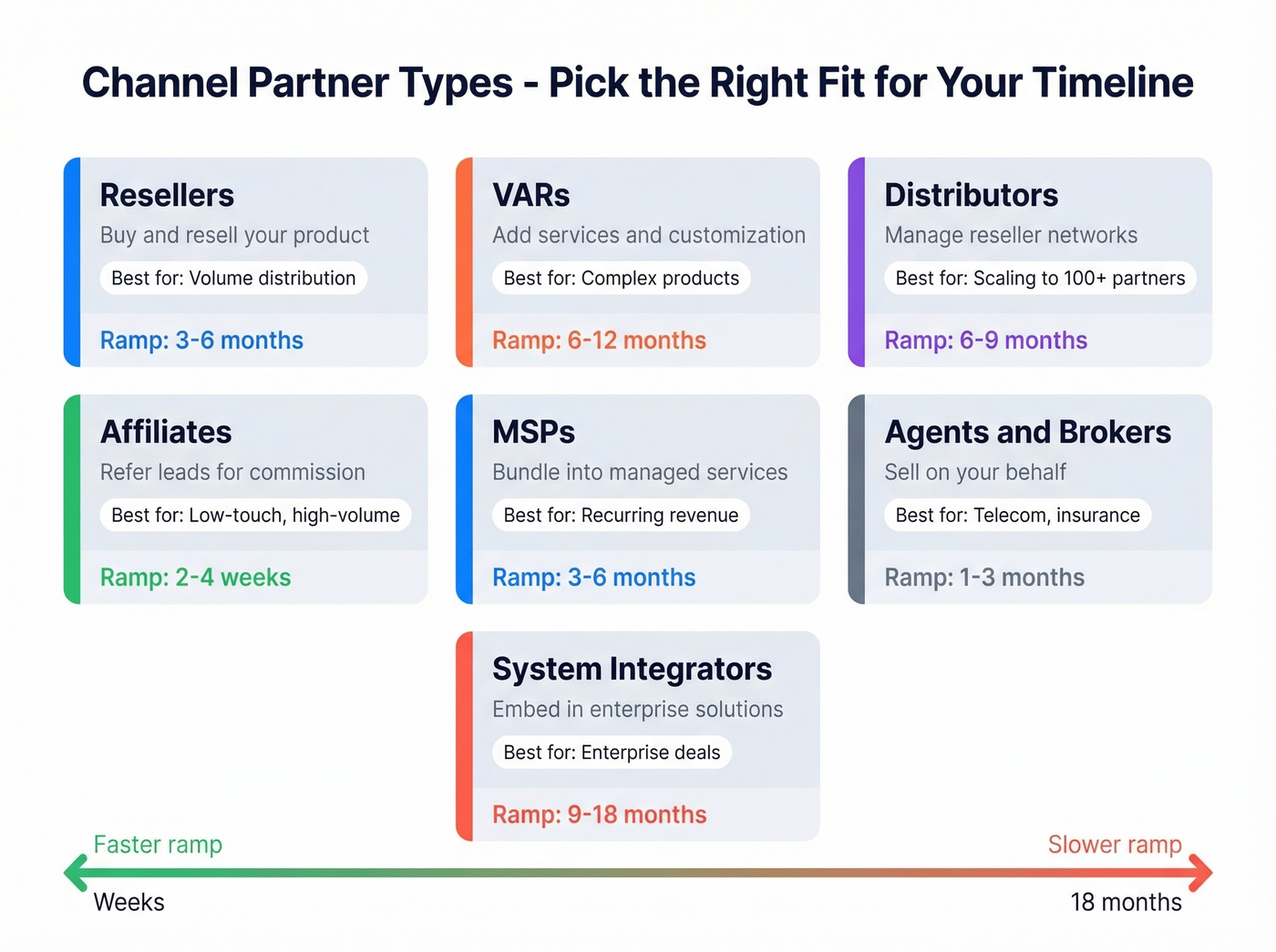
| Partner Type | What They Do | Best For |
|---|---|---|
| Resellers | Buy and resell your product | Volume distribution |
| VARs | Add services/customization | Complex products |
| Distributors | Manage reseller networks | Scaling to 100+ partners |
| Affiliates | Refer leads for commission | Low-touch, high-volume |
| MSPs | Bundle into managed services | Recurring revenue |
| Agents/Brokers | Sell on your behalf | Telecom, insurance |
| System Integrators | Embed in enterprise solutions | Enterprise deals |
VAR onboarding takes 6-12 months before they're productive. Affiliates can start driving leads in weeks. Match your partner type to your timeline.

Your channel partners need leads they can actually reach. Prospeo gives them 300M+ verified contacts with 98% email accuracy and 125M+ direct dials - so partners self-serve prospects instead of waiting on your marketing team.
Equip every partner with enterprise-grade data at $0.01 per email.
How to Build Your Channel Program
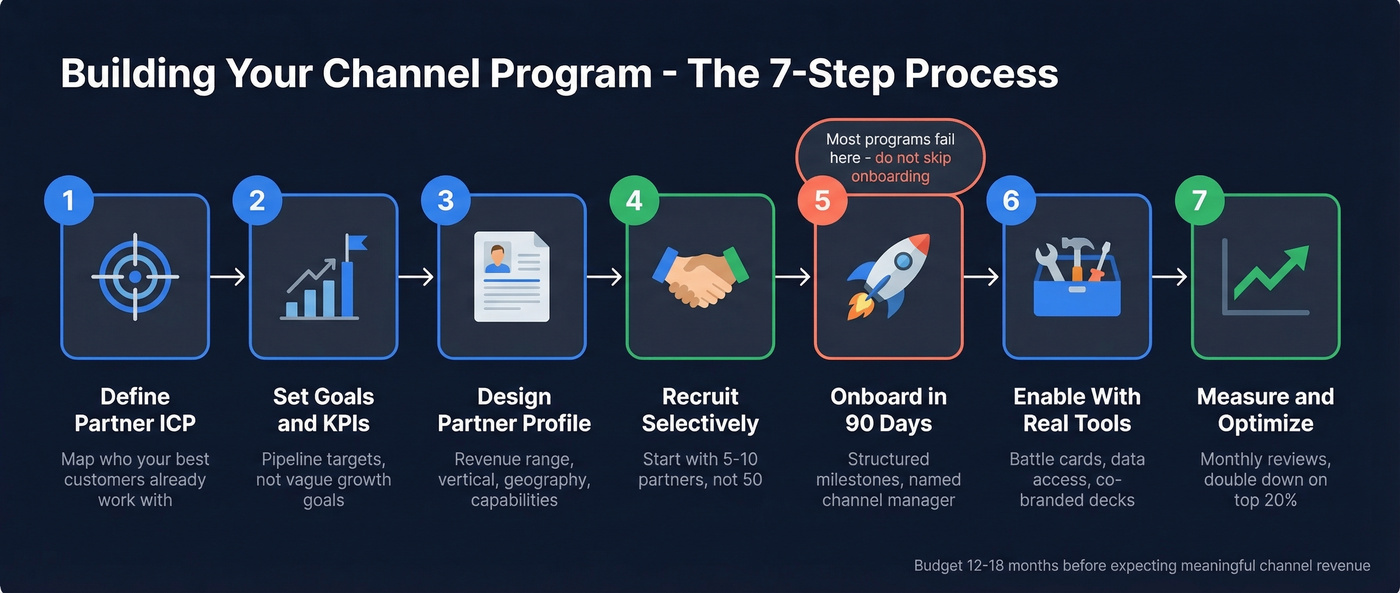
Define Your ICP for Partners
Your partner ICP isn't the same as your customer ICP. You're looking for companies that already sell to your target buyers, have complementary products, and have a sales team capable of learning your pitch. Start by mapping which partners your best customers already work with. If you need a structure for this, use an ideal customer profile scoring rubric and adapt it for partners.
Set Goals and KPIs
"Grow channel revenue" isn't a goal. "$500K in partner-sourced pipeline within 12 months from 8 active partners" is. Tie KPIs to leading indicators early - deal registrations, certification completions, portal logins - because lagging revenue metrics won't tell you anything useful for the first two quarters. (If you want a broader measurement model, borrow from funnel metrics.)
Design Your Ideal Partner Profile
Document it the same way you'd document a buyer persona: revenue range, vertical focus, geographic coverage, existing customer base, technical capabilities. This prevents your channel team from chasing every MSP that returns an email.
Here's a data point that should shape your recruiting pitch: partners rank ease of doing business above overall revenue potential when choosing which vendors to sell for, according to The Channel Company's 2026 Tech Channel Roadmap. Your onboarding friction is a competitive disadvantage. If a partner has to jump through hoops to register a deal or access collateral, they'll sell someone else's product.
Recruit Selectively
Start with 5-10 partners. The 80/20 dynamic is real - 20% of partners generate 80% of revenue. Your first cohort should be hand-picked companies where you have an existing relationship or a warm introduction. Cold-recruiting partners at scale is a year-two activity.
Start with mid-market partners who can move fast - chasing SAP or Accenture partnerships sounds impressive in board decks but burns years with no guarantee of revenue.
Onboard With a 90-Day Plan
Here's the thing: this is where most programs fail. Don't hand partners a portal login and wish them luck. Build a structured 90-day onboarding plan with specific milestones. Partners completing certification earn 6x more revenue than untrained counterparts. Only 25-33% of companies have a formal partner education program, which means building one immediately puts you ahead of two-thirds of the market. (If you want a template for structuring ramp, adapt a 30-60-90 day plan.)
Enable With Real Tools
An enablement kit isn't a shared Google Drive folder. Partners need battle cards, co-branded decks, demo scripts, ROI calculators, and - critically - access to prospecting data. If your partners can't find verified contact information for their target accounts, they'll default to selling whatever product makes prospecting easiest.
Tools like Prospeo give partners self-serve access to 300M+ professional profiles with 98% email accuracy, so they can build prospect lists without waiting on your marketing team. Add a prospecting data layer to the enablement kit on day one. (If you're comparing vendors, start with data enrichment services.)
Measure and Optimize
Review partner performance monthly. Double down on your top 20%. For underperforming partners, diagnose whether it's a training problem, a motivation problem, or a fit problem - each requires a different intervention. Track revenue by region to identify where partners are outperforming your direct team, and watch for brand dilution: partners who misrepresent your product or cut corners on compliance can damage your reputation faster than they build pipeline.
The 90-Day Onboarding Plan
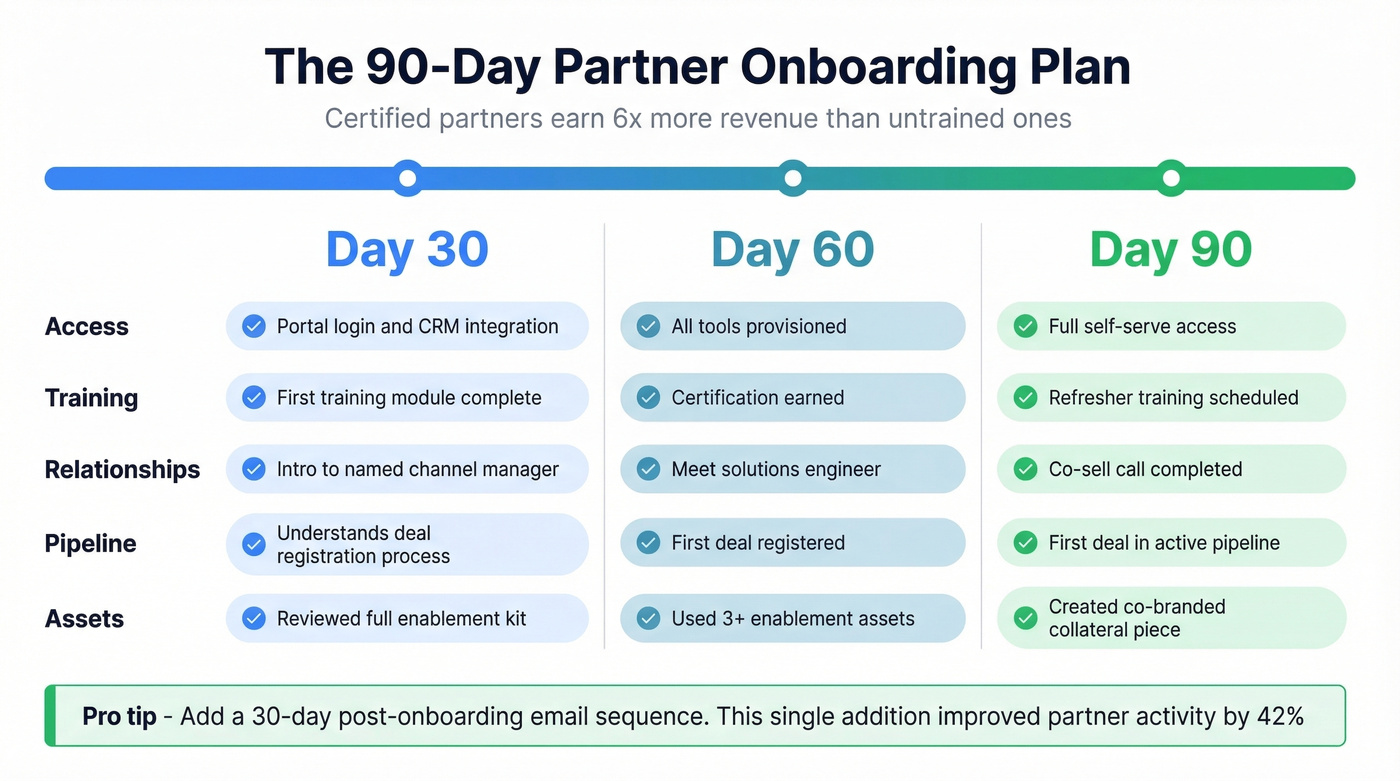
Here's the milestone framework that separates programs producing revenue from programs producing excuses:
| Milestone | Day 30 | Day 60 | Day 90 |
|---|---|---|---|
| Access | Portal login, CRM integration | All tools provisioned | Full self-serve |
| Training | First module complete | Certification earned | Refresher scheduled |
| Relationships | Intro to channel manager | Meet solutions engineer | Co-sell call completed |
| Pipeline | Understands deal registration | First deal registered | First deal in pipeline |
| Assets | Reviewed enablement kit | Used 3+ assets | Created co-branded piece |
In our experience, the partners who ramp fastest get a named channel manager in week one - not a shared inbox. One tactical detail that compounds: a 30-day post-onboarding email sequence. Kiflo reported that this single addition improved partner activity by 42%.

Your enablement kit should split into two categories. Internal-facing materials include sales playbooks, battle cards, modular product training, ROI calculators, and an FAQ library. External-facing materials include co-branded decks by vertical, case studies, outreach templates, demo scripts, and a prospecting data tool so partners can self-serve verified contacts without filing requests with your marketing team. (For partner outreach, keep a set of sales follow-up templates ready.)
Commission Structures That Work
Core Models
| Model | How It Works | Example | Best For |
|---|---|---|---|
| Revenue-based | % of deal value | 8% on $50K = $4,000 | Standard resellers |
| Flat-fee | Fixed $ per sale | $500 per closed deal | High-volume, low-ACV |
| Tiered | % increases with volume | 5% → 8% → 12% | Motivating growth |
| Recurring (SaaS) | % of annual contract | 15% of $30K ACV = $4,500/yr | SaaS partnerships |
| Performance bonus | Bonus at milestones | $5K at 10 deals/quarter | Accelerating top partners |
Referral partners earn 5-15% per deal, resellers take 15-35% margin depending on product complexity, and affiliates land in the 10-30% range depending on ACV and contract length.
One rule that'll save you headaches: pay commissions on cleared invoices, not closed deals. This eliminates the scenario where a partner closes a deal that never pays, and you're chasing back a commission check. Build this into your partner agreement from day one.
Advanced Levers
Gross margin commission incentivizes partners to sell your higher-margin products instead of defaulting to whatever's easiest to pitch. You pay a percentage of gross margin - so a $50K deal at 60% margin pays more than a $50K deal at 30% margin.
Multiplier commissions work well for strategic product launches. Take a base commission of 5% and apply a 3x multiplier for a specific product line - suddenly that partner is earning 15% on deals you really want them to push.
Draw-against-commission is underused in channel. You advance a new partner a fixed amount against future commissions, sometimes forgivable if they complete specific enablement activities like certification or co-marketing campaigns. It reduces the partner's risk of investing time before revenue materializes.
Let's be honest about the biggest friction point here: commission complexity is the number-one complaint in partner forums. 73% of partners say incentive programs are too complex. If a partner needs a spreadsheet to calculate their payout, you've already lost. For edge cases like reopened deals, deal splits between a partner and an internal rep, or cross-sell commissions, document the rules before the first dispute happens.
KPIs That Actually Matter
Most channel programs track revenue and call it a day. That's like measuring a sales team only on closed-won. You need three tiers.
Leading indicators tell you whether the program is building momentum: deal registrations per partner per month, portal login frequency, certification completion rates, and co-branded asset downloads. These predict revenue 60-90 days out.
Lagging indicators confirm whether the program is working: partner-sourced revenue, partner-influenced revenue, win rate on partner-sourced deals, and expansion revenue through existing partner accounts. Plan for only 20-30% of recruited partners becoming truly active.
Program health metrics tell you whether the program is sustainable: partner attrition rate, MDF effectiveness measured as leads generated per dollar of market development funds spent, partner satisfaction scores, and the ratio of active to inactive partners. Channelnomics recommends tracking ecosystem engagement, deal registration win rate, and expansion revenue rate as modern KPIs that go beyond basic revenue counting.
Design your KPI framework around the 80/20 reality. If 20% of partners generate 80% of revenue, your metrics should help you identify that top 20% early and invest disproportionately in their success. (To pressure-test whether the motion is actually scaling, track pipeline health alongside partner KPIs.)
7 Mistakes That Kill Channel Programs
1. Expecting revenue in 90 days. Channel takes 12-18 months to produce meaningful pipeline. Set internal expectations with a phased roadmap - awareness metrics in Q1, pipeline metrics in Q2-Q3, revenue metrics in Q4+.
2. Recruiting 50 partners instead of 5 great ones. More partners means more enablement burden, more support tickets, and more inactive accounts cluttering your PRM. Recruit 5-10, prove the model, then scale.
3. Letting direct reps manage partners. Direct sellers and channel managers have fundamentally different skill sets. A rep who's great at closing deals is often terrible at enabling someone else to close. Hire or designate dedicated channel managers.
4. Building the program "in a back room." Perfecting your partner portal for six months before engaging a single partner is a classic trap. Launch with a minimum viable program and iterate based on real partner feedback.
5. No channel conflict resolution. When a direct rep and a partner are working the same account, someone loses. Ask any channel manager what kills programs fastest, and channel conflict comes up every time. The consensus on r/sales is the same - document conflict resolution rules before your first deal registration, and enforce them consistently.
6. Overcomplicating incentives. One page, one formula, clear examples. That's it.
7. Ignoring brand dilution and compliance. Partners who misrepresent your product, cut corners on data handling, or make unauthorized claims create legal and reputational risk that scales with your program. Include brand guidelines and compliance requirements in onboarding, and audit quarterly.
Look - most companies that "fail at channel" didn't actually fail at channel. They failed at enablement. They handed partners a PDF and a portal login, then blamed the partners when nothing happened. If your partners aren't selling, the first place to look is your own onboarding program, not their effort level.
Essential Channel Sales Tools
You need three layers in your channel tech stack: partner management, pipeline management, and prospect data.
For PRM, here's what the market looks like in 2026:
| Tool | Starting Price | Best For |
|---|---|---|
| Kiflo | $299-$399/mo | Under 20 partners |
| PartnerPortal.io | Free/freemium | Getting started |
| Allbound | $500-$2,000+/mo | Mid-market programs |
| PartnerStack | $1,500+/mo | Marketplace/affiliate |
| Channeltivity | $1,399-$1,699/mo | Enterprise programs |
| Impartner | $2,000+/mo | Enterprise at scale |
| Salesforce PRM | $25/user/mo | Salesforce shops |
Skip the $2K/month platforms until you have 50+ active partners and the operational complexity to justify them. Under 20 partners, Kiflo or PartnerPortal.io will handle everything you need. Done right, PRM investments deliver 195% ROI over three years.
PRM handles partner management. Your CRM handles pipeline. But your partners still need to find prospects - and that's where most enablement kits have a gap. A B2B data platform with verified emails and direct dials closes that gap so partners can self-serve contacts without filing a single request with your marketing team. (If you're building a broader stack, start with outbound lead generation tools and then standardize what partners get access to.)
Scaling from 5 partners to 50 means scaling data access too. Prospeo's API enriches partner CRMs with 50+ data points per contact at a 92% match rate - on a 7-day refresh cycle so no one pitches a prospect who changed jobs last month.
Stop letting stale data sabotage your channel program.
FAQ
How long before a channel sales strategy produces revenue?
Budget 12-18 months for meaningful partner-sourced pipeline. Leading indicators like deal registrations should appear within 90 days if the program is healthy. VAR onboarding alone takes 6-12 months before partners are productive.
What's the difference between channel sales and direct sales?
Direct sales means your own reps sell to customers. Channel sales means third-party partners sell on your behalf for a commission or margin. Most mature B2B companies run both motions simultaneously, with the strongest results coming from aligning partnerships with your direct team rather than treating them as competing motions.
What commission should I offer channel partners?
For SaaS, 10-20% of first-year ACV as a recurring commission is standard. Reseller margins run 15-35% depending on deal complexity. Referral-only partners typically earn 5-15% per closed deal.
How many partners should I start with?
Five to ten. The 80/20 rule means most channel revenue comes from a handful of top performers. Deeply enable a small cohort rather than superficially onboard 50 partners who never ramp.
What prospecting tools do channel partners need?
Partners need a PRM for deal registration, co-branded collateral for their verticals, and a data tool for verified contacts. A free-tier prospecting tool is a low-friction addition to any enablement kit - partners self-serve leads instead of waiting on your marketing team to build lists for them.