

Go-to-Market Strategy for Startups: A Framework, 3 Examples, and a Copyable Template
A RevOps lead we know spent six weeks building a GTM plan modeled after Slack's playbook. His startup had 12 employees, no brand recognition, and a $15K ACV product. The plan flopped inside a month.
Here's the thing: every go-to-market strategy example you find online uses Slack and HubSpot without showing you what to actually steal from their playbooks - or when to ignore them entirely. CB Insights data shows 35% of startups fail because there's no market need, and another 20% get outcompeted trying to reach customers. The fix isn't a prettier slide deck. It's a tighter framework, tested faster.
What You Need (Quick Version)
- Validate before you build. Talk to 500+ potential users before committing. Friends don't count.
- Pick PLG or sales-led based on deal size. Under $10K ACV? Product-led. Over $25K? Sales-led.
- Test two channels hard for 90 days. Go deep on two and measure weekly.
- Document it on one page. Use the template below.
The 6-Step GTM Framework
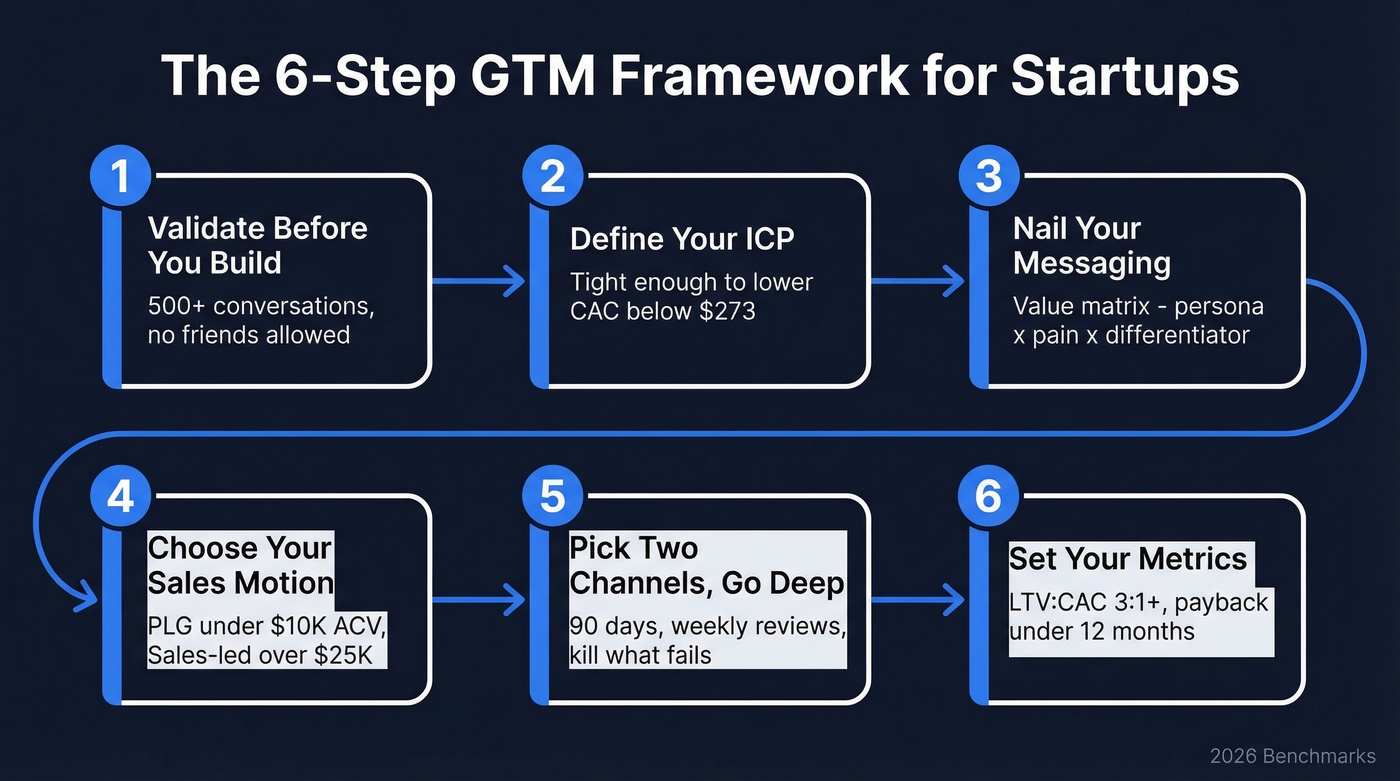
Validate Before You Build
Grid founder Jarod Estacio did between 500 and 1,000 informal conversations before committing to a direction - and explicitly excluded friends from that count. If you can't find 50 people willing to talk about the problem you're solving, you don't have a market yet. Skip the GTM plan and go back to discovery.
Define Your ICP
"Mid-market SaaS companies" isn't an ICP. "Series B fintech companies with 50-200 employees who just hired a VP of Sales" is. The tighter your definition, the cheaper your customer acquisition cost. Average B2B SaaS CAC runs $273; a vague ICP pushes that number way higher.
Nail Your Messaging
Build a value matrix: what each persona cares about, what pain you solve for them, and how you say it differently than competitors. Test messaging in cold outreach and landing pages before you invest in brand campaigns. We've seen founders burn $20K on brand awareness before they could articulate a single differentiator in plain English.
Choose Your Sales Motion
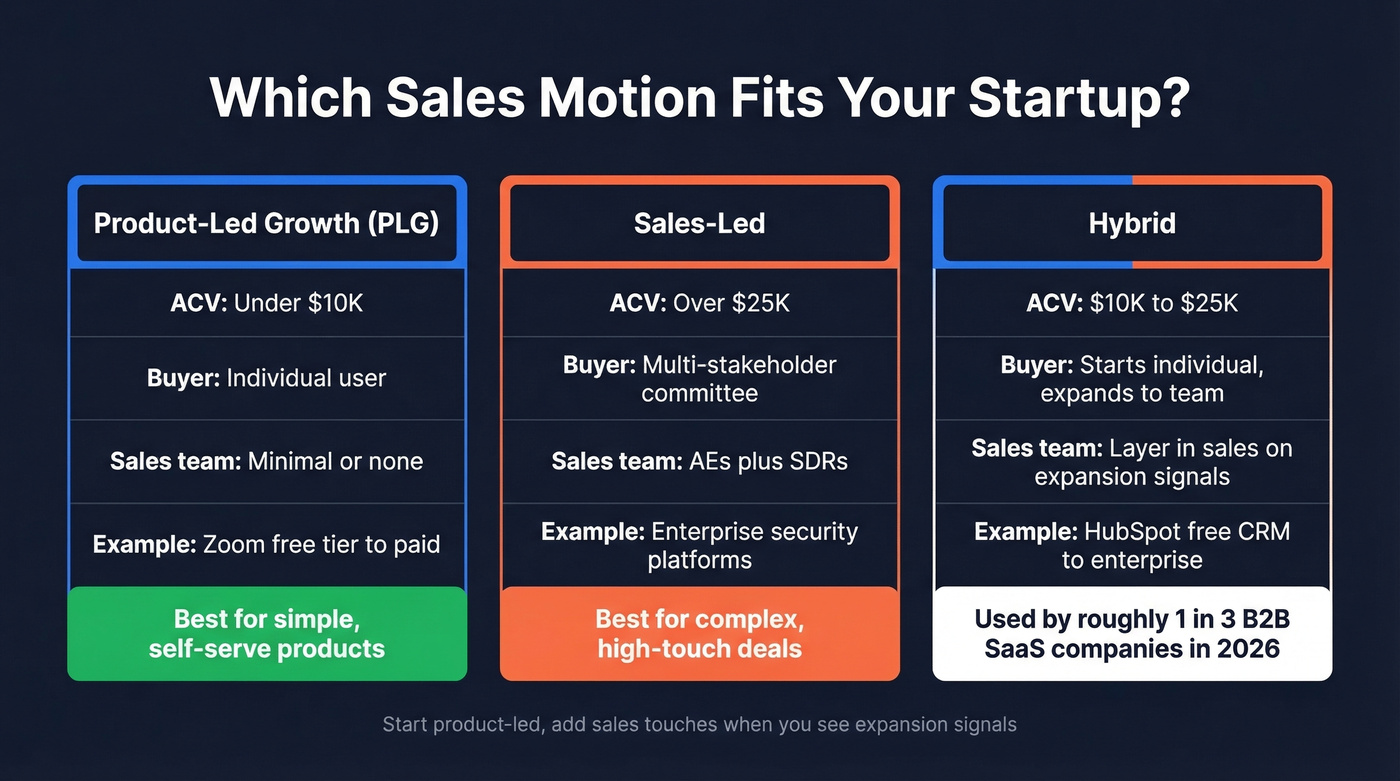
PLG works for simple products with ACV under $10K. Sales-led fits complex products with ACV above $25K and multi-stakeholder buying committees. Most B2B SaaS companies in 2026 run a hybrid - roughly one-third use hybrid pricing models blending self-serve with sales-assisted upgrades. If you're between $10K and $25K ACV, start product-led and layer in sales touches once you see expansion signals.
Pick Two Channels, Go Deep
The biggest mistake we see: spreading budget across five channels and learning nothing. Pick two, run them hard for 90 days, and review conversion rates at each step weekly. Kill what doesn't work. Founders on r/SaaS consistently advocate scrappy consistency over polished GTM decks - and they're right. A founder who sends 200 personalized cold emails per week will learn more in a month than one who spends that month perfecting a paid ads funnel.
Set Your Metrics
Target LTV:CAC of at least 3:1 and CAC payback under 12 months. The #1 GTM challenge teams report is alignment - 25.5% of respondents flagged it as their biggest problem, with another 9.8% citing stakeholder buy-in. Shared metrics fix both.
Watch AE attrition too. Once it crosses 20%, your GTM execution degrades fast regardless of strategy quality.
Go-to-Market Strategy Examples for Startups
Zoom: PLG to Enterprise
Zoom's S-1 revealed that 55% of customers contributing more than $100K in revenue started with at least one free host. The playbook: let individuals adopt the product for free, then expand into team and enterprise contracts as usage spreads organically through organizations.
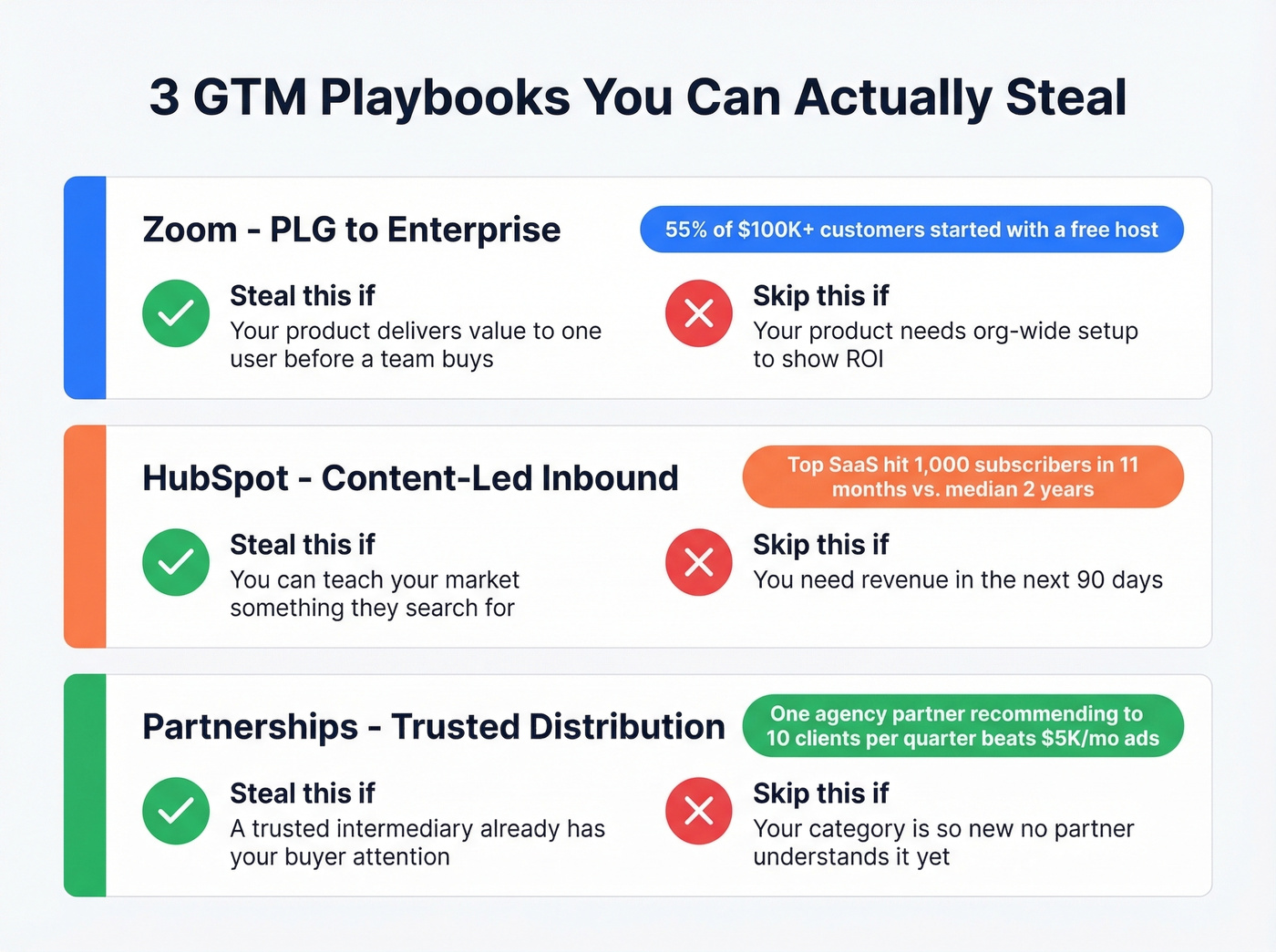
Steal this if your product delivers value to a single user before a team buys in. Skip this if your product requires org-wide implementation to show ROI - you'll burn cash on free users who never convert.
HubSpot: Content-Led Inbound
HubSpot popularized "inbound marketing" through content and education before most competitors took content seriously. The ChartMogul 2026 GTM Report tracks this benchmark: top-performing SaaS companies hit 1,000 subscribers in 11 months vs. a median of two years. That gap is the compound interest of consistent publishing.
Steal this if you can teach your market something they're actively searching for. Skip this if you need revenue in the next 90 days - content compounds slowly, and you'll run out of runway waiting for organic traffic to kick in.
Partnerships: Win Through Trusted Distribution
One of the fastest ways to get early traction is to partner with a trusted intermediary that already has your buyer's attention - agencies, consultants, platforms, communities, resellers.
Let's be honest: most early-stage startups should try channel partnerships before paid ads. Warm introductions from trusted partners convert dramatically better than cold traffic, and they can be structured so you don't front-load ad spend. A single agency partner who recommends your tool to 10 clients per quarter is worth more than a $5K/month Google Ads budget at the seed stage.
Steal this if a trusted intermediary already has your buyer's attention. Skip this if your product category is so new that no existing channel partner understands it yet.

Your GTM framework means nothing if your outbound emails bounce. Startups that tested channels with Prospeo cut bounce rates from 35% to under 4% and tripled pipeline - because 98% email accuracy lets you learn what's working instead of debugging deliverability.
Stop wasting your 90-day channel test on bad data.
Finding Your First 100 Customers
Cailen D'Sa's advice is blunt: don't hire a Head of Sales too early. "You need to become an expert" at selling your own product first. Founder-led sales isn't optional - it's how you learn what actually resonates.

For outbound at the earliest stages, target "agents of change" - people hired in the past 90 days who are more open to new tools. Watch for trigger events like funding rounds, compliance deadlines, or new product launches. Monitor public signals: conference talks, job postings for roles your product supports, and strategic announcements all reveal buying intent before a prospect ever fills out a form.
The tactical bottleneck for most founders is getting verified contact data without burning their domain on bad emails. We've tested this extensively, and tools like Prospeo solve it cleanly - 98% email accuracy, 30+ search filters including job change signals, and a free tier with 75 verified emails per month. That's enough to validate your first outbound channel without risking email deliverability or signing an enterprise contract.
Founder-led sales depends on reaching the right people. Prospeo's 30+ filters - including job change signals, funding rounds, and headcount growth - let you target agents of change at companies that match your ICP. 75 free verified emails per month, no contracts, no sales calls.
Find your first 100 customers with data that actually connects.
Your GTM Document Template
Adapted from Startmate's GTM framework, this is the one-page structure we recommend for seed and Series A startups:
- Executive Summary - one paragraph covering what you sell, to whom, and why now
- Product Offer Breakdown
- Pricing Model
- Segmentation - markets, verticals, company size
- Value Matrix - persona x pain point x message
- Buyer Personas
- Sales Funnel - TOFU / MOFU / BOFU
- Sales Strategy - motion, team, process
- Demand Generation - inbound + outbound
- Content Strategy
- Quarterly Goals
- Scale Hypotheses - what you'll test next quarter
If you're spending more than two weeks filling this out, you're overthinking it. Ship the first version, run it for a quarter, and revise based on real pipeline data.
2026 GTM Benchmarks
AI-native companies convert free trials to closed-won deals at 56% vs. 32% for non-AI-native peers at scale. If you're not using AI in your GTM workflows yet, you're paying more per lead than competitors who are. Companies spend $2 in sales and marketing for every $1 of new ARR - and that ratio climbed 14% since 2024.
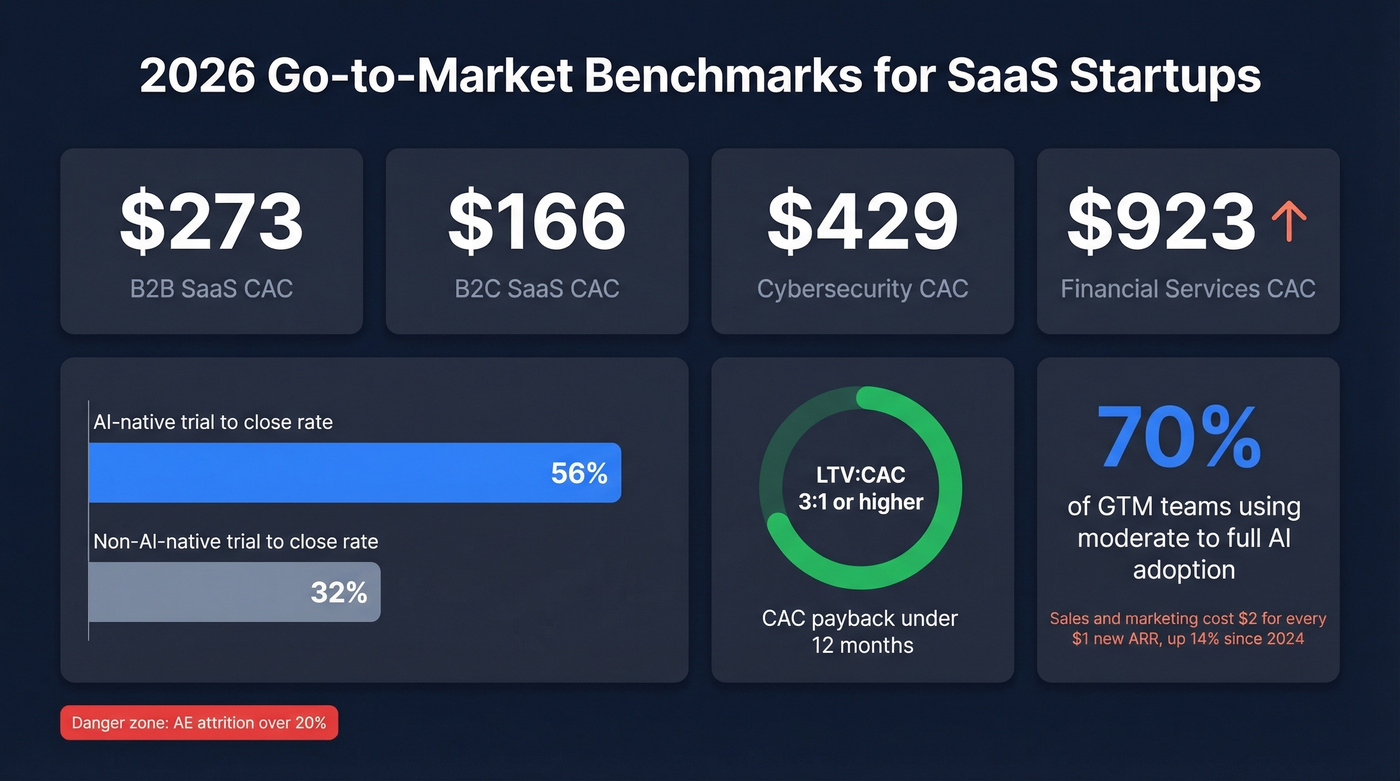
| Metric | Benchmark |
|---|---|
| B2B SaaS CAC | $273 |
| B2C SaaS CAC | $166 |
| Cybersecurity CAC | $429 |
| Financial Services CAC | $923 |
| LTV:CAC target | ≥ 3:1 |
| CAC payback target | < 12 months |
| Top-quartile ARR growth ($25M-$100M ARR) | 93% |
| AI adoption in GTM | 70% moderate/full |
| AI-native trial to closed-won | 56% vs. 32% non-AI |
| AE attrition danger zone | > 20% |
FAQ
What's the difference between a GTM strategy and a marketing plan?
A GTM strategy is the full cross-functional playbook for bringing a product to market - positioning, pricing, sales motion, channels, and metrics. A marketing plan is one slice of that. Think of GTM as the blueprint for the house; marketing is the electrical wiring.
How long should a startup GTM plan take to build?
Two to four weeks for the document, then 90 days to test channels with real pipeline data. If you're spending longer than a month on the plan itself, you're overthinking it. Ship and iterate.
What tools do I need for outbound GTM on a startup budget?
HubSpot CRM on the free tier, Prospeo for verified emails and mobile numbers (free tier covers 75 emails/month), and a cold email tool like Instantly at around $30-$40/month. That stack stays around $100/month total and covers list building, verification, and sequencing - enough to validate any go-to-market strategy before scaling spend.