


GrowMeOrganic vs QuickEnrich: Honest Comparison (2026)
You exported 5,000 contacts last quarter, loaded them into your sequencer, and watched 40% bounce before lunch. Your domain reputation took the hit. Your sequences stalled. Now you're comparing GrowMeOrganic vs QuickEnrich to find something that actually works. B2B contact data decays at roughly 30% per year, so the tool you pick needs to verify aggressively - not guess email patterns and hope for the best.
30-Second Verdict
Pick GrowMeOrganic if you want an all-in-one outreach platform with unlimited credits and can tolerate inconsistent data quality.
Pick QuickEnrich if you need enrichment-only with double verification at a low per-match cost - and you're comfortable trusting a tool with zero third-party reviews.
Feature Comparison at a Glance
| GrowMeOrganic | QuickEnrich | Winner | |
|---|---|---|---|
| Database size | 575M+ professionals | 130M+ contacts | GrowMeOrganic |
| Accuracy | Not stated | 97% (vendor claim) | QuickEnrich (on paper) |
| Verification | Pattern-based | Double (SMTP + catch-all) | QuickEnrich |
| Pricing | $39-$159/mo | $29-$99/mo | QuickEnrich |
| Cold email built-in | Yes | No | GrowMeOrganic |
| G2 score | 4.0/5 (12 reviews) | No ratings found | GrowMeOrganic |
| Trustpilot score | 1.6/5 (118 reviews) | No ratings found | Neither |
| Free trial | 14-day | Free start | Tie |
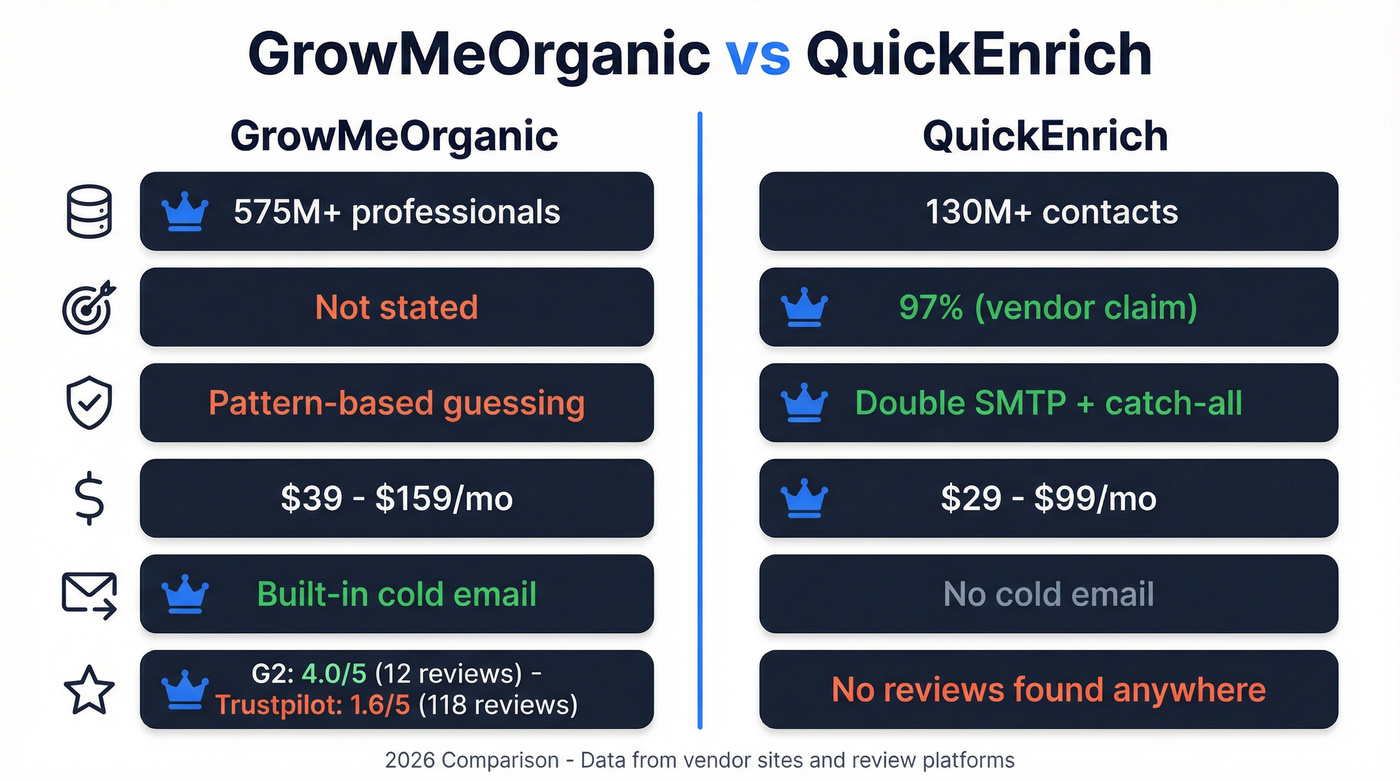
GrowMeOrganic's database is about 4.4x larger, but size means nothing if the emails don't land. QuickEnrich is smaller but adds double verification and claims 250% more email domains than comparable tools. Let's see whether either claim holds up.
Data Accuracy Head-to-Head
Here's where GrowMeOrganic falls apart. The Trustpilot page sits at 1.6 out of 5 from 118 reviews, and the accuracy complaints are brutal - one reviewer wrote that "95% of the emails are undeliverable." On G2, another reviewer said "not even 12% of accurate emails are found" and called it a waste of money. These are telltale signs of pattern-guessing: the tool deduces addresses from name + domain format rather than verifying against real mailboxes.
If you're trying to protect deliverability, it's worth understanding email bounce rate benchmarks and what actually causes spikes.
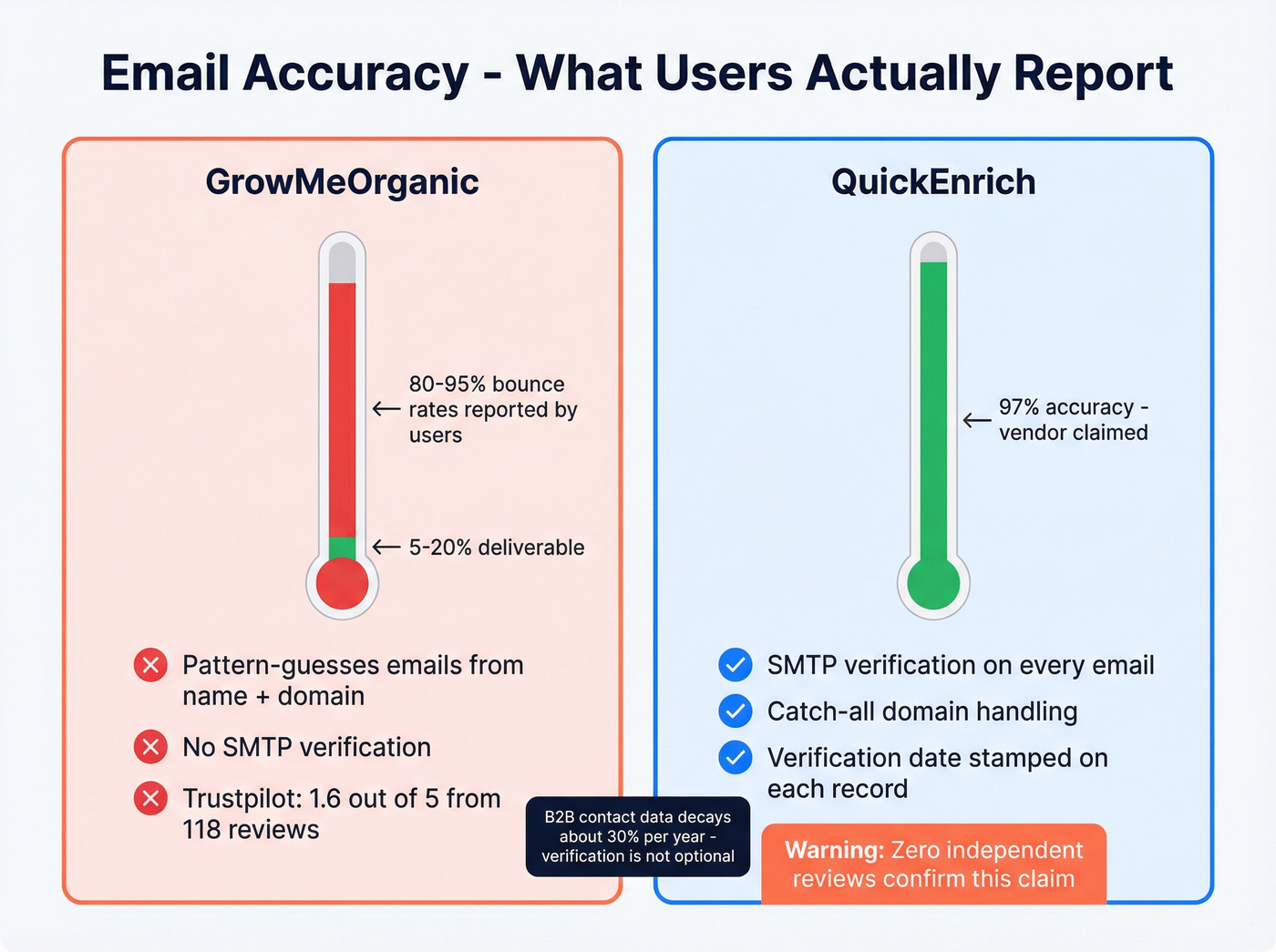
QuickEnrich takes a different approach. It runs SMTP checks, handles catch-all domains, and stamps each email with a verification date so you know how fresh it is. Around 25% of enriched contacts include mobile phone numbers, and the tool integrates with Clay, which matters if you're running enrichment workflows. The 97% accuracy claim sounds strong.
The catch? That figure has no independent validation. We couldn't find QuickEnrich reviews on G2, Capterra, or Trustpilot. You're trusting vendor marketing until you run your own test.
If you're building a repeatable outbound motion, pair enrichment with a solid email deliverability guide so verification and sending practices match.

GrowMeOrganic pattern-guesses emails. QuickEnrich has zero independent reviews. Prospeo's 5-step verification delivers 98% email accuracy across 300M+ profiles - refreshed every 7 days, not months. Snyk's 50 AEs dropped bounce rates from 35-40% to under 5%.
Test 75 free emails and see your bounce rate drop to near zero.
Pricing Breakdown
Both tools undercut the category. Kaspr charges $49/user/month, and Clearbit runs $30-$700/month for credit packs.
If you're comparing vendors beyond these two, this roundup of data enrichment services can help you sanity-check pricing models and verification depth.
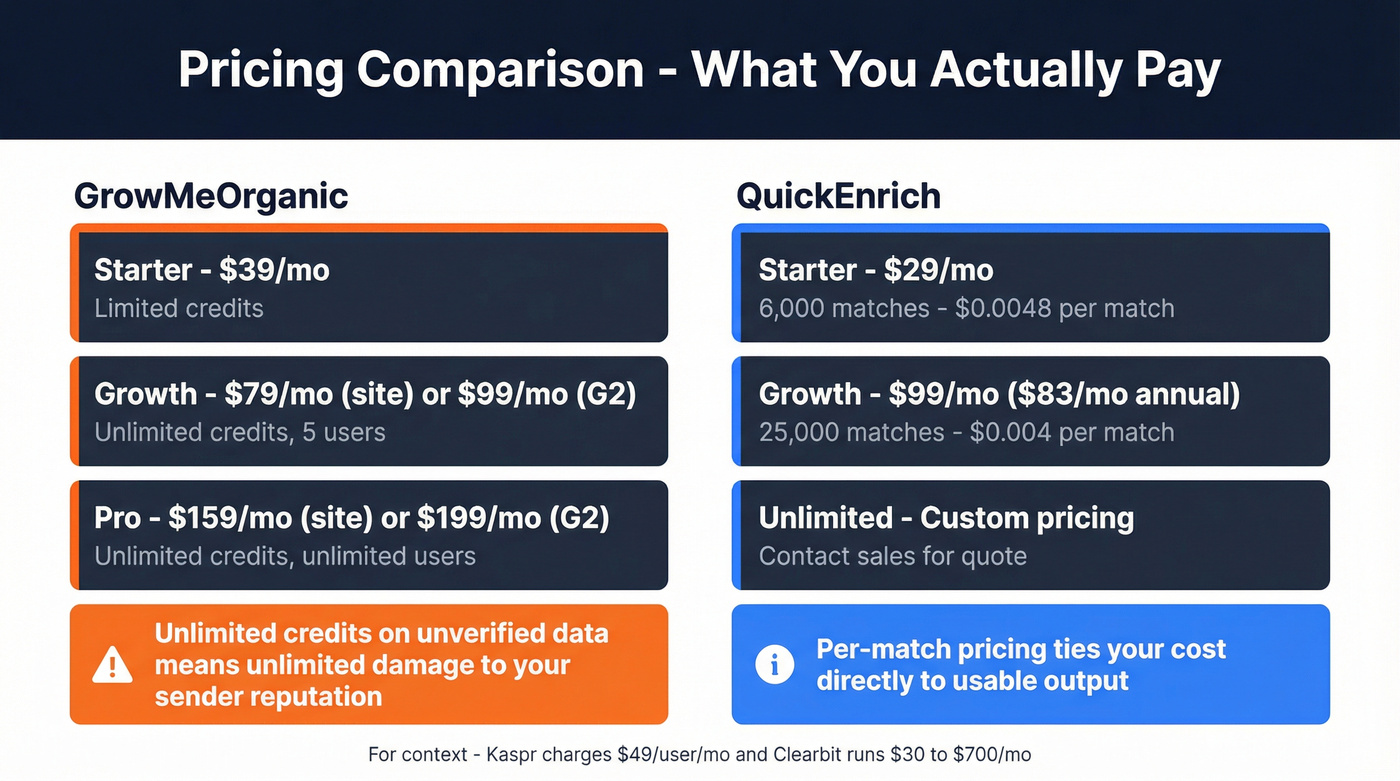
GrowMeOrganic pricing varies depending on where you look. The site shows Starter at $39/mo, Growth at $79/mo with unlimited credits, and Pro at $159/mo with unlimited credits. G2's vendor listing shows Growth at $99/mo for 5 users and Pro at $199/mo for unlimited users. Unlimited credits sound great - until you realize unlimited exports of bad data actively destroy your sender reputation.
QuickEnrich starts at $29/mo for 6,000 found emails or phone numbers ($0.00483 per match), with Growth at $99/mo for 25,000 matches ($0.004 per match). Annual billing drops Growth to $83/mo. An Unlimited tier exists at custom pricing. Per-unit pricing at least ties cost to output.
Look, unlimited credits on bad data is worse than no tool at all. We've seen teams burn through three domains in a single quarter because they trusted "unlimited" exports from providers with no verification backbone. If your average deal size is modest, you especially can't afford the deliverability hit.
If you're scaling volume, keep an eye on email velocity so you don't compound bad data with unsafe sending limits.
User Reviews and Reputation
GrowMeOrganic's review profile is deeply polarized. On G2, twelve reviews show a split: 75% five-star, 8% four-star, 16% one-star, almost nothing between. Positive reviews praise ease of use, lead extraction speed, and Google Maps scraping for local business prospecting. The one-star reviews are scathing - pattern-guessed emails, platform crashes, extension failures. Trustpilot paints an even harsher picture at 1.6/5 from 118 reviews, with refund complaints as a recurring theme. Users describe promised refunds that never materialized.
If you're evaluating tools for outbound, it helps to compare against broader SDR tools stacks so you don't overpay for features you won't use.
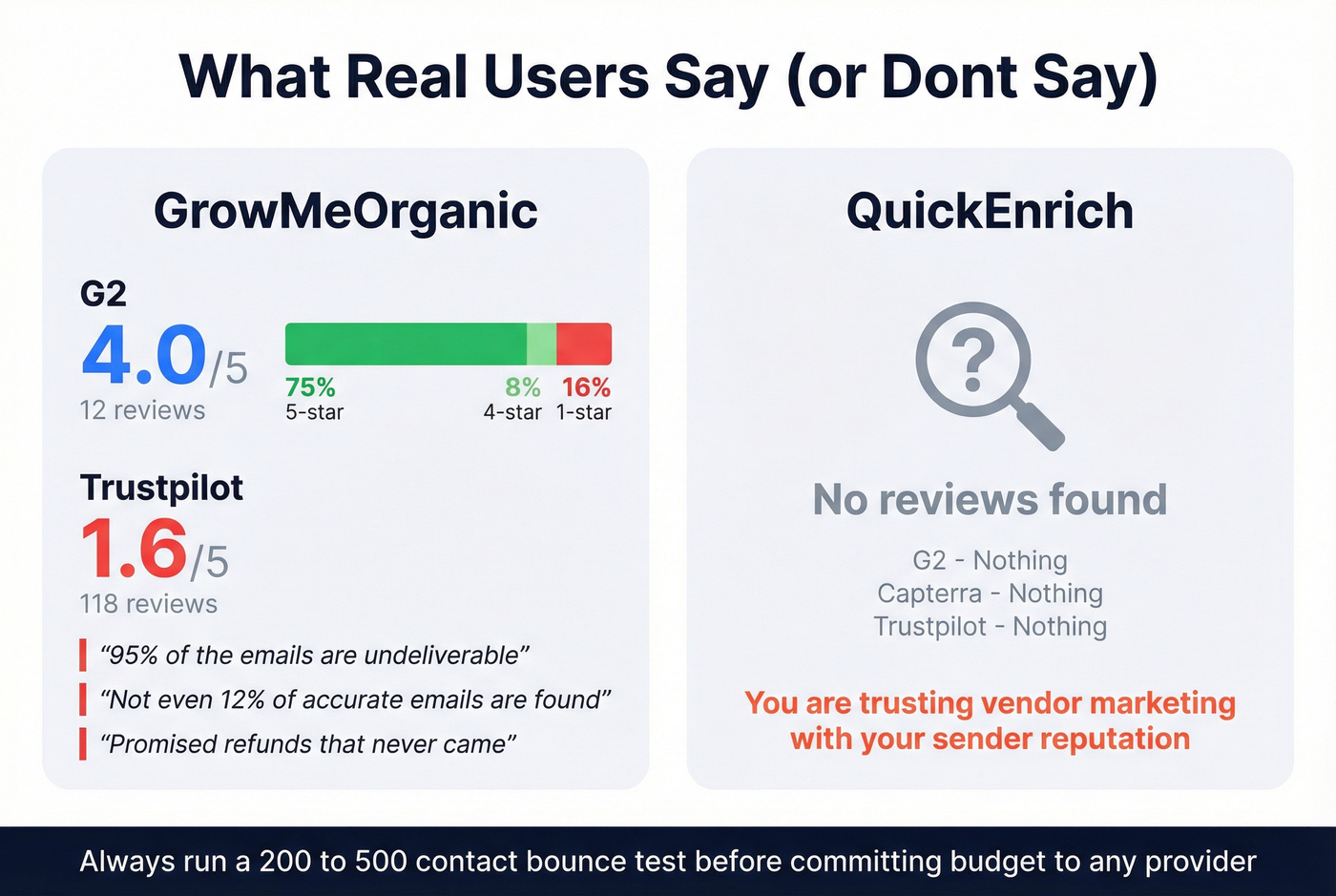
QuickEnrich has no meaningful third-party review presence as of early 2026. That's not necessarily damning for a newer tool, but it means you're flying blind. For context, Apollo.io is the top-listed alternative to GrowMeOrganic on G2, and QuickEnrich doesn't appear on that alternatives page at all.
If you're relying on enrichment workflows, consider how it fits into lead enrichment and list-building processes end-to-end.

A Stronger Alternative
At 98% email accuracy and roughly $0.01/email, it costs more per record than QuickEnrich but dramatically less than rebuilding your domain reputation after a bad provider tanks your deliverability. Real results back this up: Snyk's 50-person AE team dropped bounce rates from 35-40% to under 5% and saw AE-sourced pipeline jump 180%. The free tier gives you 75 verified emails and 100 Chrome extension credits monthly - enough to run a real comparison test against either tool.
If you want to pressure-test verification vendors specifically, start with these Bouncer alternatives to compare approaches like SMTP, catch-all handling, and risk scoring.
Unlimited credits on unverified data destroyed your domain reputation. Prospeo charges ~$0.01/email because every address passes proprietary SMTP verification, catch-all handling, spam-trap removal, and honeypot filtering before it reaches your sequencer.
Run a 75-contact test against either tool - no credit card, no contract.
Final Recommendation
Most comparison articles pretend both tools are roughly equal. They aren't.
GrowMeOrganic has a serious data quality problem that 118 Trustpilot reviewers have documented in painful detail. QuickEnrich's verification approach looks better on paper, but the total absence of third-party reviews means you're trusting marketing copy with your sender reputation.
Before committing to either tool, export 200-500 contacts and measure your actual bounce rate. That 30-minute test tells you more than any comparison article ever will. Relying on a single provider typically leaves 40-60% of qualified prospects unreachable, so test aggressively and don't marry one source.
If you need a safer sending playbook after switching data providers, use this guide on how to improve sender reputation.
FAQ
Is GrowMeOrganic's email data accurate?
Independent reviews say no. GrowMeOrganic holds a 1.6/5 on Trustpilot from 118 reviews, with recurring complaints about pattern-guessed emails that bounce at 80-95% rates. On G2, one reviewer reports accuracy as low as 12%.
Does QuickEnrich have independent reviews?
QuickEnrich has no third-party review footprint on G2, Capterra, or Trustpilot as of 2026. The 97% accuracy claim is vendor-stated only. Run a 200-contact test batch through a standalone verifier before committing budget.
What's a good alternative to both tools?
Prospeo offers 98% email accuracy across 300M+ profiles with a 7-day data refresh cycle and proprietary 5-step verification. The free tier - 75 emails and 100 Chrome extension credits per month - lets you benchmark it against either tool before spending anything.