


Gupshup in 2026: Pricing, Reviews, and Honest Pros & Cons
You just got your first Gupshup invoice and the number doesn't match anything you were quoted. Welcome to the club. We aggregated 190+ reviews across G2, Capterra, and SelectHub to give you a full breakdown - what this platform actually costs, what users love and hate, and when you should look elsewhere.
30-Second Verdict
G2: 4.4/5 (63 reviews) · Capterra: 4.3/5 (35 reviews) · SelectHub: 87% satisfaction (94 reviews)
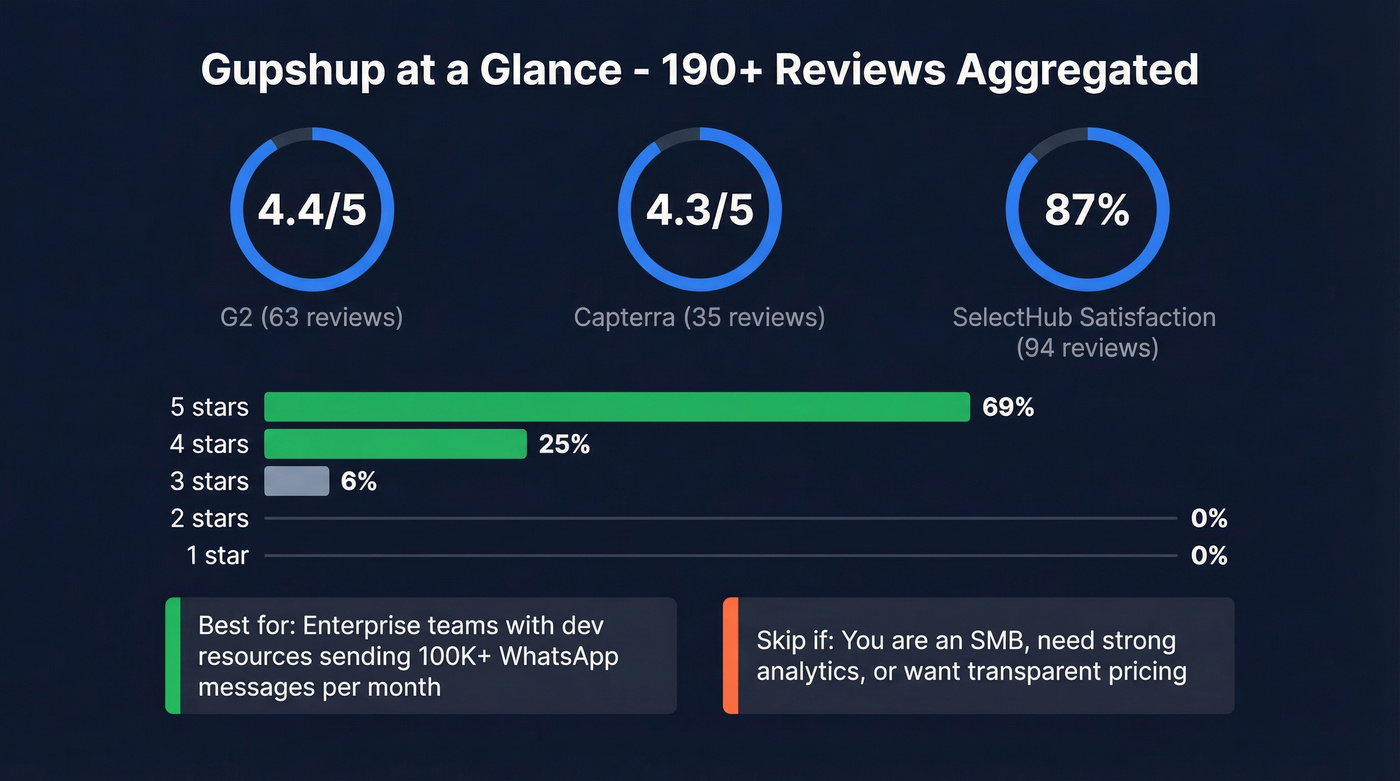
69% of G2 reviewers give 5 stars, 25% give 4 - zero 1- or 2-star reviews. Ease of use is the most-cited positive with 26+ mentions, while support delays and reporting gaps dominate complaints.
- Best for: Enterprise teams with dev resources sending 100K+ WhatsApp messages/month
- Skip if: You're an SMB, need strong analytics, or want transparent pricing
What Is Gupshup?
Gupshup is a conversational messaging platform that supports WhatsApp, SMS, RCS, and Instagram messaging at scale. The company raised $60M+ in mid-2025 from Globespan and EvolutionX, serves 50,000+ customers across 130+ countries, and processes 120B+ messages annually. Reddit threads comparing Gupshup to alternatives are surprisingly sparse - itself a signal of the platform's enterprise-heavy, developer-first user base that doesn't hang out on r/sales or r/startups asking for recommendations.
How Gupshup Pricing Actually Works
Here's the thing about Gupshup pricing: there aren't clear, buyer-friendly plan tiers. You'll see "starting from" numbers in software directories, but most real deployments come down to usage, markup, and negotiation.
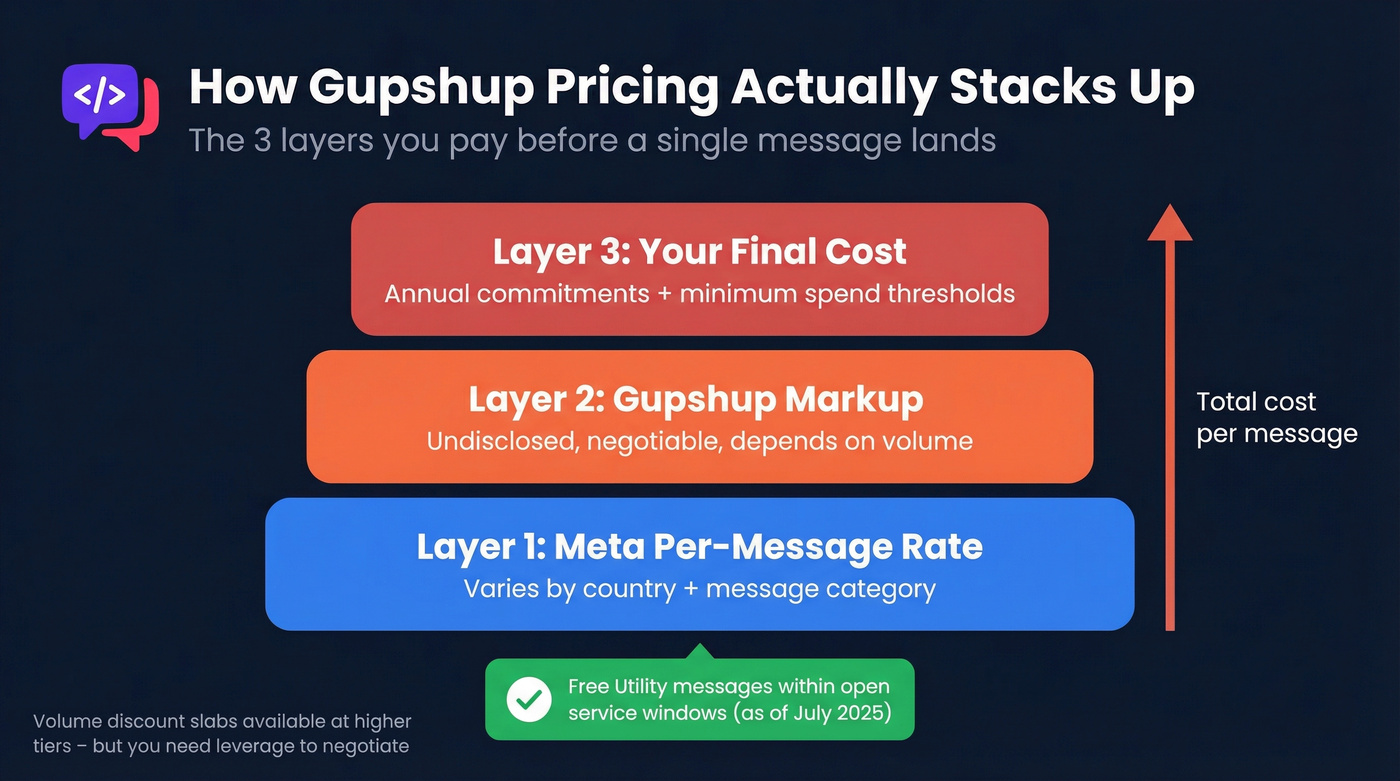
Gupshup operates as a WhatsApp BSP (Business Solution Provider). Your cost breaks down to Meta's per-message rate plus Gupshup's undisclosed markup on top, plus whatever volume discount slabs you negotiate. That three-layer pricing structure makes budgeting genuinely difficult.
Effective July 1, 2025, Meta shifted to per-message pricing (replacing the old per-conversation model) and introduced volume tiers for Utility and Authentication messages. Utility template messages sent in response to a user message within an open customer service window are now free.
SelectHub lists a freemium tier starting at $0, with per-message costs from $0.001. Real-world enterprise costs depend on message volume, category mix, and whatever markup you negotiate directly with Gupshup. Expect annual commitments and minimum spend thresholds.
| Cost Component | What You Pay |
|---|---|
| Meta per-message rate | Varies by country + category |
| Gupshup markup | Undisclosed, negotiable |
| Volume discounts | Tiered slabs at higher volumes |
| Free Utility messages | Within open service windows |
If your monthly WhatsApp volume is under 50K messages, you're paying Gupshup's markup without the leverage to negotiate it down. Wati or Interakt will cost you less and give you a number you can actually budget around.

Gupshup's opaque pricing makes every wasted message sting harder. Before you load contacts into any BSP, verify them. Prospeo's 125M+ verified mobile numbers and 98% email accuracy mean you only pay for messages that actually land.
Verify your contact list before you burn another message credit.
Pros Worth Knowing
Developer-friendly APIs. This is Gupshup's strongest card. Several Capterra reviewers praise easy integration, and G2 reviewers consistently rate the product highly for usability. If your team has backend developers who want to build custom messaging workflows, the API documentation and tooling are genuinely good - better than most competitors we've evaluated in this space.
True multi-channel reach. WhatsApp, SMS, RCS, and Instagram from a single platform. Most competitors force you to bolt on channels separately or maintain parallel integrations, which gets messy fast.
Fast enterprise implementation. G2 benchmarks time-to-implement at about one month. That's fast for enterprise messaging, where three-to-six-month rollouts aren't unusual.
Cons That Keep Coming Up
Support is painfully slow. One Capterra reviewer put it bluntly: "Queries are responded to in days and not hours... simple query will take at least a week." The billing team gets called out specifically. This isn't an outlier - it's a pattern across multiple review platforms.
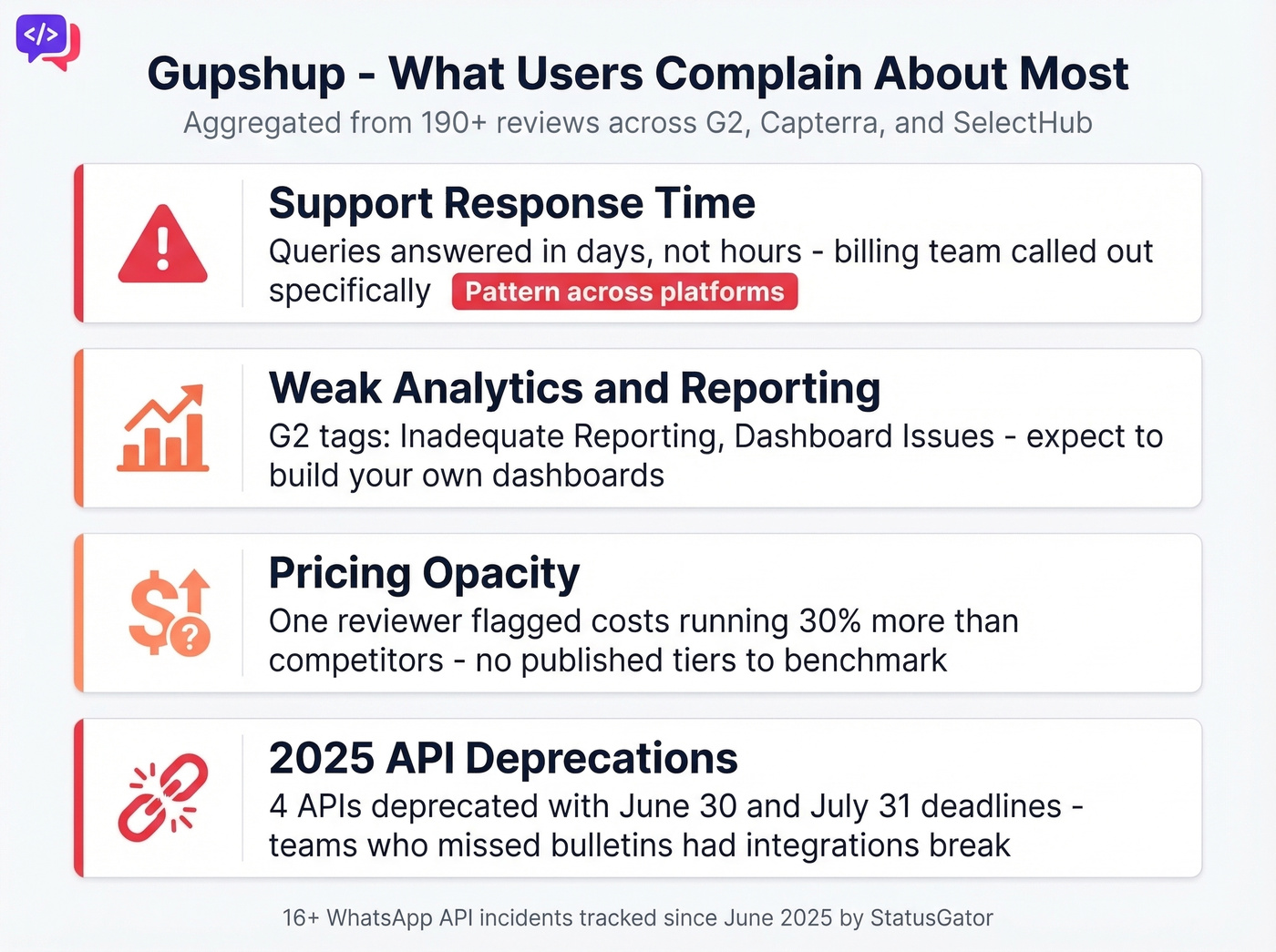
Analytics and reporting are weak. G2 tags include "Inadequate Reporting" and "Dashboard Issues." You'll end up building your own dashboards or piping data into a BI tool, which adds cost and complexity that shouldn't be necessary. If you're trying to build a more measurable funnel, tracking funnel metrics and tightening lead generation metrics can help you spot where messaging performance is actually leaking.
Pricing opacity breeds distrust. One Capterra reviewer flagged costs running "30% more costly than competitors." Without published tiers, you can't benchmark until after you've committed. That's frustrating - especially if you're trying to anchor in negotiation with a vendor that won’t publish rate cards.
2025 API deprecations forced migrations. Gupshup deprecated the Callback URL API, /sm endpoints, Template Matching Service, and Opt-in/Opt-out legacy APIs across 2025, with key June 30 and July 31 milestones. If you missed the bulletins, integrations broke. Teams that weren't monitoring Gupshup's changelog closely got burned.
Incident history warrants monitoring. StatusGator has tracked 16+ incidents on Gupshup's WhatsApp API since June 2025, with the last acknowledged outage on February 27, 2026.
Who Should Use Gupshup?
Use Gupshup if you're an enterprise team with dedicated developers, sending 100K+ WhatsApp messages monthly, and you have the leverage to negotiate favorable rates. The API quality and multi-channel orchestration genuinely shine at scale - especially for teams running enterprise B2B sales motions where reliability matters.
Skip Gupshup if you're an SMB, you need pricing you can model in a spreadsheet, or you rely on built-in analytics. G2's ROI benchmark sits at roughly 9 months - a long runway for smaller teams that need faster payback. If you’re still building your outbound engine, start with proven sales prospecting techniques and a tighter lead generation workflow before committing to enterprise-only tooling.
Top Alternatives
| Tool | Best For | Starting Price | G2 Rating |
|---|---|---|---|
| Wati | SMB WhatsApp automation | $49/mo (annual) | 4.6/5 (445) |
| Interakt | Budget India/South Asia | ~₹2,499/mo | Not listed |
| Twilio | Full developer control | ~$200+/mo typical | 4.1/5 (437) |
| FreshChat | Omnichannel support | ~$15-$29/agent/mo | 4.4/5 (462) |
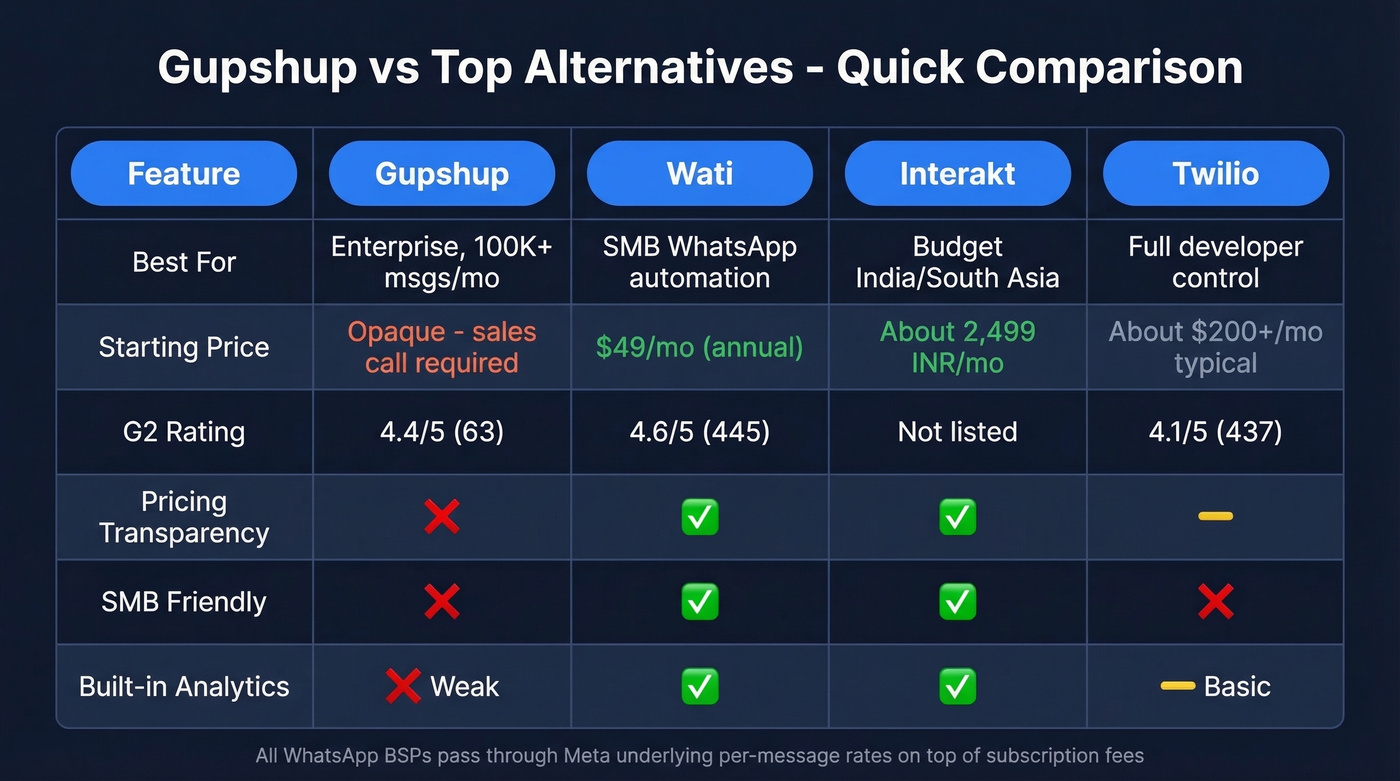
Every WhatsApp BSP passes through Meta's underlying rates. Wati adds roughly 15-20% markup on top of its subscription; Interakt runs closer to ~25%. Your total cost is always subscription plus per-message charges.
Let's be honest about something most BSP comparisons ignore: campaign ROI depends on contact data quality before you ever send a message. Bad phone numbers mean wasted message credits and tanked deliverability. We've seen teams at Prospeo's customers cut bounce rates from 35% to under 4% just by verifying contacts before loading them into their BSP. There's a free tier to test, and you can verify numbers in bulk before spending a single message credit. (If you’re also cleaning email lists, reducing your email bounce rate is usually the fastest win.)
Teams using Prospeo cut bounce rates from 35% to under 4% - that's thousands of message credits saved every month. At ~$0.01/email and 125M+ verified mobiles, cleaning your list costs a fraction of what bad data wastes on Gupshup markup.
Clean data in, better ROI out. No contracts, no sales calls.
FAQ
Does Gupshup have a free plan?
Gupshup offers a freemium tier at $0 with per-message costs starting from $0.001. There aren't published plan tiers for the core platform - enterprise pricing requires a sales conversation where you negotiate the per-message markup based on volume commitments.
How does Gupshup compare to Wati on price?
Gupshup is usage-based with no published tiers, while Wati starts at $49/mo with clear plan structures. Both mark up Meta's rates, but Wati's total cost is far easier to predict - making it the better choice for teams under 50K messages/month.
Is Gupshup good for small businesses?
No. Opaque pricing, slow support, and developer-heavy integration make it a poor SMB fit. Wati or Interakt offer transparent plans, faster onboarding, and support teams that respond in hours rather than days.
How can I improve WhatsApp campaign deliverability regardless of BSP?
Start with verified contact data. Invalid phone numbers waste message credits and hurt sender reputation across any BSP. Bulk-verifying mobile numbers before uploading to Gupshup, Wati, or any platform saves credits and protects your sender score from day one.