

How to Build a Handling Objections PPT That Actually Trains Your Team
Your manager just asked you to build an objection handling deck for next week's offsite. You went looking for templates and found a bunch of marketplaces selling slide packs full of clip art and vague platitudes. We've built dozens of these decks, and the problem with every handling objections PPT out there is always the same: they don't teach anything. They list objections without context, skip the data, and leave reps with zero muscle memory.
Here's a blueprint that actually works.
What Your Deck Needs
Keep it to 15-25 slides covering four modules: mindset, frameworks, scripts, and practice. Twenty is the sweet spot for a team session. Teach two frameworks - LAER and Feel-Felt-Found - and resist the urge to overcomplicate things. Back up every claim with data, not motivational quotes. A 67,149-meeting study from Gong is your credibility backbone.
The 20-Slide Blueprint
Each module builds on the last, moving from mindset to frameworks to scripts to practice. Whether you're creating an objection handling presentation for new hires or seasoned closers, this structure scales.
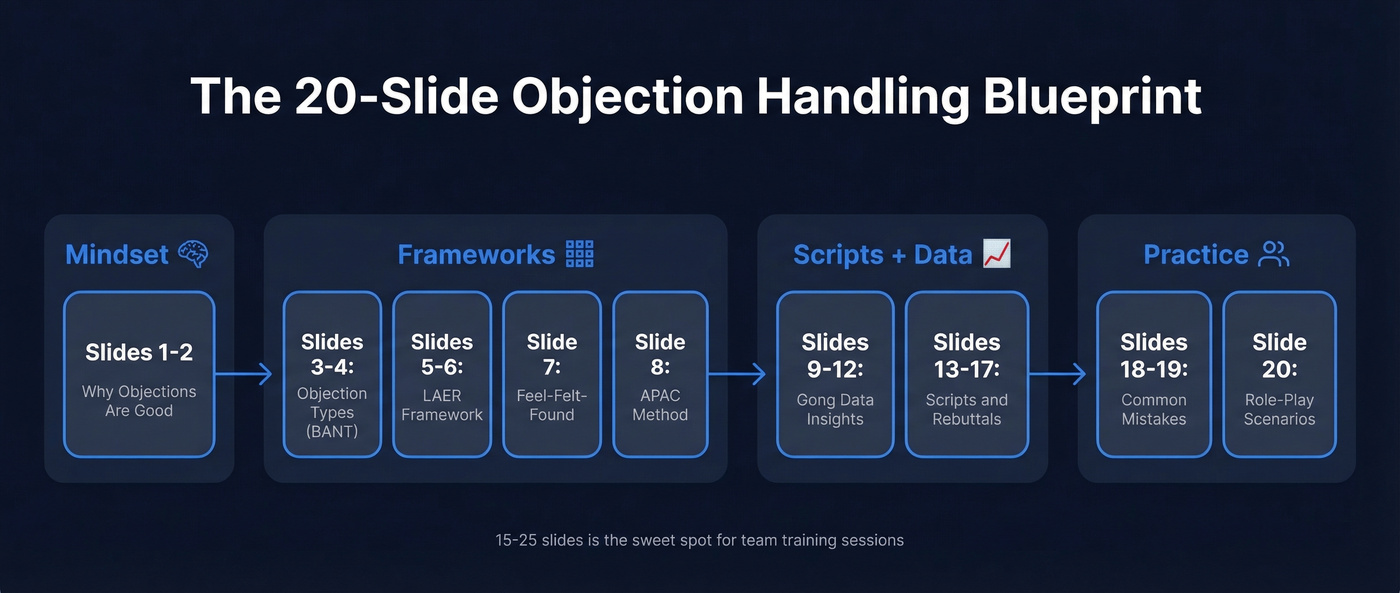
Slides 1-2: Why Objections Are Good
Open with a mindset reset. Objections feel like a punch to the gut - until you realize they mean the prospect is still engaged. Sandler's prevention philosophy nails this: don't just analyze the crash, go back to where the skidding started.
Teach reps the difference between an objection - a real reason they won't buy - and an obstruction, which is just an excuse to get off the phone. And remember: 96% of prospects research companies and products before engaging with a sales rep. Their objections are informed, not impulsive. Slide 1 frames this distinction; Slide 2 gives examples of each.
Slides 3-4: Objection Types
Use the BANT taxonomy so reps have a mental filing system instead of panic.
| Type | What It Sounds Like |
|---|---|
| Budget | "It's too expensive" |
| Authority | "I need to check with my boss" |
| Need | "We're happy with what we have" |
| Timing | "Call me next quarter" |
Slide 3 is the taxonomy. Slide 4 maps 2-3 real objections to each bucket so reps can practice categorizing on the fly.
Slides 5-8: Core Frameworks
If you only teach one framework, teach LAER. It's conversational, question-led, and doesn't feel pushy - exactly what reps on r/salestechniques praise about it. In our experience, reps who drill LAER for two weeks internalize it permanently.
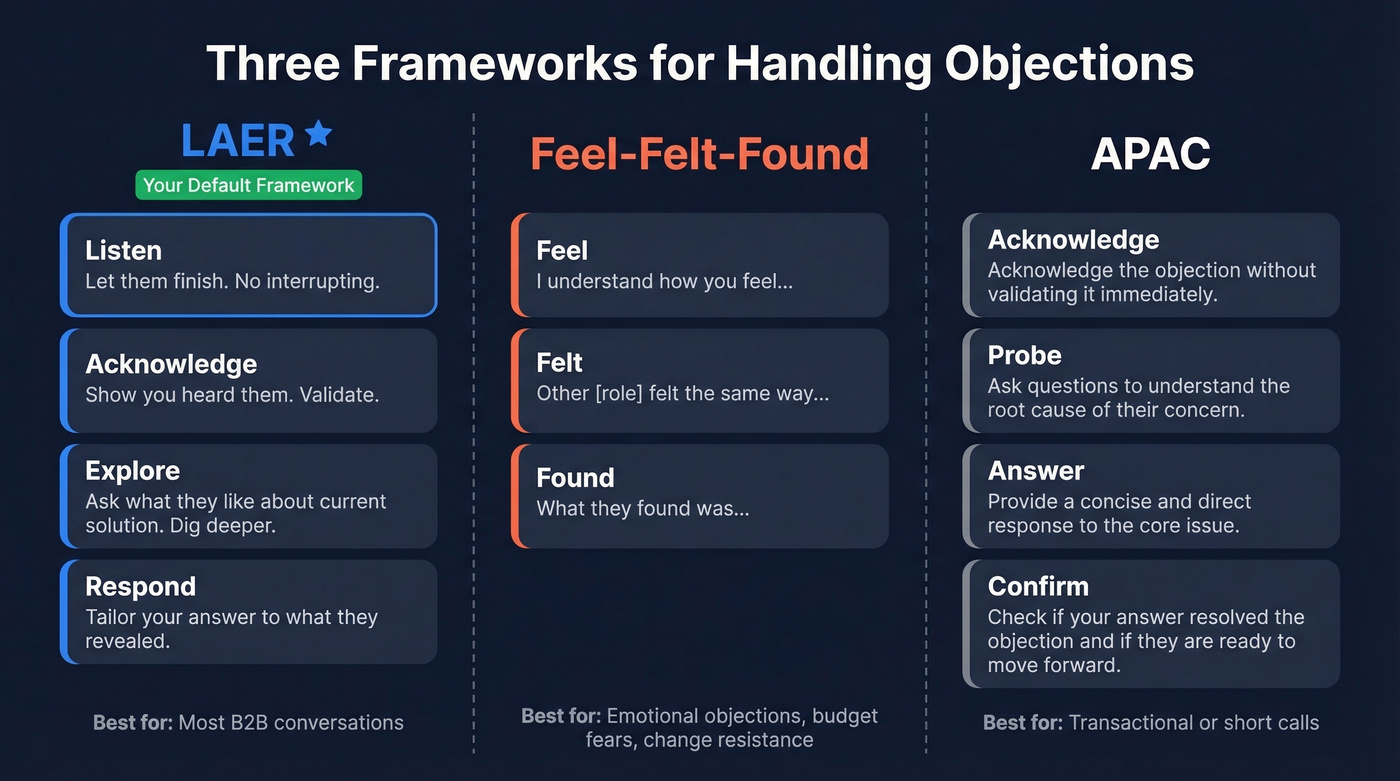
LAER (Slides 5-6): Listen, Acknowledge, Explore, Respond. The magic is in Explore: "What do you like most about your current solution? What could be improved?" Tailor your response to what they reveal. (For deeper discovery prompts, see our Discovery Questions guide.)
Feel-Felt-Found (Slide 7): Best for emotionally charged objections like budget concerns or change resistance. "I understand how you feel. Other [role] felt the same way. What they found was..." Simple, empathetic, effective.
APAC (Slide 8): Acknowledge, Probe, Answer, Confirm. A tighter loop for transactional calls. Include it as a reference slide, but LAER should be the default.
Slides 9-12: Data-Backed Insights
This is where your deck separates itself from every template on SlideTeam. Gong analyzed 67,149 sales meetings and found patterns that should shape every rep's behavior. If you want to go further, build a culture of data-driven selling so reps trust the numbers, not vibes.
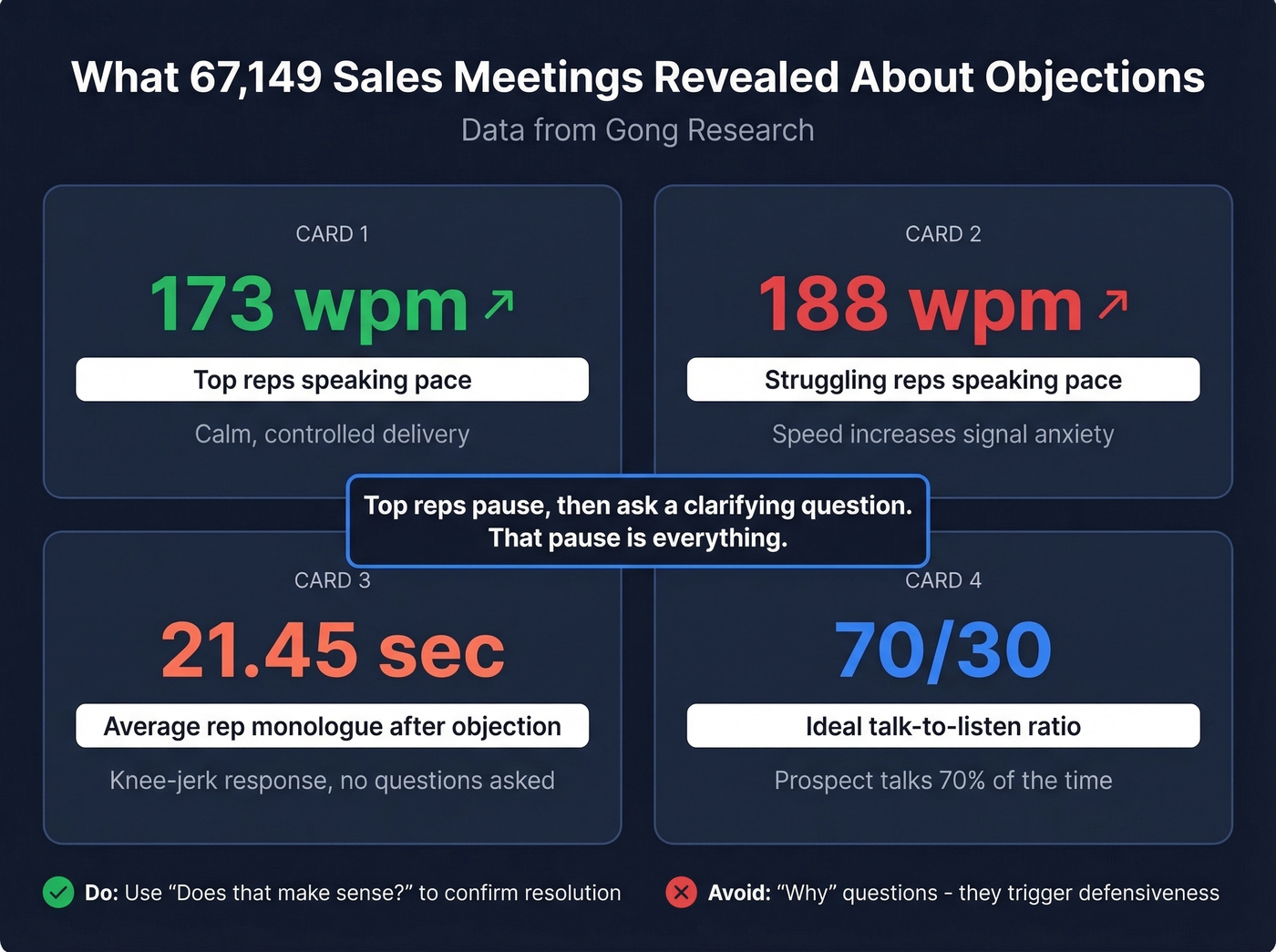
Top reps talk at 173 words per minute. Struggling reps speed up to 188 wpm when objections hit - a tell that screams anxiety. Average reps respond with a knee-jerk monologue lasting 21.45 seconds, while top reps pause, then ask a clarifying question. That pause is everything.
Put the 70/30 rule on its own slide: the prospect should talk 70% of the time. Reps who dominate the conversation after an objection lose deals. Skip "why" questions since they trigger defensiveness, and use "Does that make sense?" as a loop-closer to confirm resolution. (More on this in our Sales Communication breakdown.)
Slides 13-17: Scripts and Rebuttals
Frameworks are useless without words reps can actually say. Dedicate five slides to scripts organized by situation. If your team needs more ready-to-use talk tracks, pull a few from our Talk Track Examples library.
| Objection | Type | Response |
|---|---|---|
| "Not interested" | Cold call | "30 seconds - here's why I reached out..." |
| "Send me an email" | Cold call | Reframe: email vs. quick chat |
| "I don't have time" | Cold call | Morgan Ingram's 30-second value prop + permission to hang up |
| "It's too expensive" | Pricing | "What outcomes would make this feel worthwhile?" |
| "Competitor is cheaper" | Pricing | Ask what's included - reframe to total value |
| "Call me next quarter" | Timing | "Totally fair. What changes between now and then?" |
One slide should cover the "making the skeleton dance" technique: proactively own a perceived flaw before the prospect raises it. Pre-emption disarms objections before they calcify. We've seen reps cut pricing objections in half just by addressing cost upfront in their pitch. (If you want a full system, see our guide on how to reduce sales objection rate.)
Slides 18-19: What NOT to Do
Five mistakes from HubSpot's expert roundup that belong on a single, clean slide:
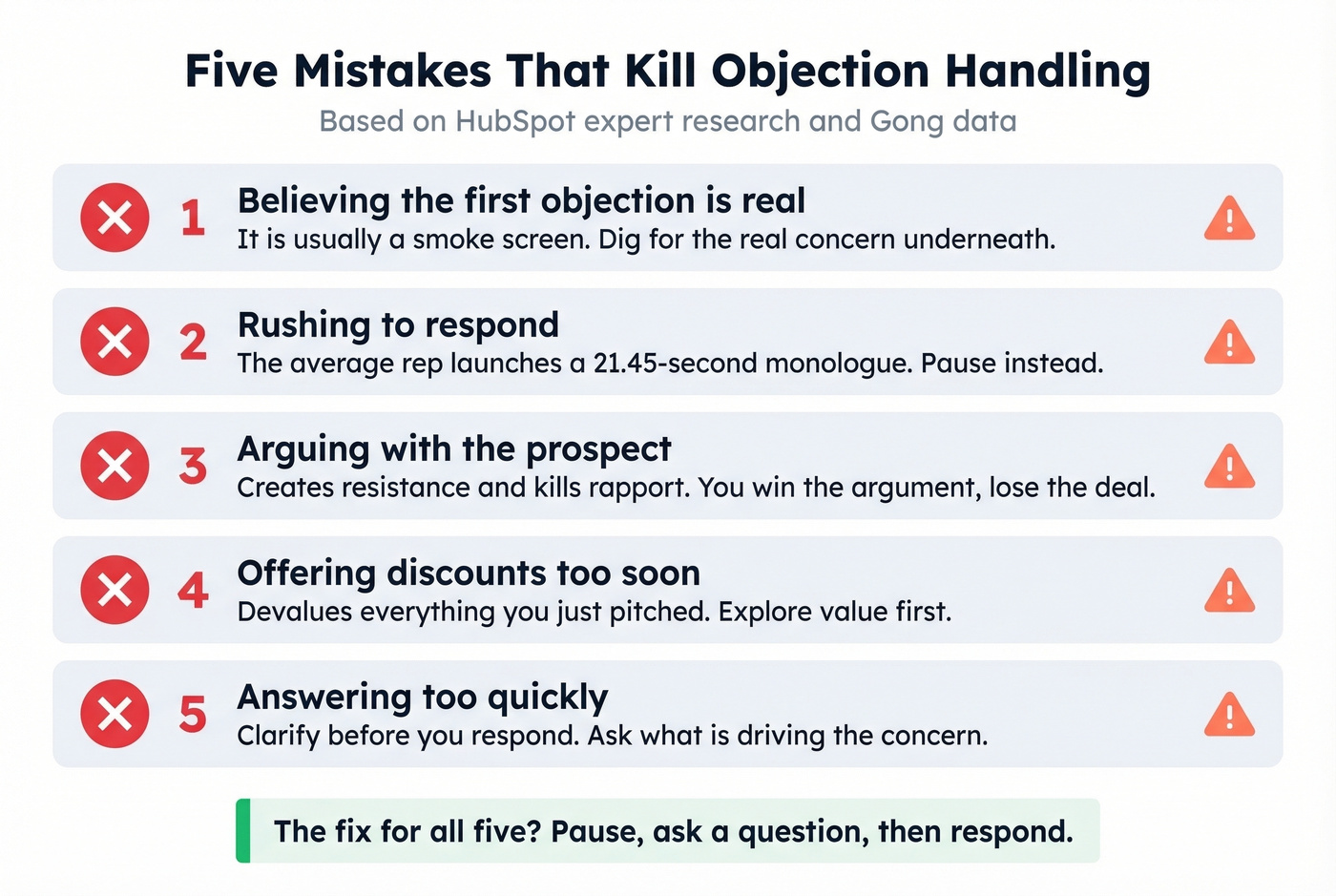
- Believing the first objection is real - it's usually a smoke screen
- Rushing to respond without understanding root cause
- Arguing, which creates resistance and kills rapport
- Offering discounts too soon, devaluing everything you just pitched
- Answering too quickly instead of pausing and clarifying
That 21.45-second monologue from the Gong data? That's the "rushing to respond" mistake in action.
Slide 20: Role-Play Scenarios
End with 2-3 scenario cards: a cold call opener, a mid-demo pricing objection, and a closing-stage authority stall. Pair reps up, rotate roles, debrief after each round.
Here's the thing: a slide deck isn't training. It's a prop for training. The role-play is where muscle memory gets built. Skip this slide and you've wasted the other 19.

You're training reps to handle every objection in the BANT taxonomy. But the best LAER framework in the world can't save a call to a dead number. Prospeo gives your team 300M+ profiles with 98% verified emails and 125M+ direct dials - so every rep who drills your deck has real buyers to practice on.
Stop wasting trained reps on bad data. Start at $0.01 per email.
Making Your Slides Land
A 20-slide wall of text won't hold attention. Steal from Flipsnack's approach and embed short video clips of real call recordings. Add quiz slides after each module. Drop a poll before the data section - "How fast do you think you talk during objections?" - to create engagement before revealing the stats. One team we worked with saw session engagement jump 40% just by adding two poll slides. If you're building a broader enablement program, this pairs well with our Sales Training Tips playbook.
Your Deck Is Ready - Is Your Data?
You've built a handling objections PPT that teaches reps what to say, when to pause, and how to handle every objection in the BANT taxonomy. Now comes the part most enablement teams forget: reps need someone to actually call.
Let's be honest - the biggest ROI killer on trained sales teams isn't bad technique. It's bad contact data. A rep who nails the LAER framework on a dead number still books zero meetings. Tools like Prospeo close that gap with 98% email accuracy and 125M+ verified mobile numbers refreshed every 7 days, so your newly trained reps are saying the right things to people who actually pick up. (If you're evaluating options, start with our Best Sales Prospecting Databases roundup.)
Your handling objections PPT teaches reps to pause, explore, and respond. Now make sure they're reaching decision-makers, not gatekeepers. Prospeo's 30+ filters - including buyer intent, job changes, and technographics - put the right prospects in front of reps who are finally ready to close.
Give your newly trained team a pipeline worth calling.
How many slides should an objection handling PPT have?
Aim for 15-25 slides for a standard team training session. Full-day workshops can stretch to 30-40. The blueprint above uses 20 - enough depth to cover mindset, frameworks, scripts, and practice without losing attention.
What's the best framework to teach in an objection handling presentation?
LAER works for most B2B teams because it's conversational, question-led, and doesn't feel scripted. Add Feel-Felt-Found for empathy-heavy situations like budget concerns or change resistance. Don't stack more than two frameworks - reps freeze when given too many options mid-call.
How do I make sure reps practice what the deck teaches?
End every session with role-play scenarios using real prospect data. Pair reps, rotate roles, and debrief each round. Pull verified contacts so reps practice on realistic call lists with working phone numbers - not fake names from a spreadsheet.