

Head of Sales: Role, Salary & 90-Day Playbook for 2026
The average sales VP lasts 18 months. Not because the role is impossible, but because most people who take it skip the diagnostic phase and start "fixing" things in week two. By month six, they've alienated the team, missed a quarter, and the board is already interviewing their replacement.
On r/sales, a recurring question is whether the head of sales jump is even "worth the squeeze" - more responsibility, more politics, and sometimes a marginal net pay bump over a high-performing IC. The answer depends entirely on whether you treat the first 90 days as a listening tour or a renovation project.
What You Need (Quick Version)
The role: A hands-on sales leader who sells, hires, and builds the playbook - especially at early-stage companies where there's no existing motion to inherit.
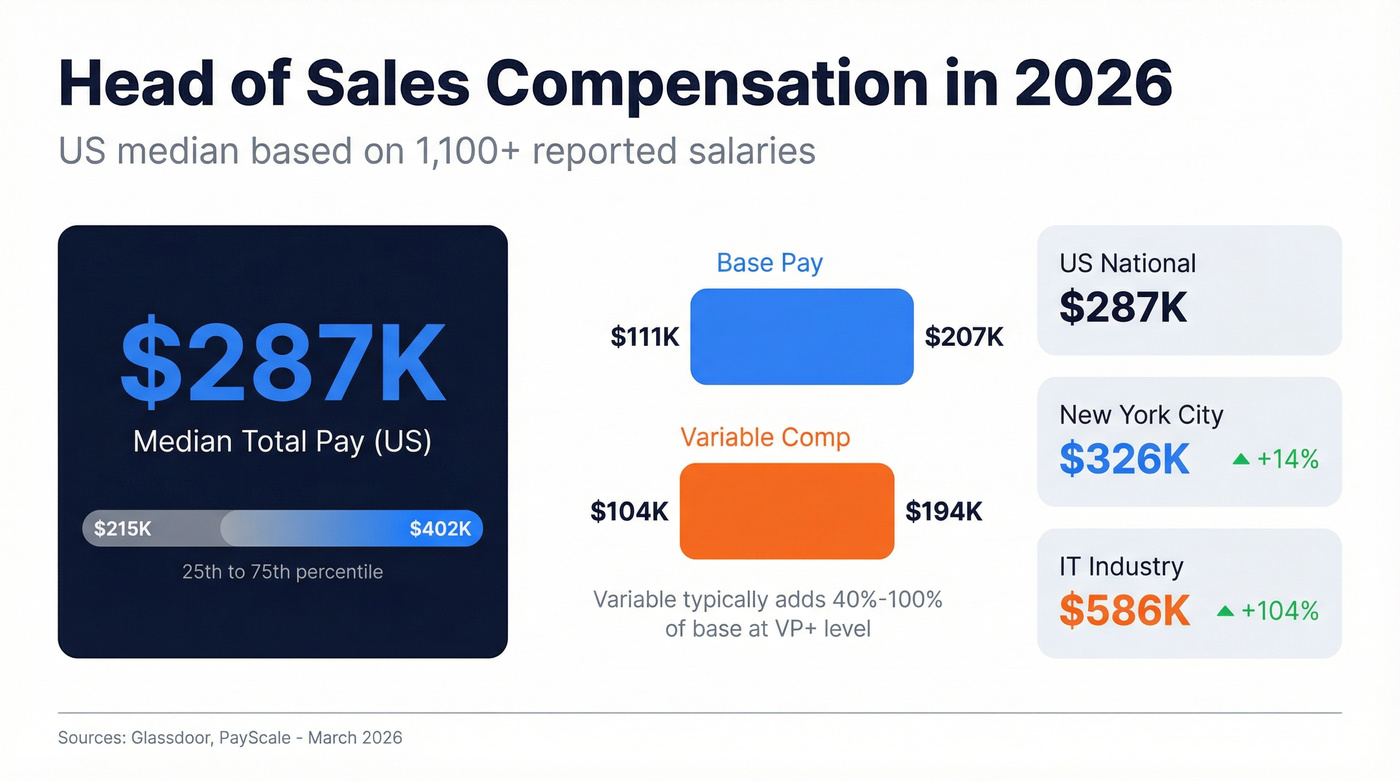
The money: Median total comp is $287K/year in the US, based on 1.1K salaries reported to Glassdoor. In New York City, that jumps to $326K.
Why most fail: That 18-month shelf life isn't a myth. Many failures trace back to the first 90 days - leaders who skip diagnosis, hire too fast, or ignore the data quality problems rotting their pipeline from the inside.
What Does This Role Actually Look Like?
Every job description for this role lists "strong communication skills" and "proven track record." That tells you nothing. Here's what the job actually looks like on a Tuesday morning: you're in a pipeline review at 9am, coaching an AE through a stuck deal at 10, and on a call with marketing about content gaps by 11. By lunch, you've context-switched six times and haven't touched your own pipeline yet.
A head of sales owns the revenue number. Not in the abstract, board-deck sense - in the "you personally close the deal when the AE can't get it across the line" sense. At a Seed or Series A company, you're likely carrying your own quota alongside managing the team. At a Series B, you might have enough reps to step back from individual deals, but you're still deep in pipeline reviews and coaching sessions.
The old-school version of this role was a quota enforcer with a whiteboard and a temper. The modern version is a cross-functional operator who happens to own the revenue number. The core responsibilities break down into five outcome areas:
- Own the number. You're accountable for hitting the quarterly and annual revenue target. Period.
- Build and coach the team. Hire reps, onboard them, run 1:1s, and develop a coaching cadence that actually moves skill levels - not just checks a box.
- Refine the playbook. Messaging, pricing, objection handling, competitive positioning. If it touches how deals get won, you own it.
- Sell directly. Especially early-stage. If you're not in deals, you're not learning what's working and what's broken.
- Align cross-functionally. Marketing needs to know what content actually helps close deals. Product needs to hear what features prospects keep asking for. CS needs a clean handoff. You're the connective tissue.
The tension that makes this role unique is the split between doing and leading. A VP of Sales at a 200-person company spends 80% of their time on strategy and org design. A sales leader at a 30-person startup spends 80% selling, hiring, and iterating. If you want to sit in dashboards all day, this isn't your role.
Head of Sales vs VP of Sales, Director, and CRO
Title inflation at startups makes this confusing. We've seen Series A companies hand out "VP of Sales" titles to someone managing three reps and carrying a personal quota - that's a head of sales by any reasonable definition. Understanding the distinction matters because hiring the wrong level of leader for your stage is one of the most expensive mistakes a founder can make.
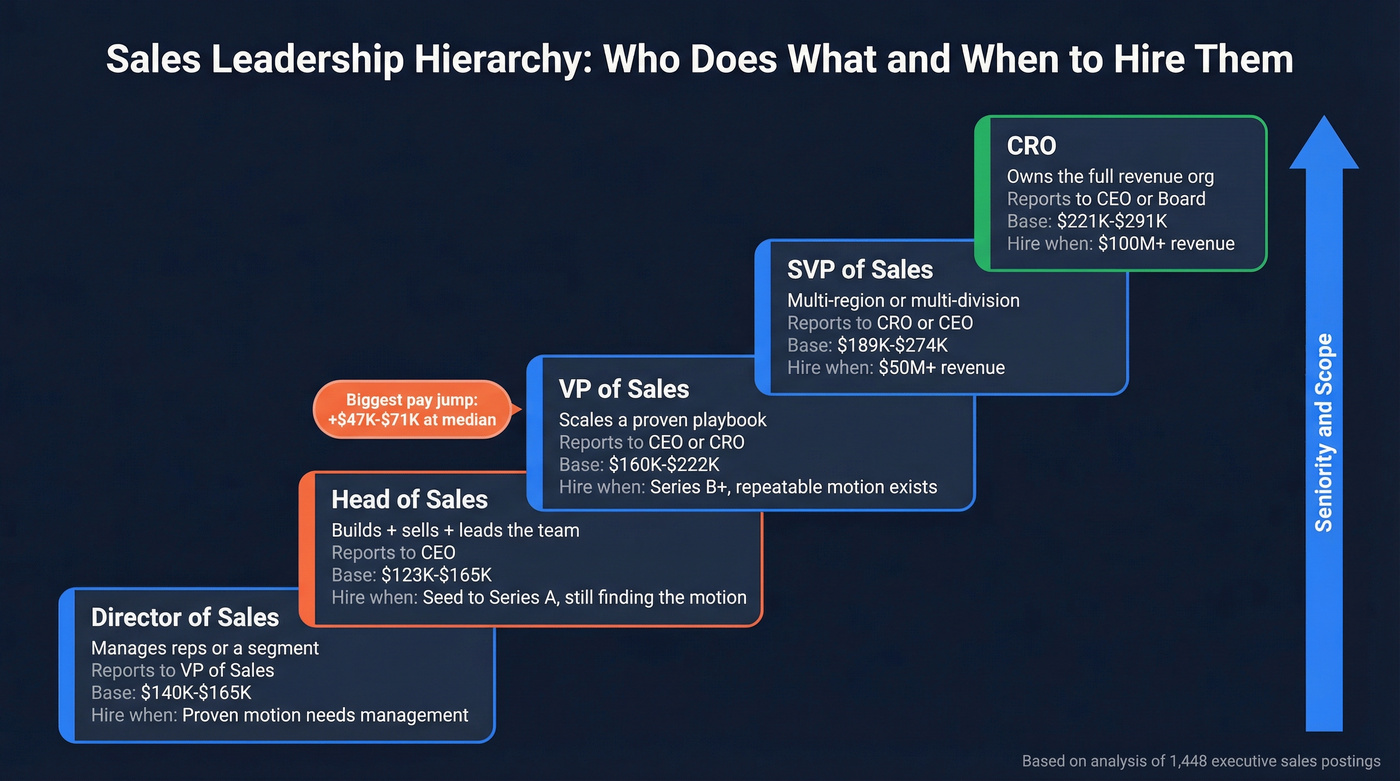
An analysis of 1,448 executive sales postings with 742 disclosed salaries lays out the hierarchy:
| Title | Typical Scope | Reports To | Median Base | When to Hire |
|---|---|---|---|---|
| Director of Sales | Manages reps/segment | VP of Sales | $140K-$165K | Proven motion, needs mgmt |
| Head of Sales | Builds + sells + leads | CEO | ~$123K-$165K | Seed-Series A |
| VP of Sales | Scales proven motion | CEO / CRO | $160K-$222K | Series B+ |
| SVP of Sales | Multi-region/division | CRO / CEO | $189K-$274K | $50M+ revenue |
| CRO | Full revenue org | CEO / Board | $221K-$291K | $100M+ revenue |
The biggest compensation jump is Director to VP - a $47K-$71K leap at the median. That's where the money inflects, and it's also where the job fundamentally changes from managing reps to managing managers.
Here's the stage-based heuristic that actually works: if you're pre-$5M ARR and still figuring out your sales motion, hire a head of sales. They'll sell alongside the team, iterate on messaging, and build the playbook from scratch. Past $5M ARR with a repeatable motion that needs to scale? Hire a VP. Hiring a VP too early is almost always a mistake - they expect existing infrastructure and a proven playbook, and they're less willing to grind through the messy early-stage work.
At mid-market companies ($50M-$500M revenue), titles start to mean what they say. Directors manage reps or segments. VPs manage Directors and own the full sales number. At enterprise scale ($500M+), you'll see layers upon layers - Director, Senior Director, VP, SVP, EVP, CRO - and a Director can manage enormous scope while still being three levels from the C-suite.
Salary Benchmarks in 2026
Glassdoor puts the median total pay at $287K/year in the US based on 1.1K salaries. The 25th-to-75th percentile range runs $215K-$402K, which tells you how much company stage, industry, and geography swing the number. Base pay ranges from $111K-$207K, with additional comp adding $104K-$194K on top.
PayScale reports a more modest average base of $123K, with bonuses ranging $10K-$101K and commissions from $30K-$100K. The smaller sample (77 profiles) skews toward earlier-stage companies where base salaries are lower but equity packages are larger.
Geography matters. In New York City, the median total pay jumps to $326K. The Information Technology industry is an outlier at $585,672 median total pay - Google shows a total pay range of $494K-$909K, which is a different planet from most sales orgs.
The base-to-variable split is where negotiations get interesting. At the VP+ level, variable comp typically adds 40%-100% of base. A common structure: $200K base + 50% variable = $300K OTE. A more aggressive plan: $260K base + 75% variable = $450K+ OTE. The higher the variable percentage, the more the company is betting on your ability to hit targets - and the more you're betting on their product-market fit.
For early-stage roles (Seed-Series A), expect a lower base ($120K-$160K) offset by meaningful equity, typically 0.5%-1.5% depending on the stage and your negotiating leverage. At Series B and beyond, equity grants shrink but base and variable both climb.

Most heads of sales fail because their pipeline is rotting from bad data - not bad strategy. Prospeo gives you 300M+ profiles with 98% email accuracy and 125M+ verified mobiles, refreshed every 7 days. Build a pipeline you can actually trust in your first 90 days.
Fix the data before you fix the team. Start free today.
Your First 90 Days
A widely cited HBR onboarding stat is that strong onboarding can reduce time-to-full-performance from six months to four. When your average shelf life is 18 months, shaving two months off ramp time isn't a nice-to-have. It's survival. In our experience, the leaders who survive past 18 months are the ones who spent their first 30 days listening, not changing.
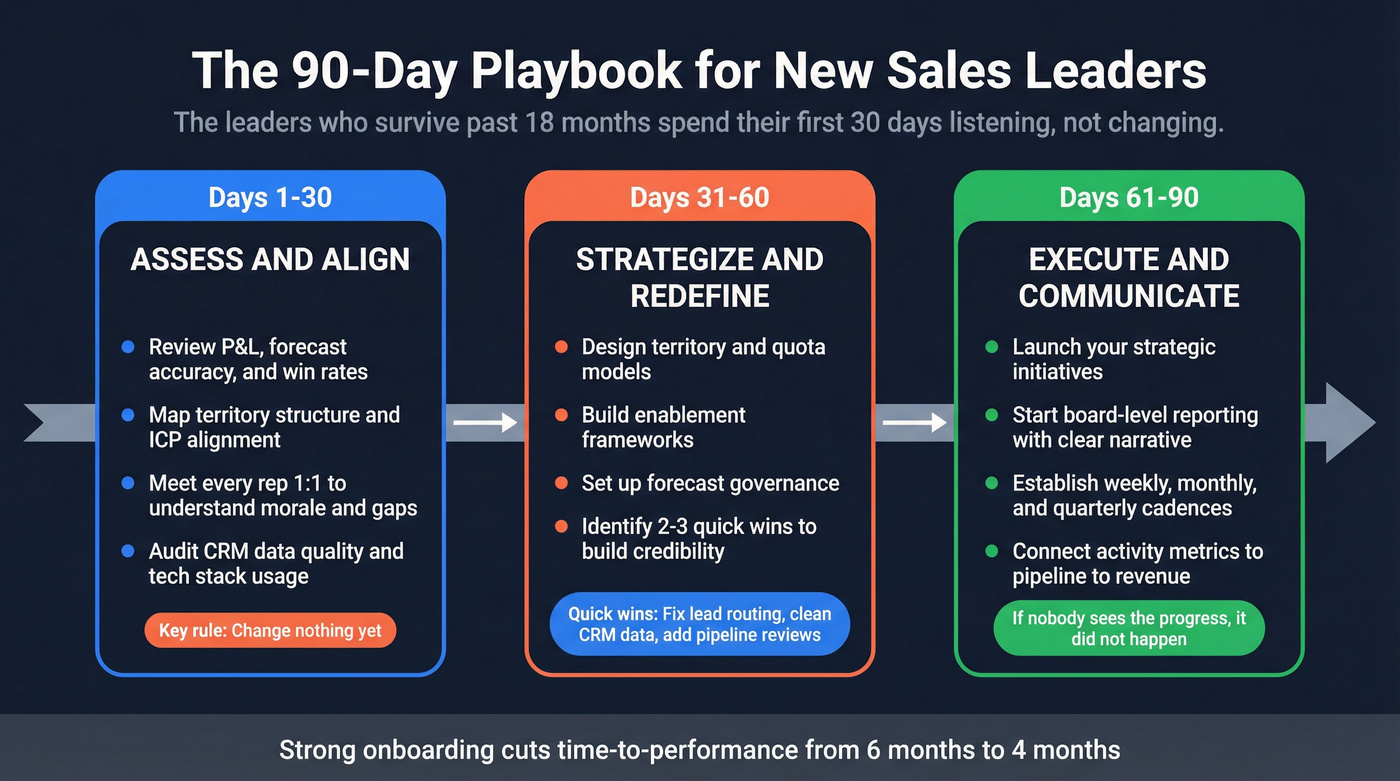
Days 1-30: Assess and Align
Your only job in the first 30 days is to understand the current state. Resist the urge to change anything. Run a diagnostic across four dimensions:
- Financial and metrics: Review the P&L, budget, forecast accuracy, pipeline coverage, and win rates. Where are the gaps between what's reported and what's real?
- Strategy and structure: How are territories divided? What's the ICP? Is the team organized by segment, geography, or function? Does the structure match the go-to-market motion?
- Enablement and people: Meet every rep 1:1. Understand their strengths, gaps, and morale. Review onboarding materials, training cadences, and coaching frequency.
- Processes and tools: Audit the CRM data quality, the tech stack utilization, and the handoff processes between marketing, sales, and CS.
Align with your CEO on expectations during this phase. Get explicit agreement on what success looks like at 90 days, 6 months, and 12 months. If those expectations are misaligned, you'll know it now - not when you miss a quarter.
The reps who've been there longer than you know where the bodies are buried. Ask them.
Days 31-60: Strategize and Redefine
Now you've got the diagnosis. Build the treatment plan. Design territory and quota models, establish enablement frameworks, and set up forecast governance. Identify two or three quick wins - things you can fix in weeks, not months - that build credibility with the team and the board.
Common quick wins include fixing a broken lead routing process, implementing a consistent pipeline review cadence, or cleaning up the CRM data that's making forecasts unreliable. The goal isn't transformation yet. It's demonstrating competence and building trust.
Days 61-90: Execute and Communicate
Launch your initiatives. Begin board-level reporting with a clear narrative connecting activity metrics to pipeline to revenue. Establish the operating cadence you'll run going forward: weekly pipeline reviews, monthly KPI reviews, and quarterly business reviews.
The communication piece is non-negotiable. Your board, your CEO, and your team all need to understand what you're doing and why. A sales leader who executes brilliantly but communicates poorly will still get fired - because nobody saw the progress happening.
The KPIs That Matter
Roughly 70% of B2B reps miss quota. The bar for "good" is lower than you'd think - but the bar for "great" is what separates leaders who last from those who don't.
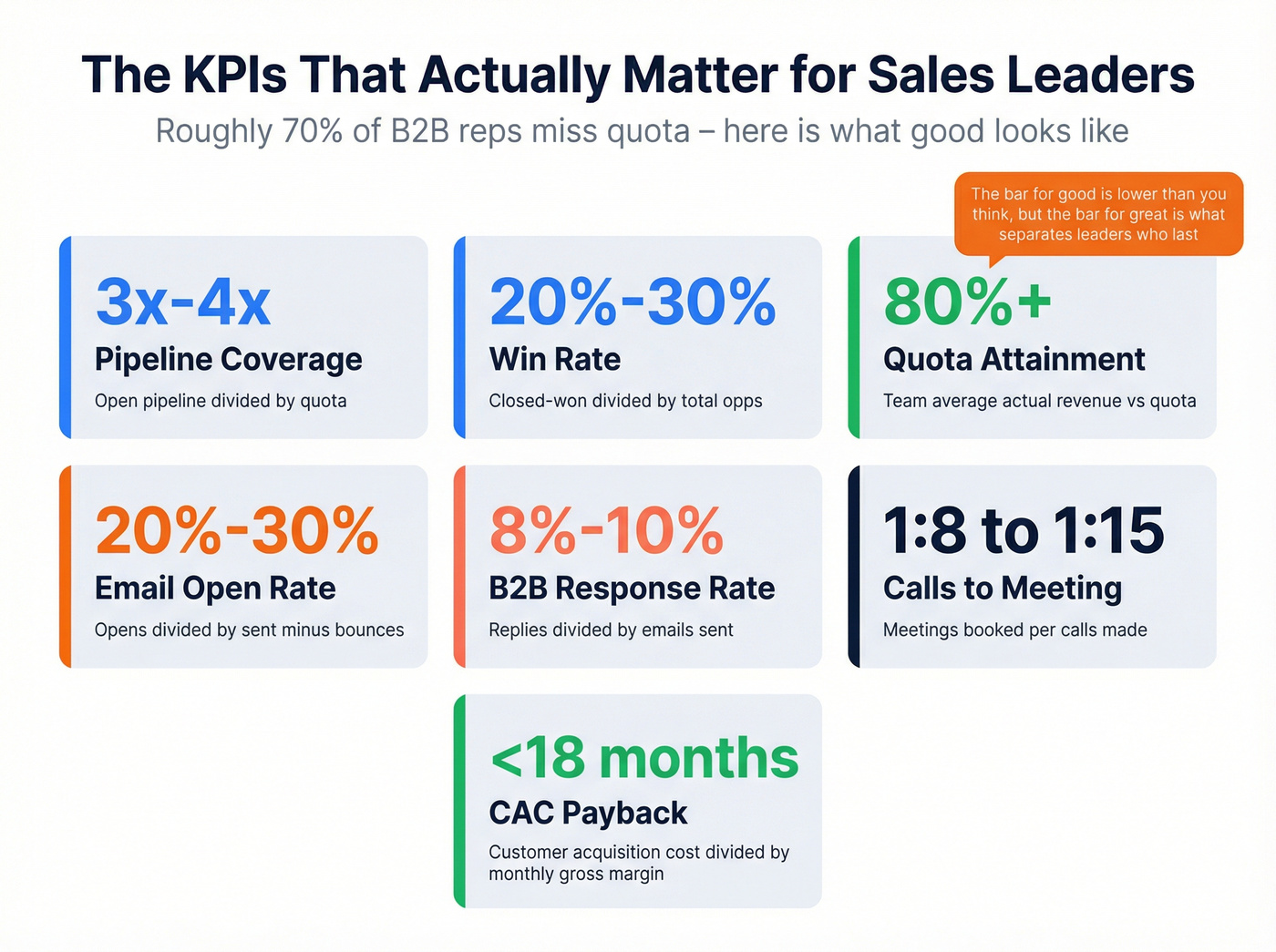
| Metric | Formula | Benchmark |
|---|---|---|
| Pipeline coverage | Open pipeline / quota | 3x-4x |
| Win rate | Closed-won / total opps | 20%-30% (B2B) |
| Quota attainment | Actual revenue / quota | 80%+ team avg |
| Email open rate | Opens / (sent - bounces) | 20%-30% |
| B2B response rate | Replies / emails sent | 8%-10% |
| Calls-to-meeting | Meetings / calls made | 1:8 to 1:15 |
| CAC payback | CAC / monthly gross margin | <18 months |
| Net revenue retention | (Start + expansion - churn) / start | >100% |
Pipeline coverage is the one metric that predicts everything else. If you're running below 3x coverage, you don't have a closing problem - you have a pipeline generation problem. Fix that first.
The activity metrics - open rate, response rate, calls-to-meeting - are leading indicators. They tell you whether your team's outbound motion is working before the revenue numbers confirm it. If your email open rates are below 20%, your subject lines or targeting are off (use these email subject lines to pressure-test). If response rates are below 8%, your messaging needs work. For phone-heavy inside sales teams, track call response rates and real-time activity volume alongside these email metrics - the same diagnostic logic applies.
CAC payback and NRR connect your sales org to the broader business model. A board that sees improving NRR alongside growing pipeline knows the sales motion is sustainable, not just growing.
Five Mistakes That Kill New Sales Leaders
Mistake 1: Sales Takeover Syndrome
You jump into a rep's deal, take over the call, and close it yourself. Feels productive. It's actually poison. You've just taught that rep to wait for you to rescue them, and this creates learned helplessness across the entire team. Coach before, debrief after, but let the rep run the call.
Mistake 2: Spending All Your Time on C-Players
Here's the coaching time allocation that actually moves the needle: 60% on B-players, 25% on A-players, 15% on C-players. Most new leaders invert this - they pour hours into their worst performers hoping for a turnaround, while their B-players stagnate and their A-players start interviewing elsewhere. B-players are the highest-ROI coaching investment because they can become A-players. C-players get a clear plan, a timeline, and then you make the call.
Mistake 3: The "I Did It, So Can You" Trap
How many calls did you make a day when you were a top rep? 80? 100? Now ask yourself: did anyone hand you a documented process, or did you figure it out through sheer force of will? Most new sales leaders assume their team will grind the way they did. They won't - not without explicit standards, documented processes, and consistent measurement. The fix isn't motivation speeches. It's writing down what "good" looks like and holding people to it.
Mistake 4: Poor Hiring Decisions
The candidate who aces the case study can crumble under real quota pressure. Assessments and structured interviews are necessary but insufficient. Check references aggressively - not the ones the candidate provides, but the ones you find yourself. Ask about deal sizes, ramp time, and how they handled a missed quarter. And hire for the stage you're at, not the stage you hope to reach. A rep who thrived at a 500-person company with full enablement support will struggle at your 20-person startup where they need to write their own sequences and source their own leads.
Mistake 5: Ignoring Data Quality
A bounce rate above 5% isn't a tools problem. It's a leadership failure.
Your reps are wasting outreach on dead contacts, tanking domain reputation, and burning hours they could spend selling. We've audited teams running 35-40% bounce rates who had no idea - because nobody was looking. Audit your team's bounce rate in week one (see email bounce rate benchmarks and fixes). Use 5% as a red line: if you're above it, fix your list-building and switch your data source. Tools like Prospeo verify emails in real-time on a 7-day refresh cycle, which means your reps stop wasting outreach on invalid addresses and start reaching actual humans.
The Sales Leader's Tech Stack
You don't need 15 tools. You need three categories locked in before anything else, and you need to make these decisions yourself - don't delegate them to an ops person who hasn't carried a quota.
Non-negotiable #1: CRM. Salesforce ($25-$500/user/month depending on edition) or HubSpot (free to ~$150/user/month). If you're early-stage, HubSpot's free tier gets you started. If you're scaling past 20 reps or need complex reporting, Salesforce is the standard. This isn't a debate worth having for long - pick one and move. (If you need a quick shortlist, start with these examples of a CRM.)
Non-negotiable #2: Sales engagement. Outreach or Salesloft, both running ~$100-$150/user/month. These platforms manage your sequences, track engagement, and give you visibility into rep activity. Without one, you're flying blind on outbound execution. If you're building this from scratch, use an SDR tools comparison to sanity-check the stack.
Non-negotiable #3: Verified data. Your reps' outbound results are capped by data quality. Prospeo provides 300M+ professional profiles with 98% email accuracy and a 7-day refresh cycle - meaning your team works off current data, not stale lists. At ~$0.01 per email with no contracts, it pays for itself in the first week. Snyk's 50-person AE team switched and saw AE-sourced pipeline jump 180%, with bounce rates dropping to under 5% and 200+ new opportunities generated per month.

Nice-to-have: Conversation intelligence. Gong or similar tools (~$100-$150/user/month) give you call recordings and AI-powered analysis. Incredibly useful for coaching, but not essential until you have 5+ reps generating enough call volume to justify the spend.
Let's be honest: if your average deal size is under $15K, you probably don't need a $150/user/month conversation intelligence tool. Spend that budget on better data and more at-bats instead. The ROI math doesn't work until deal sizes justify the investment in call analysis.
You're coaching AEs through stuck deals and running pipeline reviews by 9am. The last thing you need is a 35% bounce rate destroying your domain. Prospeo's 5-step verification keeps bounces under 4% - at $0.01 per email, not $1.
Stop losing quarters to bad contact data. Your reps deserve better.
Hiring (or Becoming) One
SaaStr's prerequisite is worth repeating: hire one or two reps and get them hitting quota before you bring on a sales leader. The job is to refine and scale a motion that's showing early signs of working - not to figure out product-market fit from scratch.
When you're interviewing candidates (or preparing for an interview yourself), these questions separate the real operators from the polished interviewers:
- "How big a team do we need right now?" Tests whether they'll build thoughtfully or just hire.
- "What deal sizes have you sold at, and what's your sweet spot?" Mismatched deal-size experience is the #1 hidden failure mode.
- "How do you recruit?" Recruiting is 50% of the job. If they don't light up talking about it, worry.
- "What sales tools have you used? What hasn't worked?" Red flag: everything they mention is pre-AI.
- "How do you work with marketing and CS?" Lone-wolf sales leaders flame out at modern companies.
The last three questions matter just as much but reveal different things. Ask candidates to walk you through a specific deal they lost to a competitor - you want granular detail, not platitudes about "learning from failure." Ask what they'd do in their first two weeks. Green flag: "visit customers." Red flag: "build dashboards." And ask directly whether they're willing to sell for the first six months. If the answer is no, they're a VP, not a head of sales.
For 2026, layer in three more dimensions. AI fluency is no longer optional - a candidate who hasn't experimented with AI-assisted prospecting, call analysis, or pipeline forecasting is already behind (see generative AI sales tools). Hybrid team leadership is table stakes. And resilience matters most: ask for a specific example of turning around a struggling sales function, with measurable outcomes. Anyone can grow a team in a bull market. The leaders who last are the ones who've rebuilt something broken.
FAQ
Is head of sales the same as VP of sales?
No. A head of sales is a hands-on, earlier-stage role at Seed through Series A companies where the leader sells alongside the team and builds the playbook from scratch. A VP of Sales scales a proven motion at Series B and beyond, managing managers and focusing on org design and strategy. Hiring the wrong level for your stage is one of the costliest founder mistakes.
What's the average salary?
Glassdoor reports a median total pay of $287K/year in the US based on 1.1K salaries. In NYC, the median jumps to $326K. Base pay ranges from $111K-$207K, with variable comp adding $104K-$194K. IT industry roles skew significantly higher - Google's range hits $494K-$909K.
What degree do you need?
No specific degree is required. Most have a bachelor's, but what matters far more is 7-10+ years of progressive sales experience, a track record of consistently hitting quota, and demonstrated ability to hire, coach, and retain reps. Results outweigh credentials at every company we've seen hire well.
What tools should a new sales leader prioritize?
Three non-negotiables: a CRM (Salesforce or HubSpot), a sales engagement platform (Outreach or Salesloft), and a verified data source for clean prospecting data. Everything else - conversation intelligence, forecasting tools, ABM platforms - is optional until the team scales past 10 reps.
How long does the average tenure last?
Industry estimates put it at roughly 18 months for senior sales leadership roles. The first 90 days are critical - leaders who skip the diagnostic phase and jump straight into execution tend to flame out fastest. A structured 30-60-90 day plan is the single best insurance policy against early failure.
The 18-month clock starts the day you accept the offer. The leaders who beat it are the ones who diagnose before they prescribe, hire for the stage they're at, and refuse to let bad data waste their team's time. Whether you're stepping into the head of sales role for the first time or evaluating your next hire, the playbook is the same: listen first, build trust second, and scale only what's already working.