

High Pressure Sales Is a Pipeline Problem, Not a Personality Problem
A guy on Reddit described sitting through a 4-hour home improvement sales appointment. The rep opened by saying he wanted a yes or no "before we are done today." Then came the rapport-building, the guilt, the staged price drops. The buyer didn't sign. He later found news clips about the company's shoddy work and felt vindicated.
That story isn't unusual - it's the default experience in industries where high pressure sales is baked into the culture. And the root cause isn't bad salespeople. It's bad systems: thin pipelines, commission-only comp plans, and data so stale that every conversation feels like the last one your rep will ever have.
The Quick Version
- If you're a buyer: Get three quotes, never decide same-day on purchases over $500, and know your cooling-off rights.
- If you're a seller: Consultative selling plus better data outperforms every pressure playbook. Talk 43% of the time, listen 57%.
- If you're a sales leader: Audit your comp plan before your scripts. Commission-only pay plus one-call-close culture equals pressure culture, whether you intend it or not.
What Is High Pressure Selling?
High pressure selling is any approach that pushes a buyer toward a quick decision using fear, urgency, guilt, or emotional manipulation - rather than letting them evaluate on their own terms. It shows up everywhere from car lots to SaaS demos to solar installations.
Not all pressure is the same, though. Research from Rutgers Business Review draws a useful distinction between aggressive pressure and directive pressure. Aggressive pressure - manufactured urgency, guilt trips, refusing to take no for an answer - destroys trust and tanks satisfaction. Directive pressure is closer to helpful guidance: it can build trust when the buyer perceives the rep as addressing a real need rather than chasing a commission.
The line between the two is thinner than most sales managers admit. When comp plans reward closing speed over customer fit, directive pressure slides into aggressive pressure fast.
Common Tactics and Examples
These pushy sales tactics span industries, but they share common DNA: prevent the buyer from comparing, deliberating, or walking away.
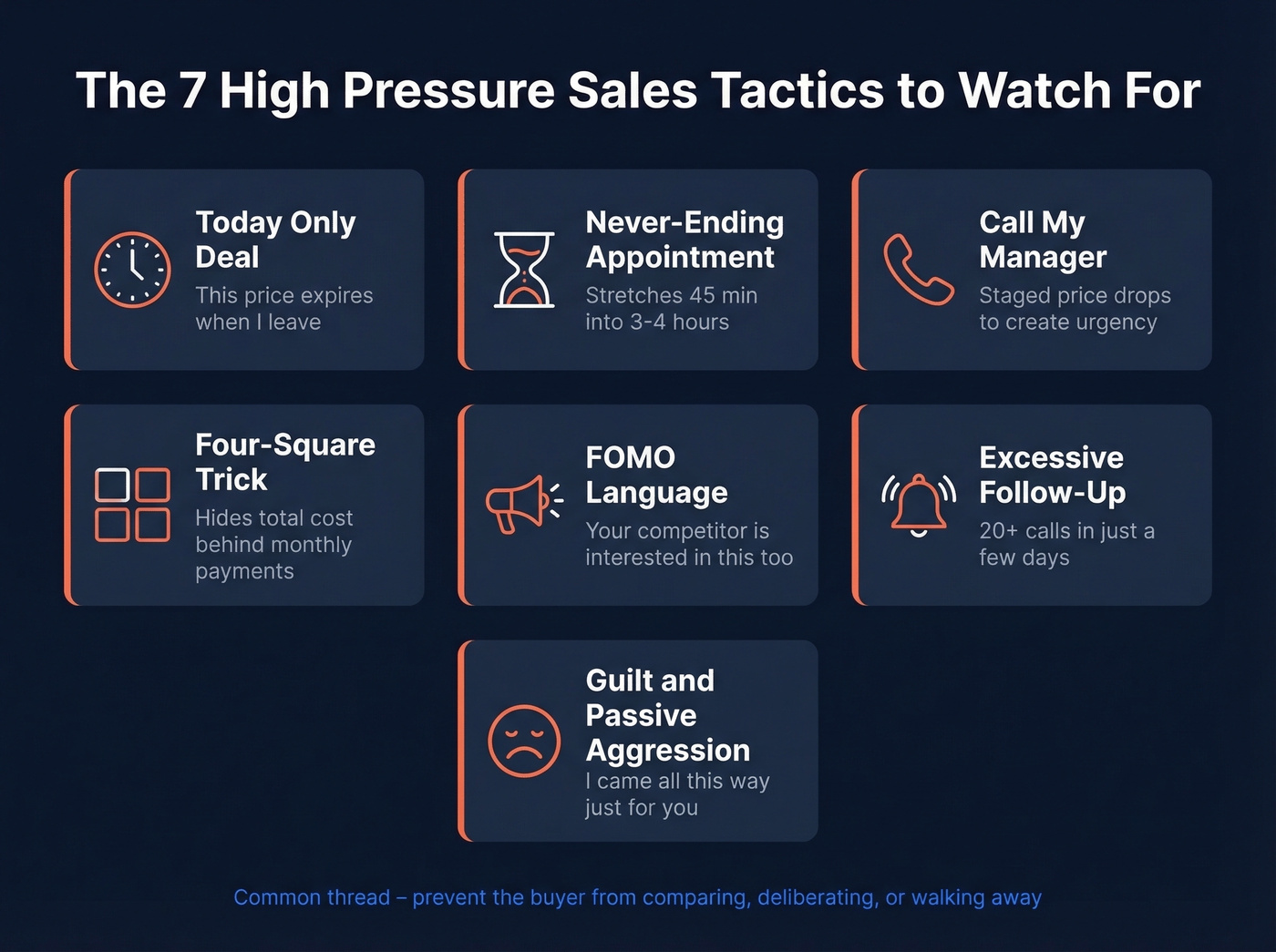
| Tactic | What It Sounds Like | Common Industry |
|---|---|---|
| "Today Only" Deal | "This price expires when I leave" | Home improvement |
| Never-Ending Appointment | 3-4 hour in-home pitch | Windows, roofing |
| Call My Manager | Staged price drops | Auto, home services |
| Four-Square | Focus on monthly payment | Auto dealers |
| FOMO Language | "Your competitor is interested" | B2B SaaS, solar |
| Excessive Follow-Up | 20+ calls in days | Real estate, solar |
| Guilt / Passive Aggression | "I came all this way" | Door-to-door |
The "Today Only" deal is the most common. A rep quotes a price, then immediately starts shaving it - cash discount, "manager approval," seasonal promo - all contingent on signing before they leave your house. The goal is to prevent you from getting the three quotes that consumer advocates recommend.
The Never-Ending Appointment is subtler and more exhausting. The rep stretches a 45-minute meeting into three or four hours, banking on decision fatigue. By hour three, signing feels easier than continuing the conversation.
The Four-Square is an auto dealer classic. Instead of negotiating total price, the salesperson shifts the conversation to monthly payments, trade-in value, and financing terms - four boxes on a worksheet, each one hiding margin. It works because many buyers focus on monthly cost, not total cost of ownership.
In B2B, the equivalent is FOMO language - "your competitor just signed" or "we only have two implementation slots left this quarter." Same mechanic, different suit.
Why Pressure Backfires
The academic evidence is clear. A study in Psychology & Marketing compared "encourage-to-deliberate" tactics against "pressure-to-purchase" tactics across five experiments spanning clothing, travel, fitness, and electronics. Encourage-to-deliberate produced more positive word-of-mouth every single time.
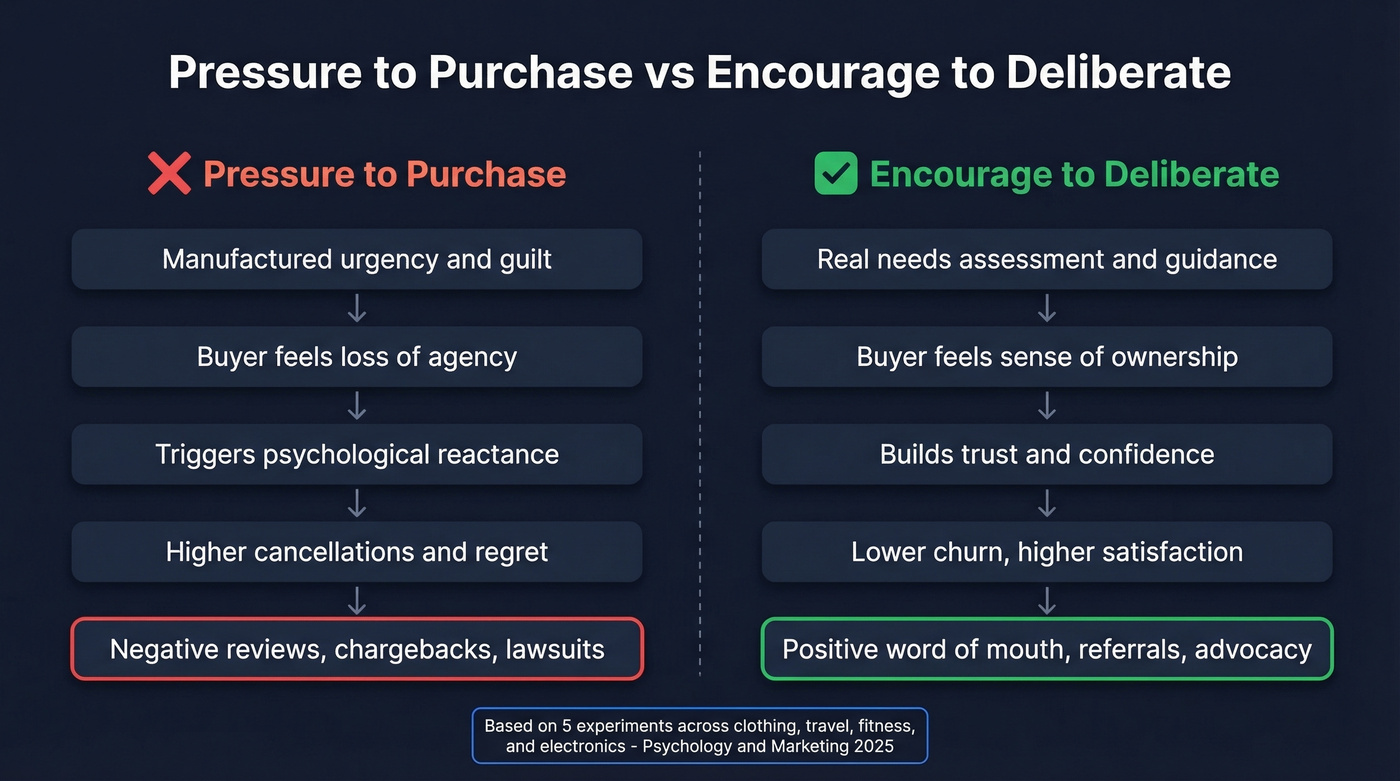
The mechanism? Sense of agency. When buyers feel they initiated the decision, they become advocates. When they feel pushed, they become detractors.
Here's the thing: pressure doesn't just fail with confident buyers. It's most damaging with low self-efficacy customers - the people who are least sure of what they want. The study found that self-efficacy moderates the effect, meaning the buyers who seem most "closeable" under pressure are the ones most likely to experience regret, cancel, or leave negative reviews.
96% of prospects research companies before engaging a sales rep. 71% prefer independent research over talking to a rep at all. Pressure tactics collide head-on with a buyer population that's already done its homework and resents being told to hurry up.
The psychological term is reactance - the instinctive pushback people feel when their freedom to choose is threatened. Pressure triggers reactance. Reactance kills deals. And the deals it doesn't kill produce buyers who churn faster and refer less.
Does Aggressive Selling Actually Work?
Let's be honest: it can produce short-term conversions in transactional, one-time-purchase settings where the seller will never see the buyer again. But even there, the cost shows up in reviews, referrals, and - increasingly - lawsuits. Hard closing techniques generate higher cancellation rates and lower lifetime value than consultative approaches. The math doesn't hold up once you factor in chargebacks, refund requests, and the reputation damage that follows a string of one-star reviews.

Pressure tactics exist because pipelines are thin. When reps have 50 qualified leads instead of 500, every conversation becomes do-or-die. Prospeo's database of 300M+ profiles with 30+ filters - buyer intent, technographics, job changes, headcount growth - means your team always has enough real prospects to sell without desperation.
Kill pressure culture at the source: build a pipeline your reps never have to squeeze.
Legal Consequences Are Real
Pressure selling doesn't just cost deals. It costs money - the legal kind.
In April 2025, the Colorado Attorney General sued two realty companies for allegedly pressuring homeowners into "Homeowner Benefit Agreements" through deceptive practices, including calling sales leads 20+ times within several days and misrepresenting contract terms. The complaint seeks $20,000 to $50,000 per violation. Per violation.
The FTC's Cooling-Off Rule gives buyers three business days to cancel purchases over $25 made at their home or at a location that isn't the seller's permanent place of business. Sellers must provide a cancellation form at the time of sale.
State-level enforcement is accelerating. According to the National Consumer Law Center, 31 states enacted new consumer protection provisions effective between December 2024 and January 1, 2026. California alone added 17 items. State attorneys general enforce Unfair and Deceptive Acts and Practices statutes broadly, and aggressive selling patterns - especially excessive contact and misrepresentation - fall squarely within their scope.
Why Companies Still Use It
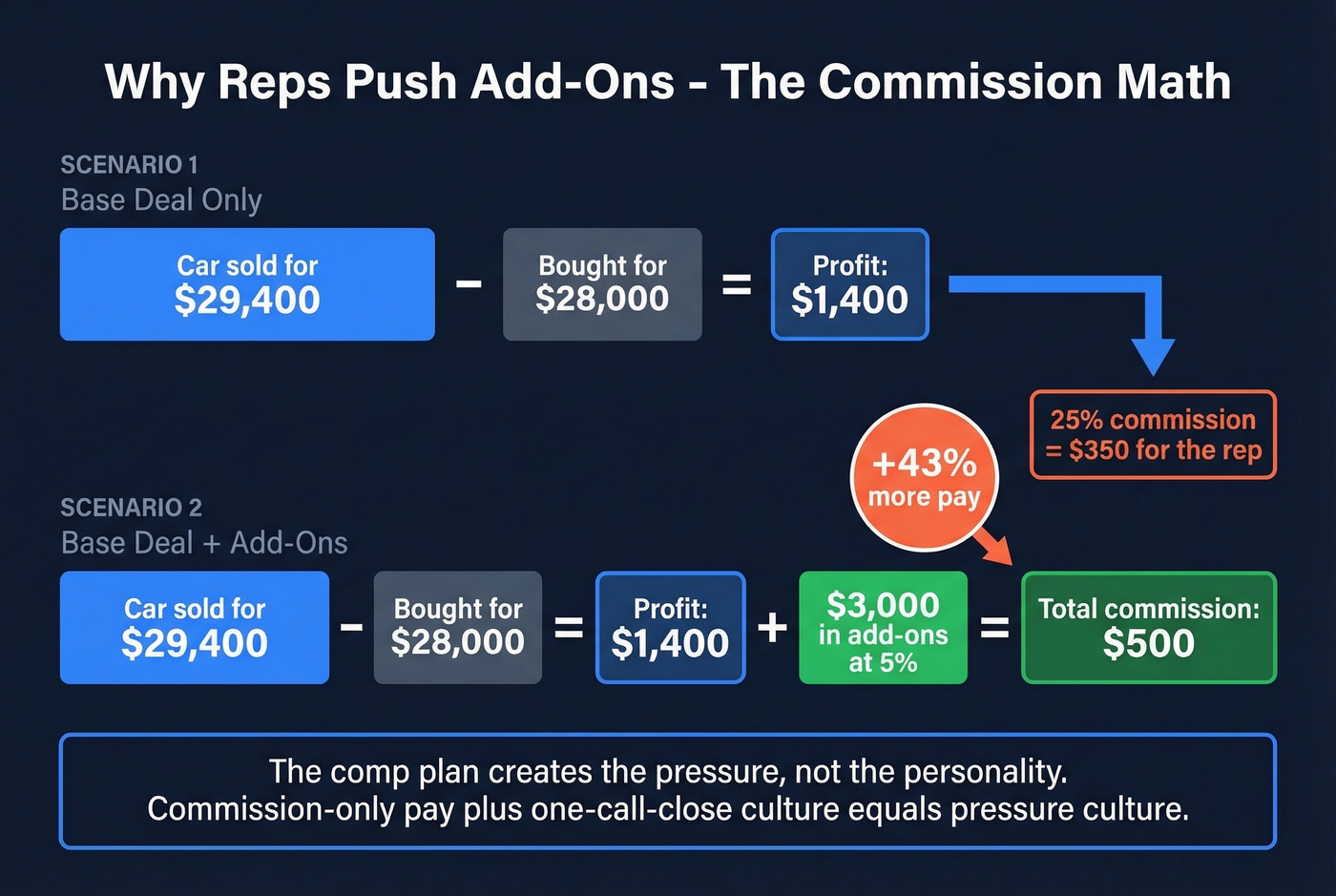
Follow the money. An auto dealer buys a car for $28,000 and sells it for $29,400 - that's $1,400 in profit. At a 25% commission rate, the salesperson makes $350. Sell $3,000 in add-ons at 5% commission and that jumps to $500. The math pushes reps toward add-on pressure because the base deal barely pays rent.
In home improvement, the incentive structure is worse. Commission-only pay combined with a one-call-close culture means every appointment is do-or-die. A solar closer on Reddit described his boss's philosophy: "we don't accept maybes here." The rep wanted to follow up when the spouse wasn't present. Management said no - close on the first visit or move on.
The deeper root cause in B2B is pipeline scarcity. Buyers now engage sellers at 61% of the journey instead of 69%, meaning reps have fewer, shorter windows to make an impression. When 86% of B2B purchases stall and 81% of buyers end up dissatisfied with their chosen provider, every live conversation feels precious. Reps squeeze because they don't have enough at-bats. And they don't have enough at-bats because their data is garbage - if a big chunk of your emails bounce, your reps are working with a fraction of the pipeline they think they have.
How to Handle Pressure (Buyer's Playbook)
Watch for three categories of red flags:
- Urgency: "Buy now or miss out," "only a few left," "this price expires today."
- Manipulation: "I came all this way to see you," "your competitor wants this but I'm offering it to you first."
- Aggression: Repeated calls and emails, interrupting your objections, arguing when you say no.
Your countermeasures are simple. Get three quotes - always. Sleep on any purchase over $500 for at least 24 hours. Say no without explaining why; less conversation is better when a rep is trained to handle objections. Use a gatekeeper - "I need to discuss this with my partner/advisor" buys time and breaks the pressure loop. Get every promise in writing before signing.
For in-home sales, you have three business days to cancel under federal law. If a company crosses the line, report them at reportfraud.ftc.gov, your state attorney general's office, the CFPB, or the BBB.
Soft Close vs Hard Close: What Works
A 2025 study across five IT firms found that higher application of consultative selling techniques correlated with shorter sales cycles and improved conversion efficiency. That's the opposite of what pressure advocates claim - they argue speed requires force. The data says speed comes from fit.
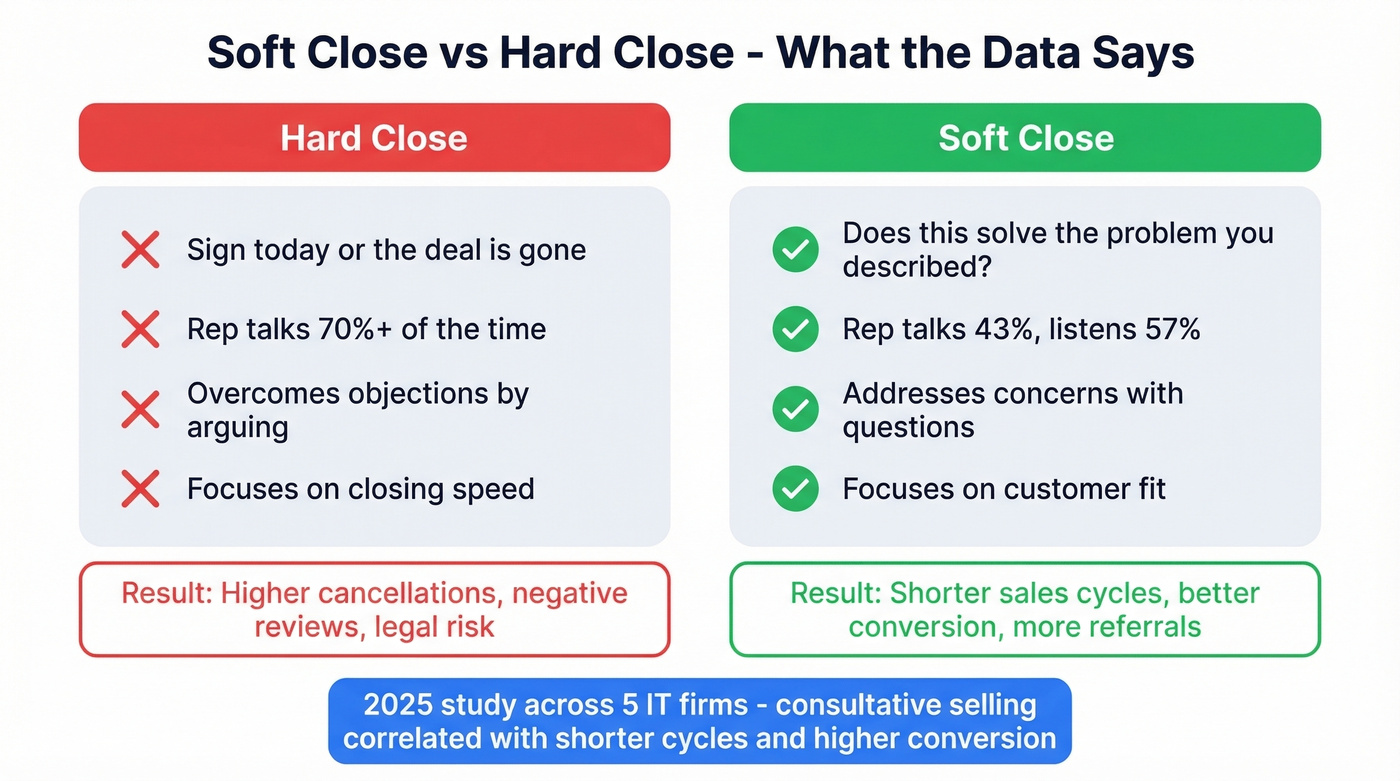
The soft close approach - asking "does this solve the problem you described?" instead of demanding a signature - lets the buyer arrive at a decision rather than being cornered into one. It's the difference between guiding and pushing, and the conversion data favors guiding every time.
The Gong talk-time ratio backs this up: top-performing reps talk 43% of the time and listen 57%. Pressure sellers invert that ratio. They talk over objections, fill silences, and pitch through discomfort. When the prospect talks more, the rep uncovers real objections and buying signals instead of guessing.
One Reddit user described visiting two auto dealerships back to back. The first was low-pressure - helpful, let them leave, no friction. The second insisted on contact info, pushed an immediate test drive, and escalated to a manager when the buyer hesitated. The buyer told the manager to close the opportunity as a loss. The low-pressure dealer got the sale.
If your deal size is under five figures, you almost certainly don't need pressure tactics - you need volume. And volume comes from pipeline abundance, not arm-twisting.
Fix the Data, Fix the Pressure
In our experience, the teams that abandon pressure tactics fastest are the ones that fix their data first. When your team has a pipeline full of verified, in-market contacts, nobody needs to squeeze a 4-hour appointment out of a single lead.
We've seen this play out with our own customers. When Snyk deployed Prospeo across 50 AEs, their bounce rate dropped from 35-40% to under 5%, and AE-sourced pipeline jumped 180%. That's what happens when reps stop working from stale lists - they stop acting desperate.
Consultative selling only works when you're talking to the right people. Prospeo delivers 98% accurate emails and 125M+ verified mobile numbers with a 30% pickup rate - so reps spend time advising real buyers, not chasing dead leads and resorting to hard closes.
Better data means better conversations. Better conversations close without pressure.
The pattern we've seen repeatedly: fix the data, fix the pipeline, and the pressure tactics disappear on their own. You don't need a "no high pressure sales" policy if your reps have enough qualified conversations to hit quota without white-knuckling every deal.
To make that repeatable, teams usually standardize their sales process, tighten sales pipeline management, and invest in data enrichment so reps aren't working from stale lists. If you're running outbound, improving cold email benchmarks and deliverability is often the fastest way to stop the desperation loop.
FAQ
Is high pressure sales illegal?
It isn't inherently illegal, but it crosses into illegality when it involves misrepresentation, fraud, or violations of consumer protection laws like state UDAP statutes. The Colorado AG's lawsuit seeks $20,000-$50,000 per violation for aggressive calling and deceptive terms. The line between "aggressive sales" and "deceptive practices" is thinner than most companies realize.
What is the FTC Cooling-Off Rule?
The FTC Cooling-Off Rule gives buyers three business days to cancel purchases over $25 made at their home or at a location that isn't the seller's permanent place of business. Sellers must provide a cancellation form at the time of sale. This applies to door-to-door and in-home transactions - not to purchases made at a store or online.
What's the difference between a soft close and a hard close?
A soft close uses questions to let the buyer confirm their own decision - "based on what you've shared, does this fit your timeline?" A hard close demands an immediate commitment with an ultimatum or manufactured urgency. Data consistently shows soft closes produce higher close rates, lower cancellation rates, and stronger long-term customer relationships.
How do I build pipeline without pressure tactics?
Start with data quality - verified emails and direct dials mean your team reaches real prospects instead of dead ends. Combine that with consultative selling and intent data tracking to prioritize in-market buyers, and reps spend time on conversations that convert instead of chasing ghosts.