

How to Find Employees: 10 Proven Strategies for 2026
A hiring manager we know ran a push last quarter - posted on three job boards, waited two weeks, and got 400 applications. Twelve were qualified. Three showed up to interviews. One accepted, then ghosted on day one.
If you've been trying to find employees recently, that probably sounds familiar.
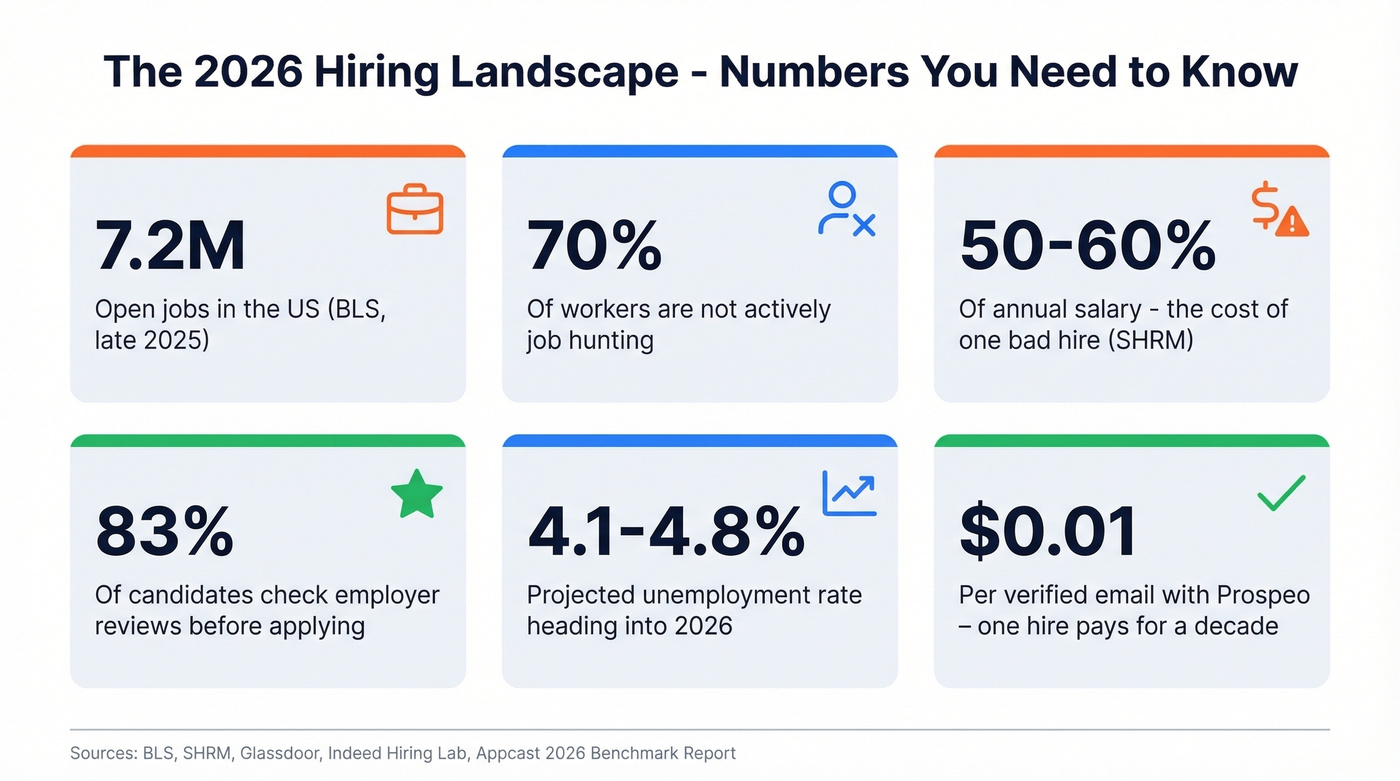
The numbers confirm what every hiring manager already feels. The BLS reported 7.2 million job openings in late 2025, with unemployment projected between 4.1% and 4.8% heading into 2026. Indeed's Hiring Lab describes the environment as "low-hire, low-fire" - companies aren't laying people off, but they're not aggressively hiring either. The best candidates are employed, comfortable, and not checking job boards.
Meanwhile, costs keep climbing. Appcast's 2026 Recruitment Marketing Benchmark Report - covering 302M+ clicks and 27M+ applications across roughly 1,200 employers - found cost-per-application and cost-per-hire both increased sharply. The playbook that worked in 2021 doesn't work anymore. Posting a job and waiting is a losing strategy when 70% of the workforce isn't actively looking.
Here's our take: most companies don't have a sourcing problem. They have a speed problem. The candidates exist - they just get snatched up in a week. The consensus on r/sales and r/recruiting echoes this constantly: "signal-to-noise ratio has tanked" and "by the time we scheduled a second round, the candidate had two offers."
What You Need (Quick Version)
- Hourly/local roles: Employee referrals + Indeed's free tier + local Facebook groups. These free channels routinely outperform sponsored listings for frontline positions. Total cost: $0-$75.
- Professional/salaried roles: LinkedIn paid posts + niche industry boards + a structured interview process so you don't lose candidates to slow follow-up.
10 Proven Ways to Find Employees
1. Write Job Posts That Filter, Not Attract
Most job posts try to sell the role. Better ones filter out bad fits before they apply. Include the salary range - pay transparency laws are expanding fast, and candidates skip listings without comp info. Be specific about shift expectations, travel, and must-have skills vs. nice-to-haves.
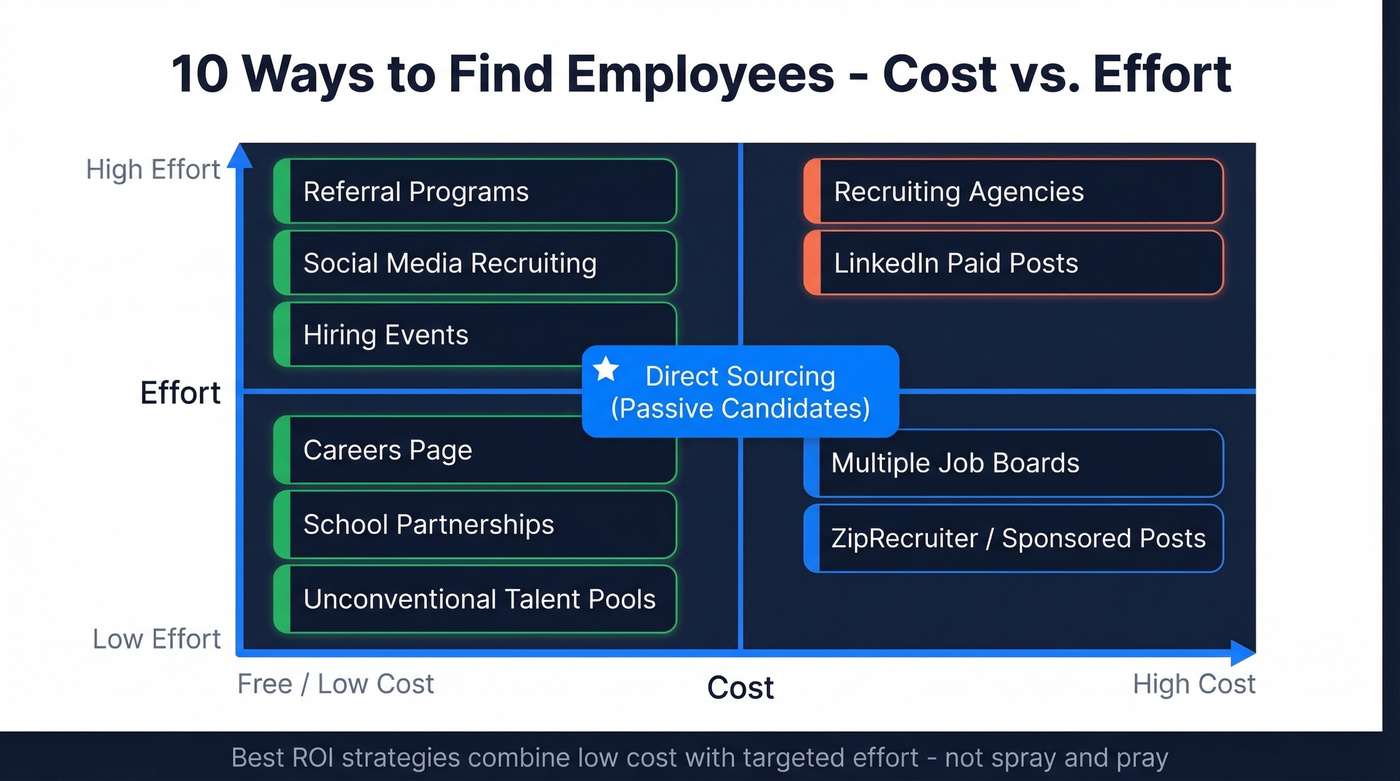
A job post that gets 50 qualified applications beats one that gets 500 random ones every time.
2. Post on Multiple Boards the Same Day
Cast a wide net fast. Indeed's 144.9M monthly visits make it the default for volume, but free listings get buried quickly. LinkedIn's 510.7M visits skew toward white-collar professionals. Craigslist ($10-$75 per listing) still works surprisingly well for local hospitality, construction, and trades roles.
Use this if you're hiring for a role where inbound volume matters and you can handle the screening load. Skip this if you're hiring a senior specialist - they're not browsing job boards.
3. Activate Your Referral Network
Referrals consistently produce higher-quality hires with better retention than any other channel. Offer a $500-$2,000 bonus per successful hire, announce it company-wide, and make the process dead simple - a form, a Slack channel, whatever removes friction.
Here's the thing: most referral programs fail because they're announced once and forgotten. Send a monthly reminder with open roles. Share the bonus amount every time. And don't limit referrals to current employees - former colleagues, vendors, and customers often know strong candidates too. We've seen companies that treat referrals as an ongoing program fill roles in half the time of those that rely on job boards alone.
4. Recruit on Social Media (Beyond Posting)
Posting a job link on your company's social accounts isn't social recruiting. Real social recruiting means your hiring managers share what it's like to work at your company - team wins, behind-the-scenes content, honest takes on the work. Candidates check your social presence before applying. If your last post is from 2024, that's a red flag.
For hourly and local roles, Facebook groups and community pages outperform corporate channels. For professional roles, a post from a real person gets 3-5x the engagement of a branded one.
5. Build a Careers Page That Converts
Your careers page is the second thing candidates look at after the job post itself. It needs open roles with clear descriptions, a sense of what working there actually feels like, and an application process that takes under five minutes on mobile. Anything longer and you're bleeding candidates.
Add employee testimonials, team photos, and benefits details. Glassdoor research shows 83% of job seekers check employer reviews before applying - your careers page is your chance to shape that first impression.
6. Tap Unconventional Talent Pools
The tightest labor markets reward creative sourcing. Career returners - people re-entering the workforce after caregiving or sabbaticals - are often highly skilled and overlooked. Freelancers and contractors who want to go full-time already know your work style. Military veterans, bootcamp graduates, and community college programs are all underused pipelines.
The companies winning the talent war in 2026 aren't fishing in the same pond as everyone else.
7. Source Passive Candidates Directly
This is where most small and mid-size companies leave money on the table. 70% of the workforce isn't actively job-hunting, but many would move for the right opportunity. Proactive sourcing means identifying people who match your ideal profile and reaching out directly, rather than waiting for them to come to you.
A platform like Prospeo's B2B database flips the script. Instead of waiting for applications, you search by job title, location, company size, and seniority across 300M+ professional profiles. Find the people who match, get their verified email at 98% accuracy, and reach out directly. The free tier gives you 75 verified emails per month - enough to run a targeted outreach campaign for one or two roles without spending anything. Paid plans start around $39/mo with no contracts.

Don't blast 500 people. Identify 20-30 who genuinely fit, write a personalized message, and reach out. In our experience, a tight list of 25 strong-fit candidates outperforms a spray-and-pray campaign of 200 every single time. (If you're building outreach sequences, start with these sales follow-up templates.)
8. Partner With Schools and Trade Programs
University career centers, trade schools, and bootcamps are eager to connect students with employers. Most will let you post roles for free, attend career fairs, or co-develop internship pipelines. For entry-level roles, this is one of the highest-ROI channels available - and it builds a long-term talent pipeline rather than solving one hire at a time.
9. Host Small Hiring Events
Job fairs get a bad reputation, but targeted hiring events still work - especially for roles where personality and culture fit matter as much as credentials. Industry meetups, local chamber events, and informal "coffee and careers" sessions at your office surface candidates who'd never apply through a job board.
One pattern we see repeatedly: companies that host small events with 10-20 people fill roles faster than those running formal career fairs with hundreds of attendees. Smaller events mean real conversations, not resume handoffs.
10. Use a Recruiting Agency (Sparingly)
Use this if you've been trying to fill a role for 60+ days, it's senior or highly specialized, and the cost of leaving it open exceeds the agency fee. Expect to pay 15-25% of the hire's first-year salary.
Skip this if you're hiring for roles where a good job post and some direct outreach would do the job. Paying $15,000-$25,000 for a recruiter to fill a role you could've filled with a $299 job post and a few hours of sourcing is a waste of money.
Job Board Comparison: Free vs. Paid
| Platform | Monthly Visits | Free Tier | Paid Pricing | Best For |
|---|---|---|---|---|
| Indeed | 144.9M | Yes (limited visibility) | Sponsored posts vary | High-volume roles |
| 510.7M | 1 post / 14 days | ~$300+/mo | Professional roles | |
| Craigslist | ~136M | No | $10-$75/listing | Local/hourly/trades |
| ZipRecruiter | ~30M+ | No | ~$299/mo | SMB hiring |
| Monster | ~20M+ | No | ~$279/mo | General roles |
| We Work Remotely | Niche | No | $299/listing | Remote roles |
| Dice / FlexJobs | Niche | Limited | $200-$400/listing | Tech / flexible work |
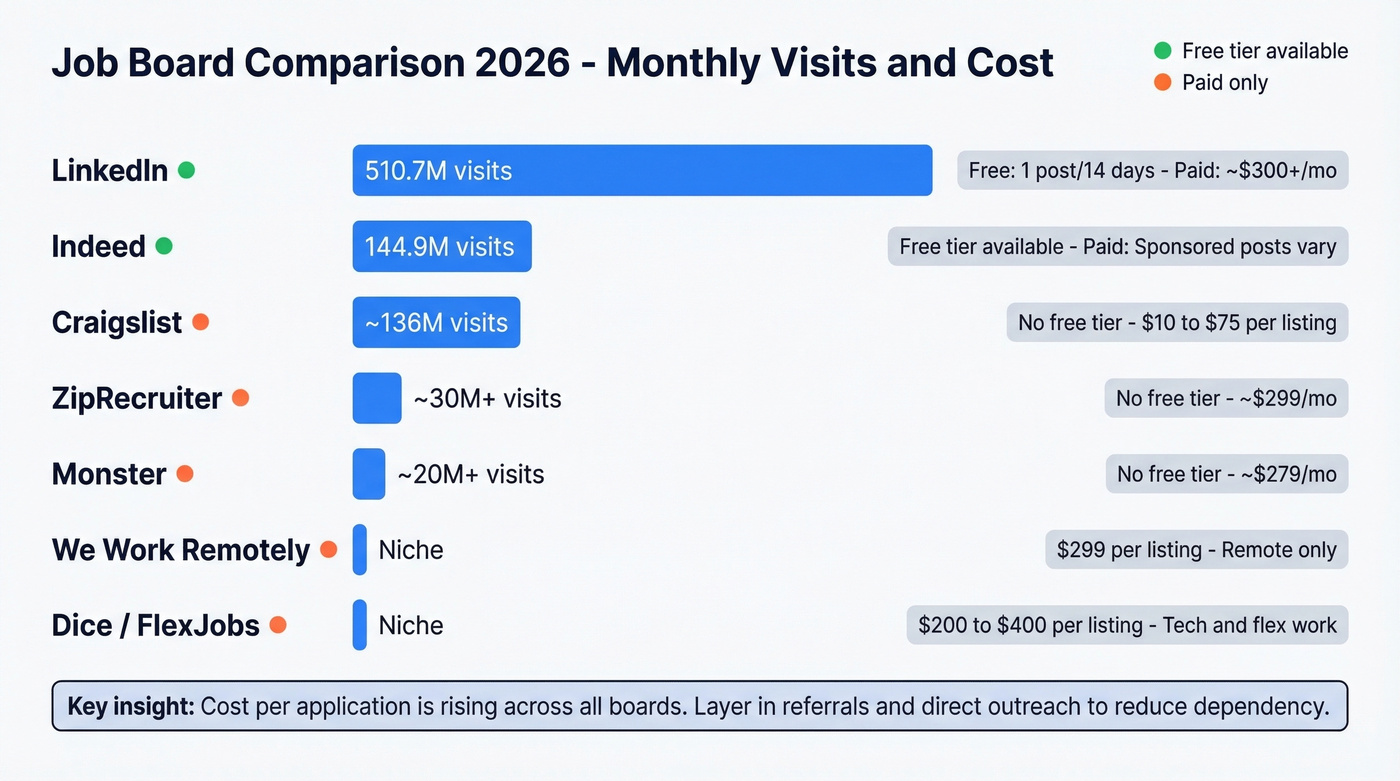
The big insight from Appcast's data: job board economics are getting worse. Cost-per-application rose across the board, and office roles saw significantly higher apply rates while frontline "standing-up" roles were expensive and difficult to fill. For healthcare, warehouse, or service roles, sponsored listings alone won't cut it - layer in referrals and direct outreach.

70% of your ideal hires aren't on job boards. Prospeo's database lets you search 300M+ professionals by job title, location, seniority, and company size - then gives you their verified email at 98% accuracy. The free tier includes 75 emails/month. No contracts.
Stop posting and praying. Start reaching the candidates who never apply.
Reaching Candidates Who Aren't Looking
Let's be honest: the best candidates for most roles aren't applying anywhere. They're employed, reasonably happy, and not scrolling Indeed at midnight. Reaching them requires a fundamentally different approach than posting and waiting.
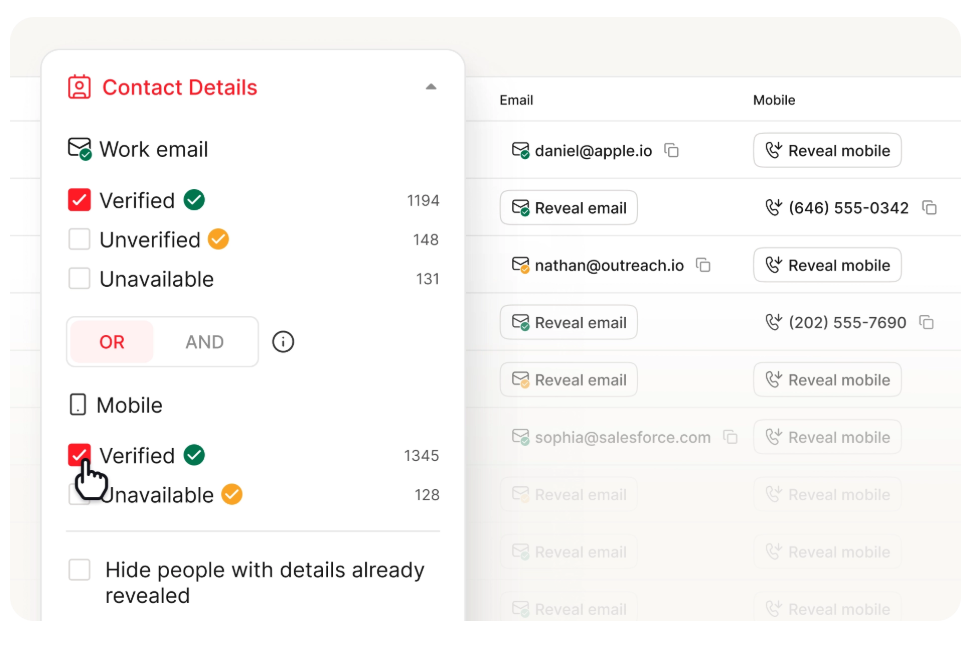
The goal isn't a massive pipeline full of noise. It's a small, high-confidence shortlist of 15-20 people who genuinely match.
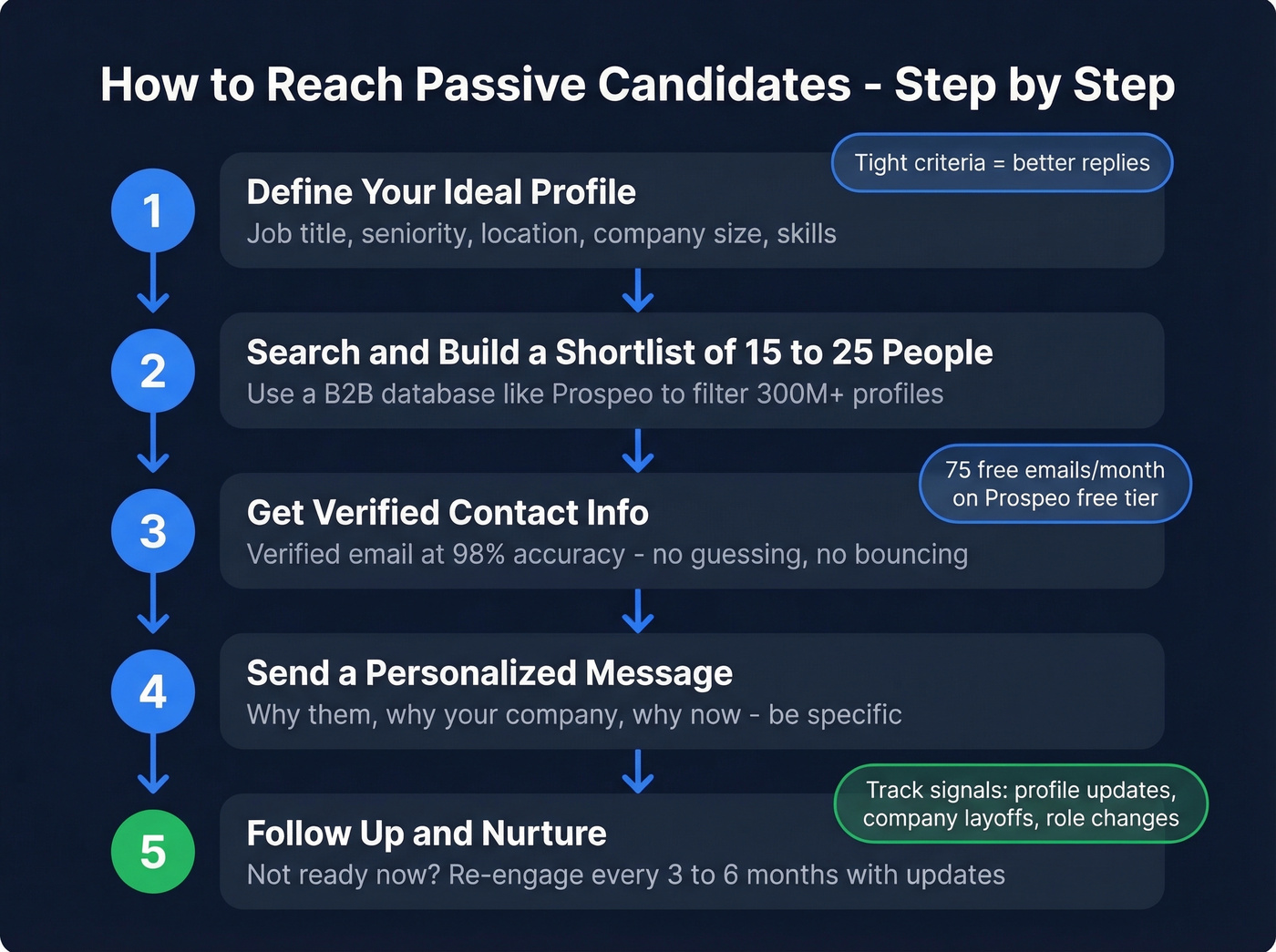
Build an "always-on" sourcing habit with concrete follow-up cadences. Reach out within 3-5 days of identifying a strong candidate. If they're not ready now, re-engage every 3-6 months with a relevant update about your company. Track signals of readiness: people who've recently changed roles, employees at companies going through layoffs, or professionals who've updated their profiles recently.
When you spot a fit, reach out with something specific - why them, why your company, why now. The mechanical part, finding verified contact info, is easy with the right tools. The strategic part - writing a message that gets a reply - is on you. (For messaging, use proven email subject lines and a simple cold email sequence.)
Every day you wait, your best candidates accept someone else's offer. Prospeo refreshes data every 7 days - not 6 weeks - so you're reaching people at current roles with current contact info. At $0.01 per verified email, one good hire pays for a decade of Prospeo.
Build a shortlist of 25 perfect-fit candidates in under an hour.
7 Hiring Mistakes That Cost You Good Candidates
SHRM estimates a bad hire costs 50-60% of that employee's annual salary. These are the mistakes that lead there:
Post and pray. Putting a job on Indeed and waiting isn't a strategy. Layer in referrals, direct outreach, and social recruiting from day one.
Moving too slowly. Good candidates get snatched up in a week. If your process takes three weeks from application to offer, you're losing people. Compress to under two weeks.
Vague job descriptions. "Fast-paced environment" and "wear many hats" tell candidates nothing. Be specific about responsibilities, compensation, and expectations.
No structured interviews. Without standardized questions and scoring rubrics, you're making gut decisions that produce inconsistent hires.
Ignoring employer brand. 83% of candidates check reviews before applying. If your Glassdoor page is a wasteland of 2-star reviews, fix that before spending money on job ads.
Skipping reference checks. It takes 20 minutes and can save you months of pain. Do it.
Not tracking metrics. If you don't know your time-to-fill, cost-per-hire, or source-of-hire breakdown, you can't improve. Even a simple spreadsheet beats flying blind. (If you want a clean way to operationalize tracking, borrow a RevOps mindset.)
Legal Requirements You Can't Skip
Hiring comes with compliance obligations that vary by state and role. Get these wrong and you're looking at fines, lawsuits, or both.
EEO compliance means you can't discriminate based on race, gender, age, religion, disability, or other protected characteristics - in job posts, interviews, and hiring decisions. Pay transparency laws are expanding: a growing number of states and cities require salary ranges in postings, and even where it isn't legally required, including comp info increases application quality. You must also provide ADA accommodations for candidates with disabilities during the application and interview process.
Two areas that trip up small businesses most often: worker classification and truth in advertising. Misclassifying a W-2 employee as a 1099 contractor is one of the most expensive mistakes you can make - the Department of Labor doesn't take it lightly. And job posts must accurately represent the role, compensation, and working conditions. When in doubt, consult an employment attorney before your first hire. It's cheaper than the alternative.
FAQ
How much does it cost to hire an employee?
Expect $4,000-$5,000 on average across all roles and industries. Entry-level hourly positions can run under $500 using free boards and referrals, while senior or specialized hires easily exceed $10,000 when factoring in recruiter fees and extended vacancy costs.
How long does it take to fill a position?
Most roles take 30-45 days from posting to accepted offer. Specialized positions stretch to 60+. The biggest variable is internal decision speed - slow interview scheduling and multi-round processes lose more candidates than weak sourcing ever will.
What's the best free way to find employees?
Employee referrals paired with Indeed's free tier and local Facebook groups cover most small business hiring needs at zero cost. Referrals alone produce higher retention and faster time-to-fill than any paid channel.
How do I source passive candidates without a recruiter?
Use a data platform like Prospeo to search 300M+ profiles by job title, location, and company size, then reach out directly with verified emails (75 free/month). This gives you proactive sourcing capability without the 15-25% recruiter fee.
Should I use a recruiting agency?
Only for senior or hard-to-fill roles that have been open 60+ days, where the 15-25% fee is justified by the cost of the vacancy. For most positions, combining job boards with direct outreach fills the role for a fraction of agency pricing.