

How Long Should a Sales Call Be? Benchmarks for Every Call Type
You scheduled 30 minutes for a discovery call and it ballooned to an hour. The prospect was engaged, but you ran out of time before qualifying budget or timeline. Now you've got a "great conversation" that goes nowhere - a warm feeling with zero pipeline impact.
Knowing how long a sales call should be starts with understanding that duration isn't the problem. Structure is. But you still need a target to aim for, so let's break down what the data actually says.
Quick Reference: Call Length by Type
| Call Type | Target Duration | Key Benchmark |
|---|---|---|
| Cold call | 5-7 min | 52s avg; ~6 min for meetings booked |
| Discovery | 30-60 min | PPO framework + tight time blocks |
| Demo | 30-60 min | SaaS: 45 min / Healthcare: 60 min |
| Follow-up | 10-20 min | Drive one clear next step |
| Closing | 30-60+ min | $500K+ deals: 89 min avg |
The overall average sales call across all types and industries runs 8 minutes 36 seconds. That number is nearly useless on its own because it blends 52-second cold calls with hour-long enterprise negotiations. Duration is a lagging indicator - get the structure right and the length follows.
Cold Calls: The 5-Minute Gap
There's a massive gap between the average cold call and one that actually books a meeting. Orum's platform data puts the average cold call at 52 seconds. The average cold call that books a meeting? About 6 minutes. That 10x difference tells you everything.
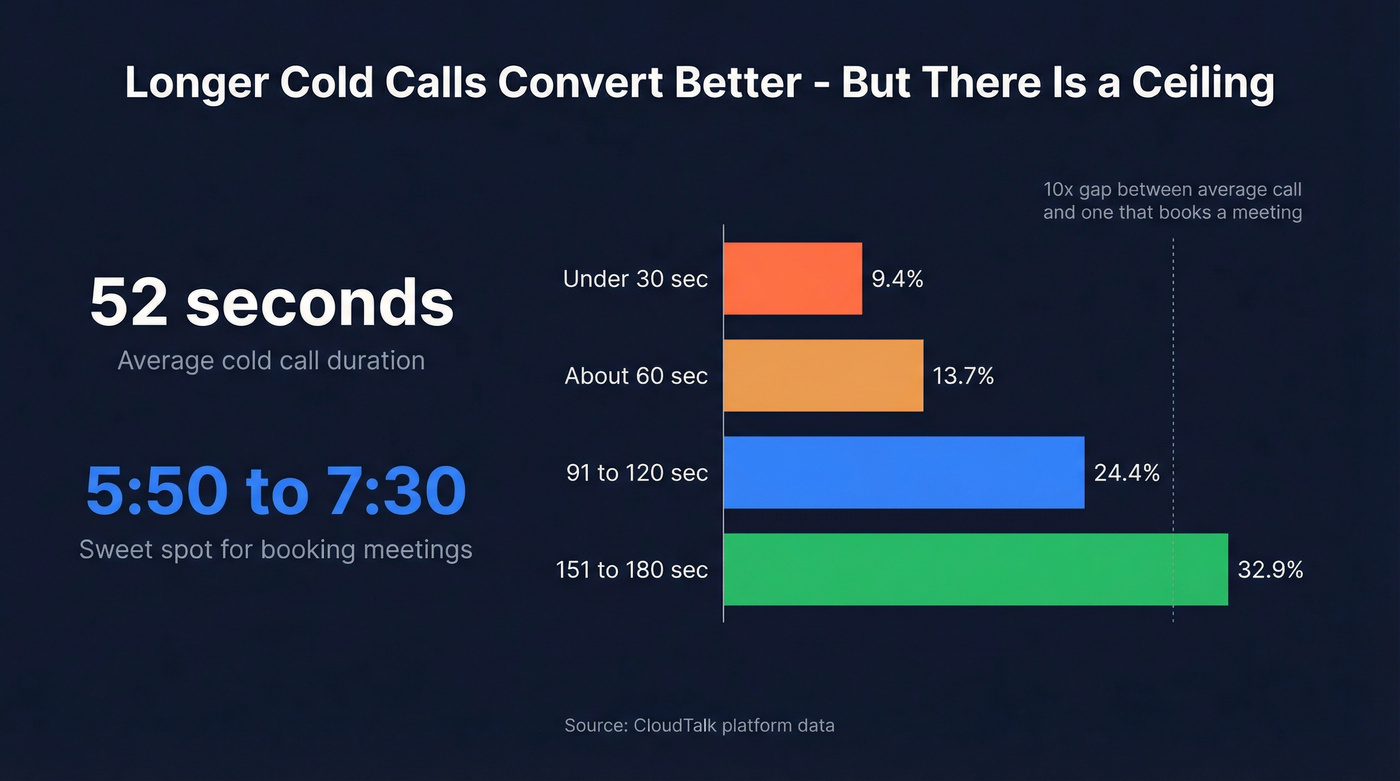
CloudTalk's data makes the progression even clearer:
| Call Duration | Conversion Rate |
|---|---|
| Under 30 sec | 9.4% |
| ~60 sec | 13.7% |
| 91-120 sec | 24.4% |
| 151-180 sec | 32.9% |
Conversion rates climb sharply as calls get longer. The 5:50 to 7:30 minute range is where the best cold calls land, and asking 11-14 questions during that window yields a 70% success rate versus 40% when reps ask only 1-6.
If your cold calls consistently last under 2 minutes, your opener needs work. Over 10 minutes? You're doing discovery on a cold call - book the meeting instead.
Discovery Calls: The 30-Minute Framework
A common r/sales thread goes something like: "How do you fit rapport, discovery, budget, timeline, stakeholders, and product into 30 minutes?" You don't. You find one or two real problems and drive to a next step.
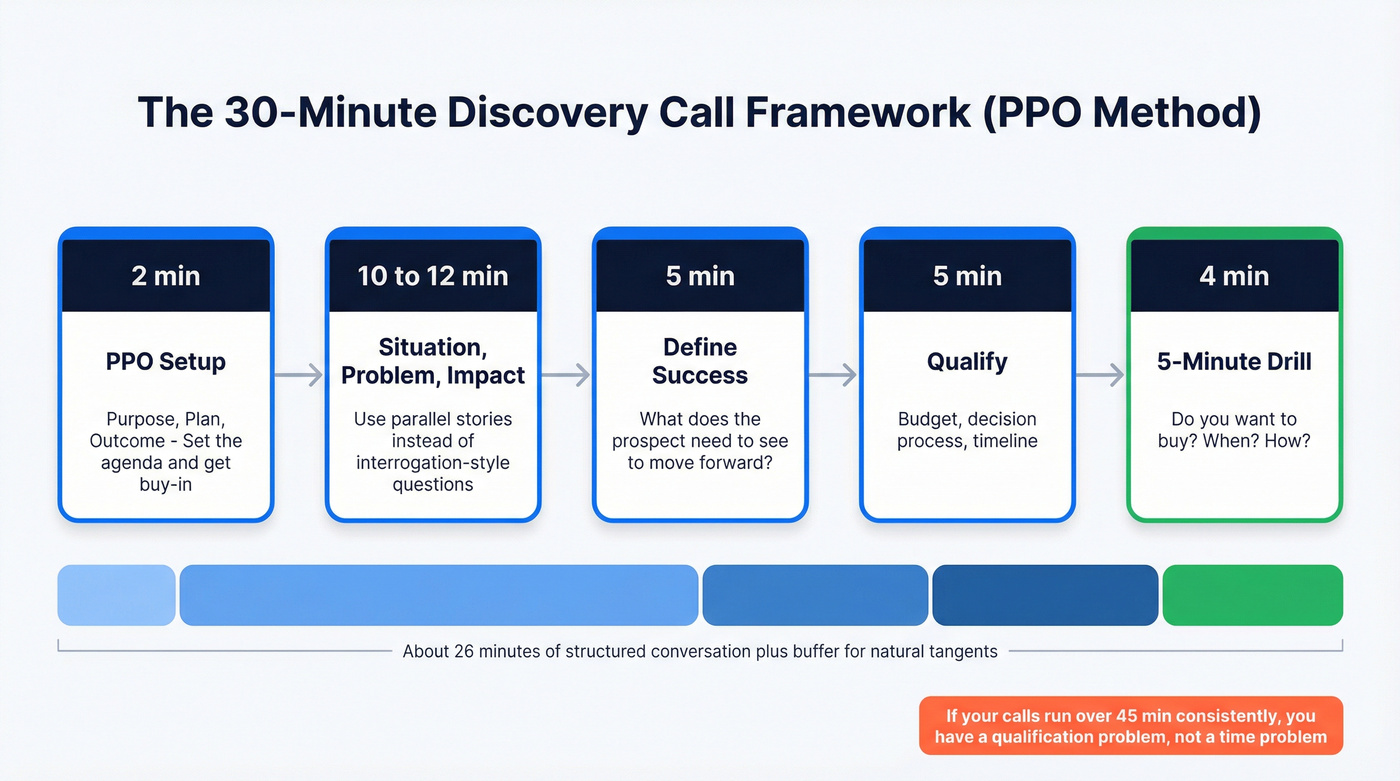
The 30MPC PPO framework keeps this tight:
- PPO (Purpose, Plan, Outcome) - 2 min. Set the agenda, get buy-in, agree on what a good outcome looks like.
- Situation, Problem, Impact - 10-12 min. Use parallel stories ("We see teams like yours dealing with X - is that resonating?") instead of interrogation-style questioning.
- Define success - 5 min. What does the prospect need to see to move forward?
- Qualify - 5 min. Budget, decision process, timeline.
- 5-Minute Drill - Close with three questions: Do you want to buy? When? How?
That's roughly 26 minutes of structured conversation with buffer for natural tangents. A popular Chorus community framework recommends a similar breakdown, plus 30 minutes of pre-call research so you're not wasting call time on questions you could've answered from their website.
Here's the thing: if your discovery calls consistently run over 45 minutes, you have a qualification problem, not a time management problem. You're either asking too many questions or failing to cut prospects who aren't a fit.

Your discovery calls don't fail because they're too short - they fail because reps waste 27% of their call block dialing bad numbers. Prospeo refreshes 300M+ contacts every 7 days, so every minute of your call block connects to a real person.
Stop burning call time on dead numbers. Start every dial with verified data.
Demo Duration by Industry
Demodesk analyzed 198 sales meetings and found demo length varies wildly by vertical:
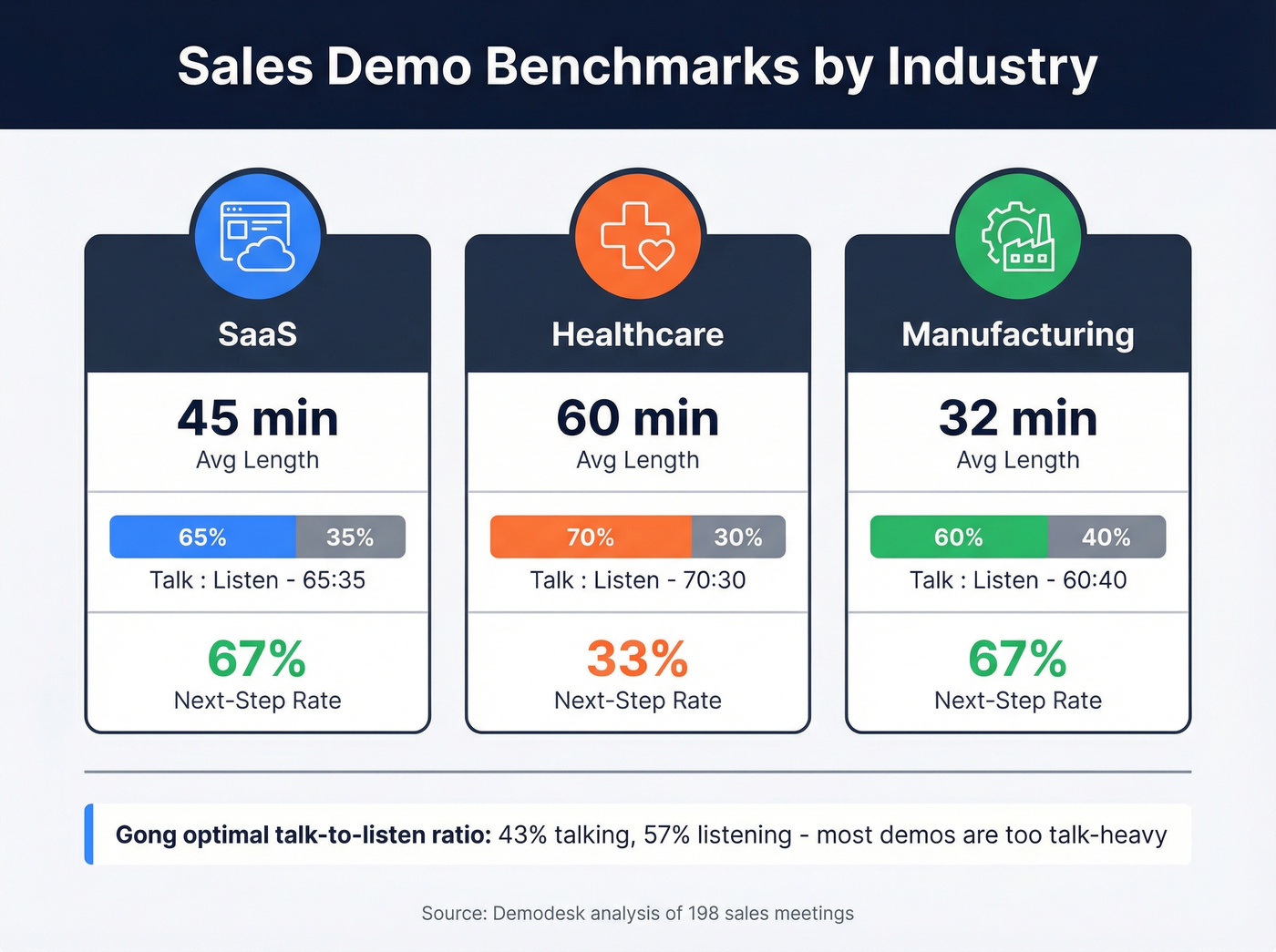
| Industry | Avg Length | Talk:Listen | Next-Step Rate |
|---|---|---|---|
| SaaS | 45 min | 65:35 | 67% |
| Healthcare | 60 min | 70:30 | 33% |
| Manufacturing | 32 min | 60:40 | 67% |
Healthcare demos run longer because compliance, security, and workflow detail demand it - and the lower next-step rate suggests those extra minutes don't always pay off. SaaS and manufacturing both hit 67% advancement rates with shorter calls.
Gong's broader dataset puts the optimal talk-to-listen ratio at 43/57. Compared to that benchmark, most demos are talk-heavy. The reps who advance deals listen more than they pitch. We've seen this pattern in our own outbound work - the moment a rep starts monologuing past the 15-minute mark without a question, engagement drops off a cliff.
Follow-Up and Closing Calls
Keep follow-ups short: 10-20 minutes. One clear agenda item, one next step. If you need more time, it's not a follow-up - it's another discovery or demo. Inbound sales calls follow a similar pattern, averaging around 4:30, just long enough to confirm fit and schedule a proper conversation.
Closing calls scale with deal size, and most reps underestimate this. A $25K deal averages 48-minute calls across 7.4 total calls. A $500K+ deal? 89-minute calls across 12.6 calls - over 18 hours of total call time per sales cycle. Skip the 15-minute closing call if you're working enterprise deals. You'll need the full hour for procurement, legal, and multi-stakeholder alignment.
What Actually Determines Ideal Call Duration
Deal Size Drives Everything
The Focus Digital benchmarks make this clear: as deal value increases, both call duration and total call count climb. A $100K deal doesn't just take longer calls - it takes more of them.
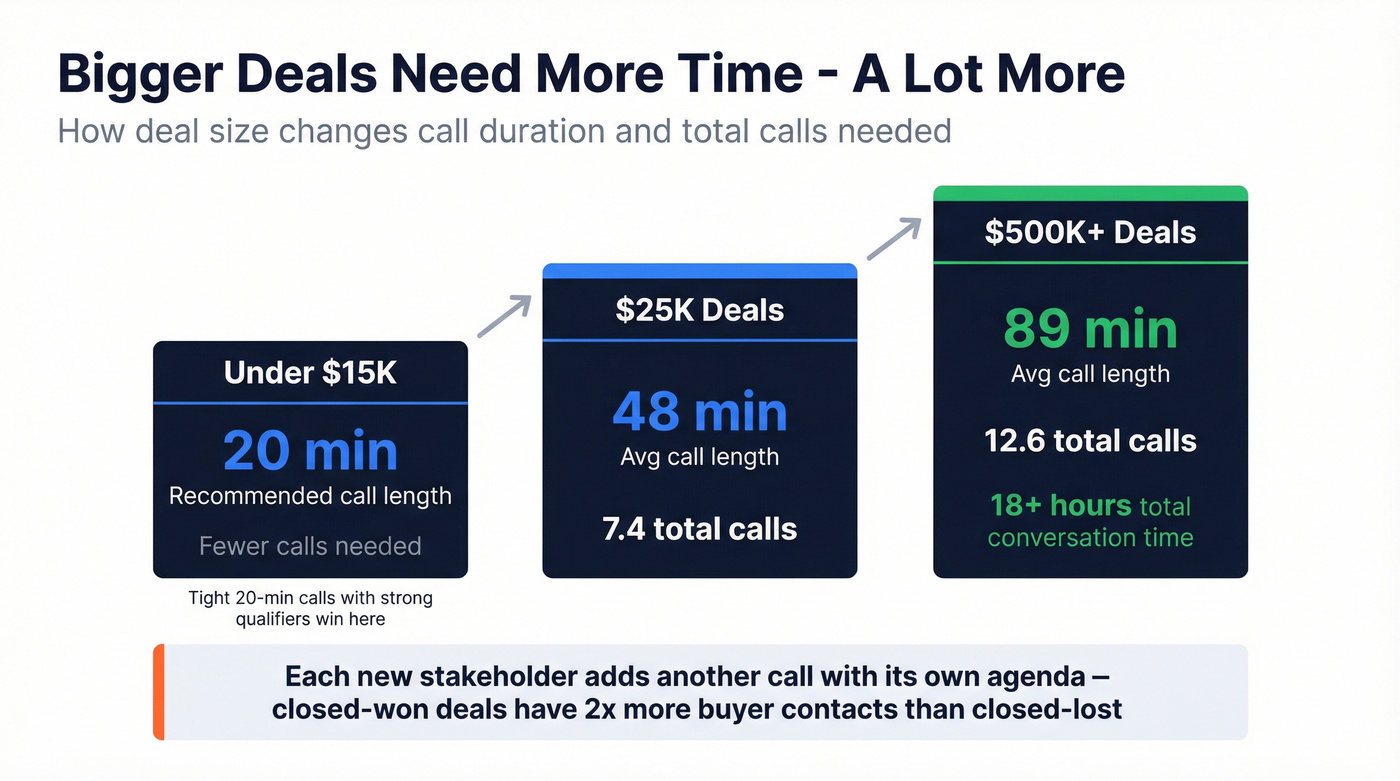
If your average contract value sits below $15K, you probably don't need 45-minute discovery calls. A tight 20-minute call with a strong qualifier will outperform a meandering hour every time.
More Stakeholders, More Time
Gong's analysis of 1.8M opportunities found 77% of deals involve multiple contacts. Closed-won deals have 2x as many buyer contacts as closed-lost, and multi-threading boosts win rates by 130% for deals over $50K. Bringing in a sales engineer lifts win rates up to 30%. Each new stakeholder means another call with its own agenda - a VP of Finance cares about ROI, not the feature demo you gave their team lead.
Bad Data Kills Call Blocks
Reps lose 27.3% of their calling time to bad contact data. B2B data decays at roughly 2.1% per month, which means 22.5% annually. If a quarter of your dials hit dead numbers, your "5-hour call block" is really 3.5 hours of actual conversations. I've watched teams celebrate hitting 200 dials in a day without realizing 50+ of those went to disconnected lines.

If you're rebuilding your outbound motion, start with sales prospecting techniques that match your ICP and channel mix.
Schedule Smarter
Gong Labs found that scheduling at 4pm versus 8am increases show-up rates by 30%, and weekend-scheduled calls have roughly 4x the no-show rate. Speed to lead matters, but so does timing the actual conversation for when the prospect will actually show up.
If you're running remote demos, these remote sales meeting tips can help keep calls tight without losing rapport.
Enterprise deals need 12+ calls and 18 hours of conversation to close. You can't afford a single dial hitting a disconnected line. Prospeo's 125M+ verified mobiles have a 30% pickup rate - 3x the industry average.
More pickups per call block means more pipeline per rep.
If you want a more formal qualification system, use a MEDDIC scorecard to decide when to extend the call.
For tighter first calls, keep a bank of discovery questions and cut anything that doesn't map to a next step.
When it's time to run the meeting, a product demo checklist helps you stay inside the 30-60 minute window.
And if you're trying to improve conversion across the whole motion, track your sales conversion rate by call type (cold → discovery → demo → close).
FAQ
How long should a cold call last to book a meeting?
Aim for 5-7 minutes. Orum's platform data shows the average cold call that books a meeting lasts about 6 minutes - roughly 10x longer than the 52-second average for all cold calls. If you're consistently under 2 minutes, rework your opener and question flow.
What's the ideal talk-to-listen ratio?
The optimal ratio is 43% talking, 57% listening, based on Gong's analysis of millions of calls. Top performers maintain a consistent ratio across all calls, while low performers swing by 10+ percentage points between won and lost deals. Consistency beats perfection.
How long should a sales call be for enterprise deals?
Enterprise deals demand significantly more time. A $500K+ deal averages 89-minute calls across 12.6 total calls - over 18 hours of conversation per sales cycle. Plan for full 60-minute blocks when working with procurement, legal, and multiple stakeholders.
How do I stop wasting time on calls that go nowhere?
Qualify harder in the first 5 minutes using the PPO framework, and verify your contact data before you dial. Reps lose 27.3% of calling time to bad numbers. Clean data won't fix a weak pitch, but it'll make sure your strong pitch reaches a real person.