

How Quickly Should You Respond to Leads (and Why Most Teams Still Fail)
Your SDR dials in 3 minutes flat. CRM says "contacted." Manager sees a green SLA checkbox and celebrates the team's discipline. Then the prospect picks up and says, "Sorry, wrong number." Or worse - the line's disconnected entirely. Meanwhile, the actual buyer already booked a demo with your competitor who had an instant scheduling link.
Speed-to-lead is the metric everyone obsesses over, but it's only half the equation.
So how quickly should you respond to leads? Here's the short answer.
The Quick Answer
Under 5 minutes. Under 2 minutes for live chat. But speed is useless if your contact data is wrong - verify before you dial.
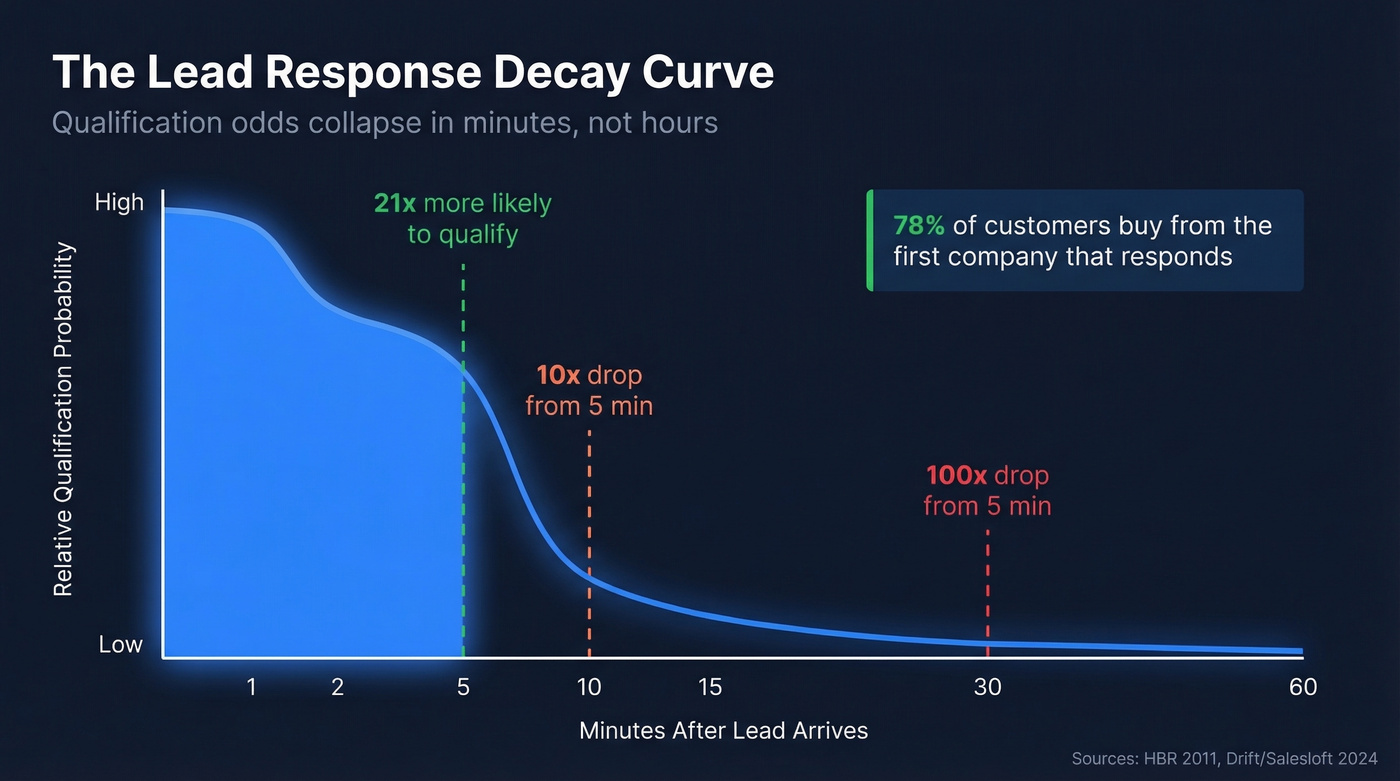
- Leads contacted within 5 minutes are 21x more likely to qualify than those contacted at 30 minutes, per the InsideSales/MIT research.
- Instant routing + real-time alerts + auto-acknowledgment with a booking link. Details in the playbook below.
- If 15% of your phone numbers are disconnected, your 4-minute response time is a vanity metric. Clean your data first.
The Research, Properly Cited
The study everyone references but rarely names is "The Short Life of Online Sales Leads" by James B. Oldroyd, Kristina McElheran, and David Elkington, published in Harvard Business Review in March 2011. The core finding was blunt: most companies respond far too slowly to online inquiries, and the window for meaningful contact collapses within minutes, not hours.
That was 2011. The data has only gotten worse for slow teams.
The most recent large-scale study - Drift and Salesloft's report from early 2024 - analyzed 30+ million conversations across 2023. For live chat, agents who responded within 2 minutes had the highest meeting-booking rates. Wait 5 minutes and the visitor's abandonment risk jumps 10x. Wait 10 minutes - 100x. The decay curve isn't gradual. It's a cliff.
78% of customers buy from the first company that responds. That single stat should dictate your entire inbound operations strategy.
Why 99% of Teams Fail at Lead Follow-Up
A Workato benchmark study of 114 B2B companies found that more than 99% didn't respond within 5 minutes. The averages were brutal: 11 hours and 54 minutes by email, 14 hours and 29 minutes by phone. That's not a response - that's a next-day afterthought.
The after-hours problem makes it worse. Drift's data shows 39% of buyer conversations happen outside 9-5, and 41% of meetings booked through chat happen outside business hours. Picture this: it's 7:42 PM on a Tuesday, and a VP of Marketing fills out your demo form while catching up on vendor research after the kids are in bed. Your team doesn't see it until 8:30 AM Wednesday. By then, she's already on your competitor's calendar.
After-hours coverage isn't a nice-to-have. It's where 4 in 10 opportunities live.
Benchmarks by Industry and Size
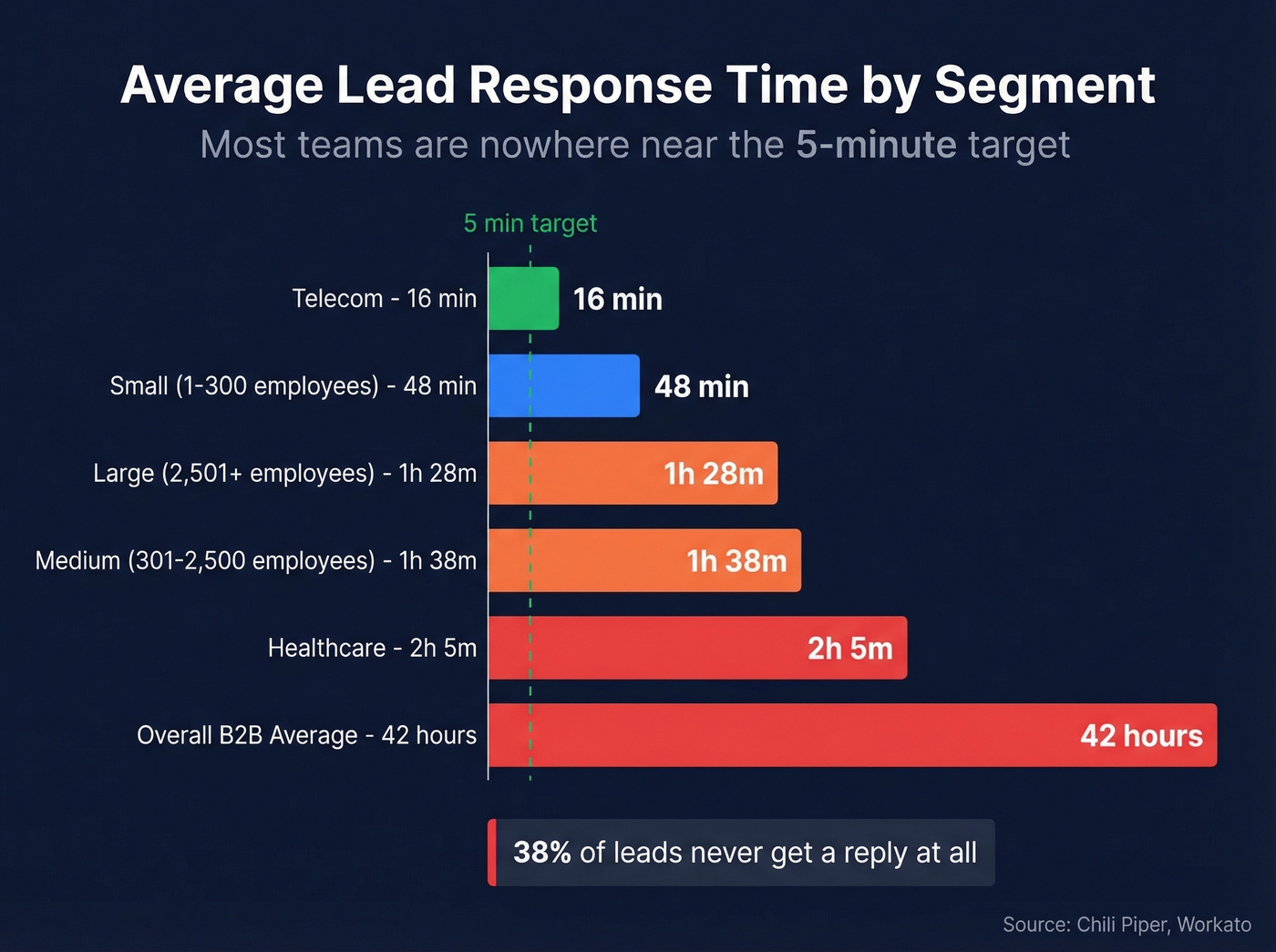
Not every industry moves at the same pace. Chili Piper's benchmarks break it down:
| Segment | Avg Response Time |
|---|---|
| Telecom | 16m |
| Small (1-300 employees) | 48m |
| Large (2,501+ employees) | 1h 28m |
| Medium (301-2,500 employees) | 1h 38m |
| Healthcare | 2h 5m |
| Overall B2B average | 42 hours |
Telecom leads the pack at 16 minutes - likely because those teams have invested heavily in routing automation. Healthcare lags at over 2 hours, which tracks with the compliance and scheduling complexity in that space. The overall B2B average sits at a staggering 42 hours, and 38% of leads never get a reply at all. Even the "best" segments here are nowhere near the 5-minute target. The bar is underground.

Speed-to-lead only works when your data is right. If 20% of your phone numbers are stale, your 5-minute SLA is a fiction. Prospeo refreshes every record on a 7-day cycle - not the 6-week industry average - delivering 98% email accuracy and a 30% mobile pickup rate.
Fix the data before you fix the routing.
Target SLAs by Channel
Different channels have different urgency curves. Here's what we recommend based on the research:
| Channel | Target SLA | Why |
|---|---|---|
| Live chat | < 2 min | 10x abandonment at 5 min |
| Phone / callback | < 5 min | 78% buy from 1st responder |
| Demo / form fill | < 5 min | 21x qualification lift |
| Email inquiry | < 15 min | Lower urgency, still same-hour |
An auto-reply doesn't count as a "response." The clock doesn't stop until a human connects. Auto-replies buy you time and set expectations, but the SLA measures real engagement - a conversation, a call, a booked meeting.
The Data Quality Problem Nobody Talks About
Here's the thing: your team builds a beautiful speed-to-lead workflow. Routing is instant. Slack alerts fire in real time. The SDR dials within 4 minutes. And the number is disconnected.
Your CRM says you hit SLA. Your pipeline says otherwise.

Speed without data accuracy is a vanity metric. We've seen teams invest months in routing automation while sitting on a lead database where 20%+ of phone numbers are stale. Before you build the automation stack, run your lead database through verification. Prospeo's 98% email accuracy and 30% mobile pickup rate - compared to the 11-12% industry average - on a 7-day refresh cycle means your reps actually reach the person they're calling. A free account handles 75 emails per month, enough to test the concept before committing.
The Automation Playbook
Here's the workflow that gets you under 5 minutes - the window backed by every major study on lead response time:
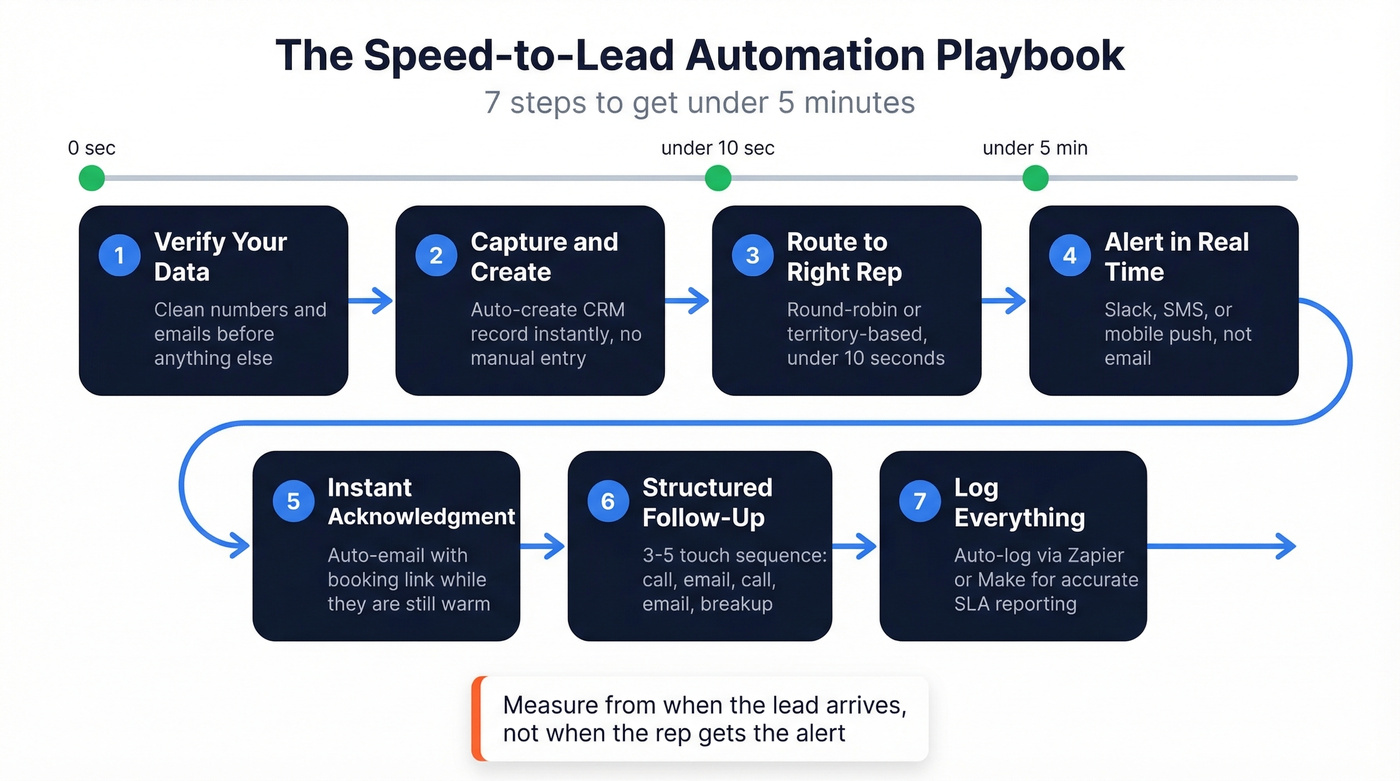
1. Verify your data. Run your lead list through a verification tool before activating your speed-to-lead workflow. Bad data at the top of the funnel poisons every step that follows.
2. Capture and create. Every form fill, chat message, or inbound call auto-creates a CRM record instantly. No manual entry, no lag.
3. Route to the right rep. Use round-robin or territory-based assignment so leads don't sit in a queue. Tools like Chili Piper or LeanData handle this natively. Chili Piper demonstrates this is possible in under 10 seconds: form fill to scheduling prompt in 3 seconds, "talk now" option in 1 second, routed call in 6 more.
4. Alert in real time. Push notifications via Slack, SMS, or mobile app. Email notifications aren't fast enough - reps don't live in their inbox.
5. Send an instant acknowledgment. An auto-email with a booking link lets the prospect self-schedule while they're still warm. Calendly, Chili Piper, or HubSpot meetings all work here.
6. Launch a structured follow-up sequence. If the rep doesn't connect live, a 3-5 touch sequence fires automatically - call, email, call, email, breakup. (If you need copy, start with these sales follow-up templates.)
7. Log everything automatically. Activity logging via Zapier, Make, or n8n ensures nothing falls through the cracks and your SLA reporting is accurate.
One framework worth stealing from LeanData: split your response time into "processing time" (matching, routing, enrichment) and "rep response time." Most of the delay isn't rep laziness - it's lead processing. Fix the plumbing before blaming the people.
Let's be honest about what we see in most orgs: they don't have a speed problem. They have a data plumbing problem disguised as a speed problem. If your enrichment takes 4 hours and your rep dials in 2 minutes after that, your "2-minute response time" is actually a 4-hour-and-2-minute response time. Measure from the moment the lead arrives, not from when the rep gets the alert.
What Happens When You Fix It
A practitioner on r/GrowthHacking shared their before-and-after numbers, and the results are worth studying in detail. From September through November, they ran manual lead response: 43 inquiries, 3.8-hour average response time, 11.5% inquiry-to-client conversion. Then they automated. December through January: 47 inquiries, 4-minute average response time, 27.5% inquiry-to-client conversion.
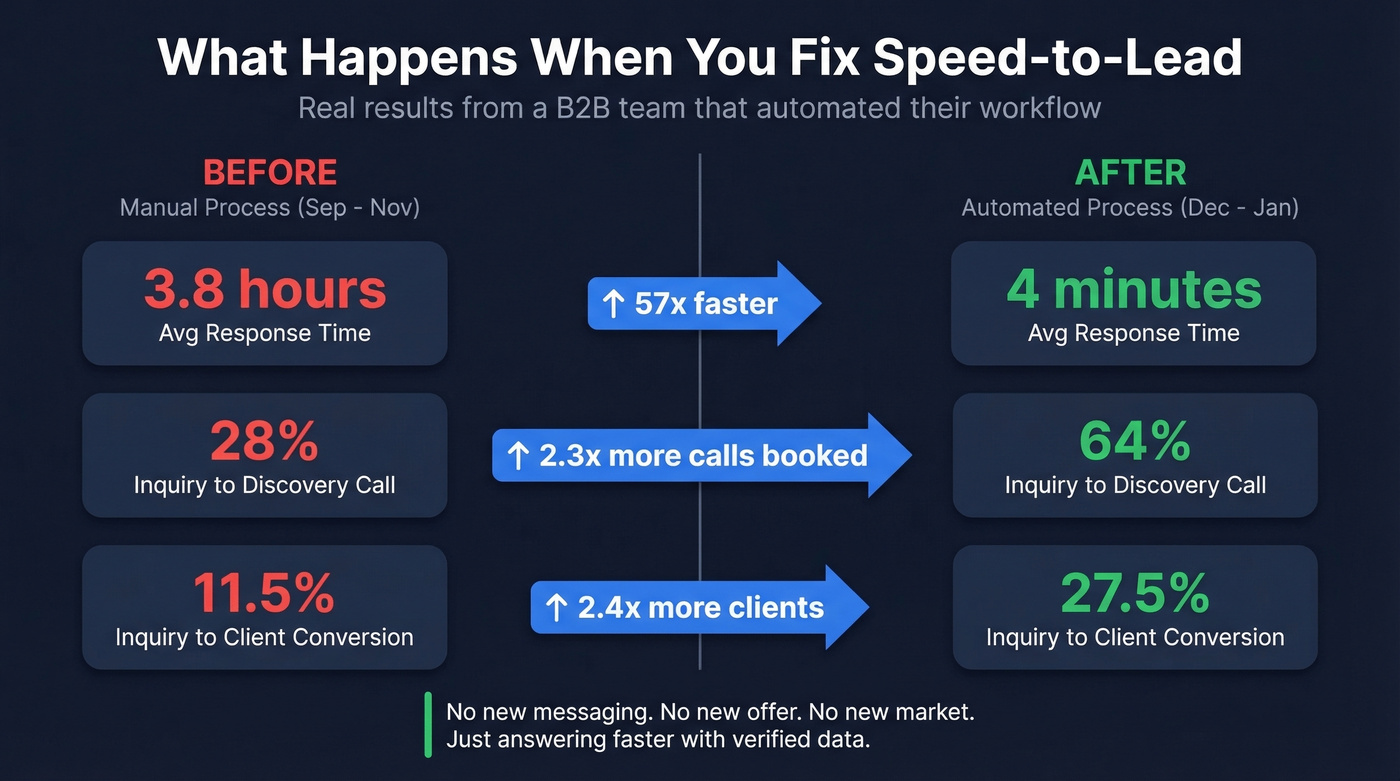
The biggest lift was at the top of the funnel. Inquiry-to-discovery-call booking jumped from 28% to 64%. But close rate barely moved - 41% to 43%. Speed didn't make them a better closer. It just got dramatically more people on the phone.
That's a 2.4x improvement in conversion from a single operational change. No new messaging. No new offer. No new market. Just answering faster with working contact data. A thread on r/Entrepreneurs echoed the same consensus - automation plus booking links are non-negotiable, even for solo founders. Skip the fancy playbooks if your fundamentals aren't there yet; get the response time and data quality right first, and the rest follows.
If you're tightening this end-to-end, it helps to map the whole lead generation workflow and define lead status rules so routing and reporting stay clean.
You just built the automation stack. Routing is instant, Slack alerts fire, reps dial in under 5 minutes. Now make sure they reach a real person. Prospeo's 5-step verification eliminates disconnected numbers and bounced emails before they enter your workflow - starting at $0.01 per email.
Stop burning SLA wins on dead contacts.
FAQ
What's the ideal lead response time?
Under 5 minutes for phone and form fills, under 2 minutes for live chat. HBR's 2011 study and Drift/Salesloft's 2024 report both confirm leads contacted in this window convert at dramatically higher rates - up to 21x more likely to qualify.
Does an auto-reply count as a response?
No. The SLA clock doesn't stop until a human connects or the prospect books a meeting. Use auto-replies to acknowledge the inquiry and embed a self-scheduling link, then follow up personally within 5 minutes.
How do I handle leads that come in after hours?
Automate an instant acknowledgment with a self-scheduling link. Drift data shows 41% of meetings booked through chat happen outside business hours - that's 4 in 10 opportunities you lose without after-hours automation.
What if my team responds fast but can't connect?
The problem is usually data quality, not speed. Verify contact data before activating outreach. Stale phone numbers and bad emails are the most common connection failures, and no amount of speed fixes a disconnected line.
How long before a lead goes cold?
Qualification odds drop 10x between 5 and 10 minutes, and 100x between 5 and 30 minutes. After an hour, you're competing with every vendor who responded faster. After 24 hours, most leads have moved on entirely.