

How to Address a CEO in an Email: The Decision Framework Nobody Gives You
Your SDR sends a cold email to a Japanese CEO starting with "Hey Takeshi" - no last name, no honorific, no pleasantries. The email gets ignored. Not because the offer was bad, but because the greeting signaled zero cultural awareness. Five words at the top of your message can kill a deal before the first paragraph loads.
A Babbel survey of 2,000 U.S. office workers found that 88% have regretted an email right after sending, and 28% say an email has actually hurt their career. CEOs read 200+ emails daily and decide within seconds whether yours is worth their time. Personalization starts with the greeting, not the pitch - and 59% of marketers already know that personalization drives engagement.
We've watched SDRs lose real pipeline over exactly this kind of misstep. The right salutation is the first filter. Get it wrong and nothing else matters.
The Quick Decision Framework
Before you write anything, run through these four scenarios:
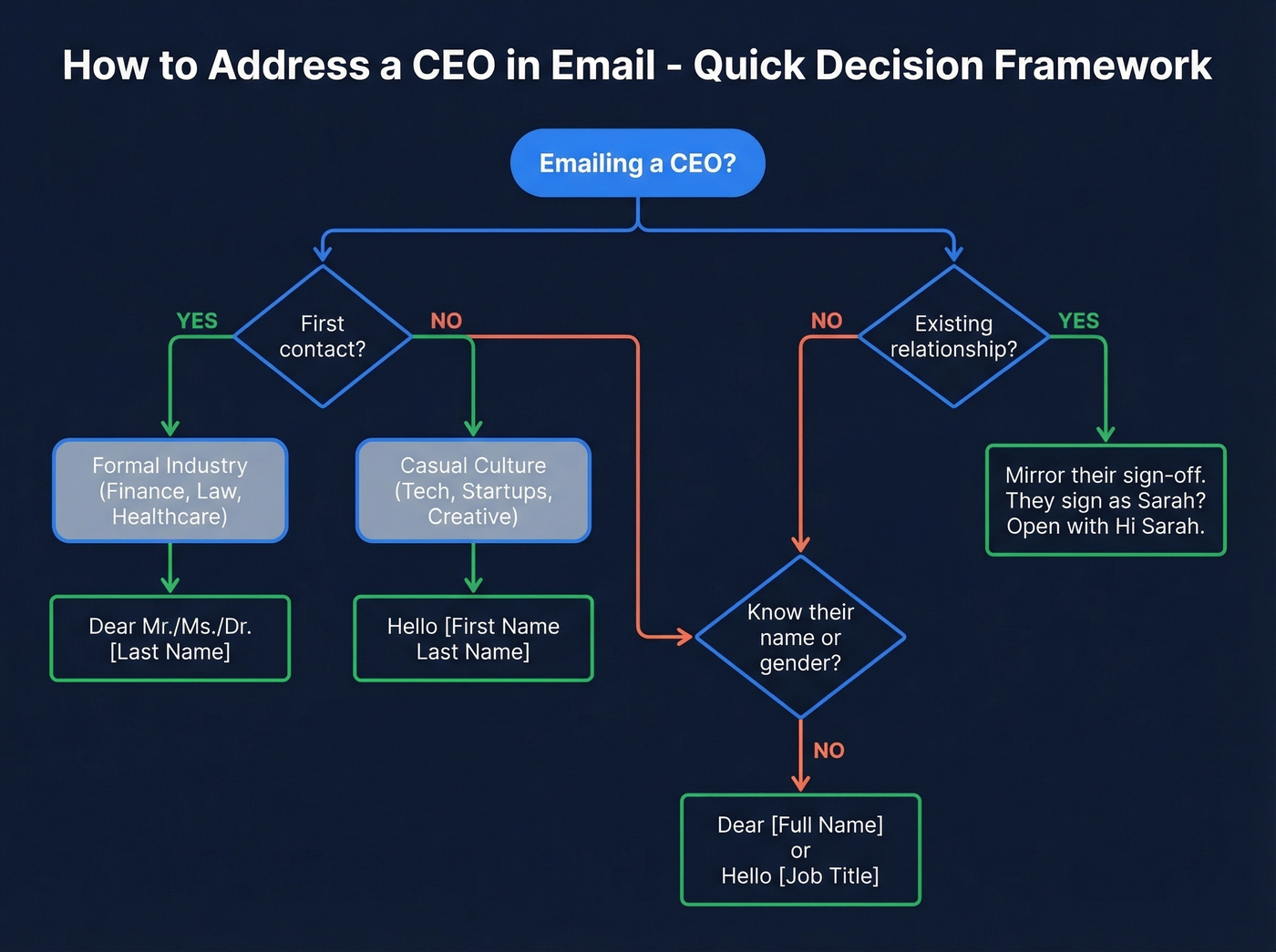
- First contact, formal industry (finance, law, healthcare) - "Dear Mr./Ms./Dr. [Last Name]"
- First contact, casual culture (tech, startups, creative) - "Hello [First Name Last Name]"
- Established relationship - Mirror their sign-off. If they sign as "Sarah," open with "Hi Sarah."
- Don't know their name or gender - "Dear [Full Name]" or "Hello [Job Title]"
That covers most situations. Below you'll find the full reasoning, international rules, gender-neutral options, templates, and how to find a verified CEO email before you hit send.
Formal Greetings and Titles
"Mr./Ms. + last name" is the safest default for CEO greetings. It's formal without being stiff, and it works across nearly every English-speaking business context. Use "Dear" for maximum formality - board communications, investor relations, regulated industries - and "Hello" for a slightly warmer but still professional tone.
One rule people constantly break: never stack honorifics. If someone holds a PhD or medical degree, it's "Dear Dr. Smith," not "Dear Mr. Dr. Smith." Professional designations like CPA, Esq., or PhD replace Mr./Ms. They don't sit alongside them.
Nobody's ever lost a deal because their greeting was too respectful. When in doubt, go formal.
When First Names Work
The "mirror their energy" rule is the simplest hack here. If a CEO replies and signs off as "James," you've been given explicit permission to open your next email with "Hi James." Matching their formality level shows social awareness, which is exactly what executives notice.
Context matters more than title. If you work in a small company and interact with the CEO regularly, opening every email with "Dear President [Last Name]" creates distance where none exists. Read the room - or in this case, read the company culture.
Gender-Neutral Options
Here's the thing: "To Whom It May Concern" is dead for CEO outreach. If you're emailing a CEO and don't know their name, you haven't done enough research.
When you know the name but not the person's gender, "Dear [Full Name]" is your best move. "Dear Alex Morgan" works perfectly without forcing a gendered honorific. "Mx." (pronounced "mix") is gaining traction as a gender-neutral title, though adoption varies by industry. For maximum safety, skip the honorific entirely and use the full name.
Role-based alternatives like "Dear CEO" or "Dear Head of Engineering" work as a last resort, but they signal you didn't personalize. And CEOs can tell.

The perfect salutation means nothing if it lands in the wrong inbox. Prospeo gives you 98% accurate CEO emails from 300M+ verified profiles - so your carefully crafted greeting reaches the actual decision-maker.
Stop perfecting emails that bounce. Start with verified data.
International CEO Email Etiquette
This is where most people get burned. American directness can read as rude in cultures that prioritize relationship-building before business, and one small detail trips up even experienced professionals: date formats. Writing "03/04/2026" means March 4th in the U.S. but April 3rd in most of Europe and much of Asia. Spell out the month.
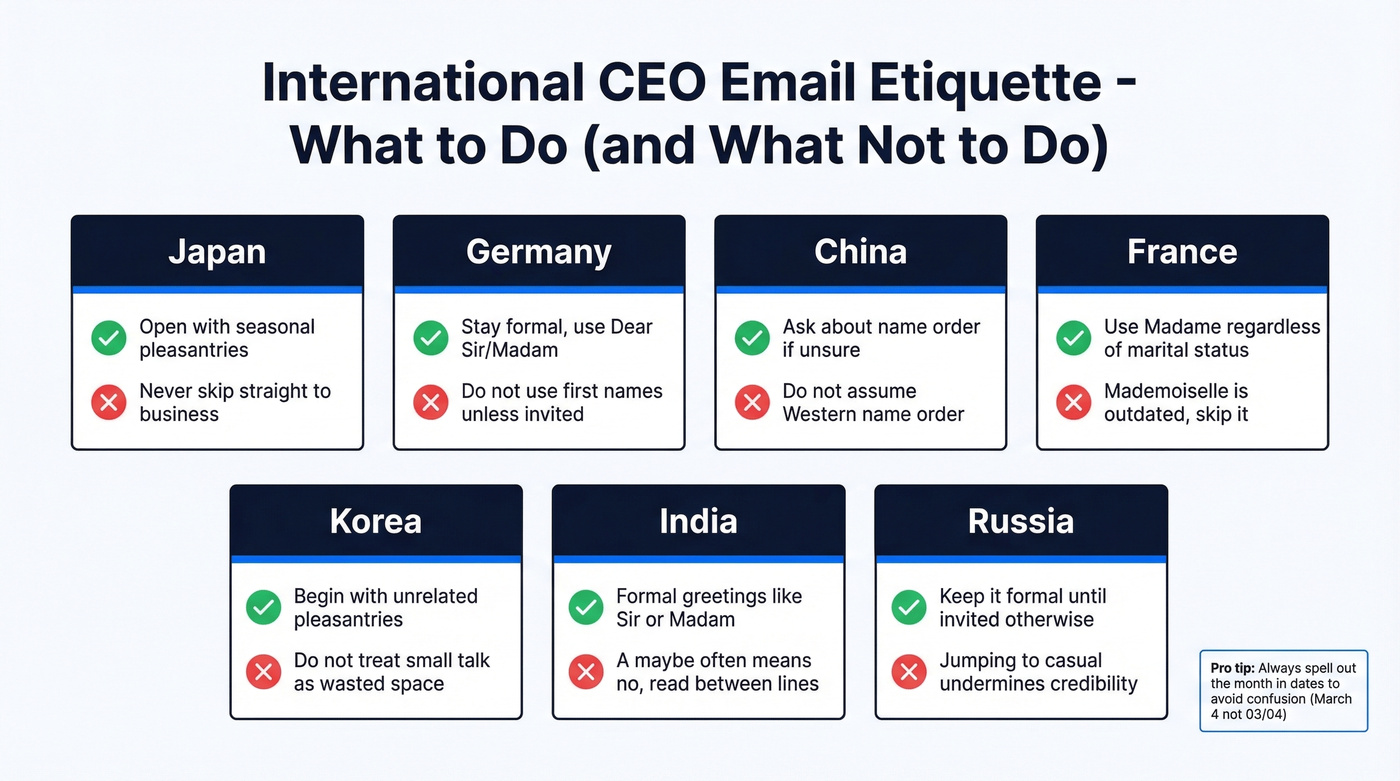
| Region | Greeting Norm | Key Pitfall |
|---|---|---|
| Japan | Open with pleasantries about the season or their company's success. Lean apologetic: "I'm sorry to trouble you, but..." | Skipping pleasantries signals you don't value the relationship. |
| Germany | Stay formal. A "Dear Sir/Madam" equivalent often shows up even within the same office. Use urgency markers like "Action Required" in subject lines - they're expected, not rude. | Don't switch to first names unless explicitly invited. |
| China | Names are often presented surname-first. Avoid addressing someone only by last name. | When unsure of name order, ask. It's a sign of respect. |
| Korea | Emails often begin with unrelated pleasantries before business. | This isn't wasted space; it's relationship maintenance. |
| India | Greetings tend formal; "Sir" and "Ma'am" are common. | A direct "no" is rare - "maybe" often means no. |
| Russia | Don't use someone's first name unless invited. | Jumping to casual too quickly undermines credibility. |
| France | "Mademoiselle" has been largely phased out. Use "Madame" regardless of marital status. | Overly casual greetings read as disrespectful. |
If you're cold-emailing a CEO at a 500-person company in an unfamiliar culture, you're probably emailing the wrong person. Target the VP or director who owns the problem you solve - they're more accessible and more likely to champion your solution internally.
Structuring the Rest of the Email
The greeting is 5% of the email. If the other 95% is a wall of text, it doesn't matter how perfectly you addressed them.
Strong structure is a sales communication advantage, not a style preference.
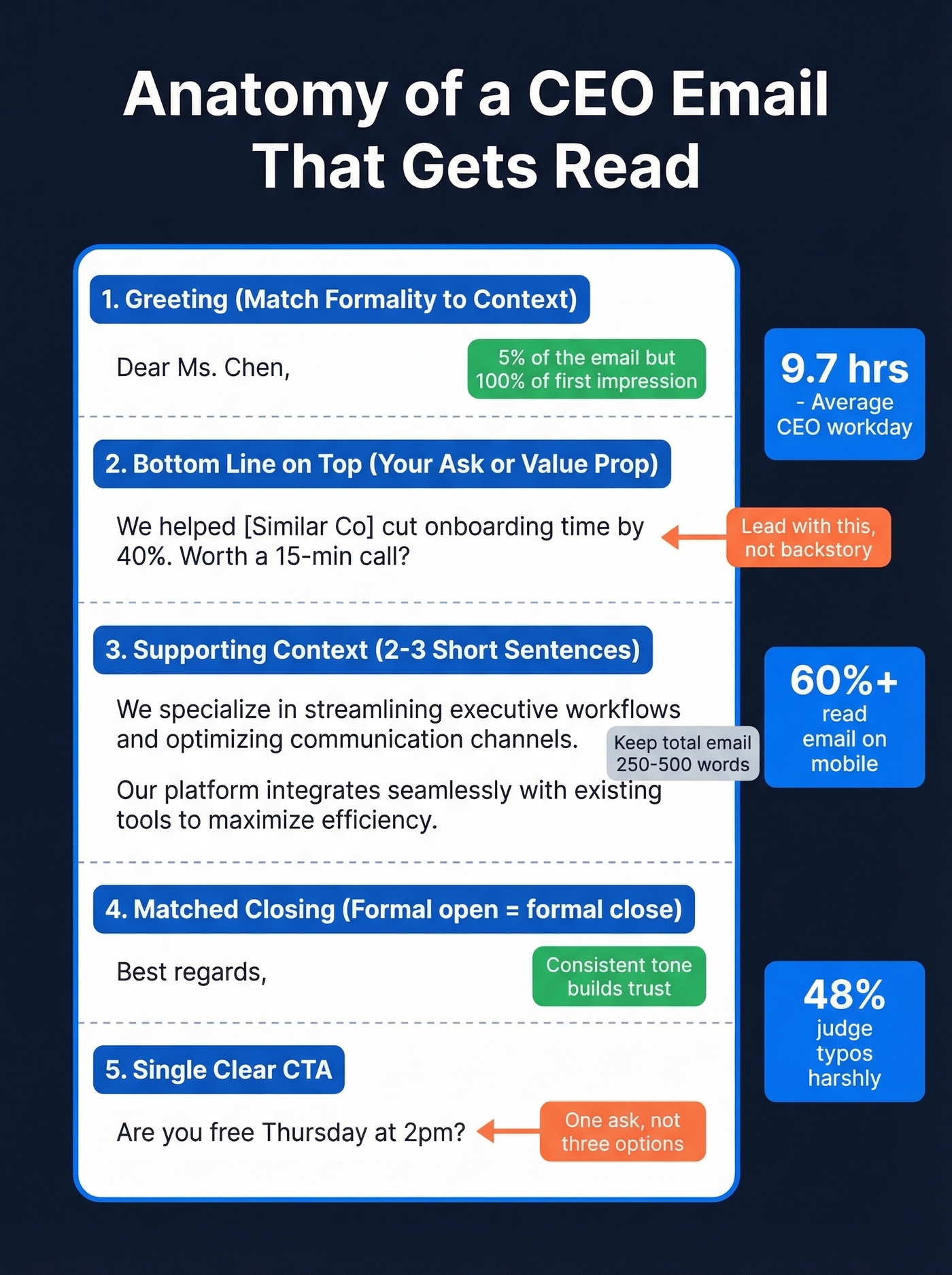
Harvard Business Review research shows CEOs work an average of 9.7 hours per weekday, so respect that with the BLOT approach: bottom line on top. Lead with your ask or your value prop, then provide supporting context. Keep it to 250-500 words. Since 60%+ of executives read email on mobile, short paragraphs and clear formatting aren't optional - they're structural requirements.
Proofread. Seriously. A Grammarly study found 48% of professionals judge typos in work emails more harshly than typos on chat platforms. One careless mistake in a CEO email can undo a perfect greeting, and we've seen it happen more times than we'd like to admit.
Match your closing to your greeting's formality. "Best regards" pairs with "Dear Mr. Smith." "Thanks" or "Cheers" pairs with "Hi James." Mismatched formality - formal open, casual close - reads as inconsistent. End with a single, clear CTA: a 15-minute call, a reply with feedback, a forwarded intro. Not three options. One specific next step that makes it easy to say yes.
Copy-Paste Templates
Cold Outreach to External CEO (Formal)
Dear Mr./Ms. [Last Name],
[Company Name]'s [specific initiative] caught my attention. We helped [similar company] achieve [specific result] in [timeframe].
Would a 15-minute call next week make sense?
Best regards, [Your Name]
Internal Request to Your CEO (Casual)
Hi [First Name],
Quick request - I need your sign-off on [specific item] by [date]:
- [Key point 1]
- [Key point 2]
- [Recommended action]
Thanks, [Your Name]
Follow-Up After No Reply
Hi [First Name / Mr./Ms. Last Name],
Following up on my [date] email about [topic]. Short version: [restate the single ask].
If the timing's off, just let me know and I'll circle back in [timeframe].
[Your Name]
Stick to three or four follow-ups maximum, spaced 3-5 business days apart. Each one should be shorter than the last. If you need more options, pull from these follow-up templates and adapt the tone to the CEO's formality.
How to Find a CEO's Email
You've nailed the greeting. Now make sure you're emailing the right address. A bounced email to a C-suite inbox doesn't just waste your effort - it damages your sender reputation, which affects every email you send afterward.
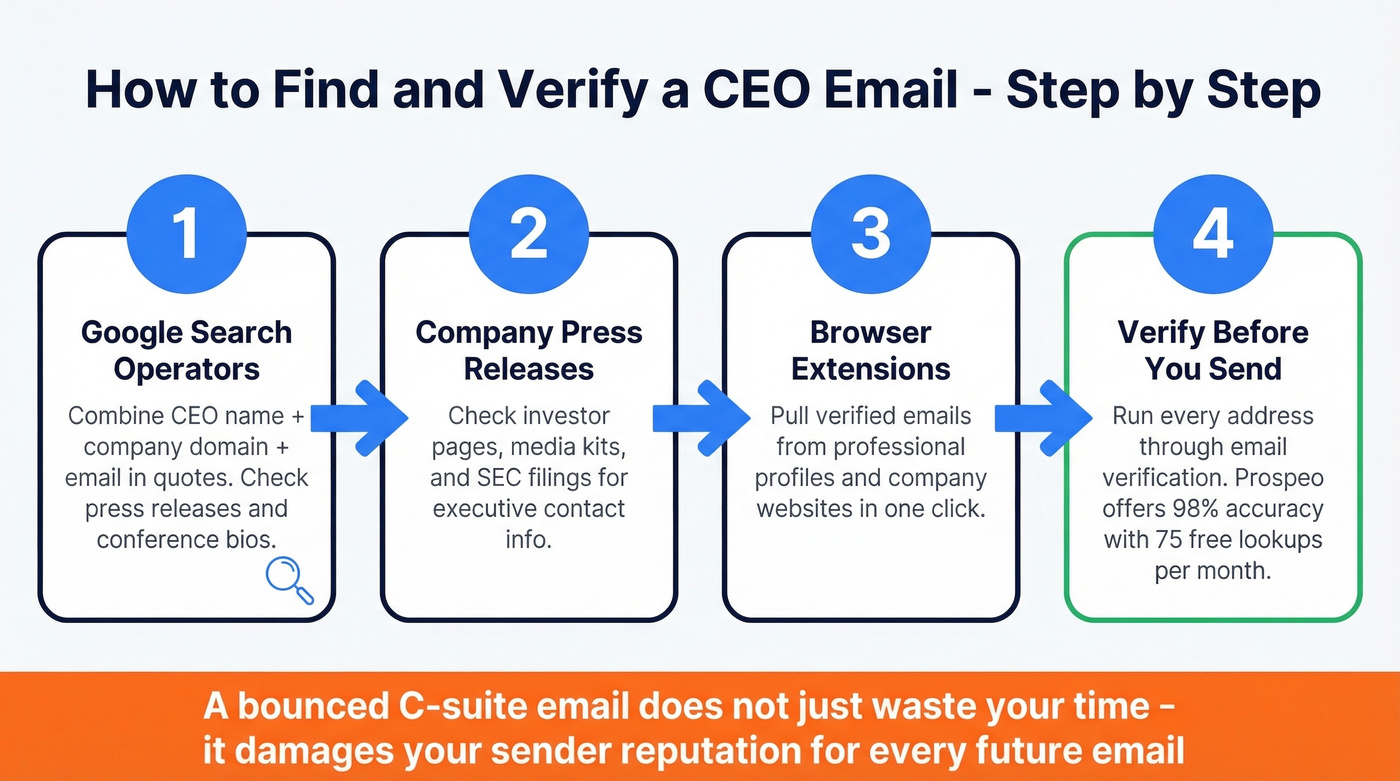
Here's what actually works:
- Google search operators - combine the CEO's name + company domain + "email" in quotes. You'd be surprised how often this surfaces a direct address from a press release or conference bio.
- Company press releases and investor pages - executive contact info frequently appears in media kits and SEC filings.
- Browser extensions - tools that pull verified emails from professional profiles and company websites in one click. (If you're comparing options, start with an email ID finder.)
- Verify before you send - Prospeo runs 143M+ verified emails at 98% accuracy with a 7-day refresh cycle, and the free tier gives you 75 lookups per month. That's enough to verify every C-suite contact on your target list without spending a dollar. If you want a broader shortlist, see these email verification options.
Let's be honest: if you're spending 20 minutes crafting the perfect CEO greeting and then sending it to an unverified address, you're doing the hard part right and the easy part wrong.
Before you stress over "Dear" vs. "Hello," make sure you have the right contact. Prospeo's Chrome extension lets 40,000+ users pull verified CEO emails and direct dials from any company website in one click - no guessing, no generic info@ addresses.
Find any CEO's real email in seconds for $0.01 each.
FAQ
Is "Dear Sir or Madam" acceptable when emailing a CEO?
Only as a last resort. "Dear [Full Name]" or "Hello [Job Title]" show you've done at least minimal research. CEOs expect personalization - generic salutations signal mass outreach and get filtered or ignored.
Should I use "CEO" or their name in the greeting?
Always use their name. "Dear CEO" tells the recipient you didn't bother to look them up. Using their actual name - even just "Dear Alex Morgan" - signals genuine interest and takes 30 seconds of research.
How many follow-ups should I send a CEO?
Three to four maximum, spaced 3-5 business days apart. Each follow-up should be shorter than the last, restating a single clear ask. After four touches with no reply, move on or try a different channel entirely.
How do I verify a CEO's email before sending?
Use a dedicated email verification tool to catch invalid addresses before they bounce. Prospeo's free tier covers 75 lookups per month at 98% accuracy with no credit card required - enough to validate an entire target account list.