

How to Be a Better Sales Coach (Templates, Scorecard & Question Bank)
It's Monday morning. You sit down for a 1:1 with your rep, pull up the pipeline, and spend 28 minutes asking "what's the latest on the Acme deal?" That's not coaching - that's an interrogation with a calendar invite. HBR nailed the starting point: most managers who think they're coaching are actually just telling people what to do.
You don't need a certification, a platform, or a personality transplant. You need a template, a scorecard, and the discipline to show up every week.
What You Actually Need
- Replace pipeline interrogations with the 10/10/10 session template below. Thirty minutes, three blocks, every week.
- Score calls with a real rubric - the 10-category scorecard in this article - instead of saying "good call, maybe tighten up the close."
- Show up consistently. Teams coached 2+ hours per week hit a 56% win rate vs. 43% for those coached under 30 minutes.
Why Coaching Drives Revenue
The numbers aren't subtle. Consistent sales coaching drives 16.7% higher revenue growth, +21.3% quota attainment, and +19% win rates. The coaching market itself hit $5.34B in annual revenue, up 17% in two years - organizations are investing because the ROI is obvious.
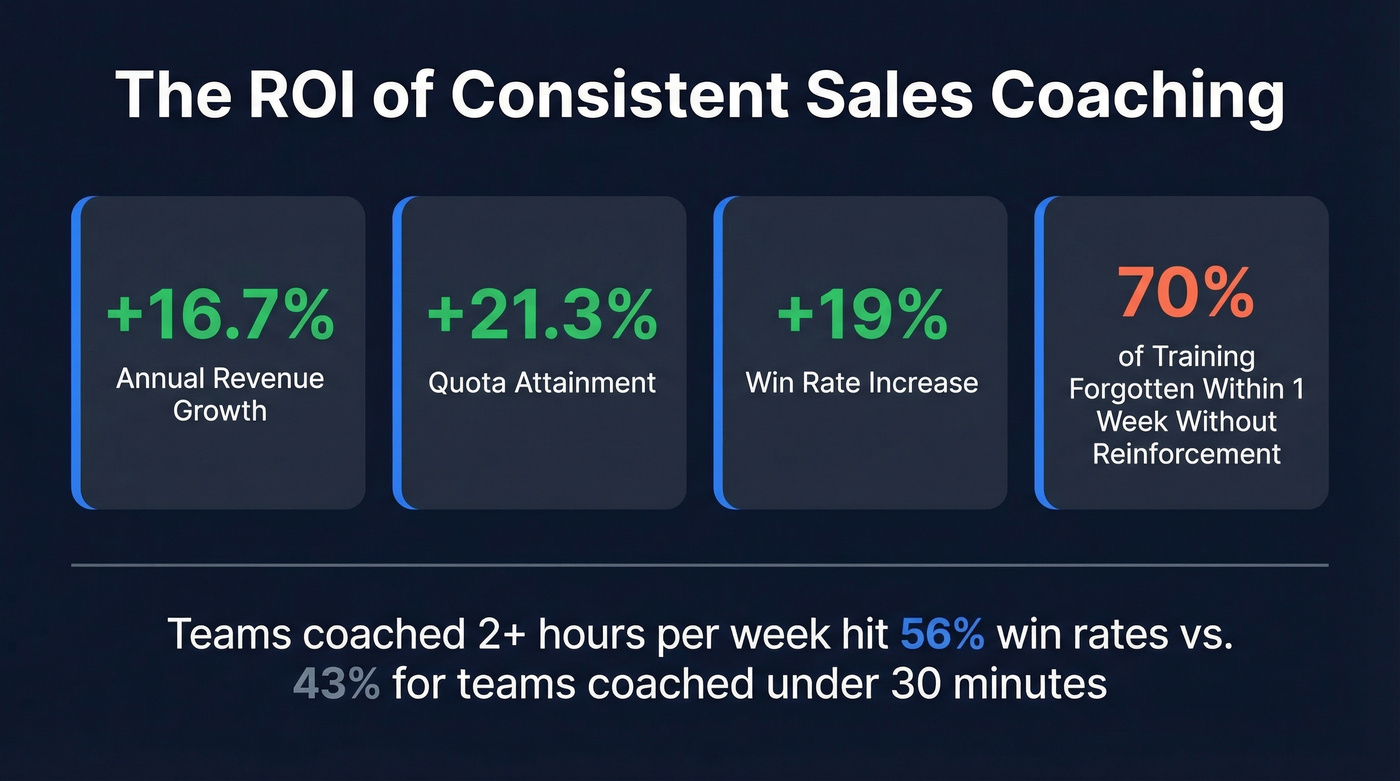
Here's the frustrating part: without reinforcement, 70% of sales training is forgotten within a week. That expensive SKO you ran in January? Already gone for most of your team. And 73% of sales managers spend less than 5% of their time coaching. The calendar killers are always the same - forecast calls, pipeline reviews, nonstop internal meetings. That's why practical frameworks beat abstract theory every time. You need structures that fit into the time you actually have, not the time you wish you had.
Seven Habits That Improve Coaching
Stop Inspecting, Start Developing
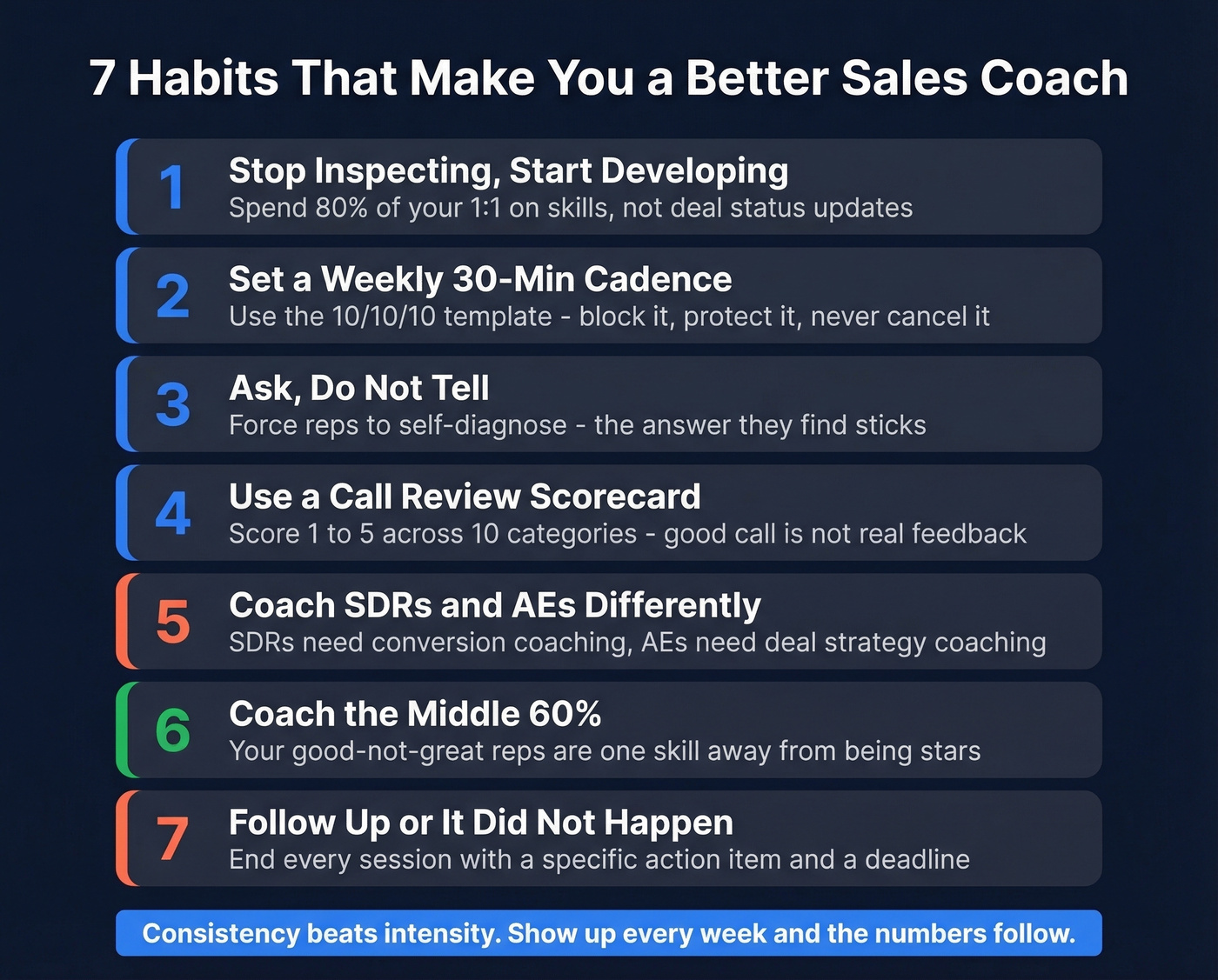
No more than 20% of your 1:1 should review deal status. The other 80% is forward-looking skill development. If you're spending half the meeting scrolling through Salesforce stages, you're running a pipeline review, not a coaching session. Rename the meeting in your head - that alone changes the dynamic.
Set a Weekly 30-Minute Cadence
Weekly 30-minute check-ins beat sporadic monthly reviews every time. The 10/10/10 structure below gives you a repeatable format, and teams that maintain this cadence hit that 56% win rate benchmark. Block it. Protect it. Don't cancel it for a forecast call.
Ask, Don't Tell
The instinct is to hear a problem and solve it. Resist. HBR's "feedback fallacy" argument is straightforward: the classic idea that more critique and more "candid feedback" automatically drives improvement is overrated. There are better ways to help people grow. Force the rep to self-diagnose:
- "What would you do differently if you ran that discovery again?"
- "Which stakeholder haven't we reached yet, and what's blocking access?"
- "What's the decision-maker's biggest concern we haven't addressed?"
The rep who finds their own answer retains it. This is one of the most effective sales coaching tips for managers - questions build ownership in a way that directives never will.
Use a Call Review Scorecard
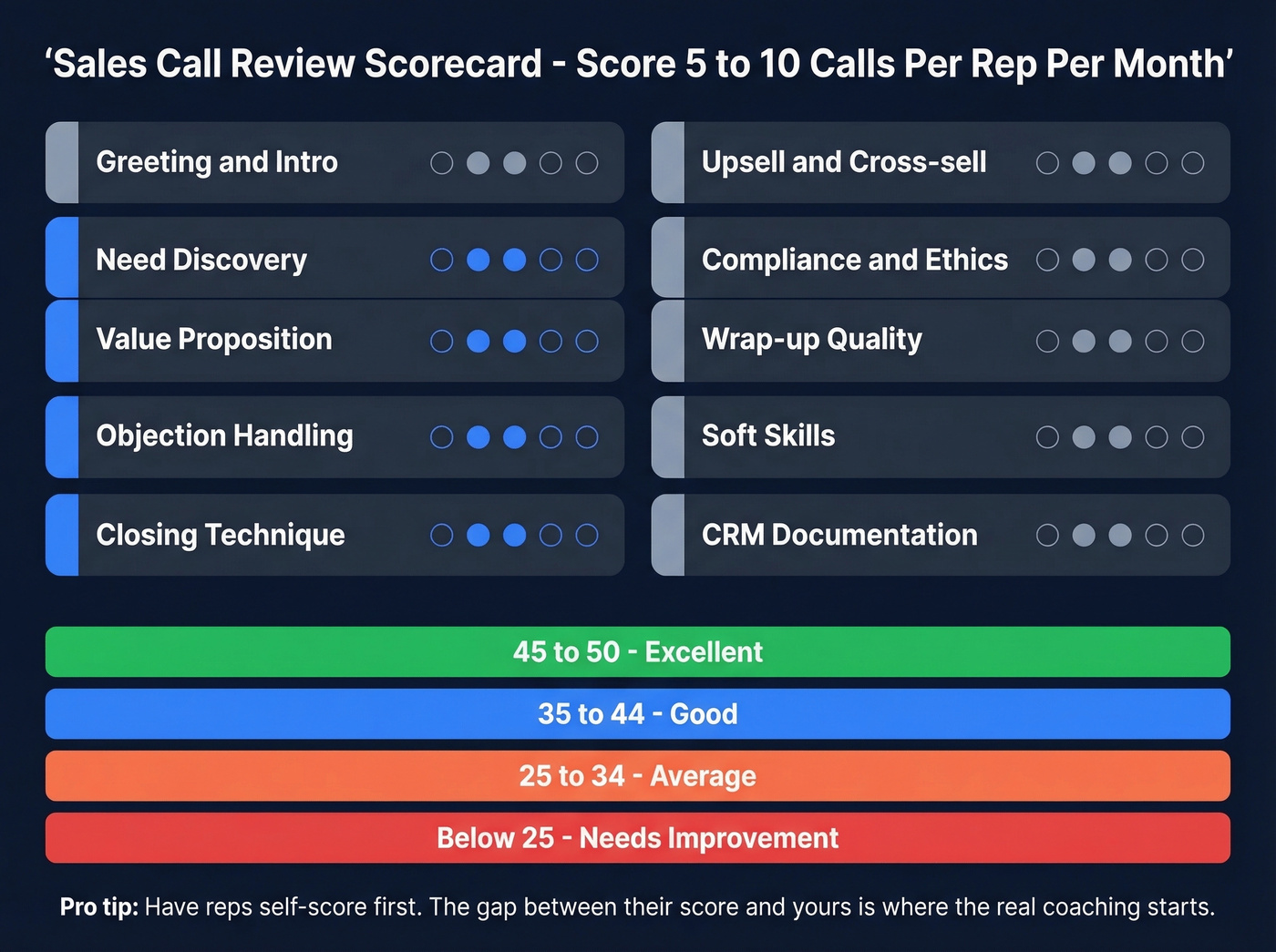
"Good call" isn't feedback. The scorecard template below gives you 10 categories scored 1-5. When you can say "your discovery scored a 2 - you asked three closed-ended questions in a row and missed the budget signal at minute four," that's coaching. Everything else is vibes. (If you want a deeper bank of prompts, pull from these discovery questions and standardize what “good” sounds like.)
Coach SDRs and AEs Differently
SDR coaching should focus on activity quality, not volume. Are they converting calls to meetings? Are emails earning replies? Coach conversion rates, not dials.
AE coaching shifts to deal strategy, multithreading into the buying committee, and discovery depth. Role-play complex objection scenarios with AEs; drill messaging and opener variations with SDRs. We've seen managers apply one-size-fits-all feedback across both roles, and it always falls flat - having distinct playbooks for each prevents that trap entirely. (If you need a baseline stack, start with a shortlist of SDR tools that support call review and coaching workflows.)
Coach the Middle 60%
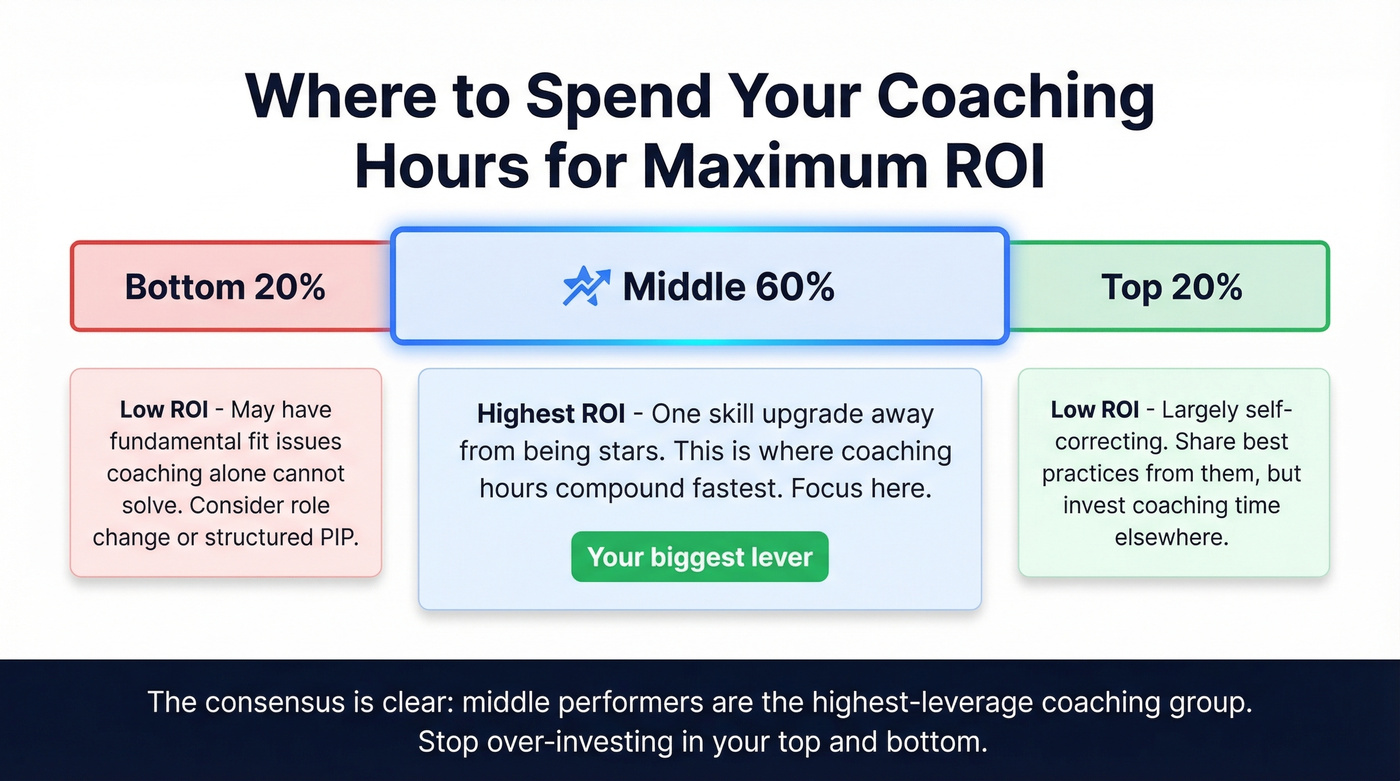
Let's be honest: your biggest coaching ROI comes from the middle 60% of your team, not the bottom 20%. Top performers are largely self-correcting. Bottom performers may have fundamental fit issues coaching can't solve. Your good-not-great reps are one skill upgrade away from being stars, and that's where coaching hours compound fastest. The consensus on r/sales backs this up - threads about coaching ROI almost always circle back to the idea that middle performers are the highest-leverage group. (This is also why tightening your sales performance management process matters: coaching sticks when it’s measured.)
Follow Up or It Didn't Happen
The GROWTH model adds two critical steps beyond the classic GROW framework: Track and Hold Accountable.
Every session should end with a specific action plan - not "work on discovery," but "record three discoveries this week using the SPIN framework, and we'll review the best one next Monday." Without deadlines, coaching conversations are just conversations. (To make follow-through automatic, keep a few sales follow-up templates ready for reps to use.)

You're coaching reps to sharpen discovery and nail objection handling - but none of that matters if they're calling the wrong people. Prospeo gives your team 300M+ verified contacts with 98% email accuracy and a 30% mobile pickup rate, so every coached skill gets practiced on real buyers, not dead leads.
Stop coaching reps to sell better into bad data.
The 30-Minute Session Template
Before the session, have your rep self-evaluate: What went well? Where did you get stuck? This primes them to be coached rather than told.
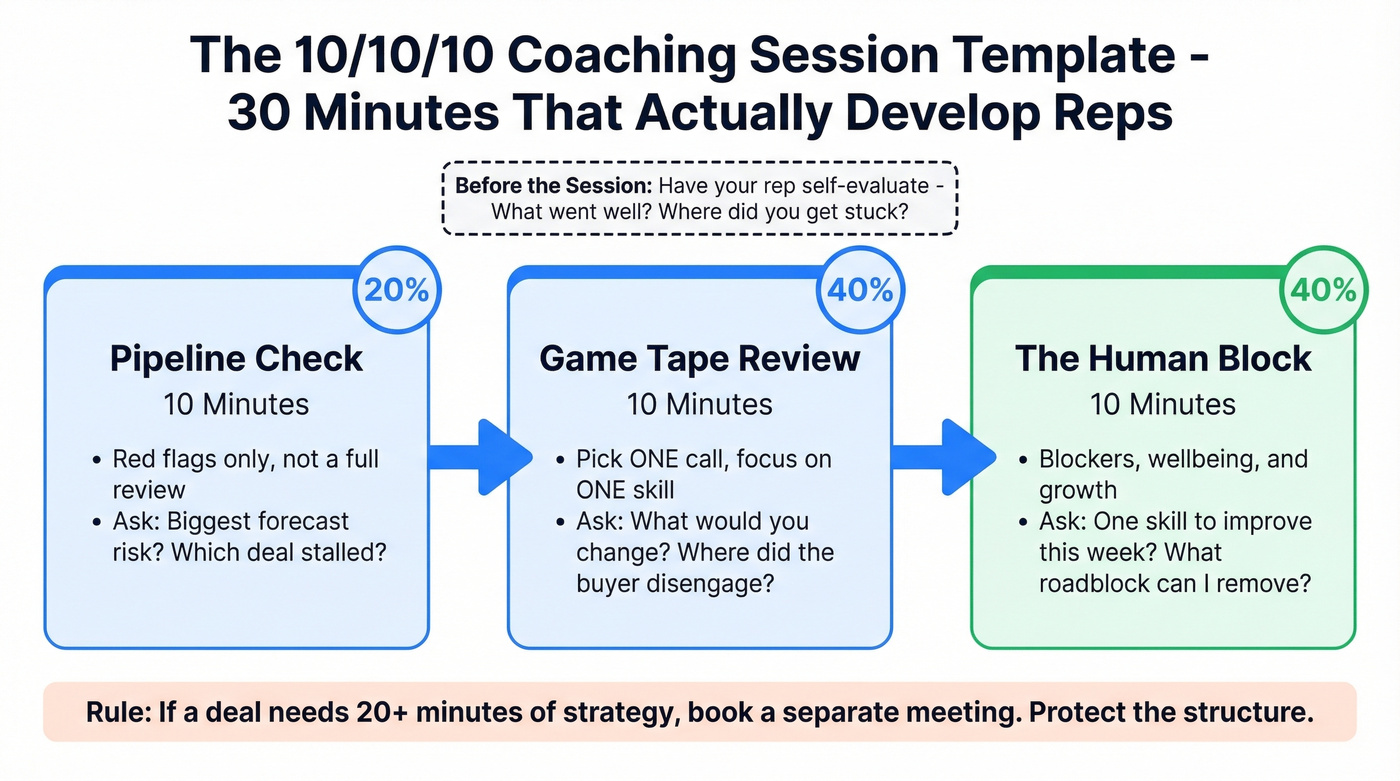
| Block | Time | Focus | Sample Questions |
|---|---|---|---|
| Pipeline | 10 min | Red flags only | "Biggest forecast risk?" / "Which deal stalled?" |
| Game Tape | 10 min | One call, one skill | "What would you change?" / "Where did buyer disengage?" |
| Human | 10 min | Blockers, wellbeing & growth | "ONE skill to improve this week?" / "What roadblock can I remove?" |
Don't let pipeline bleed into game tape time. If a deal needs a 20-minute strategy session, book a separate meeting. This template only works if you protect the structure. (If your pipeline conversations keep derailing coaching, it’s usually a sign of bigger sales pipeline challenges.)
If you implement one thing from this article, make it this.
Call Review Scorecard
Score 5-10 calls per rep per month. Have reps self-score first - the gap between their score and yours is where the real coaching conversation starts.
| Category | 1 (Poor) | 3 (Adequate) | 5 (Excellent) |
|---|---|---|---|
| Greeting/Intro | Fumbled, no rapport | Professional, basic | Warm, personalized |
| Need Discovery | Surface-level Qs | Decent probing | Deep, layered Qs |
| Value Proposition | Generic pitch | Relevant features | Tailored to pain |
| Objection Handling | Avoided/deflected | Addressed directly | Reframed to value |
| Closing | No attempt | Asked for next step | Clear commitment |
| Upsell/Cross-sell | Missed opportunity | Mentioned options | Natural expansion |
| Compliance/Ethics | Violation risk | Met standards | Exceeded standards |
| Wrap-up | Abrupt ending | Summarized steps | Confirmed + followed up |
| Soft Skills | Robotic/rushed | Engaged listener | Empathetic, adaptive |
| CRM Documentation | Missing/incomplete | Basic notes logged | Full, actionable notes |
Scoring bands: 45-50 Excellent / 35-44 Good / 25-34 Average / Below 25 Needs Improvement.
For advanced teams, weight categories: objection handling 30%, value communication 25%, closing 25%, opening/qualification 15%, process adherence 5%. Calibrate across managers quarterly - if two managers score the same call a 28 and a 41, your scorecard isn't a measurement tool, it's an opinion generator.
Coaching Tips for New Managers
If you've recently been promoted from individual contributor to team lead, everything above can feel like a lot. Start small.
Pick one rep. Run the 10/10/10 template for two weeks. Use the scorecard on a single call per session. Sales coaching for new managers isn't about mastering every framework on day one - it's about building the habit of structured, rep-focused conversations before your calendar fills with forecast meetings. Once the rhythm feels natural, expand to your full team. Your first sessions won't be perfect, and that's fine. The habit matters more than the execution early on. (If you’re also onboarding new reps, pair this with a simple 30-60-90 day plan for sales reps.)
Skip this section if you've been managing for more than a year - you already know the ramp-up feeling, and the frameworks above are ready for you to use immediately.
The Upstream Problem Nobody Talks About
You can run perfect 10/10/10 sessions and score every call - and still watch pipeline stall if your reps are calling disconnected numbers and emailing addresses that bounce. We've watched teams with great coaching cultures plateau because the data feeding their outbound was garbage. Coaching can't fix bad data. Tools like Prospeo verify emails at 98% accuracy and provide 125M+ verified mobile numbers with a 30% pickup rate, refreshing data every 7 days. When coached skills actually connect with real prospects, that's when the numbers move. (If you’re auditing your list quality, start with a quick pass using data enrichment services.)
Your middle 60% is one skill upgrade away from quota. Don't let bad contact data waste that coaching investment. Prospeo's 7-day data refresh and 125M+ verified mobile numbers mean your reps actually reach the decision-makers you're coaching them to convert.
Give your coached reps direct dials that actually connect.
FAQ
How often should I coach my sales reps?
Weekly 30-minute sessions outperform monthly reviews. Teams coached 2+ hours per week hit 56% win rates vs. 43% for those under 30 minutes weekly. Consistency matters more than session length.
What's the difference between coaching and training?
Training teaches foundational knowledge - product, process, methodology. Coaching is ongoing, individualized skill development applied to real deals and live calls. Training decays fast without coaching reinforcement; they're complementary, not interchangeable.
How do I know if my 1:1s are coaching or pipeline reviews?
Apply the 20/80 test. If more than 20% of the meeting reviews deal status, you're inspecting, not coaching. Flip the ratio to 80% skill development and call review using the 10/10/10 template above.
What tools help sales coaches improve rep performance?
A call recording platform like Gong or Chorus gives you game tape to review. A verified data provider ensures reps aren't wasting coached skills on bad numbers - 98% email accuracy and 30% mobile pickup rates mean more live conversations to coach against.