

How to Be a Good Sales Manager: Frameworks, Benchmarks, and Templates
It's your third month as a sales manager. Two reps are below 40% of quota. Your VP wants a forecast by Friday. You've got six 1:1s today and no idea what to say in any of them. Nobody taught you how to be a good sales manager - they just handed you the title and wished you luck.
Here's the uncomfortable truth: quota attainment has collapsed from 53% of reps hitting number in 2012 to just 16% in 2024. That's not a rep problem. That's a management problem. And 65% of organizations don't even evaluate coaching skills when promoting someone into a management role. They promote the best closer and hope for the best.
Most advice on this topic reads like a fortune cookie. "Communicate well." "Lead by example." We're going to skip that. What follows are frameworks, benchmarks, and templates you can use Monday morning. If you only implement one thing, make it the 10/10/10 coaching template in Section 4. Want benchmarks? Jump to the KPI table in Section 5. Just got promoted? Start right here.
The Hardest Part: Rep to Manager
Dave Anderson, one of the more respected voices in sales leadership, once said something that should be required reading for every new manager: "I want to apologize to the first group of reps I managed." He'd been promoted for his sales numbers, then managed by intimidation, hid in admin work, and failed to communicate expectations.
Challenger calls this the "Double Jump Problem." You're expected to leap from individual contributor to manager - and simultaneously from seller to coach. Those are two completely different skill sets, and nobody teaches you either one during the transition.
The skills that got you promoted - closing, objection handling, relentless hustle - aren't the skills that make you succeed as a manager. Coaching, hiring, forecasting, culture-building: these are the job now. Dale Carnegie's research on first-time leaders identifies the core competencies as communication, empathy, strategic thinking, delegation, decision-making, and conflict resolution. Notice that "crushing your own quota" isn't on the list.
Let's be honest about something: "lead by example" is the biggest lie in sales management. In practice, it means closing deals for your reps instead of developing them. You feel productive because you're selling. Your team stagnates because they're watching instead of learning. The best managers resist the urge to jump on calls and instead ask questions that force reps to think through the deal themselves.
Being a top rep is a great signal. It's not proof you can coach, hire, forecast, and build a team.
8 Skills Every Effective Sales Manager Needs
Coaching
Managers who coach effectively produce reps with 53% higher win rates. The common mistake is treating 1:1s as deal inspections instead of development conversations. Coaching is a skill, not a personality trait - and it's the single highest-leverage activity in your week.
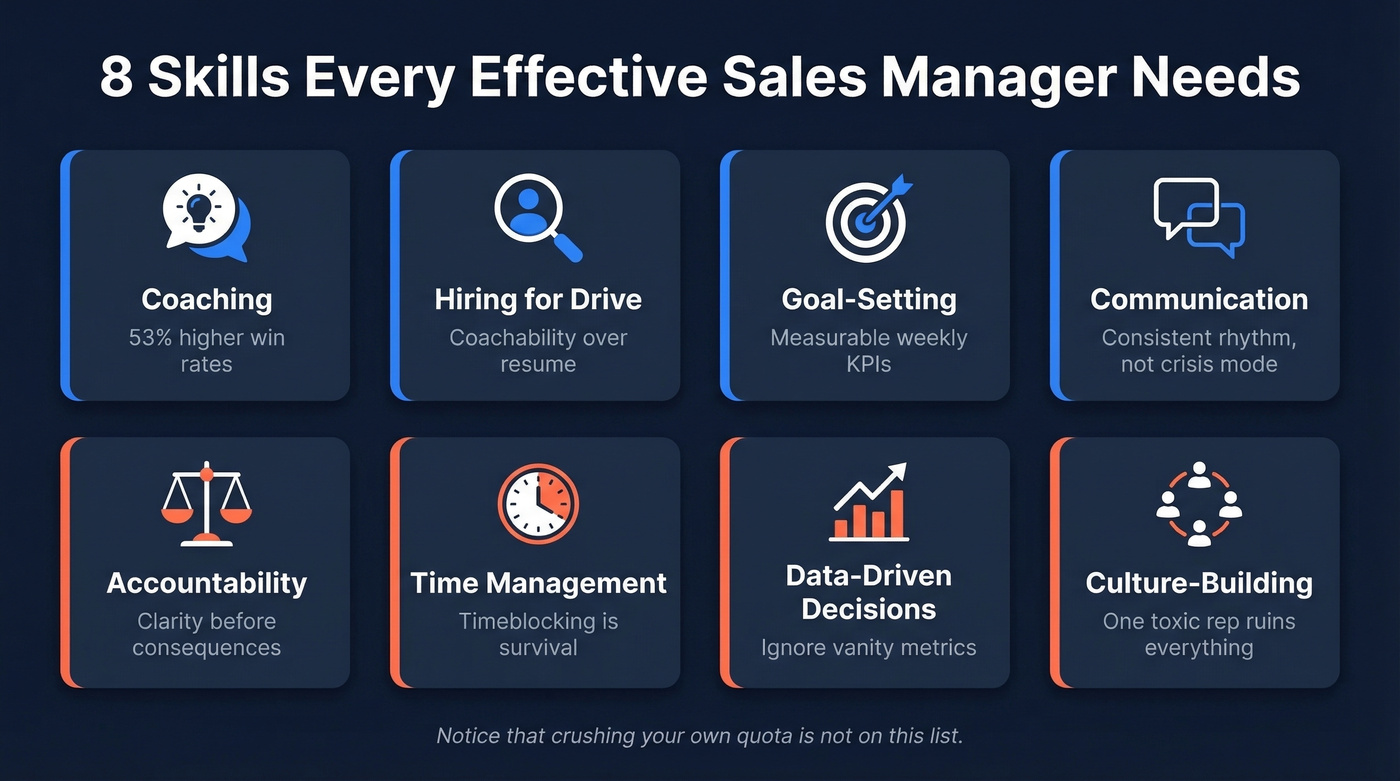
Hiring for Drive Over Experience
Hire for passion and coachability over resume bullet points. The anti-pattern is hiring someone with "10 years of experience" who actually has one year repeated ten times. Look for curiosity, resilience, and the ability to take feedback without defensiveness. We've seen hungry reps with 18 months of experience outperform decade-long veterans who stopped learning years ago.
Goal-Setting With Measurable KPIs
"Grow the pipeline" means nothing. "Add $400K in qualified pipeline by March 31 with a minimum 3x coverage ratio" means everything. The mistake is setting annual targets without weekly leading indicators.
Communication
Great sales managers establish a consistent communication rhythm - not just when things go wrong. Feedback should happen weekly or even daily. Delayed consequences lose their punch.
Accountability Without Micromanagement
"If you don't create clarity, how can you create accountability?" That's Dave Anderson, and he's right. The mistake isn't holding people accountable - it's holding them accountable to standards you never clearly defined.
Time Management
Managers juggle 60-200 tasks per day. Without a system, you'll spend your entire week firefighting. Timeblocking isn't optional. It's survival.
Data-Driven Decision-Making
Your reps can read a dashboard. Your job is to change the numbers on it. Pick a handful of KPIs that actually matter for your team's stage and obsess over those. Ignore vanity metrics.
Culture-Building
One toxic rep can destroy a team's energy in weeks. The mistake is tolerating bad behavior from a high performer because they hit quota. Brad Knepper at All Copy Products grew revenue from $1.2M to $11M in three years partly by running creative team competitions - a "Survivor"-themed contest with activity-based scoring that built energy without toxicity. That's culture as a revenue driver, not a soft skill.
The Coaching Playbook
This is the most valuable use of your time as a sales manager. Nothing else comes close.
Why You're Not Coaching Enough
Gartner found that managers spend less than 10% of their time actively coaching. Meanwhile, reps with high-performing coaches achieve 19% more sales toward goal and 53% higher win rates. Coaching within 24 hours of a call is tied to faster improvement - waiting until the weekly 1:1 means the moment is already cold.
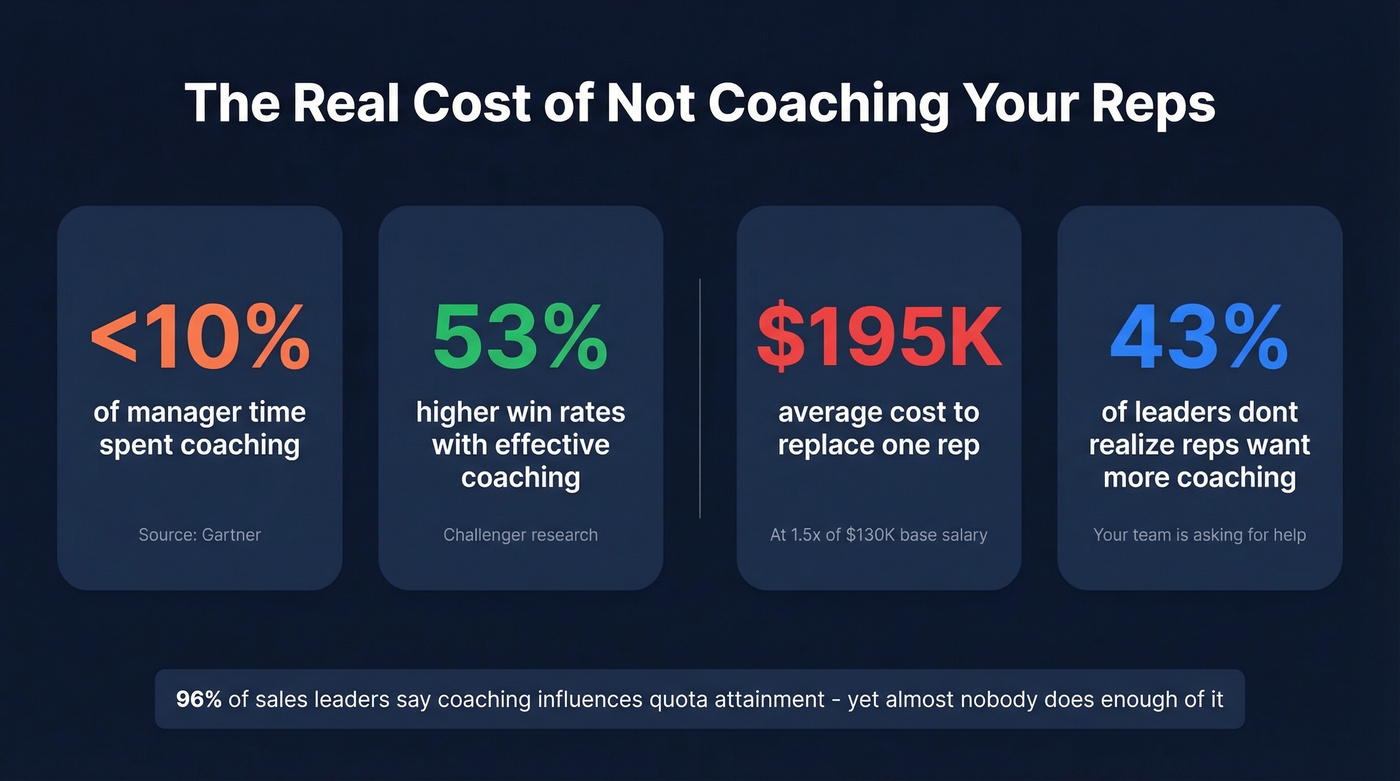
The economics are brutal. Seller turnover runs around 35%. Replacing a single rep - recruiting, onboarding, ramp time - costs between 0.5x and 2x their base salary. On a $130K base, that's roughly $195,000 at the 1.5x midpoint. Every rep who quits because of bad coaching is a six-figure loss.
And the perception gap is maddening: 96% of sales leaders say coaching influences quota attainment, yet 43% of those same leaders don't realize their reps actually want more of it. Your team is begging for development, and you're updating forecast spreadsheets.
The PAUSE Framework
PAUSE works well for sales coaching because it starts with understanding the rep, not the deal.
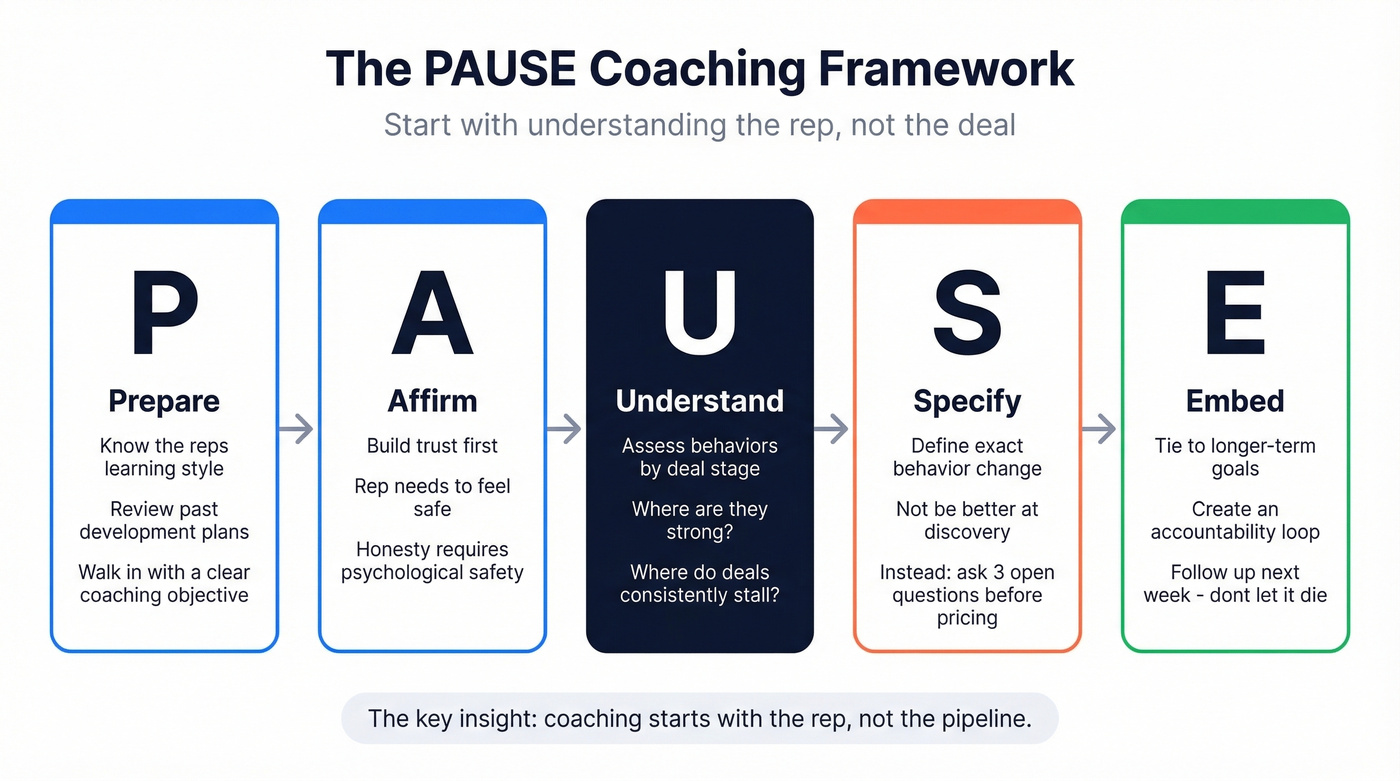
- Prepare: Know the rep's learning style, review past development plans, walk in with a clear coaching objective.
- Affirm: Build trust first. The rep needs to feel safe enough to be honest about where they're struggling.
- Understand: Assess observed behaviors by deal stage. Where are they strong? Where do deals consistently stall?
- Specify: Define the exact behavior change. "Be better at discovery" is useless. "Ask three open-ended questions before presenting pricing" is actionable.
- Embed: Tie the new behavior to longer-term goals and create an accountability loop. Follow up next week. Don't let it die.
The 10/10/10 Template (Copy This)
If you implement one thing from this guide, make it this. It's a 30-minute weekly meeting split into three equal segments:
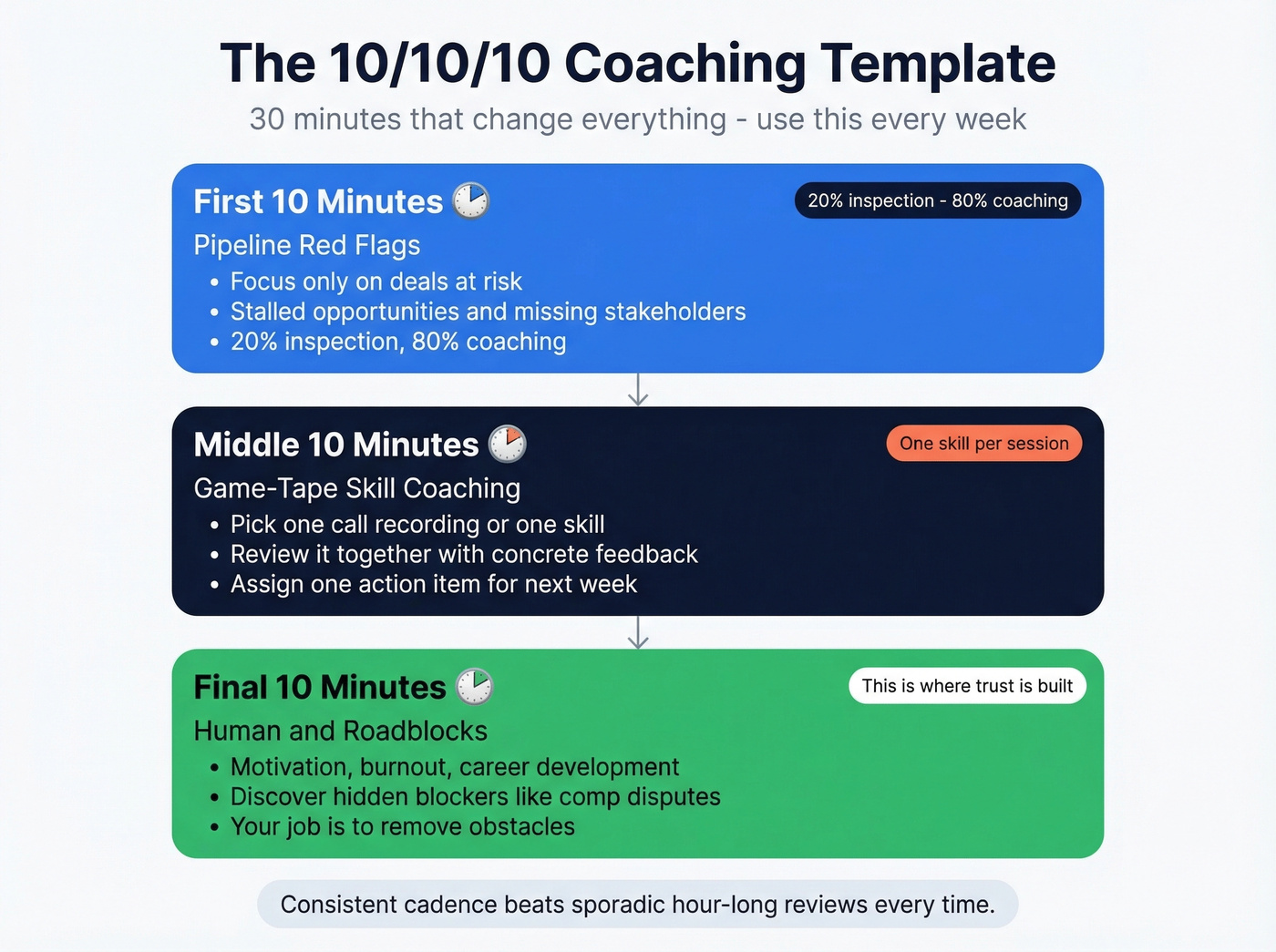
First 10 minutes - Pipeline red flags. Not a deal-by-deal review. Focus only on deals at risk: stalled opportunities, missing stakeholders, slipping close dates. Twenty percent inspection, eighty percent coaching.
Middle 10 minutes - Game-tape skill coaching. Pick one call recording or one specific skill. Review it together. Give concrete feedback. Assign one action item the rep can practice before next week.
Final 10 minutes - Human and roadblocks. Motivation, burnout, blockers, career development. This is where you discover your rep's been distracted by a comp plan dispute for three weeks. Remove obstacles - that's your job.
Seven coaching questions to rotate through your 1:1s:
- What's the biggest risk in your forecast this week?
- Which deal is missing a key stakeholder, and what's your plan?
- What's one skill you want to improve this quarter?
- Where are you getting stuck in the sales process repeatedly?
- What roadblock can I remove for you right now?
- Are you seeing any competitor patterns across your deals?
- (For newer reps) What's the most confusing part of onboarding so far?
Thirty minutes. Weekly. Consistent cadence beats sporadic hour-long reviews every time.
KPIs That Matter (With Benchmarks)
Most managers track too many metrics. These nine cover pipeline health, rep effectiveness, and team sustainability.
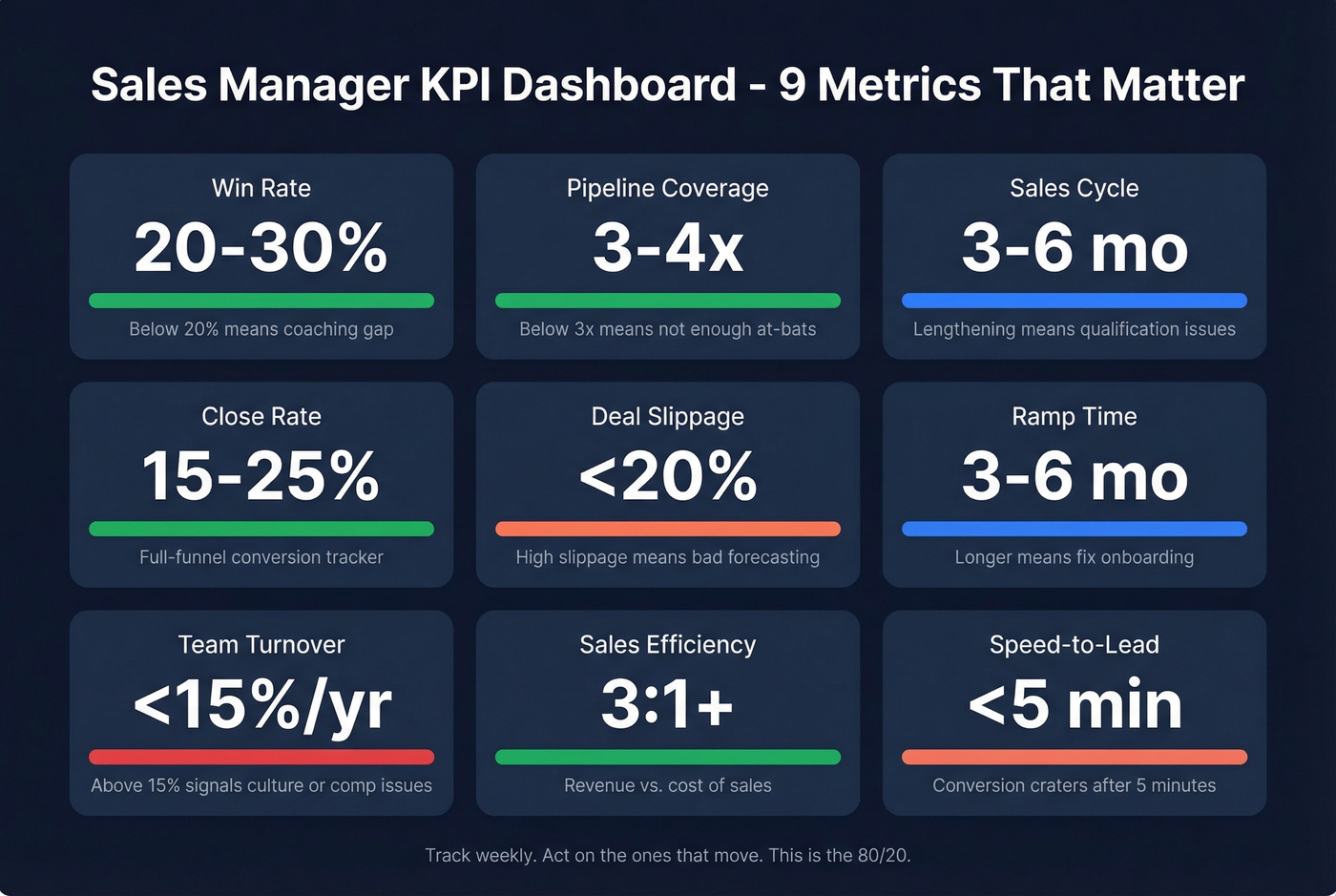
| KPI | Benchmark | Why It Matters |
|---|---|---|
| Win rate | 20-30% | Below 20% signals a coaching gap |
| Pipeline coverage | 3-4x quota | Below 3x means not enough at-bats |
| Sales cycle | 3-6 months (B2B) | Lengthening points to qualification issues |
| Close rate | 15-25% | Tracks full-funnel conversion |
| Deal slippage | <20% | High slippage means bad forecasting |
| Ramp time | 3-6 months | Longer means onboarding needs work |
| Team turnover | <15%/year | Above 15% signals culture or comp issues |
| Sales efficiency | 3:1+ ratio | Revenue vs. cost of sales |
| Speed-to-lead | <5 minutes | Conversion craters after 5 min |
Speed-to-lead deserves special attention. If your team isn't responding to inbound leads within five minutes, you're losing deals before reps even know they exist. This is a process problem, not a rep problem - and fixing the process is your job.
The essential metrics for sales managers go deeper than this table, but these nine give you the 80/20. Track them weekly. Act on the ones that move.

You just read that replacing one rep costs $195K. The fastest way to protect that investment? Give your team data that actually connects them to buyers. Prospeo delivers 98% email accuracy and 125M+ verified mobiles - so your reps spend time selling, not chasing bounced emails.
Stop coaching reps through bad data. Fix the inputs.
10 Mistakes That Undermine Sales Managers
We've seen every one of these destroy a team. Most managers are making at least three right now.
1. Assuming everyone works like you. You closed deals by grinding the phone. Your top rep closes by writing brilliant emails. Stop projecting your style - add structure, measure KPIs weekly, and let reps find their own path to the number.
2. Hiring on experience over drive. A candidate with 10 years and no curiosity will underperform a hungry rep with 18 months and a growth mindset. Hire for coachability.
3. Delaying necessary firings. Every week you wait, your top performers lose a little more respect for you. Coach first, PIP second - but when the data says it's not working, make the call.
4. Tolerating activity without outcomes. Lots of cold calls but no meetings. Lots of meetings but no pipeline. If the activity isn't converting, the activity is wrong - coach to the conversion gap.
5. Allowing low win rates to persist. A rep consistently below 15% win rate has a skill gap that won't fix itself. Diagnose it, coach to it, and if necessary, make a change.
6. Running 1:1s as pipeline interrogations.
| Pipeline Interrogation | 10/10/10 Coaching Session |
|---|---|
| "What's happening with Acme?" x 30 min | 10 min red flags, 10 min skill coaching, 10 min human factors |
| Rep dreads the meeting | Rep prepares and engages |
| Zero development happens | One actionable skill improvement per week |
7. Micromanaging instead of removing roadblocks. Set expectations, measure outcomes, trust the process. If you're monitoring individual email sends daily, you've crossed from accountability into control.
8. Neglecting continuous development. Companies that nail their GTM strategy are 2x more likely to meet revenue expectations. If you haven't invested in training this quarter, you're falling behind.
9. Letting negativity spread. One rep's cynicism at the team lunch becomes three reps' cynicism by Friday. Address it directly and privately.
10. Ignoring data quality. Your reps are only as good as the data you give them. If they're working off stale lists with 15% bounce rates, no amount of coaching fixes the conversion problem. Audit your data stack quarterly - skip this and you'll keep wondering why coaching isn't moving the needle.
Managing Underperformers Without Destroying Morale
Diagnose Before You Coach
Don't assume you know why a rep is underperforming. Find where deals actually die in the funnel. If top-of-funnel activity is fine but mid-funnel stalls, the problem isn't effort - it's qualification or discovery skills.
Three patterns to watch for:
- The rep avoids engaging buying influences beyond their initial contact - they're single-threaded on every deal.
- They skip the hard questions ("Why are you looking to change vendors now?") because those questions feel confrontational.
- They treat a meeting as serious intent when the prospect is just gathering information.
Your job isn't to recite pipeline numbers back to reps - it's to change the numbers. Diagnose the specific stage where deals break down and coach to that exact gap. Build a mentorship culture so you're not the only support channel - pair struggling reps with top performers who can model what good looks like in real time.
When Coaching Isn't Enough
A 30/60-day PIP should include clear weekly targets across three dimensions: activity metrics, pipeline generation, and conversion rates. If the rep hits the targets, great - they stay and you've documented the turnaround. If they don't, the decision is already made.
Delaying a necessary firing doesn't protect your team. It punishes the people who are performing. They see the underperformer coasting, they see you doing nothing, and they start updating their own resumes. Make the call within a reasonable timeframe. Your top performers are watching.
Your Daily Routine
Nobody teaches you time management when you get promoted. A front-line sales manager can face 60-200 tasks in a single day. Without a system, you'll spend every day reacting. The Eisenhower Matrix is the simplest prioritization tool that actually works, and timeblocking is the execution layer on top of it.
Morning (8-10am): Planning and pipeline review. Check overnight deal movement, flag at-risk opportunities, prep for 1:1s. Don't open Slack until this is done.
Midday (10am-1pm): Coaching sessions and customer calls. This is your highest-energy window - use it for the work that actually moves numbers.
Afternoon (1-4pm): 1:1s, team development, cross-functional meetings. Batch your meetings so they don't fragment the day.
Late afternoon (4-5pm): Analytics review and next-day prep. What moved today? What needs attention tomorrow?
Timeblocking can increase your effectiveness by up to 35%. The key is protecting your coaching blocks like they're customer meetings - because they're more important. If you're managing 6-10 reps, you need at least 3-5 hours per week of dedicated coaching time. Block it. Defend it. Guard your calendar or your calendar will consume you.
The Data Quality Blind Spot
Look - a sales manager who doesn't audit their team's prospect data is sending reps into battle with broken weapons. When your reps are emailing addresses that bounce and calling numbers that ring out, you're not just wasting their time. You're destroying their confidence and tanking conversion rates.
The diagnostic is simple: if your team's email bounce rate is above 5%, that's a data problem, not a rep problem. Fix the source before you coach the technique.
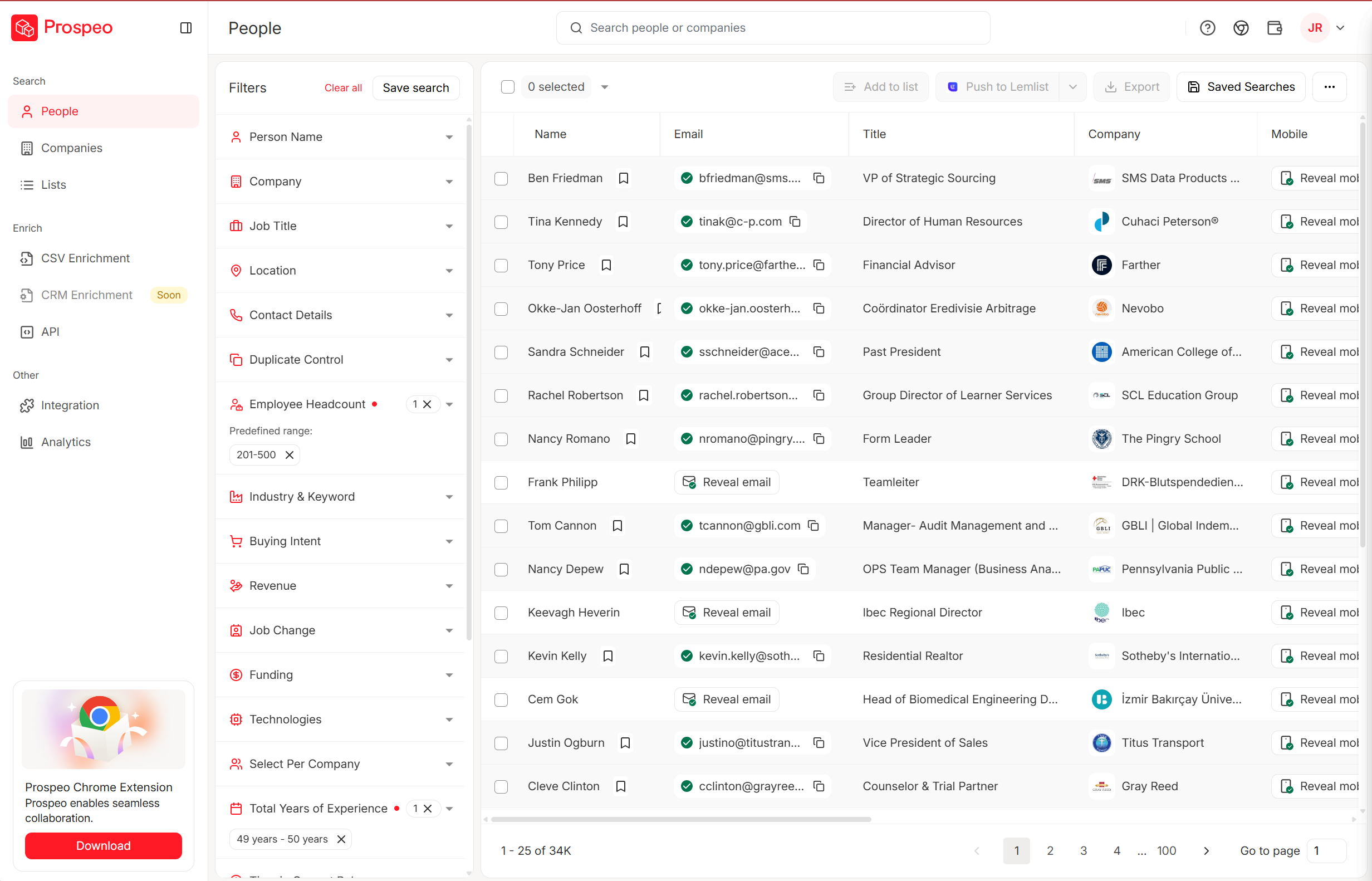
In our experience, this is where tools like Prospeo pay for themselves almost immediately - 98% email accuracy and 125M+ verified mobile numbers on a 7-day refresh cycle, so your reps aren't calling people who changed jobs two months ago. When deal sizes exceed $15K and your team's bounce rate is over 5%, bad data is costing you more per quarter than most tools cost per year. That's the easiest ROI problem a sales manager can solve.
Great sales managers obsess over leading indicators. Pipeline coverage, connect rates, meetings booked - they all collapse when your data is stale. Prospeo refreshes every 7 days and delivers a 30% mobile pickup rate, so the KPIs you track actually move.
Your forecast is only as good as the data behind it.
FAQ
What makes a good sales manager?
Eight skills separate strong sales managers from promoted closers: coaching, hiring for drive, measurable goal-setting, frequent communication, accountability without micromanagement, time management, data-driven decisions, and culture-building. Coaching is the highest-leverage skill - managers who coach effectively produce reps with 53% higher win rates.
How do you succeed as a new sales manager in your first year?
Audit pipeline quality across every rep, sit in on at least 20 calls before forming opinions, and build your 1:1 cadence using the 10/10/10 template from day one. Resist the urge to close deals yourself. Identify your top two underperformers for focused coaching and establish a consistent communication rhythm within the first 30 days.
What's the average sales manager salary in 2026?
Base salary ranges from $90K to $150K depending on segment, company size, and geography. On-target earnings typically run 1.5-2x base, so total comp can reach $180K-$300K. Enterprise SaaS and tech companies skew toward the higher end, while SMB and regional roles sit closer to the floor.
What's the best coaching framework for sales managers?
PAUSE (Prepare, Affirm, Understand, Specify, Embed) works well for structured development conversations because it starts with the rep's learning style, not the deal. Pair it with the 10/10/10 template for weekly 1:1s - 10 minutes on pipeline red flags, 10 on skill coaching, 10 on human factors and roadblocks.
How can sales managers fix bad prospecting data?
If your team's email bounce rate exceeds 5%, switch to a verified data provider before coaching technique. Prospeo offers 98% email accuracy and 125M+ verified mobile numbers on a 7-day refresh cycle, compared to the 6-week industry average. It starts free with 75 email credits per month - no contracts required.