

How to Build an Email List That Actually Makes Money
What You Need (Quick Version)
- Pick a free email platform. Kit for creators, MailerLite for small business, Brevo if you want to store lots of contacts on the free plan.
- Create one lead magnet that solves one specific problem. Aim for a 5-15% opt-in conversion rate.
Now let's get into the details.
Your List Is Your Business
Imagine you wake up tomorrow and Instagram is gone. Or your Google rankings tank overnight because of an algorithm update. Every channel you don't own can disappear without warning. Your email list can't.
Email generates $36 in revenue for every $1 spent - about 3,500% ROI, beating Google Ads (~700%) and social (~250%). Top performers see $68 per dollar, nearly double the average. There are 4.37 billion email users worldwide, heading toward 4.89 billion by 2027. And the volume keeps climbing: 376.4 billion emails are sent every single day.
The list you build today is the revenue you collect tomorrow.
Why Email Beats Every Other Channel
Pat Flynn built his email list to 200,000+ subscribers. A single broadcast email generated over $60K in affiliate earnings. His total email-attributed revenue crossed $1 million - all documented on Smart Passive Income. One creator, one channel, compounding over time.
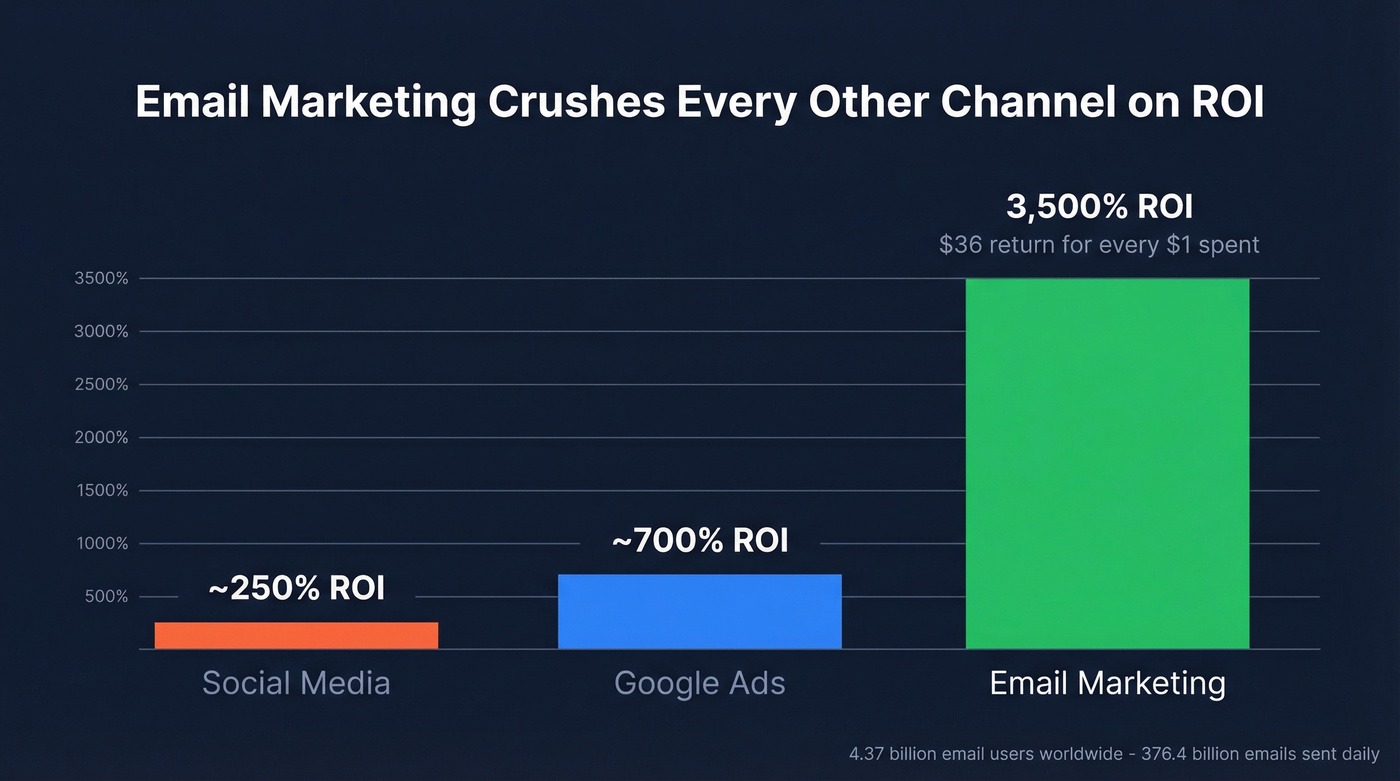
He's not an outlier. 76% of companies rank email among their top three ROI-generating channels, and the reason is simple: you own the relationship. No algorithm sits between you and your subscriber. No platform takes a cut. No feed decides whether your message gets seen.
Social followers can vanish overnight. Search rankings shift with every update. Your email list is the one asset no platform can take from you - and that's fundamentally different from a follower who might scroll past your post. It's why the smartest marketers, B2B and B2C alike, treat list building as their top priority.
Two Types of Email Lists
Most email list advice focuses on opt-in marketing lists: newsletters, welcome sequences, nurture campaigns. That's important, and we'll spend most of our time there. But there's a second type that almost nobody talks about.
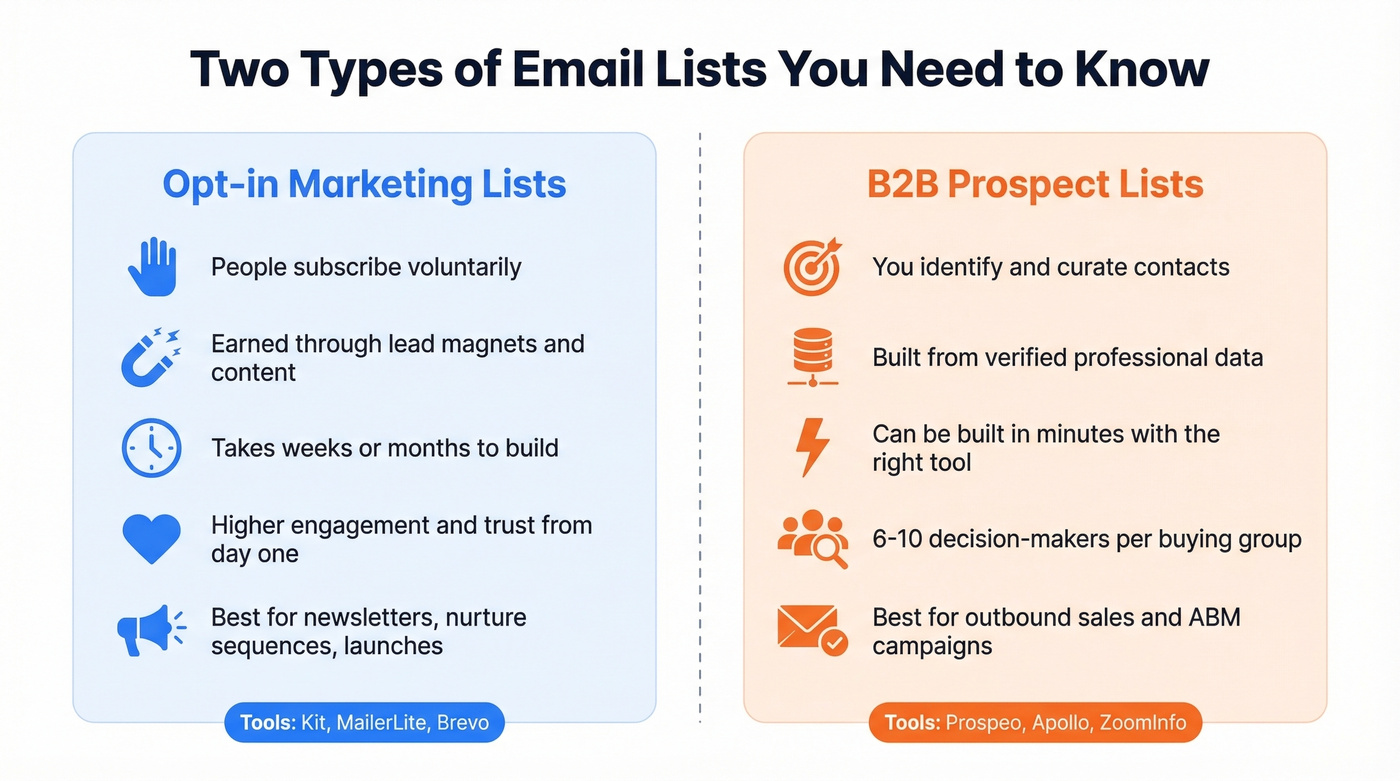
Opt-in marketing lists are people who voluntarily subscribe. You earn their attention through lead magnets, content, and value. This is the foundation of email marketing.
B2B prospect lists are curated lists of decision-makers you want to reach through outbound sales. Nobody opts in - you're identifying the right people and reaching out with relevant, personalized messages. B2B buying groups involve 6-10 decision-makers, each consuming 4-5 pieces of research before a purchase. Finding and verifying those contacts is a data problem, not a marketing problem.
We'll cover tools for both.

Opt-in lists take months to build. B2B prospect lists don't have to. Prospeo's database has 300M+ professional profiles with 143M+ verified emails - all refreshed every 7 days. Use 30+ filters to find decision-makers by intent, technographics, job changes, and more. Pay $0.01 per verified email. No contracts.
Skip the waitlist. Build a verified prospect list in minutes.
15 Proven Tactics for Email List Growth
A quick conversion reality check before we get into specifics. Not all signup methods perform equally:
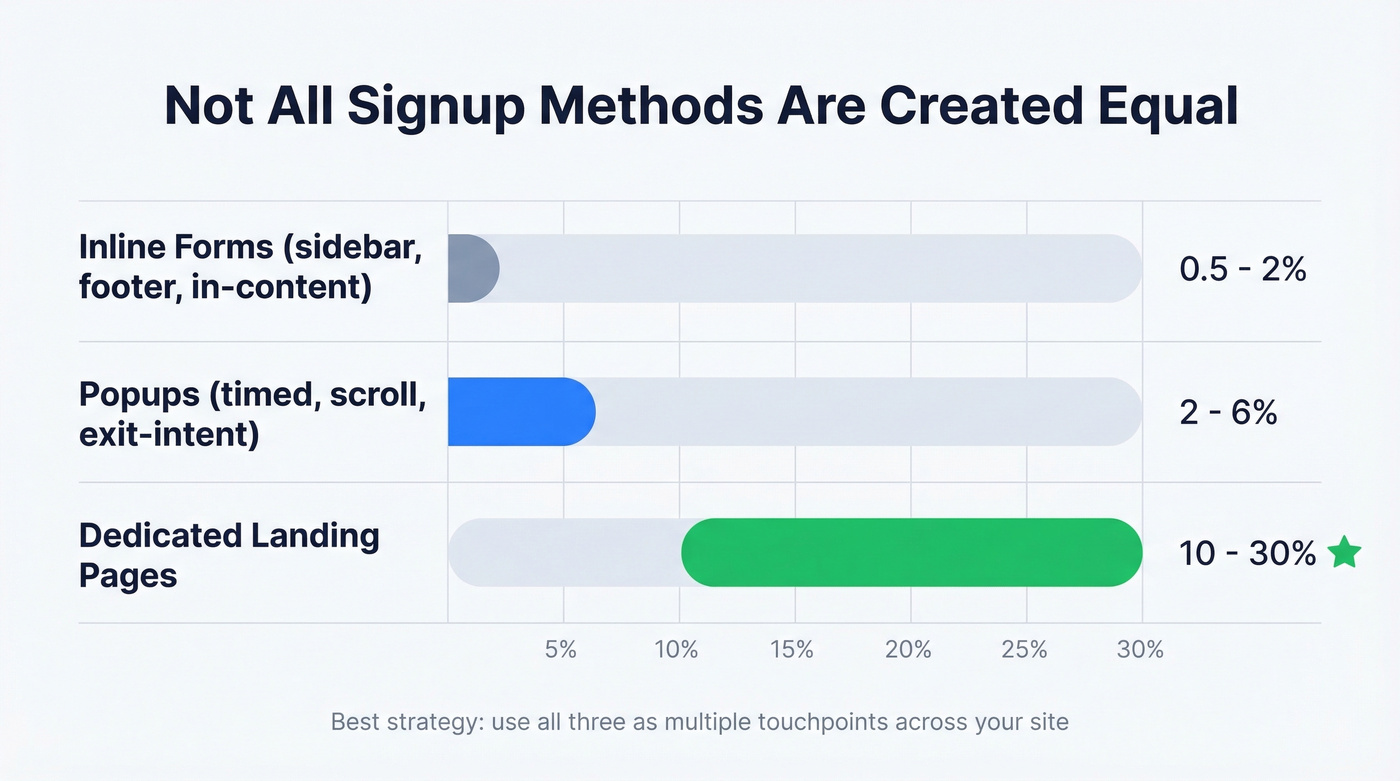
- Inline forms (sidebar, footer, in-content): 0.5-2% conversion
- Popups (timed, scroll-triggered, exit-intent): 2-6% conversion
- Dedicated landing pages: 10-30% conversion
The best strategy uses multiple touchpoints.
1. Pick a Free Email Platform
Don't overthink this. Kit gives you 10,000 subscribers with unlimited sends on its free plan - hard to beat for creators. MailerLite is cleaner for small business use. Brevo lets you store 100,000 contacts for free with a 300 emails/day send limit. Full comparison in the tools section below.
2. Create a Focused Lead Magnet
A lead magnet is the thing people get in exchange for their email address. The best ones solve one specific, urgent problem - not everything at once.
Quick wins convert fastest: checklists, templates, swipe files. Interactive formats like quizzes and calculators drive curiosity and personalization. High-value formats like mini-courses and toolkits work for higher-ticket audiences.
Here's the thing: the format matters less than the specificity. "The Ultimate Marketing Guide" converts worse than "The 5-Email Welcome Sequence Template That Converts at 3%." Every time.
Andie Swim proved this with a quiz flow that generated $70,000 in revenue over 8 months. The quiz recommended personalized swimwear, captured the email, then fed a tailored drip sequence. Specificity plus personalization equals money.
3. Optimize Form Placement (46% Lift)
EmailOpShop ran a test that should change how you think about form placement. Their client had the email opt-in CTA buried in the footer. They moved it to the header - below the nav, above the fold. No copy changes. No design changes. Just placement.
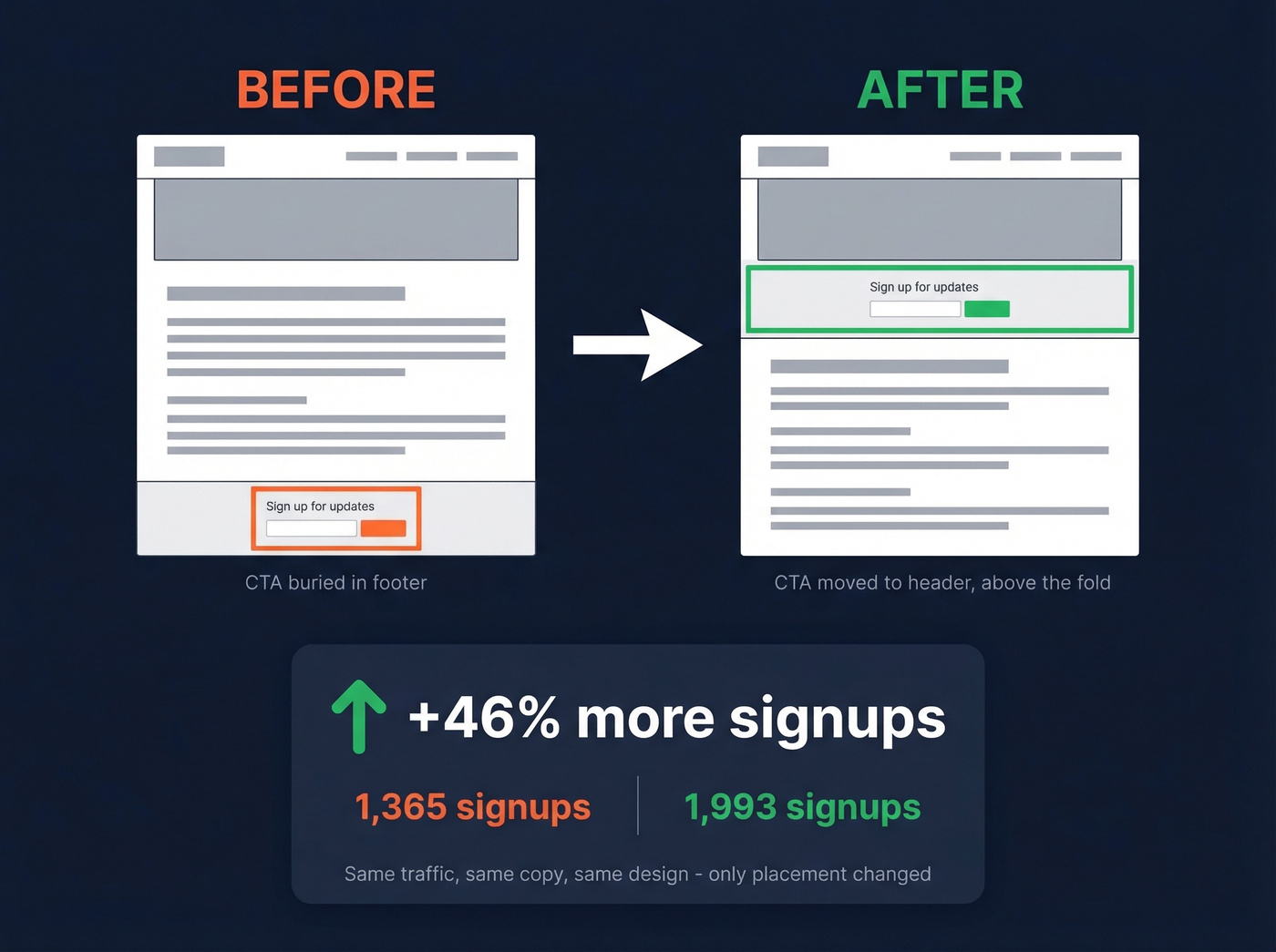
The result: a 46% increase in opt-in conversion rate. Subscriber signups jumped from 1,365 to 1,993 in the same traffic window. We've seen similar results across multiple tests - placement almost always matters more than copy.
4. Use Exit-Intent and Gamified Popups
Standard popups often convert around 3-5%. Gamified popups - spin-to-win wheels, scratch cards, pick-a-box - convert at 13.23%. That's not a marginal improvement. It's a different category of performance entirely.
Bearpaw ran an exit-intent popup that hit a submit rate 2.7x the median of their 100 closest peers. Exit-intent catches people who've already decided to leave - you're not interrupting their experience, you're making a last offer.
5. Build Dedicated Landing Pages
Landing pages convert at 10-30% because they eliminate distractions. One offer, one CTA, zero navigation links pulling attention elsewhere.
If you're running paid traffic or promoting a lead magnet on social, always send people to a dedicated landing page - never your homepage. This single change can dramatically accelerate how fast you grow your subscriber base, because every element on the page reinforces the same action instead of competing for attention.
6. Add CTAs to Every Content Piece
Personalized CTAs convert 202% better than generic ones. Every blog post, podcast episode, and video description is a signup opportunity. Match the CTA to the content: a post about email deliverability should offer a deliverability checklist, not a generic "subscribe to our newsletter" box.
7. Run a Pre-Launch Waitlist
Launching a product, course, or community? Start collecting emails before you have anything to sell. Target 500-700 signups before launch. Scarcity framing works: "Join 400 others on the early access list" outperforms "Sign up for updates" every time.
This is also a great validation mechanism. If you can't get 500 people to give you an email, rethink the offer before building it.
8. Promote Signups on Social
Do this: Tease the lead magnet content natively on the platform. Share a screenshot of one page from your template. Post one insight from your guide. Give people a reason to click through.
Not this: Drop a bare link with "sign up for my newsletter!" and wonder why nobody clicks.
Pin your signup link in your bio and header, but treat social posts as trailers for the lead magnet, not billboards.
9. Use Content Upgrades Within Posts
A content upgrade is a lead magnet specific to the blog post it lives in. Instead of a site-wide popup offering a generic ebook, you embed a relevant resource inline. A post about cold email subject lines offers a "47 Subject Line Templates" PDF.
We've tested this against site-wide popups repeatedly, and content upgrades win by a wide margin - typically 2-3x the conversion rate. Higher relevance always beats broader reach.
10. Launch a Referral Program
Referral programs become a central growth engine once you already have a core audience. The mechanics are straightforward: offer tiered rewards for referrals. Bonus content at 3 referrals, early access at 10, physical swag at 25.
A referred subscriber costs you nothing, and they tend to engage at higher rates because they arrived through a trusted recommendation.
11. Guest Appearances
Podcasts, webinars, guest posts, conference talks - every appearance should include a CTA to your signup page. Negotiate this upfront. "Where can people find you?" is the most wasted moment in podcasting if your answer is just "my website." Have a specific URL ready that points to a landing page with a relevant lead magnet, not your homepage.
12. Collect Emails Offline
Events, product packaging, receipts, business cards. A QR code pointing to a landing page with an opt-in form bridges the physical-digital gap. You can also use SMS-to-join for situations where scanning a QR code isn't practical - trade show booths, for example, where people's hands are full. Most businesses completely ignore offline-to-email conversion, which means there's almost no competition for attention in these moments.
13. Use Quizzes and Interactive Content
The Andie Swim result ($70K from a quiz) wasn't a fluke - it was good UX design. Five to seven visual questions with progress indicators and instant results. The quiz captures the email before revealing personalized recommendations, then feeds a drip sequence tailored to the answers. It's a lead magnet, segmentation tool, and sales engine in one.
14. Add Signup to Checkout
A simple checkbox at checkout captures buyers who are already in a transactional mindset. Post-purchase follow-up emails convert at 6.8% - well above typical broadcast conversion rates of 1-5%. PangoBooks implemented 20 personalized automations and drove a 63% year-over-year increase in ecommerce revenue within six months.
15. Build a B2B Prospect List
For B2B teams, you also need a prospect list for outbound - and that's a completely different workflow than opt-in forms. You're not waiting for people to subscribe. You're identifying the 6-10 decision-makers at target accounts and reaching out with verified contact data.
Prospeo covers 300M+ professional profiles with 98% email accuracy and a 7-day data refresh cycle, where the industry average sits around six weeks. You get 30+ search filters including buyer intent signals and technographics, so you're not just finding people - you're finding people who are actively researching solutions like yours. The free tier gives you 75 verified emails and 100 Chrome extension credits per month, no contracts required.

Look, if your average deal size is under $15K, you probably don't need a $15K/year data platform. Start with a free tier, validate that outbound works for your business, then scale into paid plans. Most teams overspend on data before they've even proven the channel.
B2B vs B2C - Different Rules
These two worlds require fundamentally different approaches to list building and email cadence.
| B2B | B2C | |
|---|---|---|
| Goal | Educate buying committee | Drive purchase/repeat |
| Decision-makers | 6-10 per deal | Usually 1 |
| Ideal cadence | 1-2 emails/month | Weekly (with segmentation) |
| Lead magnet style | ROI calculators, audits | Discounts, quizzes |
| Key metric | Pipeline influenced | Revenue per email |
B2B buying groups are complex. Enterprise deals can involve 16+ stakeholders, and 74% of buying groups experience internal conflict during the purchase process. Your emails aren't just convincing one person - they're arming your champion with content they can forward to skeptical colleagues.
B2C can sustain higher email frequency, but only with proper segmentation. 69% of unsubscribes cite excessive frequency as the reason. The fix isn't sending less - it's sending more relevant emails to smaller segments.
Email Benchmarks for 2026
The average open rate across industries is 42.35%, based on HubSpot's analysis of 80,000+ accounts. But that number is lying to you.
Apple Mail Privacy Protection Warning: Apple MPP has inflated open rates by 18 percentage points. With Apple Mail commanding 46% of email client market share, nearly half your "opens" are phantom opens generated by Apple's servers, not humans. If you're measuring success by open rate alone in 2026, you're navigating with a broken compass.
Focus on these instead: click-to-open rate (5.3% across industries), CTR (2.3%), bounce rate (2.48%), and unsubscribe rate (0.22%). Across all industries, a 2-5% email-to-purchase conversion rate is considered solid.
Industry conversion rates (email to purchase):
| Industry | Conversion Rate |
|---|---|
| Grocery | 7.9% |
| Fintech | 5.8% |
| Media | 4.16% |
| B2B Distributors | 2.14% |
| B2B Manufacturers | 2.18% |
| Beauty | 1.92% |
| Fashion | 1.4% |
Automated flows tell the real story of email's power. Abandoned cart sequences recover 10-15% of lost purchases. Welcome series convert at 3%. Post-purchase follow-ups hit 6.8%. These flows run on autopilot and consistently outperform broadcast campaigns by a wide margin.
Mistakes That Kill Your List
Buying email lists is a deliverability death spiral. Purchased lists violate GDPR and CAN-SPAM, tank your sender reputation, and guarantee high bounce rates. There's no shortcut here, and anyone selling you one is selling you a problem.
Automating without personalizing is almost as bad. Mail merge tokens aren't personalization. "Hi {first_name}" followed by a generic pitch signals laziness. Segment by behavior, not just demographics - what someone clicked on last week tells you more than their job title.
Sending too often is the number one unsubscribe driver. 69% of people cite frequency as the reason they leave. If you don't have something genuinely valuable to say, don't hit send.
Never cleaning your list is slow poison. Dead email addresses tank your sender reputation over time. Scrub your list quarterly at minimum - remove or suppress anyone who hasn't opened or clicked in roughly 90 days. It feels counterintuitive to delete subscribers, but a smaller, engaged list outperforms a bloated, disengaged one every time.
Ignoring mobile costs you attention. A huge share of emails are opened on phones. If your emails don't render properly on mobile, you're invisible to a big chunk of your list.
Measuring open rates as your north star is the 2026 version of vanity metrics. Apple MPP has made open rates unreliable for nearly half of email clients. Track clicks, conversions, and revenue instead.
Best Free Tools for List Building
You don't need to spend money to build your first 1,000 subscribers.
| Platform | Free Subscribers | Free Sends | Best For |
|---|---|---|---|
| Kit | 10,000 | Unlimited | Creators |
| MailerLite | 500 | 12K/mo | Small business |
| Brevo | 100,000 contacts | 300/day | High-contact storage |
| Sender | 2,500 | 15K/mo | Budget startups |
| EmailOctopus | 2,500 | 10K/mo | Simple campaigns |
| Omnisend | 250 | 500/mo | Ecommerce (small) |
| Loops | 1,000 | 4K/mo | SaaS/product-led |
Kit is the obvious winner for creators who want to grow fast without hitting a paywall - 10,000 subscribers with unlimited sends is remarkably generous. For small businesses that need more design flexibility, MailerLite's builder is cleaner. Brevo is the play if you want to store a large contact list but keep send volume low.
Skip Omnisend's free tier unless you're just testing the waters - 250 contacts and 500 sends per month won't get you far. It's better as a paid ecommerce tool than a free starter platform.
For B2B prospect lists specifically, Prospeo's free tier gives you 75 verified emails per month - enough to test outbound before committing a dollar.
If you're doing outbound, pair list building with sales follow-up templates so replies don't slip through.
Bad emails destroy deliverability - and your list-building momentum. Prospeo's 5-step verification delivers 98% email accuracy with catch-all handling, spam-trap removal, and honeypot filtering. Stack Optimize built a $1M agency on Prospeo data with bounce rates under 3% and zero domain flags.
Protect your sender reputation with emails that actually land.
FAQ
How long does it take to build an email list?
Expect 500-1,000 subscribers within 60-90 days using one solid lead magnet and one active promotion channel. Publishing weekly and promoting your signup at every touchpoint compounds faster than any single growth hack. Consistency beats cleverness.
How do I start from zero subscribers?
Create a single lead magnet that solves one urgent problem, pair it with a dedicated landing page, and promote it on whichever social platform you're most active on. You only need one great offer and one reliable traffic source to reach your first 1,000 subscribers.
Should I use single or double opt-in?
Double opt-in produces a cleaner list with higher engagement and fewer spam complaints - use it for newsletters where deliverability matters. Single opt-in grows faster but risks more bounces. For most inbound lists, double opt-in is worth the slight friction.
How often should I email my list?
B2B: 1-2 substantive emails per month. B2C: weekly works if you segment properly. The number one unsubscribe driver is excessive frequency - 69% of people cite it. Send less, but make every email genuinely useful.
What's the best free tool for B2B prospect lists?
Prospeo's free tier gives you 75 verified emails and 100 Chrome extension credits per month with 98% accuracy - no contracts or credit card required. For opt-in marketing lists, Kit offers 10,000 free subscribers with unlimited sends, making it the strongest no-cost option for creators.