

How to Choose a Sales Methodology (Without Reading Another Listicle)
Every Framework Is Basically the Same - Until It Isn't
The consensus on r/sales is blunt: "they're all basically the same." At the acronym level, that's fair - every framework boils down to need, budget, stakeholders, timeline. But organizations with a formalized methodology hit 27% higher win rates and 21% higher quota attainment than those winging it. With 84% of reps missing quota last year, "winging it" isn't a strategy.
Knowing how to choose a sales methodology for your specific motion is the difference between a forecast you trust and one you pray over.
Quick picks by sales motion:
- Enterprise SaaS ($50K+ ACV, buying committees): MEDDIC or MEDDPICC
- Mid-market ($15-50K ACV, competitive deals): Challenger + MEDDIC hybrid
- SMB / founder-led ($5-20K ACV, short cycles): Sandler or SPIN
- Inbound / product-led: SPIN for discovery + lightweight qualification
Here's the thing: the methodology matters less than whether your managers can coach it. We've watched teams agonize over MEDDIC vs. Challenger for months, then fail at both because nobody built a coaching cadence. Below is the framework to decide - and the stats that prove execution is everything.
Methodology vs. Process
Think of it as the difference between a map and driving instructions. Your sales process defines the stages from lead to close. Your methodology defines how reps navigate each stage - what questions they ask, how they qualify, when they push back. You need both, and confusing them is where most rollout plans go sideways.
The Big Five (and When Each Wins)
MEDDIC / MEDDPICC
Use this if: You're selling complex B2B sales deals with longer cycles and buying committees. MEDDIC forces you to map Metrics, the Economic Buyer, Decision Criteria, Decision Process, Identify Pain, and the Champion before a deal hits your forecast.
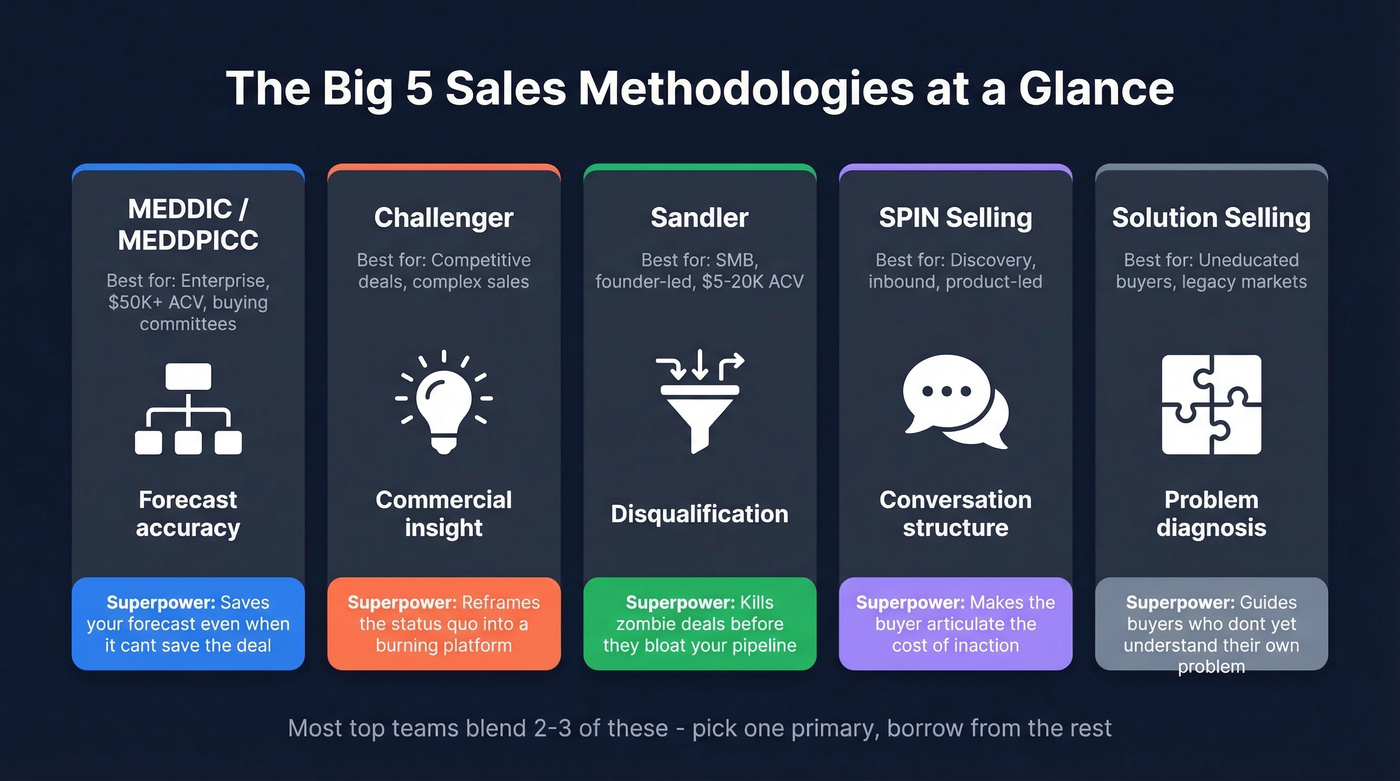
In one case, a $72K ARR ITSM deal was slipping - a MEDDIC review exposed zero economic buyer access, unquantified metrics, and no real champion. The deal still slipped, but the forecast got honest. That's MEDDIC's superpower: it saves your forecast even when it can't save the deal.
Skip this if: You're selling to a single decision-maker in low-ACV, fast-cycle deals. MEDDIC's overhead will slow your reps down without adding value.
The Challenger Sale
Challenger is built for complex deals where winning requires more than "being helpful." The CEB research studied 6,000+ reps and found that 54% of top performers in complex sales were Challengers - reps who teach, tailor, and take control.
A $350K billing SaaS deal closed because the rep reframed a "works fine" homegrown system into a growth bottleneck, quantifying revenue leakage and scalability limits. Xerox reported a 17% sales increase and $65M in contract value after implementing Challenger.
But here's the catch: if you can't get the whole company aligned around delivering commercial insight - not just sales - don't bother. Challenger without company-wide buy-in is just aggressive selling with a nicer name.
Sandler Selling System
Sandler is the most underrated framework in B2B sales, and I'll die on that hill.
It teaches disqualification - the skill most early-stage teams lack. An EdTech team selling $8-10K deals used Sandler's upfront agendas and early disqualification to cut demos, accelerate decisions, and raise close rates. Reps learned to walk away from bad deals early instead of nursing them for months. If you're founder-led, running high-volume pipeline, and tired of bloated forecasts full of zombie deals, start here.
For teams selling into large buying committees with heavy procurement and complex evaluation paths, Sandler still helps - but many pair it with a heavier qualification layer like MEDDIC sales qualification so deals don't go "feel-based" late in the cycle.
SPIN Selling
Neil Rackham built what we'd argue is the best conversation model in the business - developed from analyzing 35,000+ sales calls across 20+ countries over 12 years. A $20K chatbot SaaS deal closed because the rep used SPIN's Implication and Need-Payoff questions to make the buyer articulate the cost of inaction.
SPIN excels at discovery. It doesn't tell you how to manage a deal through procurement, so pair it with MEDDIC or Sandler for full-cycle coverage.
Solution Selling
If your buyers are already educated - and with 80% of B2B interactions happening in digital channels, most are - skip this. Solution Selling was built for guiding buyers through problem diagnosis before presenting a solution. It still works when the buyer genuinely doesn't understand their own problem, but that scenario is increasingly rare in product-led and inbound-heavy motions.

MEDDIC says identify the Economic Buyer. Challenger says teach them something new. Both assume your reps can actually reach them. Prospeo gives you 98% verified emails and 125M+ direct dials so your methodology hits real decision-makers, not dead inboxes.
Your methodology is only as good as the contact data behind it.
Matching a Methodology to Your Sales Motion
Post-mortem your last 20-30 deals. Where did deals stall - executive buy-in, procurement, technical evaluation, budget? That pattern tells you more about which framework you need than any blog post.
If you're selling enterprise B2B sales, pay extra attention to where committee deals break: economic buyer access, technical validation, or procurement.
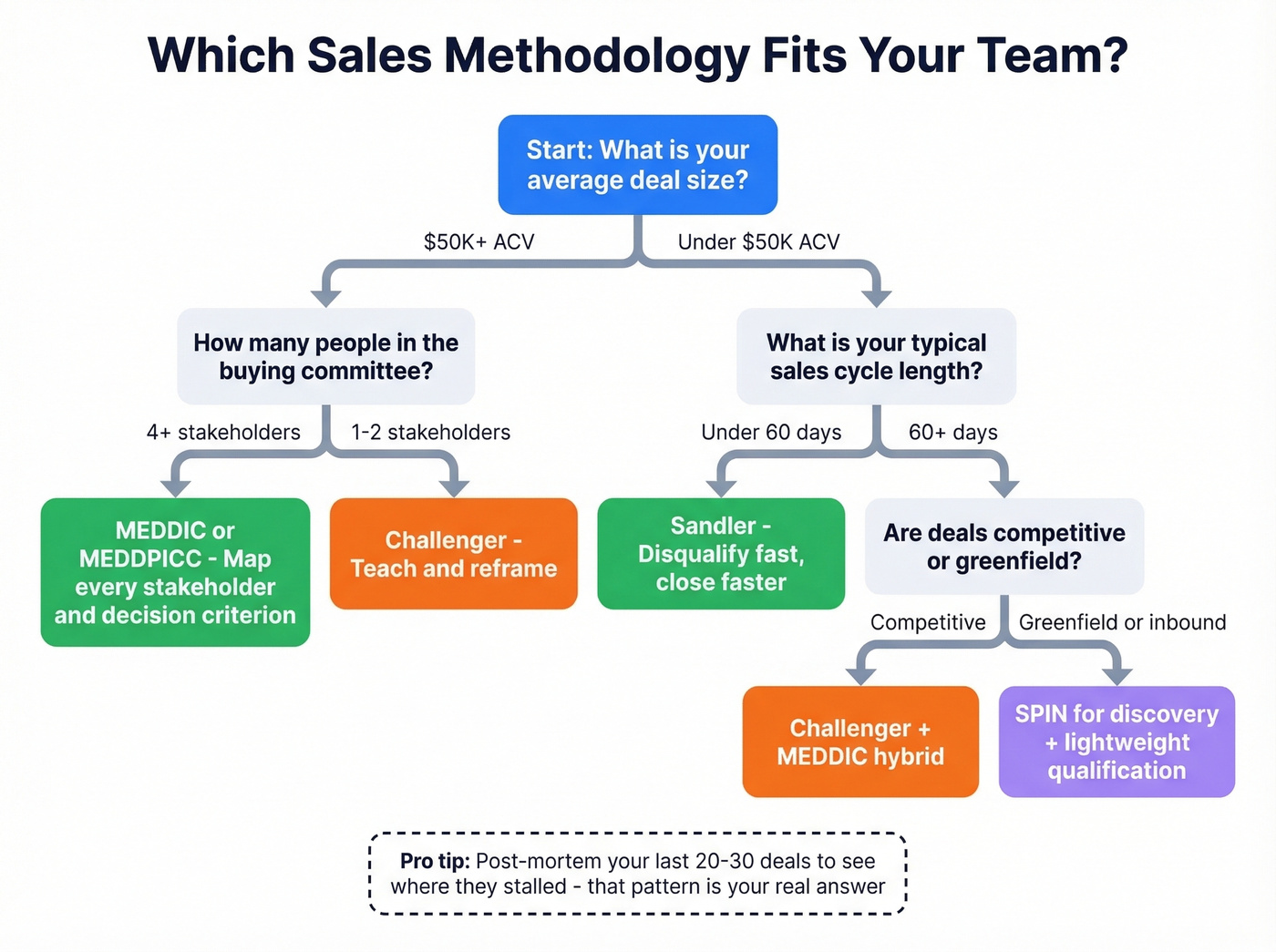
Then score each one against your reality:
| Criteria | MEDDIC | Challenger | SPIN | Sandler |
|---|---|---|---|---|
| ACV $50K+ | ★★★ | ★★★ | ★★ | ★ |
| Cycles <60 days | ★ | ★ | ★★★ | ★★★ |
| Committee 4+ | ★★★ | ★★★ | ★★ | ★ |
| Junior reps | ★★ | ★ | ★★★ | ★★★ |
| Competitive deals | ★★ | ★★★ | ★★ | ★★ |
Short cycles with junior reps? Sandler or SPIN. Competitive displacement? Challenger. Other frameworks like NEAT, SPICED, and Value Selling exist but are variations on these core approaches.
Most high-performing teams blend: SPIN for discovery, MEDDIC for qualification and forecasting, Challenger for competitive displacement. Pick one primary framework, then borrow techniques where they fit.
Why Most Rollouts Fail
Let's be honest: the methodology you pick matters about 20% as much as whether your managers actually coach it. Only 30% of organizations follow a formal methodology consistently, and 50-70% of rollouts fail to reach sustained adoption without manager-led coaching and tooling.
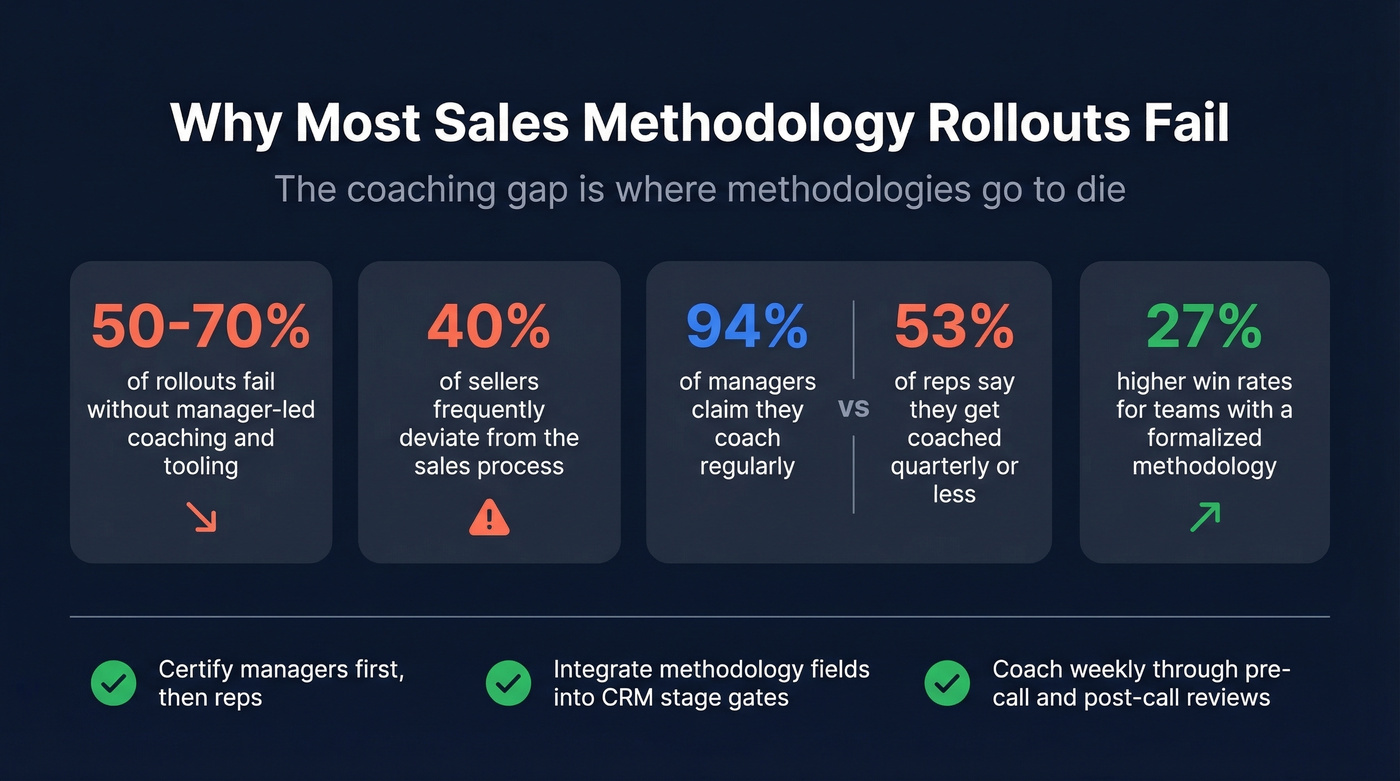
The numbers are damning. 40% of sellers frequently deviate from the sales process. Meanwhile, 94% of managers claim they coach regularly, but 53% of reps say they get coached quarterly or less. That disconnect is where methodologies go to die.
The Alexander Group identifies common pitfalls: playbooks too broad to be actionable, playbooks that don't evolve as the company changes, and playbooks that never get integrated into a routine coaching cadence. When done right, focusing reps on key plays improves productivity by up to 15%. Two other failure modes we've seen repeatedly: tribal knowledge stays locked with top reps instead of being documented, and the playbook never evolves as the company moves upstream from SMB to enterprise.
The fix is concrete. Certify managers first, then reps. Integrate methodology fields into your CRM so qualification criteria are enforced at stage gates, not just discussed in training. Deals closed within 50 days hit a 47% win rate; beyond that, you're looking at 20% or lower. Methodology drives that velocity, but only if managers reinforce it weekly through pre-call planning and post-call reviews.
If you need a practical rollout structure, bake it into your 30-60-90 day plan for new reps and managers.
The Data Problem Nobody Talks About
MEDDIC requires reaching the economic buyer. Challenger requires delivering insight to the right stakeholder. Neither works if your contact data is stale and you're emailing the wrong person.
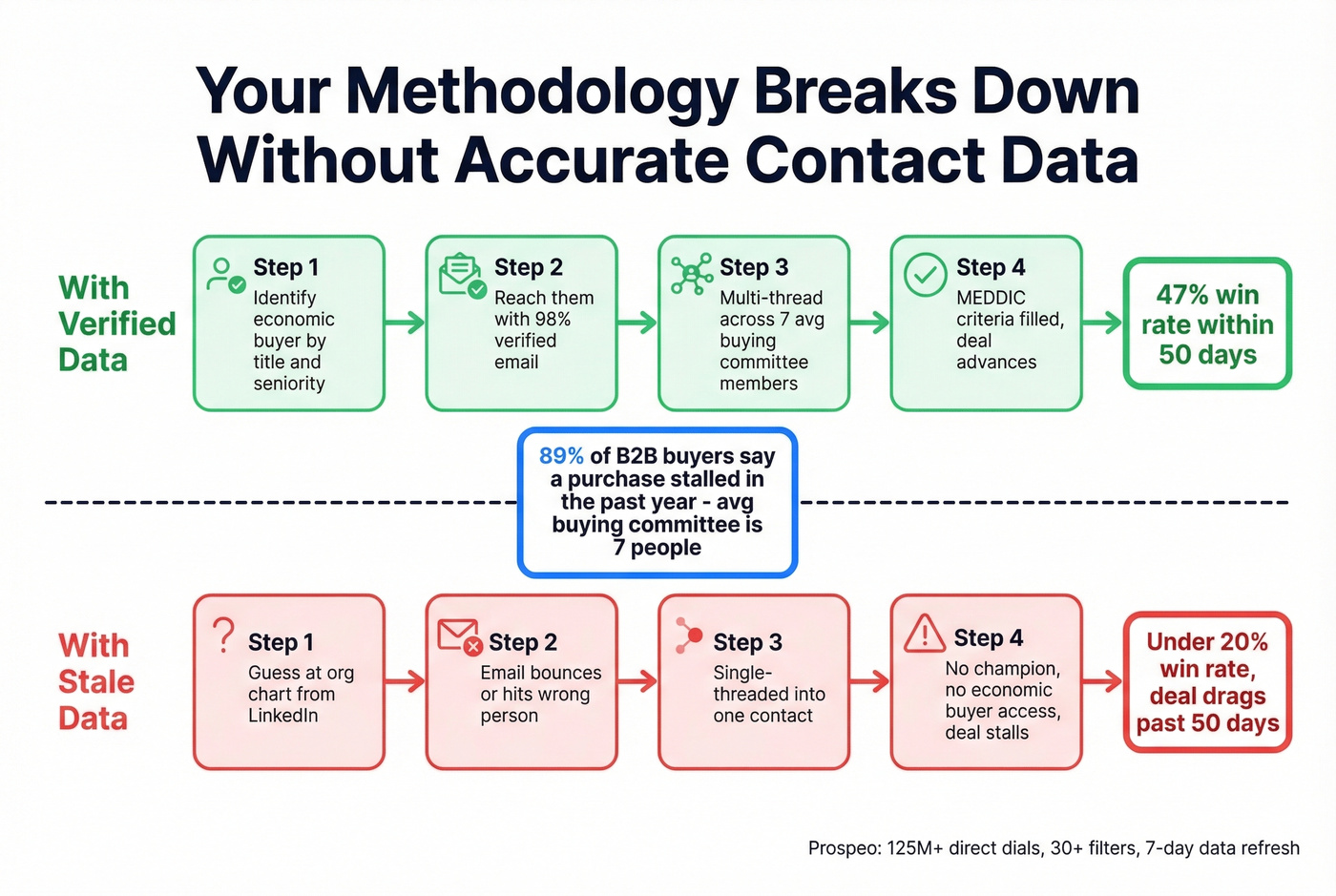
With an average of 7 people in a B2B buying committee - and 89% of B2B buyers reporting a purchase stalled in the past year - accurate multi-threaded outreach isn't optional. When you're mapping a buying committee for a MEDDIC deal, tools like Prospeo let you filter by title, seniority, department, and 30+ other attributes to find the economic buyer and champion directly, with a 7-day data refresh cycle that keeps records current.
If your pipeline is leaking before discovery, tighten your top-of-funnel with proven sales prospecting techniques and better lead enrichment.

You just spent weeks choosing a methodology and building a coaching cadence. Don't let it fail because reps waste 4-6 hours a week hunting for prospect data. Prospeo's 30+ filters - including buyer intent, job changes, and department headcount - let reps spend time selling, not searching.
Stop losing deals to bad data. Start with 75 free verified emails.
FAQ
Can I combine multiple sales methodologies?
Most high-performing teams do. A common recipe: SPIN for discovery, MEDDIC for deal qualification and forecasting, Challenger for competitive displacement. Pick one primary framework for structure, then borrow specific techniques where they fit your motion.
How long does methodology adoption take?
Expect 8-12 weeks for initial enablement and 3-6 months for consistent field adoption. The bottleneck is always manager coaching capacity - 53% of reps get coached quarterly or less, which is why most rollouts stall after kickoff.
Do I need a formal methodology for a small team?
Not a branded framework, but you need a shared language for qualifying deals. For teams under 10 reps, Sandler or SPIN gives you structure without overhead. The 27% win-rate lift from formalized methodology applies at every team size.
What tools help enforce methodology adoption?
CRM stage-gate fields are the minimum - force reps to log MEDDIC criteria before advancing a deal. Beyond that, accurate contact data matters more than most teams realize. Pair your CRM with call recording tools for coaching reviews, and a verified data source so reps can actually execute multi-threading instead of guessing at org charts.