

How to Close a Deal: Data-Backed Playbook With Scripts That Work
You had the champion. You had the verbal yes. Then the deal went dark - no reply to your follow-up, no calendar hold for the contract review, just silence. 35% of salespeople say closing is the hardest part of the job, and in a buying environment where committees keep growing and cycles keep stretching, the reasons are structural, not just tactical.
Here's what we've learned after watching hundreds of deals cross the finish line (and hundreds more die in the last mile): most closing problems aren't closing problems. They're discovery problems, stakeholder problems, or data problems disguised as a "prospect went cold" story.
Fix Three Things First
If you only change three things about how you close:
- Run better discovery so the close is a formality, not a Hail Mary.
- Master three techniques - the assumptive close, the summary close, and the question close. They cover most scenarios.
- Verify your contact data so your closing sequence actually reaches the decision-maker, not a gatekeeper or a dead inbox.
The Buyer Has Changed - But Not How You Think
61% of B2B buyers now prefer a rep-free buying experience, per a Gartner survey of 632 buyers. And 73% actively avoid suppliers who send irrelevant outreach. Worse, 69% of B2B buyers report inconsistencies between what a supplier's website says and what the seller tells them. If your closing motion feels like pressure - or worse, like spin - you've already lost.
But here's the counterpoint most "the buyer has changed" articles miss: buyers who use supplier digital tools in partnership with a sales rep are 1.8x more likely to complete a high-quality deal than those going it alone. The pushy rep is dead. The rep who adds context, removes friction, and helps navigate internal politics? That person is more valuable than ever.
The math has shifted, though. 57% of sales professionals say cycles are getting longer, and buying committees average 6-10 decision-makers. So when you finally get to the close, you can't afford to fumble it - because getting back to that moment might take another three months.
Sales Closing Techniques That Actually Work
You've read 10 articles listing the same 6 techniques with zero scripts. Here's what to actually say - and more importantly, when each technique earns its place. Pick three. Practice them until they're reflexive.
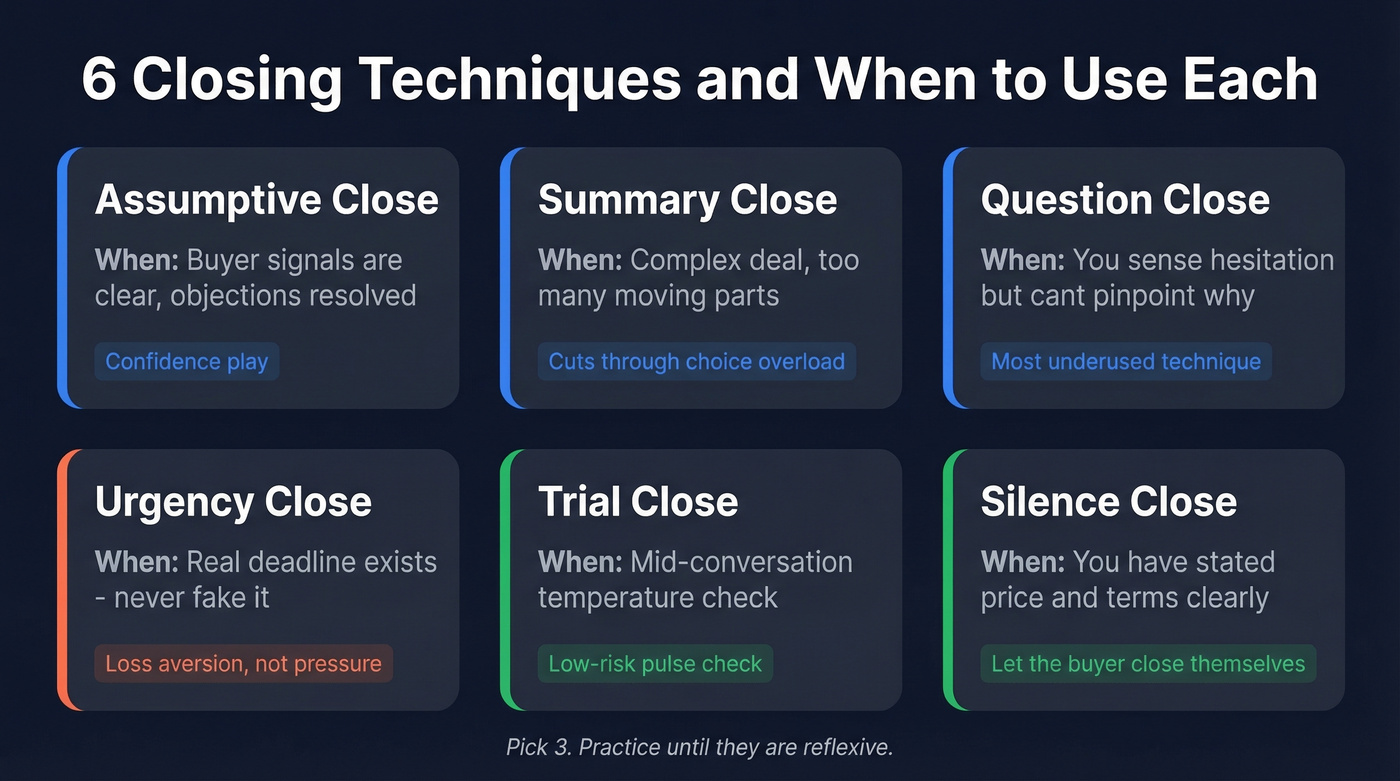
The Assumptive Close
Use it when the prospect has shown clear buying signals and you've addressed every objection.
"Great - I'll send the agreement over this afternoon. Should I address it to you or to [procurement contact]?"
Don't deploy this before you've earned the right. If discovery was shallow, it comes off as presumptuous, not confident.
The Summary Close
The psychology here matters more than the script. Research on choice overload - the classic Iyengar & Lepper study - found that shoppers facing a large display were one-tenth as likely to purchase as those shown fewer options. Complex, multi-stakeholder deals suffer the same paralysis. The summary close cuts through it by reducing everything to two or three clear outcomes.
"So we've got [pain point 1] solved with [feature], [pain point 2] handled by [capability], and your team gets [outcome 3]. Does that cover everything, or is there something I'm missing?"
The Question Close
This is the most diagnostic close in your toolkit, and in our experience, the most underused. It forces the prospect to articulate the gap - and often, saying it out loud makes them realize the gap is smaller than they thought.
"What would need to be true for this to be a yes by [date]?"
Use it when you sense hesitation but can't pinpoint the specific blocker.
The Urgency Close (Without Gimmicks)
"The current pricing holds through the end of Q2. After that, the new rate kicks in. I'd rather lock this in for you now - but I want to make sure you're ready, not rushed."
Loss aversion is real: emphasizing what buyers lose by not acting is more persuasive than stacking benefits. But false urgency - countdown clocks, "only 3 seats left" when that's not true - destroys credibility. Misleading consumers with false urgency is illegal under Section 5 of the FTC Act. If your urgency isn't real, don't manufacture it.
The Trial Close
"If we could solve [specific pain] within the first 30 days, would that be enough to move forward?"
A "yes" here is a temperature check, not a signature. Use it to test the water mid-conversation without committing to a hard ask.
The Silence Close
"The annual plan comes to $48,000/year. That includes onboarding and dedicated support for the first 90 days."
That's it. State the price, the terms, or the next step - then stop talking. Most reps can't handle three seconds of silence. They fill it with discounts, caveats, or nervous rambling. The silence close works because it gives the buyer space to process, and often, they'll close themselves.

You just learned how to handle objections and save stalled deals. But none of that matters if your closing sequence lands in a dead inbox or reaches the wrong stakeholder. Prospeo gives you 98% verified emails and 125M+ direct dials to the actual decision-maker - so your close reaches the person who can sign.
Stop closing gatekeepers. Start reaching the person who signs the contract.
Scripts That Save Stalled Deals
When a deal stalls, most reps either chase harder or give up. Neither works. The framework that does: Validate, Isolate, Reframe. Acknowledge the objection, narrow it to the real blocker, then reposition.
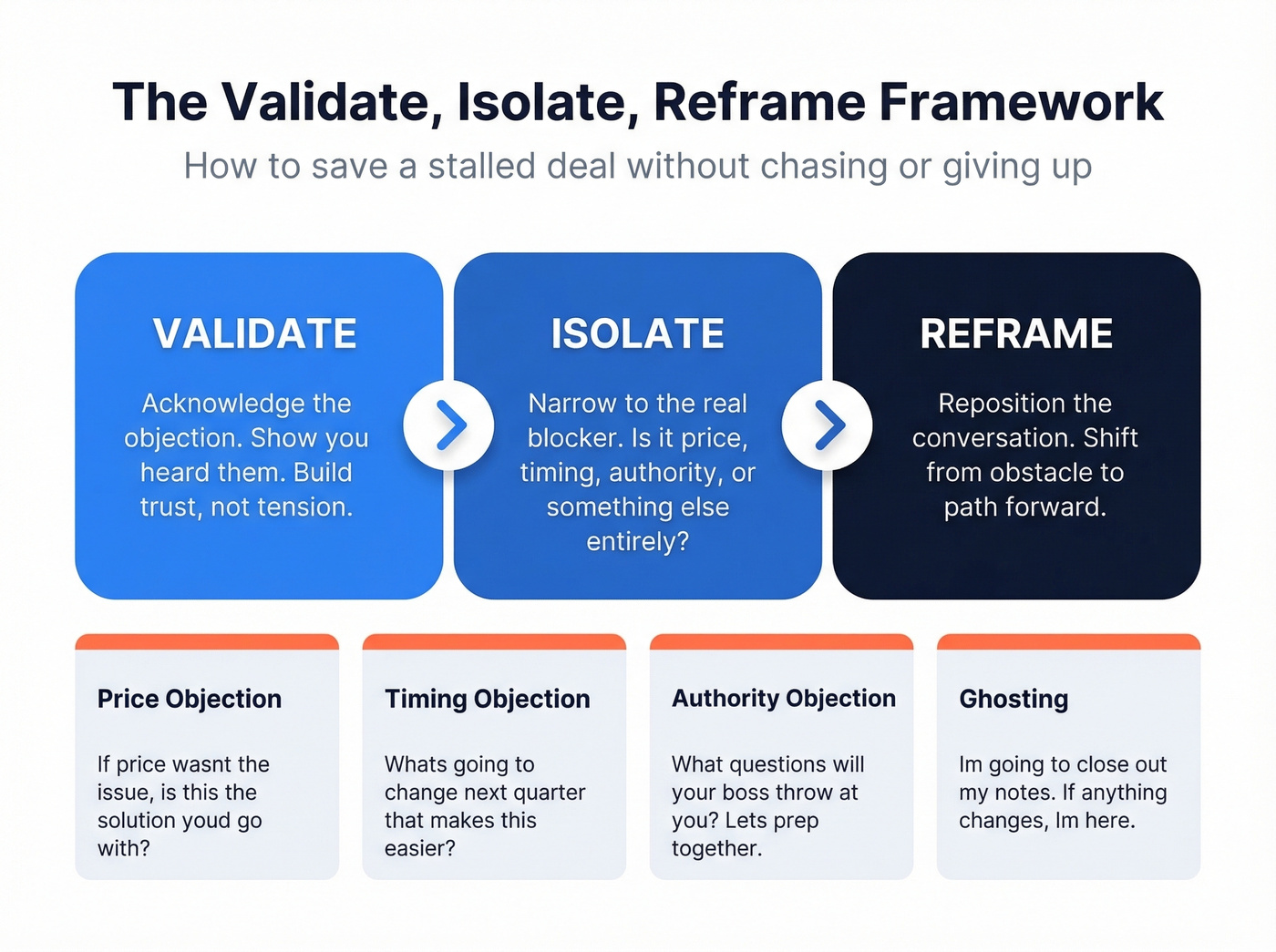
Price objection:
Don't say: "I can check with my manager on a discount." Say this: "Totally fair - budget matters. If price wasn't the issue, is this the solution you'd go with? ... Then let's figure out the packaging. What's the number that makes this a no-brainer?"
Timing objection:
Don't say: "No problem, let's reconnect next quarter." Say this: "What's going to change between now and next quarter that would make this easier to move on? If the answer is 'nothing,' we're just pushing the same conversation forward."
Authority objection ("need to check with my boss"):
Don't say: "Sure, let me know what they say." Say this: "Makes sense. What questions will they throw at you? Let's build the case together so you walk in with answers, not just a pitch."
Ghosting:
Don't say: "Just checking in!" (for the fourth time) Say this: "Hey [name] - I'm going to assume the timing isn't right and close out my notes on this. If anything changes, I'm here. No hard feelings either way."
That last one works because it triggers loss aversion. The prospect suddenly realizes the option is going away - and the ones who were genuinely interested will re-engage. It's one of the most effective closing moves you'll ever learn.
Closing Benchmarks Worth Knowing
Look, if 40-60% of your "lost" deals are actually "no decision," your pipeline isn't a pipeline - it's fiction. Most teams don't have a closing problem. They have a qualification problem wearing a closing costume.
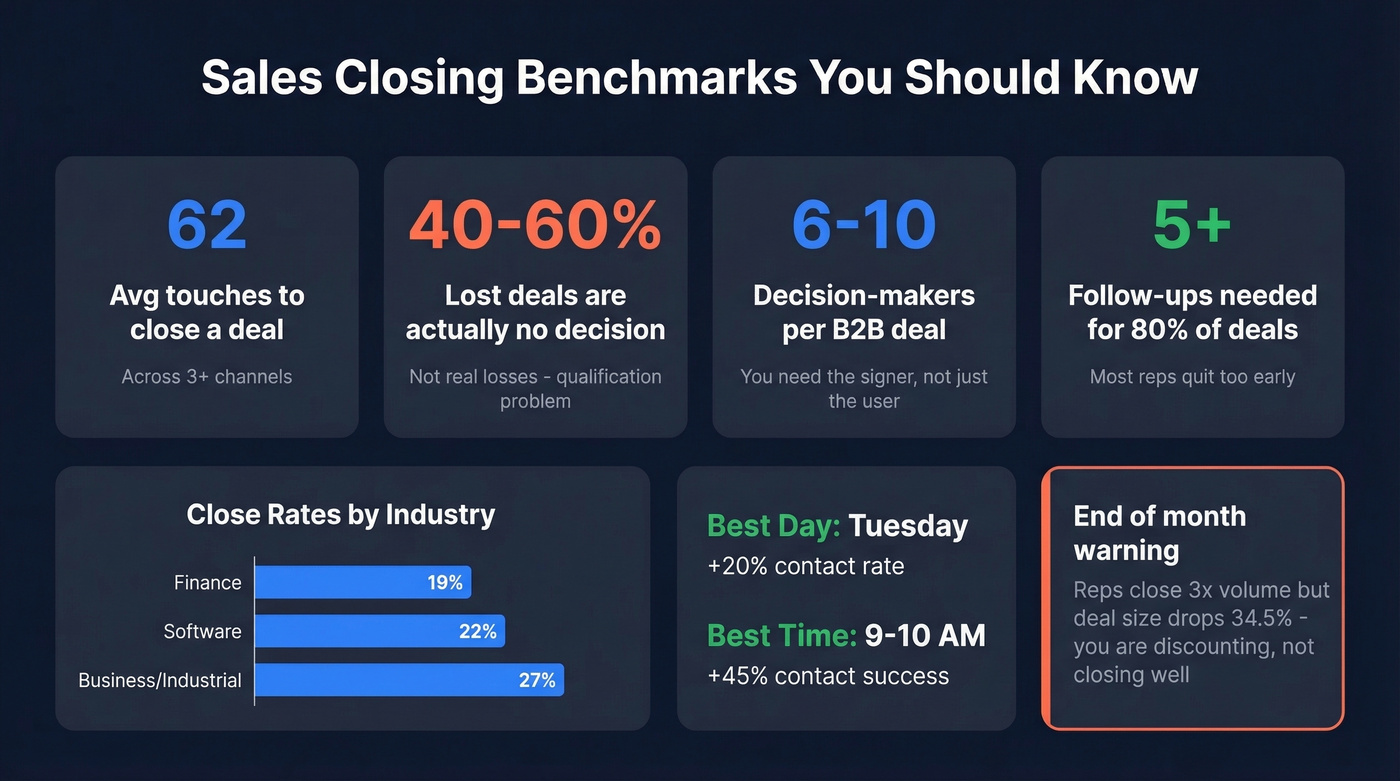
If only 2% of deals close on the first meeting, the obsession with closing techniques is misplaced. The real work happens before the close - qualification, multi-threading, and building a business case your champion can sell internally without you in the room.
| Metric | Benchmark | Source |
|---|---|---|
| Finance close rate | 19% | GetAccept |
| Computer software close rate | 22% | GetAccept |
| Business/industrial close rate | 27% | GetAccept |
| Avg. touches to close | 62 across 3+ channels | Allego |
| "No decision" rate | 40-60% of lost deals | Thunderbit |
| Best day to contact | Tuesday (+20%) | GetAccept |
| Best time to contact | 9-10 a.m. (+45%) | GetAccept |
| Avg. decision-makers | 6-10 | Outreach |
Tuesday outperforms other days by about 20%. Calling between 9-10 a.m. yields 45% higher contact success. And end-of-month? Reps close 3x the volume, but deal size drops 34.5% - which means you're discounting to hit quota, not closing well.
One tactical note: follow-up cadence should match deal complexity. Simple deals can move faster; multi-stakeholder buying groups need room for internal conversations to happen without feeling hounded.
Mistakes That Kill Deals
We've seen every one of these tank real pipeline. With reps spending 60% of their time on non-selling tasks, every minute of actual selling time matters - which makes these mistakes doubly expensive.
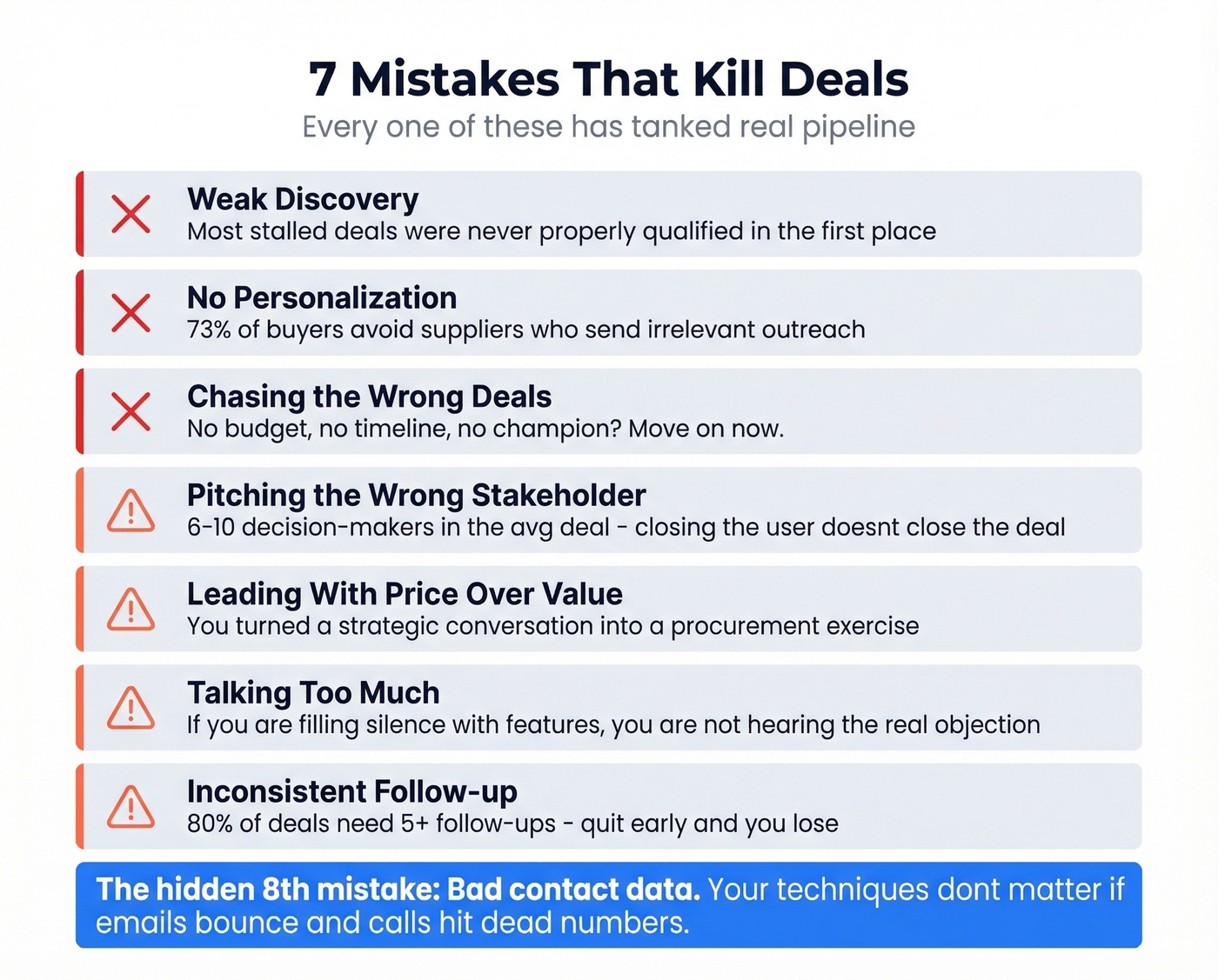
Weak discovery. If you don't understand the buyer's pain in their words, you're guessing at the close. Most "stalled deals" were never properly qualified. (If you want a tighter framework, use these discovery questions.)
No personalization. 73% of buyers avoid suppliers who send irrelevant outreach. Generic decks and templated follow-ups signal that you don't understand their business.
Chasing the wrong deals. Not every opportunity deserves your closing energy. No budget, no timeline, no champion? Move on. Skip this if you already have a rigorous sales qualification framework - but most teams don't, and they know it.
Pitching the wrong stakeholder. With 6-10 decision-makers in the average B2B deal, closing the end user doesn't close the deal. You need the economic buyer and the person who signs.
Leading with price over value. The moment you anchor on cost before establishing ROI, you've turned a strategic conversation into a procurement exercise. (More on this in our guide to anchor in negotiation.)
Talking too much. The best closers listen more than they pitch. If you're filling silence with features, you're not hearing the objection underneath.
Inconsistent follow-up. 80% of deals require 5+ follow-ups. The math is simple: quit early, lose. If you need copy you can send today, use these sales follow-up templates.
Bad contact data. You can master every technique in this guide, but if your emails bounce and calls hit dead numbers, none of it matters. Prospeo verifies contact data in real time - 98% email accuracy, 125M+ verified mobiles - so your closing sequence reaches the right person.
Why "Closed" Isn't Always Closed
A rep on r/sales shared a story that should be required reading. They closed their first $100K deal - signed contract, celebration, the works. Then the buyer's funding got revoked overnight by an executive order. The nonprofit laid off 90% of its staff within 24 hours. The deal evaporated.
Their team already had a policy for this: "Nothing is finalized until the client premiers on our platform." Signature doesn't equal revenue. If you don't have implementation alignment, a mutual action plan, and confirmation that the budget is actually released - not just approved in principle - you don't have a closed deal. You have a handshake that can still unravel.
Build the post-signature plan before the signature. Confirm go-live dates, implementation owners, and success criteria in writing. That's how you close a deal that stays closed.
Deals die in the last mile because reps lose access to the buying committee. With 300M+ profiles, 30+ filters including job changes and buyer intent, and a 7-day data refresh cycle, Prospeo ensures you always have current, verified contact data for every stakeholder in the deal - not stale records from six weeks ago.
Every stakeholder's real email and direct dial, refreshed weekly, at $0.01 per lead.
FAQ
What's the best closing technique for beginners?
The assumptive close. It's simple, natural, and works across deal sizes. Practice saying "I'll send the agreement over this afternoon" until it feels reflexive, not forced. Pair it with strong discovery so you've earned the right to assume.
How many follow-ups does it take to close?
On average, 62 touchpoints across at least three channels. 80% of deals require 5+ follow-ups, yet most reps stop after two. Persistence - not pestering - separates top closers from average ones.
Why do deals stall at the last stage?
Usually it's a discovery problem, not a closing problem. Unclear pain, unidentified stakeholders, or no documented decision process means the deal was never truly qualified. Re-qualify before re-pitching.
What's a good close rate in B2B sales?
Finance averages 19%, computer software 22%, and business/industrial 27%. Consistently above 25% means you're outperforming most teams. Below 15%, audit your qualification criteria first.
How do I reach the actual decision-maker?
Verify contact data before outreach. Prospeo provides verified emails and direct dials across 300M+ profiles - with a 98% email accuracy rate and 30% mobile pickup rate - so your closing sequence lands with the right person, not a gatekeeper.