

How to Cold Call Successfully: The Data-Backed Playbook for 2026
A RevOps Manager lead we work with ran the numbers last quarter: his team made 4,200 dials in a week. They booked 3 meetings. Not because the reps were bad - because 40% of the phone numbers were dead. If you want to know how to cold call successfully, the answer starts with data, not scripts. Here's the playbook that separates reps booking 18 meetings a month from those booking 2, backed by benchmarks from 300M+ analyzed calls.
The Five Things That Actually Move Your Numbers
Before the full breakdown, here's the short version:
- Fix your data first. Bad numbers kill call blocks before technique matters.
- Call Tuesday through Thursday, mid-morning. That's when prospects pick up.
- Use a permission-based opener, not a pitch. The first 10 seconds decide everything.
- Leave voicemails - 80% of dials go there. Don't waste them.
- Know your numbers. Dials to conversations to meetings. If you can't do the math, you can't improve.
Cold Calling Isn't Dead - Bad Execution Is
Every year, someone publishes a "cold calling is dead" take. Every year, the data says otherwise. HubSpot's survey of 379 sales professionals found that 49% of sales teams use cold calling as a primary or secondary channel. That's nearly half the industry.
Here's what really matters: an analysis of 300M+ cold calls shows that even when a call goes to voicemail, the follow-up email reply rate jumps to 3.44% vs. 1.81% without the call attempt. Cold calling nearly doubles your email effectiveness even when nobody picks up. The channel isn't dead. It's just unforgiving if you're doing it wrong.
Cold Calling Benchmarks for 2026
Most reps have no idea what "good" looks like. The 300M-call dataset gives us the clearest picture:
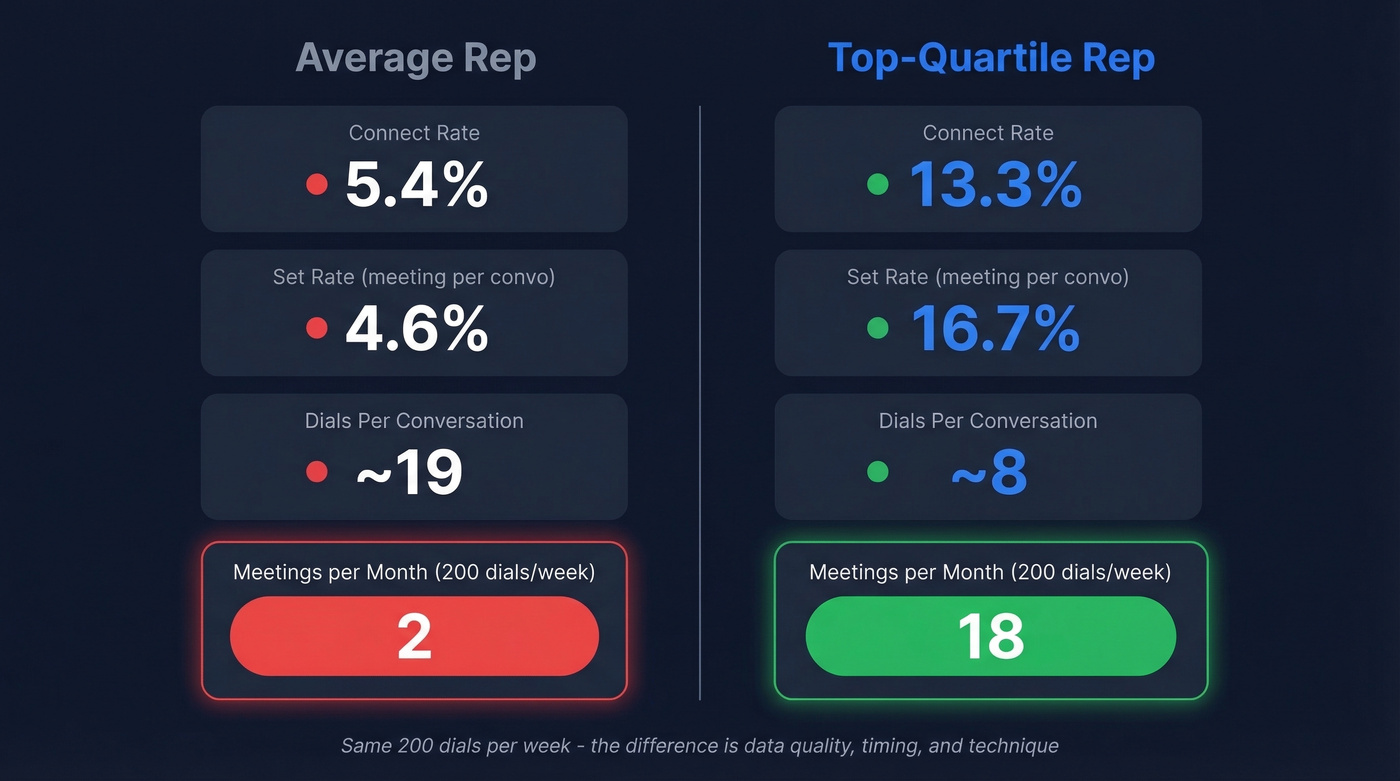
| Metric | Average Rep | Top-Quartile Rep |
|---|---|---|
| Connect rate | 5.4% | 13.3% |
| Set rate (meeting/convo) | 4.6% | 16.7% |
| Dials per conversation | ~19 | ~8 |
| Meetings per 200 dials/week | ~2/month | ~18/month |
Read that last row again. Same 200 dials per week. One rep books 2 meetings a month. The other books 18. The difference isn't effort - it's data quality, timing, and technique compounding on each other.
The WHAM dataset from Cognism adds another benchmark: the average cold call success rate sits at 4.82%, and average call length has crept up to about 93 seconds. That tells you something - the calls that work aren't 30-second pitches. They're short conversations.
At 200 dials per week, an average rep generates roughly 10-11 conversations and books 2 meetings per month. A top-quartile rep, with the same dial volume, generates 25+ conversations and books 18. The fix isn't "dial more." It's "connect more and convert better."
When to Call
Timing isn't everything, but it's not nothing either. ZoomInfo's analysis of 1.4M outbound calls gives us the clearest day-of-week picture:
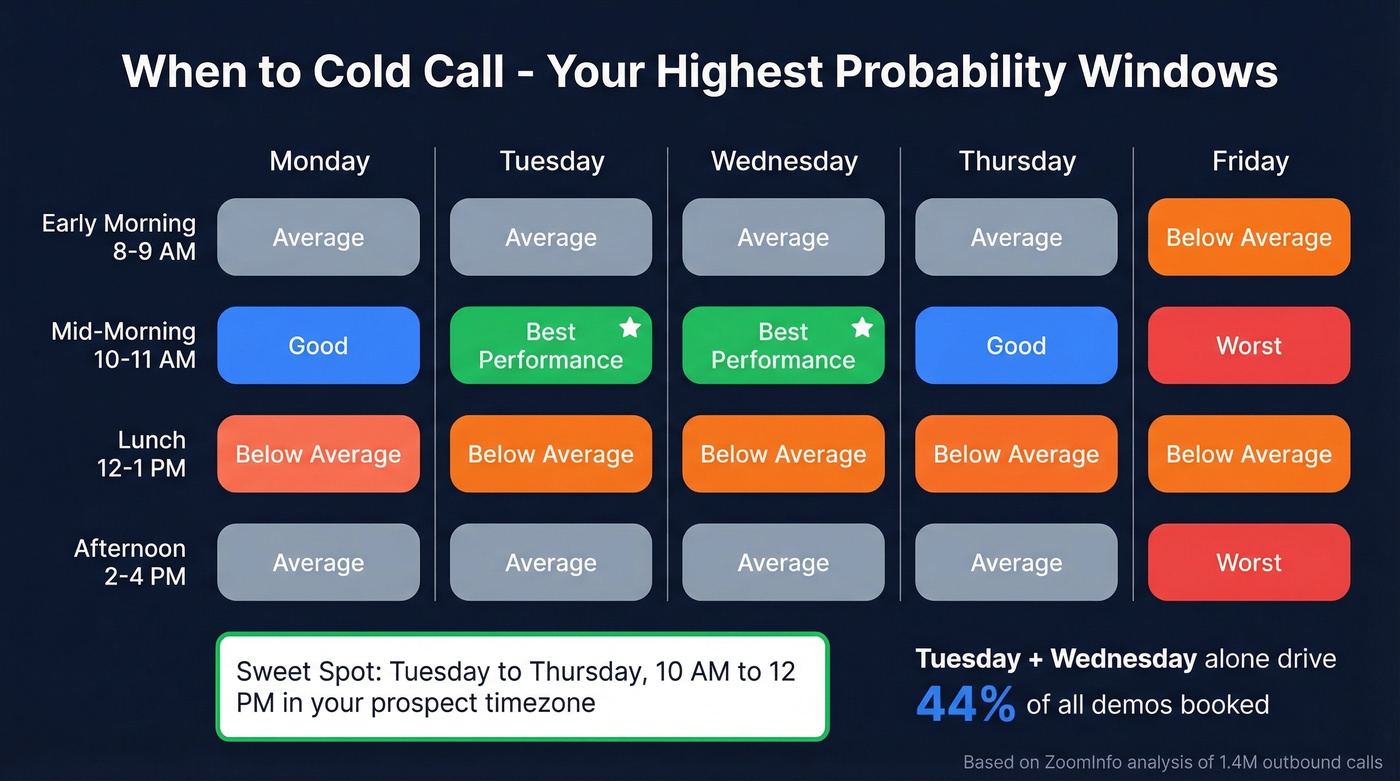
| Day | Relative Performance | Demo Share |
|---|---|---|
| Monday | Best efficiency (1.19%) | Moderate |
| Tuesday | Peak connections | ~22% of demos |
| Wednesday | Strong connections | ~22% of demos |
| Thursday | Solid | Above average |
| Friday | Worst across all metrics | Lowest |
Tuesday and Wednesday alone drive 44% of total demos booked. Friday is consistently the worst - prospects are mentally checked out.
For time of day, the pattern is clear across multiple datasets: mid-morning (10-11 AM in the prospect's timezone) outperforms everything else. Lunch hours underperform. If you're running a 2-hour call block, Tuesday through Thursday from 10 AM to noon in your target timezone is the highest-probability window.
Before You Dial: Data Quality
Look, most cold calling advice gets this backwards. It starts with scripts. Scripts don't matter if you're dialing disconnected numbers.
Data quality is the single most controllable variable in your results, and it's the one most reps ignore. We've seen this pattern over and over: a team complains about low connect rates, we audit their list, and 30-40% of the numbers are dead. That's not a technique problem. That's a garbage-in, garbage-out problem.
Meritt, an outbound agency, saw pipeline triple from $100K to $300K/week after switching to cleaner, verified contact data. Their bounce rate dropped from 35% to under 4%, and connect rate climbed to 20-25%. The root cause of their old numbers was always the same: stale data, landlines instead of mobiles, and numbers that hadn't been verified in months.
Spend 2-3 minutes per prospect before you dial. Check their company's recent news, their role, and whether they're likely the right person. Not a 20-minute deep dive - just enough to sound like you know who you're calling.
For the numbers themselves, use a provider with verified mobiles and a fast refresh cycle. Prospeo's database includes 125M+ verified mobile numbers with a 30% pickup rate, refreshed every 7 days compared to the industry-average 6-week refresh that leaves you dialing stale numbers. The free tier gives you 75 emails and 100 Chrome extension credits per month, so you can test data quality before committing a dollar.

The difference between 2 meetings and 18 meetings a month starts with your data. Prospeo's 125M+ verified mobile numbers deliver a 30% pickup rate - refreshed every 7 days, not the 6-week industry average that leaves you dialing dead lines.
Fix your connect rate at the source. Start free, no contracts.
GreyScout cut bounce rates from 38% to under 4% and grew pipeline 140% after switching to verified contact data. When 40% of your dials hit dead numbers, no script or timing hack can save you. Clean data compounds every improvement you make.
Book more meetings from the same dial volume - starting today.
The Cold Call Script
Scripts are frameworks, not teleprompter lines. The moment you sound like you're reading, you've lost.
If you want more options beyond a single framework, pull a few talk track examples and test them against your own connect and set rates.
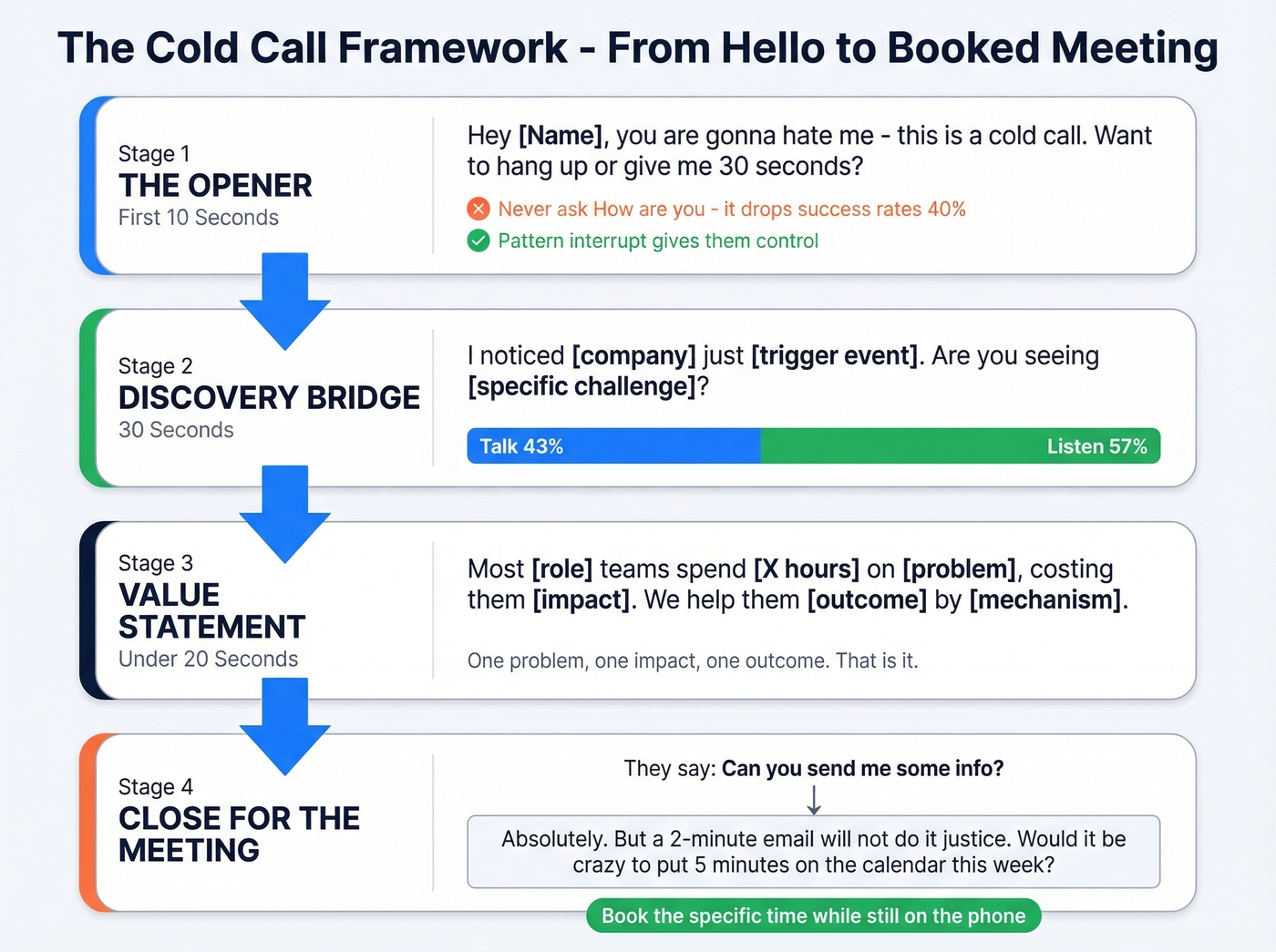
The Opener (First 10 Seconds)
The permission-based opener has become the gold standard on r/sales for a reason - it works:
"Hey [Name], you're gonna hate me - this is a cold call. Do you want to hang up, or give me 30 seconds?"
This is a pattern interrupt. The prospect expects a pitch. Instead, they get honesty and a choice. That micro-moment of control makes them far more likely to say "go ahead." Asking "How are you?" actually reduces success rates by 40%, so skip the pleasantries. Some reps ask for an oddly specific time - "27 seconds" instead of "30" - to make the interrupt even more memorable.
Discovery Bridge (30 Seconds)
You got the green light. Don't waste it by pitching. Ask 2-3 targeted questions that show you've done your homework, and keep your talk-to-listen ratio around 43/57 from the very first exchange.
"I noticed [company] just [trigger event]. Are you seeing [specific challenge] on your end?"
Then shut up. Let them talk. The discovery bridge isn't about gathering intel for a future call - it's about earning enough trust right now to pitch.
If you need a deeper bank of prompts, build a swipe file of discovery questions by persona.
Value Statement
Keep this under 20 seconds. Problem, impact, how you help:
"Most [role] teams we talk to are spending [X hours] on [problem], which means [impact]. We help them [outcome] by [mechanism]."
One problem, one impact, one outcome. That's it.
Close for the Meeting
The most common deflection is "Can you just send me some info?" This isn't interest - it's a polite exit. Here's the pivot:
"Absolutely, I'll send that over. But honestly, a 2-minute email won't do it justice. Would it be crazy to put 5 minutes on the calendar this week so I can walk you through the part that's actually relevant to [their specific situation]?"
If they agree, book a specific time and send the calendar invite while you're still on the phone. Don't say "I'll follow up" - that's where meetings go to die.
What Top Reps Do Differently
Tone Beats Words
Prospects decide whether to keep listening before they process your sentence. Tone, pacing, and confidence carry more weight than perfect word choice.
The real insight from the 300M-call data isn't about the ideal talk ratio. It's about consistency. Low performers swing their talk time by about 10% between won and lost deals - they talk 54% of the time on calls that convert, then jump to 64% on calls that don't. Top performers stay steady. They don't speed up when nervous or over-explain when they sense resistance.
Call Reluctance Is Real
The hardest part of cold calling isn't objections. It's picking up the phone.
If you feel resistance before your first dial, batch your calls into 25-minute blocks with a 5-minute break. Momentum beats motivation. And the reps who plateau are the ones who dial 200 times and never listen back to a single recording. Start reviewing your own calls - that's where the real coaching happens. If this is a recurring issue, build a plan around cold call rejection so it stops derailing your call blocks.
Objection Handling with LARA
Most objections on cold calls are reflexive, not rational. "We're not interested" usually means "I don't know why I should be interested yet." The LARA framework gives you a repeatable response:
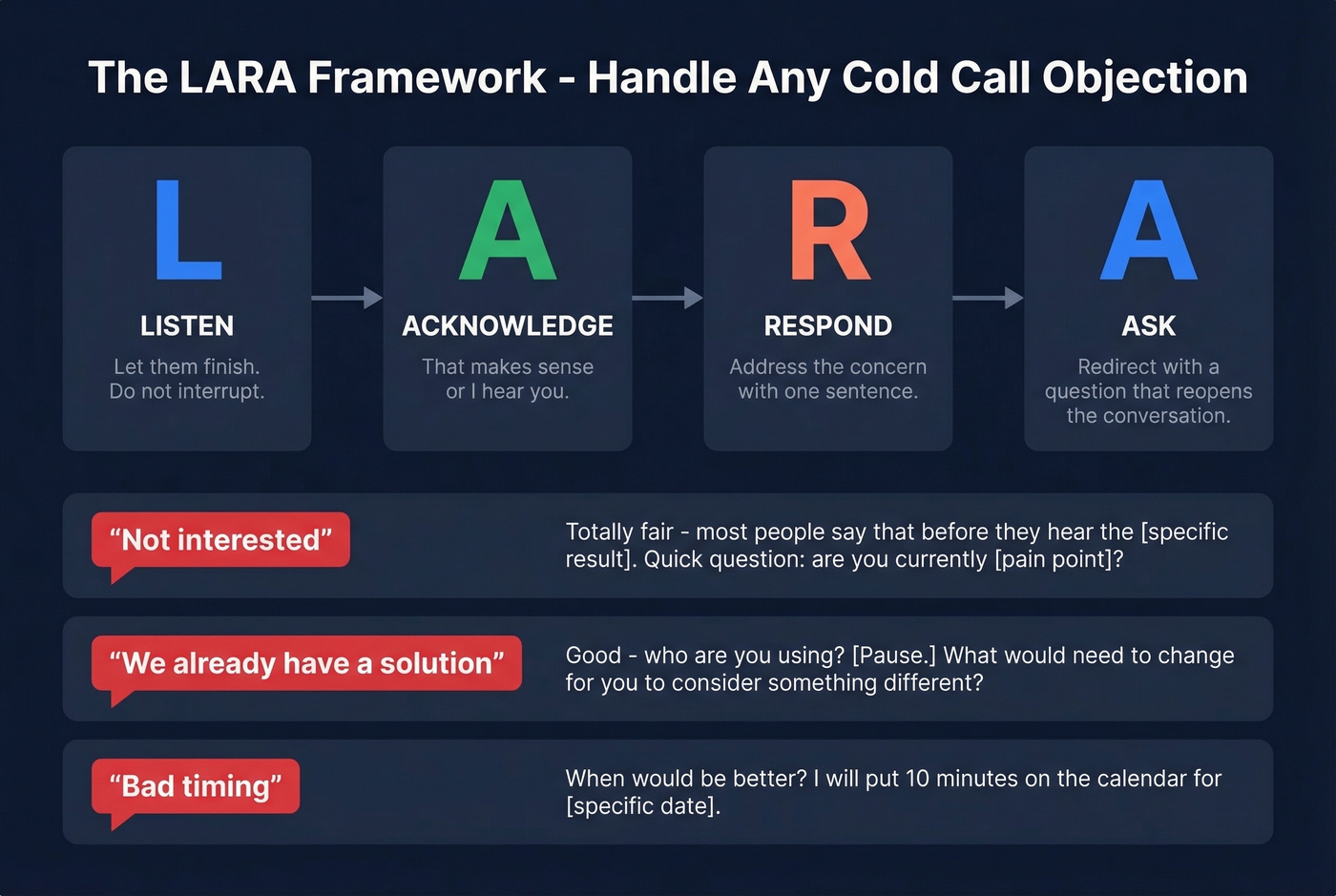
- Listen - let them finish. Don't interrupt.
- Acknowledge - "That makes sense" or "I hear you."
- Respond - address the specific concern with one sentence.
- Ask - redirect with a question that reopens the conversation.
For the three objections you'll hear most often: "Not interested" gets "Totally fair - most people say that before they hear the [specific result]. Quick question: are you currently [pain point]?" For "We already have a solution," try "Good - who are you using? [Pause.] What would need to change for you to consider something different?" And "Bad timing" becomes "When would be better? I'll put 10 minutes on the calendar for [specific date]."
Know When to Stop
Conversations drop 73% between call 1 and call 2, and another 60% between call 2 and call 3. By call 3, you've captured 93% of total conversations you'll ever get from that prospect. By call 5, it's 98.6%.
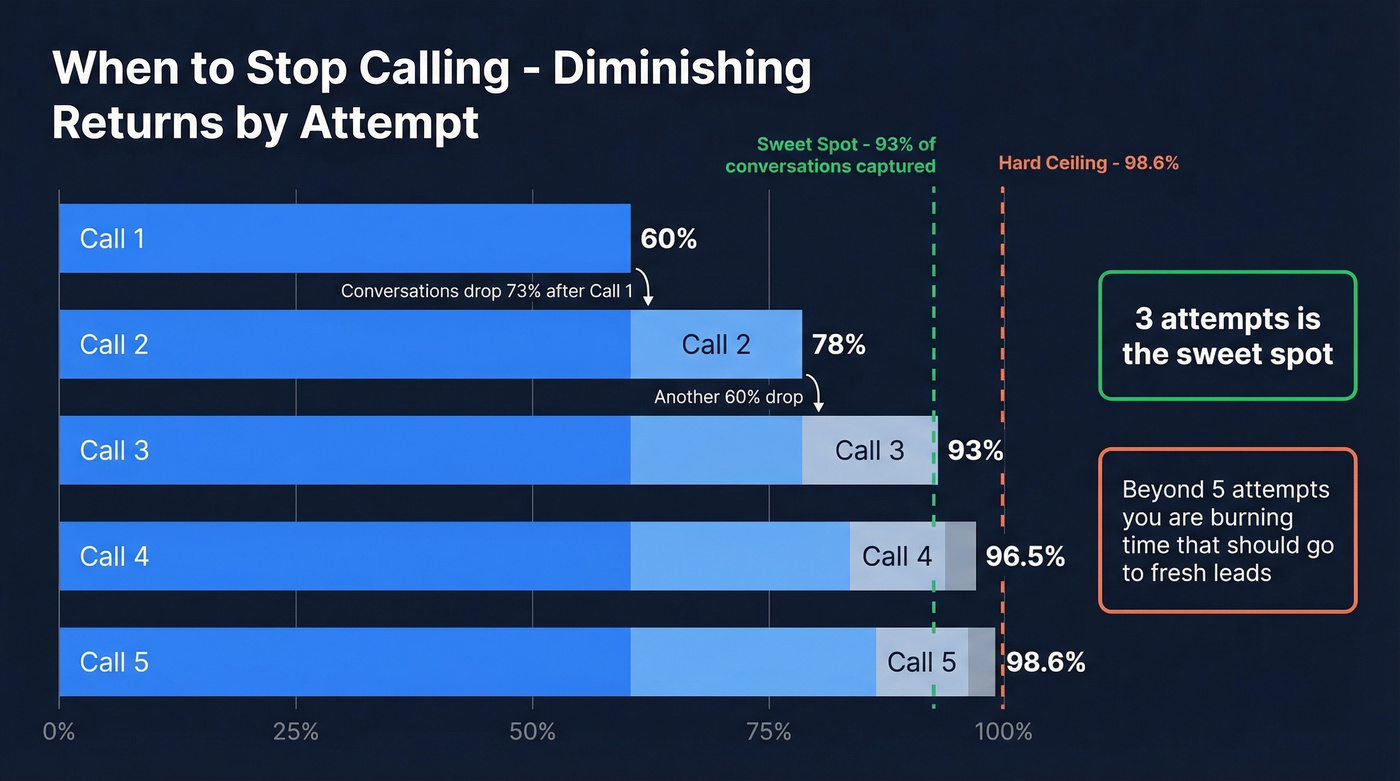
Three attempts is the sweet spot. Five is the ceiling. Beyond that, you're burning time that should go toward fresh leads.
Your Voicemail Strategy
80% of cold calls go to voicemail. A well-crafted voicemail lifts callbacks by up to 22%. Keep it under 20 seconds. Three templates that work:
The Pain-Point Voicemail:
"Hey [Name], it's [Your Name] at [Company]. I'm calling because most [role] teams at [company size] are dealing with [specific problem] - and it's costing them [impact]. I've got a quick idea that might help. My number is [number]. Talk soon."
The Social Proof Voicemail:
"Hey [Name], [Your Name] from [Company]. We just helped [similar company] cut their [metric] by [result]. Thought it might be relevant for [their company]. Call me back at [number] if you want the 2-minute version."
The Ultra-Short Callback:
"Hey [Name], [Your Name], [Company]. Got something quick for you - call me at [number]."
That last one feels almost too short. It works because curiosity drives callbacks better than a 45-second pitch they'll delete halfway through.
Follow-Up and Self-Coaching
Multi-Channel Follow-Up
The call ended. Send the follow-up email within 5 minutes. Cold calls nearly double email reply rates (3.44% vs. 1.81%), but only if the email actually goes out. If you booked a meeting, send the calendar invite immediately - not "later today," not "after my call block." Now.
For teams with average deal sizes under $10K, you probably don't need a 12-touch, multi-threaded sequence. But for contracts over $50K, start multi-threading early. An analysis of 1.8M opportunities found that closed-won deals have roughly 2x as many buyer contacts as closed-lost. Multi-threading boosts win rates by 130% in larger deals. Your second cold call should be to the prospect's colleague, not a follow-up to the same person.
If you want plug-and-play copy for the email that goes out after the call, use these sales follow-up templates.
Review Your Own Calls
Record your calls (where legal). Review 2-3 per week. Track which openers get the best response. Log objections and test different responses. One HubSpot practitioner documented 11,519 cold calls that produced 335 meetings, a 69.1% meeting-to-SQL conversion rate, and $287K in closed revenue. Those numbers happened because he tracked every metric and iterated weekly. Treating every dial as a data point - not just a task to check off - is the mindset shift that separates reps who improve from reps who plateau.
Compliance: TCPA, DNC, and State Laws
TCPA litigation surged nearly 95% in 2025. This isn't a theoretical risk.
- Federal calling hours: 8 AM - 9 PM in the recipient's local timezone.
- TCPA penalties: $500 per violation, up to $1,500 per willful violation.
- DNC violations: up to $43,792 per infraction.
- Caller ID: spoofing is prohibited. Your real number and company name must display.
- Consent revocation: consumers can revoke consent by any reasonable method. You must honor it immediately.
The June 2025 Supreme Court decision in McLaughlin v. McKesson made things more complex - district courts are no longer bound by FCC interpretations in civil TCPA cases, so enforcement varies by jurisdiction. And 15+ states now have their own "mini-TCPA" laws that are often stricter than federal rules. Connecticut, for example, restricts calling hours to 9 AM - 8 PM and imposes penalties up to $20,000 per violation.
Maintain an internal DNC list. Scrub against the national registry. Process opt-outs within 24 hours. This isn't optional - it's the cost of doing business in outbound.
Building Your Outbound Stack
You don't need 10 tools. You need four categories covered. Here's what a high-performing outbound stack looks like:
| Category | Tool | Approx. Cost |
|---|---|---|
| Data provider | Prospeo | Free; paid from ~$39/mo |
| Parallel dialer | Orum / PhoneBurner / Nooks | ~$100-300/user/mo |
| CRM | HubSpot (free) or Salesforce | Free - ~$25-165+/user/mo |
| Conversation intel | Gong | ~$100-200+/user/mo |
The consensus on r/sales is clear: clean data plus a parallel dialer is the minimum viable stack for 200+ dials per day. Skip the conversation intelligence tool if budget's tight - you can review recordings manually. But don't skip the data. Pair a verified data source with a dialer and a CRM, and you've got everything you need to run this playbook. The goal is eliminating friction so reps spend time talking, not searching for numbers. If you want to systematize this end-to-end, build a repeatable cold calling system your team can run every week.
FAQ
Is cold calling dead in 2026?
No. 49% of sales teams still use cold calling as a primary or secondary channel, and calls nearly double email reply rates even when they go to voicemail. The channel punishes lazy execution, not the tactic itself.
How many cold calls should I make per day?
Top performers average 40-50 dials per day, or 200+ per week. With a 5-13% connect rate, that yields 2-7 live conversations daily. Consistency matters more than marathon sessions.
What's a good cold call connect rate?
The average is 5.4%; top-quartile reps hit 13.3%. If you're consistently below 5%, your data quality is the bottleneck - not your pitch.
What's the best day to cold call?
Tuesday, Wednesday, and Thursday outperform every other day. Tuesday and Wednesday alone drive 44% of demos booked. Friday is the worst day across every metric.
How do I get started if I'm brand new?
Focus on three fundamentals: verify your contact data before dialing, use a permission-based opener, and review at least two of your own call recordings each week. Track your connect rate, set rate, and objection patterns over time - iteration based on real conversations beats memorizing a perfect script every time.