

How to Create Battle Cards That Actually Get Used
A RevOps lead we work with ran a battlecard audit last quarter. Twelve competitors covered, beautifully designed slides, months of PMM effort. Rep usage? Single digits. The cards weren't bad - they were missing the sections that actually change deal outcomes.
If you're figuring out how to create battle cards that reps open mid-call, the answer isn't design. It's architecture. 68% of sales opportunities are competitive, and 71% of businesses using battlecards report increased win rates. Yet a Klue audit of 150+ battlecards found only 43% included talk tracks, just 19% had proof points, and a third of deals were lost to a competitor - with nearly half of those winnable. The gap isn't effort. It's what's on the card.
What to Include in a Sales Battle Card
Three sections drive real usage:
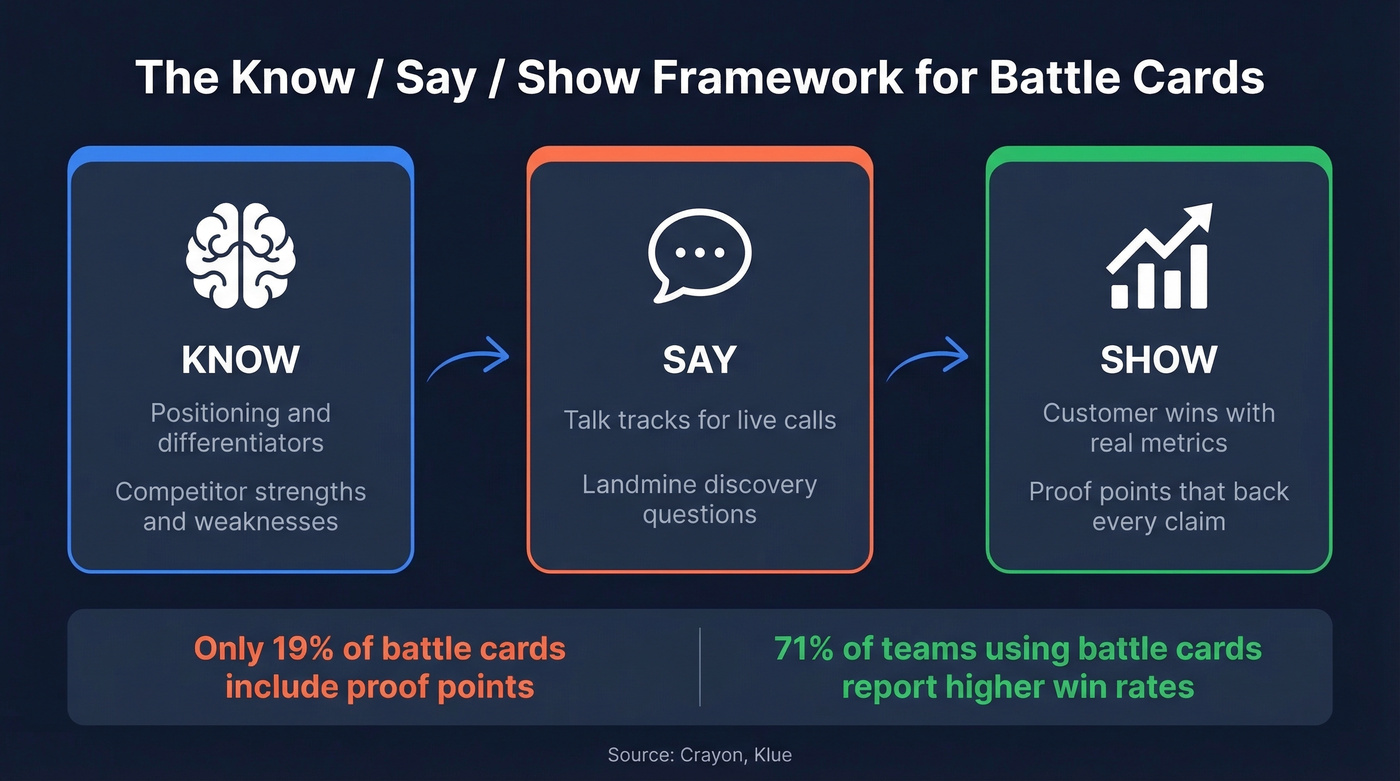
- Talk tracks - what reps should say when a competitor comes up
- Proof points - customer wins, stats, and evidence backing the talk tracks (only 35% of audited battlecards include customer-facing proof points)
- Landmines - two or three discovery questions designed to expose a competitor's weakness on a live call
Among the highest-retention battlecards analyzed, 100% included both talk tracks and proof points. This is the Know/Say/Show framework: reps know the positioning, say the right things, and show the evidence.
If you only have time for one section, make it Landmines. That's the section that changes what happens on the call - everything else supports the conversation, but landmines shape it. Format doesn't matter. Google Doc, Slide, Notion page - the container is irrelevant. The sections inside are everything.
Anatomy of a High-Retention Card
The best cards follow a modular structure guided by the ABC principle - Accuracy, Brevity, Consistency. Each section serves a specific moment in the deal cycle, and building effective competitive battlecards starts with getting this structure right.
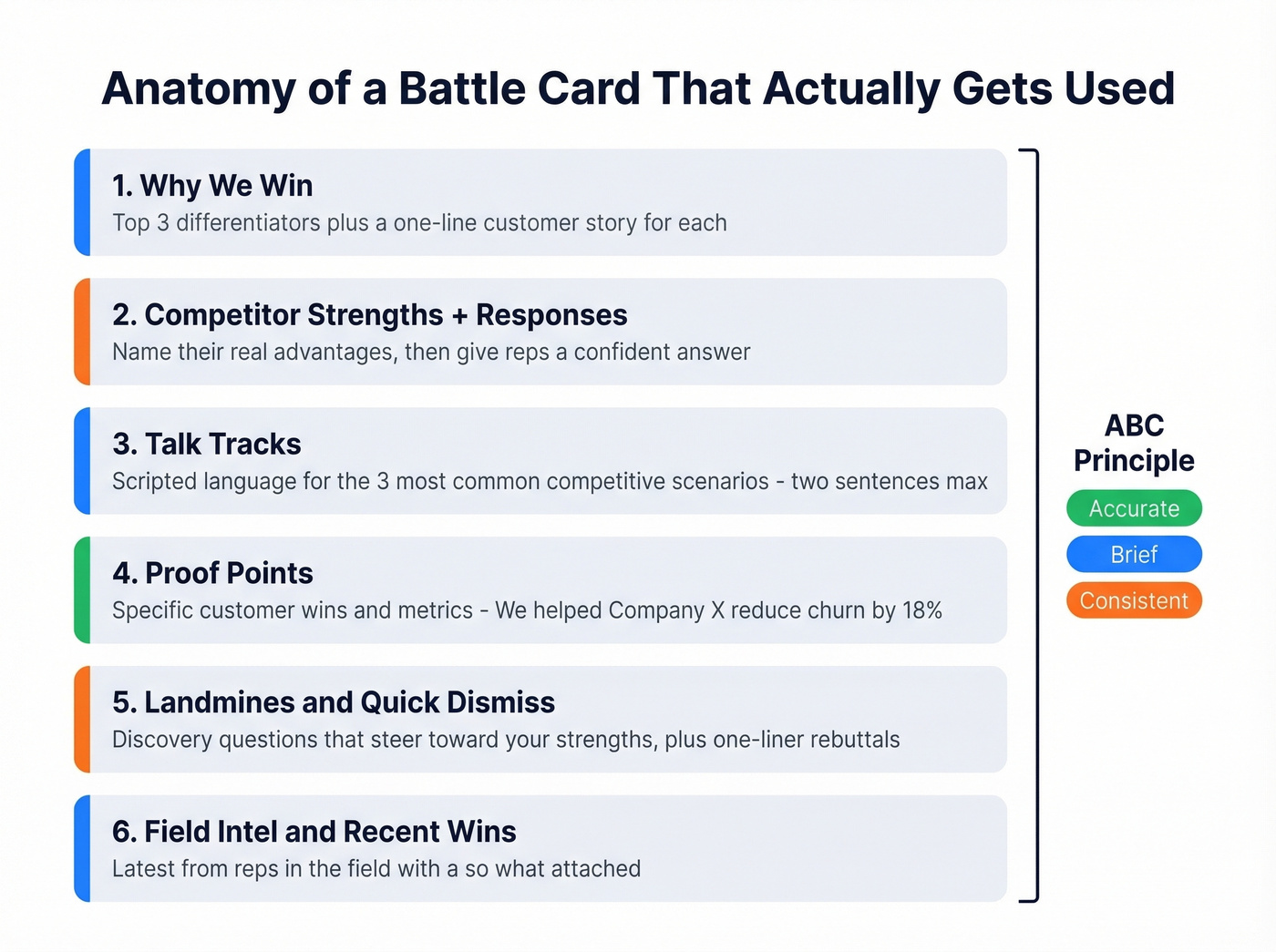
Start with Why We Win: your top differentiators (usually three) plus a one-line customer story for each. Then Competitor Strengths + Responses - don't pretend competitors are weak. Name their real advantages, then give reps a confident response to each one. Here's the thing: PMMs on Reddit consistently report the same frustration - beautifully designed cards that "collect dust" because they dodge the hard questions. Acknowledging competitor strengths is what makes reps trust the rest of the card. Some teams also create a card for their own product's weaknesses, which forces honest positioning and prepares reps for the hardest objections they'll face.
The remaining sections:
- Talk Tracks - scripted language for the three most common competitive scenarios. A sentence or two per scenario, not a paragraph. (If you need examples, see these talk track examples.)
- Proof Points - specific customer wins and metrics. "We helped [Company] reduce churn by 18%" beats "customers love us" every time.
- Landmines & Quick Dismiss - discovery questions that steer toward your strengths, plus one-liner rebuttals for objections that don't deserve a full response.
- Recent Wins - who's beating this competitor right now, and what made the difference.
- Field Intel - the latest from reps in the field, with a "so what" attached.
Consider creating role-specific versions. A BDR card focused on discovery and landmines, an AE card weighted toward proof points and pricing responses.
Look at how Cisco Webex structures their cards - scenario-based discovery prompts (like asking about MFA on specific devices) that give reps a concrete move. Parallels uses a blunt two-page comparison table designed to be scanned in 30 seconds. Netskope leads with buyer questions and pairs each with a micro case study. All three work because they're built for the moment a rep needs them, not for a PMM's portfolio.
For a more structured approach, the Competitive Advantage Matrix maps your features against buyer importance to identify your "secret sauce" zones versus "change the subject" zones - a useful exercise before writing a single word.

Your battle card's proof points are only as strong as the data behind them. Prospeo gives your reps 98% verified emails and 125M+ direct dials - the kind of concrete metrics that turn "customers love us" into "we connected 50 AEs to real buyers and grew pipeline 180%."
Arm your reps with data that wins the competitive deal.
5 Steps to Build Competitive Battle Cards
Step 1: Research the Competitor
Start with the competitor's website, recent product launches, pricing changes, and G2 reviews. AI tools like Gemini can compress this - feed it a competitor URL and ask for a feature comparison, pricing breakdown, and sentiment summary. But always fact-check the output. AI will confidently invent product features that don't exist.
Step 2: Write for Scannability
Use the modular anatomy above. Every section gets its own block, consistent across competitors - reps shouldn't have to relearn the layout for each card. Two-sentence max per point. Bold the competitor's strength, then immediately follow with your response. Nobody reads a 500-word paragraph mid-call.
Step 3: Distribute Where Reps Already Work
Most battle cards die here. Forcing sellers into a new tool or shared drive is a non-starter.
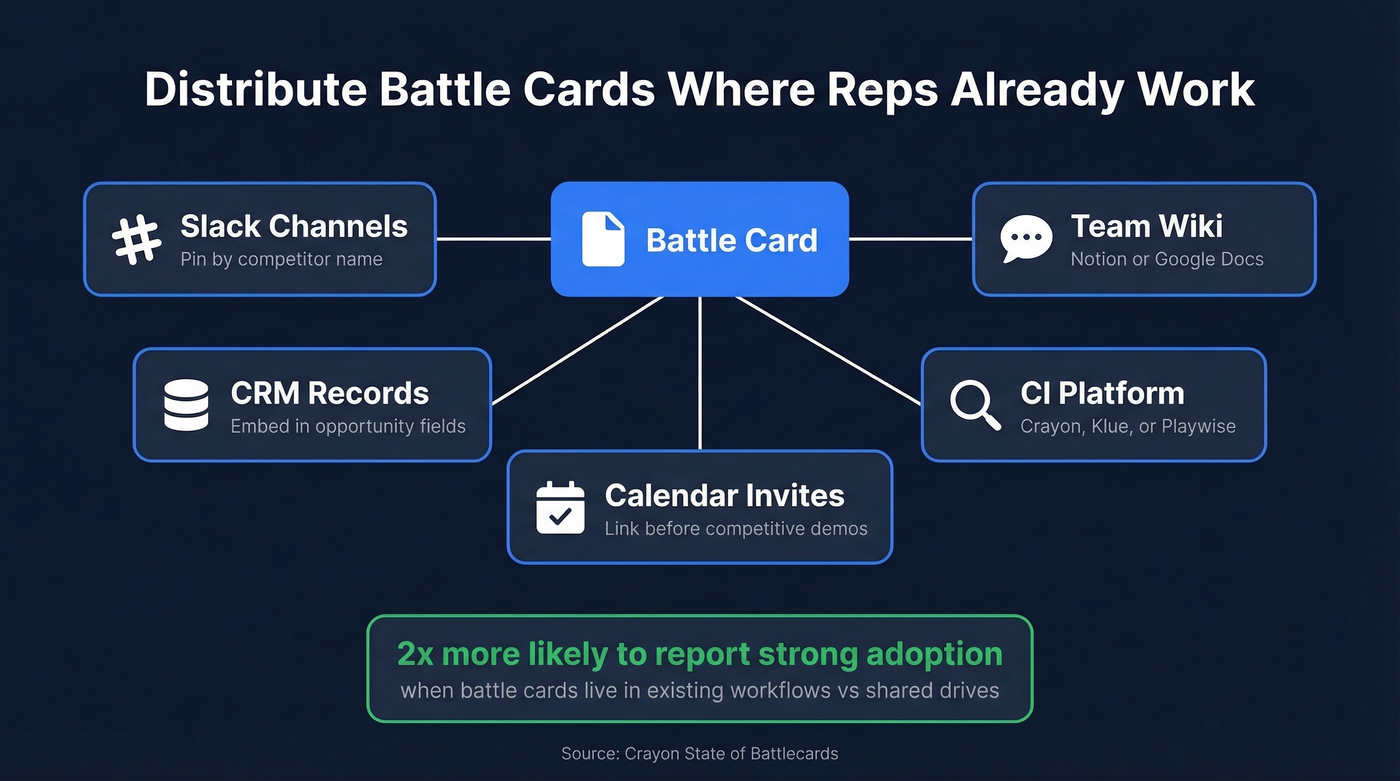
Pin cards in Slack channels by competitor name. Embed them in CRM opportunity records. Link them in calendar invites before competitive demos. Crayon's survey of 1,200+ responses found that teams with a dedicated CI platform are more than 2x as likely to report strong adoption, and large CI teams are 3x more likely to hit that mark. You don't need a $15K+ platform on day one - you need the right distribution habit. Organizations with enablement practices in place for 2+ years report a 7-percentage-point improvement in win rates, and even just involving enablement in competitive analysis lifts win rates by 3 points.
Step 4: Maintain Relentlessly
A battle card that's three months stale is worse than no card at all. Reps lose trust fast. Assign one owner per card - a person, not a committee.
Step 5: Measure and Iterate
Track card views, Slack link clicks, and - most importantly - competitive win rates before and after rollout. If a card isn't getting opened, the problem is usually distribution or staleness, not content quality. (To benchmark what to track, use a sales operations metrics framework.)
The Cadence That Keeps Cards Alive
Treat battle cards as living systems, not static documents.
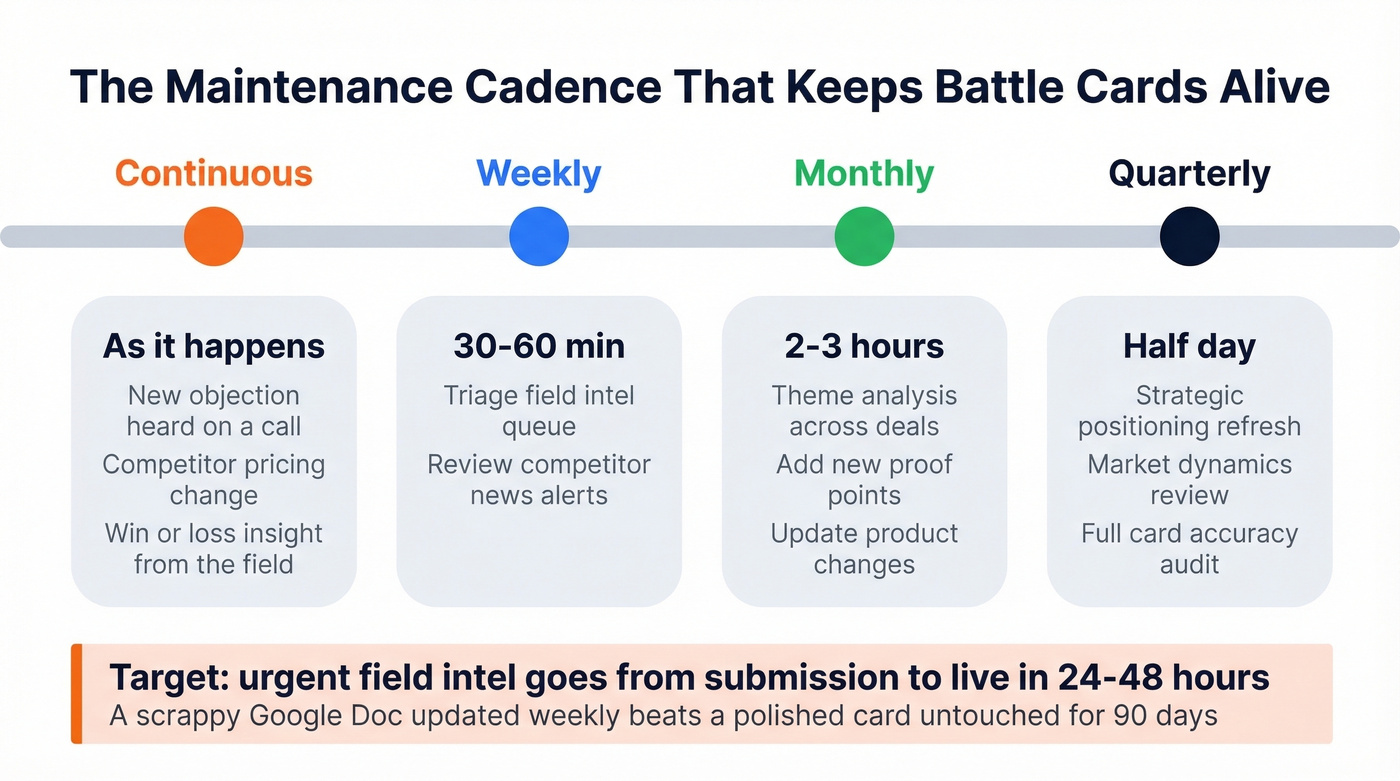
| Cadence | Time | Triggers |
|---|---|---|
| Continuous | As it happens | New objection, pricing change, win/loss insight |
| Weekly | 30-60 min | Triage field intel queue, review competitor alerts |
| Monthly | 2-3 hrs | Theme analysis, new proof points, product changes |
| Quarterly | Half day | Strategic positioning refresh, market dynamics |
The operational target: urgent field intel - a competitor dropping prices or launching a feature - should go from submission to live within 24-48 hours. A dedicated Slack channel or a two-field form works better than a formal intake process nobody uses.
Let's be honest: most teams over-invest in the initial build and under-invest in maintenance. We've seen it repeatedly. A scrappy Google Doc updated weekly will outperform a polished Klue card that hasn't been touched in 90 days. The cadence is the product.
Tools Worth Considering
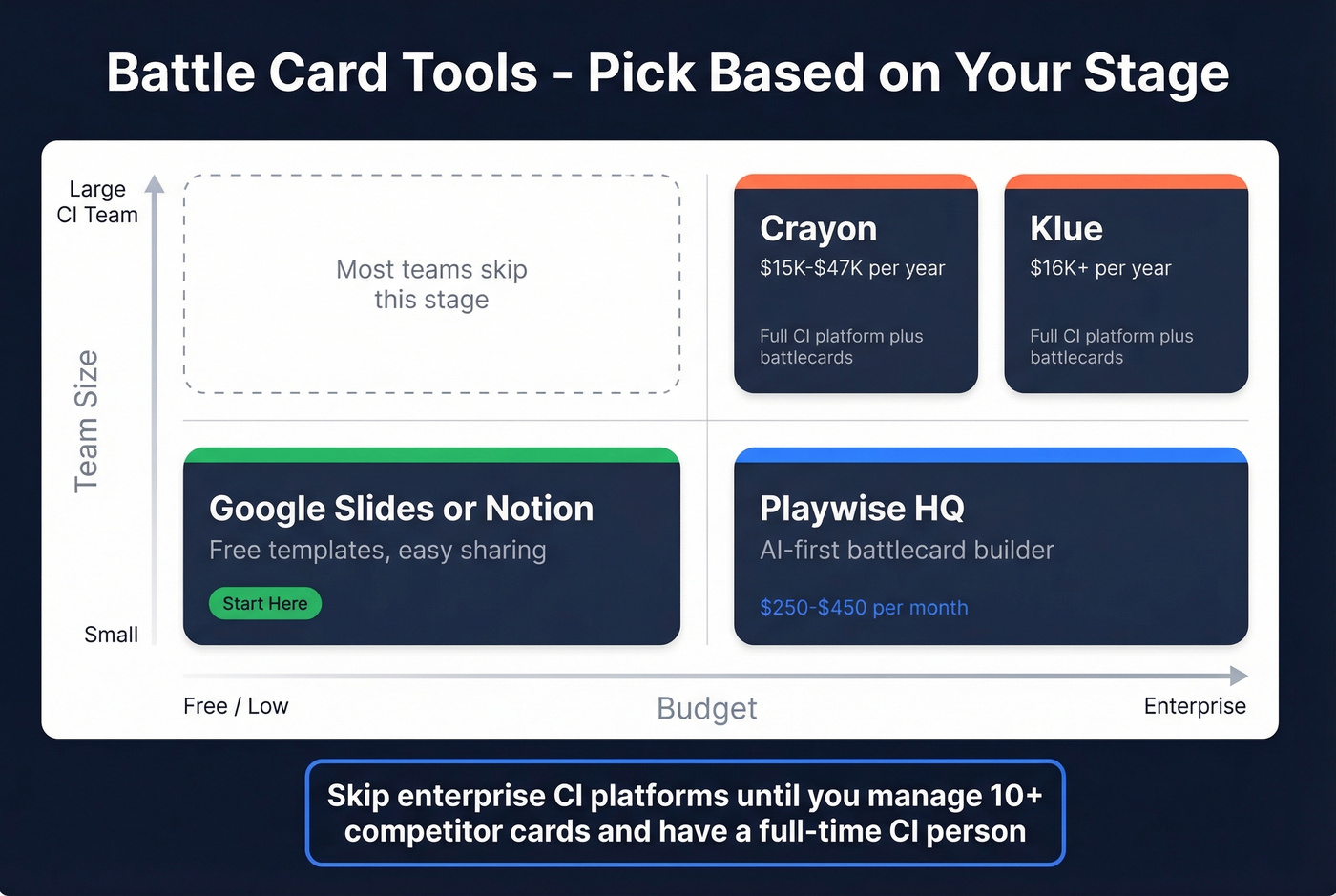
Start with free tools and a good process. Upgrade when adoption proves the investment.
| Tool | What It Does | Best For | Pricing |
|---|---|---|---|
| Google Slides / Notion | Free templates, easy sharing | Zero budget, fewer than 5 competitors | Free |
| Playwise HQ | AI-first battlecard builder | Small teams wanting AI-first workflow | Free, then $250-$450/mo |
| Crayon | CI platform + battlecards | Enterprise CI teams | ~$15K-$47K/yr |
| Klue | CI platform + battlecards | Enterprise CI teams | ~$16K+/yr |
Crayon and Klue are excellent if you've got the budget and a dedicated CI team. For everyone else, start with Notion or Slides, nail the sections, prove adoption, then invest. Skip the enterprise CI platforms until you're managing 10+ competitor cards and have a full-time CI person - otherwise you're paying for features nobody touches.
Your battle card tells reps what to say. But it doesn't matter if they can't reach the decision-maker they're competing for. That's where a verified data layer fits in - stale contact info mid-deal kills momentum faster than a weak talk track. (If you're evaluating providers, start with these data enrichment services and sales prospecting databases.)
Battle cards die when reps can't reach the accounts they're competing for. With 300M+ profiles, 30+ filters including buyer intent and technographics, and a 7-day data refresh cycle, Prospeo ensures the contact data powering your competitive plays is never stale.
Stop losing competitive deals to outdated prospect data.
FAQ
How long does it take to create a battle card from scratch?
Plan 2-3 hours per competitor for a solid first version. AI tools like Gemini can cut the research phase to about 15 minutes, but always fact-check before distributing - AI will confidently fabricate product features.
What's the single most important section?
Landmines. Two or three discovery questions that expose a competitor's weakness during a live call. If reps memorize one section, this is the one that changes outcomes.
How do I make sure reps actually use them?
Put them where reps already work - pinned in Slack, embedded in CRM records, linked in calendar invites before competitive demos. Teams using in-workflow distribution are 2x more likely to report strong adoption than those relying on shared drives.
What contact data tools pair well with battle cards?
Any tool that keeps prospect emails and direct dials accurate. Prospeo's free tier gives you 75 emails and 100 Chrome extension credits per month, which is enough to validate contact data alongside competitive prep. The 7-day refresh cycle means you aren't acting on stale records when a deal is on the line.