

How to Find a Business Owner's Name (Even When They Don't Want to Be Found)
You searched the state database, clicked through three pages of filings, and the only name staring back at you is "Northwest Registered Agent, Inc." You're not doing it wrong. The problem is that state disclosure rules vary wildly, and many U.S. states don't require LLCs to list their actual owners in public filings.
Knowing how to find a business owner name takes a specific sequence of steps, and most guides skip the ones that actually work. Let's fix that.
Quick Version
- One business? Start with the Secretary of State filing history - annual reports and amendments, not just the original articles of organization.
- Hit a registered agent wall? Try UCC filings or county property records. These two workarounds surface real names more often than you'd expect.
- Doing this at scale? Use a B2B data platform to search by title, industry, and location across millions of profiles.
WHOIS lookups and Chamber of Commerce directories are usually low-yield for small businesses. Start with public filings and escalate from there.
8 Methods to Find a Business Owner Name
1. Secretary of State Business Entity Search
This is step one, every time. Every state maintains a business entity database through its Secretary of State office. Whether you need the owner's name for sales outreach or due diligence, this is where you begin.
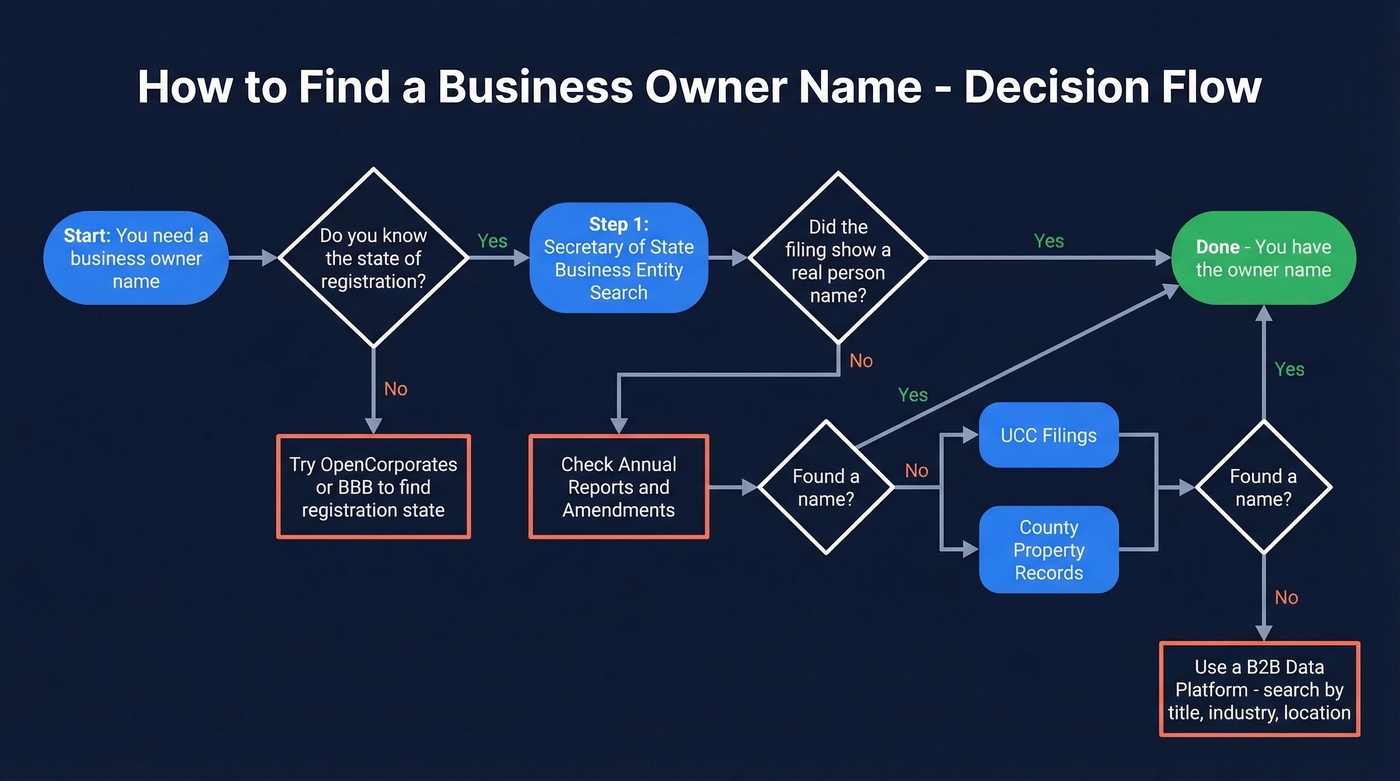
Go to the state's SOS business search page. Here are five commonly used portals: California, Texas, Florida, New York, and Delaware. Search by business name or entity number. Then - and this is the part most people miss - open the filing history. Articles of organization, annual reports, amendments. Don't stop at the summary page.
About 25-30 states require member names in at least some public LLC filings; the rest often show only the organizer or registered agent. Check the state disclosure table below before you start so you know what you're working with.
If the business is formed in Wyoming, Delaware, or another privacy-friendly state, you'll almost certainly hit a registered agent wall. That's when you move to the next methods.
2. Annual Reports & Amendments
Most people skip this. The initial filing often lists only the organizer - a lawyer or formation service, not the owner. Annual reports filed in subsequent years are more likely to include member names because many states require them for ongoing compliance.
Amendments matter too. If the LLC changed ownership or added members, those changes appear in amendment filings. Always scroll through the full filing history, not just the top result.
3. County Property Records
When SOS filings give you nothing but a registered agent, property records are your next move. If the business owns commercial property, the county recorder or assessor's office will have deeds on file.
Search the county recorder or assessor website where the business operates. Look for deeds filed under the business name, then check signature blocks and notary acknowledgments - these often identify the individual signing on behalf of the LLC. This won't work for every business, but for companies that own real estate, it's one of the most reliable workarounds for due diligence and KYB research.
4. UCC Filings
Here's the thing: this is the most underrated method on this list, and often the best way to uncover the person behind a company when state filings come up empty. UCC (Uniform Commercial Code) filings are public records created when a business pledges assets as collateral for a loan. In some cases, filings also surface an individual name tied to the transaction - for example, when a person is listed alongside the entity.
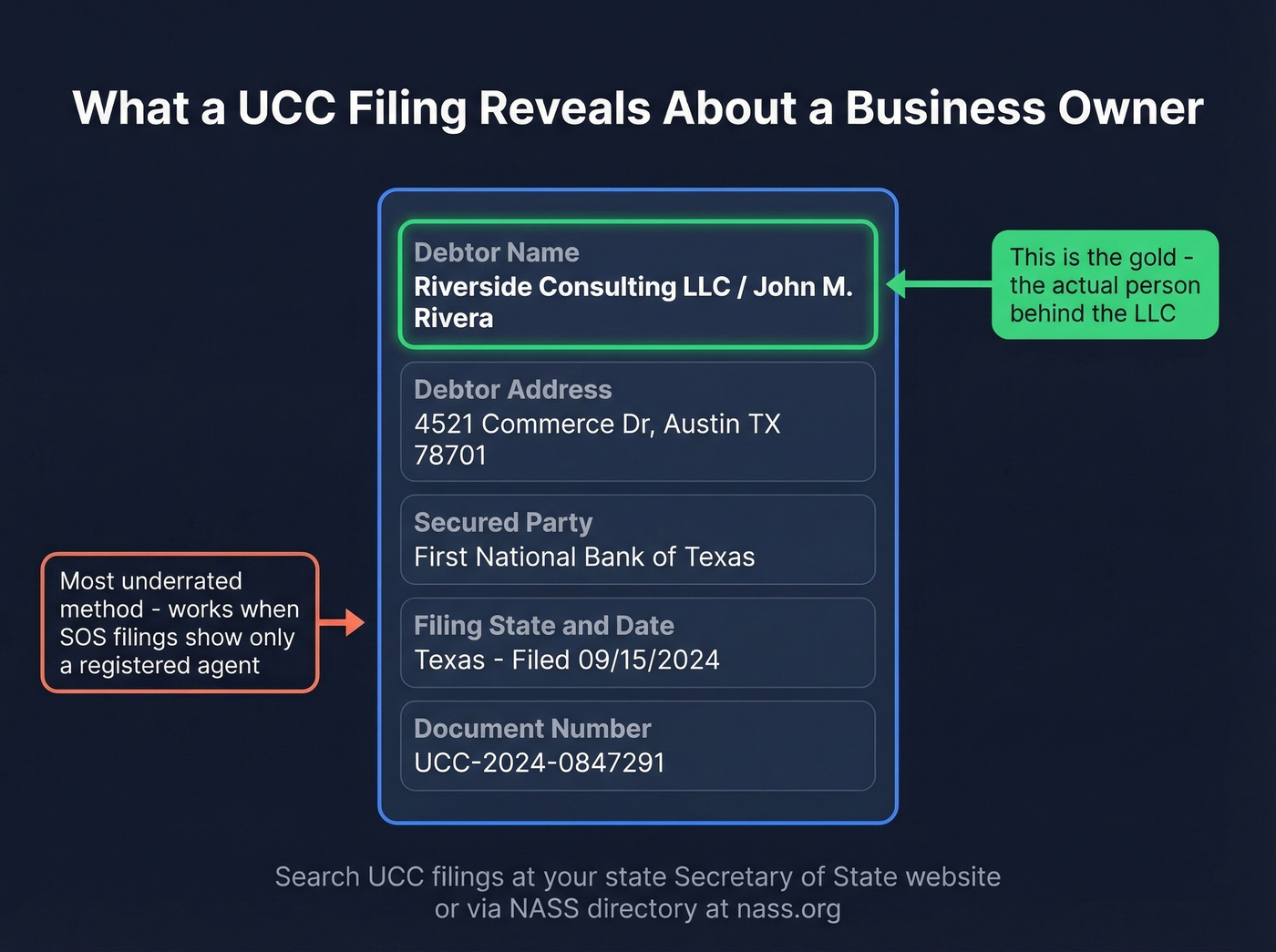
A UCC search reveals the debtor name and address, secured party, filing state and date, and document number. Many states allow online UCC searches through the Secretary of State's office. The National Association of Secretaries of State maintains a state-by-state directory of UCC filing portals - bookmark it.
We've seen UCC filings crack cases where every other method hit a dead end. If the business has ever taken out a loan or equipment lease, there's a strong chance a filing exists with a real human name attached. We've also found that UCC records tend to be more current than SOS filings, since lenders file them close to the transaction date.
5. Business Directories & BBB
The Better Business Bureau, OpenCorporates, and Dun & Bradstreet can help you triangulate who's behind a business using aggregated company directory data and, depending on the listing, officer or management names. OpenCorporates is free for basic searches and pulls from multiple state databases, saving time if you aren't sure where a business is registered. BBB profiles often list the principal's name directly. D&B is paid and more useful for formal due diligence.
6. Company Website & Professional Profiles
Don't overlook the obvious. Many small businesses list their owner on an About or Team page. If the website doesn't name names, search for the company on professional networking sites - founders and owners frequently list their business affiliation publicly.
7. Domain Registration (WHOIS)
If you've been reading articles that say "just do a WHOIS lookup," those articles were written by people who haven't tried it since May 2018. Post-GDPR, registrant data is almost always redacted. The industry is transitioning from WHOIS to RDAP (Registration Data Access Protocol), which uses authenticated, tiered access instead of open lookups.
Skip this unless you're researching a domain registered before 2018. Historical records can still help, but don't expect a clean "owner name" field on modern lookups. This is one of the most overrated methods out there.
8. Use a B2B Data Platform
Everything above works when you're researching one business. But if you're trying to identify owners across 50 or 500 companies - building a prospect list, running outreach, doing competitive research - manual SOS searches don't scale.
Here's a reality check from lead gen communities: tools like Apollo and ZoomInfo work fine for mid-market and enterprise companies, but small agency owners and local businesses are genuinely hard to find in those databases. That's where Prospeo's B2B leads database fills the gap - 300M+ professional profiles with 30+ search filters including title, company size, location, and industry, refreshed on a 7-day cycle.
One tip: don't just search for "Owner." Business owners go by Founder, Managing Member, Principal, CEO, Managing Director, and a dozen other titles. Use multiple title filters to cast a wider net.

If your average deal size is under $5K, you probably don't need ZoomInfo-level data. A self-serve platform with accurate emails and a free tier will get you 80% of the way there at a fraction of the cost.
If you plan to email the owners you find, pair your list-building with data enrichment and basic email deliverability hygiene so your outreach actually lands.

Searching state databases one at a time works for a single company. But when you need to find business owners across hundreds of companies, Prospeo's 300M+ profile database lets you filter by title (Owner, Founder, CEO, Managing Member), industry, location, and company size - with 98% verified email accuracy and a 7-day data refresh cycle.
Find the owner and their verified contact info in one search.
Which States Disclose Owner Names
Not all Secretary of State databases are created equal. Knowing which states disclose member information saves you from wasting 20 minutes on a search that was never going to work.
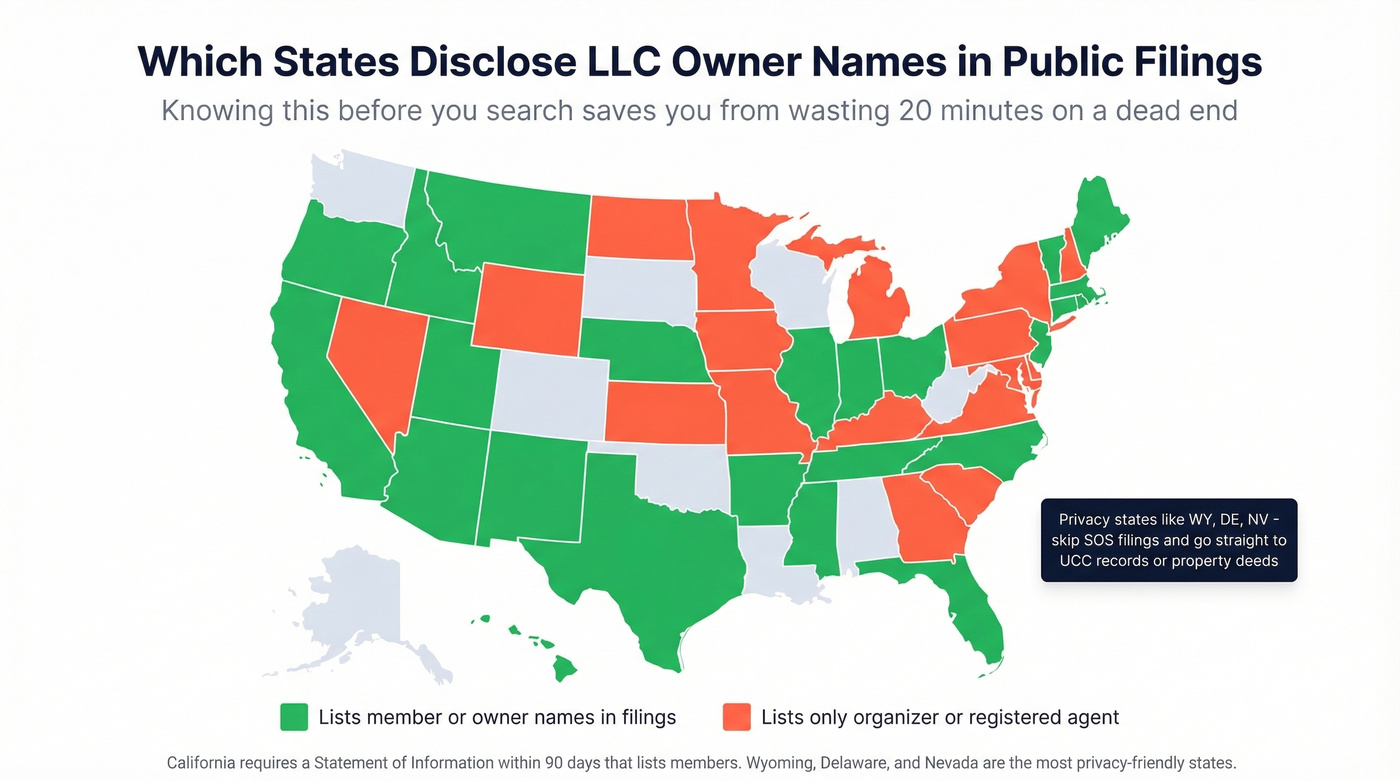
| States That List Member Names | States That List Only Organizer / Registered Agent |
|---|---|
| AZ, AR, CA*, CT, DC, FL, HI, ID, IL, IN, MA, ME, MS, MT, NE, NV, NJ, NM, NC, OH, OR, TN, TX, UT, VT | DE, GA, IA, KS, KY, MD, MI, MN, MO, NH, NY, ND, OK, PA, RI, SC, SD, VA, WI, WY |
*California: Articles of Organization don't list members, but the Statement of Information (required within 90 days of formation) does - and it's public record.
Privacy is the product in states like Wyoming, Delaware, and Nevada - not a bug. Wyoming's articles require only the LLC name and registered agent; annual reports don't include ownership either. Wyoming's filing fee runs $100 ($102 online) with a $60 annual report. Delaware charges $90 to form plus $300/year in franchise tax.
If you're researching a business formed in a right-column state, SOS filings alone won't get you there. Jump to UCC filings, property records, or a data platform.
If you're doing this for outreach, build a repeatable lead generation workflow so you can move from “found a name” to “booked a meeting” without reinventing the process each time.
The Corporate Transparency Act
The CTA was supposed to change everything. As of 2026, it's changed almost nothing for domestic companies.
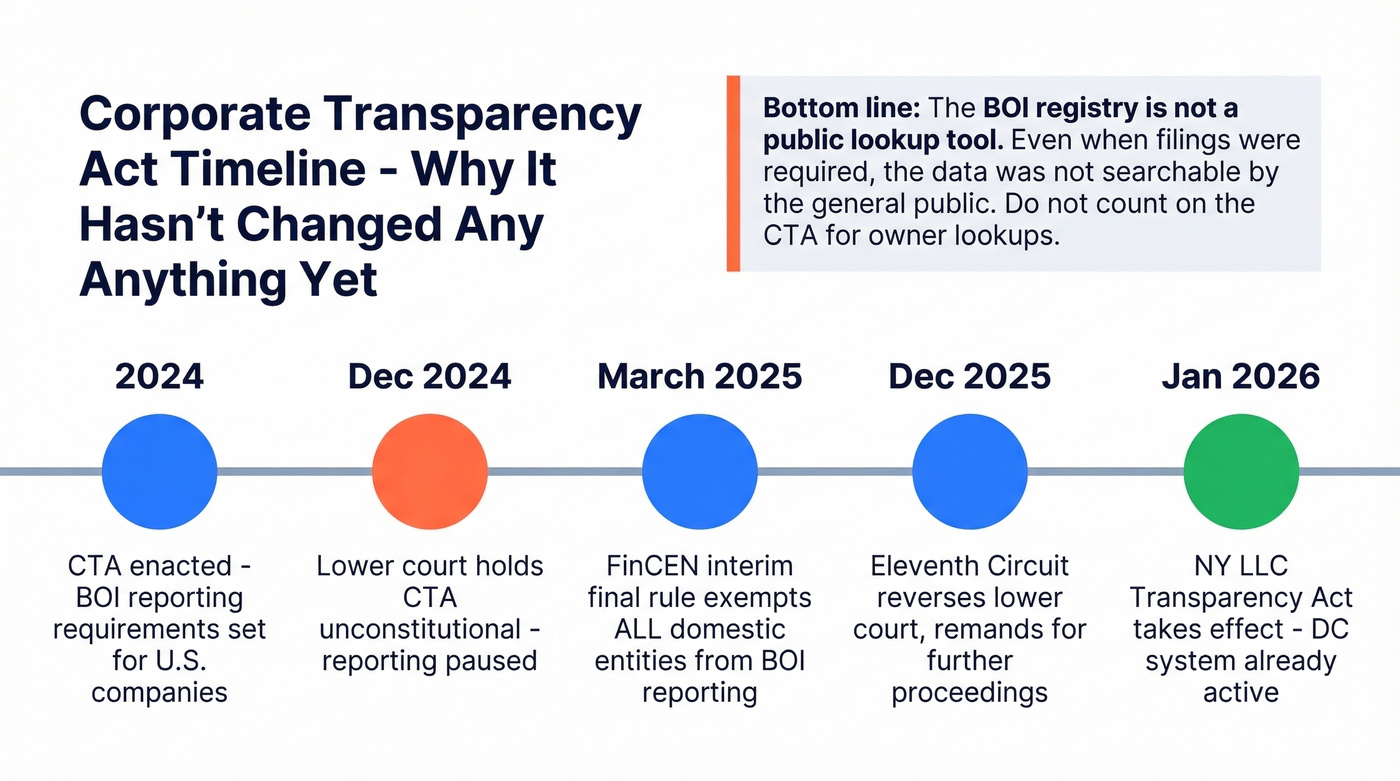
FinCEN's interim final rule, published March 26, 2025, exempted all U.S.-created entities from Beneficial Ownership Information reporting. The revised rule applies only to foreign entities registered in a U.S. state or tribal jurisdiction. The BOI registry isn't a public lookup tool - even when filings were required, the data wasn't searchable by the general public.
On December 19, 2025, an Eleventh Circuit panel reversed a lower court decision that had held the CTA unconstitutional, remanding for further proceedings. At the state level, the New York LLC Transparency Act took effect January 1, 2026, and DC's system is already active, requiring disclosure of persons with more than 10% ownership in biennial reports.
If you're counting on the CTA to make business owner lookups easier, don't hold your breath. The eight methods above remain your best options.
SOS filings, UCC records, and property deeds give you a name. Prospeo gives you the name, verified email, and direct phone number - across 300M+ profiles with 30+ filters including title, headcount, and industry. At $0.01 per email, it costs less than the time you'd spend on a single county recorder search.
Skip the registered agent wall. Get the real person behind the business.
FAQ
What's the fastest way to find a business owner's name?
Start with the Secretary of State business entity search for the state where the company is registered. Pull up annual reports - not just the original articles. If the state doesn't disclose members, escalate to UCC filings or county property records. Most owner names surface within 10-15 minutes using this sequence.
Can I look up a business owner by EIN?
No. The IRS doesn't offer a public EIN-to-owner lookup. You can verify an EIN belongs to a specific business, but it won't reveal the owner's identity. Use SOS filings, UCC records, or a B2B data platform instead.
Is it legal to search for a business owner's name?
Yes. Business formation records, UCC filings, and property records are public records maintained by government agencies. BBB listings are publicly accessible business directory profiles. There's no legal barrier to searching them - you're using information that's already part of the public record.
What if the business is a franchise?
The local franchise owner typically operates through a separate LLC. Search the state SOS database for the local entity name - it's usually different from the franchise brand - then check the filing history for member names. Franchise Disclosure Documents can also list franchisee details, though access varies.
How do I find an LLC owner when the state hides member names?
Skip straight to UCC filings and county property records - these two sources frequently list individual names even when SOS filings only show a registered agent. Failing that, a B2B data platform can surface the owner by matching title and company data across professional profiles.