

How to Find a Sales Mentor in 2026 (Exact Playbook)
You've been an SDR or AE for a year or two. You're decent at the job, but you have no idea what the path to VP of Sales actually looks like - and your peers don't know either. The role of sales rep is changing faster than ever, and the gap between where you are and where you want to be feels wider each quarter.
Stop romanticizing the concept and start sending messages.
76% of professionals say mentors are important, but only 37% actually have one. That gap isn't because mentors are rare - it's because most people never ask. Mentees get promoted 5x more often than people without mentors, and 98% of Fortune 500 companies run formal mentoring programs. But most individual sellers are completely on their own. Meanwhile, 63% of millennials say their leadership skills aren't being fully developed by their employers. Your company probably isn't going to build this for you. You have to go get it.
Quick Version
- Pick a community from the table below and start showing up.
- Use the outreach template in Section 5 to send a specific, respectful message.
- Set a monthly 30-minute cadence and own the agenda every time.
That's it. The rest of this article is the how.
Sales Mentor vs. Sales Coach
These get conflated constantly. The distinction matters for your wallet.
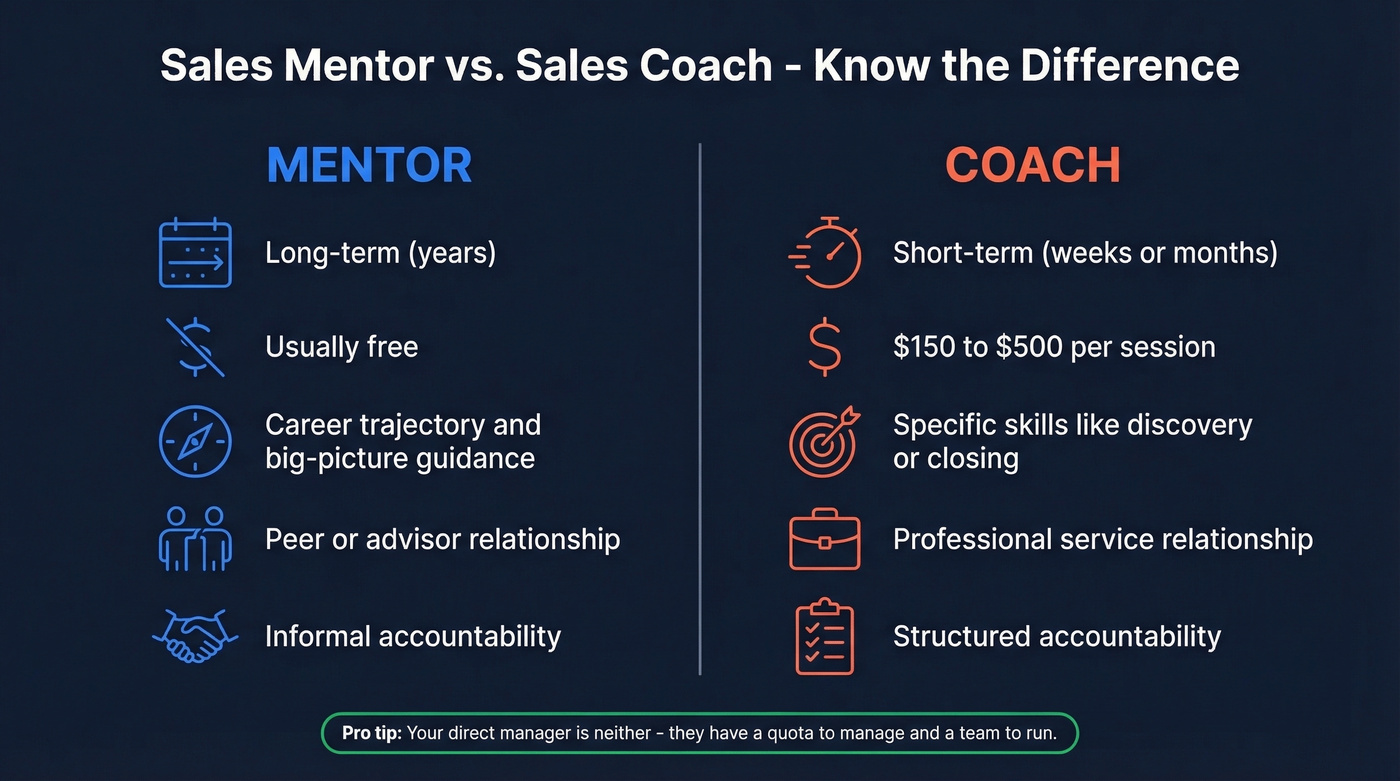
| Mentor | Coach | |
|---|---|---|
| Duration | Long-term (years) | Short-term (weeks/months) |
| Cost | Usually free | $150-500/session or /mo |
| Focus | Career trajectory | Specific skills |
| Relationship | Peer/advisor | Professional service |
| Accountability | Informal | Structured |
Your direct manager isn't your mentor either. They've got a quota to manage and a team to run. You need someone with no stake in your next deal - someone who can tell you "your comp plan is bad, start interviewing" without it being awkward on Monday.
Where to Find a Sales Mentor
Inside Your Company
Look for skip-level managers or cross-functional leaders - the VP of Customer Success who used to carry a bag, or the CRO who built the team from five reps. Approach someone outside your direct reporting line. Your manager coaches you on methodology. A mentor helps you figure out whether you should even be at this company in two years.
When scanning your org chart, pay attention to titles that signal cross-functional experience. People who've held both revenue and go-to-market roles tend to offer the broadest perspective, and they're often flattered to be asked because nobody ever does.
Sales Communities
Here's the thing: this is where most mentor relationships actually start. You show up, contribute, and eventually someone senior notices. Think of it as personal branding for your sales career - the more consistently you share insights and ask thoughtful questions, the more top reps in these groups want to invest in you.
If you're trying to build a repeatable system for meeting the right people, treat it like sales prospecting: show up consistently, add value, and follow up.
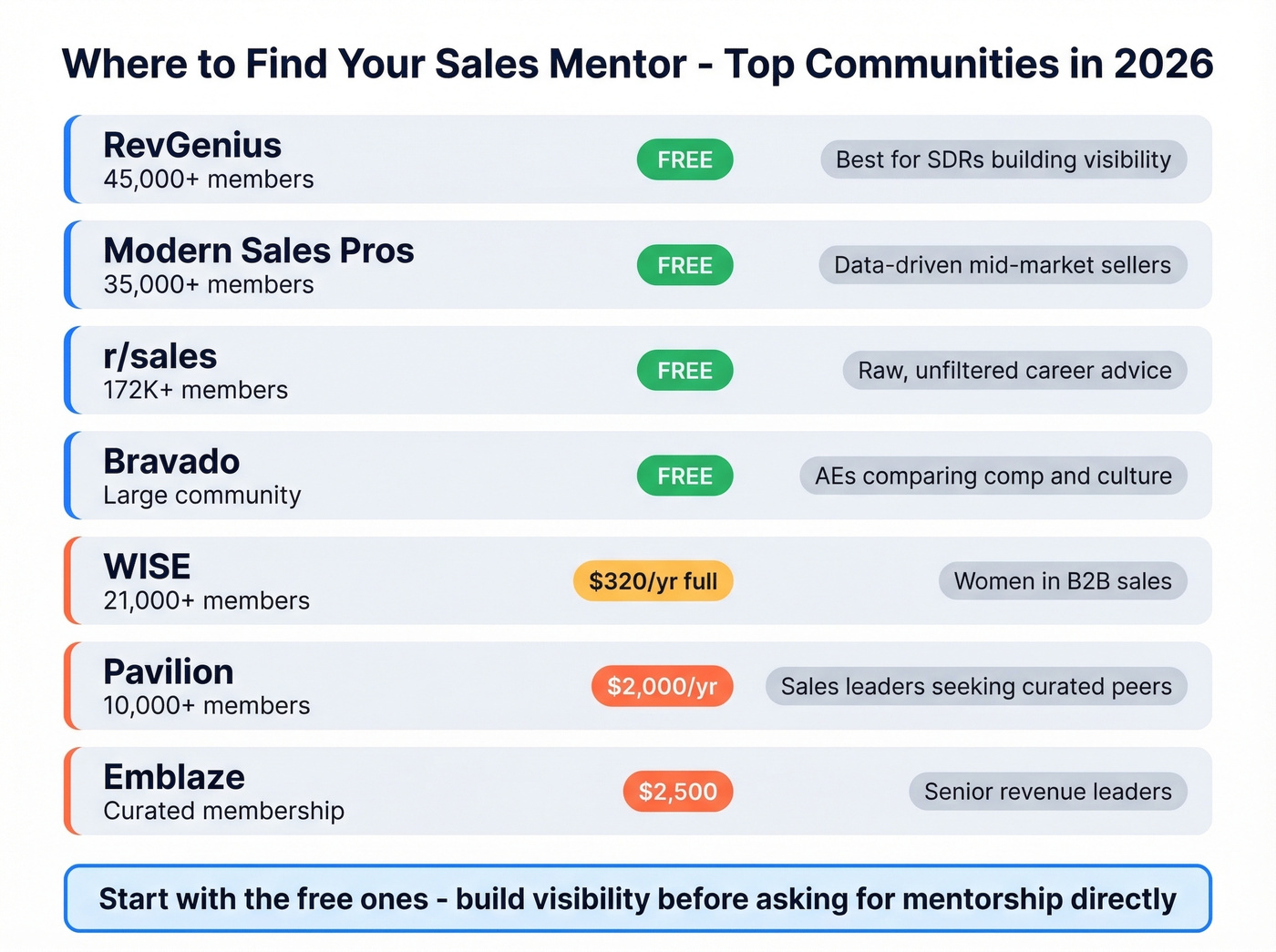
| Community | Members | Cost | Best For |
|---|---|---|---|
| RevGenius | 45,000+ | Free | SDRs building visibility |
| Modern Sales Pros | 35,000+ | Free | Data-driven mid-market sellers |
| Pavilion | 10,000+ | ~$2,000/yr | Sales leaders seeking curated peers |
| WISE | 21,000+ | Free Slack / $320/yr full membership | Women in B2B sales |
| Bravado | Large community | Free | AEs comparing comp and culture |
| r/sales | 172K+ | Free | Raw, unfiltered career advice |
| Emblaze | Curated | $2,500 | Senior revenue leaders |
Start with the free ones. RevGenius and Modern Sales Pros both have active Slack channels where you can build visibility before ever asking someone for mentorship directly. The consensus on r/sales is that cold outreach to potential mentors works better than most people expect - as long as you're specific, respectful of time, and don't open with "will you be my mentor?" Ask for a single call first.
Pavilion's worth the investment if you're already in a leadership role. WISE is especially valuable for women in B2B sales, connecting members with senior leaders who've navigated the unique challenges of building a revenue career. We've seen several people in our network land long-term mentors through WISE's structured programs.
Paid Mentorship Platforms
For teams or individuals who want structure without the networking legwork:
MentorCruise ($150-500/mo) is the strongest option for ongoing 1:1 relationships. You pick a mentor based on their background, set a cadence, and get async access between calls. GrowthMentor (~$99/mo) is session-based - good for tactical advice on a specific problem, less useful for long-term career guidance. Leland runs a marketplace model at $100-300/session, popular for tech sales and career pivots. SCORE is free and government-backed, but it's general business mentoring, not sales-specific - better for founders than for AEs trying to break into enterprise.
Let's be honest: free mentorship beats paid if you find the right person. A senior AE at your dream company who takes your call monthly is worth more than any $400/mo coaching subscription. Paid platforms are a shortcut for matching, not an upgrade in quality.
If you're building a list of potential mentors to contact, it helps to think in terms of contact management so you don't lose track of who you reached out to and when.

The best mentor outreach gets a response because it lands in the right inbox. Prospeo gives you verified emails (98% accuracy) and current titles for 300M+ professionals - so your carefully crafted message doesn't bounce or rot in a LinkedIn queue.
Stop guessing at email addresses. Start landing in the inbox that matters.
How to Ask (Without Being Awkward)
Before you write that message, do your homework. Use Prospeo's Chrome extension to grab their verified email and current title so you can bypass a crowded inbox and land directly in theirs. LinkedIn DM template:
Hi [Name] - I'm a [your role] at [your company], selling [what you sell]. I've been following your work at [their company], especially [specific thing - a post, a podcast appearance, a deal they closed publicly]. I'm trying to get better at [specific skill or career goal], and you're one of the few people I've found who's actually done it. Would you be open to a 20-minute call sometime this month? Happy to work around your schedule. No pressure either way.
Email template:
Subject: Quick question from a [your role] at [your company]
Hi [Name],
I'm [your name], a [role] at [company]. I came across your background at [their company] and was impressed by [specific detail - their career path, a talk, a metric].
I'm working on [specific challenge - breaking into enterprise, moving from SDR to AE, building a book of business], and I think your experience with [relevant thing] could help me think through it.
Would you be open to a 20-minute call in the next few weeks? I'll come prepared with specific questions and respect your time.
Thanks, [Your name]
Specificity is the whole game. Reference their actual role and something concrete about why you chose them. Calling someone a "sales leader" when their title is Chief Revenue Officer signals you didn't do your homework.
If you want more options beyond the two scripts above, pull from proven sales follow-up templates and adapt the tone to mentorship (short, specific, low-pressure).
You wrote the perfect mentor ask. Now make sure it reaches them. Prospeo's Chrome extension - used by 40,000+ sales pros - pulls verified contact details from any professional profile in one click, so your outreach bypasses crowded DMs and hits their actual inbox.
Research any sales leader in seconds and reach out with confidence.
Your First 90 Days
You got the yes. Now don't waste it.
If you want a tighter structure for what to do each month, borrow the logic from a 30-60-90 day plan and apply it to mentorship outcomes (skills, deals, career moves).
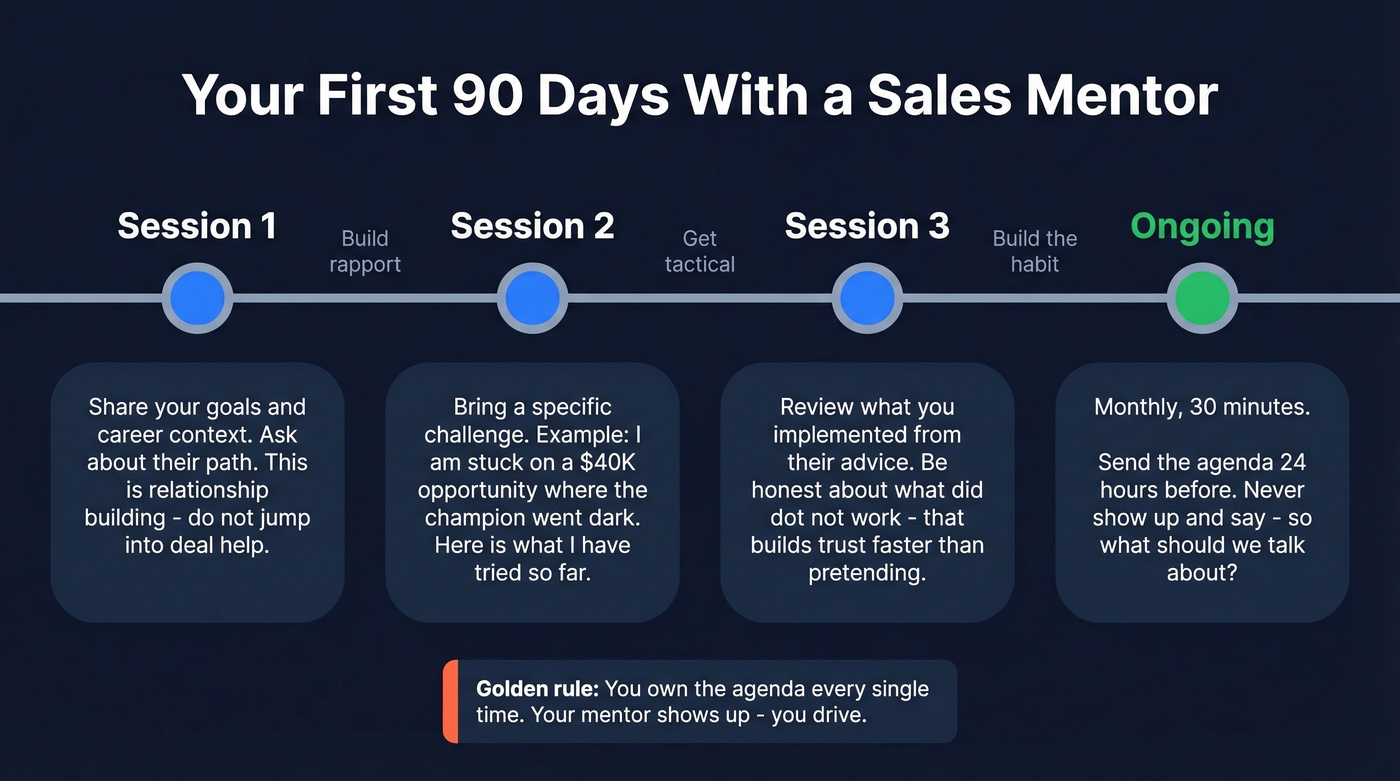
Session 1: Share your goals and career context. Ask about their path. This is relationship-building - don't jump straight into "help me close this deal."
Session 2: Bring a specific challenge. "I'm stuck on a $40K opportunity where the champion went dark - here's what I've tried." Concrete beats abstract every time. A great mentor can teach you how to build internal advocates instead of relying on a single thread, which is the kind of strategic thinking you won't get from a playbook.
If you're struggling to diagnose what's actually happening in deals, it can help to pressure-test your discovery questions with your mentor and refine what you ask.
Session 3: Review what you've implemented from their advice. Adjust cadence if needed. If something they suggested didn't work, say so - that honesty builds trust faster than pretending everything went perfectly.
Ongoing: Monthly, 30 minutes. Send the agenda 24 hours before. Never show up and say "so, what should we talk about?"
What the Best Reps Learn From Mentors
The most common question early-career sellers ask mentors is some version of "will AI replace my job?" The answer is more nuanced than a yes or no. AI is automating research, sequencing, and even parts of discovery, but the best sales reps are evolving from order-takers into strategic advisors. A good mentor helps you understand the difference between an evangelist mindset and a transactional one: one educates the market and builds trust before a deal even exists, while the other waits for inbound.
If you're trying to stay ahead of the curve, it helps to understand what generative AI sales tools are actually good for (and what they aren't).
The path from content curator to closer - someone who shares relevant insights to earn attention and then converts that attention into pipeline - is exactly the kind of career evolution a mentor can accelerate. In our experience, the reps who make this shift fastest are the ones getting outside perspective from someone who's already been through it. Rewiring how you think about your role, from pitch-first to insight-first, requires a mirror. That's what a mentor is.
Mistakes That Kill Mentorships
Every one of these is the mentee's fault.
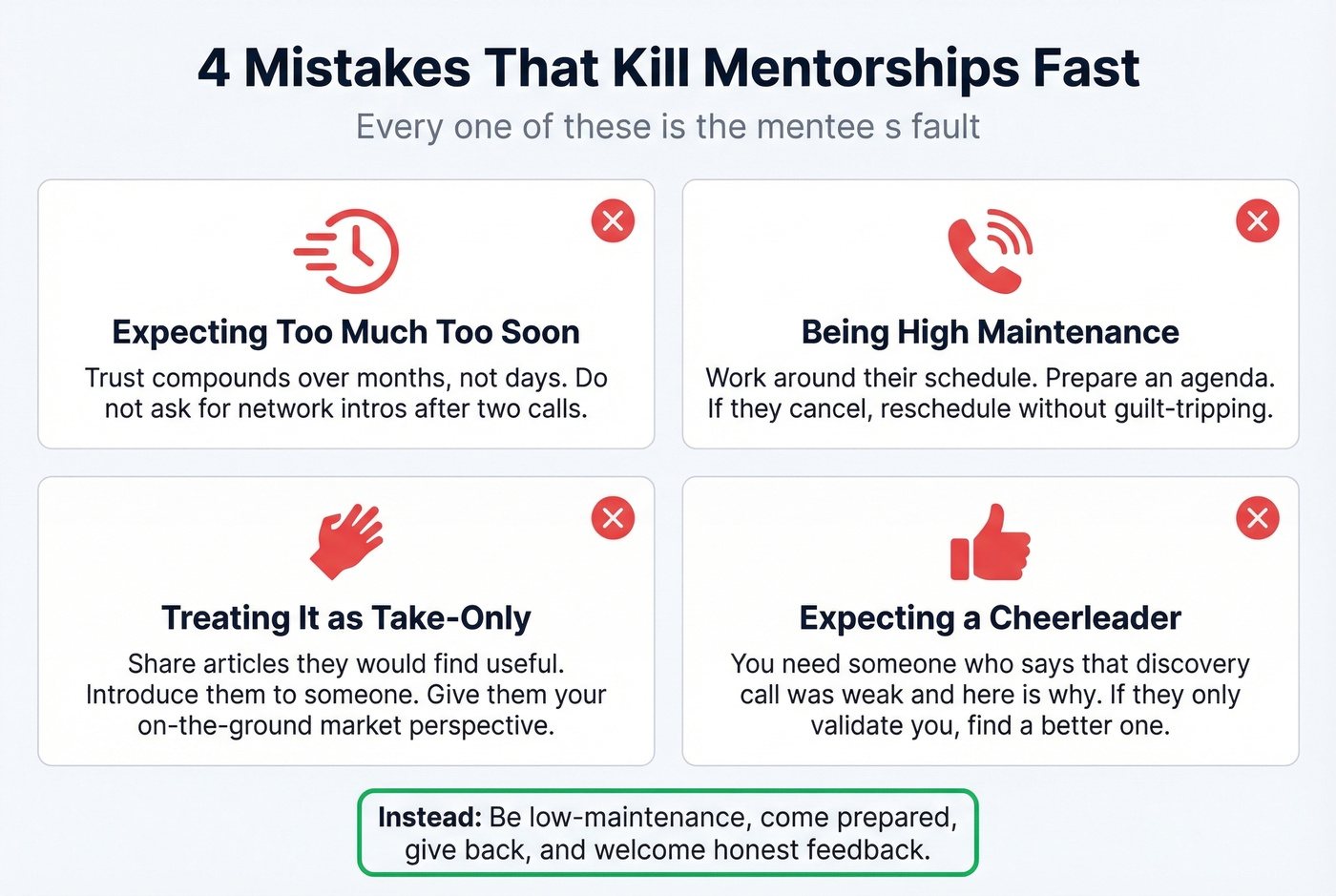
Expecting too much too soon. Your mentor isn't introducing you to their network after two calls. Trust compounds over months, not days.
Being high maintenance. Work around their schedule. Prepare an agenda. If they cancel, reschedule without guilt-tripping. You're getting free access to hard-won experience - act like it.
Treating it as take-only. Share an article they'd find useful. Introduce them to someone. Give them a window into how junior reps think about the market - your on-the-ground perspective on today's buying process is genuinely valuable to leaders who are further from the frontline. Reciprocity keeps the relationship alive.
If you want to be more intentional about what you bring to the relationship, focus on how to add value in sales and translate those habits to mentorship (insights, intros, and follow-through).
Expecting a cheerleader. You need someone who says "that discovery call was weak and here's why." If your mentor only validates you, find a better one. Skip anyone who just tells you what you want to hear - that's a friend, not a mentor.
FAQ
Should I pay for a sales mentor?
Free mentorship is better if you can find the right person through communities like RevGenius or Pavilion. Paid platforms like MentorCruise or GrowthMentor are a shortcut for matching, not an upgrade in quality. Start free, go paid only if you can't find the right fit organically after 4-6 weeks of active networking.
Can my sales manager be my mentor?
No. They have a quota to manage, a team to run, and a direct stake in your performance reviews. You need someone who can give you unfiltered career advice - including "you should leave this company" - without creating a conflict. Look one or two levels up, ideally outside your direct reporting line.
How often should I meet with my mentor?
Once a month for 30 minutes is the sweet spot. Send a brief agenda 24 hours in advance with 2-3 specific topics. Over-scheduling burns out even the most generous mentors; under-scheduling kills momentum. Monthly keeps the relationship active without becoming a burden.