

How to Find Out Business Owners: 7 Methods That Actually Work
You found the LLC filing, and the only name listed is "Registered Agents, Inc." Now what?
Most guides tell you to "check the Secretary of State database" like it's a magic button. It's not - especially when the business is registered in Delaware or Wyoming, where anonymity is the whole point. If you're trying to find out business owners for a legal matter, a compliance check, or sales outreach, the path forward depends entirely on why you're looking and how much anonymity the owner has layered on top. Here are seven methods that work in 2026, starting with the free ones.
Quick Reference
Just need the owner's name? Start with your state's Secretary of State business search. It's free.
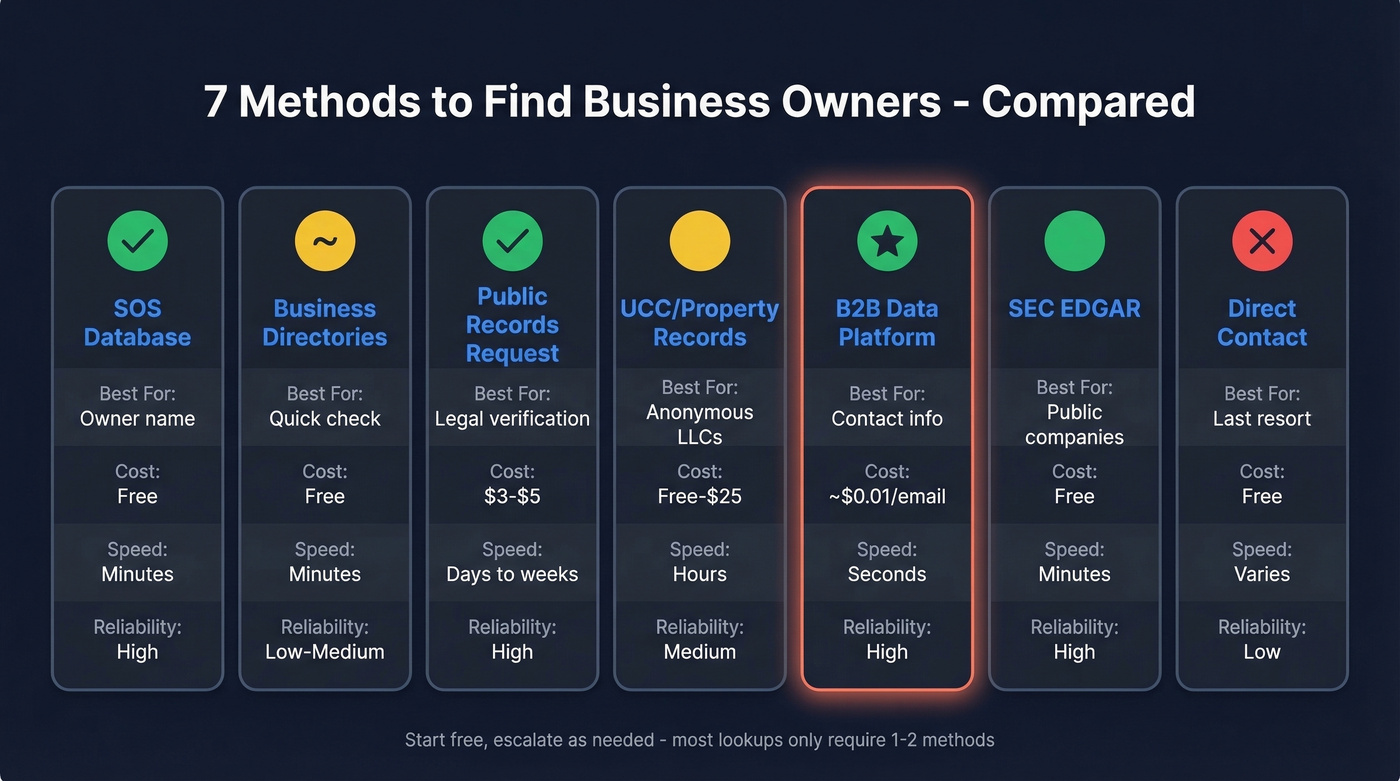
Need to verify ownership for legal or compliance reasons? Combine SOS records with UCC filings and a public records request.
Need the owner's verified email or phone number? A B2B data platform lets you search by company name, filter by title, and pull verified contact info in seconds.
| Method | Best For | Cost | Speed | Reliability |
|---|---|---|---|---|
| SOS Database | Owner name | Free | Minutes | High (most states) |
| Business Directories | Quick check | Free | Minutes | Low-Medium |
| Public Records Request | Legal verification | $3-$5 | Days to weeks | High |
| UCC/Property Records | Anonymous LLCs | Free-$25 | Hours | Medium |
| B2B Data Platform | Contact info | Free tier; ~$0.01/email | Seconds | High |
| SEC EDGAR | Public companies | Free | Minutes | High |
| Direct Contact | Last resort | Free | Varies | Low |
7 Methods to Find Business Owners
1. Search Secretary of State Databases
Every state maintains a business entity database through its Secretary of State office. When someone forms an LLC or corporation, they file Articles of Organization - or Articles of Incorporation - and in most states, those filings include the names of members, managers, or organizers.
Not every state requires the same level of disclosure. Delaware, Wyoming, New Mexico, and Nevada are specifically designed to keep owner names out of public filings. In those states, you'll often see only a registered agent listed. A registered agent isn't the owner. They're a third-party service that accepts legal documents on the company's behalf. Don't confuse the two.
For the other 46 states, the process is straightforward: go to your state's SOS business search portal, enter the company name or entity number, and pull up the filing. LLC University maintains an updated directory of all 50 state search portals plus DC and Puerto Rico. One quirk we've run into - New Hampshire's search portal doesn't play well with Chrome, so use Firefox or Edge. Also check the "Annual Report" or "Statement of Information" filings, which are often more current than the original articles.
For international lookups, OpenCorporates covers 140+ jurisdictions, though roughly half of its registry sources are no longer actively updated.
2. Check Business Directories and Websites
Before you go deep into government records, do the obvious stuff first:
- Google Business Profile - many small businesses list the owner's name
- LinkedIn - search the company page and check who lists "Owner," "Founder," or "CEO" in their title
- BBB (Better Business Bureau) - shows the principal or owner for accredited businesses
- Yelp business pages - sometimes list the owner, especially for restaurants and service businesses
- The company's own website - check the About, Team, or Leadership page
Set realistic expectations here. Many business owners deliberately keep their names off public-facing directories. This method works best for local businesses where the owner is also the face of the company - restaurants, contractors, retail shops. For a faceless holding company in Wilmington? Skip ahead.
3. Submit a Public Records Request
If the SOS database doesn't give you what you need, file a public records request. At the federal level this is called a FOIA request; state-level requests go by different names depending on where you are. Business license applications and DBA filings often contain the owner's legal name and address.
Contact your city or county clerk's office and request copies of the business license application for the company in question. Most jurisdictions charge $3-$5 for copies. Turnaround ranges from a few days to several weeks.
This is worth the wait when you need documentation for legal or compliance purposes - a business license application is a signed government document, which carries more weight than a database entry.
4. Search Property and UCC Records
Here's the thing: this is the workaround most guides skip entirely.
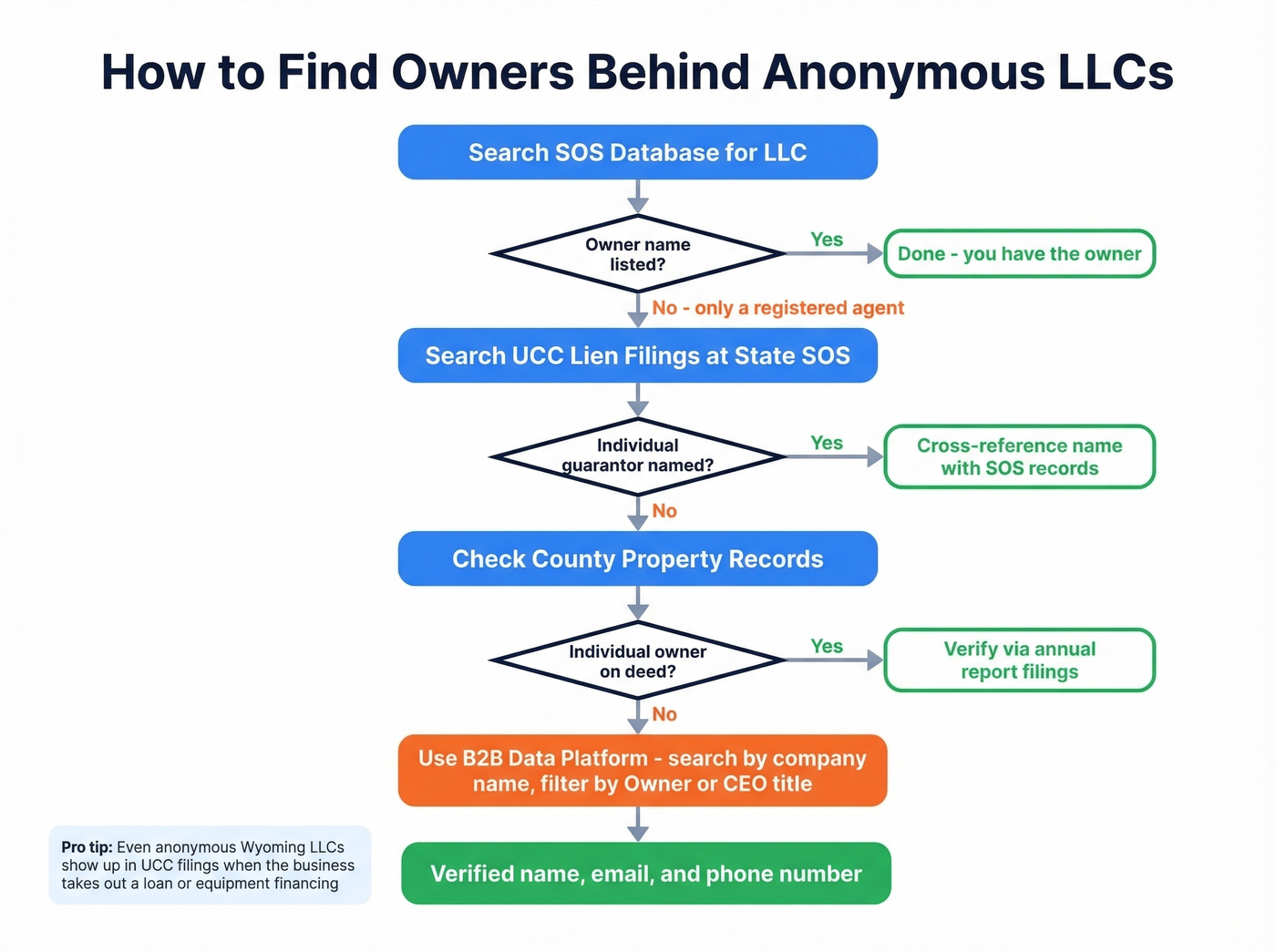
UCC (Uniform Commercial Code) lien filings are public records that document secured transactions - when a business uses assets as collateral for financing. These filings are recorded with the state SOS office or county recorder's office, and they can name individuals tied to the business. Even if someone formed an anonymous LLC in Wyoming, the moment that LLC takes out a business loan or equipment financing, a UCC filing gets created that may list an individual guarantor. It's a breadcrumb trail that anonymity structures can't easily hide.
We've used this method to identify owners behind privacy-shielded LLCs that were completely invisible in standard SOS searches. It's one of the most reliable workarounds for businesses deliberately hidden behind privacy-friendly state filings.
Property records work similarly. If the business owns real estate, the county assessor's office will have records showing the owner of record - sometimes the LLC name, sometimes the individual, especially for smaller operations.
The tricky part is that filing location varies by state. Some states centralize UCC filings at the SOS office. Others record them at the county level, which means you need to know the right county. Start with the state SOS and work down from there. The National Association of Secretaries of State has a directory of UCC filing offices by state.
5. Use a B2B Data Platform
Every method above gets you a name. But if you're in sales, recruiting, or business development, a name isn't enough - you need a way to actually reach the person. This is especially true when you need to find small business owners and decision makers who don't have a large public profile.
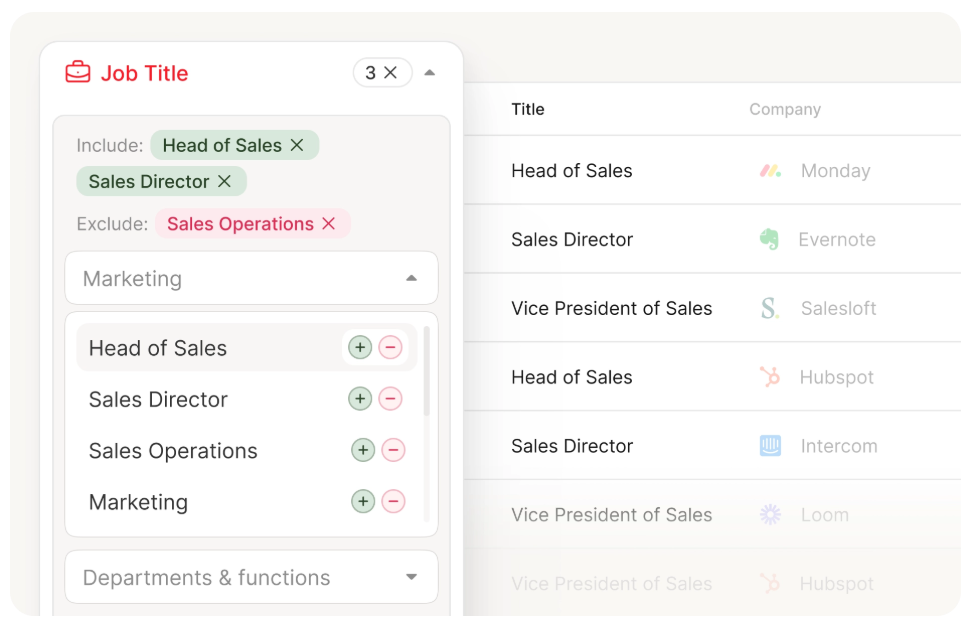
Prospeo is the fastest way to go from company name to verified contact info. Search by company name, filter by title - Owner, CEO, Founder, Managing Member - and get a verified email and direct phone number. The database covers 300M+ professional profiles with 143M+ verified emails at 98% accuracy, plus 125M+ verified mobile numbers. There's a free tier to test it, and credits run about $0.01 per email.
The real value is skipping the multi-step research process entirely. Instead of searching the SOS database, cross-referencing UCC filings, and then guessing an email format, you go straight to verified contact info. For anyone whose goal is reaching the owner - not just identifying them - this saves hours per prospect.
If you're building repeatable outreach, pair this with sales prospecting and a simple lead generation workflow so owner lookups don’t become a bottleneck.
6. Use SEC EDGAR for Public Companies
This only applies to publicly traded companies, but it's definitive when it does. The SEC's EDGAR system contains every filing a public company makes, and several reveal ownership.
Look for DEF 14A proxy statements - these disclose major shareholders and board members. Forms 3, 4, and 5 track insider ownership and transactions. The 10-K annual report lays out corporate structure, subsidiaries, and executive compensation. Between these filings, you'll know exactly who controls the company and how much they own.
7. Contact the Business Directly
When all else fails, pick up the phone.
Call the main business line and ask to speak with the owner or managing member. If you found a name through one of the methods above, ask for them by name - it dramatically increases your chances of getting through. Keep in mind that the person who answers may use a different title than "owner." Look for CEO, Principal, Managing Partner, or President depending on the industry.
If you’re doing this for outbound, a consistent cold calling system helps you get past gatekeepers faster.

You don't need to cross-reference SOS filings, UCC liens, and property records just to reach a business owner. Prospeo's database covers 300M+ profiles - search by company name, filter by title (Owner, CEO, Founder), and get 98% accurate emails and verified direct dials in seconds.
Skip the research rabbit hole. Go straight to verified contact info.
Why Some Owners Are Hard to Find
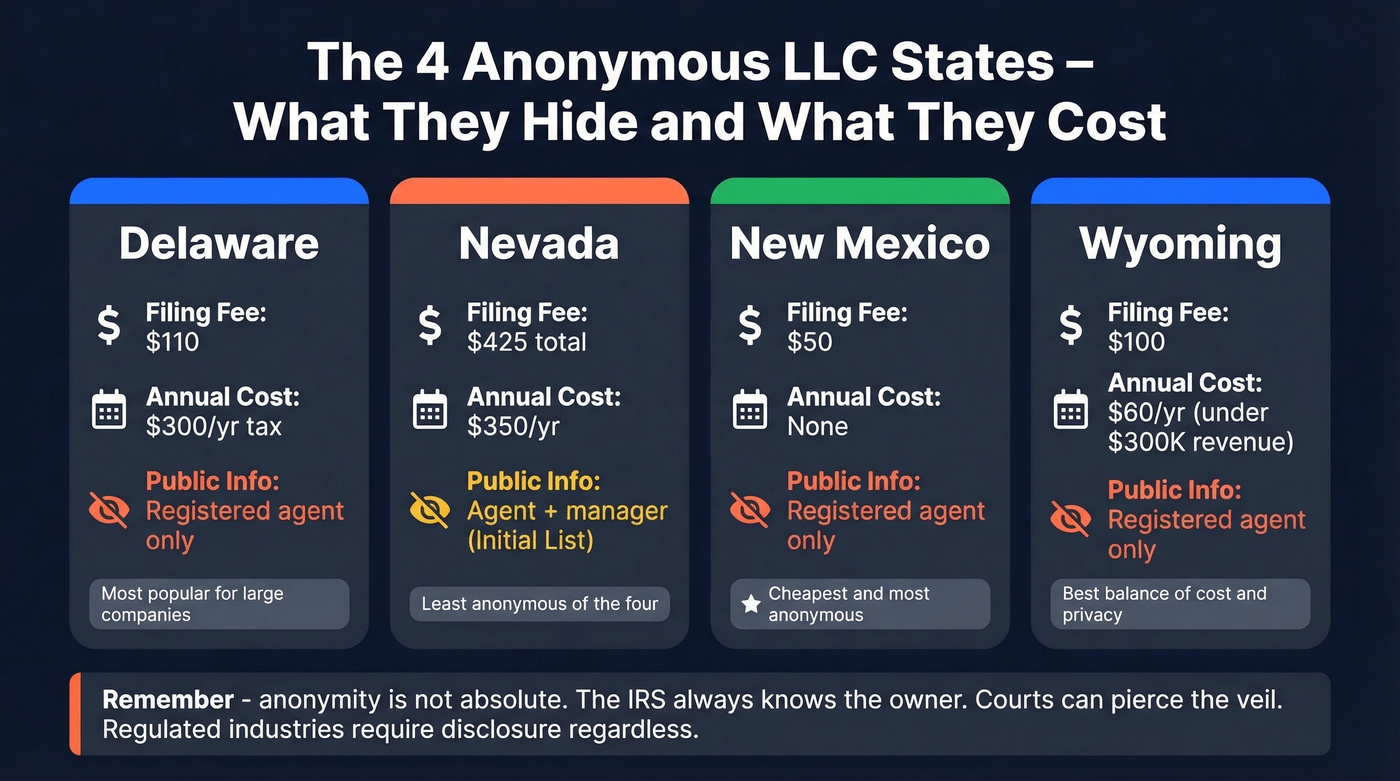
A common frustration is hitting a registered agent dead end - the exact scenario we opened with. Four states specifically allow anonymous LLC formation where member and manager names don't appear in public state records:
| State | Filing Fee | Annual Cost | What's Public |
|---|---|---|---|
| Delaware | $110 | $300/yr tax | Registered agent only |
| Nevada | $425 total | $350/yr | Agent + manager (Initial List) |
| New Mexico | $50 | None | Registered agent only |
| Wyoming | $100 | $60/yr (under $300K) | Registered agent only |
For $50 in New Mexico - with zero ongoing costs - anyone can form an LLC that's essentially invisible in public records. Beyond state-level anonymity, owners stack additional layers: registered agent services, nominee managers, and holding companies that own the operating LLC. A Wyoming LLC owned by a Delaware holding company with a New Mexico registered agent is nearly opaque to public searches.
Anonymity isn't absolute, though. The IRS always knows who owns the entity. Courts can pierce the veil through subpoenas. And in regulated industries, ownership disclosure is mandatory regardless of state formation. But for everyday research - whether you're running due diligence or prospecting - these structures create real obstacles.
Let's be honest: if you're spending more than 30 minutes trying to identify a single business owner through public records, you're almost certainly better off paying $0.01 for a data platform lookup. Your time is worth more than your stubbornness.
The Corporate Transparency Act: Don't Count on It
The Corporate Transparency Act was supposed to end anonymous business ownership in the United States. It hasn't.
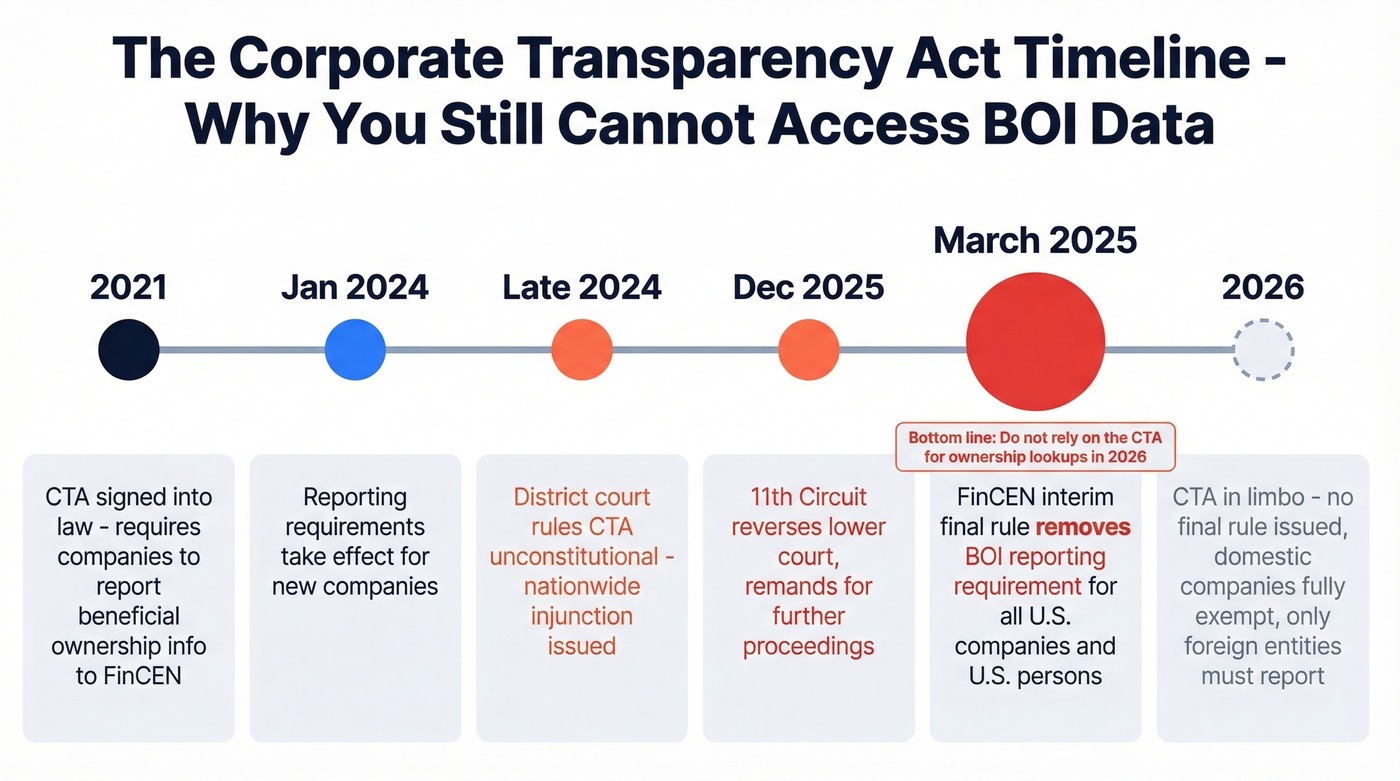
FinCEN issued an interim final rule on March 21, 2025 that removed the requirement for U.S. companies and U.S. persons to report beneficial ownership information. The rule redefined "reporting company" to cover only foreign entities formed under foreign law and registered to do business in a U.S. state. Every domestic LLC, corporation, and partnership is now exempt from BOI reporting.
The litigation hasn't helped either. The Eleventh Circuit reversed a 2024 district court decision that had found the CTA unconstitutional, remanding for further proceedings in December 2025. FinCEN planned to issue a final rule by end of 2025 but didn't. As 2026 begins, the CTA is in flux - and the consensus on r/smallbusiness is that nobody's holding their breath for enforcement.
Don't count on BOI data to help you identify who owns a business. It's not public, it's not comprehensive, and the regulatory framework is still being litigated.
Paid Tools Compared
If you're doing this research regularly, manual SOS searches won't scale. We've run the SOS-to-UCC-to-data-platform workflow enough times to know that the platform step alone would've saved us hours in most cases. Here's how the paid options stack up:
| Tool | Best For | Pricing | Scope |
|---|---|---|---|
| Prospeo | Prospecting + contact info | Free tier; ~$0.01/email | Self-serve, no minimums |
| OpenCorporates | Basic company lookup | Free; ~$3,000/yr API | Entity data, 140+ jurisdictions |
| Orbis (Moody's) | Enterprise compliance | $25,000+/yr | Global corporate structures |
| Experian Business | Credit/risk reports | ~$40/report | U.S. credit + risk data |
| Global Database | Mid-market research | Starts ~$250/mo | Company + contact data |
Enterprise platforms like ZoomInfo, D&B Hoovers, and LexisNexis typically run $10,000-$40,000/year depending on seats and modules. For compliance teams running KYB checks at scale, Orbis and Experian make sense despite the price tags. But most teams don't need that level of infrastructure. If your goal is finding business owners and actually reaching them with a verified email or direct dial, skip the enterprise sales cycle - a self-serve platform with transparent pricing gets you there faster and at a fraction of the cost.
If you’re comparing data vendors, start with a shortlist of sales prospecting databases and add data enrichment services only when you need deeper coverage.
Finding the owner's name is step one. Actually reaching them is the hard part. Prospeo gives you verified emails at $0.01 each and 125M+ mobile numbers with a 30% pickup rate - so you're not just identifying business owners, you're connecting with them.
Turn a company name into a conversation in under 30 seconds.
FAQ
Can you find out who owns an LLC for free?
Yes. Most states let you search LLC filings through the Secretary of State website at no cost. You'll see member or manager names in about 46 states. Privacy-friendly states like Delaware, Wyoming, New Mexico, and Nevada may only show a registered agent, not the actual owner.
What if the LLC only lists a registered agent?
A registered agent accepts legal documents - they're not the owner. Try a UCC lien search at the state SOS or county recorder's office, which may reveal an individual guarantor. Filing a public records request for the business license application is another reliable workaround.
Is beneficial ownership information public?
No. BOI filed with FinCEN isn't publicly accessible. As of early 2025, FinCEN exempted all domestic U.S. companies from BOI reporting, so this database won't help you identify most business owners in 2026.
How do I find a business owner's email?
The fastest method is a B2B data platform - search by company name, filter by title (Owner, CEO, Founder), and get verified results in seconds. Far faster than guessing email formats or scraping websites.
Which states allow anonymous LLC formation?
Delaware, Wyoming, New Mexico, and Nevada all permit anonymous LLCs. Formation costs range from $50 (New Mexico, one-time fee) to $425 (Nevada), with annual fees from $0 to $350. New Mexico is the cheapest option with no ongoing costs.