

How to Follow Up on a Quote Without Sounding Desperate
You sent the quote three days ago. The prospect seemed excited on the call. Now? Silence.
Most quotes don't fail because of price - they fail because of bad follow-up. Only 8.5% of sales outreach emails get a response, yet 77% of buyers expect immediate interaction when they engage with a company. That gap between sending and closing is where revenue goes to die, and knowing how to follow up on a quote properly is the difference between a signed deal and a stale pipeline entry you eventually delete.
Here's the contrarian truth most follow-up guides won't tell you: sending 5-8 follow-ups doesn't make you persistent. It makes you annoying. A study of 16.5 million cold emails by Belkins found that four or more emails in a sequence more than triples spam complaints and unsubscribes. Fewer, better follow-ups win.
The 4-Touch Rule
If you only remember one thing from this article, make it this cadence:
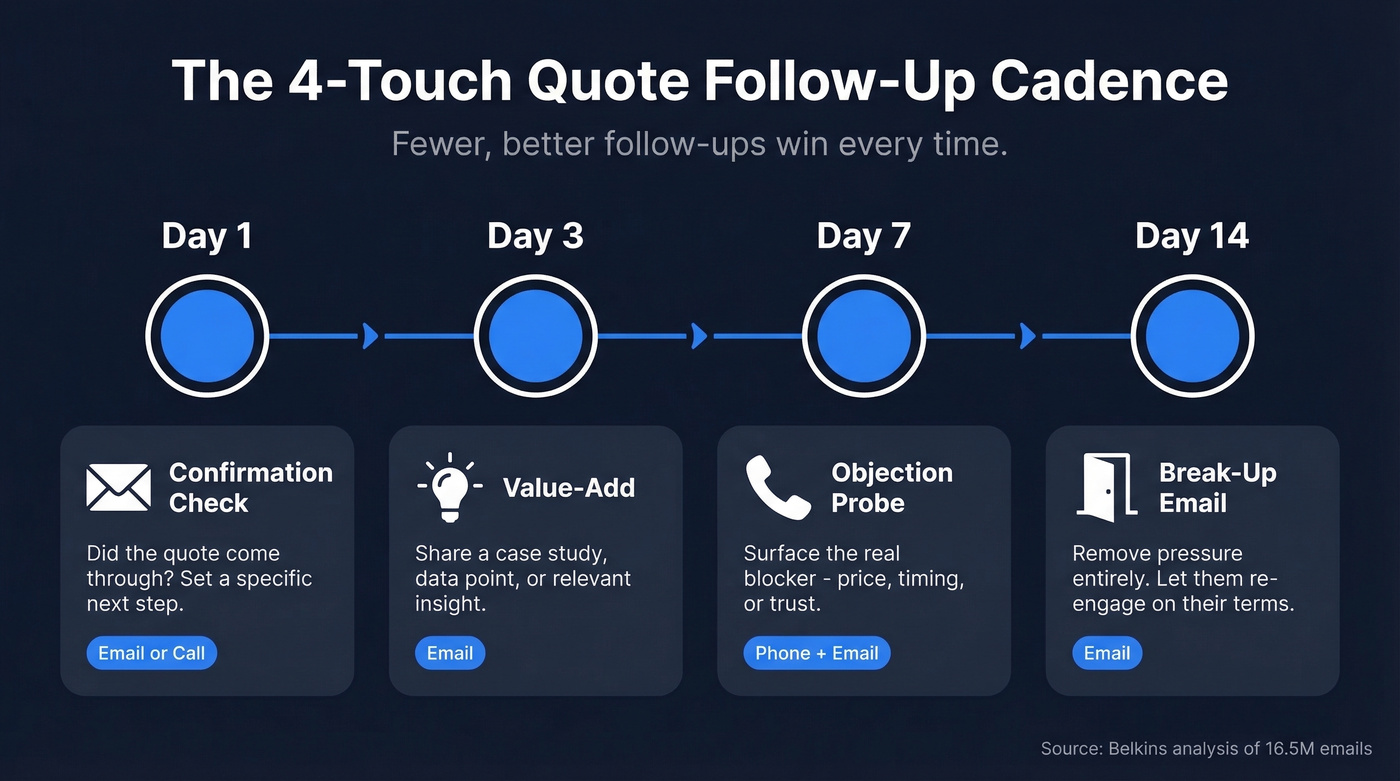
- Day 1 - Confirm they received the quote
- Day 3 - Add new value: a case study, a data point, a relevant insight
- Day 7 - Probe for the real objection (phone + email)
- Day 14 - Send a break-up email that resets the conversation
Each touchpoint needs a new reason to reply. Mix email, phone, and SMS. And verify your contact's email before you start - a bounced follow-up is worse than no follow-up at all.
Before You Send That First Follow-Up
Set the next step before you send the quote. When you deliver it, say: "I'll follow up Thursday to walk through any questions." Now your Day 1 email isn't cold outreach - it's a scheduled conversation the prospect already agreed to.
Confirm you're reaching the decision-maker. If your contact needs to "run it by their boss," your entire strategy changes. Get the actual buyer's contact info and tailor messaging to their concerns, not your champion's.
Verify the email actually works. We've seen teams run entire follow-up sequences into bounced inboxes - four carefully crafted emails, all hitting a dead address. Run your contacts through Prospeo's email verification before you start so you're not wasting touches on addresses that don't exist.

Day-by-Day Quote Follow-Up Cadence
This cadence is adapted from the 3-7-7 framework:
| Day | Action | Channel | Goal |
|---|---|---|---|
| 0 | Send quote | Deliver + set expectations | |
| 1 | Confirmation check | Email or call | Confirm receipt |
| 3 | Value-add follow-up | New reason to reply | |
| 7 | Objection probe | Phone + email | Surface the blocker |
| 14 | Break-up email | Strategic reset |
Waiting a couple of days before your first follow-up usually lands better than chasing them the same afternoon. But waiting too long for your value-add lets the quote go cold. Day 3 is a strong default.
Pro tip: Use email tracking to see when the prospect opens your quote, then reach out quickly while it's top-of-mind.
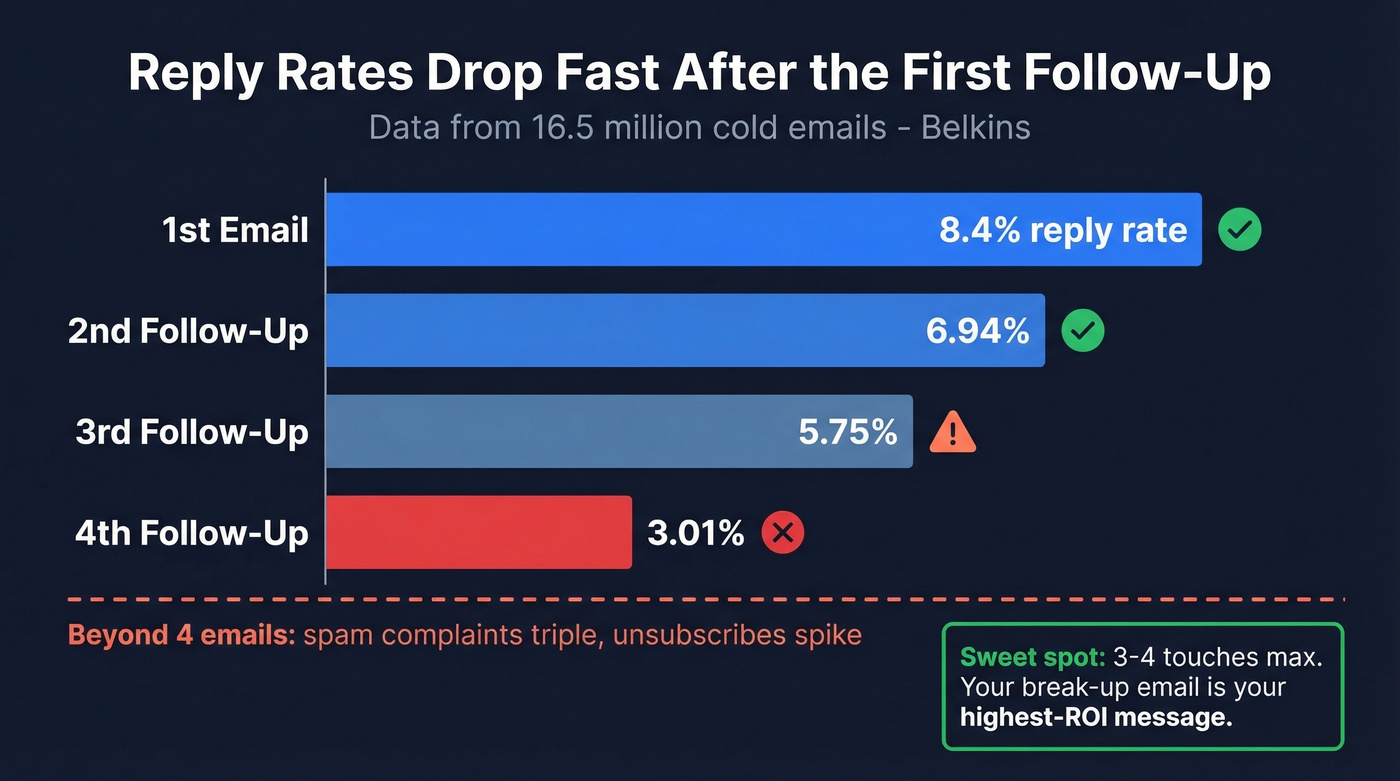
Don't extend past four touchpoints. In Belkins' analysis, reply rates peak with the first email at 8.4% and decline with every subsequent message. For founders specifically, response rates drop to 3.01% by the fourth follow-up. More isn't better.

Your 4-touch quote follow-up cadence is worthless if the emails bounce. Prospeo verifies contacts with 98% accuracy so every follow-up lands in a real inbox - not a dead address that silently kills your deal.
Stop crafting perfect follow-ups for inboxes that don't exist.
Follow-Up Email Templates After Sending a Quote
Keep every email between 50 and 125 words. Aim for subject lines around 41 characters - short enough to display fully on mobile, long enough to convey value. If you want more options, pull from these follow-up templates and adapt them to your quote context.
Template 1: The Confirmation Check (Day 1)
Subject: Quick question on the [project] quote
Hi [Name],
Wanted to make sure the quote I sent yesterday came through clearly. If anything looks off or you have questions about scope, I'm happy to jump on a 10-minute call.
What does your Thursday look like?
This isn't "just checking in." It's a specific ask with a specific next step.
Template 2: The Value-Add (Day 3)
Subject: Thought this might help
Hi [Name],
While putting together your quote, I noticed [specific observation about their business]. We helped [similar company] solve that exact problem - they saw [specific result].
Happy to share the details if it's useful for your evaluation.
Show proof from a similar company. It builds trust and urgency at the same time. If you’re stuck, here’s a deeper playbook on how to add new value in each touch.
Template 3: The Objection Probe (Day 7)
Subject: Honest question about [project]
Hi [Name],
I know these decisions take time. If there's something about the quote that doesn't feel right - pricing, timeline, scope - I'd rather know now so we can adjust.
What's the biggest concern on your end?
"Any questions?" gets ignored. "What's the biggest concern?" demands a specific answer. The difference is night and day.
Template 4: The Scheduling Urgency Play
Subject: Finalizing my schedule for next week
Hi [Name],
I'm locking in my calendar for [next week/month] and wanted to see if [date] still works for kicking off [project]. If timing has shifted, no problem - just let me know so I can plan accordingly.
This one's adapted from an r/sales thread - it creates urgency without pressure. You're not pushing them; you're managing your own capacity. The consensus on r/sales is that this framing consistently outperforms "just wanted to touch base" by a wide margin.
Template 5: The Phone Script
Voicemail (15 seconds max): "Hey [Name], it's [your name] from [company]. Calling about the quote for [project]. I had a quick thought on [specific detail] - shooting you an email now with the details. Talk soon."
Same-day email: Reference the voicemail, add the "quick thought," and give them a reason to respond even if they don't call back. The voicemail-plus-email combo works better than email alone because it signals effort and creates two separate moments of awareness in the same day. If you need a tighter system, build it into a repeatable cold calling system.
Template 6: The SMS Follow-Up
Sent the quote for [project] last week - any questions I can answer? Happy to hop on a quick call. - [Your name]
90% of texts get read within three minutes. Use SMS only when you've already established a relationship and the prospect has given you their mobile number. Don't cold-text someone who only gave you their work email. (If you do use SMS at scale, make sure you understand cold texting compliance and risk.)
Template 7: The Break-Up Email (Day 14)
Subject: Should I close this out?
Hi [Name],
I haven't heard back on the [project] quote, so I'm guessing the timing isn't right. Totally understand.
I'll close out my file on this, but if things change down the road, I'm here. No hard feelings either way.
The break-up email frequently triggers a response because it removes pressure entirely. The prospect can re-engage on their terms. We've seen deals close months later off a single well-written break-up email - sometimes the timing genuinely wasn't right, and giving someone an easy exit is what brings them back.
5 Mistakes That Kill Your Follow-Up
"Just checking in" with no new information. Every follow-up needs a new angle - a case study, a question, a scheduling update. "Just checking in" adds zero value and signals you have nothing useful to say. If you can't think of a new angle, you're not ready to send. If you keep defaulting to that phrase, use these alternatives for how to say just checking in professionally.
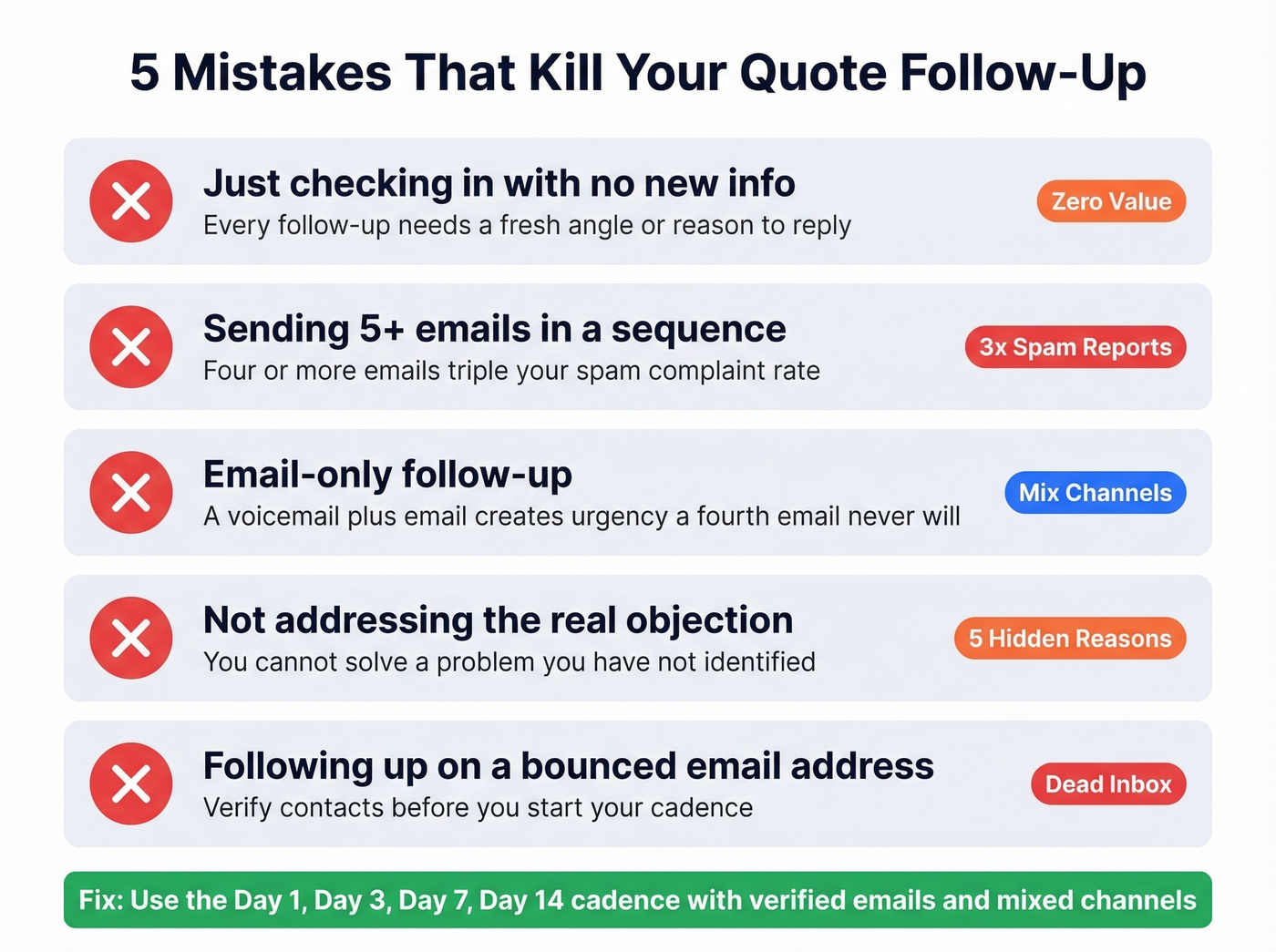
Sending 5+ follow-ups in a sequence. Cap it at 3-4 touches. Four or more emails triple your spam complaint rate. You're not being persistent - you're getting flagged.
Email-only follow-up. A voicemail followed by an email the same day creates urgency that a third email never will. One r/sales commenter nailed it: "If they won't reply to your email, they definitely won't reply to your fourth email." Pick up the phone. (If you’re managing this across a team, a sales engagement platform helps keep touches consistent.)
Not addressing the real objection. The GMass objection framework identifies five reasons prospects go silent: no need, price concerns, no urgency, don't want it, or don't trust you. Use the Day 7 probe to find out which one you're dealing with. You can't solve a problem you haven't identified. For a more structured approach, use discovery questions to surface blockers earlier.
When to Stop Following Up
Reply rates peak with the first email at 8.4% and decline from there. For founders, response rates hold steady through the second follow-up at 6.94%, then drop sharply - 5.75% after the third, 3.01% by the fourth.
Enterprise prospects are even less tolerant. Large companies ghost quickly and punish persistence with spam reports. If you're selling into 1,000+ employee organizations, two follow-ups might be your ceiling. (For longer cycles, see how enterprise B2B sales teams structure multi-threaded follow-up.)
Let's be honest: if your average deal size is under five figures, you probably can't afford to chase any single quote past four touches. Your time is better spent generating new quotes than resuscitating dead ones. The break-up email isn't giving up - it's the highest-ROI email in your sequence.
Adjust by Business Type
B2B sales means longer cycles and multiple stakeholders. Your follow-ups should include content that helps your champion sell internally - ROI calculators, case studies from their industry, implementation timelines. For high-value deals, a handwritten thank-you note after delivering the quote can set you apart from every competitor who just hit "send." I've personally seen a $40K deal close partly because the prospect mentioned our handwritten note to their CFO during the approval meeting. If you’re tightening your process end-to-end, map it to these steps to close a sale.
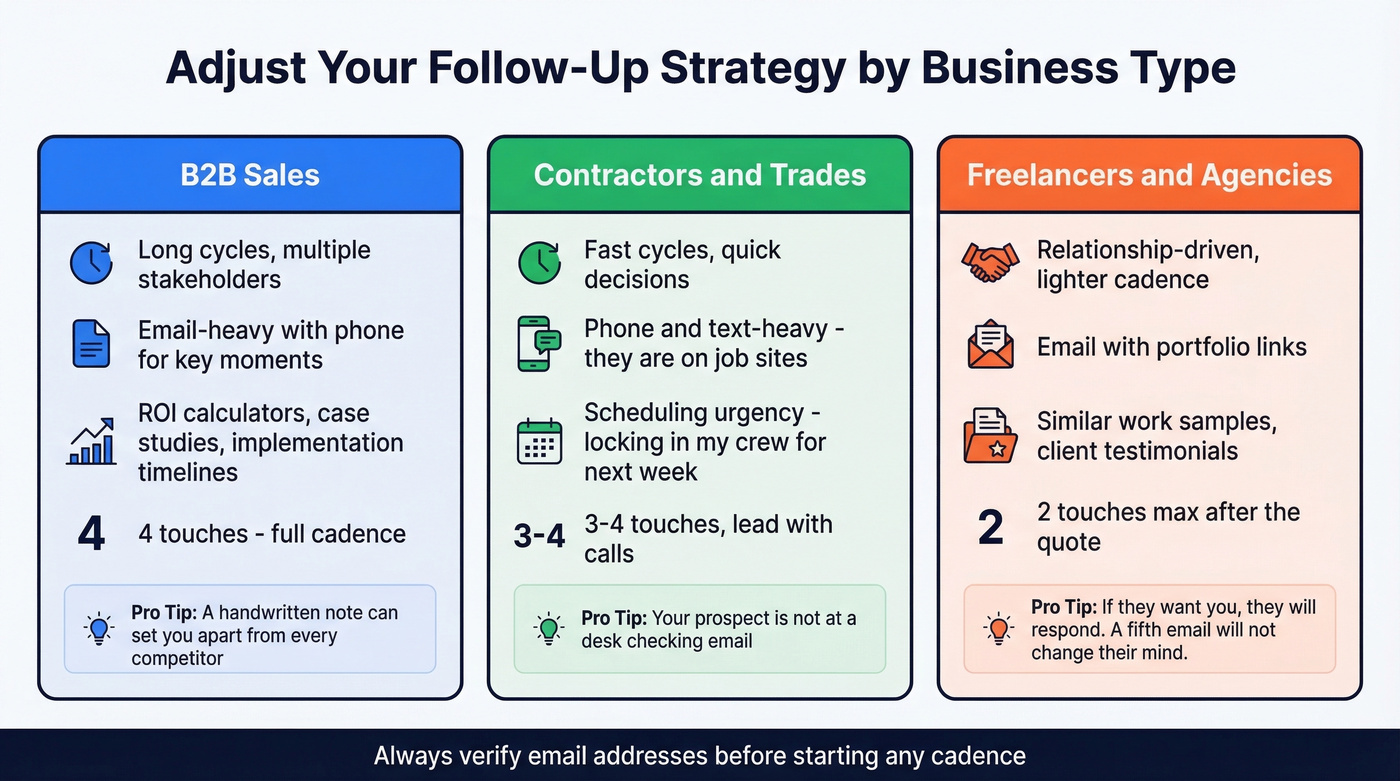
Contractors and trades run fast cycles that are phone and text-heavy. Your prospect is on a job site, not checking email at a desk. Lead with calls and texts, keep messages short, and use scheduling urgency - "locking in my crew for next week" works because it's real.
Freelancers and agencies are relationship-driven and need a lighter cadence. Include portfolio proof - a link to similar work, a testimonial from a comparable client. Two touches after the quote is usually enough. Skip the full 4-touch cadence here; if they want you, they'll respond. A fifth email won't change their mind.
FAQ
How many times should I follow up after sending a quote?
Three to four times maximum. Data from 16.5 million emails shows four or more follow-ups triple spam complaints. The Day 1, Day 3, Day 7, Day 14 cadence hits the sweet spot between persistence and professionalism.
How do I write a follow-up email for a quotation?
Lead with a specific reason to reply - a case study, a question about their timeline, or a scheduling update. Keep it between 50 and 125 words with a subject line under 41 characters, and always include a clear next step like a proposed call time.
Should I call or email to follow up on a quote?
Both. Email creates a paper trail; phone calls surface objections prospects won't type out. The voicemail-plus-email combo on the same day consistently outperforms email-only sequences across deal sizes.
How do I follow up without sounding desperate?
Add new value in every touchpoint - a case study, a scheduling update, a specific question. Never "just checking in." Cap your sequence at four touches so you don't cross from persistent to pushy.
What if my follow-up emails are bouncing?
Bounced emails mean your contact data is bad, not your messaging. Use a verification tool like Prospeo to validate addresses before launching any sequence. The free tier includes 75 verifications per month - enough to clean a small pipeline before your next campaign.
Can't reach the decision-maker your champion needs to "run it by"? Prospeo's database of 300M+ profiles with 30+ filters finds the actual buyer's verified email and direct dial in seconds - so your quote follow-up hits the person who signs the check.
Find the real buyer before your quote goes cold.