

How to Get Clients for Your Software Company in 2026 - A Data-Backed Playbook
A RevOps lead at a dev shop hired a "lead generation agency" that delivered a list full of bad emails. Half the list bounced on the first sequence, domain reputation tanked, and it took weeks to recover. That's the reality for a lot of software companies trying to grow: the old advice ("just do cold outreach" or "post on LinkedIn") skips the infrastructure that actually determines whether any channel works.
The average B2B deal now involves roughly 266 touchpoints and about 2,879 impressions from first touch to closed-won. Buyers do 80-90% of their research before they'll talk to your sales team, and they spend only 17% of their buying time actually meeting with suppliers. Meanwhile, 80% of B2B sales interactions happen in digital channels. The bar for earning attention has never been higher - but the playbook for clearing it is more concrete than most founders realize.
Here's the thing: most software companies don't have a lead generation problem. They have a targeting and infrastructure problem. Fix those two things and every channel starts working.
The Three Things That Actually Matter
If you take nothing else from this article, take these:
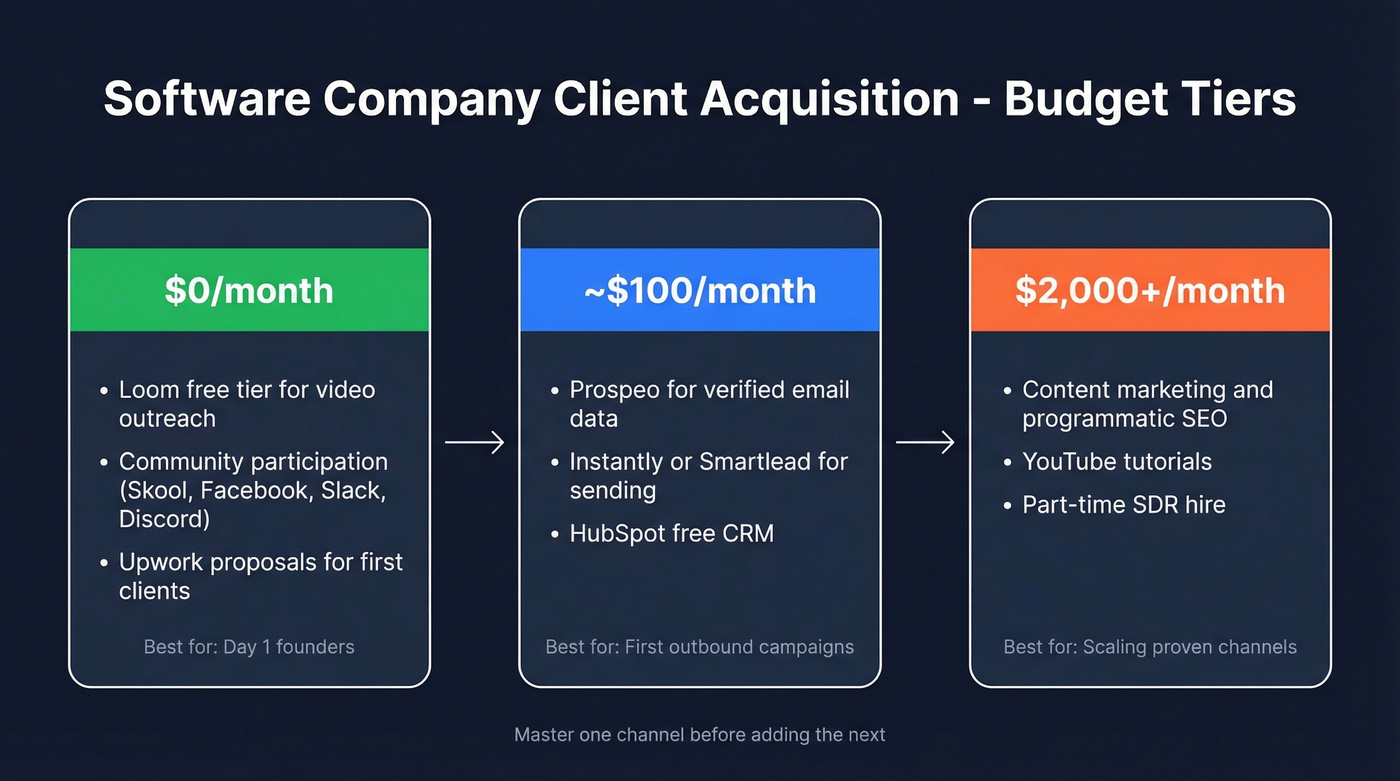
- Pick ONE niche and ONE outbound channel. Master both before adding anything else. Spreading across five channels with mediocre execution loses to one channel done well.
- Cold email with verified data is the highest-ROI scalable channel - but only if your sending infrastructure is solid. Bad data kills deliverability, and deliverability is everything.
- Communities are the most underrated channel with 40-50% close rates on warm leads. If you've got $0, start there.
By budget:
- $0/month: Loom free tier, community participation in Skool, Facebook groups, or niche Slack/Discord channels, plus Upwork for first clients
- ~$100/month: Add cold email with verified data from Prospeo, Instantly or Smartlead for sending, and HubSpot free for CRM
- $2,000+/month: Layer in B2B content marketing, programmatic SEO, YouTube, and a part-time SDR
Niche Down or Stay Invisible
Every software company founder has heard "niche down." Most ignore it because it feels like leaving money on the table. It's the opposite.
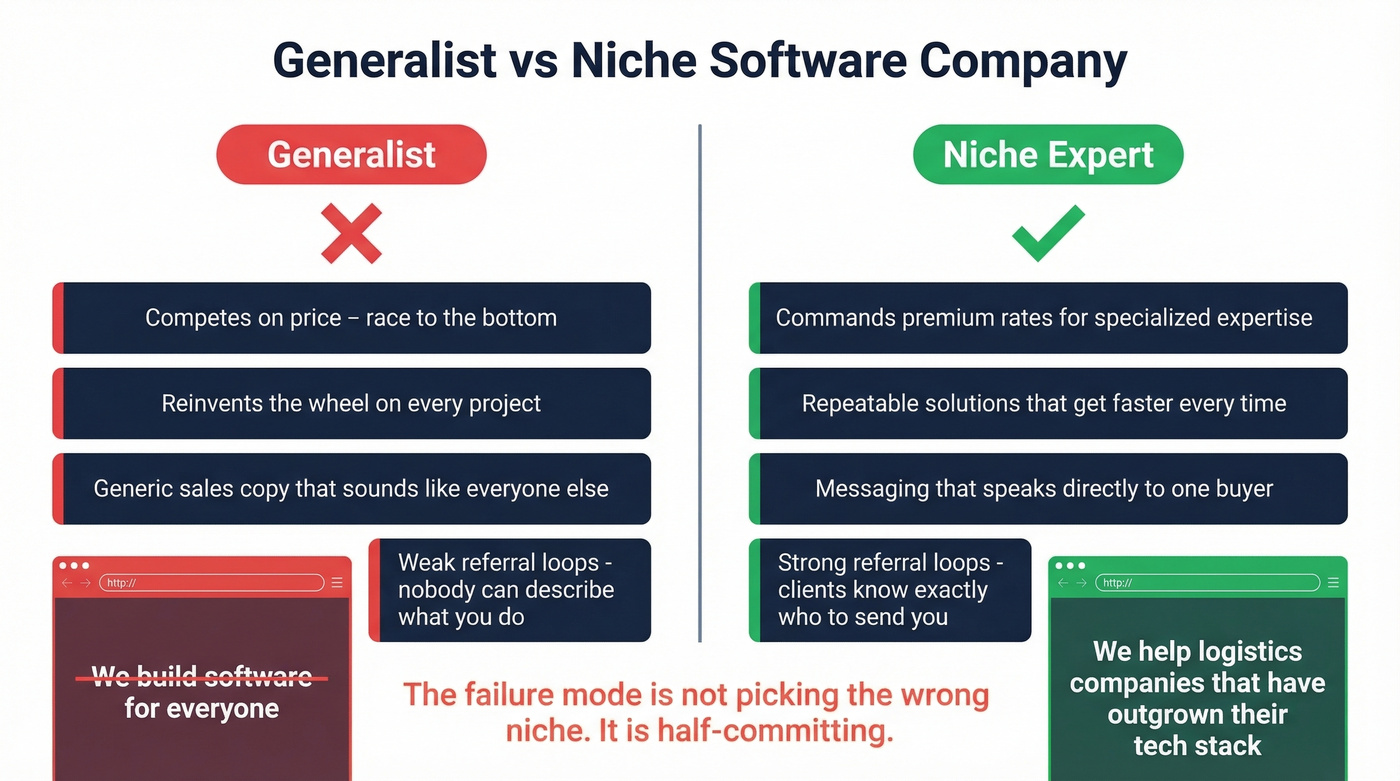
Generalist agencies compete on price. They reinvent the wheel on every project, write generic sales copy, and struggle to build referral loops because no one can describe what they actually do. Niche shops command higher rates because they're solving a specific, repeatable problem - and clients pay premiums for expertise they trust.
Here's a method we've seen work repeatedly: go back through your last 10 client calls or discovery notes. Highlight the exact phrases prospects used to describe their problems. One agency founder kept hearing "we've outgrown our technology" from mid-market logistics companies - that was the lightbulb. He stopped marketing to "businesses that need software" and started marketing to "logistics companies that have outgrown their tech stack." Pipeline tripled within two quarters. The failure mode isn't picking the wrong niche. It's half-committing - publishing a few niche blog posts while the rest of your site still says "we build software for everyone." Either your homepage, your outbound messaging, and your case studies all speak to the same buyer, or you're invisible.
Build Outbound Infrastructure First
Before you send a single cold email, you need three things: clean data, a proper sending setup, and a way to personalize at scale. We've watched agencies burn through three sending domains before they take list hygiene seriously. Don't be that team.
Bad data doesn't just waste time. It actively damages your domain reputation. Every bounced email signals to inbox providers that you're a spammer, and once that reputation drops, even your emails to real, interested prospects land in spam. Recovery takes weeks.
Outbound-sourced deals tend to be about 50% larger than inbound. You're reaching buyers who aren't actively shopping but have the budget and the problem. That's why the infrastructure investment pays off.
Data quality is the unsexy foundation that makes or breaks outbound. Prospeo covers 300M+ professional profiles with 98% email accuracy - verified through a 5-step process that catches spam traps, honeypots, and catch-all domains. Data refreshes every 7 days, compared to the 6-week industry average. You can search by 30+ filters including industry, company size, job title, headcount growth, and intent data powered by Bombora across 15,000 topics. The free tier gives you 75 verified emails per month, enough to test whether cold email works for your ICP before spending a dollar.
Your starter stack:
- Data: Prospeo (free tier to start, paid plans available)
- Sending: Instantly or Smartlead (~$30/mo)
- Personalization: Loom (free tier)
Total launch cost: $0-$150/month.

The article says it clearly: software companies don't have a lead gen problem - they have a targeting and infrastructure problem. Prospeo gives you 30+ filters to pinpoint your exact ICP by industry, headcount growth, tech stack, and buyer intent across 15,000 topics. Every email is 98% verified. Data refreshes every 7 days, not 6 weeks.
Find your niche buyers before your competitors do.
You just read that cohorts of 50 contacts produce 2.76x higher reply rates. That only works if every email in that micro-list actually lands. Prospeo's 5-step verification catches spam traps, honeypots, and catch-all domains so your sending reputation stays intact. At $0.01 per email, one booked meeting pays for thousands of verified contacts.
Protect your domain and triple your reply rates with data that's actually clean.
The Channel Playbook
Here's each channel broken down with real benchmarks, timelines, and tactical how-tos.
Cold Email
Use this if: You've got a defined ICP, verified data, and the patience to iterate on messaging for 2-4 weeks.
Skip this if: You don't have a dedicated sending domain, your list isn't verified, or you're planning to send the same generic pitch to 5,000 people. Seriously, don't.
Inboxes are more crowded than ever, and founders regularly complain that generic outreach gets zero replies. That's exactly why segmentation and personalization aren't optional anymore.
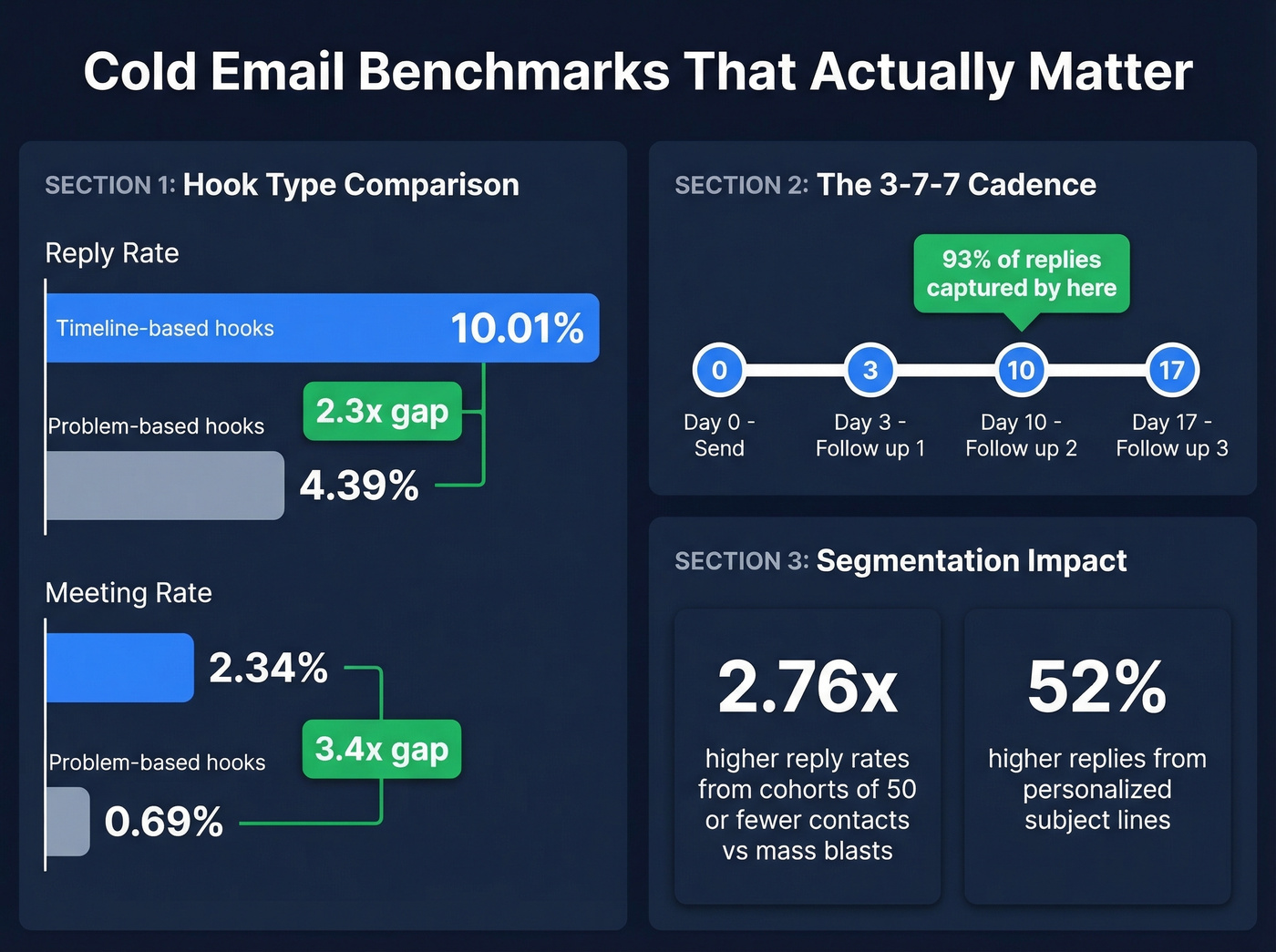
Timeline-based hooks ("planning your Q3 roadmap?") pull a 10.01% reply rate versus 4.39% for problem-based hooks - a 2.3x gap. Meeting rates are even more dramatic: 2.34% vs 0.69%. The 3-7-7 cadence - send on Day 0, follow up Day 3, Day 10, Day 17 - captures 93% of replies by Day 10. Most teams give up after one email, which is like planting a seed and pulling it out of the ground the next morning to check if it's growing.
Segmentation is the biggest lever most people ignore. Cohorts of 50 contacts or fewer produce 2.76x higher reply rates than mass blasts. Personalized subject lines drive 52% higher replies. The math is simple: 100 targeted, personalized emails outperform 1,000 generic ones every time. If you need a starting point, use these sales follow-up templates and adapt them to your niche.
Loom Mini-Audits
This is the tactic that separates software companies that get replies from those that get ignored. Instead of a cold pitch, record a 2-minute Loom video showing one specific improvement you'd make to the prospect's product, website, or workflow.
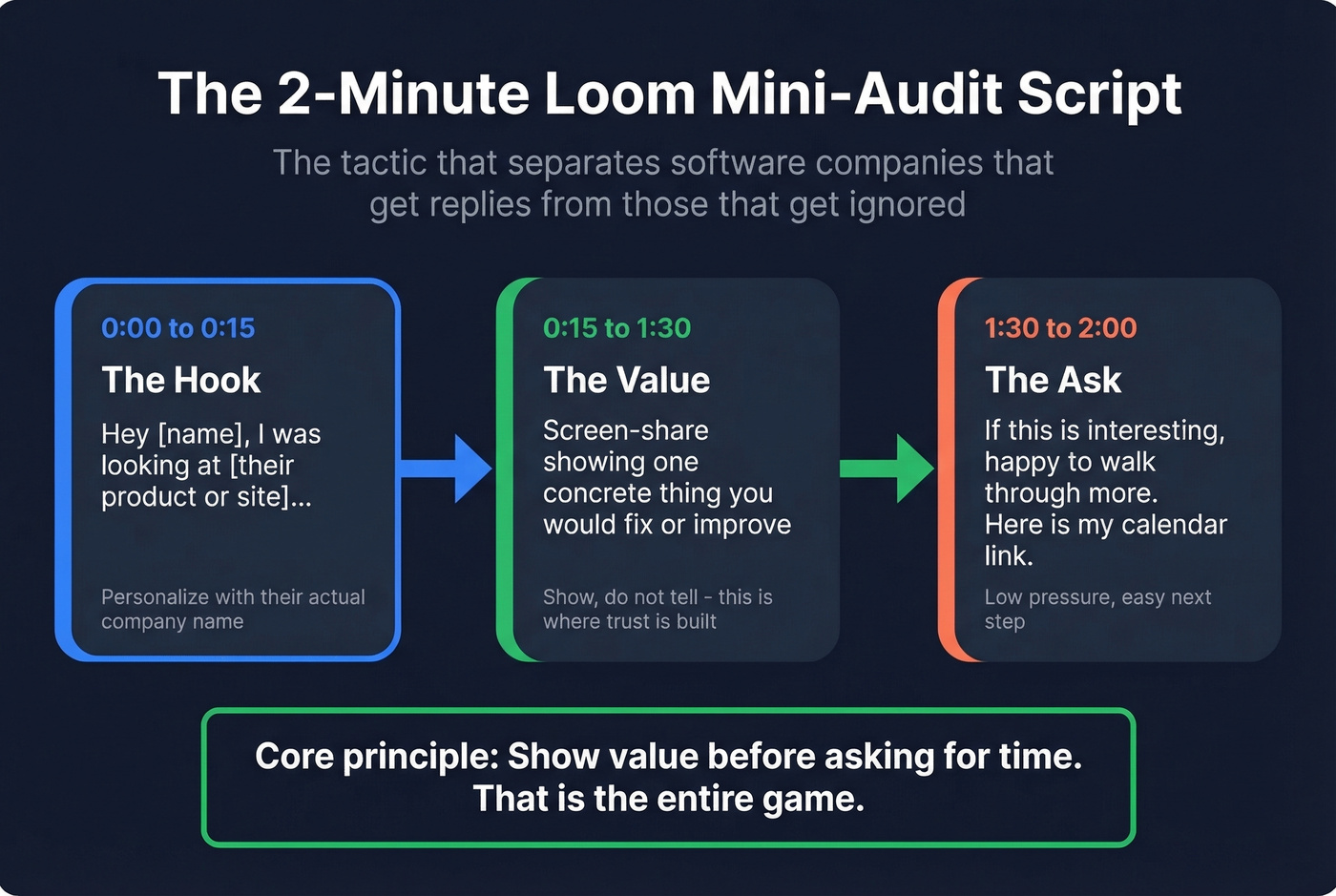
A YC founder described this as their highest-converting outbound tactic: narrow ABM lists combined with short Loom "mini-audits" instead of cold pitches. Here's the script framework:
- 0:00-0:15: "Hey [name], I was looking at [their product/site]..."
- 0:15-1:30: Screen-share showing one concrete thing you'd fix or improve
- 1:30-2:00: "If this is interesting, happy to walk through more. Here's my calendar link."
You're showing value before asking for time. That's the entire game. For more examples, see this Loom video cold email approach.
Communities
One agency founder signed 4 clients in a single month by sharing product demos and case studies in Facebook groups. No ads, no cold outreach - just genuine participation. Another founder reported 40-50% close rates on warm community leads because trust was already built before the first sales conversation happened.
The platforms producing results right now: Skool communities, niche Facebook groups, industry-specific Slack and Discord channels. Show up, answer questions with genuine depth, share work you've done rather than pitches, and let inbound interest build. Timeline to meaningful results: 2-3 months of consistent participation.
The catch is that this doesn't scale linearly. You can't hire someone to "be you" in a community. But for anyone trying to find software development clients with zero ad spend, communities are the highest-leverage starting point. The consensus on r/Entrepreneur and r/SaaS backs this up - founders consistently report that community-sourced leads close faster and churn less than any other channel.
Founder-Led LinkedIn
Two posts per week plus fast DM responses to anyone who engages generates meetings. It works, but it's hard to scale - and that's accurate. Treat it as a complementary channel, not a primary one.
Post about problems you've solved, lessons from client projects, and contrarian takes on your niche. Respond to comments within the first hour. DM anyone who engages with something relevant, not a pitch. Expect 4-8 weeks before this generates real pipeline. Once the founder stops posting, the pipeline dries up.
Upwork & Marketplaces
Write quality proposals on Upwork to land your first 3-5 clients and collect reviews. One community member closed $4,300 in their first 12 days. Proposal-to-reply rates hit 30% when you customize each one. Get profiles on Clutch and GoodFirms - they can generate passive inbound.
Skip this once you're past $30k/month in revenue and want to own your pipeline. The 10-20% platform fee is a tax on guaranteed deal flow - worth it early, painful later.
Content & Programmatic SEO
For teams with 3-6 months of runway and a niche locked in, build programmatic SEO pages around templates, generators, and calculators - pages that are genuinely useful and rank for long-tail keywords. A 100M+ datapoint study from Ruler Analytics puts the average website conversion rate at 2.9% for qualified leads. Not spectacular, but it compounds.
If you don't have 3-6 months, skip this for now and revisit once outbound is generating revenue. 67% of buyers prefer self-service over talking to a rep, so the content you build becomes a 24/7 sales asset - but only after the initial investment period. Start with one pillar piece per month targeting your niche's highest-intent keywords, then expand into programmatic pages once you've validated what converts. If you want more benchmarks, compare against the average B2B lead conversion rate.
YouTube & Referrals
One agency founder attributed a $3,000 client directly to a YouTube tutorial. Tutorial-style content works best - show how you'd solve a specific problem, and the right buyers will reach out. Timeline: 3-6 months to find your product-content fit.
Referrals deserve a brief note: ask for them systematically, not randomly. The underexplored angle is expansion revenue - your existing clients probably have adjacent problems you could solve. Most software companies leave that money on the table.
Pipeline Benchmarks
Buyers now use about 10 interaction channels on average, up from 5 in 2016. Here's what each channel looks like in practice:
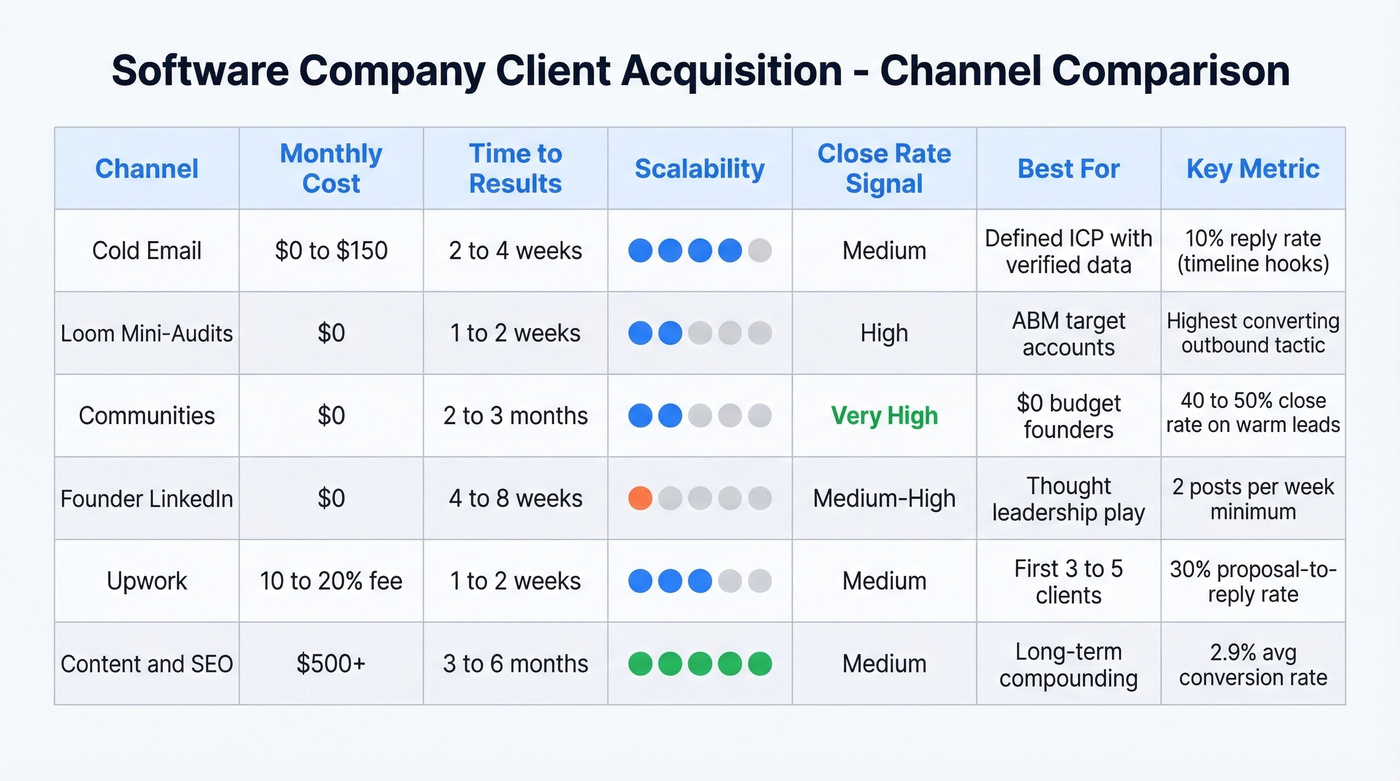
| Channel | Time to First Client | Est. Monthly Cost | Response/Conversion |
|---|---|---|---|
| Cold Email | 2-4 weeks | $50-$150 | 3-8.5% reply; 2-3% positive |
| Communities | 2-8 weeks | $0 | 40-50% close on warm leads |
| Loom Mini-Audits | 1-3 weeks | $0 | 2-3x reply rate vs text-only |
| 4-8 weeks | $0 | 1-3% DM reply; ~2 meetings/week | |
| Upwork | 1-4 weeks | 10-20% fee | 20-30% proposal reply |
| Content/SEO | 3-6 months | $0-$500 | 2.9% visitor-to-lead |
| YouTube | 3-6 months | $0-$200 | High deal size when it hits |
Some broader context from Databox's agency benchmark group: the median team schedules 64 meetings per month, with top performers hitting 121+. Median time to close is 49 days; top performers close in 25. The average B2B close rate sits around 29%, and mid-sized firms involve about 7 people in buying decisions. 84% of B2B reps miss quota annually. This isn't easy. But the teams that build proper infrastructure and stay consistent for 90 days are the ones that break through.
Mistakes That Kill Your Pipeline
Targeting "the world." If your ICP is "any company that needs software," you'll waste months sending generic messages no one responds to. Define your niche, your buyer persona, and the specific problem you solve before you write a single email - use an ideal customer profile template if you need structure.
Same message to every prospect. A Series A CTO and a Fortune 500 VP of Engineering have completely different pain points. Segment into cohorts of 50 or fewer and tailor your hook to each segment.
Sending to unverified lists. This is the most expensive mistake because it compounds. Every bounce damages your domain reputation, pushing future emails to spam. Verify every email before sending - no exceptions. If you’re troubleshooting, start with email bounce rate benchmarks and fixes.
No feedback loop. Review your reply rates, objections, and deal-death reasons every Friday. What hooks worked? Where did deals stall? Adjust weekly. The teams that treat outbound like a product - shipping iterations, measuring results, killing what doesn't work - are the ones that win. This is also where pipeline health metrics keep you honest.
Quitting after one campaign. 93% of replies come by Day 10 of a proper sequence. Most channels need 2-3 months of consistent effort. Commit to 90 days before judging any channel.
Month-by-Month Roadmap
Month 0-3: Foundation
- Pick your niche and define your ICP
- Set up outbound infrastructure: data platform + sending tool
- Launch your first cold email campaign targeting 100 prospects
- Join 2-3 communities in your niche and start contributing
- Post on LinkedIn twice a week
- Create profiles on Upwork, Clutch, and GoodFirms
Month 3-6: Iteration
- Refine messaging based on reply rate data and objection patterns
- Add Loom mini-audits to your highest-value outbound sequences
- Publish your first case study
- Collect client reviews on Clutch and GoodFirms
- Test a second channel based on what's working
Month 6-12: Scale
- Add content marketing or programmatic SEO with one pillar piece per month
- Consider YouTube if you've found product-content fit
- Systematize referral asks after every successful project
- Hire your first SDR if pipeline supports it - don't hire before the playbook is proven (here are the best SDR tools to evaluate).
FAQ
How long does it take to get the first client for a new software company?
Communities and Upwork can deliver clients in 1-4 weeks. Cold email typically yields meetings within 2-4 weeks if your data is verified and messaging is segmented. The median close time across agencies is 49 days, with top performers closing in 25.
What's the best free channel for software client acquisition?
Communities produce 40-50% close rates on warm leads and cost nothing. Join niche Slack channels, Discord servers, or Facebook groups where your ideal buyers hang out. Pair with Loom mini-audits for outbound and a free-tier data tool to test cold email alongside.
How many cold emails should I send per day?
Start with 30-50 per sending domain to protect deliverability. Keep cohorts under 50 contacts and personalize each sequence. Scale by adding sending domains, not by blasting higher volume from one domain - segmentation and quality beat volume every time.
Do I need to niche down as a full-stack development agency?
Yes. Niche agencies command higher rates, close faster, and build referral loops that generalists can't replicate. Pick the vertical where you have the strongest case studies, then expand once you own that market.
How do software companies maintain consistent pipeline over time?
Combine at least two channels - typically cold email plus one inbound source like content or communities. Treat acquisition as a system: verified data flowing into segmented sequences, community presence building trust in parallel, and a weekly feedback loop refining messaging. Consistency across 90 days matters more than any single tactic. HubSpot's State of Sales report consistently shows that multi-channel approaches outperform single-channel by 2-3x.
Pick your niche. Verify your list. Send 50 emails this week. Knowing how to get clients for a software company is only useful if you act on it - the teams that start messy but start now are the ones that build real pipeline. The ones that wait for the perfect playbook never send the first email.