

How to Get Email Addresses for Email Marketing (2026)
Email returns $36-$40 for every $1 spent, with retail peaking at $45. But that ROI only works if you're emailing people who actually want to hear from you - or who you've identified with surgical precision for B2B outreach. Those are two different problems, and most guides mash them together. We won't.
What You Actually Need
Building an inbound list? Put an opt-in form on every page, create one genuinely useful lead magnet, and add an exit-intent popup. That combination alone beats 90% of businesses still relying on a single footer form.
Both tracks work. Most growing companies need both.
Never Buy an Email List
Bought lists don't just underperform - they actively destroy your sender reputation. In a head-to-head case study comparing opt-in and non-opt-in segments under identical conditions, the opt-in list converted at roughly 15x the rate of the purchased segment. Open rates were 126% higher. Click-through rates? 662% higher.
The downside risk is brutal. CAN-SPAM penalties run up to $53,088 per email violation. GDPR fines can hit EUR 20 million or 4% of global turnover. Even if you dodge enforcement, your domain reputation takes the hit - and once major ESPs flag you as a spammer, clawing back deliverability takes months.
Every dollar spent on a purchased list would've performed better invested in any of the tactics below. No exceptions.
Collecting Emails Through Inbound Channels
Opt-In Forms on Every Page
The simplest tactic is the most neglected. Put a signup form on every high-traffic page - blog posts, product pages, your about page, your homepage header and footer. Keep forms short: name and email is plenty. Making the ask consistently across your site can generate roughly 100 new subscribers per month. Not glamorous, but it compounds fast.
Popups That Actually Convert
Popups have a bad reputation, but the data tells a different story. Across 875 widgets, 214 sites, and 14.7 million impressions analyzed in an r/analytics benchmark report, the mean popup conversion rate is 3.2%, with the top 10% hitting 8.5% or higher.
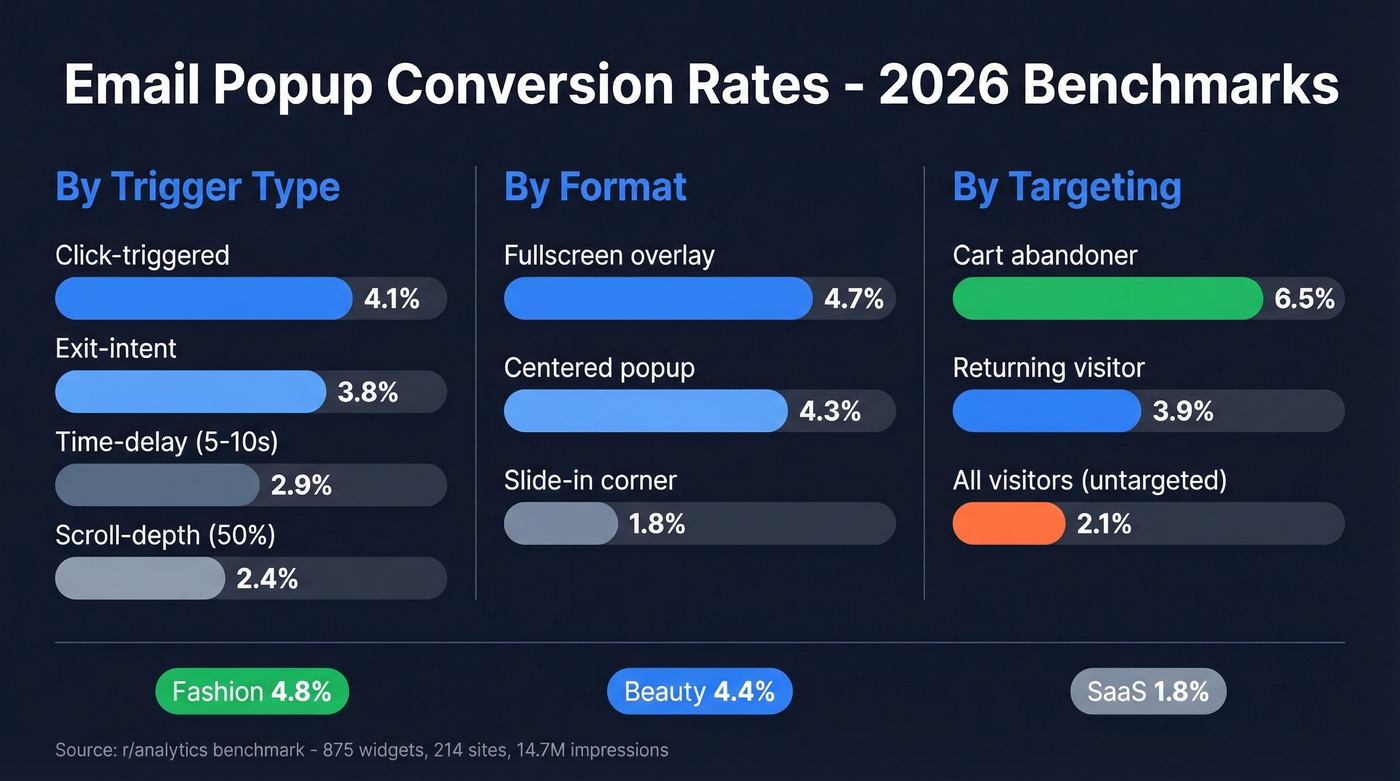
The trigger matters more than the design.
| Trigger Type | Avg CR |
|---|---|
| Click-triggered | 4.1% |
| Exit-intent | 3.8% |
| Time-delay (5-10s) | 2.9% |
| Scroll-depth (50%) | 2.4% |
Fullscreen overlays average 4.7%, centered popups hit 4.3%, and slide-in corners lag at 1.8%. Targeting makes the biggest difference: cart abandoner popups convert at 6.5%, returning visitors at 3.9%, while untargeted "all visitors" popups scrape by at 2.1%.
Industry variation is significant too. Fashion sites average 4.8%, beauty hits 4.4%, and SaaS sits at 1.8%. If you're in SaaS and your popup converts at 2%, you're actually above average - don't panic.
Lead Magnets Worth an Email
Static PDFs are losing ground. The lead magnets performing best in 2026 are interactive: assessments, quizzes, and calculators that give personalized results. Interactive assessments typically convert 5-15% of visitors, far above the 1-3% range for generic ebook downloads. Short-form video training series work well for B2B audiences learning a specific skill, and exclusive research reports still convert when the data is genuinely original.
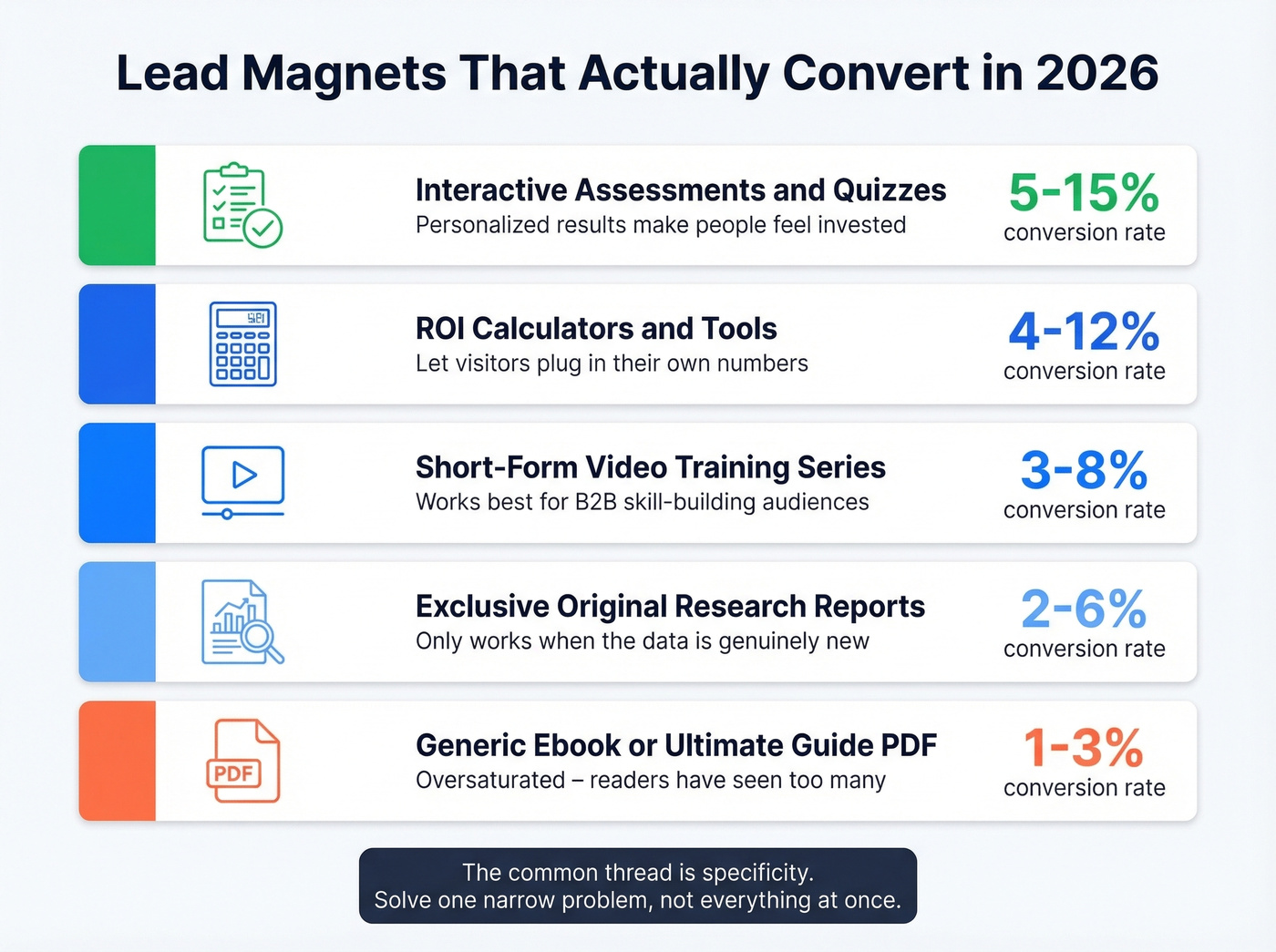
The common thread is specificity. Solve one narrow problem rather than offering a generic "ultimate guide."
Social, Contests, and Referrals
Contest platforms like Gleam and ViralSweep make it easy to run giveaways that require an email entry. Facebook Lead Ads capture emails without sending people to a landing page - no extra page load, no form to fill out manually.
One underexploited conversion point: the thank-you page. After someone opts in, that confirmation page is prime real estate for a referral ask or a share prompt. We've tested personalizing thank-you pages by traffic source and device across dozens of campaigns, and it consistently doubles or triples the visitor-to-subscriber conversion rate.
Content Upgrades and Landing Pages
In-post content upgrades - a downloadable template or checklist embedded within a relevant blog post - capture high-intent readers at the moment they're most engaged. They consistently outperform sidebar forms because the offer is contextually matched to what the reader is already consuming.
For campaigns, dedicated landing pages with a single CTA outperform multi-purpose pages every time. Use double opt-in to confirm intent and protect deliverability. It adds a step, but the list quality improvement is worth the slight drop in raw signups.

You just read why buying email lists destroys deliverability. The alternative for B2B: find verified emails for the exact people you want to reach. Prospeo's 300M+ database delivers 98% email accuracy with a 7-day refresh cycle, so you're never emailing stale contacts.
Get 75 verified emails free this month - no credit card, no contract.
Finding B2B Emails for Outbound
When Outbound Makes Sense
If you're running sales, managing agency campaigns, or executing ABM plays, you need specific people's email addresses - not a list of random opt-ins. Estimates suggest 20-40% of SDR time gets wasted on manual data research instead of actual selling. A good email finder tool cuts that to under five minutes per prospect list.
This isn't spam. It's targeted, one-to-one sales outreach to people who fit your ICP. The compliance rules differ from bulk marketing, and the tools are purpose-built for accuracy.
Best Email Finder Tools
Here's the thing: ZoomInfo is still the most comprehensive all-in-one data platform. But most teams don't need all-in-one - they need accurate emails that don't bounce. And that's a very different buying decision.
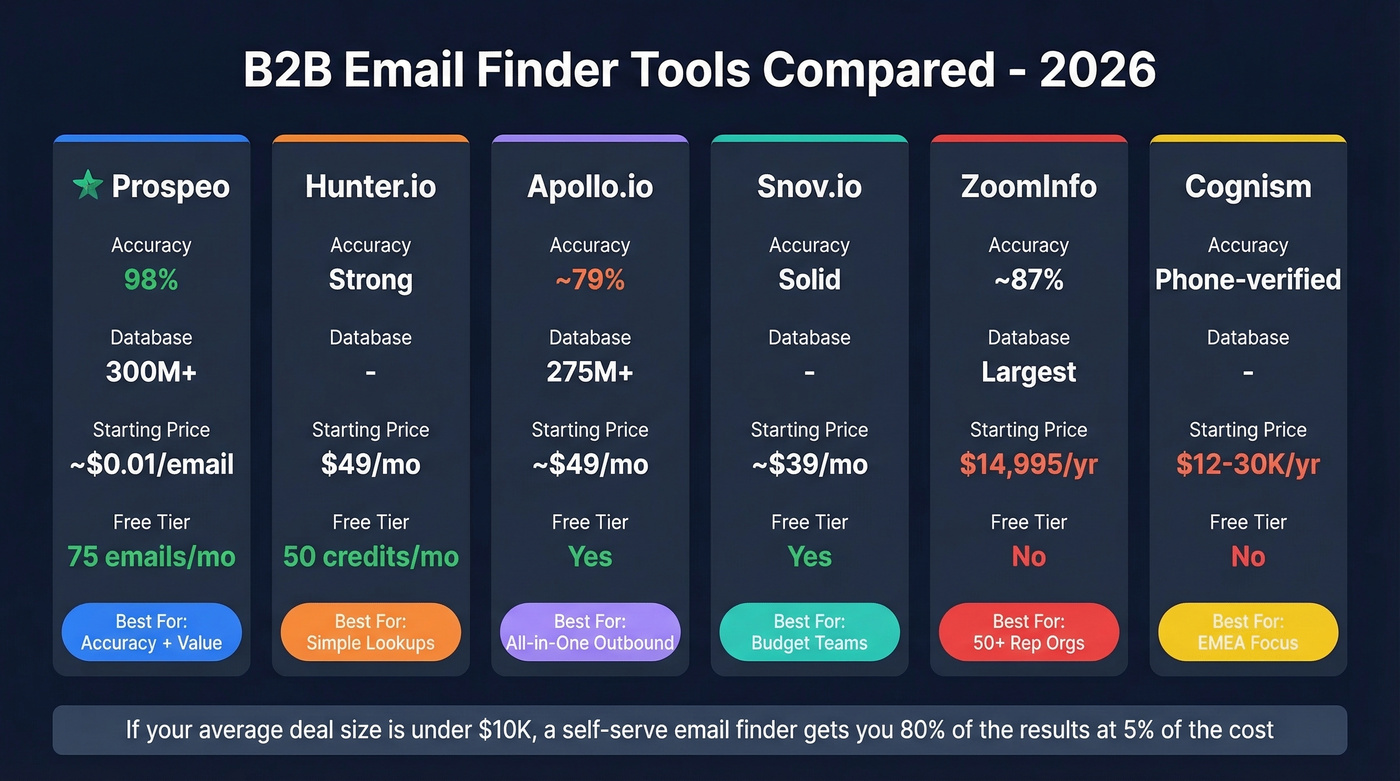
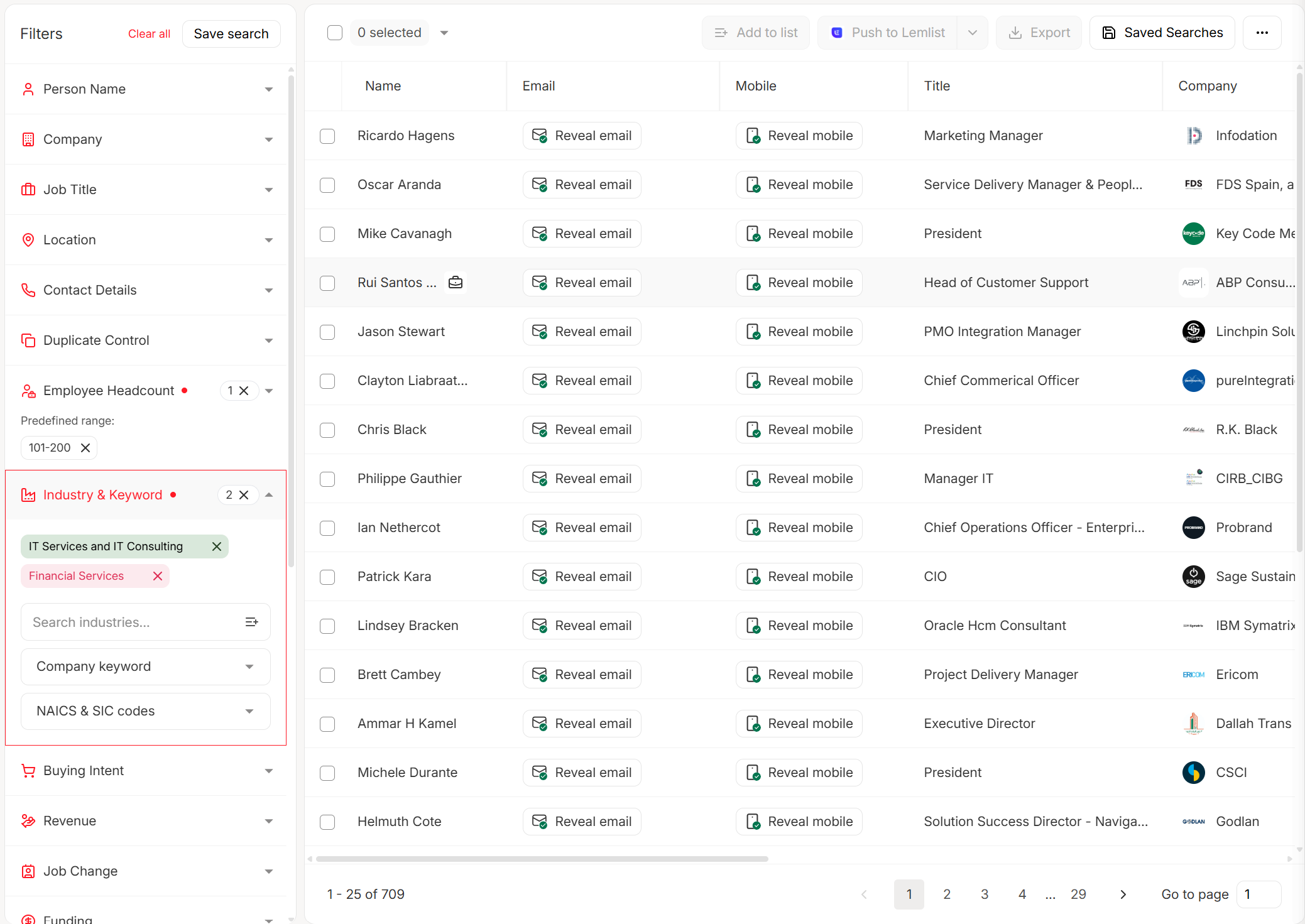
Prospeo is the strongest option for teams that prioritize accuracy and cost efficiency. Its database covers 300M+ professional profiles with 98% verified email accuracy, built on proprietary infrastructure with a 5-step verification process that handles catch-all domains, removes spam traps, and filters honeypots. The 7-day data refresh cycle means you're not emailing someone who changed jobs six weeks ago. Free tier gives you 75 verified emails per month plus 100 Chrome extension credits, and paid plans run roughly $0.01 per email.
Hunter.io keeps things simple: domain search, individual email lookup, and built-in verification. The free plan includes 50 monthly credits, and the Starter tier runs $49/month for 2,000 credits. Great for one-off lookups and small-volume prospecting.
Apollo.io is the best pick if you want sequencing and data in a single platform. The database covers 275M+ contacts across 73M+ companies, with a free tier and paid plans starting around $49/month. Where Apollo shines is workflow - find a contact, add them to a sequence, and track engagement without leaving the platform.
Snov.io offers a free tier and paid plans from ~$39/month. A good fit for small teams who want email finding, verification, and warmup in one tool. Not as deep on data, but the price-to-feature ratio works for early-stage outbound.
ZoomInfo is the enterprise anchor. Starts at $14,995/year and typically runs $25-40K for a mid-size team. Overkill for teams under 50 reps, and the contract structure locks you in. We've seen plenty of companies pay for ZoomInfo's intent data, chat, and workflow modules without ever turning them on.
Cognism is worth a look if your outreach is EMEA-focused - strong European compliance and phone-verified data, with pricing typically in the $12k-$30k/year range.
| Tool | Starting Price | Email Accuracy | Free Tier | Best For |
|---|---|---|---|---|
| Prospeo | ~$0.01/email | 98% | 75 emails/mo | Accuracy + value |
| Hunter | $49/mo | Strong | 50 credits/mo | Simple lookups |
| Apollo | ~$49/mo | ~79% | Yes | All-in-one outbound |
| Snov.io | ~$39/mo | Solid | Yes | Budget teams |
| ZoomInfo | $14,995/yr | ~87% | No | 50+ rep orgs |
If your average deal size is under $10K, you probably don't need ZoomInfo-level data. A self-serve email finder paired with a good sequence management tool will get you 80% of the results at 5% of the cost.
Compliance: CAN-SPAM, GDPR, and PECR
Getting this wrong is expensive. Here's the compliance checklist that matters.
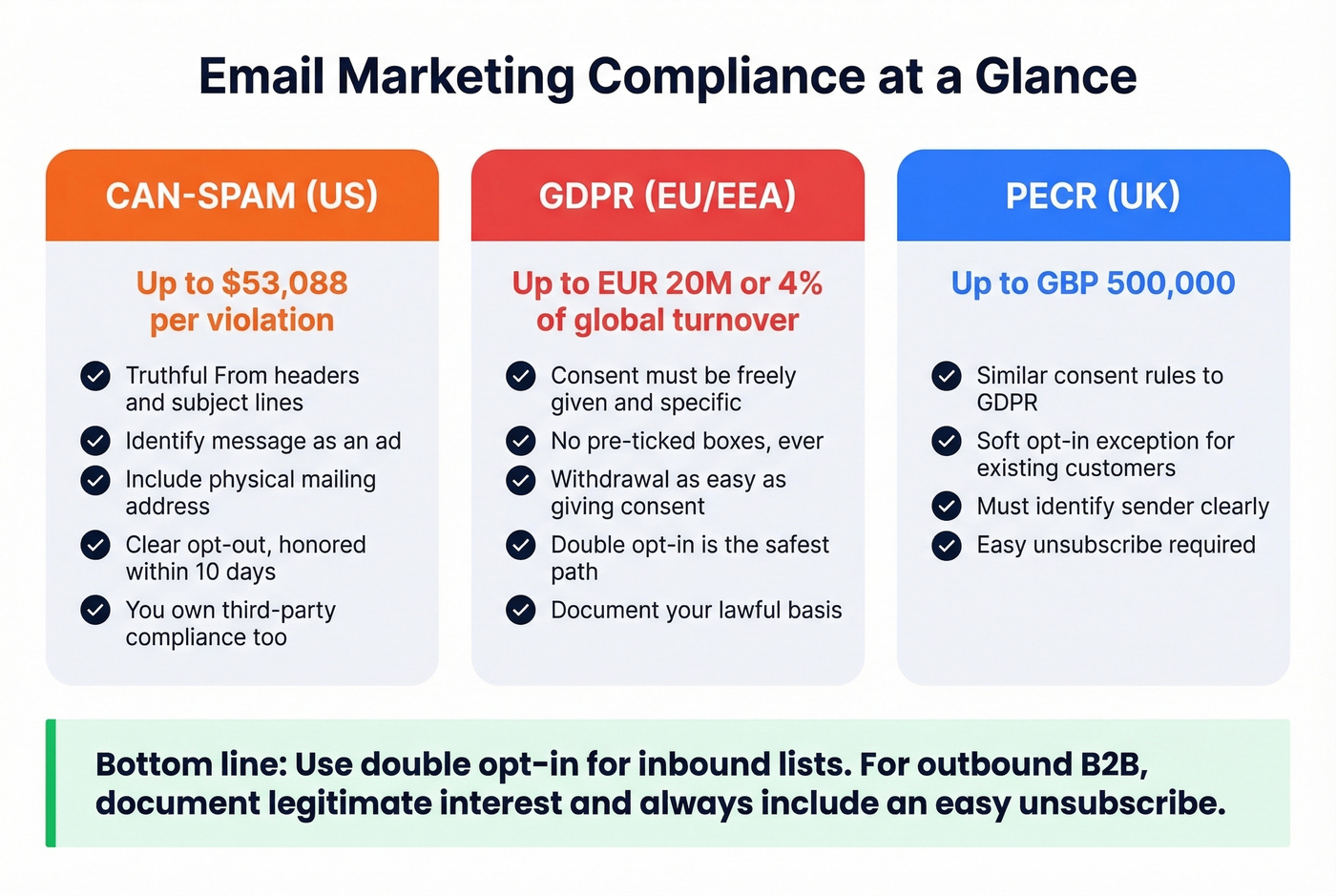
CAN-SPAM (US) - up to $53,088 per violation:
- Use truthful "From" headers and non-deceptive subject lines
- Identify the message as an advertisement
- Include your physical mailing address
- Provide a clear opt-out mechanism and honor requests within 10 business days
- You're responsible for third parties sending on your behalf
GDPR (EU/EEA) - up to EUR 20M or 4% of global turnover:
- Consent must be freely given, specific, informed, and unambiguous
- No pre-ticked boxes - ever
- Withdrawal must be as easy as giving consent
- Double opt-in is the safest implementation
PECR (UK) - up to GBP 500,000:
- Similar consent requirements to GDPR for marketing emails
- Soft opt-in exception exists for existing customer relationships
Double opt-in adds friction, but it's the single best insurance policy against compliance risk and deliverability damage. Use it for inbound lists. For outbound B2B, ensure you have legitimate interest documented and always include an easy unsubscribe.
Mistakes That Kill Your List
Automation without personalization. Triggered sequences are powerful, but "Hi {first_name}" isn't personalization. Segment by behavior, not just demographics. The consensus on r/sales is that even basic behavioral triggers - like referencing a prospect's recent job change or company funding round - outperform demographic-only personalization by a wide margin.
If you're building outbound sequences, start with proven sales follow-up templates and then layer in personalization.
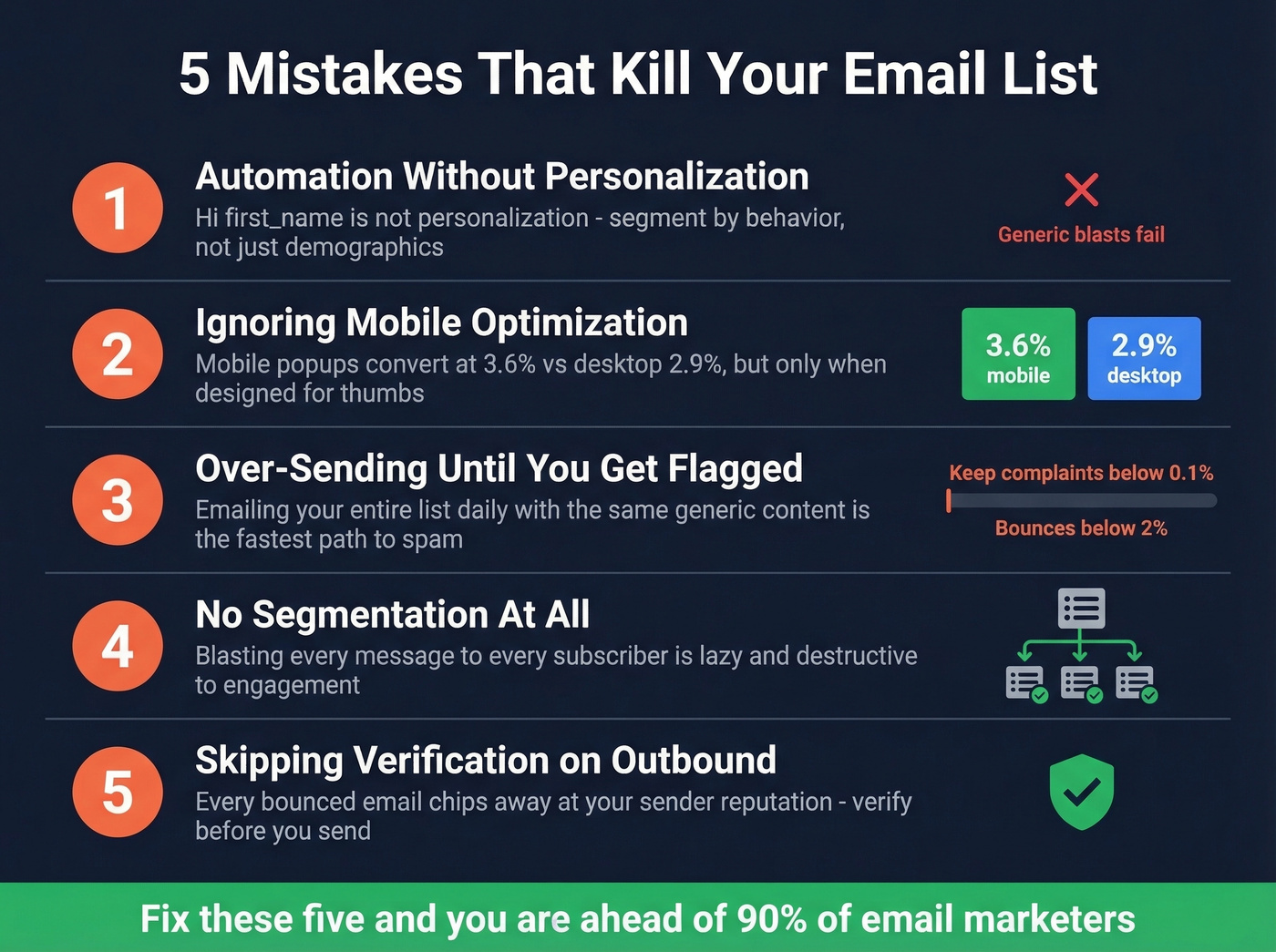
Ignoring mobile optimization. Mobile popups convert at 3.6% vs. desktop's 2.9%, but only when they're designed for thumbs, not mice. A popup that's hard to close on mobile will spike your bounce rate instead of growing your list.
Over-sending until subscribers flag you. The fastest way to land in spam is to email your entire list daily with the same generic content. Keep complaint rates below 0.1% and bounce rates under 2%. If you're struggling, follow a proper email deliverability guide before you scale volume.
No segmentation. Blasting your entire list with every message is lazy and destructive. Even basic segmentation - by engagement recency, signup source, or purchase history - dramatically improves performance. For B2B, consider intent based segmentation to prioritize accounts that are actually in-market.
Skipping verification on outbound. Every bounced email chips away at your sender reputation. Run your prospect list through a verification tool before hitting send. Teams that do keep bounce rates under 4%. Skip this step if you enjoy explaining deliverability craters to your VP of Sales.
Best Tools at a Glance
| Category | Tool | Starting Price | Free Tier |
|---|---|---|---|
| Popup/Forms | OptinMonster | $7/mo | No |
| Popup/Forms | OptiMonk | $29/mo | Yes |
| Popup/Forms | Sleeknote | $69/mo | No |
| ESP | Mailchimp | $4.63/mo | Yes |
| ESP | Klaviyo | $45/mo | Yes |
| ESP | HubSpot | $20/mo | Free CRM |
| ESP | MailerLite | $10/mo | Yes |
| ESP | SendPulse | $8/mo | Yes |
| Email Finder | Hunter | $49/mo | 50 credits/mo |
| Email Finder | Apollo | ~$49/mo | Yes |
For most teams, the winning stack is one ESP (Mailchimp or Klaviyo for ecommerce, HubSpot for B2B), one popup tool (OptinMonster at $7/mo is hard to beat), and one email finder if you're doing outbound. If you're comparing options, start with this breakdown of free lead generation tools.
FAQ
Is it legal to buy email lists?
Technically legal in some US jurisdictions, but practically disastrous. CAN-SPAM fines reach $53,088 per email. GDPR makes it effectively illegal in the EU without proper consent. Opt-in lists convert 15x better anyway. Don't do it.
What's a good popup conversion rate?
The average across industries is 3.2%. Exit-intent popups hit 3.8%, and click-triggered popups reach 4.1%. If you're below 2%, test your trigger type and offer first - fullscreen overlays with a discount average 4.7%.
What's the best lead magnet in 2026?
Interactive tools - assessments, quizzes, and ROI calculators - outperform static PDFs consistently, converting 5-15% of visitors vs. 1-3% for ebooks. The key is specificity: solve one narrow, painful problem rather than offering a broad overview.
How many subscribers do I need before sending?
Send immediately - even 50 engaged subscribers are worth emailing. Waiting for a "big enough" list is the number one reason people never start. Segment from day one and iterate based on real engagement data.
Every hour your SDRs spend hunting for email addresses is an hour they're not selling. Prospeo cuts list building from hours to minutes with 30+ filters, 98% verified accuracy, and emails at ~$0.01 each - 90% cheaper than ZoomInfo with higher accuracy.
Teams using Prospeo book 26% more meetings than ZoomInfo users.