

How to Get Email Addresses for Marketing: Build, Prospect, and Verify
Your email list loses roughly a quarter of its value every year. That's not a guess - 22.5% annual database decay is the benchmark, driven by job changes, closed accounts, and unsubscribes. If you're not actively replacing those contacts, your list is shrinking while you read this.
Most advice on how to get email addresses for marketing falls into two camps: generic "add a popup" tips or shady "buy a list" pitches. Neither is useful. What actually works in 2026 is a combination of smart organic capture, targeted B2B prospecting with verified data, and consistent list hygiene. We've tested both sides of this equation across dozens of outbound campaigns, and the gap between doing it right and doing it wrong is enormous.
Two Paths, Depending on Your Goal
Building a marketing list from scratch? Focus on popups and interactive lead magnets. Target a 3.2% mean conversion rate on your opt-in forms - that's the current benchmark across 14.7M impressions. Anything above 5% means you're doing something right.
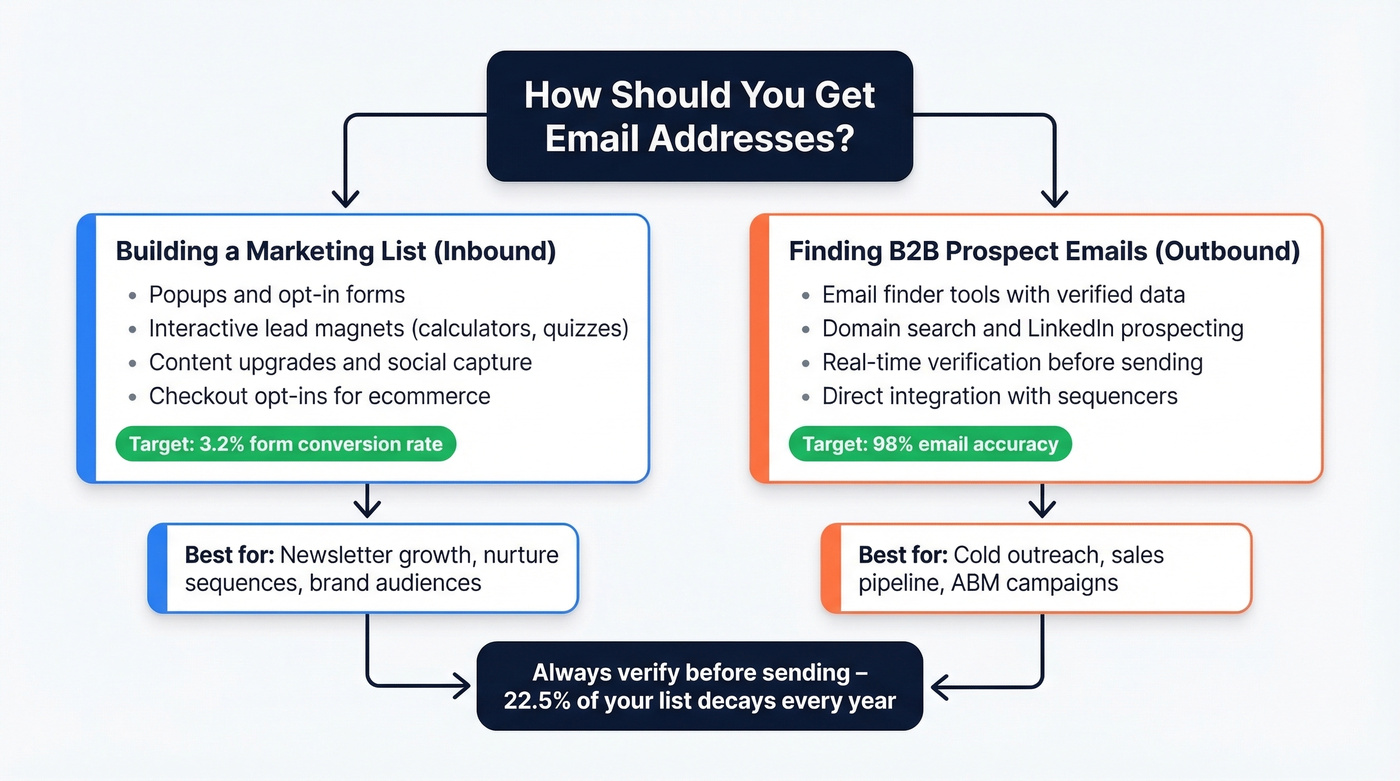
Finding B2B prospect emails for outbound? Skip the list brokers entirely. Use an email finder tool with verified data - 98% accuracy, real-time verification, and self-serve pricing beat paying thousands for a stale CSV that tanks your deliverability.
Organic Capture Methods That Work
Popups That Actually Convert
Popups get a bad reputation because most are terrible. But the data doesn't lie - they're still the highest-converting list-building tool available when you get the triggers and layout right.
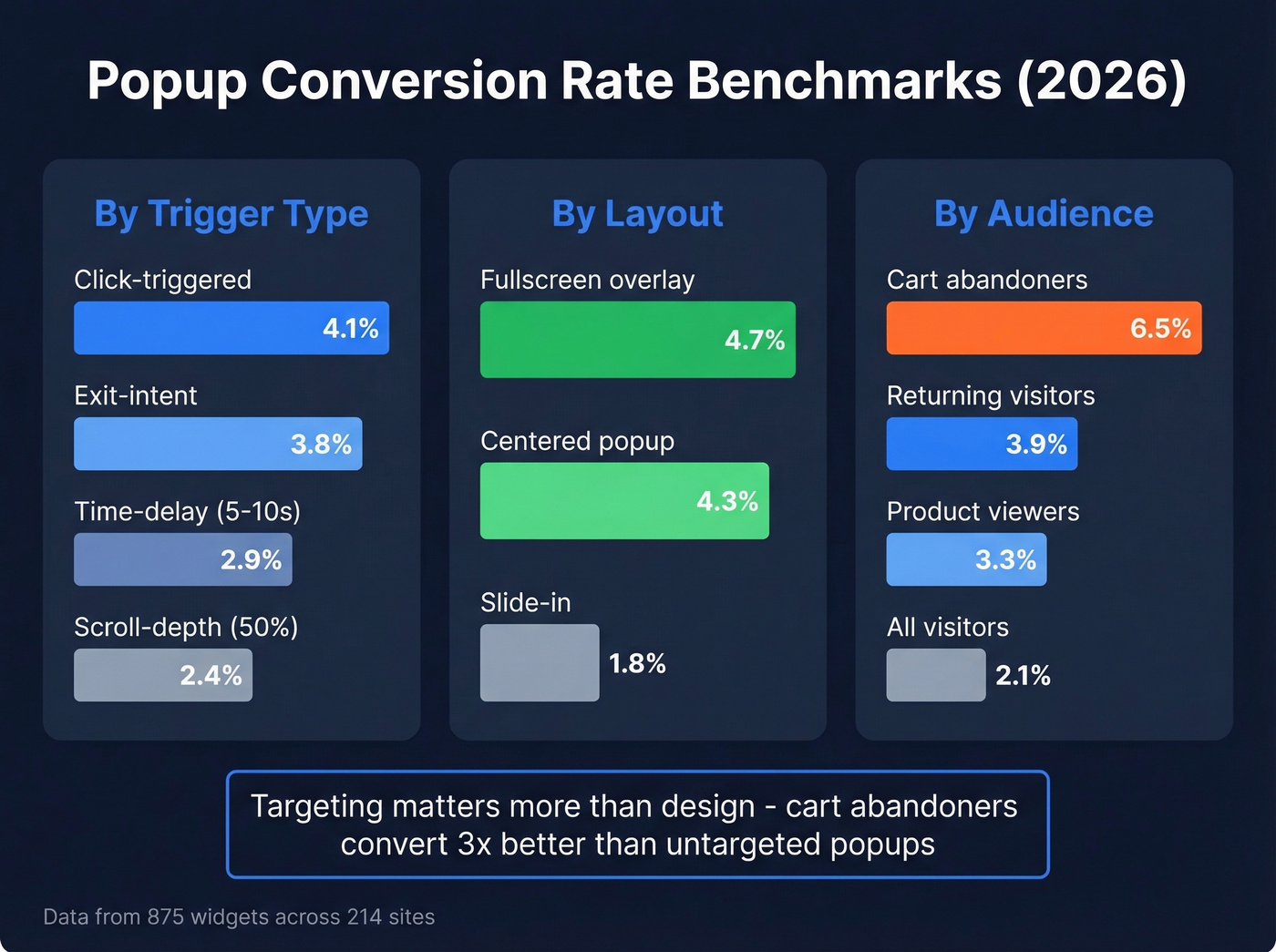
Here are the benchmarks from a dataset of 875 widgets across 214 sites:
By trigger type:
| Trigger | Conversion Rate |
|---|---|
| Click-triggered | 4.1% |
| Exit-intent | 3.8% |
| Time-delay (5-10s) | 2.9% |
| Scroll-depth (50%) | 2.4% |
By layout:
| Layout | Conversion Rate |
|---|---|
| Fullscreen overlay | 4.7% |
| Centered popup | 4.3% |
| Slide-in | 1.8% |
By audience targeting:
| Audience | Conversion Rate |
|---|---|
| Cart abandoners | 6.5% |
| Returning visitors | 3.9% |
| Product viewers | 3.3% |
| All visitors | 2.1% |
Targeting matters more than design. A popup shown to cart abandoners converts 3x better than one shown to everyone. Spin-to-win mechanics push conversion rates from 3.2% to 7-9%, which is why every DTC brand uses them during BFCM, where popup CR jumps +65% vs. regular weeks. Christmas sees a similar +42% lift, and even Valentine's Day pushes +28%.
If you're running a blanket popup for all visitors and wondering why your conversion rate is under 1%, that's your answer. Segment your triggers by visitor behavior and you'll hit the median at minimum.
Lead Magnets Worth Trading an Email For
If your lead magnet is a "10 Tips" ebook, you're competing with ChatGPT - and losing. The consensus on r/smallbusiness is that interactive tools now outperform static PDFs by a wide margin.
Build a calculator, a quiz, or a diagnostic tool. An ROI calculator that takes three inputs - traffic, conversion rate, average deal size - and spits out a personalized growth projection is worth an email address. A generic PDF checklist isn't.
The best lead magnets give the visitor something they can't get from a quick prompt: personalized output based on their specific inputs, benchmarking against their industry, or a score they can share with their team. That's what earns the opt-in in 2026.
Social, Events, and Content Upgrades
These are table-stakes tactics, but they compound over time. Facebook lead ads with pre-filled forms reduce friction for webinar signups. Every social profile should drive to a landing page, not your homepage. Blog-embedded content upgrades specific to the post outperform generic sidebar forms. For ecommerce, a simple checkbox during checkout captures high-intent buyers who already trust you with their credit card.
Teams that run multiple channels consistently grow their lists 2-4% net per year after accounting for decay. Teams that rely on one channel stagnate. For reference, nonprofit email lists - one of the few segments with published growth data - grew just 3% in 2024, down from 6% two years prior. Organic growth is a grind everywhere.
What "good" looks like once those subscribers are on your list: across 3.6M campaigns analyzed by MailerLite, the benchmark open rate is 43.46% and the benchmark click rate is 2.09%. If your numbers are significantly below those, the problem isn't your list size - it's your content or deliverability.
How to Find Business Emails for Outbound
If you're in B2B, organic list building is only half the equation. You also need to find specific people at specific companies and reach them directly. Let's be honest: the gap between good and bad sales prospecting tools is enormous, and choosing the wrong email finder can wreck your outbound campaigns before they start.
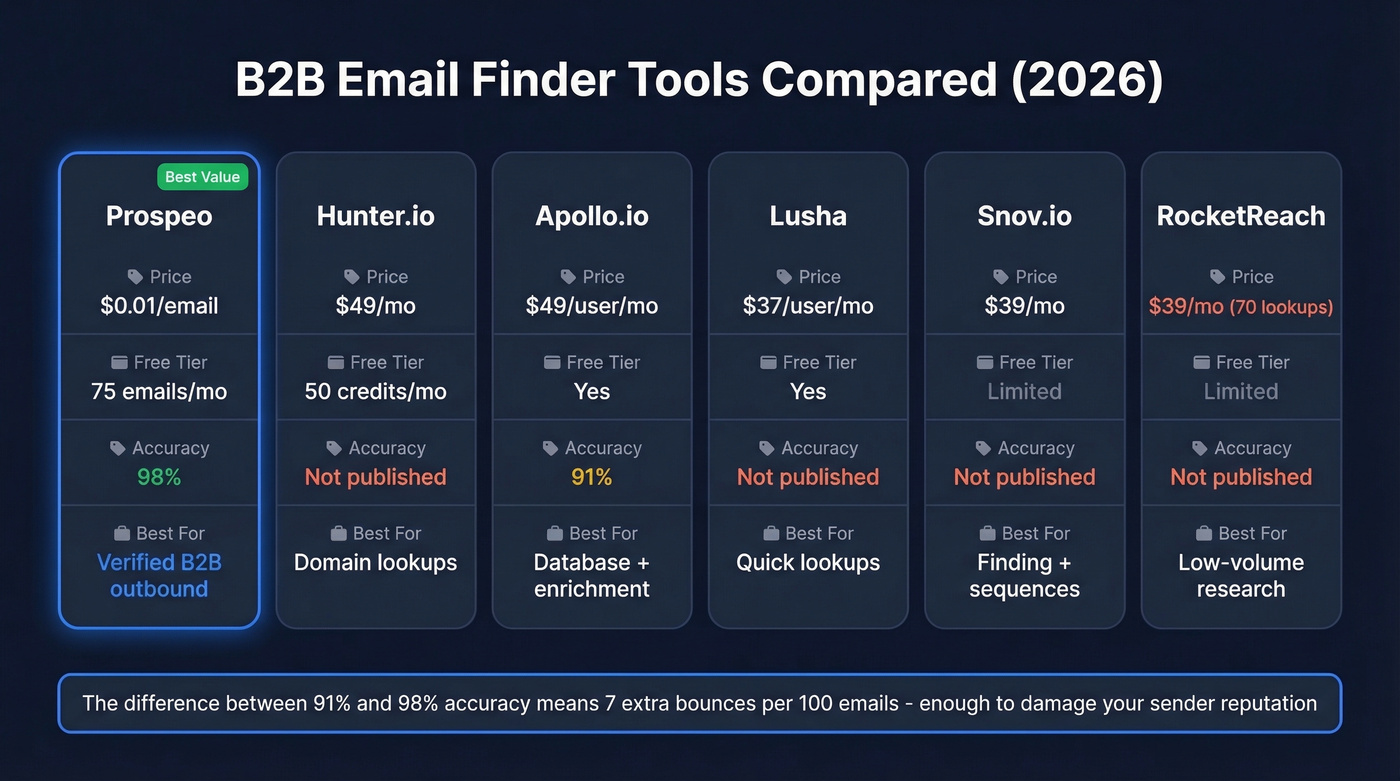
| Tool | Starting Price | Free Tier | Email Accuracy | Best For |
|---|---|---|---|---|
| Prospeo | ~$0.01/email | 75 emails/mo | 98% | Verified B2B emails + outbound |
| Hunter.io | $49/mo | 50 credits/mo | Not public | Domain lookups |
| Apollo.io | $49/user/mo | Yes | ~91% | Database + enrichment |
| Lusha | $37/user/mo | Yes | Not public | Quick lookups |
| Snov.io | $39/mo | Limited | Not public | Sequences + finding |
| RocketReach | $39/mo | Limited | Not public | Individual lookups |
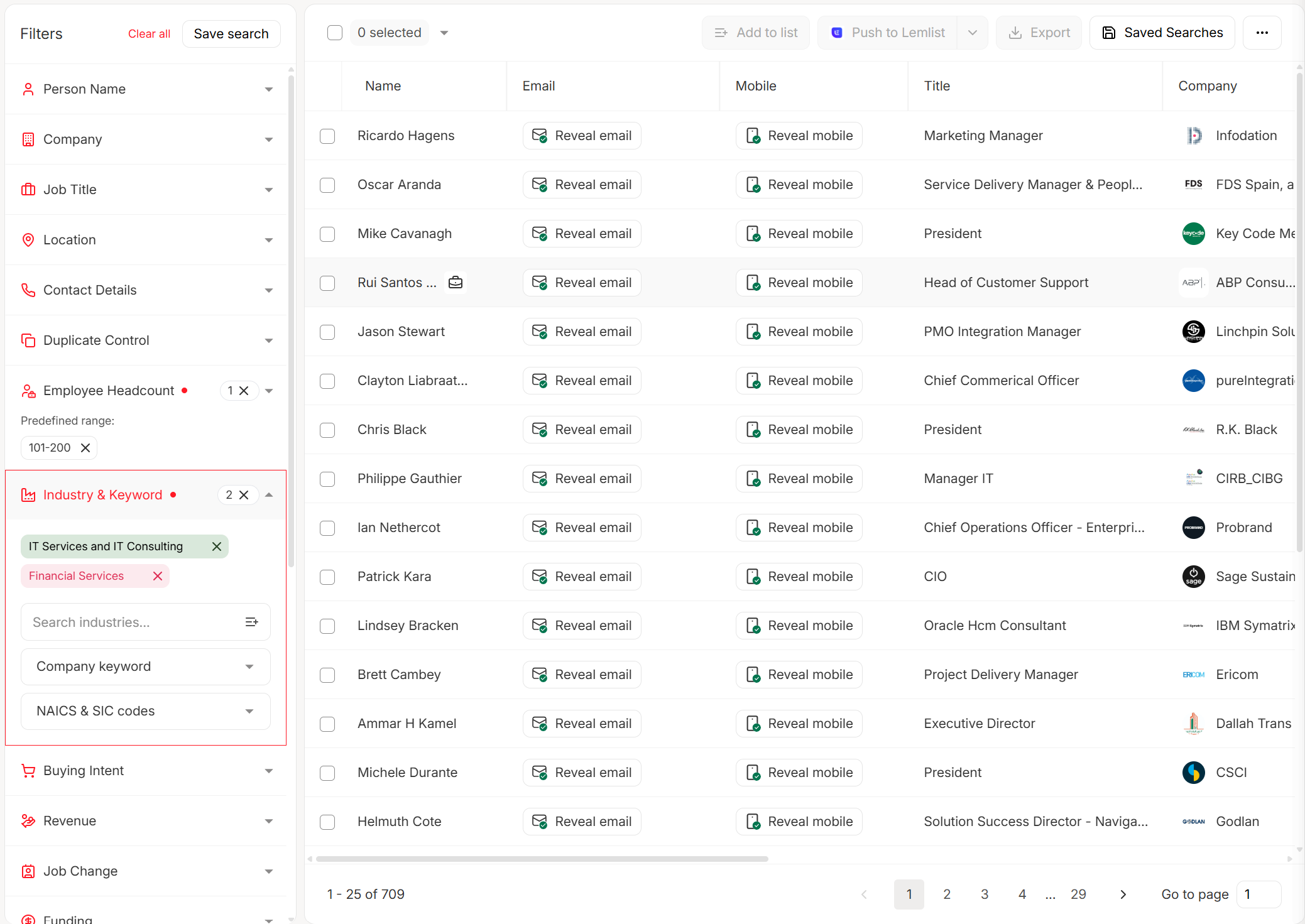
Prospeo
Use this if: You need verified B2B emails that won't bounce and tank your domain reputation. You want self-serve pricing without annual contracts or sales calls.
Prospeo's database covers 300M+ professional profiles with 143M+ verified emails. The 5-step verification pipeline handles catch-all domains, removes spam traps, and filters honeypots - which is why accuracy sits at 98%. Data refreshes every 7 days, compared to the 6-week industry average, so contacts don't go stale between campaigns.
Real-world proof: Meritt went from a 35% bounce rate with their previous provider to under 4% after switching, tripling their pipeline from $100K to $300K per week. At ~$0.01 per email, the unit economics are hard to argue with. The free tier gives you 75 emails/month plus 100 Chrome extension credits/month to test before committing anything. Native integrations with Instantly, Lemlist, and Smartlead mean you can pipe verified contacts straight into your sequencer without manual exports.

Stop losing a quarter of your list every year to stale data. Prospeo's 7-day refresh cycle and 98% email accuracy mean every contact you add actually reaches a real inbox - not a bounce, spam trap, or dead end.
Get 75 verified emails free and see what accurate data does for your campaigns.
Hunter.io
Hunter is the simplest tool in this category, and that's its strength. Type in a domain, get a list of email addresses associated with it. The free plan gives you 50 credits/month - enough to test the workflow. Paid plans start at $49/mo for 2,000 credits.
It works well when you already know the company and just need email formats and addresses. It falls short for building targeted prospect lists at scale - there's no intent data, no advanced filtering, and no mobile numbers. For simple domain-based research, it's fast and reliable.
Apollo.io
Apollo's database covers 275M+ contacts across 73M+ companies, making it one of the largest in the space. The free tier is generous, and paid plans run $49-$79/user/mo. Apollo also bundles a sequencer, so you can find contacts and email them from one platform.
The tradeoff: Apollo's email accuracy sits around 91%, which sounds good until you compare it to providers hitting 98%. That 7-point gap translates to real bounces on real campaigns. We've seen teams run Apollo data through a separate email verification step before sending - which works, but adds friction and cost.
Other Options Worth Knowing
Lusha starts at $37/user/mo with a free plan. Solid for quick one-off contact lookups, not built for bulk prospecting.
Snov.io runs $39/mo for 1,000 credits and bundles email finding with drip sequences. Good for solopreneurs who want finding and sending in one tool.
RocketReach starts at $39/mo but only gives you 70 lookups - the most expensive per-contact pricing in this group. Skip this unless you're doing very low-volume, high-value research.
Bad email data doesn't just waste credits - it wrecks your domain reputation. Prospeo's 5-step verification catches spam traps, honeypots, and catch-all domains before they hit your sender score. Meritt cut their bounce rate from 35% to under 4% and tripled pipeline.
Protect your deliverability with emails verified in real time at $0.01 each.
Why You Should Never Buy an Email List
Look, the fact that half the results for this query are companies trying to sell you a list tells you how broken this space is. Purchased lists contain stale, unverified contacts with no consent history. When you send to them, you get high bounce rates, spam complaints, and - if you're unlucky - your domain lands on a blocklist. Blocklist recovery is difficult and can take weeks of remediation. Most ESPs (Mailchimp, Klaviyo, ActiveCampaign) explicitly ban purchased lists and will suspend your account if they detect one.
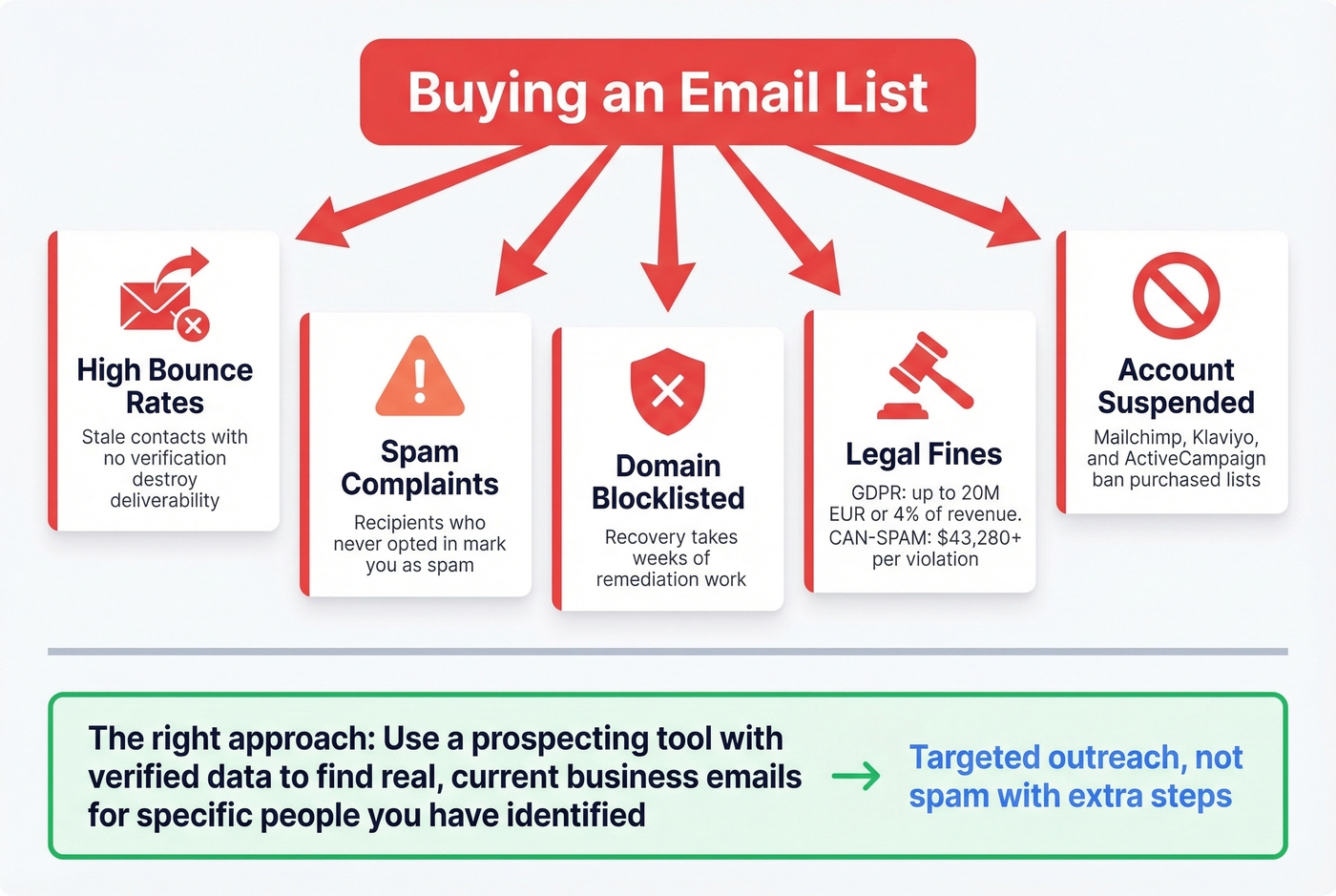
There's also legal exposure. Under GDPR, sending to EU contacts without consent can trigger fines up to EUR20M or 4% of global revenue. CAN-SPAM is more lenient - unsolicited email is technically allowed with opt-out - but penalties still run $43,280+ per violation.
The distinction matters: buying a list isn't the same as using a prospecting tool with verified data. A prospecting tool finds real, current business emails for specific people you've identified. A purchased list is a bulk CSV of unknown quality from unknown sources. One is targeted outreach. The other is spam with extra steps. (If you want the legal breakdown, see Is it legal to buy email lists.)
Verify Before You Send

Even if you're collecting email addresses organically, verification isn't optional. Typos, disposable addresses, and bots slip through every signup form. For B2B prospecting data, verification is the difference between a successful campaign and a domain reputation crisis.
The threshold that matters: keep your bounce rate under 2%. Above that, inbox providers start throttling your deliverability. Way above that, you're looking at blocklisting.
In our experience, teams that skip SMTP-level verification see bounce rates 3-5x higher than those that don't - and the damage compounds with every send. A strong verification pipeline runs five checks: syntax validation, domain/MX record lookup, SMTP handshake, catch-all domain handling, and spam-trap removal. Whatever tool you use, make sure it goes beyond basic syntax checking. SMTP-level verification is the minimum for any serious sending operation. (More on this in our email deliverability guide.)
Compliance in 60 Seconds
Two frameworks matter:
| GDPR | CAN-SPAM | |
|---|---|---|
| Consent | Opt-in required | Unsolicited OK with opt-out |
| Penalties | Up to EUR20M / 4% revenue | $43,280+ per violation |
| Scope | Any org processing EU data | US commercial email |
| Key rule | Affirmative consent, no pre-checked boxes | Physical address + clear opt-out |
GDPR enforcement has reached EUR5.88B across 2,245 actions. These aren't theoretical fines - they're real penalties hitting real companies. CAN-SPAM requires a physical mailing address in every email and gives recipients 10 business days to be removed after unsubscribing.
Adopt GDPR's stricter rules globally and you'll never worry about which framework applies. One standard, one process, full coverage.
Mistakes That Kill Your List
Over-automating without personalizing. Automation is a delivery mechanism, not a strategy. A common complaint on r/EmailWhisperers: teams set up elaborate drip sequences with zero personalization beyond {first_name}. Recipients can tell. If you're building sequences, start with a proven B2B cold email sequence structure.
Ignoring mobile optimization. Mobile popup conversion rates actually run higher than desktop (3.6% vs. 2.9%), but only if the experience is designed for thumbs, not mice. If your forms require pinch-zooming, you're losing subscribers.
Blasting your entire list. Segmentation isn't a nice-to-have. Sending the same message to your entire database guarantees low engagement, which signals to inbox providers that your emails aren't wanted. If your unsubscribe rate exceeds the 0.22% benchmark, you're probably over-sending or under-segmenting. Segment by behavior, intent, and engagement level at minimum. (If you're scaling volume, also watch email velocity.)
FAQ
Is it legal to buy email lists?
Under CAN-SPAM, technically yes - with opt-out mechanisms and a physical address included. Under GDPR, no - you need affirmative consent before sending. Most ESPs ban purchased lists regardless and will suspend accounts that use them.
What's a good popup conversion rate?
The current mean is 3.2% across all industries. Above 5% is strong. Top performers using spin-to-win or targeted exit-intent hit 8-9%. Below 1% means your targeting or offer needs reworking.
How fast should my email list grow?
Expect 2-4% net growth per year after accounting for 22.5% annual decay. That means you need to add roughly 25% new contacts annually just to stay flat.
Do I need to verify emails from signup forms?
Yes - even organic signups include typos, disposable addresses, and bot submissions. Running SMTP-level verification keeps your bounce rate under 2% and protects sender reputation long-term.