

How to Get Leads for Free in 2026 (Without Wasting Your Time)
A RevOps lead we know spent $30K over two years on lead lists from ZoomInfo, Apollo, and third-party brokers. ROI dropped every quarter because, as he put it, "everyone else is buying the same data." His best-converting leads? A closed/lost CRM report he'd been ignoring for months.
Here's the uncomfortable truth about getting leads for free: the average B2B SaaS CAC sits at $239, but organic acquisition costs just $205 versus $341 for paid channels. That's a 40% discount for doing the work yourself. And since B2B sales reps already spend 64% of their time on non-selling activities, the tactics you pick need to be efficient - not just free.
What You Need (Quick Version)
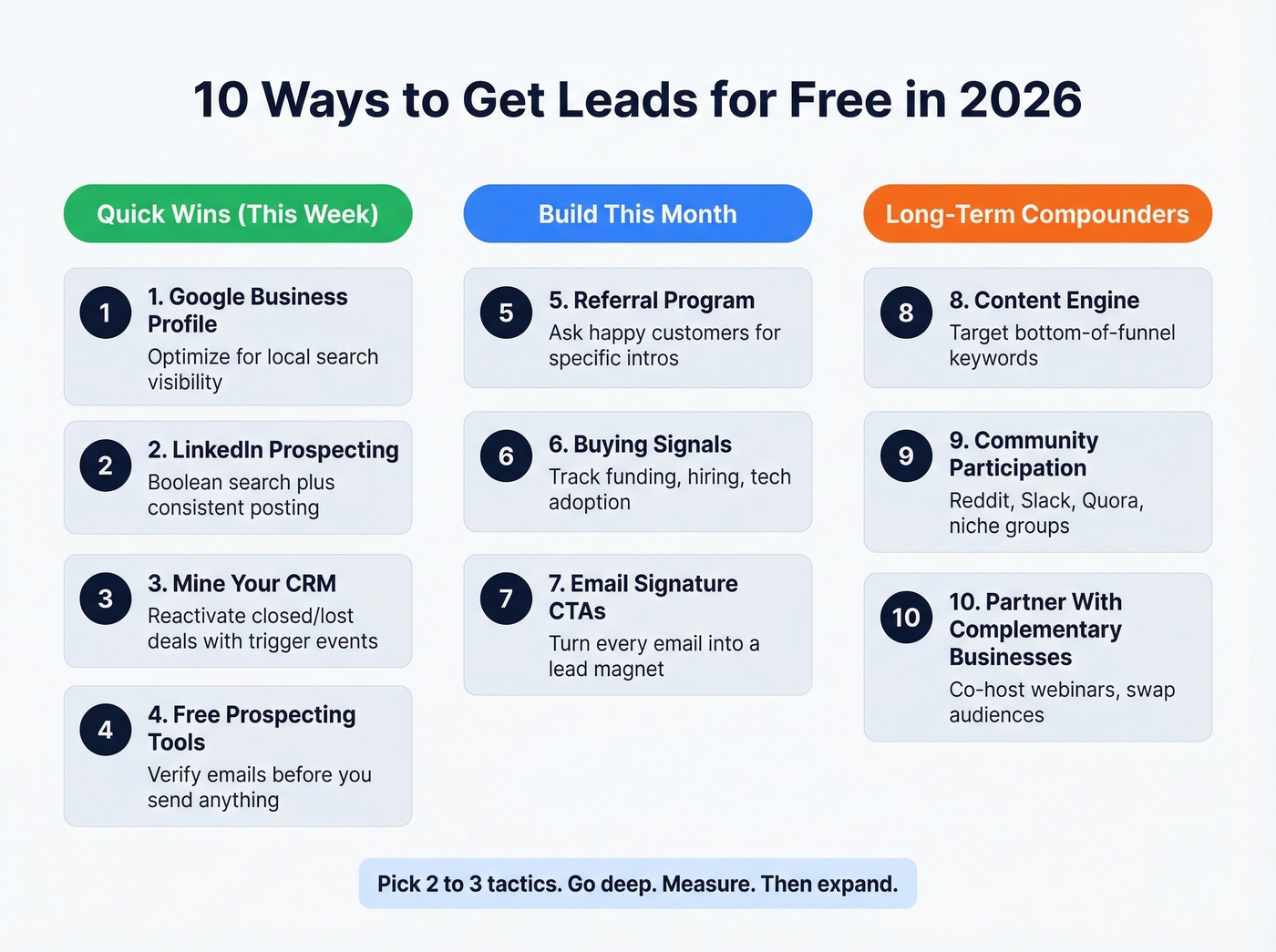
This week: Boolean search on LinkedIn plus a free prospecting tool for verified emails.
This month: Optimize your Google Business Profile and mine your CRM for closed/lost accounts.
Long-term: Build a content engine targeting bottom-of-funnel keywords.
Don't try all 10 tactics below at once. Pick 2-3, go deep, measure, then expand. Spreading thin across every channel is how you burn 40 hours and generate leads that cost nothing but also produce nothing.
Set Realistic Expectations First
Cold email open rates land between 15-25%. Reply rates sit between 1-5%. Send-to-conversion? Somewhere around 0.2-2%. And 80% of leads never convert at all, regardless of source. A healthy LTV:CAC ratio is 3:1, so track your time investment honestly.
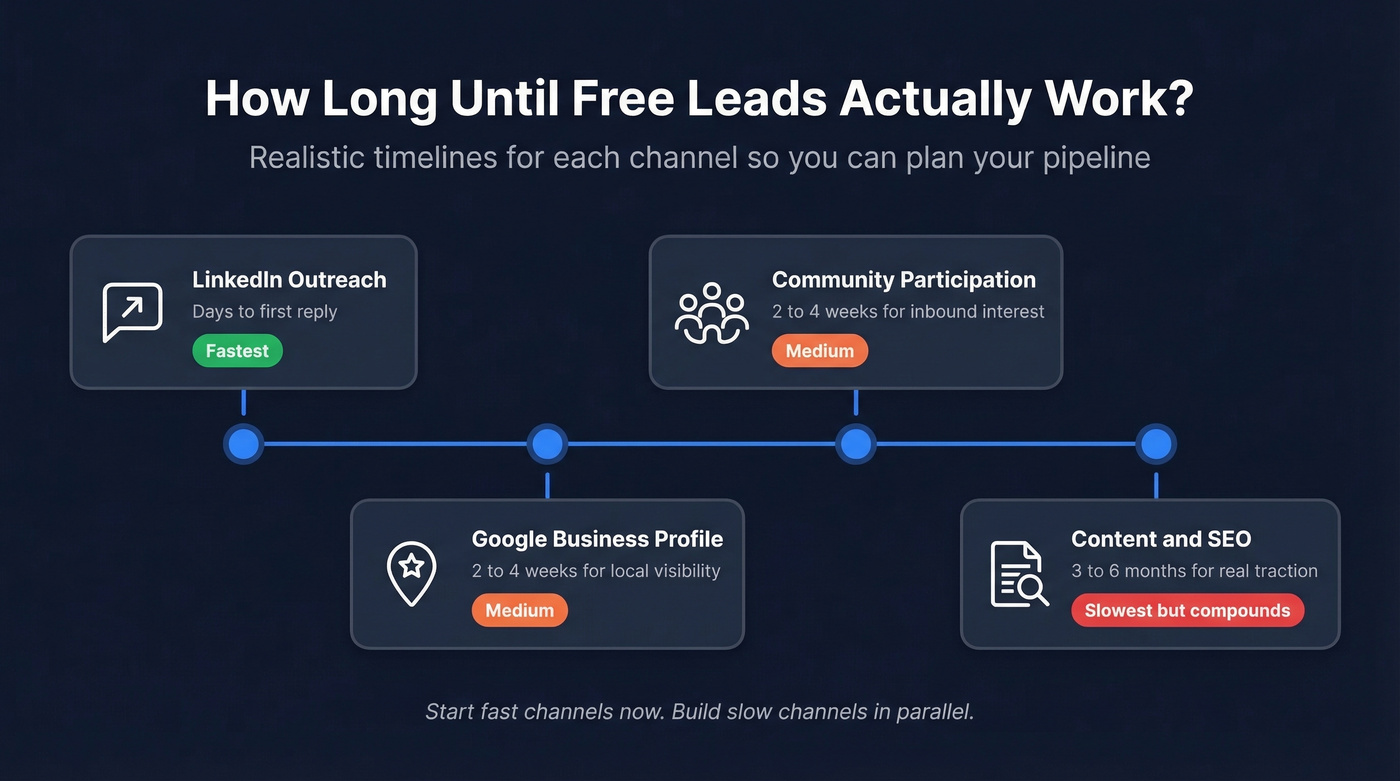
Here's what "free" actually costs in time:
- LinkedIn outreach: Days to first reply. Fastest free channel.
- Google Business Profile: 2-4 weeks for local visibility shifts.
- Community participation: 2-4 weeks before inbound interest picks up.
- Content/SEO: 3-6 months for meaningful traction. Slowest play, but it compounds.
Start with the fast channels while building the slow ones in parallel.

You're hunting leads for free - don't waste them on bad emails. Prospeo's free tier gives you 75 verified emails and 100 Chrome extension credits every month, backed by 98% accuracy and a 7-day data refresh cycle. That's enough to validate your best prospects without spending a dollar.
Free leads deserve verified data. Start with 75 emails on the house.
10 Free Lead Generation Tactics That Work
1. Optimize Your Google Business Profile
Your GBP is one of the most effective free lead generation channels for any business with a local component. Google ranks local results on relevance, distance, and prominence - you can directly influence two of those three.
Write a full 750-character description with your primary service and location front-loaded in the first 250 characters. Set your primary category precisely since it's a strong ranking signal, then add a handful of relevant secondary categories. Upload at least 8-10 high-quality images and post weekly with clear CTAs - even short updates signal activity to Google. Seed your Q&A section with real FAQs before random users do it for you, share a direct review link to reduce friction, and respond to every review you get.
Keep your name, address, and phone consistent across every directory listing. Monthly maintenance - fresh photos, review responses, Q&A monitoring - is what separates profiles that generate leads from profiles that collect dust.
2. Prospect on LinkedIn for Free
You don't need Sales Navigator. 89% of B2B marketers already use LinkedIn for lead gen, and the platform converts visitors to leads at 2.74% - roughly 3.5x Facebook's rate. The free plan gives you enough to build a pipeline if you're methodical about it.
Start with Boolean search. A query like "marketing manager" AND (SaaS OR software) NOT enterprise narrows results fast. Save up to 3 searches on a free account and get notified when new people match. Filter by 2nd-degree connections for warm intro paths, and join groups where your buyers hang out.
Post 2-3 times per week - case studies, actionable tips, trend analysis. When you reach out, reference their recent post or a mutual group. Track everything in a spreadsheet if you don't have a CRM yet.
3. Mine Your Existing CRM
This is the most underrated free lead source. Period.
Your CRM is full of people who already know your product and said no for reasons that may no longer apply. Run a closed/lost report. Exclude anything from the last 90 days. Then look for trigger events: the company raised funding, your champion changed roles, you shipped the feature they asked for, or their competitor just bought from you.
We've seen closed/lost reactivation become a meaningful slice of quarterly pipeline for teams that actually bother to run the report. It takes an afternoon to build and write the re-engagement sequence. There's no cheaper lead source than the data you already own.
4. Use Free-Tier Prospecting Tools
You've found prospects - now you need verified contact details before you send anything. Sending to unverified emails is how you tank your domain reputation in a single campaign.
If you're comparing options, start with free lead generation tools and then narrow down based on accuracy and workflow fit.
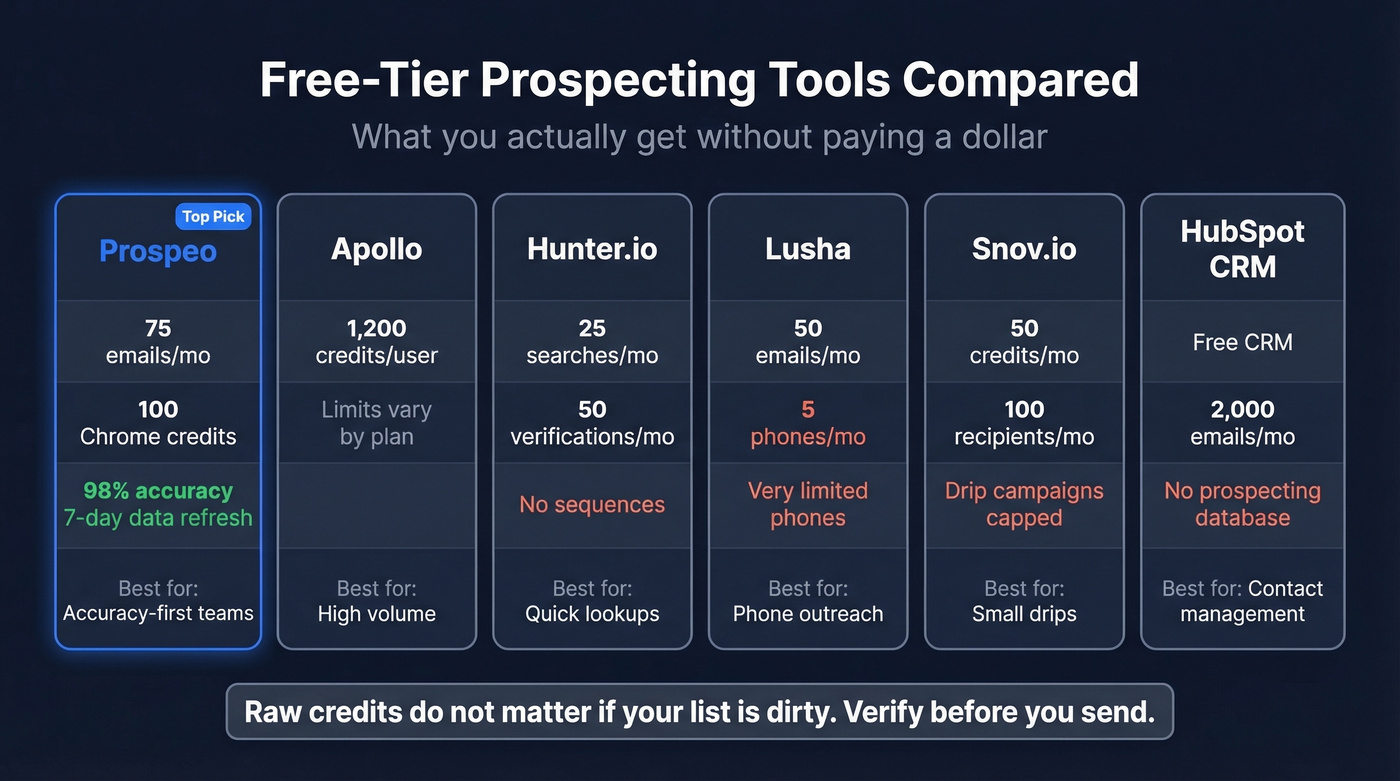
Here's how the free tiers stack up:
| Tool | Free Tier | Key Limit | Best For | Paid From |
|---|---|---|---|---|
| Prospeo | 75 emails + 100 Chrome credits/mo | 98% accuracy, 7-day refresh | Accuracy-first teams | ~$0.01/email |
| Apollo | 1,200 credits/user | Limits vary by plan | High-volume prospecting | $49/user/mo |
| Hunter.io | 25 searches + 50 verifications/mo | Search only, no sequences | Quick email lookups | $34/mo |
| Lusha | 50 emails + 5 phones/mo | Very limited phone credits | Phone-heavy outreach | $36/user/mo |
| Snov.io | 50 credits + 100 recipients/mo | Drip campaigns capped | Small drip campaigns | ~$30/mo |
| HubSpot CRM | Free CRM + 2,000 emails/mo | No prospecting database | Contact management | From $15/user/mo |
Raw credits don't matter if your list is dirty. Prospeo's 5-step verification catches spam traps and honeypots that other tools miss - critical when you're running lean and can't afford a domain reputation hit.
5. Build a Content Engine
Content is the compounding play. One well-ranked article can generate leads for years without additional spend.
Focus on bottom-of-funnel and long-tail keywords - the queries buyers search when they're close to a decision. "Best CRM for 10-person sales teams" converts better than "what is a CRM." Create lead magnets that match the intent: free calculators, ROI templates, comparison checklists. Gate them with an email form. Case studies are the most underrated conversion content out there. Publish them ungated for SEO, then use them as follow-up assets in outbound sequences.
If you want the bigger picture, this is B2B content marketing done for pipeline, not vanity traffic.
6. Participate in Communities
Reddit, Quora, niche Facebook groups, industry Slack channels - these are where your buyers ask questions before they ever Google a solution. The consensus on r/sales is clear: show up where your audience talks.
Help first, sell second. Answer questions thoroughly. Share frameworks. Be the person who consistently adds value. Over weeks, people start clicking your profile, visiting your site, and reaching out. It's not scalable in the traditional sense, but the lead quality is unmatched because trust is already built before you ever pitch.
7. Use Buying Signals as Triggers
Look, static firmographic lists are dead. Everyone's buying the same data and blasting the same people. If your average deal size is under five figures, you usually don't need ZoomInfo-level spend - you need better-timed data.
To operationalize this, build a simple scoring model around identifying buying signals and keep it updated weekly.
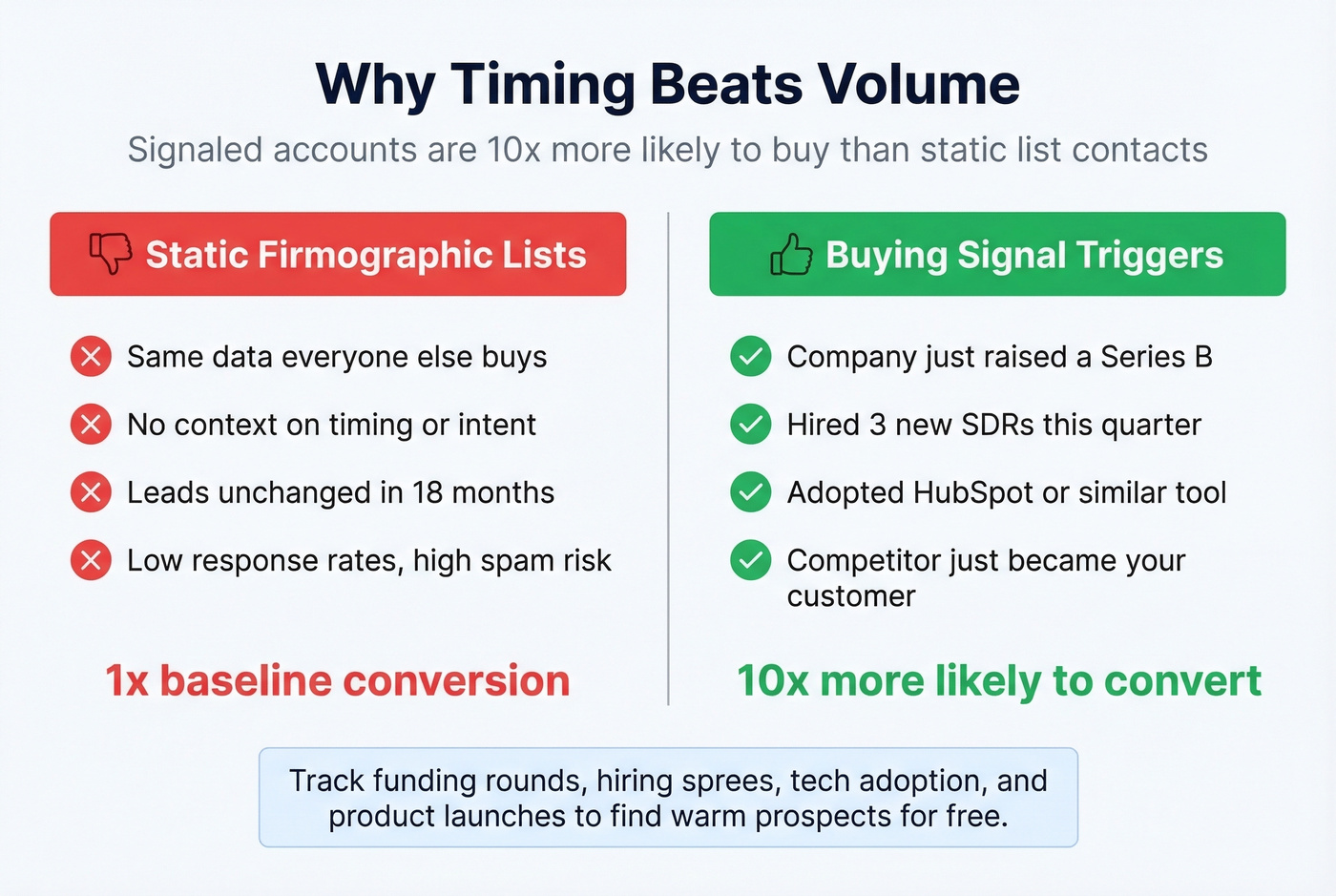
A company that just raised a Series B, hired three SDRs, and adopted HubSpot is a much warmer prospect than one matching the same firmographic filters but unchanged in 18 months. One B2B practitioner who tracked this found signaled accounts are 10x more likely to buy than static-list contacts. That tracks with what we've seen internally. Watch for funding rounds, hiring sprees, tech adoption, and product launches.
8. Launch a Referral Program
A referral program doesn't need a budget. Mutual introductions, co-marketing credits, or early access to new features all work as incentives. The key is making the ask specific: "Do you know a VP of Sales at a Series A company who's struggling with outbound?" converts better than "Know anyone who'd benefit from our product?"
One email to your happiest customers, one clear ask, one easy way to make the intro. That's it. Referrals from people who already trust you close faster than any cold outreach.
9. Turn Email Signatures Into Lead Magnets
Every email your team sends is a micro-billboard. Add a banner linking to your best lead magnet, a recent case study, or a booking page. Tools like Mailtastic let you manage signature banners across your whole team and rotate CTAs.
It won't flood your pipeline, but it's zero effort after setup and generates a consistent trickle of warm clicks from people already in conversation with your team.
10. Partner With Complementary Businesses
Find companies that sell to your ICP but don't compete with you. A CRM vendor and an email deliverability tool share the same buyer. Co-host a webinar - average webinar CPL runs around $72 versus roughly $811 for trade shows, according to Bizzabo's event benchmarks. Swap guest blog posts. Share lead lists with consent.
Two companies, two audiences, one event. You both get leads you couldn't have reached alone, and neither of you spent a dollar on ads.
Verify Before You Send
None of these tactics matter if you're sending to bad data. Email addresses decay fast - people change jobs, companies rebrand, domains expire. Don't trust any contact data older than 30 days without re-verifying it.
If you're doing any outbound at all, pair verification with an email deliverability checklist so you don't fix one problem and create another.
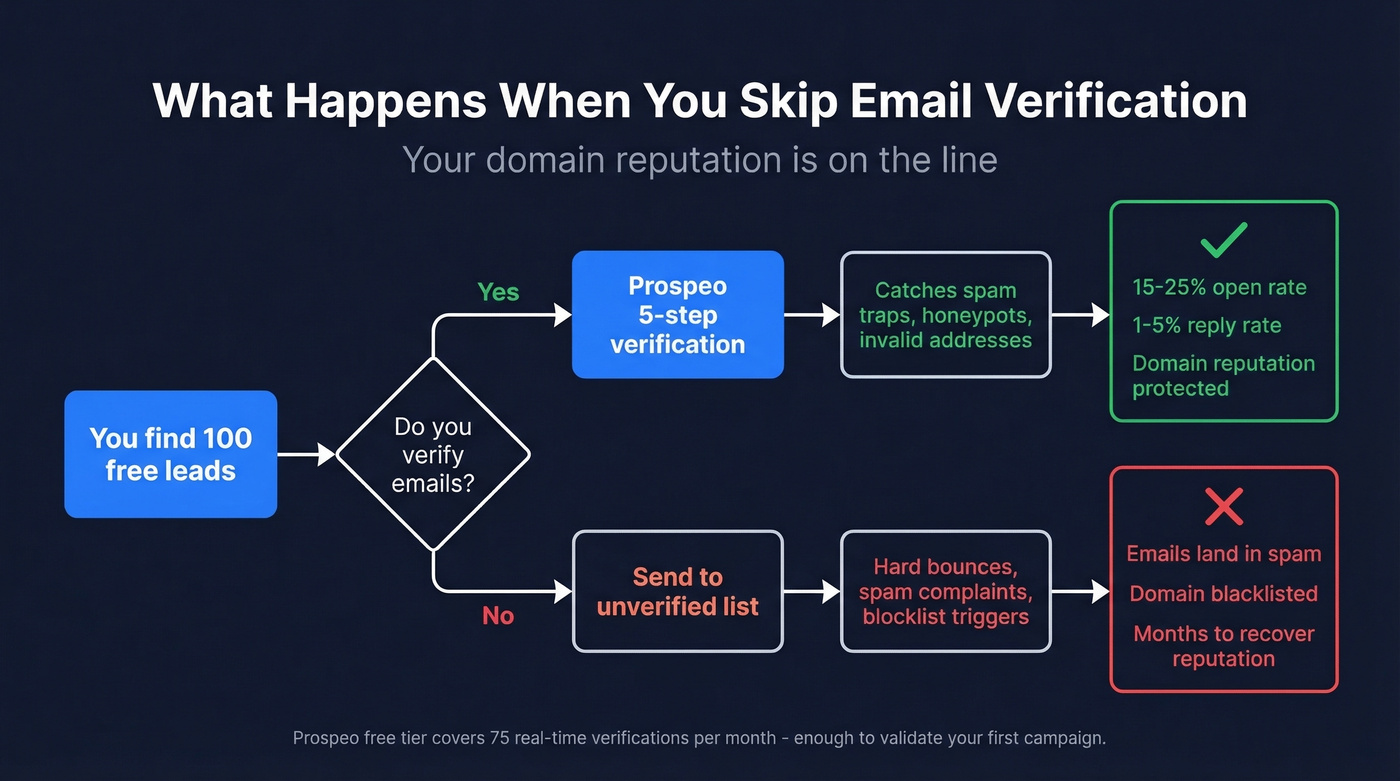
Sending to invalid addresses damages your domain reputation, triggers spam filters, and can land you on blocklists that take months to escape. Those cold email benchmarks of 15-25% open and 1-5% reply only hold if your list is clean. Prospeo's free tier covers 75 real-time verifications per month with 5-step verification - enough to validate your first outreach campaign without risking your sender reputation.
If you're seeing issues already, start by checking your email bounce rate and tightening list hygiene.

Don't Skip Compliance
GDPR applies even if you're not based in the EU - if you're targeting EU residents, you're subject to it. Fines can reach EUR20M or 4% of global annual turnover, whichever is higher.
Consent must be freely given, specific, informed, and unambiguous. Silence doesn't count. Keep proof of where each contact was found and when. Be ready to fulfill data subject access requests within 30 days. Confirm any prospecting tools you use are GDPR compliant and offer DPAs. And don't store contact data longer than you need it - purpose limitation is a core GDPR principle.
Most founders ignore compliance until they get their first DSAR or a prospect threatens to report them. Build the habit now. It takes five extra minutes per campaign, and it'll save you from a nightmare later.
Your closed/lost CRM list and LinkedIn prospects are only valuable if you can actually reach them. Prospeo's 5-step verification catches spam traps and honeypots that kill domain reputation - the exact thing that tanks free outbound campaigns. At ~$0.01 per email when you scale, it's the cheapest insurance your pipeline will ever get.
Don't burn your domain on unverified contacts. Verify before you send.
FAQ
Is free lead generation actually worth the effort?
Yes. Organic acquisition costs $205 on average versus $341 for paid channels - a 40% savings. Pick 2-3 tactics from this list and go deep rather than spreading thin across all 10. The unit economics are significantly better than paid alternatives for most early-stage and bootstrapped teams.
How long until free leads start converting?
LinkedIn outreach can produce replies within days. Google Business Profile optimization takes 2-4 weeks to impact local visibility. Content and SEO are 3-6 month plays that compound over time. Start with LinkedIn prospecting and CRM mining for immediate pipeline, then layer in content as a longer-term investment.
What's the best free prospecting tool for beginners?
Prospeo offers the strongest accuracy-to-volume ratio on a free plan: 75 verified emails plus 100 Chrome extension credits per month at 98% accuracy. Apollo gives more raw credits at 1,200 but lower verification rates. HubSpot CRM is free for contact management but lacks a prospecting database, so you'll need a separate finder tool regardless.
How do I get leads for free if I'm just starting out?
Start with LinkedIn Boolean search and CRM mining - both cost nothing and can produce replies within a week. Layer in Google Business Profile optimization and community participation during weeks two through four. Save content and SEO for month two; they take longer but compound, giving you a sustainable pipeline long after the initial effort.